
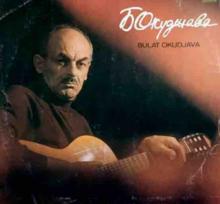
Okudzhava’s Georgian father was a prominent Communist party worker who was executed in 1937. His Armenian mother was imprisoned in Stalin’s camps until 1955. Nevertheless, their son went willingly to the front upon leaving school in 1942. After the war he studied in the philology department of the University of Tbilisi and then worked as a teacher of Russian in the Kaluga district until 1955, when he was accepted into the Communist party. His first book of rather undistinguished poems was) published there in 1956.
Okudzhava’s popularity began only when he took a guitar in his hands and sang his poems to his own simple, but very melodious, music. Soon they were sung all over the Soviet Union in student and worker dormitories. While no recordings were released officially, poems and songs performed by Okudzhava were sold in hundreds of thousands of illegal cassettes. He became the father of the rather powerful modern “bard” movement, out of which emerged such celebrated poet-singers as Aleksandr Galich, Vladimir Vysotsky, and more recently Aleksandr Bashlachov. To many, Okudzhava is superior as a poet to all his offspring, for none of them is as subtle textually. His poetry often takes a dim view of the world, sounding themes of loneliness and vacillation between hope and hopelessness; he also employs religious and military motifs. The composer Dmitri Shostakovich admired the songs of Okudzhava for their unforgettable melodies.
Okudzhava is also the author of several unique prose works: “Bud’ zdorov, shkoliar” (Good Luck, Schoolboy) (1961); Bednyi Avrosimov (Poor Avrosimov) (1969); Merci Hi pokhozhdeniia Shipova (Mercy or Shipov’s Escapades) (1971); and Puteshestvie diletantov (The Dilettantes’ Journey) (1978). Okudzhava’s public reputation in literary politics is impeccable; he has spoken out many times in defense of dissidents and against injustices. Often criticized and finally threatened with expulsion from the party, in the end he left it himself — the inevitable outcome of a rash marriage.
Bulat Okudzhava
Song about a Moscow ant
To worship someone is my aspiration.
Imagine, just a simple ant of mine
Felt suddenly like kneeling in prostration,
Believing in his touch with the divine.
The ant then was bereft of peace and calmness,
So everyday was everything he saw
That lastly, in his image, in his likeness,
A goddess he created to his awe.
And on day seven, at a random moment,
The glow of night had shaped into her mold
Without a sign from heaven or an omen,
Light jacket was her cover from the cold.
Remembering no miseries nor blessings,
He let her in, he opened wide the door,
And to the windburned hands his lips were pressing,
And to the worn-out booties that she wore.
Two shadows crossed the doorstep, slowly flowing,
Without a word, they silently conversed —
As gods in heaven beautiful and knowing,
And sorrowful as dwellers of the earth.
Translated by Evgenia Sarkisyants
Булат Окуджава
Песенка о московском муравье
Мне нужно на кого-нибудь молиться.
Подумайте, простому муравью
вдруг захотелось в ноженьки валиться,
поверить в очарованность свою!
И муравья тогда покой покинул,
все показалось будничным ему,
и муравей создал себе богиню
по образу и духу своему.
И в день седьмой, в какое-то мгновенье
она возникла из ночных огней
без всякого небесного знаменья...
Пальтишко было легкое на ней.
он двери распахнул в свое жилье
и целовал обветренные руки
и старенькие туфельки ее.
И тени их качались на пороге,
безмолвный разговор они вели,
красивые и мудрые, как боги,
и грустные, как жители Земли.