
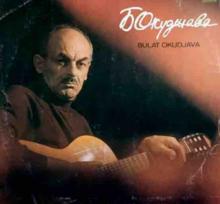
Okudzhava’s Georgian father was a prominent Communist party worker who was executed in 1937. His Armenian mother was imprisoned in Stalin’s camps until 1955. Nevertheless, their son went willingly to the front upon leaving school in 1942. After the war he studied in the philology department of the University of Tbilisi and then worked as a teacher of Russian in the Kaluga district until 1955, when he was accepted into the Communist party. His first book of rather undistinguished poems was) published there in 1956.
Okudzhava’s popularity began only when he took a guitar in his hands and sang his poems to his own simple, but very melodious, music. Soon they were sung all over the Soviet Union in student and worker dormitories. While no recordings were released officially, poems and songs performed by Okudzhava were sold in hundreds of thousands of illegal cassettes. He became the father of the rather powerful modern “bard” movement, out of which emerged such celebrated poet-singers as Aleksandr Galich, Vladimir Vysotsky, and more recently Aleksandr Bashlachov. To many, Okudzhava is superior as a poet to all his offspring, for none of them is as subtle textually. His poetry often takes a dim view of the world, sounding themes of loneliness and vacillation between hope and hopelessness; he also employs religious and military motifs. The composer Dmitri Shostakovich admired the songs of Okudzhava for their unforgettable melodies.
Okudzhava is also the author of several unique prose works: “Bud’ zdorov, shkoliar” (Good Luck, Schoolboy) (1961); Bednyi Avrosimov (Poor Avrosimov) (1969); Merci Hi pokhozhdeniia Shipova (Mercy or Shipov’s Escapades) (1971); and Puteshestvie diletantov (The Dilettantes’ Journey) (1978). Okudzhava’s public reputation in literary politics is impeccable; he has spoken out many times in defense of dissidents and against injustices. Often criticized and finally threatened with expulsion from the party, in the end he left it himself — the inevitable outcome of a rash marriage.
Bulat Okudzhava
Georgian song
To M. Kvilividze
I shall bury a grape stone in the warm fertile soil by my house,
and I’ll kiss the vine twig and gather sweet grapes, my reward,
and I’ll call all my friends to the feast, and love in my heart I will rouse...
Otherwise, what’s the purpose of living in this lasting world?
Dear guests, come to table, I extend you my kind invitation,
tell me straight in my face the opinion of me that you hold,
God almighty will send me forgiveness for my transgression.
Otherwise, what’s the purpose of living in this lasting world?
Dressed in purple, my charming Dali for me will be singing,
dressed in black, I’ll sit bending my head without saying a word,
I’ll be listening enchanted and I’ll die from deep love and sad feeling...
Otherwise, what’s the purpose of living in this lasting world?
When the sunset starts swirling and searching the corners around,
May the images float, as if real, again, may them swirl
right in front of my eyes: a blue ox, a white eagle, a trout...
Otherwise, what’s the purpose of living at all in this world?
Translated by Alec Vagapov
Булат Окуджава
Грузинская песня
М. Квливидзе
Виноградную косточку в теплую землю зарою,
и лозу поцелую, и спелые гроздья сорву,
и друзей созову, на любовь свое сердце настрою.
А иначе зачем на земле этой вечной живу?
Собирайтесь-ка, гости мои, на мое угощенье,
говорите мне прямо в лицо, кем пред вами слыву.
Царь небесный пошлет мне прощение за прегрешенья.
А иначе зачем на земле этой вечной живу?
В темно-красном своем будет петь для меня моя Дали,
в черно-белом своем преклоню перед нею главу,
и заслушаюсь я, и умру от любви и печали.
А иначе зачем на земле этой вечной живу?
И когда заклубится закат, по углам залетая,
пусть опять и опять предо мной проплывут наяву
белый буйвол, и синий орел, и форель золотая.
А иначе зачем на земле этой вечной живу?