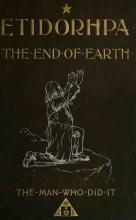

Etidorhpa, or, the end of the earth: the strange history of a mysterious being and the account of a remarkable journey is the title of a scientific allegory or science fiction novel by John Uri Lloyd, a pharmacognocist and pharmaceutical manufacturer of Cincinnati, Ohio. Etidorhpa was published in 1895.
The word "Etidorhpa" is the backward spelling of the name "Aphrodite." The first editions of Etidorhpa were distributed privately; later editions of the book feature numerous fanciful illustrations by John Augustus Knapp. Eventually a popular success, the book had eighteen editions and was translated into seven languages. Etidorhpa literary clubs were founded in the United States, and some parents named their infant daughters Etidorhpa.
ETIDORHPA
THE END OF EARTH
DUKE UNIVERSITY LIBRARY
The Glenn Negley Collection of Utopian Literature
To THE Subscribers of Etidorhpa.
U'hilk men of classical education may freely cull from scientific fields in order to embellish a romance or establish a plot, the open question remains as to whether students of science have, in return, a right to intrude upon their possessions in order pleasantly to carry science speculation beyond the realms of dry science provings.
Whether a romance (for to many " Etidorhpa" will be altogether such) may properly be introduced by one who is bound to the science side of thought, or whether such works must be left for the warmer pulse of the man of letters, is perhaps as yet unde- termined. Recognizing these problems, it was not without hesitation that the under- signed concerned himself in a subject apparently so far from his usual field of activity as in some phases of Etidorhpa ; and for seven years the manuscript has rested in his possession, known only to a few close friends.
Questions as to the nature of Etidorhpa have been so numerous since the an- nouncement of the work, that the limited time at the disposal of the undersigned has prevented personal replies. " Who, what is • Etidorhpa?" Whose faces are those printed in the vaguely-worded preface ? Who is, or was, Ivlewellyn Drury ? To what do the references to the antiquarian library refer?" etc. Never before has the writer neg- lected to answer correspondence ; but in this case, much to his regret, it was found impracticable, impossible to reply. However, the nature of the communications indi- cates that the book will answer most questions, although others may then arise not less mysterious than are those suggested by the weird preface and table of contents, which seem to have proven entertaining, at least, to many recipients.
That the subscribers to "Etidorhpa" have, since its announcement, been im- patiently looking for the book, is shown by the letters of inquiry alluded to, as well as others concerning certain features of the work, which the querists will generally find answered in this volume.
While no person could be more anxious to receive the volume than was the under- signed to issue the book, no pains were spared to make it artistically, and, in work- manship, all that could be desired, even at the risk of some delay, while a further de- lay resulted from the international copyright laws.
Originally, as announced, the intention was to print five hundred copies of "Eti- dorhpa," and it was in the nature of a pleasant .surprise to find that more than twice that number of subscribers applied quickly for the issue. Not less gratifying to the writer of these lines were the hundreds of pleasant letters of a personal nature that he had no valid reason to anticipate.
The writer of this page can not therefore but feel grateful for the unexpected en- couragement extended this literary effort, and herein expresses his personal thanks to the writers of the many kind letters of encouragement, trusting that " Etidorhpa" will meet the expectations of each recipient. That the reading of " Etidorhpa " may tend to elevate the mind, open up lines of pleasant thought, and lead none to regard less earnestly their science or love less deeply their God, is his sincere desire. Maj' the conception of this fair " Etidorhpa " introduce itself as gracefull}-, and in return be as pleasing to them as their kind words have been to him !
The prospectus announcing the work " Etidorhpa " was distributed to a selected list of recipients, mostly professional, and none were sent promiscuously. Opinions concerning any subject embraced in the book, even though expressed in but a line, and whether complimentary or the reverse, will be appreciated.
As soon as possible, then, after the book is read, please oblige the undersigned by giving him your impressions concerning any phase of the subject matter that may ap- peal to sympathy, excite curiosity, or be a matter of adverse criticism.
Respectfully,
JOHN URl LLOYD.
Digitized by the Internet Archive in 2010 with funding from
Duke University Libraries
http://www.archive.org/details/etidorhpaorendOOIIoy
ACKNOWLEDGMENTS.
The composition of this publication is by the Standard Publishing
Company, Cincinnati ; the electrotyping by Winkelman & Burbank,
Cincinnati ; the exquisite presswork and binding by Cranston & Curts,
Cincinnati ; the photogravure of Etidorhpa by Rombach & Groene,
Cincinnati ; and the half-tone engravings and frontispiece by the Photo- electrotype Engraving Company, New York City.
The production of this admirable volume is due to the patience, skill, and care exercised by these parties, to whom, on behalf of the recipients and himself, the undersigned hereby extends grateful acknowl- edgments. JOHN URl LLOYD.
.^h^>
i2^ C\1*>v^V/WjI— ; uA^^ €LAn\iX0fjL^% XfxcAr to
^ Uv Kr^c TiiviL |a^ct: (I
a*AjL ^A*jk^m^ \k%jL- 4yt4ot^^^ a**^^^ t^«u4i iuoICbc
V* <VMHt M*4^A«^^ jai^K^ HlA*-^ jC4/^V*^>^ ;; i|^
Xcx'^^ Hu^ u**j5tiV4>^v Am^A^ -lite L^A^^jJkj^.^^uJL
^M^^ii^ iBHfc't*^^^ H^y-v^ '•S -jjo-O-cj^vr .
:f
ETIDORHPA
THE END OF EARTH.
HE STRANGE HISTORY OF A MYSTERIOUS BEING
The Account of a Remarkable Journey
AS COjMMUNICATED IN MANUSCRIPT TO
LLKWELIvYN DRURY
WHO PROMISED TO PRINT THE SAME, HUT FINALLY EVADEIJ THE RESPONSIBILITY
WHICH WAS ASSl'MEn BV
JOHN URI LLOVD
WITH MANY ILLUSTRATIONS BV
J. v\UOUSTUS IvNA^r^P
AUTHORS EDITION. LIMITED
CoPYRK.HTEn, 1S95, •^^■'^ Prr.i.isHEn by John Uri Li.oyd
CINClNNAll
ASCRIPTION
To Prof. W. H. Veuable, who reviewed the manuscript of this work, 1 am indebted for many valuable suggestions, and I can not speak too kindly of him as a critic.
The illustrations, excepting those mechanical and historical, mak- ing in themselves a beautiful narrative without words, are due to the admirable artistic conceptions and touch of ]\Ir. J. Augustus Knapp.
Structural imperfections as well as word selections and phrases that break all rules in composition, and that the care even of Prof
Venable could not eradicate, I accept as wholly my own. For much, on the one hand, that it may seem should have been excluded, and on the other, for giving place to ideas nearer to empiricism than to science, I am also responsible. For vexing my frien<ls with problems that seemingly do not concern in the least men in my position, and for venturing to think, superficially, it may be, outside the restricted lines of a science bound to the unresponsive crucible and retort, to which my life has been given, and amid the problems of which it has nearly worn itself away, I have no plausible excuse, and shall seek none.
JOHN URI IJ.OYD.
PREPACE
OOKS arc as tombstones made by the living for the living, but destined soon only to remind us of the dead. The preface, like an epitaph, seems vainly to " im- plore the passing tribute" of a moment's interest. No man is alhircd l)y either a gra\-e-inscrip- tion or a preface, unless it be accom])anied by that ineffable cluinn \vhicli age casts over mor- tal productions. Libraries, in one sense, represent cemeteries, and the rows of silent volumes, with their dim titles, suggest burial tablets, many of which, alas! mark only cenotaphs — empty tombs. A modern book, no matter how talented the author, carries with it a
PREFACE.
familiar personality which may often be treated with neglect (jr even contempt, bnt a volume a centnry old demands some reverence ; a \ellum-l)ound or hog-skin print, or antique )ellow parchment, tw(^ three, five hundred years old, regardless of its contents, impresses one with an indescribable feeling akin to awe and veneration, — as does the wheat from an Hg)-ptian tomb, even
though it be only wheat.
We take such a work from the shelf carefully, and replace it gentK'. While the productions of mod- ern writers are handled familiarly, as men living jostle men yet ali\'e ; those of authors long dead are touched as tho' clutched by a hand from the unseen world ; the reader feels that a phantom form opposes his own, and that spectral eyes scan the pages as he turns them.
The stern face, the penetrating eye of the personage whose likeness forms the frontispiece of the yellowed volume in m>- hand, speak across the gulf of two centuries, and bid me beware. The title page is read with rever- ence, and the great tome is replaced with care, for an almost superstitious sensation l)ids me be cautious and not offend. Let those who presume to criticise the intellectual productions of such men be careful; in a few da\s the dead will face their censors — dead.
Standing in a library of antiquated works, one senses the shadows of a cemetery. Each volume adds to the oppression, each old tome casts the influence of its spirit over the beholder, for have not these old books spirits? The earth-grave covers the mind as well as the body of its moldering occupant, and while
" THE STERX FACK,
ACROSS THE GULF.
PREFACR.
only a stroncr im- agination can as- sume that a spirit
h()\-ers over and lingers around in- animate clay, here each title is a voice that speaks as though the heart %^ of its creator still throbbed, the mind essence of the dead writer en\-el- ops the li\ing reader. Take down f'l that \-elluni-bound
\()lunie, — it was written in one of the centuries long past. The pleasant face of its creator, as fresh as if but a
\n\ni of \-esterday, smiles upon )'ou from the exquis- itely engraved cop- per-plate frontispiece ; the mind of the author rises from out the words before you. This man is not dead and his comrades live.
Turn to the sIkUcs about, before each b(j(jk stands a guardian spirit, — together the\- form a phantom arm\- that, iiu'isible to mortals, encircles the beholder.
Ah ! this antique library is not as is a cluirch graveyard, onl\- a cemeteiy for the dead ; it is also a mansion for the living. These alcoves are trysting places for elemental shades. Ivs.scnccs of di.s- enthralled minds meet here and revel. Tlumglits of the pa.st take shape and live in this atmosphere, — who can .say that pulsatioii.s nnperceived, beyond the reach of physics or of chemistry, are not as ethereal mind-seeds whicli, although unseen, yet, in living brain, e.\])osed to such an atmosi)here as this, formulate embryotic
" Till-; I'Ll-,Af.A.\ 1 1A(.1-. ul- 1 In V-KKATOK
h.MII.I,.-. I I1>N V>
PREFACE.
thoiij^lit-cxpressions dcs- lincd to become ener- getic intellectual forces?
I sit in such a weird li- brar)' and meditate. The shades of grim authors whisper in my ear, skel- eton forms oppose my own, and phantoms pos- sess the gloomy alcoves of the library I am building.
With the object of carrying to the future a section of thought cur- rent from the past, the antiquarian libraries of many nations have been culled, and purchases made in every- book market of the world.
These books surround me. Naturalh' many persons have become interested in the movement, and, considering it a worthy one, unite to further the project, for the purpose is not personal gain. Thus it is not imusual for boxes of old chemical or phar- niacal volumes to arrive by freight or express, without a word as to the donor. The mail brings manuscripts unprinted, and pamphlets recondite, with no word of introduction. They come unheralded.
The authors or the senders realize that in this unique library a l)lace is vacant if any work on connected subjects is missing, and thinking men of the world are uniting their contributions to fill such vacancies.
jl'POSE MY (J\\
Enough has been said concerning the ancient librar\- that has bred these reflections, and my own personalit)' does not concern the reader. He can now fonnulate his conclusions as well perhaps as I, regarding the origin of the manuscript that is to follow, if he concerns himself at all over subjects mysterious or historical, and
rRi;i"Aci;. vii.
Ill}- coniicction therewith is of minor ini])ortance. Whether Mr.
Driiry brought the strange pa])er in ])erson, or sent it by express or mail, or whether it was slipped into a box of Ijooks from foreign lands, — wdicther I stood face to face with Mr. Drnry in the shadows of this room, or have but a fanciful conception of his figure, — whether the artist drew upon his imagination for the vivid likene.s.s of the several personages figured in the book that follows, or from reliable data has gi\-en fac-similes authentic, — is immaterial. vSufficient l)e it to say that the niainiscript of tliis book has l)cen in u\y possession for a period of seven }'ears, and my lips nmst now be sealed concerning all that transpired in connection there- with outside the subject-matter recorded therein. And \ct I can not deny that for these seven years I ha\e hesitated concerning my proper course, and more than once liave decided to cover from sight the fascinating leaflets, hide them among .surrounding volumes and let them slumber until chance should bring them to the attention of the future student, — but now with Ixirely time to fulfill the self-accepted trust, I am impelled to act; I can hesitate no longer; the manuscript shall be printed.
It may seem to some persons that, 1)\' thrusting this manu- script u])()n another, Llewellyn Drnry has ex'aded a duty, for he seemingly did not care to fulfill his promise, and yet, we should not judge him harshly lest we misjudge. Why did lie shrink from publicity at the sacrifice of his solemnly gi\en word?
Why have I permitted myself to agree to fulfill his promise?
These thoughts rise before me as they will come to others who read this book, and, this gloomy day of December, i<S94, as, snatching a moment from the exactions of business, I sit among these old xolumes devoted to science-lore, and again study over the unicpie manu.script of thirty years ago, and meditate, I hesitate again: — Shall I, or .shall I not? — but a duty is a duty. Perliaj)s the my.sterious part of the .subject will be cleared to me only when m\ own thought-words come to rest among the.se venerable relics of the past, when books that I have written become companions of ancient works about me, for then I can claim relation.sliip with the .shadows that flit in and out, and can demand that they, the ghosts of the librarv, commune with the shade ot the writer of this preface.
viii. I'RIUACH.
Suffice it then to say, that having decided to issue a Hmited edition of the work that this preface announces, I liav^e assumed the full responsibihty that Mr. Drury evaded, and have further- more obligated myself to carry out the promises recorded in the pages that are to follow; that if I can locate the persons mentioned in the epilogue of the strange story, should these persons be in want, in accordance with the conditions to which
Mr. Drury agreed, and which I have assumed, I will recognize the request made of ]\Ir. Drury.
John Uri Li.ovi), Cincinnati, O.
SUMMARY AND CONTENTS.
The work be.^ins with ;i bio.i(r;ii)hical note i-DiiriTiiiii},' Mr. I.k-wcllvu I)rury, a Cinciiiiiiiti business man of morose disposition an<l scholarly allainmtnts.
In a despondent mood, he challenges fate and occultism, and is unex- pectedly confronted by a savant, who comjicls Mr. Drury to agree U) read, or listen to the reading of a manuscrijjt.
This paper purports to recite the life history of the intruding guest, and contains statements that often seem to conflict with science and philos<jj)hy, and even intrude upon orthodox religion. In several instances, Mr. Drury takes issue with the statements made by his guest, who then permits Mr. Drury to fortify himself with evidence, and afterward, by a])i)ointnient, they meet to discuss the questions at issue. During these interludes the jjuest performs several curious experiments, and seemingly supports his startling assertions.
Finally, he vanishes as mj'steriously as he appeared, leaving in Mr. Drurj's hand his strange manuscript and a sealed letter, the latter indicating the manner in which the nianuscrii)t. after thirty years, is to be given to the public.
Mr. Drury, however, evaded the responsibility without offering any explan- ation of his reasons for doing so. Air. Lloy<l, who subse(iuently assumed tl>e publication of the book, wrote the preface, from which each reader can formulate an opinion concerning the part he has taken in the affair, and answer as best he can the question as to what is true and what is fiction in the curious story [history] of I — Am— The— Man.
PAOR.
Prologue.— History of Llewellyn Drury -- I
CI1.\PTER.
I. Home of Llewellyn Drury— "Never Less .\lone than When .\l..iu ' :;
II. A Friendly Conference with Prof. Chickering Hi
III. .\ Second Interview with the Mysterious Visitor -- 23
IV. .\ Search for Knowledge— The .Mchemistic Letter 35
V. The Writing of "My Confession" ■!•*
VI. Kidnapped - '^^
VII. A Wild Night I am Prematurely Aged-- ->»
VIII. A Lesson in Mind Stu.ly — 63
IX. I Can Not Establish My Identity - -- 67
X. My Journey Towards the Knd of Kartli lUeins The AdepU Broth- erhood •*
XI. My Tournev Continues Instinct 80
X. SUMMARY AM) CONTENTS.
CHAPTER. PAGE.
XII. A Cavern Discovered Biswell's Hill 84
XIII. The Punch Bowls anil Caverns of Kentucky -" Into the Un-
known Country" 8'.>
XIV. I'arewell to God's Sunshine — " The Echo of the Cry " 90
XV. A Zone of Lijilit, Deep Within the Earth lOo
X\I. X'italized Darkness — The Narrows in Science lU'J
X\'II. The Funj^us Forest — Enchantment 111)
XVIII. The Food of Man 12:5
XIX. The Cry from a Distance — I Reliel Against Continuing the
Journey l-*^
FIRST IXTKRLl'DE.— THE NARRATIVE IXTERRIPTEU.
XX. My Unljiddeu t'lUest Proves His Statements, and Refutes My
Philosophy 134
MY UNBIDDEN GUEST CONTINUES HIS MANUSCRIPT.
XXI. My Weight Disappearing 142
SECOND INTERLUDE.
XXII. The Story Again Interrupted— My Guest Departs 149
XXIII. Scientific ^len (Questioned — Aristotle's Ether 151
XXIV. The Soliloquy of Prof. Daniel Vaughn — " Gravitation is the Be-
ginning and Gravitation is the End: All Earthly Bodies
Kneel to Gravitation" 156
THE UNBIDDEN GUEST RETURNS TO RE.\D HIS MANU-
SCRIPT, CONTINUING THE NARRATIVE.
XX\'. The Mother of a \'olcano — "Vou Can Not Disprove, and You
Dare Not Admit" 162
XX\T. Motion from Inherent Energy — " Lead Me Deeper Into this Ex- panding Study " 169
XX\TI. Site]), Dreams, Nightmare— "Strangle the Life from My Body" 175
THIRD INT1:RI,UDE.— THE N.\RR.VriVE AG.\IN INTER-
RUPTED.
XXVIII. .V Challenge My Unbidden Guest Accepts It 179
XXIX. Beware of Biology — The Science of the Life of Man— The old
man relates a story as an object lesson 186
XXX. Looking Backward — The Living Brain 193
THE M.\NUSCRIPT CONTINUED.
XXXI. .\ Lesson on Volcanoes — Primary Colors are Capable of Farther
Sulxli vision 204
XXXII. :\Iatter is Retarded :Motioii "A Wail of Sadness Inexpressible" 218
XXXIII. ".\ Study of True Science is a Study of God " — Communing
with Angels 224
XXXIV. I Cease to Breathe, and Yet Live 226
XXXV. "A Certain Point Within a Circle" — Men are as Parasites on the
Roof of Earth 230
CHAPTHR.
XXXVI.
XXXVII.
XXXVIII.
XXXIX.
XL.
XLI.
XLII.
XIJII.
XLIV.
XLV.
XLVI.
XIA'II.
XLVIII.
XIJX.
h.
LI.
LIT.
Epii^oguk
SUMMARY .\ND CONTlvNTS. ^i.
PACE.
The Drinks of Man -S-ih
The Drunkard's Voice L'.JH
The Drunkard's Den iMO
Among the Drunkards IMT
Further Tenii)lation^Ktidorhpa Appears -J'yJ
Misery litiii
Eternity Without Time L'7"J
FOURTH IN'n;RI,UI)l%.
The Last Contest '_'77
THE NARRATIVH CONTINUKD.
The I'alhomless Abyss— The Edge of the Ivarlh's Shell .'',()«;
My Heart-throb is Stilled, and Yet I Live 310
The Inner Circle, or the Ivnd of (Vravitation In the Botlom-
lessGulf — 317
Hearing Without Ears— "What Will Be the End" 322
Why and How — The Straggling Ray of Light from those
I'arthermost Outreaches 327
Oscillating Through Space— The Earth Shell Above Us :i:?:i
My Weight Annihilated—" Tell me," I cried in alarm, " is this
a living tomb?" 3-10
Is That a Mortal ?—" The Ivnd of ICarth " 34o
FIFTTT INTIvKI-rnK.
The Last Farewell 352
, — Letter Accompanying the ^Mysterious Manuscript •^^]0
I LT.T TSTR ATIONS
Muiiuscripl (Ifdicalion of AuUiur's Kdilion, jjicccdiii,!^ lillc-jjat^e.
Frontispiece— Likeness of The— JMan -Who— Did— It (])hoto,^ravnre).
HACK.
iii. Preface Introduction — "Here lies the bones," etc.
7, S. " And to niv amazement, saw a white-haired man."
29, 30. "The same j(littering, horri1)le, mysterious knife."
35,36. "Fac-simile of the mysterious manuscript of I— Am— The— ^Man—
Who-^Did— It.
85, 86. " Map of Kentucky near entrance to cavern."
95, 96. "Confronted by a singular looking being."
K)i, 102. "This struggling ray of sunlight is to be your last for years."
1 17, 118. " I was in a forest of colossal fungi.
131, 132. " ^Monstrous cubical cr\'stals."
147, 148. "Far as the eye could reach the glassy barrier spread as a crystal
mirror. '
'57. 'S'*^- "Soliloquy of Prof. Daniel X'aughn ' Ciravitation is the beginning, and gravitation is the end ; all earthly bodies kneel to gravitation." "
165, 166. " We came to a metal boat."
197, 198. " Facing the open window he turned the jjupils of his eyes ui)ward. '
205, 206. "We finally reached a precipitous bluff. '
209,210. " The wall descended perpendicularly to seemingly infinite depths."
255i 256. Rtidorhpa (photogravure).
297, 298. " We passed through caverns filled with cree])ing re]jtiles."
303, 304. " I'lowers and structures beautiful, insects gorgeous. "
307, 308. " With fear and trembling I crept on my knees to his side."
332, 333. Diagram descriptive of journey from the Kentucky cavern to the
" Knd of Earth," showing section of earth's crust.
347. 348- " Suspended in vacancy, he seemed to float."
357, 358. " I stood alone in my room holding the mysterious manuscript."
HAUK-l*A(iE AND TEXT Ct'TS.
iv. "The Stern I'ace." P'acsimile, reduced from c<)])per ])late title l)age of the botanical work (1708), 917 pages, of Sinionis Paulli, 1>., a
Danish physician. Original plate 7x514 inches.
V. " The Pleasant I'ace." I'ac-simile of the original copper ])late front- ispiece to the finely illustrated botanical work of Joannes Hur- mannus, M. D., descriptive of the plants collected by Carolus
Plumierus. Antique. Original plate 9x13 inches.
ILI.rSTRATIONS xiii.
PAGE.
vi. "Skeleton forms oppose iiiyowii." I'liotoj^rapli of John I'ri Llovil in the gloomy alcove of llie ;inli(iuate<l liljrary.
12. " Let me liuve your answer now."
14. " I espied upon the table a long white hair."
32. " Drew the knife twice across the front of llie floor knoh."
52. " I was taken from the vehicle, and transferred to a blockhouse. "
54. " The dead man was thrown overboard."
58. " A mirror was thrust beneath my ga/e."
70. " I am the man you seek."
106. "We approach dayliglit, I can see your face."
108. " Seated himself on a natural bench of stone."
129. "An endless variety of stony figures."
136. Cuts showing water and brine surfaces.
137. Cuts showing earth chambers in which water rises above brine.
13S. 139. Cuts showing that if properly connected, water and brine reverse tiie usual law as to the height of their surfaces.
143. " I bounded upward fully six feet."
144. " I fluttered to the earth as a leaf would fall."
145. "We leaped over great inecjualities."
173. "The bit of garment fluttered listlessly away to the distance, and
then — vacancy."
1S2. Cut showing that water may be nuide to flow from a tube higher
than the surface of the water.
1S4. Cut showing how an arto--.ian fountain may l>e made without earth
strata.
191. " Rising abruptly, he grasped my hand."
200. " A brain, a living brain, my own brain."
211. " Shape of drop of water in the earth cavern."
227. "We would skip several rods, alighting gently."
229. " .\n uncontrollable, inexjiressible desire to flee."
232. " I dropped on my knees before him."
2^^4. " Handing me one of the halves, he spoke the single word, 'Drink.'"
242. "Each finger pointed towards the open way in front."
280. "Telescoped energy spheres."
281. " Space dirt on energy spheres."
I drew back the bar of iron to smite the apparently defenseless
being in the forehead." ii5. 'lie sprung from the edge of the clilT into the abyss below, carrying
me with him into its depths."
(-56. " The Earth and its atmosphere."
313-
PROLOGUE.
M\' nanic was JoliaiiiK-s IJcwclKn Ll()tiL:;^oll\ii I)rnr\'. I was named Llewellyn at my mother's desire, ont of respect to lier father, Dr. I-' van Llewellyn, the scientist and specnlative phil- osopher, well known to cnrious stndents as the antlu)r of varions rare works on occnlt snbjects. The other jjjiven names were ancestral also, but when I reached the a^j^e of appreciation, they naturally became distasteful ; so it is that in early youth I dr()|)ped the fust and tliird of these cuud)ersome words, and retained only the second Christian name. While perhaps the reader of these lines may rco;ard this coij^nomen with less favor than either of the otliers, still I liked it, as it was the fa\orite of m\- mother, who alwa\-s iised the name in full ; the world, howe\er, contracted
Llewellyn to Lew, much to the distress of my dear mother, wlio felt aggrieved at the liberty. After her death I decided to move to a western city, and also determined, ont of respect to her memory, to select from and rearrange the letters of my se\eral names, and con.struct therefrom three short, ter.se word.s, whicli would convey to myself only, the resemblance of my former name. Hence it is that the Cincinnati Directory does not record my self-selected name, which I have no reason to l)ring before the public. To the reader my name is Llewellyn I)rnr\-. I might add that my ancestors were among the early settlers of wliat is now New York City, and were direct descendants of the early
Welsh kings; but these matters do not concern the reader, and it is not of them that I now choose to write. My object in jnitting down these ])reliminarv paragraphs is simply to a.ssnre the reader of such facts, and .such only, as may give him confidence in my personal sinceritv and responsibility, in order tliat he may with a right understanding read the remarkable statements that occur in the succeeding chapters.
The story I am about to relate is very direct, and some parts
of it are verv stran<re, not to sav marvelous; but not on account
1
2 I'.TIDORHl'A.
of its Strangeness alone do I ask for the narrative a readinj^ ; — that were mere trifling. What is here set down happened as recorded,
Imt I shall not attempt to explain thinjj^s which even to myself are enij^matical. Let the candid reader read the story as I have told it, and make ont of it what he can, or let him pass the page by unread — I shall not insist on claiming his further attention.
Only, if he does read, I beg him io read with an open mind, without prejudice and without ])redilection.
Who or what I am as a participant in this work is of small importance. I mention my history only for the .sake of frankness and fairness. I have nothing to gain b\- issuing the volume.
Neither do I court praise nor shun censure. ISIy purpose is to tell the truth.
Early in the fifties I took u}) my residence in the Queen City, and though a very young man, found the employment ready that a friend had obtained for me with a manufacturing firm engaged in a large and complicated business. M\ duties were varied and peculiar, of such a nature as to tax body and mind to the utmost, and for several years I served in the most exacting of business details. Besides the labor which my vocation entailed, with its manifold and multiform perplexities, I voluntarily imposed upon myself other tasks, which I pursued in the privacy of my own bachelor apartments. An inherited love for books on abstruse and occult subjects, probably in part the result of my blood connection with Dr. Kvan Llewellyn, caused me to collect a unique librarv, largely on mystical subjects, in which I took the keenest delight. My business and my professional duties by day, and mv studies at night, made my life a busy one.
In the midst of my work and reading I encountered the char- acter whose strange story forms the essential part of the following narrative. I may anticipate by saying that the manuscript to follow only incidentally concerns myself, and that if possible I would relinquish all connection therewith. It recites the physical, mental, and moral adventures of one whose life history was abru]nU- thrust upon my attention, and as abruptly interrupted.
The vicissitudes of his body and soul, circumstances seemed to compel me to learn and to make public.
KTinORHPA.
chai'Ti-:r I.
NEVKR M'.SS AI.OXI-: TIIAX WHI-.X AI.oNK.
()KI'", llian thirty years aj^o occnrrcfl the
first of the series of remarkable events
I am about to relate. The exact date I
can not recall ; but it was in November,
and, to those familiar with November weather
in the Ohio Valley, it is hardly necessary to
state that the month is one of possibilities.
hat istosav, it is liable to l)rin<^ every vari-
etv of weather, from the delicious, dreamy
Indian sunnner da>s that linger late in the
fall, to a combination of rain, hail, snf)w, sleet, — in
short, atmospheric conditions sufficiently a<;,i;ravat-
ing to develop a suicidal mania in any one the least
susceptible to such influences. While the general
character of the month is much the same the conntr>' over, —
showing dull grey tones of sky, abundant rains that penetrate
man as they do the earth ; cold, shifting winds, that search the
verv marrow, — it is always safe to count more or less ujion the
probability of the unexpected throughout the month.
The particular day which ushered in the event about to be chronicled, was one of these possil)le heterogeneous days j^resent- ing a combination of sunshine, shower, and snow, with winds that ran"- all the chanees from balmv to blusterv, a niornijig air of caloric and an evening of numbing cold. The earlv morning started fair and sunny ; later came light showers suddenly switched bv shifting winds into blinding .sleet, until the middle of the afternoon found the four winds and all the elements commingled in one wild orgy with clashing and roaring as of a great organ
i:tii»()Riip\.
with all the stops out, and all the stoiin-rK-iids (lancing over the key-boards! Xit^htfall biou^dit some semblance of order to the soundinij: chaos, but still kept up the wild music of a typical
November day, with every accompaniment of bleakness, gloom, and desolation.
Thousands of chimneys, exhaling murky clouds of bituminous soot all day, had covered the city with the proverbial pall which the winds in their sport had shifted hither and yon, but as, thor- oughly tired out, they subsided into silence, the smoky mesh sud- denly settled over the houses and into the streets, taking possession of the city and contributing to the melancholy wretchedness of such of the inhabitants as had to be out of doors. Through this smoke the red sun when \isible had dragged his downward course in manifest discouragement, and the hastening twilight soon gave place to the blackness of darkness. Night reigned supreme.
Thirty vears ago electric lighting was not in vogue, and the
SNSteni of street lamps was far less complete than at present, although the gas burned in them may not ha\-e been any w^orse.
The lami)s were much fewer and farther between, and the light which they emitted had a feeble, sickly aspect, and did not reach any distance into the moist and murky atmosphere. And so the night was dismal enough, and the few people upon the street were visible only as they passed directly beneath the lamps, or in front of lighted windows; seeming at other times like moving shadows against a black ground.
As I am like to be conspicuous in these pages, it may be proper to say that I am very susceptible to atmospheric influences.
I figure among my friends as a man of quiet disposition, but I am at times morose, although I endea\or to conceal this fact from others. My ner\'ous system is a sensitive weather-glass. Some- times I fancy that I nuist have been born under the planet Saturn, for I find mvself unpleasantly influenced by moods ascribed to that depressing planet, more especially in its disagreeable phases, for I regret to state that I do not find corresponding elation, as I should, in its brighter aspects. I have an especial dislike for wintrv weather, a dislike which I find growling with my years, until it has developed almost into positive antipathy and dread.
On the dav I have described, my moods had varied with the weather. The fitfulness of the winds had found its way into niv
"Ni'Ai'.R ij:ss ai.onI'; than wiii.x ai.oni-;." 5
feelinojs, and iIk- soinlK-r tone of the clouds into my meditations.
I was restless as the elements, and a deep sense of dissatisfaction with nnself and everytliinf^ else, possessed me. I conld not con- tent myself in an>- place or position. Readin;^ was distastefnl, writinj; equally so; but it occurred to me that a brisk walk, for a few blocks, mij^ht afford relief. Mufflinj; myself uj) in my overcoat and fur cap, I took the street, only to find the air <;nstv and raw, and I gave up in still <,n-eater dis.s^nist, and returninj^ home, after drawino^ the curtains and lockinjj^ the doors, planted my.self in front of a glowin.*; <^rate fire, finnly resolved to rid my.self of myself by resortin<; to the oblivion of thonj.,dit, reverie, or dream.
To sleep was impossible, and I sat moodily in an easv chair, noting the quarter and half-hour strokes as they were chimed out sweetly from the spire of vSt. Peter's Cathedral, a few blocks away.
Nine o'clock passed with its silver-voiced song of " Home,
Sweet Home " ; ten, and then eleven strokes of the ponderous bell which noted the hours, roused me to a strenuous effort to shake off the feelings of despondency, unre.st, and turbulence, that all combined to produce a state of mental and physical niiser>' now insufferable. Rising suddenly from my chair, without a con.scious effort I walked mechanically to a book-case, seized a volume at random, reseated myself before the fire, and opened the book. It proved to be an odd, neglected volume, " Rilev's
I)ictionar>- of Latin Quotations." At the moment there flaslied
U])on me a conscious duality of existence. Had the old book some mesmeric power? I seemed to myself two persons, and I quickly said aloud, as if addressing my double : "If I can not quiet you, turbtilent Spirit, I can at least adapt my.self to your condition. I will read this book haphazard from bottom to top, or backward, if necessary, and if this docs not change the .subject often enough, I will try Xoah Webster." Opening the b<K)k mechanically at page 297, I glanced at the bottom line and read,
" Xunquam minus .solus quam cum solus" (Xcver le.ss alone than when alone). These words arrested my thoughts at once, as, by a singular chance, the\' seemed to fit my mood ; was it or was it not some conscious in\isible intelligence that caused me to .select that page, and brought the apothegm to my notice?
Again, like a (lash, came the con.sciousnc.ss of duality, and I began to argue with m\' other self. " This is arrant non.scnse,"
6 IvTIDOREII'A.
I cried aloud; "even thouorh Cicero did say it, and, it is on a par with many other dehisive maxims that have for so many years embittered the existence of our modern youth by misleadinj^ thoujj^ht. Do you know, Mr. Cicero, that this statement is not sound? That it is unworthy the position you occupy in history as a thinker and philosopher? That it is a contradiction in itself, for if a man is alone he is alone, and that settles it?"
I mused in this vein a few moments, and then resumed aloud:
" It won't do, it won't do; if one is alone — the word is absolute, — he is sin<;^le, isolated, in short, alone ; and there can by no manner of possibility be any one else present. Take myself, for instance :
I am the sole occupant of this apartment ; I am alone, and yet you say in so many words that I was never less alone than at this instant." It was not without some misgiving that I uttered these words, for the strange consciousness of my own duality constanth' grew stronger, and I could not shake off the reflection that even now there were two of myself in the room, and that I was not so nuicli alone as I endeavored to conx'ince ni\sclf.
This feeling oppressed me like an incubus ; I must throw it off", and, rising, I tossed the book upon the table, exclaiming:
" What folly ! I am alone, — positively there is no other living thing visible or invisible in the room." I hesitated as I spoke, for the strange, undefined sensation that I was not alone had become almost a conviction ; but the sound of my voice encouraged me, ami I determined to discuss the subject, and I remarked in a full, strong voice: "I am surely alone ; I know I am! Why, I will wager everything I possess, even to my soul, that I am alone."
I stood facing the smoldering embers of the fire which I had neglected to replenish, uttering these words to settle the contro- versy for good and all with one person of m\- dual self, but the other ego seemed to dissent violently, when a soft, clear voice claimed my ear :
"You have lost your wager; you are not alone."
I turned instantly towards the direction of the sound, and, to my amazement, saw a white-haired man seated on the opposite side of the room, gazing at me with the utmost composure. I am not a coward, nor a believer in ghosts or illusions, and yet that sight froze me where I stood. It had no supernatural appearance
— on the contrary, was a plain, ordinar\-, flesh-and-blood man;
AND TO MY AMAZKMIIXT SAW A WIirrH-IIAIRKD >[AN'.
"N'i;\i;r ij;ss ai.oniv than \vin;.\ ai.oni;." 9
but the wcatlicr, the experiences of the day, tlie weird, inck-iiRiit ni.i^ht, had all c()ns])ircd to strain my nerves to the lii<;hest p(;int of tension, and I trend)led from head to f(jot. Xotinj; this, the stranj^er said pleasantly: "Oniet yonrself, my dear sir; you have nothing to fear; be seated." I obeyed, mechanically, and regain- ing in a few moments some semblance of composure, took a mental inventory of my visitor. Who is he? what is lie? how did he enter without my notice, and why? what is his busine.ss? were all questions that flashed into my mind in quick succession, and quickly flashed out unanswered.
The stranger .sat eying me composedly, even pleasantly, as if waiting for me to reach some conclusion regarding himself. At last I surmised: " He is a maniac who has found his way here by methods peculiar to the insane, and my personal safety demands that I use him discreetly."
"Very good," he remarked, as though reading mv thoughts;
" as well think that as anything else."
" But why are you here? What is )-our business?" I a>ke(l.
"Von have made and lost a wager," he said. " Vou have committed an act of folly in making positive statements regarding a matter about which you know nothing — a very common failing, b\- the way, on the j)art of mankind, and concerning which I wish first to set you straight."
The ironical coolness with which he said this provoked me, and I hastily rejoined: "You are impertinent; I nnist ask you to leave my house at once."
"Very well," he answered ; " but if >ou insist upon this, I shall, on behalf of Cicero, claim the stake of your voluntar\- wager, which means that I nuist first, by natural though \iolent means, release your soul from your body." So .saving he aro.se, drew from an inner pocket a long, keen knife, the blade of whicli quiveringly gli.stened as he laid it uj)on the table. Mo\-ing his chair so as to be within easy reach of the gleaming weapon, lie sat down, and again regarded me with the .same quiet coniposure
I had noted, and which was fast dispelling my first impression concerning his sanit\'.
I was not prepared for his strange action; in truth, I was not prepared for anvthing ; my mind was confu.sed concerning the whole night's doings, and I was unable t«j rea.son clearlv or
10 ETIDORIIPA.
consecutively, or even to satisfy myself what I did think, if indeed I thoiij^dit at all.
The sensation of fear, ho\ve\er, was fast leaving me; there was something reassuring in my unbidden guest's perfect ease of manner, and the mild, though searching gaze of his eyes, which were wonderful in their expression. I began to observe his personal characteristics, which impressed me favorably, and yet were extraordinary. He was nearly six feet tall, and perfectly straight ; well proportioned, with no tendency either to leanness or obesity. But his head was an object from which 1 could not take my eyes, — such a head surely I had never before seen on mortal shoulders. The chin, as seen through his silver beard, was rounded and well developed, the mouth straight, with pleasant lines about it, the jaws square and, like the mouth, indicating decision, the eyes deep set and arched with heavy eyebrows, and the whole surmounted by a forehead so vast, so high, that it was almost a deformity, and yet it did not impress me unpleasantly ; it was the forehead of a scholar, a profound thinker, a deep student.
The nose was inclined to aquiline, and quite large. The contour of the head and face impressed me as indicating a man of learning, one who had given a lifetime to experimental as well as speculative thought. His voice was mellow, clear, and distinct, always pleas- antlv modulated and soft, never loud nor unpleasant in the least degree. One remarkable feature I must not fail to mention — his hair; this, while thin and scant upon the top of his head, was long, and reached to his shoulders; his beard was of unusual length, descending almost to his waist; his hair, eyebrows, and beard were all of singular whiteness and purity, almost transpar- ent, a silver}' whiteness that seemed an aureolar sheen in the glare of the gaslight. What struck me as particularly remarkable
' was that his skin looked as soft and smooth as that of a child ; there was not a blemish in it. His age was a puzzle none could guess ; stripped of his hair, or the color of it changed, he might be twenty-five, — given a few wrinkles, he might be ninety. Taken altogether, I had never seen his like, nor anything approaching his like, and for an instant there was a faint suggestion to my mind that he was not of this earth, but belonged to some other planet.
I now fancy he nnist have read m\- impressions of him as these ideas shaped themselves in my brain, and that Ik- was quietly
"NIvVI'.R I,i:SS AI.ONI-: TIIAX WHF.N AI.ONK." 11
waiting;; for hk- to i\i;aiii a (UL,n'ee of SL-ir-]')os.scssion that would allow him lo disclose tin.- |)ur])()Sc- of his \isil.
He was first to l^reak the silence: "I see that you are not disposed to pay >our w^aj^er an\- more than I am toc<jllect it, so we will not discuss that. I admit that m\- introduction to-nij^ht was abrupt, but you can not deny that you challen<;ed me to appear."
I was not clear upon the point, and said .so. " Your menior)' is at fault," he continued, " if you can not recall ytnir experiences of the day ju.st past. Did you not attempt to interest yourself in modern book lore, to fix your mind in turn upon history, chem- istry, botany, poetry, and general literature? And all these failing, did )ou not deliberately challenge Cicero to a practical demonstra- tion of an old apothegm of his that has survived for centuries, and of your own free will did not you make a wager that, as an admirer of Cicero's, I am free to accept?" To all this I could but silently assent. "\'ery good, then ; we will not ])ursue this subject further, as it is not rcle\-ant to my purpose, which is to ac(juainl you with a narrati\'e of unusual interest, U])(tn certain conditions, with which if \()U conipU', nou will not onh' ser\-e yourself, but me as well."
" Please name the conditions," I said.
"They are .simple enough," he answered. " The narrative I speak of is in manuscript. I will produce it in the near future, and my design is to read it aloud to you, or to allow you to read it to me, as you may select. Further, my wi.sh is that during the reading you shall interpose any objection or question that you deem proper. This reading will occupy many evenings, and I shall of necessity be with you often. When the reading is con- cluded, we will seal the package .securely, and I .shall leave you forever. Yon will then de]M)sit the manuscript in .some .safe place, and let it remain for thirt\- years. When this period has elapsed, I wish you to publi.sh this history to the world."
" Your conditions .seem easy." I said, after a few .seconds' pau.sc.
"They are certainly very simple; do you accej>t?"
I hesitated, for the prospect of giving my.self up to a suc- cession of interviews with this extraordinary and my.sterious personage .seemed to require consideration. He evidently divined mv thoughts, for, ri.sing from his chair, he .said abniptly: "Let me ha\e N'our answtT now."
12
KTIDoRIirA.
I debated the matter no further, but auswered : "I accept, conditioually."
" Xanie your couditious," the guest replied.
" I will either publish the work, or induce some other man to do so."
"let mk iiavk your answer now."
"Good," he said; "I will see you again," with a polite bow; and turning to the door which I had previously locked, he opened it softly, and with a quiet "Good night" disappeared in the hall-way.
I looked after him with bewildered senses; but a sudden impulse caused me to glance toward the table, when I saw that he had forgotten his knife. With the view of returning this, I reached to pick it up, but my finger tips no sooner touched the handle than a sudden chill shi\-ered along my nerves. Not as an electric shock, but rather as a sensation of extreme cold was the current that ran through me in an instant. Rushing into the hall-way to
"NIvVIvR IJCSS AKONI', THAN WIII'N AI,( )Ni:." ]?,
the landinjj^ of the stairs, I called after the mysterious heiiij^s
" Von have forj^otten your knife," hut beyond the faint echo of niv voice, I heard no sound. The i)liant()ni was i;(Mie. A moment later I was at the foot of the stairs, and had thrown open tlie door. A street lamp shed an uncertain light in front of the house. I stepped out and listened intently for a moment, but not a sound was audible, if indeed I except the beating of m\- own heart, which throbbed so wildly that I fancied I heard it. No footfall echoed from the deserted streets; all was silent as a churchyard, and I closed and locked the door softly, tiptoed mv way back to my room, and sank collapsed into an eas\- chair. I was more than exhausted; I quivered from head to foot, not with cold, but with a strange nervous chill that found iuten.sest expres- sion in my spinal colunni, and seemed to flash up and down mv back vibrating like a feverous pulse. This active ]>ain was succeeded by a feeling of fnven numbness, and I sat I know not how long, trying to tranquilize myself and think temperatelv (^f the night's occurrence. By degrees I recovered m\' normal sensations, and directing my will in the channel of .sober reasoning, I said to myself: "There can be no nii.stake about his visit, for his knife is here as a witness to the fact. So nuich is sure, and I will secure that testimony at all events."
With this reflection I turned to the table, but to my astoni.shment
I discovered that the knife had di.sappeared. It needed but this miracle to start the perspiration in great cold beads from every pore. My brain was in a whirl, and reeling into a chair, I cov- ered my face with my hands. How long I .sat in tliis posture
I do not remember. I only know that I began to doubt my own sanity, and wondered if this were n(jt the way people became deranged. Had not my ])eculiar habits of isolation, irregular and intense study, erratic living, all conspired to nn.seat rea.son ?
Surely here was every ground to believe so ; and Net I was able still to think consistently and hold steadily to a .single line of thought. Insane people can not do that, I reflected, and gradu- ally the tremor and excitement wore away. When I had become calmer and more collected, and my .sober judgment .said, "(io to bed ; sleep just as long as you can ; liold your eyelids down, and when yon awake refreshed, as yon will, think out the wliole subject at vouv leisure," 1 aro.se, threw open llie shutler.s, ami
14
KTinoRHPA.
found that day was brcakinj^. Hastily undressing I went to bed, and closed my eyes, vaguely conscious of some soothing
<ruardiauslii]j. Perhaps because I was physically exhausted, I soon lost myself in the oblivion of sleep.
"I KSPIEP UPON THK TAKI.K A I.ONC. WHlTlv HAIR."
I did not dream,— at least I could not afterwards remember my dream if I had one, but I recollect thinking that somebody struck ten distinct blows on my door, which seemed to me to be of metal and very sonorous. These ten blows in m>- semi-conscious .state I counted. I lay very quiet for a time collecting my thoughts and noting various objects about the room, until mv eye caught the dial of a iMeuch clock ni)on the
"ni-;vi:r ijvSS ai/^xi' thax \vin;\ alom-;." 15
mantel. It was a few minutes past ten, and the blows I had heard were the strokes of the hammer upon the j^onj; in the clock. The sun was shininj; into the room, which was quite cold, for the fire had gone out. I aro.se, drcs.sed my.self quickly, and after thoroughly laving my face and hands in ice-cold water, felt considerably refreshed.
Before going out to breakfast, while looking around the room for a few things which I wanted to take with me, I espied upon the table a long white hair. This was indeed a surprise, for I had about concluded that my adventure of the previous night was a species of waking nightmare, the result of (nerworked brain and weakened body. But here was tangible e\idence to the contrary, an assurance that my mysterious \isitor was not a fancy or a dream, and his parting words, " I will see >on again," recurred to me with singular effect. "He will see me again; very well ; I will preser\'e this evidence of his visit f(jr future use." I wound the delicate filament into a little coil, folded it carefully in a bit of paper, and consigned it to a corner in my pocket-book, thoiigh not without some misgixing that it too might disappear as did the knife.
The strange experience of that night hatl a good effect on me ; I became more regular in all my habits, took abundant sleep and exercise, was more methodical in m\' modes of study and reasoning, and in a short time found myself vastly im])ro\ t-d in every way, mentalh- and plusically.
The days went fleeting into weeks, the weeks into niDUlhs, and while the form and figure of the white-haired stranger were seldom absent from my mind, he came no more.
CHAPTKR II.
A KRIKXDLV CONKKRKN'CK.
It is rare, in onr present civilization, to find a man who lives alone. This remark does not apply to hermits or persons of abnormal or perverted mental tendencies, but to the majorit\' of mankind living and moving actively among their fellows, and engaged in the ordinary occupations of humanity. Ever)- man must have at least one confidant, either of his own household, or within the circle of his intimate friends. There may possibly be rare exceptions among persons of genius in statecraft, war, or commerce, but it is doubtful even in such instances if any keep all their thoughts to themselves, hermetically sealed from their fellows. As a prevailing rule, either a loving wife or very near friend shares the inner thought of the most secretive individual, even when secrecy seems an indisjiensable element to success. The tendency to a free interchange of ideas and experiences is almost universal, instinct prompting the natural man to unburden his most sacred thought, when the proper confidant and the proper time come for the disclosure.
For months I kept to myself the events narrated in the preceding chapter. And this for several reasons: first, the dread of ridicule that would follow the relation of the fantastic occur- rences, and the possible suspicion of my sanity, that might result from the recital ; second, very grave doubts as to the reality of my experiences. Rut b)- degrees .self-confidence was restored, as I reasoned the matter over and reassured myself by occa- sional contcmi)lation of the silverv hair I had coiled in my pocket-book, and which at first I had expected would \anish as did the stranger's knife. There came u])on me a feeling that I should see my weird visitor again, and at an early day. I resisted this ini])ression, for it was a feeling of the idea, rather than a thought, but the vague expectation grew upon me in spite of myself, until at length it became a conviction which no argument
' 16 '
A I'RII;NI>I,V CoNII.KI-.N'CIv 17
or lot^ic could shake. Curiously (.uouj^h, as llic ori^^iual incidciil receded iuto ihc i)ast, this uiw idea thrnsl itself into tlie fore- ground, and I beji^an in my own mind to court another interview.
At times, sitting alone after night, I felt tliat I was watched by unseen eyes; these eyes haunUd uie iu my solitude, and I was morally sure of the presence of another than myself in the rof)m.
The sensation was at first unpleasant, and I tried to throw it off, with partial success. Hut ouK' for a little while could I banish the iulrusise idea, and as the thouglil took form, and the inx'isible presence became more actual to consciousness, I hoped that the stranger would nuike good his parting promise, " I will see you again."
On one thing I was resolved; I would at least be better informed on the subject of hallucinations and apparitions, and not l)e taken unawares as I had been. To this end I decided to confer with my friend. Professor Chickering, a quiet, thought- ful man, of varied accomplishments, and thoroughly read upon a great number of topics, especially in the literature of the marvelous.
So to the Profes.sor I went, after due appointment, and confided to him full particulars of my adventure. He listened patiently throughout, and when I had finished, assured me in a matter-of-fact way that such hallucinations were by no means rare. His remark was provoking, for I did not expect from the patient interest he had shown while I was telling my story, that the whole matter would be dismissed thus summarih-. I said with some warmth :
" But this was not a hallucination. I tried at first to persuade myself that it was illusory, but the more I have thought the experience over, the more real it becomes to me."
" Perhaps you were dreaming," suggested the Profes.sor.
"No," I answered; "I have tried that hypothesis, and it will not do. Many things make that view untenable."
" Do not be too sure of that," he .said ; " you were, by your own account, in a highly nervous condition, and physically tired.
It is possible, perhaps probable, that in this state, as you .sat in your chair, von dozed ofT for a short interval, during which the illusion flashed through Nour mind."
" How do \()ii fxi)!;!!!! llu- fact that incidents occnpyinj^ a larj^e portion of the nij^ht, occurred in an interval wliich \on describe as a flash?"
"Easily enough; in dreams time may not exist: periods embracing weeks or months may be reduced to an instant.
Long journeys, hours of conversation, or a multitude of transac- tions, may be compressed into a term measured by the opening or closing of a door, or the striking of a clock. In dreams, ordinars- standards of reason find no place, while ideas or events chase through the mind more rapidly than thought."
"Conceding all this, why did I, considering the unusual character of the incidents, accept them as real, as substantial, as natural as the most commonplace events?"
" There is nothing extraordinary in that," lie replied. " In dreams all sorts of absurdities, impossibilities, discordancies, and violation of natural law appear realities, without exciting the least surprise or suspicion. Imagination runs riot and is supreme, and reason for the time is dormant. We see ghosts, spirits, the forms of persons dead or living, — we suffer pain, pleasure, hunger, — and all sensations and emotions, without a moment's question of their reality."
" Do any of the subjects of our dreams or visions leave tangible evidences of their presence?"
" Assuredly not," he answered, with an incredulous, half- impatient gesture ; " the idea is absurd."
" Then I was not dreaming," I mused.
Without looking at me, the Professor went on: "These false presentiments may have their origin in other ways, as from mental disorders caused by indigestion. Nicoiai, a noted bookseller of
Berlin, was thus afflicted. His experiences are interesting and possibly suggestive. Let me read some of them to you."
The Professor hereupon glanced over his bookshelf, selected a volume, and proceeded to read : *
"I generally saw human forms of both sexes; but they usually seemed not to take the smallest notice of each other, moving as in a market place, where all are eager to press through the crowd; at times, however, they seemed to be transacting business with each other. I also saw several times, people on horseback, dogs, and birds.
'•'This work I have fouiul to be Vol. IV. nf Clianibtrs' Miscellany, published by Gould and
Lincoln, Boston. — J. U. I,.
A I'Kii';ni)1,v con I' I', Ki-; NCI-;. i',»
"All llicsf pliaiilasiiis aijpcartd lo iiii- in lluir natural nJ/u, ami ;i.s ilislincl as if alive, exhibilinj^^ diircrciit sliades of carnation in the uncovercfl parts, as well as (lifferenl colors and fashions in their dresses, tliou^h the colors seemed somewhat paler than in real nature. None of the figures appeared i)articularly terrible, comical, or (lis<,aistin,ij, most of them heinj,' of iiidifTereiit shape, and some prcsentinj^ a pleasant aspect. The lonj^jer these i)hanlasms continued to visit me, the more frecjuently did they return, while at the same time they increased in number about four weeks after they liad first appeared. I also began to hear them talk: these phantoms conversed among themselves, but more frequently addressed their discourse to me; their speeches were uncom- monly short, and never of an un])leasant turn. .\t different times there appeared to me both dear and sensible friends of both sexes, whose addresses tended to appease my grief, which had not yet wholly subsided: their consola- tory speeches were in general addressed to me when I was alone. Sometimes, however, 1 was accosted by these consoling friends while I was engaged in company, and not unfrequently while real persons were speaking to me.
The.se consolatory addresses consisted sometimes of abrupt phrases, and at other times they were regularh- executed."
Here I interrupted: "I note, Profe.s.sor, that Mr. Xieolai knew the.se forms to be illusions."
Without answering my remark, he eonlinued to read:
"There is in imagination a potency far exceeding the fabled power of
Aladdin's lamp. How often does one sit in wintry evening musings, and trace in the glowing embers the features of an absent friend? Imagination, with its magic wand, will there build a city with its countless spires, or marshal contending armies, or drive the tempest-shattered ship upon the ocean. The following storv, related by Scott, affords a good illustration of this principle:
" ' Not long after the death of an illustrious i)oet, who had filleil, while living, a great station in the e\-es of the public, a literary frien<l, to wliom the deceased had been well known, was engaged during the darkening twilight of an autumn evening, in perusing one of the publications which jjrofessed to detail the habits and opinions of the distinguished individual who was now no more. As the reader had enjoyed the intimacy of the deceased to a consider- able degree, he was deeply interested in the publication, which contained sonic particulars relating to himself and other fricn<ls. A visitor was sitting in the apartment, who was also engaged in reading. Their sitting-room opened inlt) an entrance hall, rather fantastically fitted up witli articles of armor, skins of wild animals, and the like. It was when laying down his book, and passing into this hall, through which the moon was beginning to shine, that the individual of whom I speak saw right before him. in a standing posture, the exact representation of his departed friend, whose recollection had been so strongly brought to his imagination. He stopped for a single moment, so as to notice the wonderful accuracy with which fancy had impressed upon the bodily eye the peculiarities of dress and position of the illustrious poet.
Sensible, however, of the delusion, he felt no sentiment save that of wonder at the extraordinary accuracv of the resemblance, and stepped onward to the figure, which resolved itself as he approached into the various materials of
20 I'.TIDORHrA.
which it was composed. These were merely a screen occupied hy j^reat coats, shawls, plaids, and such other articles as are usually found in a country entrance hall. The spectator returned to the spot from which he hail seen the illusion, antl endeavored with all his power to recall the image which had been so singularly vivid. But this he was unable to do. And the person who had witnessed the apparition, or, more properly, whose exciterl state had been the means of raising it, had only to return to the apartment, and tell his young friend under what a striking hallucination he had for a moment labored." "
Here I was constrained to call the Professor to a halt. " Your stories are very interesting," I said, "but I fail to perceive any analogy in either the conditions or the incidents, to my experience.
I was fully awake and con.scious at the time, and the man I .saw appeared and moved about in the full glare of the gaslight," —
" Perhaps not," he answered; " I am simply giving you .some general illustrations of the subject. But here is a case more to the point."
Again he read :
"A lady was once passing through a wood, in the darkening twilight of a stormy evening, to visit a friend who was watching over a dying child. The clouds were thick — the rain beginning to fall; darkness was increasing; the wind was moaning mournfully through the trees. The lady's heart almost failed her as she saw that she had a mile to walk through the woods in the gathering gloom. But the reflection of the situation of her friend forbade her turning back. Excited and trembling, she called to her aid a nervous resolu- tion, and pressed onward. She had not proceeded far when she beheld in the path before her the movement of some very indistinct object. It appeared to keep a little distance ahead of her, and as she made efforts to get nearer to see what it w-as, it seemed proportionally to recede. The laily began to feel rather unpleasantly. There was some pale white object certainly discernible before her, and it appeared mysteriously to float along, at a regular distance, without any effort at motion. Notwithstanding the lady's good sense and unusual resolution, a cold chill began to come over her. She made every effort to resist her fears, and soon succeeded in drawing nearer the mysterious object, when she was appalled at beholding the features of her friend's child, cold in death, wrapt in its shroud. She gazed earnestly, and there it remained distinct and clear before her e\'es. She considered it a premonition that her friend's child was dead, and that she must hasten to her aid. But there was the apparition directly in her path. She must pass it. Taking up a little stick, she forced herself along to the object, and behold, some little animal scampered away. It was this that her excited imagination had transformed into the corpse of an infant in its winding sheet."
I was a little irritated, and once more interrupted the reader warmly: "This is exasperating. Now what resemblance is there between the vagaries of a hysterical, weak-minded woman, and my case ?"
A iRii-.NDi.v c()N1"i;ki;nli-;. 21
He smiled, and a<;;iiii read;
■' TIk- luiiiKToUh slDfics lold of j^liosls, or iIr- spirits of |)irsoii> who are
(lead, will in iiiosl instances be found lo have orij^inaled in diseaseil iniaj^iiia- lion, aj^j^ravated by some aljiiornial defect of mind. We may mention a reniarkabls case in point, and one which is not mentioneil in ICn^lish works on this subject; it is told by a compiler of Les Causes COlebres. Two vouti)( noblemen, the Marquises I)e Rambouillet and De I'recy, belonxinj; to two of the first families of l-'rance, made an agreement, in the warmth of their friendship, that the one wlio died first should return to the other with ticlinvjs of the world to come. Soon afterwards I)e Rambouillet went lo the wars in '
I'lanilers, while De Precy remained at I'aris, stricken bv a fever. Lving alone in bed, and severely ill, De Precy one day heard a rustlinj; of his bed curtains, and turninj^ round, saw his friend De Raml)ouillel, in full military attire. The sick man sprung over the bed to welcome his friend, but the other recede<l, ami said that he had come to fulfill his ])romise, having been killecl on that verv
(l.iy. He further said that it behooved De Precy to think more of the after- world, as all that was said of it was true, and as he himself would <lie in his fust 1)attle. De Precy was then left by the phantom; and it was afterward found that De Rambouillet had fallen on that day."
"All," I said, "and so the phantom ])rc(lictcd an f\fnl that followed as indicated."
" vSpiritnal illusions," explained the Professor, "are not unnsnal, and well anthenticaled cases are not wanting; in which they ha\e been induced in persons of intellij^ence by functional or oru^anic disorders. In the last case cited, the prediction was followed by a fulfillment, but this was chance or mere coincidence. It would be stran^^e indeed if in the uiullitnde of dreams that come to humanity, some few should not be followed by events so similar as to warrant the belief that they were prefi.i^nred. Hut here is an illustration that fits your case: let me read it:
" In some instances it may be ilifncnll to decide whether specttal ap|K-ar- ances and sjjcctral noises proceeil frotn physical «lerangemcnt or fro»n an overwrought state of mind. Want of exercise and amusement may also be a prevailing cause. .V friend mentions to us the following case: .\n acijuaintance of his, a merchant, in London, who had for years paiil very close attention to business, was one day, while alone in his counting house, very much surprised to hear, as he imagined, persons outside the door talking freely al)out him.
Thinking it was some actjuaintances who were playing off a trick, he o|H'ne«l the door to request them to come in, when to his ama/ement, he found that nobodv was there. He again sat down to his desk, and in a few minutes the same dialogue recommenced. The language was verj- alarming. One voice seemed to sav : 'We have the scoundrel in his own counting house; let us go in and seize him.' ' Certainly." replied the other voice, 'it i-i right lo take him; he has been guiltv of a great crime, ami ought to be brought to condiini
•>•_' KTIDOkHI'A.
punishment.' Alarme<l at these threat"., the hewihlered merchant rushed to the floor; and there a){ain no person was to he seen. He now locked his door and went home ; hut the voices, as he thought, f(jllowed him through the crowtl, and he arrived at his house in a most unenviable state of mind. Incline<l to ascribe the voices to derangement in miinl, he sent for a metlical attendant, and told his case, and a certain kind of treatment was prescribe<l. This, however, failed; the voices menacin); him with ]ninishment for purely imaj^inary crimes continueti, and he was reduced to the brink of despair. At length a friend prescribed entire relaxation from business, and a daily game of cricket, which, to his great relief, proved an effectual remedy. The e.xercise banished the phantom voices, and they were no more heard."
"So vou think that I am in need of ont-door exercise?"
" E.xactly."
" And that my experience was ilUi.sory, the resnlt of vertigo, or some temporary calenture of the brain?"
" To be plain with you, yes."
" But I asked you a while ago if specters or phantoms ever leave tangible evidence of their presence." The Profes.sor's eyes dilated in interrogation. I continued: "Well, this one did.
After I had followed him out, I found on the table a long, white hair, which I still have," and producing the little coil from my pocket-book, I handed it to him. He examined it curiously, eyed me furtively, and handed it back with the cautious remark :
" I think vou had better commence vour exercise at once."
CIIAPTI'.R III.
A SKcoxi) iNTKmTi-:\v wrrii tiN'. Mvs'ri-.kiors visitor.
It is not pleasant to have one's mental responsibilitv bron^ht in qncstion, and the result of my interview with Professor
Chickerint^ was, to put it mildly, unsatisfactory. Not that he had exactly questioned my sanity, but it was all too evident that he was di.spo.sed to accept my statement of a plain matter-of-fact occurrence with a too liberal modicum of salt. I sav ''matter-of- fact occurrence" in full knowled,u:e of the truth that I nnself had at first rej^arded the wdiole transaction as a fantasia or flitch t of mind, the result of extreme ner\-ous tension ; but in the interval succeedint];- I had abundant oi)])ortunity to correlate my thoughts, and to bring .some .sort of order out of the mental and physical chaos of that strange, eventful night. True, tlie preliminary events leading up to it w^ere extraordinar\- ; the dismal weather, the depression of body and spirit under which
I labored, the wild wdiirl of thought keeping pace with the elements — in short, a general concatenation of events that seemed to be ordered especially for tlie introduction of some abnormal \'isitor — the night would indeed have been incomjdete without a ghost I But was it a ghost? There was nothing ghostly about my \-isitor, except the manner of his entrance and exit. In other respects, he seemed substantial cnougli. He was, in his manners, courteous and ]«)lished as a Chesterfield; learned as a savant in his con\-ersation ; human in his thought- ful regard of my fears and misgivings; but that tremendous forehead, with its crown of siKer hair, the long, translucent beard of ])early w'hiteness, and above all the astounding facility wdth which he read my hidden thought.s — the.se were not natural.
The Professor had been patient with me — I had a right to expect that ; he was entertaining to the extent of reading such excerpts as he had with him on the subject of hallucina- tions and their supposed causes, but had he not spoiled all bv
:.'4 ETIDORHI'A.
assigning me at last to a place with the questionable, unbal- anced characters he had cited? I thought so, and the reflection provoked me ; and this thought grew upon me until I came to regard his stories and attendant theories as so much literary trash.
My own reflections had been sober and deliberate, and had led me to seek a rational explanation of the unusual phenomena.
I had gone to Professor C bickering for a certain measure of
SNinpathy, and what was more to the point, to secure his stiggestions and assistance in the further unraveling of a profound mystery that might contain a secret of untold use to humanity. Repulsed bv the mode in which my confidence had been received, I decided to do what I should have done from the outset — to keep my own counsel, and to follow alone the investigation to the end, no matter what the result might be.
I could not forget or ignore the silver hair I had so religiously preserved. That was genuine ; 'it was as tangible, as real, as convincing a witness as would have been the entire head of my singular visitant, whatever might be his nature.
I began to feel at ease the moment my course was decided, and the feeling was at once renewed within me that the gray head would come again, and by degrees that expectation ripened into a desire, only intensified as the days sped by. The weeks passed into months ; summer came and went ; autumn was fast fading, but the mysterious unknown did not appear. A curious fancy led me now to regard him as my friend, for the mixed and indefinite feelings I felt at first towards him had almost unaccountably been changed to those of sincere regard. He was not always in my thoughts, for I had abundant occupation at all times to keep both brain and hands busy, but there were few e\enings in which I did not, just before retiring, gi\e m\self up for a brief jK-riod to quiet communion with my own thoughts, and I must confess at such times the unknown occupied the larger share of attention. The constant contemplation of anv theme begets a feeling of familiarit>' or acquaintance with the same, and if that subject be an individual, as in the present instance, such contemplation lessens the liability to surprise from any unexpected development. In fact, I not only anticipated a visit, but courted it. The old Latin maxim that I had played
A SECOND INTKRVIKW. 25
with, "Never less alone than wlien alone" liad domiciled itself within my brain as a permanent lod^^er — a conviction, a feeling rather than a thonght defined, and I had bnt little difificnlty in associating an easy-chair which I had come to place in a certain position for my expected visitor, with his presence.
Indian snmmer had passed, and the fall was nearly gone when for some inexplicable reason the nnmber seven began to hannt me. What had I to do with seven, or seven with me?
When 1 sat down at night this persistent nnmber mixed itself in ni)' thoughts, to my intense annoyance. Bother take the mystic numeral ! What was I to do with seven? I found myself asking this question audibly one evening, when it suddenly occurred to me that I would refer to the date of my friend's visit. I kept no journal, but reference to a record of some business transactions that I had associated with that event showed that it took place on November seventh. That settled the importunate seven! I should look for whomever he was on the first anniversary of his visit, which was the seventh, now close at hand. The instant I had reached this conclusion the number left me, and troubled me no more.
November third had passed, the fourth, and the fifth had come, when a stubborn, protesting notion entered my mind tliat
I was yielding to a superstitious idea, and that it was time to control my vacillating will. Accordingly on this da\' I sent word to a friend that, if agreeable to him, I would call on him on the evening of the seventh for a short social chat, but as I expected to be engaged until later than usual, would he excuse me if I did not reach his a])artments until ten? The request was singular, but as I was now accounted somewhat odd, it excited no comment, and the answer was returned, requesting me to come. The seventh of November came at last. I was nerv'ous during the day, which seemed to drag tediously, and several times it was renuirked of me that I seemed abstracted and ill at ease, but I held my peace. Night came cold and clear, and the stars shone brighter than usual, I thought. It was a sharp contrast to the night of a year ago.
I took an early supper, for which I had no appetite, after which
I strolled aimlessly about the streets, revolving how I should put in the time till ten o'clock, when I was to call upon my
I't) l-.TIDoRHl'A.
friend. I decided to <^i) to the theater, and to the theater I went.
The pla)' was spectacular, " Aladthn ; or, The Wonderful Lamp."
The entertainment, to me, was a flat failure, for I was busy with my thoughts, and it was not long until my thoughts were busy with me, and I found myself attempting to answer a series of questions that finall\' became embarrassing. " \\'h\' did \ou make an appointment for ten o'clock instead of eight, if \ou wished to keep away from your apartments?" I hadn't thought of that before ; it was stupid to a degree, if not ill-mannered, and I frankly admitted as much. " Why did you make an ai)pointment at all, in the face of the fact that you not only expected a visitor, but were anxious to meet him?" This was easily answered : because I did not wish to yield to what struck me as superstition. " But do you expect to extend your call until morning?" W^ell, no, I hadn't thought or arranged to do so.
''Well, then, what is to prevent your expected guest from awaiting your return? Or, what assurance have you that he will not encounter you in the street, under circumstances that will provoke or, at the least, embarrass you?" None whatever.
"Then what have you gained by your stupid perversity?"
Nothing, beyond the assertion of my own individuality. " Why not go home and receive your guest in becoming style?" No; I would not do that. I had started on this course, and I would persevere in it. I would be consistent. And so I persisted, at least until nine o'clock, when I quit the theater in sullen dejection, and went home to make some slight preparation for my evening call.
With my latch-key I let myself into the front door of the apartment house wherein I lodged, walked through the hall, up the staircase, and paused on the threshold of my room, wondering what I would find inside. Opening the door I entered, lea\'ing it open behind me .so that the light from the hallway would shine into the room, which was dark, and there was no transom abo\'e the door. The grate fire had caked into a .solid mass of charred bituminous coal, which shed no illumination beyond a faint red glow at the bottom, showing that it was barely alive, and no more. I struck a match on the underside of the mantel .shelf, and as I lit the gas I heard the click of the door latch. I turned instanth' ; the door had been iienlK' closed 1)\- some unknown
A SKCONI) inti:rvii;\v. 27
force if not by unseen hands, for there was no breath of air stirrinjy. This preternatural interference was not pleasant, for I had hoped in the event of another visit from my friend, if friend he was, that he would bring no uncanny or j^hostlv manifestation to disturb me. I looked at the clock; the index pointed to half past nine. I glanced about the room ; it was orderly, evervthing in projjcr position, e\en to tlie arm-chair that I had been wont to place for my nondescript visitor. It was time to be going, so I turned to the dressing case, brushed my hair, put on a clean scarf, and moved towards the wash-stand, which stood in a little alcove on the opposite side of the room. My self-command well-nigh deserted me as I did so, for there, in the arm-chair that a moment before was empty, sat my guest of a year ago, facing me with placid features ! The room began to revolve, a faint, sick feeling came over me, and I reeled into the first convenient chair, and covered my face with my hands. This depression lasted but an instant, however, and as I recovered self-pos.sessicju, I felt or fancied I felt a pair of penetrating eyes fixed upon me with the same mild, searching gaze I remembered so well. I ventured to look up ; sure enough, there they were, the beaming e\es, and there was he! Rising from his chair, he towered up to his full height, .smiled pleasantly, and with a slight inclination of the head, murmured : "Permit me to wish \ou good exening; I am profoundly glad to meet you again."
It was full a minute before I could nuister courage io answer:
" I wish I could say as much for nu'self "
"And why shouldn't you?" he said, gently and courteously;
" you have realized, for the past six month.s, that I would return ; more than that — you have known for some time the very day and almost the exact hour of my coming, have even wished for it, and, in the face of all this, I find you preparing to evade the requirements of common hospitality; — are xou doing either me or \-ourself justice?"
I was nettled at the knowledge he displayed of my move- ments, and of ni)' \ery thoughts; m\' old stubbornness as.serted itself, and I was rude enough to say : " Perhaps it is as you .say ; at all events, I am obligated to keej) an engagement, and with your permission will now retire."
28 HTirK)RHPA.
It was curious to mark tlic effect of this speech upon the intruder. He imniediately became grave, reached quietly into an inner pocket of his coat, drew thence the same glittering, horrible, mysterious knife that had so terrified and bewildered me a year before, and looking me steadily in the eye, said coldly, yet with a certain tone of sadness : " Well, I will not grant permission. It is unpleasant to resort to this st\le of argument, but I do it to save time and controversy."
I stepped back in terror, and reached for the old-fashioned bell-cord, with the heavy tassel at the end, that depended from the ceiling, and was on the point of grasping and giving it a vigorous pull.
" Not so fast, if you please," he said, sternly, as he stepped forward, and gave the knife a rapid swish through the air above niv head, causing the cord to fall in a tangle about my hand, cut cleanly, high above my reach !
I gazed in dumb stupor at the rope about my hand, and raised my eves to the remnant above. That was motionless ; there was not the slightest perceptible vibration, such as would naturally be expected. I turned to look at my guest; he had resumed his seat, and had also regained his pleasant expression, but he still held the knife in his hand with his arm extended, at rest, upon the table, which stood upon his right.
" Let us have an end to this folly," he said ; " think a moment, and you will see that you are in fault. Your error we will rectif\' easily, and then to business. I will first sliow^ you the futility of tr\ing to escape this interview, and then we will proceed to work, for time presses, and there is much to do." Having delivered this remark, he detached a single silver) hair from his head, blew it from his fingers, and let it float gently upon the upturned edge of the knife, which was still resting on the table. The hair was divided as readily as had been the bell-cord. I was transfixed with astonishment, for he had c\i(leiitl\- aiincd to exhibit the quality of the blade, though he made no allusion to the feat, but smilingly went on with his discourse: "It is iust a year ago to-night since we first met. l^pou that occasion you uuule an agreement with me which you are in honor bound to keep, and" — here he paused as if to note the effect of his words upon me, then added significantly — " will keep. I lia\ e been at some
THE SAME GIJTTERIXC., MVSTEKIULS KNIFE.
A sivcoxi) ixti;r\ii;w. 3i
])ains to impress upon your mind llie fact tliat I wonld be here to-nij^lit. You responded, and knew that I was cominj^, and yet in obedience to a silly whim, deliberately made a meanin<,dess engagenunt witli no other purpose tlian to violate a solemn obligation. I now insist that you keep your prior engagement with me, l)ut I do not wish that you should be rude to your
Iriend, so you had better write him a polite note excusing your- self, and dis])atch it at once."
I saw that he was right, and that there was no sliadow of justification for my conduct, or at least I was subdued b\- his presence, so I wrote the note without delay, and was casting about for some way to send it, when he said : " Fold it, seal it, and address it ; you seem to forget what is proper." I did as he directed, mechanically, and, without thinking what I was doing, handed it to him. He took it naturally, glanced at the super-
.scri])tion, went to the door which he opened slightly, and handed the billet as if to some messenger who seemed to be in waiting outside, — then closed and locked the door. Turning toward me with the apparent object of seeing if I was looking, lie deftly drew his knife twice across the front of the door-knob, making a deep cross, and then deposited the knife in his ])ocket, and resumed his seat. '■"
As soon as he was comfortably seated, he again began the conversation: "Now that we have settled the ])reliniinaries, I will ask if yon remember what I required of n-ou a vear ago?" I thought that I did. " Please repeat it; I wish to makf sure that
\'ou do, then we will start fair."
" In the first ])lac(.', \"ou were to j)resent uk- with a manu- script " —
"Hardly correct," he interrupted; "I was to acqiuiint \()U with a narrative which is alreadx' in manuscript, accjuaint \(>n with it, read it to yon, if you ])referred not to read it to me" —
"I beg your })ar<lon," I answered; "that is correct. Y<»u were to read the manu.script to me, and during the reading I was to interpose such comments, remarks, or objections, as seemed proper; to embody as interludes, in the manu.script, as my own interpolations, however, and not as jxiri of the original."
'■ I noted afterward tliat tlie door-kiiDh, wliiili wa-> of solid metal, was cut deeplv. as thoiiKli made of putty.
32 KTlDoklll'A.
" \'erv jijood," he replied, *' you have the idea exactly ; proceed."
" I aj^reed that when the readiuj^ had been completed, I would
seal the complete manuscript securely, deposit it in some safe
place, there t(^ remain for thirty years, when it nui>t he published."
"DKIAV MIS KNU'l': TWICE ACROSS THE FRONT OF THE DOOR-KNOB."
"Ju.st SO," he answered; "we understand each other as we should. Before we proceed further, however, can >ou think of any point on which you need enlijj^htenment ? If so, ask such questions as you choo.se, and I will answer them."
I thou^^ht for a moment, but no query occurred to me ; after a pause he said : " Well, if you think of nothincj now, perhaps hereafter questions will occur to you which nou can ask; but as it is late, and you are tired, we will not coninRuce now. I will
A si'CoxD i.\Ti;uvii;\v. 33
see you just one week from to-iii^^^ht, when we will be<,nn. From that time on, we will follow the sul)ject as rapidly as \(ju choose, but see to it that you make no enj;a<;ements that will interfere with our work, for I shall be more exactinjr in the future." I promised, and he rose to go. A sudden im])ulse seized me, and I said: "May I ask one question?"
"Certainly."
"What shall I call you?"
"Why call me aught? It is not nece.s.sary in addressing eacli other that any name be used."
" But what are you?" I persisted.
A pained expression for an instant rested np(Mi his face, and
he said, sadly, pausing between the words: " I — Am — The Man
Who— Did— It."
"Did what?"
"Ask not; the manuscript will tell )-ou. Be content, Llewel- lyn, and remember this, that I — Am — The — Man."
So saying he bade me good night, opened the d(;or, and disappeared down the broad stair-case.
One week thereafter he appeared promptly, .seated him.self, and producing a roll of manuscript, handed it to me, saving, " I am listening; you may begin to read."
On examination I found each page to be somewhat lana-r than a sheet of letter paper, with the written matter occup\ ing a much smaller space, .so as to leave a wide white border. One hundred pages were in the package. The last sentence ending abruptly indicated that my guest did not expect to complete his ta.sk in one evening, and, I may anticipate by saying that with each successive interview he drew about the same amount of writing from his bosom. Upon attemjning to read tlie manu- script I at first found my.self puzzled by a style of chirography very peculiar and characteristic, but execrably bad. Vainly did I attempt to read it ; even the opening .sentence was not deciphered without long inspection and great difficulty.
The old man, whom I liad promised that I would fulfill the task, ob.serving my discomfiture, relieved me of the charge, and without a word of introduction, read fluentlv as follows:
THE MANUSCRIPT OF I— AM— THE— MAN. chapti:r IV.
A vSKARCH FOR KXOWIJ'.DCK. — THK AUCHPv.MISTIC LF.TTF.R.
I am the man who, unfortunately fur my future liappiness, was dissatisfied with such kncnvledj^e as ccnikl be derived fr(uu ordinar)' books concerning semi-scientific subjects in which I liad long been absorbed, I studied the current works of ni)' da\- on philosophy and chemistr\', hoping therein to find something tangible regarding the relationship that exists between matter and spirit, but studied in vain. Astronomy, history, philosophy and the mysterious, incoherent works of alchemy and occultism were finally appealed to, but likewise failed to satisfy me. These studies were pursued in secret, though I am not aware that any necessity existed for concealment. Be that as it may, at every opportunity I covertly acquainted myself with such alchemical lore as could be obtained either b\' purchase or b\- correspondence with others whom I found to be pursuing investigations in the same direction. A translation of Geber's " De Claritate Alche- mise," by chance came into my possession, and afterwards an original version from the Latin of Bcerhaave's "Elementa
Chemiai," published and translated in 1753 by Peter Shaw.
This magnificent production threw a flood of light upon the early history of chemistry, being far more elaborate than any modern work. It inspired me with the deepest regard for its talented author, and ultimately introduced me to a brotherhood of adepts, for in this publication, although its author disclaims occultism, is to be found a talisman that will enable an\ earuest searcher after light to become a member of the societ\- ol secret
"Chemical Improvers of Natural Philosophy," with which I affiliated as soon as the key was discovered. Then followed a systematic investigation of autlu^rities of the Alchemical
"/^<^^
2^-^
^
^>v 'J'^-^«-?
/
i-'
y/^ ^^"^!^u^<^v-^
^^^KiO^^
y
-•--V
-..-.-t-^
FAC-StMlI.K O
,^^. ^-^
,.• VACK <>«• MAM SCRIPT.
A sivARcii I'OR kx()\vm:i)(;i':. 37
vSchool, incln(liiio(;clKT, Moricnus, Ro-rcr Hacon, C^cor^^a- Rii)lcy,
Raymond Liilh", r.cnuird, CouiU of Trevise, Isaac Hollandus,'
Arnoldus de la Villanova, Paracelsus, and others, not oniittin<r the learned researches of the distincruished scientist, Llewellyn"^
I discovered that many talented men are still firm believers in the lost art of alchemy, and that among the followers of tlie
"thrice-famed Hermes " are to be found statesmen, cler<ryinen, lawyers, and scientific men who, for various reasons, inx'ariably conceal with great tact their connection with the fraternity of adepts. Some of these men had written scientific treatises of a very different character from lliose circulating among the members of our brotherhood, aiul to their materialistic read- ers it would seem scarcely possible that the authors could be tainted with hallucinations of any description, while others, conspicuous leaders in the church, were seemingly be\ond occult temptation.
The larger num1)er, it was evident, hojied b>- studies of the works of the alchemists, to find the key to the alkahest of \'au
Helmont, that is, to discover the Philosopher's vStone, or the
Klixir of Life, and from their writings it is plain that tlie inner consciousness of thoughtful and scientific men rebelled against confinement to the narrow bounds of materialistic science, within which they were forced to appear as dogmatic pessimists. To them scientific orthodoxy, acting as a weight, prr)hibited intel- lectual s])eculation, as rank heresy. A few of my co-laborers were expert manipulators, and worked experimentally, following in their laboratories the suggestions of those gifted students who had pored over precious old manuscripts, and had attempted to solve the enigmatical formulas recorded therein, puzzles familiar to students of Hermetic lore. It was thus demonstrated,— for what I have related is history, — that in this nineteenth century there exists a fraternity, the members of which are as earnest in their belief in the truth of Esoteric ])hiiosophv, as were the followers of Hermes himself; saxauls who. in secret, circulate among themselves a literature that the materialism of this self- same nineteenth century has relegated to the deluded and murky periods that produced it.
(^ne da\- a postal package came to my address, this being the manner in which some of our literature circulated, which, on
38 KTIDORHl'A.
examination, I found to be a letter of instruction and advice from some unknown member of our circle. I was alread\' becoming disheartened over the mental confusion into which my studies were leading me, and the contents of the letter, in wliich I was greatly interested, made a lasting impression upon me. It seemed to ha\e been circulating a long time among our members in Europe and America, for it bore numerous marginal notes of various dates, but each and every one of its readers had for one reason or another declined the task therein suggested.
From the substance of the paper, which, written exquisitely, >et partook of the ambiguous alchemistic style, it was evident that the author was well versed in alchemy, and, in order that my position may be clearly understood at this turning point in a life of remarkable adventure, the letter is appended in full :
THE ALCHEMISTIC LETTER.
To THK BROTHER ADEPT WHO DARES TRY TO DISCOVER ZOROASTER'S CAVE,
OR THE PHII^OSOPHER'S INTEL-LECTUAL echoes, by MEANS OF WHICH
THKY COMMUNICATE TO ONE ANOTHER KROM THEIR CAVES.
Know thou, that Hermes Trisniegistus did not originate, but he gave to our philosophy his name — the Hermetic Art. Evolved in a dim, mystic age, before antiquity began, it endured through the slowly rolling cycles to be bandied about by the ever-ready flippancy of nineteenth century students. It has lived, because it is endowed with that quality which never dies — truth.
Modern philosophy, of which chemistry is but a fragment, draws its sustenance from the prime facts which were revealed in ancient Egypt through Hermetic thought, and fixed by the Hermetic stylus.
"The Hermetic allegories," so various in interpretable susceptibility, led subsequent thinkers into speculations and experimentations, which have resulted profitably to the world. It is not strange that some of the followers of Hermes, especially the more mercurial and imaginative, should have evolved nebulous theories, no longer explainable, and involving recondite spiritual considerations. Know thou that the ultimate on psycho-chemical investigation is the proximate of the infinite. Accordingly, a class came to believe that a projection of natural mental faculties into an advanced state of consciousness called the "wisdom faculty" constitutes the final possibility of Alchemy. The attainment of this exalted condition is still believed practicable by many earnest savants. Once on this lofty plane, the individual would not be tram- melled bv nuiterial obstacles, but would abide in that spiritual ])lacidity which is the exquisite realization of mortal perfection. So exalted, he would be in naked parallelism with Omniscience, and through his illuminated understaiul- ing, could feast his soul on those exalted pleasures which are only less than deific.
Notwithstanding the exploitings of a number of these philosophers, in which, by reason of our inability to comprehend, sense seemed lost in a passage
A SHARCII I'Ok KNOWIJ'.lxVlv 39
of ilicohesive (Ireaint'iv and rtsonaiu-}- of UTiiiinolony, sonif of llu- purest spiritual researches the world has ever known, were made in the dawn of history. The much al)used alcliemical philosophers existed upon a plane, in some respects al)ove the kvel of the science of to-day. Many of them lived for the good of the world only, in an atmosphere above the materialistic hordes that people the wt>rld, and toiling over their crucibles and alembics, died in their cells " uttering no voice." Take, for example, Eirena;us Philalethes, who, born in 1623, lived contemporaneously with Robert Hoyle. A fragment from his writings will illustrate the purpose which impelled the searcher for the true light of alchemy to record his discoveries in allegories, and we have ^ no right to question the honesty of his utterances :
"The Searcher of all hearts knows that I write the truth; nor is there any cause to accuse me of eiivv. I \\v\lv uilh an unterrified quill in an unheard of style, to the honor of Ciod, to the profit of my neighbors, with contempt of the world and its riches, because Elias, the artist, is already born, and now glorious things are ileclared of the city of God. I dare affirm that I do possess more riches than the whole known world is worth, but I can not make use of it l)ecause of the snares of knaves. I disdain, loathe, and detest the idolizing of silver and gold, by which the pomps and vanities of the world are celebrated.
Ah! filthv evil! Ah! vain nothingness! Believe ye that I conceal the art out of envv ? No, verily, I protest to you ; I grieve from the very bottom of my soul that we (alchemists) are driven like vagabonds from the face of the Loril throughout the earth. But what need of many words? The thing that we have seen, taught, and made, which we have, possess, and know, that we do declare; being moved with compassion for the studious, and with indignation of gold, silver, and precious stones. Believe me, the time is at the door, I feel it in spirit, when we, adeptists, shall return from the four corners of the earth, nor shall we fear any snares that are laid against our lives, but we shall give thanks to the Lord our God. I would to God that ever}- ingenious man in the whole earth understood this science; then it would be valued only for its wisdom, and virtue only would be had in honor."
Of course there was a more worldly class, and a large contingent of mer- cenar}' impostors (as science is always encumbered), parasites, whose animus was shamefullv unlike the purity of true esoteric psychologists. These men devoted their lives to experimentation for selfish advancement. They con- structed alchemical outfits, and carried on a ceaseless inquiry into the nature of solvents, and studied their influences on earthly bodies, their ultimate object being the discovery of the Philosopher's Stone, and the alkahest which
Rcerhaave asserts was never discovered. Their records were often a verl)ose melange, purposely so written, no doubt, to cover their tracks, and to make themselves conspicuous. Other Hermetic believers occupied a more elevated position, and connected the intellectual with the material, hoping to gain by their philosophy and science not only gold and silver, which were secondary considerations, but the highest literary achievement, the Magnum Opus.
Others still sought to draw from Astrology and Magic the secrets that would lead them to their ambitious goal. Thus there were degrees of fineness in a fraternity, wdiich the science of to-day must recognize and admit.
Bcerhaave, the illustrious, respected Geber, of the alchemistic school, and none need feel comproiniscd in admiring tlic talented alchemists who. like
40 KTIDORIIPA.
Geber, wrouj(ht in the twilight of iiiorii for the eoiiiiiiji world's j(i>o<l. W'c are now enjoyinji a fraj<inent of the ultimate results of their genius an<l industry in the materialistic outcomes of present-day chemistry, to be followeil bv others more valuable; and at last, when mankind is ripe in the wisdom faculty, by spiritual contentment in the complacent furtherings beyond. Allow me briefly to refer to a few men of the alchemistic type whose records may be considered with advantage.
Rhasis, a conspicuous alchemist, born in 850, first mentioned orpiment, borax, compounds of iron, copper, arsenic, and other similar substances. It is said, too, that he discovered the art of making brandy. About a century later,
Alfarabe (killed in 950), a great alchemist, astonished the King of Syria with his profound learning, and excited the admiration of the wise men of the East by his varied accomplishments. Later, Albertus Magnus (born 12(^5), noted for his talent and skill, believed firmly in the doctrine of transmutation. Ilis beloved pupil, Thomas Aquinas, gave us the word amalgam, and it still serves us. Contemporaneously with these lived Roger Bacon (born 1214), who was a man of most extraordinary ability. There has never been a greater English intellect (not excepting his illustrious namesake, Lord Bacon), and his pene- trating mind delved deeper into nature's laws than that of any successor.
He told us of facts concerning the sciences, that scientific men can not fully comprehend to-day; he told us of other things that lie beyond the science
])rovings of to-day, that modern ])hilos()])hers can not grasp. He was an enthusiastic believer in the Hermetic philosophy, and such were his erudition and advanced views, that his ])rother friars, through jealousy and superstition, had him thrown into prison — a common fate to men who in those da3S dared to think ahead of their age. Despite (as some would say) of his mighty reasoning power and splendid attainments, he believed the Philosopher's
Stone to be a reality; he believed the secret of indefinite prolongation of life abode in alchemy; that the future could be predicted by means of a mirror which he called Almuchese, and that by alchemy an adept could produce pure gold. He asserted that bv means of Aristotle's "Secret of Secrets," pure gold can l)e made; gold even purer and finer than what men now know as gold. In connection with other predictions he made an assertion that may with other seemingly unreasonable predictions be verified in time to come. He said : " It is equally possible to construct cars which may be set in motion with marvelous rapidity, independently of horses or other animals." He declared that the ancients had done this, and he believed the art might be revived.
Following came various enthusiasts, such as Raymond, the ephemeral
(died 1315), who flared like a meteor into his brief, brilliant career; Arnold de
Villanova (1240), a celebrated adept, whose books were burned by the Incjuisi- tion on account of the heresy they taught; Nicholas Flamel, of France (1350), loved by the people for his charities, the wonder of his age (our age will not admit the facts) on account of the vast fortune he amassed without visible means or income, outside of alchemical lore ; Johannes de Rupecissus, a man of such remarkable daring that he even (1357) reprimanded Pope Innocent VI., for which he was pronijitly im])risoned ; Basil Valentine (1410), the author of many works, and the man who introduced antimony (antimonaches) into medicine ; Isaac of Holland who, with his son, skillfully made artificial gems that could not be distinguished from the natural ; Bernard Trevison (born
A SIvARCH I'OR KN()\VM:I)0K. 41
1406), who spent |30,cxx> in the study of alclieiiiy, out of nuu-li of whicli he was cheated by cruel alchemic pretenders, for even in that day tliere were jdenty of rogues to counterfeit a good thing. I'nder stress of his strong alchemic convictions, Thomas Dalton placed his head on the block by order of the virtuous (?) and conservative Thomas Herbert, 'squire to King Kdward ; Jacob
Rohnie (born 1575), the sweet, pure spirit of Christian mysticism, "The Voice of Heaven," than wlioni none stood higher in true alchemy, was a Christian, alchemist, theosophist ; Roliert Boyle, a conspicuous alchemical philosopher, in 1662 published his " Defense of the Doctrine touching the Spring and
Weight of the Air," and illustrated his arguments by a series of ingenious and beautiful experiments, that stand to-day so high in the estimation of scientific men, that his remarks are copied verbatim Ijy our highest authorities, and his apparatus is the best yet devised for the purpose. Boyle's " Law " was evolved and carefully defined fourteen years before Mariotte's " Discours de la
Nature de 1' Air " appeared, which did not, however, prevent rrench and
German scientific men from giving the credit to Mariotte, and they still follow the false teacher who boldly jii rated not only Boyle's ideas, but stole his apparatus.
Then a])]ieare(l sucli men as Paracelsus (born 1493), t'lc celebrated physi- cian, who tauglit that occultism (esoteric ])hilosophy) was superior to exj)eri- mental che-nustry in enlightening us concerning the transmutation of baser metals into gold and silver; and CrUepi)o Francisco (born 1627), who wrote a beautiful treatise on " lUementary Spirits," which was copied without credit by
Compte de Gabalis. It seems incredible that the man (Guepjjo I'Vanciscoj, whose sweet spirit-thoughts are revivified and breathe anew in " I'ndine " ami
" The Rape of the Lock," should have been thrown into a prison to jierish as a Hermetic follower; and this should teach us not to question the earnestness of those who left us as a legacy the beauty and truth so abundantlv found in pure alchemy.
These and many others, cotemporaries, some conspicuous, and others whose names do not shine in written history, contributed incalculablv to the grand aggregate of knowledge concerning the divine secret which enriched the world. Compare the benefits of Hermetic philosophy with the result of bloody wars ambitiously waged by .self-exacting tyrants — tvrants whom liistory applauds as heroes, but whom we consider as butchers. .Among the workers in alchemy are enumerated nobles, kings, and even popes. Pope John XXH. was an alchemist, which accounts for his bull against impostors, promulgated in order that true students might not be discredited ; and King Frederick of
Naples sanctioned the art, and protected its devotees.
At last. Count Cagliostro, the chequered "Josepli Balsanio " (born 1743), who combined alchemy, magic, astrology, sleight of hand, niesmerism, I'ree
Masonry, and remarkable personal accomplishments, that altogether have never since been e([ualled, burst upon the world. I'ocusing the ga/e of the church, kings, and the commons upon himself, in many resjjccts the most audacious pretender that histon.- records, lie raised the Hermetic art to a dazzling height, and finally buried it in a blaze of splendor as he passed from existence beneath a mantle of shame. As a meteor streams into view from out the star mists of space, and in corrnscating glory sinks into the sea. Cagliostro blazed into the sky of the uiueteenth century, from the nebuUe of alchemistic
4J IvTllXJRlIl'A.
speculation, ami txlinguishfd both himself and his science in the li^ht of the risin>j sun of materialism. Caj^liostro the visionary, the poet, the inspired, the erratic comet in the universe of intellect, perished in prison as a mountebank, and then the plodding chemist of to-day, with his tedious mechanical methods, and cold, unresponsive, materialistic dogmas, arose from the ashes, and sprang into prominence.
Read the story backward, and you shall see that in alchemy we behold the beginning of all the sciences of to-day ; alchemy is the cradle that rocked them. Fostered with necromancy, astrology, occultism, and all the progeny of mvstic dreamery, the infant sciences struggled for existence through the dark ages, in care of the once persecuted and now traduced alchemist. The world owes a monument to-day more to Hermetic heroes, than to all other influences and instrumentalities, religion excepted, combined, for our present civilization is largely a legacy from the alchemist. Begin with Hermes Trismegistus, and close with Joseph Balsamo, and if you are inclined towards science, do not criticise too severely their verbal logorrhea, and their romanticism, for your science is treading backward; it will encroach upon their field again, and you may have to unsay your words of hasty censure. These men fulfilled their mis.sion, and did it well. If they told more than men now think they knew, they also knew more than they told, and more than modern ])hilosophy embraces. They could not live to see all the future they eagerh- hoped for, but they started a future for mankind that will far exceed in sweetness and light the most entrancing visions of their most imaginative dreamers. They spoke of the existence of a "red elixir," and while they wrote, the barbarous world about them ran red with blood, — blood of the pure in heart, blood of the saints, blood of a Saviour; and their allegory and wnsdom formuUt were recorded in blood of their own sacrifices. They dreamed of a "white elixir" that is yet to bless mankind, and a brighter day for man, a period of peace, happiness, long life, contentment, good will and brotherly love, and in the name of this " white elixir " they directed the world towards a vision of divine light. FIven pure gold, as they told the materialistic world who worship gold, was penetrated and whelmed by this subtle, superlatively refined spirit of matter. Is not the <l;iy of the allegorical "white elixir" nearly at hand?
Would that it were !
I sav to you now, brothers of the nineteenth century, as one speaking by authoritv to you, cease (some of you) to study this entrancing past, look to the future by grasping the present, cast aside (some of you) the alchemical lore of other days, give up your loved allegories; it is a duty, you must relinquish them. There is a richer field. Do not delay. Unlock this mystic door that stands hinged and ready, waiting the touch of men who can interpret the talisman; place before mankind the knowledge that lies behind its rivets.
In the secret lodges that have preserved the wisdom of the days of luioch and
Ivlias of Ivgypt, who propagated the Egyptian Order, a branch of your ancient brotherhood, is to be found concealed much knowledge that should now be spread before the world, and added to the treasures of our circle of adepts.
This cabalistic wisdom is not recorded in books nor in manuscri])t, but has been purposely preserved from the uninitiated, in the unreadable brains of unresponsive men. Those who are selected to act as carriers thereof, are. as a rule, like dumb water bearers, or the dead sheet of paper that mechanically
A SI'iARCn I'OR K.\()\VIj.;i)C,i.;.
43
preserves an n.sjnralu.n ,k.riv.,l in„n nnn,ls unseen: Ihev serve a purpose as . clu .1 nK-elKuueallyeonunits to n.cn.ory a blank verse toVepeat to'others who n, tun. co:„nnt to repeat a^ain neither of then, speakin,. understamlin;
Search ye these huh en paths, for the <lay of n.ental liberation approache and pubhsh o the world all that is loeked within the doors of t m ant ouaTed organ.zat.on. The world is nearly ripe for the wisdom faculty. an<l m ntre readv ,,,„ 1 the .^olden threads that n.ystic wisdon, has inwoven h"
.eb of secret knowledge. Look for knowledge where I have indicated ad to ga.n :t do not hes,tate to swear allegiance to this sacred order, for sc^ .u
"u St do o ga:u cnlran.. to the brotherhood, and then you n.ust ac what „,e w. call the trauor. Vou will, however, be doing a sacred dutv. for the v r
-! l'-^- 1 — -ty will be the gainer. " Peace on Karth. Good Will to Ma " will be cCser to mankind, and at last, when the sign appears, the " white elixir'"
Cr .r; Tv '^^;"^"^^«"-l= '' -" '— a reality. In the name o , e
Great Mysbc ^ase-Man, go thou into these lodges, learn of their secrets and spread their treasures before those who can interpret them.
Here thi.s letter ended. It wa.s evident that the writer referred to a .secret society into wliicli I conld probably enter- and takino- the advice, I did not hesitate, but applied at once for membership. I determined, regardless of con.seqnence, to follow the sn.cro.estion of the unknown writer, and bv .so doincr for I accepted their pled-es, I invited mv destinv '
xAIy gne.st of the ma.ssive forehead' pan.sed' for a moment, stroked his lono- white beard, and then, after casting an inouir- incr glance on me, asked, " Shall I read on?"
"Yes," I replied, and The-Man-Who-Did-Tt. proceeded as tollows :
CHAPTER V.
THK WRITIXCi OK MY CONFESSION.
Havinj^ become a ineinber of the Secret Society as directed by the writer of the letter 1 ha\e just read, and liavintj;^ obtained tlie secrets hinted at in the in\stic directions, my next desire was to find a sechided spot where, without interruption, I could prepare for publication what I had gathered surreptitiously in the lodges of the fraternity I designed to betray. This I entitled
" My Confession." Alas! why did my evil genius prompt me to write it? Why did not some kind angel withhold my hand from the rash and wicked deed? All I can urge in defense or palliation is that I was infatuated by the fatal words of the letter, " You must act what men will call the traitor, but humanity will be the gainer."
In a section of the state in which I resided, a certain creek forms the boundary line between two townships, and also between two counties. Crossing this creek, a much traveled road stretches east and west, uniting the extremes of the great state. Two villages on this road, about four miles apart, situated on opposite sides of the creek, also present themselves to m>- memory, and midway between them, on the north side of the road, was a substantial farm house. In going west from the easternmost of these villages, the traveler begins to descend from the very center of the town. In no place is the grade steep, as the road lies between the spurs of the hill abutting upon the valley that feeds the creek I have mentioned. Having reached the valley, the road winds a short distance to the right, then turning to the left, cro.sses the stream, and imme- diately begins to climb the western hill ; here the ascent is more difficult, for the road lies diagonally over the edge of the hill. A mile of travel, as I recall the scene, sometimes up a steep, and again among rich, level farm lands, and then on the very height, close to the road, within a few feet of it, appears
44
Till- WRITIXC, OI- MV CUXri-SSION.
45
tlic square structure wind, was, at tlic time I „K-ntion, known as the Stone Tavern. Uu tl.e opposite side of tl.e road were located extensive stables, and a ^^rain barn. In the northeast chani])er of that stone buildin- durin- a summer in the twen ties, I wrote for publication the description of the nustic work that my oath should have made forever a secret, a sacred trust
I am the man wlio wantonly committed the deplorable act'
Under the infatuation of that alchemical manuscript, I strove to show the world that I could and would do that whicl, mi<d,t never benefit me in the least, but might serve humanitv '^t was late. I was not a bad man. neither malicr„itv, avarice nor anil)ition formino: a part of mv nature. I was a close student, of a rather retiring disposition, a stone-mason bv trade careless and indifferent to public honors, and so thriftless that many tnfling neighborhood debts had accumulated against me
What I have reluctantly told, for I am forbidden to crive the names of the localities, comprises an abstract of part'' of the record of my early life, and will introduce the extraordinarv narrative which follows. That I liave spoken the truth and in no manner overdrawn, will be silently evidenced bv hundreds of brethren, botli of tlic occult societv and the fraternal brother- hood, with which I united, who can (if thev will) testifv to the accuracy of the narrative. They know the storv of mv crime and disgrace; only myself and God know the full retribution that followed.
CHAPTER VI.
KIDNAPPED.
The events just narrated occurred in the prime of my life, and are partly matters of publicity. My attempted breach of faith in the way of disclosintr their secrets was naturally infamous in the eves of mv societv brethren, who endeavored to prevail upon me to relent of my design which, after writing my "Confession," I made no endeavor to conceal. Their importunities and threaten- ings had generally been resisted, however, and with an obliquity that can not be easily explained, I persisted in my unreasonable design. I was blessed as a husband and father, but neither the thought of home, wife, nor child, checked me in my inexplicable course. I was certainly irresponsible, perhaps a monomaniac, and yet on the subject in which I was absorbed, I preserved my mental equipoise, and knowingly followed a course that finally brought me into the deepest slough of trouble, and lost to me forever all that man loves most dearly. An overruling spirit, perhaps the shade of one of the old alchemists, possessed me, and in the face of obstacles that would have caused most men to reflect, and retrace their steps, I madly rushed onward. The influence that impelled me, whatever it may have been, was irre- sistible. I apparently acted the part of agent, subject to an ever-present master essence, and under this dominating spirit or demon my mind was powerless in its subjection. M\- soul was driven imperiously by that impelling and indescribable something, and was as passive and irres])onsible as lyco])odium that is borne onward in a steady current of air. Methods were vainly sought bv those who loved me, brethren of the lodge, and others who endeavored to induce me to change my headstrong purpose, but I could neither accept their counsels nor heed their forebodings. Summons by law were served on me in order to disconcert me, and my numerous small debts became the pretext for legal warrants, until at last all my papers (excepting
46
KIDXAriMvI). 47
my "Confession "), and my person also, were sei/x-d, njion an exe- cution served by a constable. Minor claims were quickly satisfied, but when I regained my li])ert\-, the aggression continued. ICven arson was resorted to, and tlie printing office that held my manu- script was fired one night, that the obnoxious revelation which I persisted in putting into print, might be destroyed. Finallv I found myself separated by process of law from home and friends, an inmate of a jail. My opponents, as I now came to consider them, had confined me in prison for a debt of only two dollars, a sufficient amount at that time, in that state, for my incarcer- ation. Smarting under the humiliation, my spirit became .still more rebellious, and I now, perhaps justly, came to view myself as a martyr. It had been at first as.serted that I had stolen a shirt, but I was not afraid of any penalty that could be laid on me for this trumped-up charge, believing that the imputation and the arrest would be shown to be designed as willful oppres- sion. Therefore it was, that when this contemptible arraignment had been swept aside, and I was freed before a Justice of the
Peace, I experienced more than a little surprise at a rearrest, and at finding myself again thrown into jail. I knew that it had been decreed by my brethren that I nnist retract and destrov my *' Confession," and this fact made me the more determined to prevent its destruction, and I persisted sullenly in pursuing mv course. On the evening of August 12th, i(S26, m\- jailer's wife informed me that the debt for which I had been incarcerated had been paid by unknown "friends," and that I could depart; and I accepted the statement without (juestion. Upon my stepping from the door of the jail, however, my arms were firmly grasped by two persons, one on each side of me, and before I could realize the fact that I was being kidnapped, I was thrust into a closed coach, which immediateh- rolled awa\-, l)ut not until I made an outcry which, if heard by anyone, was unheeded.
" For your own sake, be quiet," said one of my companions in confinement, for the carriage was drajjed to exclude the light, and was as dark as a dungeon. My spirit rebelled; I felt that I was on the brink of a remarkable, perhaps perilous e.xperience, and I indignantly replied by asking:
" What have I done that you should presume forcibly to im])rison me? Am I not a freeman of America?"
48 F.TinoRHrA.
" WTiat have you done?" he answered. " Have you not bound vourself by a series of vows that are sacred and should be inviolable, and have you not broken them as no other man has done before you? Have you not betrayed your trust, and merited a severe judgment? Did you not voluntarily ask admission into our ancient brotherhood, and in good faith were you not initiated into our sacred mysteries? Did you not obligate \ourself before man, and on your sacred honor promise to preserve our secrets?"
"I did," I replied; "but previously I had sworn before a higher tribunal to scatter this precious wisdom to the world."
" Yes," he said, " and you know full well the depth of the self-sought solemn oath that you took with us — more solemn than that prescribed by any open court on earth."
" This I do not deny," I said, " and yet I am glad that I accom- plished my object, even though you have now, as is evident, the power to pronounce my sentence."
"You should look for the death sentence," was the reply, "but it has been ordained instead that }ou are to be given a lengthened life. You should expect bodily destruction ; but on the contrary,
\ou will pass on in consciousness of earth and earthly concerns when we are gone. Your name will be known to all lands, and vet from this time you will be unknown. For the welfare of future humanity, you will be thrust to a height in our order that will annihilate you as a mortal being, and yet you will exist, suspended between life and death, and in that intermediate state will know that you exist. You have, as you confess, merited a severe punishment, but we can only punish in accordance with an unwritten law, that instructs the person punished, and elevates the human race in consequence. You stand alone among mortals in that you have openly attempted to give broadly to those who have not earned it, our most sacred property, a property that did not belong to you, property that you have only been permitted to handle, that has been handed from man to man from before the time of Solomon, and which belongs to no one man, and will continue to pass in this way from one to another, as a hallowed trust, until there are no men, as men now exist, to receive it.
You will soon go into the shadows of darkness, and will learn many of the mysteries of life, the undeveloped mysteries that
KIDXAI'l'IvI). 49
are withheld from xoiir tVllows, hut wliicli nou, who liave been so presumptuous aud auxious for knowlcdj^e, are destiued to possess aud solve. Vou will fiud secrets that uiau, as uiau is uow coustituted, cau uot yet discover, aud yet which the future uiau uuist ,i;aiu and l)e instructed in. ;\s \ou have sowed, .so shall you reaj). Vou wished to become a distributor of knowl- edge ; you .shall now by bodily trial aud mental suffering obtain unsought knowledge to distribute, and in time to come vou will be commanded to make your discoveries known. As >-our ])ath- way is surely laid out, .so nnist )ou walk. It is ordained ; to rebel is useless."
"Who has pronounced this sentence?" I asked.
"A judge, neither of heaven nor of earth."
"You speak in enigmas."
" No ; I speak openly, and the truth. Our brotherhood is linked with the past, and clasps hands with the antediluvians; the flood scattered the races of earth, but did not disturb our secrets. The great love of wisdom has from generation to generation led selected members of our organization to dej^ths of study that our open work does not touch upon, and behind our highest officers there stand, in the occult shades between the here and the hereafter, unknown and unseen agents who are initiated into .secrets above and beyond tlio.se known to the ordinary craft. Those who are introduced into the.se inner recesses acquire superhuman conceptions, aud do not give an open sign of fellow.ship; they need no tali.smau. They walk our streets possessed of powers unknown to men, they concern themselves as mortals in the affairs of men, and even their breth- ren of the initiated, open order are unaware of their exalted condition. The means by which they have been instructed, their several individualities as well, have been concealed, because publicity would destroy their value, and injure humanity's cause."
Silence followed these vague di.sclosures, and the carriage rolled on. I was mystified and alarmed, and \x-t I knew that, whatever might be the end of this nocturnal ride, I had invited it — yes, merited it — and I steeled myself to hear the .sentence of my judges, in whose hands I was powerless. The per.sons on the seat opposite me continued their conversation in low tones, audible only to themselves. An individual by my side neither
'iO KTIDORIirA.
moved nor spoke. Tlicre were four of us in the carriage, as I learned intuitively, althouj^h we were surrounded by utter dark- ness. At lenijth I addressed the companion beside me, for the silence was unbearable. Friend or enemy though he might be, anything rather than this long silence. " How long shall we continue in this carriage?"
He made no reply.
After a time I again spoke.
" Can \'OU not tell me, comrade, how long our journey wall last? When shall we reach our destination?"
Silence onl\-.
Putting out my hand, I ventured to touch ni\- mate, and found that he was tightly strapped, — bound upright to the seat and the back of the carriage. Leather thongs held him firmly in position; and as I pondered over the mystery, I thought to myself, if I make a disturbance, they will not hesitate to manacle me as .securely. My custodians seemed, however, not to exercise a guard o\er me, and yet I felt that they were certain of my inability to escape. If the man on the seat was a prisoner, why was he so reticent? win- did he not answer my cjuestions? I came to the conclusion that he nnist be gagged as well as bound.
Then I determined to find out if this were so. I began to realize more forcibly that a terrible sentence must have been meted me, and I half hoped that I could get from my partner in captivity some information regarding our destination. vSliding my hand cautiously along his chest, and under his chin, I intended to remove the gag from his mouth, when I felt my flesh creep, for it came in contact with the cold, rigid flesh of a corpse. The man was dead, and stiff.
The shock unnerved me. I had begun to experience th-e results of a .severe mental strain, ])artly induced by the recent ini])risonment and extended previous persecution, and parth' b\ the mysterious significance of the language in which I had recently been addressed. The sentence, " You will now go into the X'alley of the Shadow of Death, and learn the mysteries of life," kept ringing through my head, and even then I sat beside a corpse. After this discovery I remained for a time in a semi- stupor, in a state of profound dejection, — how long I can not say.
Then I experienced an inexplicable change, such as I imagine
KIDN \I'I'I-;i).
51
comes over a condemned man wilhont liopc of reprieve, and
I became unconcerned as a man nii-lit who had acccj)ted his destiny, and stoically determined to await it. Perhaps moments passed, it may have been lionrs, and then indifference -^ave place to reviving curiosity. I realized that I conld die onlv^once, and r coolly and complacentlv revolved tlie matter, ,specnlatin<('over my possible fate. As I look back on tlie nioht in wliich ? rode be.side that dead man, facing the mysterious agents of an all- powerful judge, I marvel over a mental condition that permitted me finally to rest in peace, and slumber in unconcern. So I did, however, and after a period, the length of which I am not able' to estimate, I awoke, and soon thereafter tiie carriage stopped, and our horses were changed, after which our journey wa.s resumed, to continue hour after hour, and at last I slept again, leaning back in the corner. Suddenly I was violently shaken from slumber, and commanded to alight. It was in the gray of morning, and before I could realize what was happening, I was transferred by my captors to another carriage, and the dead man also was rudely hustled along and thrust beside me, m>' compan- ions speaking to him as though he were alive. Indeed, as I look back on these maneuvers, I perceive that, to all appearances,
I was one of the abducting party, and our actions were really such as to induce an obser\'er to believe that this dead man was an obstinate prisoner, and myself one of his official guards.
The drivers of the carriages seemed to give us no attention, but they sat upright and unconcerned, and certainly neither of them interested himself in our transfer. The second carriage, like that other previously described, was securely clo.sed. and our journey was continued. The darkness was as of a dungeon. It may have been days, I could not tell anything about the pas.sage of time; on and on we rode. Occasionally food and drink were handed in, but my captors held to their course, and at last I was taken from the vehicle, and transferred to a block-house.
I had been carried rapidly and in secret a hundred or more miles, perhaps into another state, and probably all traces of my journey were effectually lost to outsiders. I was in the hands of men who implicitly obeyed the orders of their superiors, masters whom they had never seen, and j^robably did not know. I needed no reminder of the fact that I had violated every sacred pledge
52
I-:TII)nKHl'.\.
voluntarily made to the craft, and now that tliey held me power- less, I well knew that, whatever the punishment assi<(ned, I had invited it, and could not prevent its fulfillment. That it would be severe, I realized ; that it would not be in accordance with ordinary human law, I accepted.
Had I not in secret, in m\' little room in that obscure vStone
Tavern, engrossed on paper the mystic sentences that never
I WAS TAKEN FROM THE VEHICLE, AND TKANSEERRED TO A HI.OCK-HOrSK.
before had been penned, and were unknown excepting to per- sons initiated into our sacred mysteries? Had I not previously, in the most solemn manner, before these words had been imparted to my keeping, sworn to keep them inviolate and secret? and had I not deliberately broken that sacred vow, and scattered the hoarded sentences broadcast? My part as a brother in this fraternal organization w^as that of the holder only of property that belonged to no man, that had been handed from one to another through the ages, sacredly cherished, and faithfulh- protected by men of many tongues, always considered a trust.
KIDNAPPI',!).
53
a chari^e of honor, and never before betrayed. M\- erinie was deep and dark. I shnddered.
"Come what may," I mused, reflecting; over m\- ])errid\-, "I am ready for the penalty, and my fate is deserved; it can not but be a righteous one."
The words of the occupant of the carriage occurred to me again and again; that one sentence kept ringing in mv brain; I could not dismiss it: "You have been tried, convicted, and we are of those appointed to carry out the sentence of the judges."
The black silence of m>- lonely cell beat again"st nie ; I could feel the absence of sound, I could feel the dismal weight of nothingness, and in my solitude and distraction I cried out in anguish to the invisible judge : " I am ready for mv .sentence, whether it be death or imprisonment for life"; and .still the iurther words of the occupant of the carriage pa.s.sed tlirough my mind: "You will now go into the Valley of the vShadow of
Death, and will learn the mysteries of Life."
Then I slept, to awake and sleep again. I kept no note of time ; it may have been days or weeks, .so far as my record could determine. An attendant came at intervals to minister to my wants, always ma.sked completely, ever silent.
That I was not entirely .sej^arated from mankind, however, I felt assured, for occasionalh- sounds of voices came to me from without. Once I ventured to shout aloud, hoping to attract attention ; but the persons whom I felt assured overheard me,
])aid no attention to my lonely cry. At last one night, my door opened abruptly, and three men entered.
" Do not fear," said their spokesman, " we aim to protect vou ; keep .still, and soon you will be a free man."
I con.sented quietly to accompany them, for to refu.se would have been in vain; and I was conducted to a boat, which I found contained a corpse — the one I had journeyed with, I suppose — and embarking, we were silently rowed to the middle of the river, our cour.se being diagonally from the .shore, and the dead man was thrown overboard. Then our boat returned to the desolate bank.
Thrusting me into a carriage, that, on our return to the river bank we found awaiting us, my captors gave a signal, and I was driven awav in the darkness, as silently as before, and our journey
54 KTIDORHI'A.
was continued I believe tor fiilK' two (lass. I was aj;aiii confined in another log cabin, with but one door, and destitute of windows.
My attendants were masked, they neither spoke to me as they day after day supplied my wants, nor did they give me the least information on any subject, until at last I abandoned all hope of ever regaining ni\- libert)'.
THE DEAD MAN WAS THROWN OVERBOARD.
CHAPTI-.R \'II.
A WILD XKiHT. — I AM I'RIvMATrRlCIA' AGKD.
In the (k'])tlis of ni<^iit I was awakened by a noise made by tile openin^^^ of a door, and one b)- one seven masked figures silenth' stalked into ni)- prison. Each bore a lif^hted torch, and they passed me as I lay on the floor in m\- clothes (for I luul no beddint^), and ranj^ed themselves in a line. I arose, and seated myself as directed to do, npon the onh- stool in the room.
Swint^int^ into a semi-circle, the weird line wonnd about me, and from the one seat on which I rested in the center of the room,
I gazed successively upon seven pairs of gleaming eyes, each pair directed at myself; and as I turned from one to another, the black cowl of each deepened into darkness, and grew more hideous.
" Men or devils," I cried, "do your worst! Make me, if such is your will, as that sunken corpse beside which I was once seated ; but cease your persecutions. I have atoned for m\- indiscretions a thousand fold, and this .suspense is unbearable ;
I demand to know what is to be my doom, and I desire its fulfilment."
Then one stepped forward, facing me squarely, — the others closed together around him and me. Raising his forefinger, he pointed it close to m\- face, and as his sharp eyes glittered from behind the black mask, piercing through me, he slowly said :
"Why do you not say brothers?"
"Horrible," I rejoined; "stop this mockery. Have I not suffered enough from your persecutions to make me reject that word as applied to yourselves? You can but murder; do your duty to your unseen masters, and end this prolonged torture !"
" Brother," said the spokesman, " you well know that the sacred rules of our order will not j^crmit us to murder any human being. We exist to benefit hunuinity, to lead the way- ward back across the burning desert into the pathways of the
5R IvTIDOklll'A.
ri^litcous ; not to destroy or persecute a l)rotlier. ( )urs is an eleemosynary institution, instructinj^ its members, helping them to seek happiness. Von are now expiating the crime you have committed, and the good in your spirit rightfully revolts against the bad, for in divulging to the world our mystic signs and brotherly greetings, you have sinned against yourself more than against others. The sting of conscience, the bitings of remorse punish you."
" True," I cried, as the full significance of what he said burst upon me, "too true; but I bitterly repent my treachery. Others can ne\'er know how my soul is harrowed by the recollection of the enormity of that breach of confidence. In spite of my open, careless, or defiant bearing, my heart is humble, and my spirit cries out for mercy. By night and b\- day I have in secret cursed myself for heeding an unhallowed mandate, and I have long looked forward to the judgment that I should suffer for my perfidy, for I have appreciated that the day of reckoning would surely appear. I do not rebel, and I recall my wild language ; I recant my 'Confession,' I renounce myself! I say to you in all sincerity, brothers, do your duty, only I beg of you to slay me at once, and end my suspense. I await m)- doom. What might it be?"
Grasping my hand, the leader said : " You are ready as a member of our order; we can now judge you as we have been commanded; had you persisted in calling lis devils in >our mistaken frenzv, we should have been forced to reason with )-ou until you returned again to us, and became one of us. Our judgment is for you onh- ; the world must not now know its nature, at least so far as we are concerned. Those you see here, are not your judges ; we are agents sent to labor wath you, to draw you back into our ranks, to bring you into a condition that will enable you to carry out the sentence that )'ou have drawn iipon yourself, for you must be your own doomsman. In the first place, we are directed to gain your voluntary consent to leave this locality. You can no longer take part in affairs that interested you before. To the people of this State, and to your home, and kindred, you must become a stranger for all time.
Do you consent?"
" Yes," I answered, for I knew that I must ac([uicsce.
A WIIJ) MCiri'.
57
" In tiK- iK'xt place-, vou nmst ]iel|. us in remove all traces of vour identity. Von must, so far as the world is concerned, leave yonr body where you have apparently been drowned,' for a world's benefit, a harmless mockery to deceive the people, and also to make an example for ..tliers that are weak. Are' vou ready?"
" Ves."
"Then remove your clothin-, and replace it with this suit." .
I obeyed, and chan<,-ed my .t^annents, receiving- others in' return. One of the party then, takincr from beneatii his crown a box containing several bottles of liquids, proceeded arrfullv to mix and compound them, and then to ])aint mv face with the combination, which after being mixed, formed a clear solution.
^ "Do not fear to wash;" said the spokesman, "the effect of tliis lotion is permanent enough to stav until vou are well out of this State."
I passed my hand over my face; it was drawn into wrinkles as a film of gelatine might have been shrivelled under the influence of a strong tannin or astringent liquid ; beneath mv fingers it felt like the furrowed face of a very old man, but I experienced no pain. I vainly tried to smooth the wrinkles; immediately upon removing the pressure of my hand, the fur- rows reappeared.
Next, another applied a colorless liquid freelv to mv hair and beard; he rubbed it well, and afterward wiped it drv with a towel. A mirror was thrust beneath my gaze. I started back, tlie transformation was complete. My appearance had entirely changed. My face had become aged and wrinkled, mv hair as white as snow.
I cried aloud in amazement: "Am I sane, is this a dream?"
" It is not a dream ; ])ut, under methods that are in exact accordance with natural physiological laws, we have been enabled to transform vour appearance from that of one in the prime of manhood into the semblance of an old man, and that, too, without impairment of your vitality." Another of the masked men opened a curious little casket that I perceived was surmounted by an alembic and other alchemical figures, and embossed with an Oriental design. He drew from it a lamp
58
I'.TIDOklll'A.
which lie lij^hted with a taper; the flame that resulted, first pale blue, theu yellow, uext violet aud fiually red, seeuied to becouie uiore weird and ghastly with each uiutatiou, as I gazed spell- bound upon its fantastic changes. Then, after these transform- ations, it burned steadilv with the final strange blood-red hue.
"A MIKKOK WAS THRUST BENEATH MV GAZE.
and he mnv held over the blaze a tiny cup, \vliich, in a few moments, commenced to sputter and then smoked, exhaling a curious, epipolic, semi-luminous \apor. 1 was commanded to inhale the vapor.
I hesitated ; the thought rushed upon me, " Now I am another person, so cleverly disguised that even my own friends would perhaps not know me, this vapor is designed to suffocate me, and mv bodv, if found, will not now be known, and could not be identified when discovered."
'' Do not fear," said the spokesman, as if divining my thought, " there is no danger," and at once I realized, by quick reasoning, that if m\- death were demanded, in\- Ixxlx niiglit long
A WILD XKillT. 5g
since have been easily dcstrovcd, and all this ceremony would have been nnnecessan-.
I hesitated no lon-er, but drew into my lun-s the vapor that arose from the m>-sterious cup, freely expandin- mv chest several times, and then asked, "Is not that enou-h ?" ' Despair now overcame me. My voice, no longer the full, strong tone of a man m middle life and perfect strength, squeaked and quavered as If impaired by palsy. I had seen my i„,age in a mirror, an' old man with wrinkled face and white hair; I uow heard mvself speak with the voice of an octogenarian.
"What have you done?" I cried.
"We have obeyed your orders; you told us von were readv to leave your own self here, and the work is complete The man who entered has disappeared. If you should now stand m the streets of your village home, and crv to ^■our former friends, ' It is I, for whom you .seek,' thev would smile, and call you a madman. Know," continued the voice, " that there is m Eastern metaphysical lore, more true philosophv than is embodied in the sciences of to-day, and that b^■ means of the ramifications of our order it becomes possible, when necessary, for him who stands beyond the inner and upper Worshipful
Master, to draw these treasures from the occult Wisdom pos-
.sessions of Oriental .sages who forget nothing and lose nothing.
Have we not been permitted to do his bidding well?"
" Ves," I squeaked; "and I wish that you had done it better.
I would that I were dead."
" When the time comes, if neccssar>-, vour dead bodv will be fished from the water," was the reply ;'" witnesses have .seen the drowning tragedy, and will surely identify the corpse."
"And may I go? am I free now?" I asked.
"Ah," said he, "that is not for us to .say; our i)art of the work is fulfilled, and we can return to our native lands, and resume again our several studies. So far as we are concerned, you are free, but we have been directed to pass von over to the keeping of others who will carrv forward this judgment— there is another step."
"Tell me," I cried, once more desponding, " idl uie the full extent of mv .sentence."
GO IvTIhORIIPA.
" That is not known to us, and probably is not known to any one man. So far as the members of our order are concerned,
Nou have now vanished. When you leave our sight this night, we will also separate from one another, we shall know no more of you and your future than will those of our working order who live in this section of the country. We have no personal acquaintance with the guide that has been selected to conduct vou farther, and who will appear in due season, and we make no surmise concerning the result of your journe)-, only we know that \ou will not be killed, for \ou have a work to perform, and will continue to exist long after others of your age are dead.
Farewell, brother; we have discharged our duty, and by your consent, now we must return to our various pursuits. In a short time all evidence of your unfortunate mistake, the crime com- mitted by you in printing our sacred charges, will have vanished.
Even now, emissaries are ordained to collect and destroy the written record that tells of your weakness, and with the destruc- tion of that testimony, for every copy will surely be annihilated, and with your disappearance from among men, for this also is to follow, our responsibility for you will cease."
Each of the seven men advanced, and grasped my hand, giving me the grip of brotherhood, and then, without a word, they severally and silently departed into the outer darkness.
As the last man disappeared, a figure entered the door, clad and masked exactly like those who had gone. He removed the long black gown in which he was enveloped, threw the mask from his face and stood before me, a slender, graceful, bright- looking young man. By the light of the candle I saw him distinctly, and was at once struck by his amiable, cheerful countenance, and my heart bounded with a sudden hope. I had temporarily forgotten the transformation that had been made in my person, which, altogether painless, had left no ])liysical sensation, and thought of myself as I had formerly existed ; m\- soul was still my own, I imagined ; my blood seemed unchanged, and must flow as rapidly as before ; my strength was unaltered, indeed I was in self-consciousness still in the prime of life.
"Excuse me. Father," said the stranger, "but my services have been sought as a guide for the first part of a journey that I am informed vou intend to take."
A WILD NT,! IT. 61
His \-()ice was mild and pkasanl, liis l)earin<; respectful, but the peculiar manner in which he spoke convinced me that he knew that, as a ^uide, he must C(Miduct me to some previously designated spot, and that lie purposed lo do so was evident, with or without my consent.
"Why do you call me Father?" I attempted to say, but as the first few words csca|)ed ni\- lips, the recollection of the events of the night rushed upon me, for instead of my own, I recognized the piping voice of the old man I had now become, and my tongue faltered ; the sentence was unspoken.
" You would ask me why I called yon Father, I perceive ; well, because I am directed to be a son to you, to care for your w^ants, to make )our journey as easy and pleasant as possible, to guide you quicth' and carefull\- to the point that will next ]irove of interest to you."
I stood before him a free man, in the prime of life, full of energy, and this stripling alone interposed between myself and liberty. Should I permit the slender youth to carrs- me away as a prisoner? would it not be best to thrust him aside, if necessary, crush him to the earth? go forth in my freedom?
Yet I hesitated, for he might have friends outside ; probably he was not alone.
" There are no companions near us," said he, reading my mind, " and, as I do not seem formidable, it is natural you should weigh in ^•our mind the probabilities of escape ; but you can not evade your destiny, and you must not attempt to denv Nourself the pleasure of my company. You must leave this locality and leave without a regret. In order that you mav acquiesce willingly I ]iropose that together wc return to your former home, which you will, however, find no longer to be a home. I will accompany you as a comjiauion, as your .son.
You may speak, with one exception, to whomever you care to address; may call on an>- of xour old associates, may assert openlv who vou are, or whatever and whoever you please to represent yourself, only I must also have the ])rivilege of joining in the conversation."
'* Agreed," I cried, and extended my hand ; he grasped it, and thcni by the light of the candle, I .saw a peculiar expression flit o\er his face, as he added :
02 KTIDORIIl'A.
" To one person only, as I have said, and you have promised, vou must not speak — your wife."
I bowed my head, and a flood of sorrowful reflections swept over me. Of all the world the one whom I longed to meet, to clasp in my arms, to counsel in ni\' distress, was the wife of my bosom, and I begged him to withdraw his cruel injunction.
" You should have thought of her before ; now it is too late.
To permit vou to meet, and speak with her would be dangerous ; she might pierce your disguise. Of all others there is no fear."
" Must I go with you into an unknown future without a farewell kiss from my little child or from my babe scarce three months old?"
'' It has been so ordained."
I threw mvself on the floor and moaned. " This is too hard, too hard for human heart to bear. Life has no charm to a man who is thrust from all he holds most dear, home, friends, family."
" The men who relinquish such pleasures and such comforts are those who do the greatest good to humanity," said the youth.
"The multitude exist to propagate the race, as animal progen- itors of the multitudes that are to follow, and the exceptional philanthropist is he who denies himself material bliss, and punishes himself in order to w^ork out a problem snch as it has been ordained that you are to solve. Do not argue further — the line is marked, and you must walk direct."
Into the blaze of the old fireplace of that log house, for, although it was autumn, the night was chilly, he then cast his black robe and false face, and, as they turned to ashes, the last evidences of the vivid acts through which I had passed, were destroyed. As I lay moaning in my utter misery, I tried to reason with myself that what I experienced was all a hallucina- tion. I dozed, and awoke startled, half conscious only, as one in a nightmare; I said to myself, "A dream! a dream!" and slept again.
CHAPTKR \'III.
A LESSON IN MINI) STTDV.
The door of the cabin was open wIku I awoke, the sun shcjne brightly, and my friend, apparentlx' happy and unconcerned, said: "Father, we must soon start on our journe\-; I liave taken advantage of vour refreshing sleep, and have engaged breakfast at yonder farm-house; our meal awaits ns."
I arose, washed my wrinkled face, combed my white hair, and shuddered as I saw in a pocket mirror the reflection of ni\' figure, an aged, ap])arenll\- decrcint man.
" Do not be disturbed at your feeble condition," said my companion; "your infirmities are not real. Few men have ever been permitted to drink of the richness of the revelations that await you ; and in view of these expectations the fact that you are prematurely aged in appearance should not unnerve you.
Be of good heart, and when you say the word, we will start on our jonrne\', which will begin as soon a.-? you have said farewell to former friends and acquaintances."
I made no reply, but silently acconii)anie(l him, for my thoughts were in the past, and my reflections were far from ])leasanl.
We reached the farm-house, aiul as I observed the care and attention extended me by the pleasant-faced housewife, I reali/.ed that, in one respect at least, old age brought its com])ensation.
After breakfast a man appeared from the farmer's barn, driving a team of horses attached to an oi)en spring-wagon which, in obedience to the request of my guide, I entered, accompanied by my young friend, who directed that we be driven toward the village from which I had been abducted. He .seemed to know my
])ast life as I knew it; he asked me to .select tho.se of my friends to whom I first wished to bid farewell, even mentioning their names; he .seemed all thai a patient, faithful son could be. and I began to wonder at his audacity, even as nnich as I admired his self-confidence.
(54 i:Tii)()kni'A.
As \vc journeyed onward \vc enga<;ed in familiar talk. W'c sat to^i^ether on the back seat of the open spring-wafj^on, in full sitrht of passers, no attempt beinjj^ made to conceal m\- person.
Thus we traveled for two days, and on our course we passed throutrh a larj;e city with which I was acquainted, a city that my abductors had pre\'iousl\' carried me through and be\'ond. I found that my "son" possessed fine conversational power, and a rich mine of information, and he became increasingly interesting as he drew from his fund of knowledge, and poured into m\- listening ears an entrancing strain of historical and metaphysical infornuition. Never at a loss for a word or an idea, he appeared to discern nu- cogitations, and as my mind wandered in this or that direction he fell into the channel of my fancies, and answered my unspoken thoughts, my mind-questions or medi- tations, as pertinenth' as though I had spoken them.
His accomplishments, for the methods of his perception were unaccompanied by any endeavor to draw me into word expression, made me aware at least, that, in him, I had to deal with a man unquestionablv possessed of more than ordinary intellect and education, and as this conviction entered nu- mind he changed his subject and promptly answered the silent inquiry, speaking as follows :
" Have you not sometimes felt that in yourself there may exist undeveloped senses that await an awakening touch to open to yourself a new world, senses that may be fully developed, but which saturate each other and neutralize themselves ; quiescent, closed circles which you can not reach, satisfied circuits slum- bering within your body and that defy your efforts to utilize them? In vour dreams have you not seen sights that words are inadequate to describe, that your faculties can not retain in waking moments, and which dissolve into intangible nothingness, leaving onlv a vague, shadowy outline as the mind quickens, or rather when the senses that possess you in sleep relinquish the body to the returning vital functions and s]:»irit? This uncon- scious conception of other planes, a beyond or betwixt, that is neither mental nor material, neither here nor located elsew^here, belongs to humanity in general, and is made evident from the unsatiable desire of men to pry into phenomena latent or recon- dite that offer no a])])arent return to humanit\-. This desire has
A Li:SS()X I\ MINI) STTDV. 65
given men the knowled.L^c tliey now possc-ss of the sciences; sciences yet in their infancy. Stndy in tliis direction is, at present, altogether of the material plane, bnt in time to come, men will gain control of ontlying senses which will enable tlieni to step from the seen into the consideration of matter or force that is now^ subtle and evasive, which nnist be accomplished by means of the latent faculties that I have indicated. There will be an unconscious development of new mind-forces in the student of nature as the rudiments of these so-called sciences are elaborated. Step by step, as the ages pass, the faculties of men will, under progressive series of exolutions, imperceptibly pass into higher phases until that which is even now possible with some individuals of the purified esoteric school, but whidi would seem miraculous if practiced openly at this day, will prove feasible to humanity generally and be found in exact accord with natural laws. The conversational method of men, whereby communion between human beings is carried on by disturbing the air by means of vocal organs so as to produce mechanical pulsations of that medium, is crude in the extreme. Mind craves to meet mind, but can not yet thrust matter aside, and in order to communicate one with another, the impression one mind wishes to convey to another must be first made on the brain matter that accompanies it, which in turn influences the organs of speech, inducing a disturbance of the air by the motioiis of the vocal organs, which, by undulations that reach to another being, act on his ear, and secondarily on the earthly matter of his brain, and finally by this roundabout course, impress the second being's mind. In this transmission of motions there is great waste of energ}^ and loss of time, but such methods are a necessit>- of the present slow, much-obstructed method of communication.
There is, in cultivated man, an innate craving for something more facile, and often a partly develoj^ed conce])tion, si)ectral and vague, appears, and the being feels that there may be for mortals a richer, brighter life, a higher earthly existence that science does not now indicate. Such intimation of a deeper play of faculties is now most vi\id with men during the perfect loss of mental self as experienced in dreams, which as vet man in the quick can not grasp, and which fade as he awakens. As mental sciences are developed, investigators will find that the
66 IvTlDoRHl'A.
niediiuu known as air is nnnecessary as a means of conveyinor mind conceptions from one ])erson to another; that material sounds and word pulsations are cumbersome ; that thou<;ht force unexpressed may be used to accomplish more than speech can do, and that physical exertions as exemplified in motion of matter such as I have described will be unnecessary for mental com- munication. As door after door in these directions shall open before men, mystery after mystery will be disclosed, and vanish as mysteries to reappear as simple facts. Phenomena that arc impossible and unrevealed to the scientist of to-day will be familiar to the coming multitude, and at last, as by degrees, clearer knowledge is evolved, the vocal language of men will disappear, and humanity, regardless of nationality, will, in silence and even in darkness, converse eloquently together in mind language. That which is now esoteric will become exoteric.
Then mind will meet mind as my mind now impinges on your own, and, in reply to your unuttered question regarding m>' apparently unaccountable powers of perception, I say they are perfectlv natural, but while I can read your thoughts, because of the fact that you can not reciprocate in this direction, I must use my voice to impress your mind. You will know more of this, however, at a future day, for it has been ordained that you are to be educated with an object that is now concealed. At present you are interested mainly in the affairs of life as you know them, and can not enter into these purer spheres. We are approaching one of your former friends, and it may be your pleasure to ask him some questions and to l)id him farewell."
CHAI'Tl'.R IX.
I CAN NOT KSTAin.ISII MV IDI-.NTITV.
Ill surprise I perceived c()iiiin<4" towards us a lijjjlit spriujj; wagou, iu whicli rode cue of iny old acquaintances. Pleasure at the discovery led ine to raise my hat, wave it around ui\' head, and salute him even at the considerable distance that then separated us. I was annoyed at the look of curiosity that passed over his countenance, and not until the two vehicles had stopped side by side did it occur to me that I was unrecoo^nized. I IkuI been so engrossed in m\' companion's rc\elations, tliat I had forgotten my unfortunate physical condition.
I stretched out my hand, I leaned over almost inlu the other vehicle, and earnestly said :
"Do you not know me? Only a short time ago we sat and conversed side by side."
A look of bewilderment came over his features. " I liave never seen you that I can recall," he answered.
]\Iy spirit sank within me. Could it be possible that I was really so changed? I begged him to try and recall my former self, giving my name. "I am that person," I added; but he, with an expression of countenance that told as plaiiih- as words could speak that he considered me deranged, touched his horse, and drove on.
My companion broke the awkward silence. " Do you know that I perceived between you two men an unconscious displa\- of mind-language, especially evident on your part? You wished with all the earnestness of your soul to bring your.'^elf as you for- merly appeared, before that man, and when it proved impossible, without a word from him, his mind exhibited itself to your more earnest intellect, and \()n realised that he said to himself, 'This person is a poor lunatic' He told you his thoughts in mind- language, as plainly as words could ha\-e spoken, because the intense earnestness on your part quickened y(Mir j^erceptive
OS in'IDORlIl'A.
faculties, ImU he could uot see your uiental state, aud the plcadiuj; voice of the apparent strauo^er before him could not convince the unconcerned lethari^ic mind within him. I observed, however, in addition to what yon noticed, that he is really looking for you. That is the object of his journey, and I learn that in everv direction men are now spreading the news that you have been kidnapped and carried from your jail. However, we shall soon be in the village, and you w^ill then hear more about
\-oursclf."
We rode in silence while I meditated on my remarkable situation. I could not resign myself without a struggle to my approaching fate, and I felt even yet a hope, although I seemed powerless in the hands of destiny. Could I not, by some method, convince my friends of my identity? I determined, forgetting the fact that my guide was even then reading m\- mind, that upon the next opportunity I would pursue a different course.
" It will not avail," mv companion replied. " Von must do one of two things : \ou will \-oluntarily go with me, or you will involuntarily go to an insane asylum. Neither >ou nor I could by any method convince others that the obviously decrepit old man beside me was but >esterday hale, hearty, young and strong.
You will find that you can not prove your identity, and as a friend, one of the great brotherhood to which you belong, a craft that deals charitably wdth all men and all problems, I advise you to accept the situation as soon as possible after it becomes evident to your mind that you are lost to former affiliations, and must henceforth be a stranger to the people whom you know.
Take my advice, and cease to regret the past and cheerfulh- turn your thoughts to the future. On one side of you the lun- atic asylum is open ; on the other, a journey into an unknown region, bevond the confines of any known country. On the one hand, imprisonment and subjection, perhaps abuse and neglect ; on the other, liberation of soul, evolution of faculty, and a grasping of superior knowledge that is denied most men — yes, withheld from all but a few ])ersons of each generation, for onl\- a few, unknown to the millions of this world's inhabitants, have passed over the road yon are to travel. Just now you wished to meet your jailer of a few hours ago; it is a wise conclusion, and
I CAN NOT I'STAUMSir MV IDIvNTITV. (>«>
if he does not rcco.^iii/e nou, I ask in sinccrit\-, who will he likely to do so? We will drive strai<;ht to his honu' ; hut, here he comes."
Indeed, we were now in the village, v/here ni\ niisc'ra])le jour- ney began, and perhaps by chance — it seems that it could not have been otherwise — my former jailer actualK- approached ns.
" If you please," said my eompaniolT, "I will assist you to alight from the wagon, and you may privately converse with him."
Our wagon stopped, ni)- guide opened a conversation with the jailer, saying that his friend wished to speak with him, and then assisted me to alight and retired a distance. I was vexed at my infirmities, which embarrassed me most exasperatinglv, but which I knew were artificial ; my body appeared unwilling although my spirit was anxious; but do what I could to control my actions, I involuntarily behaved like a decrepit old man.
However, my mind was made up ; this attempt to prove my personality should be the last; failure now would i)rove the turning point, and I would go willingly with my companion upon the unknown journey if I could not convince the jailer of my identit)-.
Straightening myself before the expectant jailer, who, with a look of inquisitiveness, regarded me as a stranger, I asked if he knew my former self, giving my name.
"That I do," he replied, "and if I could find him at this moment I would be relieved of a load of worry."
"Would you surely know him if you met him?" I asked.
"Assuredly," he replied; "and if you bring tidings of his whereabouts, as your bearing indicates, speak,, that I ma\- rid myself of suspicion and suspense."
Calling the jailer by name, I asked him if my countenance did not remind him of the man he wished to find.
" Not at all."
"Listen, does not my \-oice resembh' tliat of \()ur escaped prisoner?"
" Xot in the least."
With a violent elTorl I drew m\- form as straight as pos- sible, and stood upright before him, with every facial muscle strained to its utmost, in a vain endeavor to bring my wrinkled countenance to its former smoothness, and with the energy that
70
IvTIDORlirA.
a drowning man might exert to grasp a passing object, I tried to control my voice, and preserve my identity by so doing, vehementlv imploring him, begging him to listen to my story.
" I am the man you seek ; I am the prisoner who, a few days
"l AM THK MAX VOr SKKK."
ago, stood in the ])rime of life before von. I have been spirited away from you by men who are leagued with occult forces, which extend forward among hidden mvsteries, into forces which illuminate the present, and reach backward into the past unseen. These persons, by artful and damnable manipulations under the guidance of a power that has been evolved in the secrecy of past ages, and transmitted only to a favored few, have changed the strong man you knew into the one apparently feeble, who now confronts nou. ( )iil\- a short period has passed
I CAN NOT r;sT,\i!i.isir mv iDi-xrrTv.
71
back to un cHI. Seal vo,„ <l„„r.s, a„d 1,„I<1 mc ajrai.i for your flunsfon w,li „ow be to n,c a paradise "
tint [he hif ,' 1 ™' '''""'"""' '"'"'"• *■'" «■■"' ^'■'^'' "'O^l ' '■-••li«<l pece.yed that he beheved n,e to be a l„„atic. Pleadin'es a„d etnreattes were of „„ avail, a„d ,„>• eagerness rapidK ^a,,' 't
...to despa,r until a, last I cried: ■■ If ™„ will u ,. 1 el ev m
-vcls I w,n throw ut.vself o„ the u.erev of „,v vouug co , pau-
■•■"• ask vou to consider his testin.ouv, and if he s^vs t It I au, not what I assert n.vself to be, I will leave ,nv ho ne a m country aud go with hint <p,ietly into the unknown fut, re "
beckoned the youug ,nau wd,o, „p to this time, had stood aloof
Jaillr'Tan k'^T- "^- '"'"'■ ^"""■■"- --• -Idressi t e jailer, called hi,„ by name, aud corroborated mv storv Ves
strange as ,t sounded to n,e, he reiterated the substance of nn' narrative as I had repeated it. "Now, von will believe i ' cned ,n ecstaev ; "now you need no longer <,uestiou the l^tets tiiat I ]ia\-e related."
_ Instead, however, of acceptiii- tlie .storv of the witness the jailer upbraided liim.
"Thi.s i.s a preconcerted arrangement to .<;et me into ridicule or further trouble You two have made up an incredible storv that on Its face is fit only to be told to men as craxv or desicMiin.V as yourselves. This youn.<r man did not even overhear\our conversation with me, and yet he repeats his le.sson without a question from me as to what I wish to learn of him."
"He can see our minds," I cried in despair
"Crazier than I should have beliexed from vour countenance " tlK- jailer replied. "Of all the improbable stories ima^^nnable you have attempted to inveiole me into accepting that which is most unreasonable. If you are lea^nied tOK^ether intent on some swindling scheme, I give you warning now that I am in no mood for trifling. Go your way, and trouble me no more with his foolish .scheming, which villainy or Innacv of some descrip- tion must underlie." Ik- turned in anger and left us "
72 RTIDORIII'A.
"It is as I predicted," said ni\' coinpaniou; " nou are lost to man. Those who know you best will turn from )'ou soonest. I mi^^ht become as wild as you are, in your interest, and onl\ serve to make your story appear more extravaj^ant. In human affairs men jud^e and act accordinj^ to the limited knowledge at command of the multitude. Witnesses who tell the truth arc often, in our courts of law, stunned, as you have been, by the decisions of a narrow-minded jury. Men sit on juries with little conception of the facts of the case that is brought before them ; the men who manipulate them are mere tools in unseen hands that throw their several minds in antagonisms unexplainable to man. The judge is unconsciously often a tool of his own errors or those of others. One learned judge unties what another has fastened, each basing his views on the same testimony, each rendering his decision in accordance with law derived from the same authority. Your case is that condition of mind that men call lunacy. You can see much that is hidden from others because you have become acquainted with facts that their narrow education forbids them to accept, but, because the majority is against you, they consider you mentally unbalanced. The philos- ophy of men does not yet comprehend the conditions that have operated on your person, and as you stand alone, although in the right, all men will oppose you, and you must submit to the views of a misguided majority. In the eyes of a present generation you are crazy. A jury of your former peers could not do else than so adjudge you, for you are not on the same mental plane, and I ask, will you again attempt to accomplish that which is as impossible as it would be for you to drink the waters of Seneca
Lake at one draught ? Go to those men and propose to drain that lake at one gulp, and you will be listened to as seriously as when you beg your former comrades to believe that you are another person than what you seem. Only lengthened life is credited with the production of physical changes that under favorable conditions, are possible of accomplishment in a brief period, and such testimony as you could bring, in the present state of human knowledge, would only add to the proof of your lunacy."
" I see, I see," I said ; " and I submit. Lead on, I am ready.
Whatever my destined career may be, wherever it may be, it can only lead to the grave."
ICANNOT HSTAnr.fSH MV IMKXTITV. 73
"Do not be so sure of that," was tin- rci>Iv
■n> c„,„pa„i„„ ,|i,„,isse,l the farme ' ' , ''" ""■"'
liberalh-, and secured l„d,ri„„s T ■ / ''■''■ l'^-""« '■"»
were expeeted), and fte.K^rt- ',"''■ '"""• " '""^^'^ *^
chapti<:r X.
MV JOURNKY TOWARDS THE END OK KARTH BKC.INS. — TIlp; adepts' BROTHERHOOD.
My companion did not attempt to watch over my motions or in anv way to interfere with my freedom.
" I wall for a time necessarily be absent," he said, " arrano^intr for onr journey, and while I am cretting ready you must emplo>- yourself as best you can. I a.sk you, however, now to swear that, as you have promised, you will not seek your wife and children."
To this I agreed.
"Hold up your hand," he said, and I repeated after him:
" All this I most solemnly and sincerely promise and swear, with a firm and steadfast resolution to keep and perform my oath, without the least equivocation, mental reservation or self-evasion whatever."
"That will answer; see that you keep your oath this time," he said, and he departed. Several days were consumed before he returned, and during that time I was an inquisitive and silent listener to the various conjectures others were making regarding my abduction which event was becoming of general interest.
Some of the theories advanced were quite near the truth, others wild and erratic. How preposterous it seemed to me that the actor himself could be in the very seat of the disturbance, will- ing, anxious to testify, ready to prove the truth concerning his position, and yet unable even to obtain a respectful hearing from those most interested in his recovery. Men gathered together discussing the "outrage"; women, children, even, talked of little else, and it was evident that the entire country was aroused.
New political issues took their rise from the event, but the man who was the prime cause of the excitement was for a period a willing and unwilling listener, as he had been a willing and unwilling actor in the tragedy.
74
Mv jouRNivv Towards thi-: icnd oi" I'Artii p.i;c,ins. 7o
One moniini; my coinijanion drove up in a lij;lit carriage, drawn by a span of fine, spirited, black horses.
"We are ready now," he said, and my unprecedented journcv began.
Wherever we stopped, I lieard my name mentioned. Men combined against men, brother was dechiiming against brother, neighbor was against neighbor, everywhere suspicion was in the air,
"The passage of time alone can quiet these people," said 1.
" The u.sual conception of the term Time — an indescribable something flowing at a constant rate — is erroneous," replied my comrade. "Time is humanity's best friend, and should be pict- ured as a ministering angel, instead of a skeleton with hour-glass and scythe. Time does not fly, but is permanent and quiescent, while restless, force-impelled matter rushes onward. Force and matter fly ; Time reposes. At our birth we are wound up like a machine, to move for a certain number of years, grating against
Time. We grind against that complacent spirit and wear not
Time, but ourselves away. We hold within ourselves a certain amount of cnergs', which, an evanescent form of matter, is the opponent of Time. Time has no existence with inanimate objects. It is a conception of the human intellect. Time is rest, perfect rest, tranquillit}' such as man never realizes unless he becomes a part of the sweet silences toward which human life and human mind are drifting. Somucli for Time. Now for Life.
Disturbed energy in one of its forms, we call Life ; and this Life is the great enemy of peace, the opponent of steadfast perfection.
Pure energ}', the soul of the universe, penneates all things with which man is now acquainted, but when at rest is imperceptible to man, while disturbed energ}-, according to its condition, is apparent either as matter or as force. A substance or material body is a manifestation resulting from a disturbance of cnergA-.
The agitating cause removed, the manifestations disappear, and thus a uni\erse mav be extinguished, without unbalancing tlie cosmos that remains. The worlds known to man are conditions of abnormal energy moving on sejiarate jdanes through what men call .space. They attract to them.selves bodies of similar description, and thus influence one another — they have each a separate existence, and are swayed to and fro under the influence
76 I'.TIDORIII'A.
of the various disturbances in energy common to their rank or order, which we call forms of forces. Unsettled energy also assumes numerous other expressions that are unknown to man, but which in all perceptible forms is characterized by motion.
Pure energy can not be appreciated by the minds of mortals.
There are invisible worlds besides those perceived by us in our planetary system, unreachable centers of ethereal structure about us that stand in a higher plane of development than earthly matter which is a gross form of disturbed energy. There are also lower planes. Man's acquaintance with the forms of energy is the result of his power of perceiving the forms of matter of which he is a part. Heat, light, gravitation, electricity and magnetism are ever present in all perceivable substances, and, although purer than earth, they are still manifestations of absolute energy, and for this reason are sensible to men, but more evanes- cent than material bodies. Perhaps you can conceive that if these disturbances could be removed, matter or force would be resolved back into pure energy, and would vanish. Such a dissociation is an ethereal existence, and as pure energy the life spirit of all material things is neither cold nor hot, heavy nor light, solid, liquid nor gaseous — men can not, as mortals now exist, see, feel, smell, taste, or even conceive of it. It moves through space as we do through it, a world of itself as transparent to matter as matter is to it, insensible but ever present, a reality to higher existences that rest in other planes, but not to us an essence subject to scientific test, nor an entity. Of these problems and their connection with others in the unseen depths beyond, you are not yet in a position properly to judge, but before many years a new sense will be given you or a develop- ment of latent senses by the removal of those more gross, and a partial insight into an unsuspected unseen, into a realm to you at present unknown.
" It has been ordained that a select few must from time to time pass over the threshold that divides a mortal's present life from the future, and your lot has been cast among the favored ones.
It is or should be deemed a privilege to be permitted to pass farther than human philosophy has yet gone, into an investiga- tion of the problems of life ; this I say to encourage you. We have in our order a handful of persons who have received the
MV jorRXIvV TOWARDS TIIIC I-:XI) OI' HARTII lU-.fVINS. 77
acciiimilaled fruits of tlic close attention otliers have given to these subjects which have been handed to them by the genera- tions of men who have preceded. You are destined to become as they are. Tliis study of semi-occult forces has enabled those selected for the work to master some of the concealed truths of being, and by the partial development of a new sense or new senses, partly to triumph over death. These facts are hidden from ordinary man, and from the earth-bound workers of our brother- hood, who can not even interpret the words they learn. The methods by which they are elucidated have been locked from man because the world is not prepared to receive them, selfishness being the ruling pa.ssion of debased mankind, and publicity, until the chain of evidence is more complete, would embarrass their further evolutions, for man as yet lives on the selfish plane."
" Do you mean that, among men, there are a few persons possessed of powers such as you have mentioned?"
" Yes; they move here and there through all orders of society, and their attainments are unknown, except to one another, or, at most, to but few persons. These adepts are scientific men, and may not even be recognized as members of our organization ; indeed it is often necessary, for obvious reasons, that they should not be known as such. These studies must constantly be prosecuted in various directions, and some monitors must teach others to perform certain duties that are necessary to the grand evolution. Hence, when a man has become one of our brother- hood, from the promptings that made you one of us, and has been as ready and determined to instruct outsiders in our work as you has been, it is ])roper that he should in turn be compelled to serve our people, and eventualh-, mankind."
" Am I to infer from this," I exclaimed, a sudden light breaking u])on me, "that the alchemistic manuscript that led me to the fraternity to which you are related may have been artfully designed to serve the interest of that organization?" To this question I received no rejily. After an interval, I again sought information concerning the order, and with more success.
" I understand that yon propose that I shall go on a journey of investigation for the good of our order and also of luimanity."
"True ; it is neces.sary that our discoveries be kept alive, and it is essential that the men who do this work accept the tnist of
7S IvTlDORlll'A.
their own accord He who will not ccMisent to add to the common stock of knowledtre and nnderstandin*;, mnst be deemed a drone in the hive of natnre — bnt few persons, however, are called npon to serve as yon mnst serve. Men are scattered over the world with this object in view, and are unknown to their families or even to other members of the order ; they hold in solemn trust our sacred revelations, and impart them to others as is ordained, and thus nothing perishes ; eventually humanity will profit.
"Others, as you soon will be doing, are now exploring assigned sections of this illimitable field, accumulating further knowledge, and they will report results to those whose duty it is to retain and formulate the collected sum of facts and principles.
So it is that, unknown to the great body of our brotherhood, a chosen number, under our esoteric teachings, are gradually passing the dividing line that separates life from death, matter from spirit, for we have members who have mastered these problems. We ask, however, no aid of evil forces or of necrom- ancv or black art, and your study of alchemy was of no avail, although to save the vital truths alchemy is a part of our work.
We proceed in exact accordance with natural laws, which will yet be known to all men. vSorrow, suffering, pain of all descriptions, are enemies to the members of our order, as they are to mankind broadly, and we hope in the future so to control the now hidden secrets of Nature as to be able to govern the antagonistic disturbances in energy with which man now is everywhere thwarted, to subdue the physical enemies of the race, to affiliate religious and scientific thought, cultivating brotherly love, the foundation and capstone, the cement and union of this ancient fraternity."
"And am I really to take an important part in this scheme?
Have I been set apart to explore a section of the unknown for a bit of hidden knowledge, and to return again?"
"This I will say," he answered, evading a direct reply, "you have been selected for a part that one in a thousand has been required to undertake. You are to pass into a field that will carry • you beyond the present limits of human observation.
This much I have been instructed to impart to you in order to nerve you for your duty. I seem to be a young man; really I am aged. You seem to be infirm and c^ld, but you are young.
MY joruxi-v Towards tiii-. r:\i) oi- ivarth uivtiixs. :<»
Many vears aoo, cycles a-o as men rcconl time, I was promoted to do a certain work becanse of my /.eahnis natnre; like \on, I also had to do penance for an error. I disai)peared, as yon are destined to do, from the si-ht of men. I regained my yonth • yonrs has been lost forever, bnt yon will re-ain more than vonr former strencrtli. We shall both exist after this generation of men has passed away, and shall min-le with venerations yet to be born, for we shall learn how to restore onr yonthfnl vicror, and will supply it time and a.y:aiii to earthly matter. Rest^'assured also that the object of onr labors is of the most landable nature and we must be upheld under all difficulties by the fact that mul- titudes of men who are yet to come will be benefited therebN."
CHAPTER XL
MY JOURXKV COXTlxrF.S. — IXSTIXCT.
It is unnecessary for nie to oi\e the details of the first part of ni\' lonjj^ journe)'. My coni])anion was (^nided by a perceptive faculty that, like the compass, enabled him to keep in the proper course. He did not (picstion those whom we met, and made no endeavor to maintain a given direction ; and yet he was traveling in a part of the country that was new to himself. I marveled at the accuracy of his intuitive perception, for he seemed never to be at fault. When the road forked, he turned to the right or the left in a perfectly careless manner, but the continuity of his course was never interrupted. I began mentally to question whether he could be guiding us aright, forgetting that he was reading my thoughts, and he answered : " There is nothing strange in this self-directi\'e faculty. Is not man caj)able of following where animals lead? One of the objects of my special study has been to ascertain the nature of the instinct-power of animals, the sagacity of brutes. The carrier pigeon will fiv to its cote across hundreds of miles of strange country. The )oung pig will often return to its pen by a route unknown to it ; the sluggish tortoise will find its home without a guide, without seeing a familiar object ; cats, horses and other animals possess this ])ower, which is not an unexplainable instinct, but a natural sense better developed in some of the lower creatures than it is in man. The power lies dormant in man, but exists, nevertheless.
If we develop one facult)' we lose acuteness in some other ])ower.
Men ha\e lost in mental development in this particular direction while seeking to gain in others. If there were no record of the fact that light brings objects to the recognition of the mind through the agency of the eye, the sense of sight in an animal would be considered by men devoid of it as ada])til)ilitN- to extraor- dinary circumstances, or instinct. vSo it is that animals often vSee clearl\- where to the sense of man there is onl\- darkness;
80
MY jOlRXIvV CONTINl'IvS. 81
such sii;lit is not irrcspoiisixc action without consciousness of a purpose. Man is not very nia*(naninious. Instead of giving credit to the lower animals for superior perception in nian\- directions, he denies to them the conscious possession of ])owcrs imperfectly developed in mankind. We egotistically aim to raise ourselves, and do so in our own estimation by clothing the actions of the lower animals in a garment of irrespon.sibility. Becau.se we can not understand the inwardness of their power, we assert that they act by the influence of instinct. The term instinct, as
I would define it, is an expression applied by men to a series of senses which man possesses, but has not developed. The word is used b)- man to characterize the mental superiority of other animals in certain directions where his own senses are defective. Instead of crediting animals with these, to them, invaluable faculties, man conceitedly says they are involuntary actions. Ignorant of their mental status, man is too arrogant to admit that lower animals are superior to him in any way. But we are not consistent. Is it not true that in the direction in which you question my powder, some men by cultivation often become expert beyond their fellows? and such men have also given ver)' little systematic study to subjects connected with these undeniable mental qualities. The hunter will hold his course in utter dark- ness, passing inequalities in the ground, and axoiding obstructions he can not see. The fact of his superiority' in this wa\', o\er others, is not questioned, although he can not e\j)lain his methods nor understand how he operates. His quickened sense is often as much entitled to be called instinct as is the dixining power of the carrier pigeon. If scholars would cea.se to devote their entire energies to the development of the material, artistic, or scientific part of modern cixilization, and turn their attention to other forms of mental culture, many beauties and powers of Nature now unknown would be revealed. However, this can not be, for under existing conditions, the .strife for food and wannth is the most important struggle that engages mankind, and controls our actions. In a time that is surely to come, however, when the knowledge of all men is united into a comprehensive whole, the book of life, illuminated thereby, will contain many l)eautiful pages that may be easily read, but which are now not susjiccted to exist. The power of the magnet is not uniform — engineers
s2 irriDoRni'A.
know that the needle of the compass inexpHcably deviates from time to time as a line is run over the earth's surface, but they also know that aberrations of the needle finall\- correct them- selves. The temporary variations of a few dej^rees that occur in the runnini^ of a compass line are usually overcome after a time, and without a change of course, the disturbed needle swerves back, and again points to the calculated direction, as is shown b>- the vernier. Should I err in my course, it would be by a trifle onh', and we could not go far astray before I would unconsciously discover the true path. I carry my magnet in ni\' mind."
!\lan\- such dissertations or explanations concerning related questions were subsequently made in what I then considered a very impressive, though always unsatisfactory, manner. I recall those episodes now, after other more remarkable experiences which are yet to be related, and record them briefl\- with little wonderment, because I have gone through adventures which demonstrate that there is nothing improbable in the statements, and I will not consume time with further details of this part of my journcN'.
We leisurely traversed State after State, crossed rivers, moun- tains and seemingly interminable forests. The ultimate object of our travels, a location in Kentucky, I afterward learned, led mv companion to guide me by a roundabout course to Wheeling,
Virginia, by the usual mountain roads of that day, instead of going, as he might perhaps have much more easily done, via
Buffalo and the Lake Shore to Northern Ohio, and then southerly across the country. He said in explanation, that the time lost at the beginning of our journey by this route, was more than recompensed by the ease of the subsequent Ohio River trip.
Upon reaching Wheeling, he disposed of the team, and we embarked on a keel boat, and journeyed down the Ohio to Cin- cinnati. The river was falling when we started, and became very low before Cincinnati was reached, too low for steamers, and our trip in that flat-bottomed boat, on the sluggish current of the tortuous stream, proved tedious and slow. Arriving at
Cincinnati, my guide decided to wait for a rise in the river, designing then to complete our journey on a steamboat. I spent several days in Cincinnati quite pleasantly, expecting to
MY JOURNKY CONTINUICS. 83
continue onr course on the steamer " Teeniiiseh," tlien in j)()rt, and ready for departure. At the hist moment my guide chan<(ed his mind, and instead of embarking on tliat l)oat, we took passage on the steamer "Cieorge Washington," leaving vShi])ping-Port
Wednesday, December 13, 1826.
During that entire journey, from tlie commencement to (jur final destination, my guide paid all the bills, and did not want either for money or attention from the people with whom we came in contact. He seemed everywhere a stranger, and yet was possessed of a talisman that opened every door to which he applied, and which gave us unlimited accommodations wherever he asked them. When the boat landed at Smithland, Kentucky, a village on the bank of the Ohio, just above Paducah, we dis- embarked, and my guide then for the first time seemed nientallv disturbed.
"Our journey together is nearly over," he said; "in a few days my responsibility for you will cease. Nerve vourself for the future, and bear its trials and its pleasures manfully. I m ax- never see you again, but as you are even now conspicuous in our history, and will be closely connected with the development of the plan in which I am also interested, although I am destined to take a different part, I shall probably hear of you again."
CHAPTER XII.
A CAVKRX DISCOVKRKI). — HISWKLl/S HIIJ..
We stopped that ni^lit at a tavern in Sniithland. Leaving^ this place after dinner the next day, on foot, we strnck through the country, into the bottom lands of the Cumberland River traveling leisurely, lingering for hours in the course of a circui- tous tramp of only a few miles. Although it was the month of December, the climate was mild and balmy. In my former home, a similar time of year would have been marked with snow, sleet, and ice, and I could not but draw a contrast between the two localities. How different also the scenery from that of my native State. Great timber trees, oak, poplar, hickory, were in majestic possession of large tracts of territory, in the solitude of which man, so far as evidences of his presence were concerned, had never before trodden. From time to time we passed little clearings that probably were to be enlarged to thrifty plantations in the future, and finally we crossed the
Cumberland River. That night we rested with ]\Ir. Joseph
Watts, a wealthy and cultured land owner, who resided on the river's bank. After leaving his home the next morning, we journeyed slowly, very slowly, my guide seemingly passing with reluctance into the country. He had become a vers- pleasant companion, and his conversation was ver>' entertaining.
We struck the sharp point of a ridge the morning we left Mr.
Watts' hospitable house. It was four or five miles distant, but on the opposite side of the Cumberland, from Smithland. Here a steep bluff broke through the bottom land to the river's edge, the base of the bisected point being washed by the Cumberland
River, which had probably cut its way through the stony mineral of this ridge in ages long passed. We climbed to its top and sat upon the pinnacle, and from that point of command- ing observation I drank in the beauties of the scene around me.
The river at our feet wound gracefullv before lis, and disappeared
84
SECTION OF KENTUCKY, NKAR SMTTHI^ANn, IN WHICH THE ENTRANCE TO
THE KENTICKY CAVERN IS SAID TO BE l,OCATi;n.
I
Paducah.
15-
Salem.
29.
Hurricane Creek.
2
Sniithlaiul.
i6.
Hampton.
30
Ford's Ferry.
3
GUI Sininilaiul.
17.
Faulkner.
3i-
Weston.
4
rattcrsoii.
iS.
IMnllikin.
32-
Caseyville.
5
Frenchtown.
19-
Back Creek.
33
Tradewater Ri\er.
6
Hickory Creek.
20.
Carrsvillc.
34-
Dycusbnrgli.
7
Underwood.
21.
Givcn's Creek.
35-
Livingstone Creek
S
Birdsville.
22.
Golconda.
36
Francis
9
Bayou Jlills.
23-
lUizabethtown.
37-
Harrold. View.)
0
Oak Ridge.
24-
Jletropoli.s City.
3S.
Crider
1
Moxley's I^audiug.
25-
Hamletsburgh
39
Levias.
2
Kildare.
26.
Sheridan
40
Crayneville.
3
Lola
27.
Deer Creek
4"-
Marion.
4
Pinckucyville.
28.
Hurricane.
A c \\i;k\ i)isc()\i:ki;n. 87
in l)()lli (lirc'Clioiis, its fxlixiius dissohin,!^ in a bed of forest. A
^ivat black l)hitT, far uj) the slriain, rose like a inountaiu, iij^on the kft side of the ri\er; bottom lands were about us, and hills appc ;u\(l across the ri\-er in the far distance — towards the
'i\niicsscc Ri\cr. With rcL^n I I finally drew uiy eyes from the
\isiou, and we resumed the journe\-. W'e followed the left bank of the river to the base of the black blulT, — " liiswell's Hill," a s(inalter called it, — and then skirled the side of that hill, passinj^, aloui;- precipitous stone blufls and aniout^ stunted cedars. Above us towered cliff o\'er cliff, almost i)eri)endicularly; below us rolled the ri\-er.
1 was deeply impressed by the cliaui^in^ beauties of this stran_i;e Kentucky scenery, but marveled at the fact that while I became light-hearted and enthusiastic, my guide grew corre- spondingly despondent and gloomy. From time to time he lapsed into thoughtful silence, and once I caught his e)'e directed toward me in a manner that I inferred to imply either pity or envy. We passed Biswell's Bluff, and left the Cumberland
River at its upper extremity, where another small creek empties into the river. Thence, after ascending the creek some distance, we struck across the country, finding it undulating and fertile, with here and there a small clearing. During this journey we either camped out at night, or stopped with a resident, when one was to be found in that sparsely settled country. Some- times there were exasperating intervals between our meals; but we did not suffer, for we carried with us supplies of food, such as cheese and crackers, purchased in Smithland, for emergencies.
We thus proceeded a considerable distance into Livingston
County, Kentucky.
I observed remarkable sinks in the earth, sometimes cone- shaped, again precipitous. These cavities were occasionally of considerable size and depth, and they were more numerous in the uplands than in the bottoms. They were somewhat like the familiar "sink-holes" of New York State, but monstrous in comparison. The first that attracted my attention was near the Cumberland River, just before we reached Biswell's Hill. It was about forty feet deep and thirty in diameter, with precipitous stone sides, shrubbers- growing therein in exceptional spots where loose earth had collected on shelves of stone that cropped out
K8 ICTlDORIirA.
alon<jf its rugged sides. The bottom of the depression was flat and fertile, covered with a hixuriant mass of vej^etation. On one side of the ])ase of the j^ij^antic bowl, a cavern struck down into the earth. I stood upon the ed^a- of this funnel-like sink, and marveled at its peculiar api)earance. A s])irit of curiosity, such as often influences men when an unusual natural scene presents itself, possessed me. I clambered down, swinjj^in^ frou) brush to brush, and stepping from shelving-rock to shelving-rock, until I reached the bottom of the hollow, and placing my hand above the black hole in its center, I perceived that a current of cold air was rushing therefrom, upward. I probed with a long stick, but the direction of the opening was tortuous, and would not admit of examination in that manner. I dropped a large pebble-stone into the orifice ; the pebble rolled and clanked down, down, and at last, the sound died away in the distance.
"I wish that I could go into the cavity as that stone has done, and find the secrets of this cave," I reflected, the natural love of exploration possessing me as it probably does most men.
My companion above, seated on the brink of the stone wall, replied to my thoughts : " Your wish shall be granted. You have requested that which has already been laid out for you.
You will explore where few men have passed before, and will have the privilege of following your destiny into a realm of natural wonders. A fertile field of investigation awaits you, such as will surpass your most vivid inuiginings. Come and seat yourself beside me, for it is my duty now to tell you something about the land we are approaching, the cavern fields of Kentucky."
cn.\i^Ti-:K xiii.
TIN'; ITNCH-i;()\VI.S AM) CA\i;k.\S oi. Ki:.\T(CKV.— "into THK
rxK\( )\v.\ corxTKv."
"Tliis pail (.r KciiUK-k\- borders a field ..fcaxcrns tliat readies
Iroin near the vSlale of 'IViinesscc to the Ohio River, and from ihe moiilli of tlie Cuniberlaiid, eastward to and beyond the center of tlie State. This crreat area is of irregular outline, and as yet has been little explored. Underneath the surface are layers of limestone and sandstone rock, the deposits ranging from ten to one hundred and fifty feet in thickness, and o7tcn great masses of conglomerate appear. This conglomerate some- times caps the ridges, and varies in thickness from a few feet onl>-, t(^ sixty, or even a hundred, feet. It is of a diversified character, sometimes largely composed of pebbles cemented together by iron ore into compact beds, while again it passes abruptly into gritty sandstone, or a fine-grained compact rock destitute of pebbles. Sometimes the conglomerate rests directly on the limestone, but in the section about us, more often argil- laceous shales or veins of coal intervene, and occasionally inferior and sujicrior layers of conglomerate arc separated by a bed of coal. In addition, lead-bearing veins now and then crop up, the crystals of galena being disseminated through masses of fluor- spar, calc-spar, limestone and clay, which fill fissures between tilted walls of limestone and hard quartzose sandstone. \'alleys, hills, and mountains, grow out of this remarkable crust. Rivers and creeks How through and under it in crevices, cither directlv upon the bedstone or over deposits of clay which underlie it. In
.some places, beds of coal or slate alternate with layers of the lime rock; in others, the interspace is clay aiul sand. Sometimes the depth of the .several limestone and conglomerate deposits is great, and they are often hone\combed by innumerable transverse and diagonal spaces. Water drips have here and there washed out the more friable earth and stone, forming grottoes which are
DO f;tidorhpa.
as yet unknown to men, but whicli will be discovered to be wonderful and fantastic beyond an\thing of a like nature now familiar. In other places cavities exist between shelves of rock that lie one above the other — monstrous openings caused bv the erosive action of rivers now lost, but that have flowed during unnumbered ages past ; great parallel valleys and gigantic chambers, one over the other, remaining to tell the story of these former torrents. Occasionally the weight of a portion of the disintegrating rock above becomes too great for its tensile strength and the material crumbles and falls, producing caverns sometimes reaching so near to the earth's surface, as to cause sinks in its crust. These sinks, when first formed, as a rule, pre- sent clear rock fractures, and immediately after their formation there is usually a water-way beneath. In the course of time soil collects on their sides, they become cone-shaped hollows from the down-slidings of earth, and then vegetation appears on the living soil ; trees grow within them, and in many places the sloping sides of great earth bowls of this nature are, after untold years, covered with the virgin forest; magnificent timber trees growing on soil that has been stratified over and upon decayed monarchs of the forest whose remains, imbedded in the earth, speak of the ages that have passed since the convulsions that made the depressions which, notwithstanding the accumulated debris, are still a hundred feet or more in depth. If the drain or exit at the vortex of one of these sinks becomes clogged, which often occurs, the entire cavity fills with water, and a pond results. Again, a slight orifice reaching far beneath the earth's surface may permit the soil to be gradually washed into a subterranean creek, and thus are formed great bowls, like funnels sunk in the earth — Kentucky punch-bowls.
" Take the country about us, especially towards the Mammoth
Cave, and for miles beyond, the landscape in certain localities is pitted with this description of sinks, some recent, others very old. Alany are small, but deep ; others are large and shallow.
Ponds often of great depth, curiously enough overflowing and giving rise to a creek, are to be found on a ridge, telling of underground supply springs, not outlets, beneath. Chains of such sinks, like a row of huge funnels, often appear; the soil between them is slowly washed through their exit into the river,
THI-; prNciM'.()\vi,s Axn cavivRns or kivxtuckv. 91
flowiiij;- ill the depths l)clo\v, and as the earth that separates them is carried away by the subterranean streams, the bowls coalesce, and a ravine, closed at both ends, results. Along the bottom of such a ravine, a creek may flow, rushing from its natural tunnel at one end of the line, and disappearing in a gulf at the other.
The stream begins in mystery, and ends in unfathomed darkness.
Near Marion, Hurricane Creek thus disappears, and, so far as men know, is lost to sight forever. Near Criders\'ille, in this neighborhood, a valley such as I liave described, takes in the surface floods of a large tract of country. The waters that run down its sides, during a storm form a torrent, and fence-rails, timbers, and other objects are gulped into the chasm where the creek plunges into the earth, and they never appear again. This part of Kentucky is the most remarkable portion of the known world, and although now neglected, in a time to come is surely destined to an extended distinction. I have referred only to the surface, the skin formation of this honeycombed labyrinth, the entrance to the future wonderland (jf the world. Portioiis of such a superficial ca\-ern maze ha\-e been traversed b\- man in the ramifications known as the Mammoth Ca\-e, but deeper than man lias yet explored, the subcutaneous structure of that series of caverns is yet to be investigated. The IMammoth Cave as now traversed is simply a superficial series of grottoes and passages overlying the deeper cavern field that I have described. The explored chain of passages is of great interest to men, it is true, but of minor importance compared to others yet unknown, being in fact, the result of mere surface erosion. The river that bisects the cave, just beneath the surface of the earth, and known as
Kcho River, is a miniature stream : there are others more mag- nificent that flow majestically far, far beneath it. As we descend into the earth in that locality, caverns multiply in number and increase in size, retaining the general configuration of those I have described. The layers of rock are thicker, the inter\-ening spaces broader; and the spaces stretch in increasingly expanded cliambers for miles, while high above each series of caverns the solid ceilings of stone arch and interarch. vShcltered under these subterrene alcoves are streams, lakes, rivers and water-falls. Near the surface of the earth such waters often teem with aquatic life, and some of the caves are inhabited by species of birds, reptiles
92 I:TI1)()RIII'A.
and mammals as yet unknown to men, creatnres possessed of senses and organs that are different from any we find with surface animals, and also apparently defective in particulars that would startle persons acquainted only willi creatures that live in the sunshine. It is a world beneath a world, a world within a world — " My guide abruptly stopped.
I sat entranced, marveling at the young-old adept's knowl- ed-J^e, admiring his accomplishments. I gazed into the cavity that yawned l)eneath me, and imagined its possible but to me invisible secrets, enraptured with the thought of searching into them. Who would not feel elated at the prospect of an explor- ation, such as I foresaw might be pursued in my immediate future? I had often been charmed with narrative descriptions of discoveries, and book accounts of scientific investigations, but
I had never pictured myself as a participant in such fascinating enterprises.
'' Indeed, indeed," I cried exultingly; "lead me to this Won- derland, show me the entrance to this Subterranean World, and
I promise willingly to do as you bid."
"Bravo!" he replied, "your heart is right, your courage sufficient ; I have not disclosed a thousandth i)art of the wonders which I have knowledge of, and which await your research, and probably I have not gained even an insight into the mysteries that, if your courage permits, you will be pri\ileged to comprehend.
Your destiny lies beyond, far beyond that which I have pictured or experienced; and I, notwithstanding my opportunities, have no conception of its end, for at the critical moment my heart faltered — I can therefore only describe the beginning."
Thus at the lower extremity of Biswell's Hill, I was made aware of the fact tliat, within a short time, I should be separated from my sympathetic guide, and that it was to be my duty to explore alone, or in other company, some portion of these
Kentucky cavern deeps, and I longed for the beginning of ni\' underground journey. Heavens! how different would have been my future life could I then have reali/.ed my ]K)sition ! Would that I could have seen the end. .After a few days of uneventful travel, we rested, one afternoon, in a hilly country that before us appeared to be more rugged, even mountainous. We had wandered leisurelv, and were now at a considerable distance from
THI-: ITXCH-HOWI.S AND CAVI-.RNS Ol' KIvXTT'CKV. 93
the Cuniljerhuul Ri\cr, tlic aim of my <^ui(le beino^, as I surmised, to evade a direct api)roach to some object of interest wliich I must not locate exacth', and yet which I sliall tr\- to describe accnrateh- enough for identification by a person familiar with the topog- rapliy of that section. We stood on the side of a stonv, slojjing hill, back of which sjjread a wooded, undiilatinjj^ vallew
" I rcnK'in1)(,r to hax'e passed ah^ni^ a creek in that valle\-," I remarked, U)okin;^ back over onr pathway. " It appeared to rise from this direction, but the source ends abruptl)' in this chain of liills."
" The stream is beneath us," he answered. Advancing a few paces, he brought to my attention, on the hillside, an opening in the earth. This aperture was irregular in form, about the diameter of a well, and descended perpendicularly into the stonv crust. I leaned far over the orifice, and heard the gurgle of rushing water beneath. The guide dropped a heavv stone into the gloomy shaft, and in some seconds a dull splash announced its plunge into underground water. Then he leaned over the stony edge, and — could 1 be mistaken? — seemed to signal to someone beneath; but it must be imagination on m\- ])art, I argued to myself, even against m\- \cry sense of sight. Rising, and taking me by the hand, m\' guardian spoke :
"Brother, we apjiroacli the spot where you and I must se]-)arate. I serve my masters and am destined to go where
I shall next be commanded ; you will descend into the earth, as
\ou have recentU' desired to do. Here we part, most likelv forever. This rock\- fissure will admit the last ray of sunlight on your path."
My heart failed. I low often are we courageous in da\light and timid by night? Men unflinchingly face in sunshine dangers at which the\- shudder in the darkness.
"How am 1 to descend into that abyss?" I gasped. "The sides are perpendicular, the depth is unknown I" Then I cried in alarm, the sense of distrust deepening : "Do \ on mean to drown me; is it for this nou have led me away from my native State, from friends, home and kindred? Vou ha\e enticed me into tliLs wilderness. I have been decoxed, and, like a foolish child, have willingly accom])anied m\- tlestro\er. Vou feared to murdex me in \u\ di>lanl liome ; the earth could not ha\e hidden me;
94 irriDURHl'A.
Niagara even might have given up my body to dismay the mur- derers! In this underground river in the wilds of Kentucky, all trace of my existence will disappear forever."
I was growing furious. My frenzied eyes searched the ground for some missile of defense. By strange chance some one had left, on that solitary spot, a rude weapon, providentially dropped for my use, I thought. It was a small iron bolt or bar, somewhat rusted. I threw myself upon the earth, and, as I did so, picked this up quickly, and secreted it within my bosom. Then I arose and resumed my stormy denunciation :
"You have played your part well, you have led your unre- sisting victim to the sacrifice, but if I am compelled to plunge into this black grave, you shall go with me I" I shrieked in desperation, and suddenly threw my arms around the gentle adept, intending to hurl him into the chasm. At this point I felt my hands seized from behind in a cold, clammy, irresistible embrace, my fingers were loosed by a strong grasp, and I turned, to find myself confronted by a singular looking being, who quietly said :
"You are not to be destroyed; we wish only to do your bidding."
The speaker stood in a stooping position, with his face towards the earth as if to shelter it from the sunshine. He was less than five feet in height. His arms and legs were bare, and his .skin, the color of light blue putty, glistened in the sunlight like the slimy hide of a water dog. He raised his head, and I shuddered in aff'right as I beheld that his face was not that of a human. His forehead extended in an unbroken plane from crown to cheek bone, and the chubby tip of an abortive nose without nostrils formed a short projection near the center of the level ridge which represented a countenance. There was no semblance of an eye, for there were no sockets. Yet his voice was singularly perfect. His face, if face it could be called, was wet, and water dripped from all parts of his slippery person.
Yet, repulsive as he looked, I shuddered more at the remem- brance of the touch of that cold, clammy hand than at the sight of his figure, for a dead man could not have chilled me as he had done, with his sappy skin, from which the moisture seemed to ooze as from the hide of a water lizard.
COXKRONTi:!) I!V A SIXCILAR LonKIXC. I'.KIXG.
Tiiic rrxcir-Rowi.s and cavi-rxs of KKXTrcKv. 97
Tnriiiii<i^ to inv .uiiidc, this freak of nature said, softly:
" I have come in obedience to the sij^nal."
I realized at once that alone with these two I wa.s powerless, and that to resist would be suicidal. Instanth- my effervescing passion subsided, and I expressed no further surprise at this sudden and remarkable aj)parition, but mentally acquiesced. I was alone and helpless; rage gave place to inertia in the despondency that followed the realization of my hopeless condi- tion. The grotesque newcomer who, though sightless, possessed a strange instinct, led us to the base of the hill a few hundred feet away, and there, gushing into the light from the rocky bluff, I saw a magnificent stream issuing many feet in width. This was the head-waters of the mysterious brook that I had previously noticed. It flowed from an archway in the solid stone, springing directly out of the rock-bound cliff; beautiful and picturesque in its surroundings. The limpid water, clear and sparkling, issued from the unknown source that was t>pical of darkness, but the brook of crystal leaped into a world of sunshine, light and freedom.
" Brother," said my companion, " this spring emerging from this prison of earth images to us what humanity will be when the prisoning walls of ignorance that now enthrall him are removed. Man has heretofore relied chiefly for his advancement, both mental and physical, on knowledge gained from so-calk-d
.scientific explorations and researches with matter, from material studies rather than s]nritual, all his investigations having been confined to the crude, coarse substance of the surface of the globe. vSi)iritualistic investigations, unfortunately, are considered by scientific men too often as reaching backward only. The religions of the world clasp hands with, and lean upon, the dead past, it is true, but point to a living future. Man must yet search by the agency of senses and spirit, the unfiithomed mvsteries that lie beneath his feet and o\er his head, and he who refuses to bow to the Creator and honor his handiwork discredits himself.
When this work is accomplished, as it yet will be, the future man, able then to com])rehend the problem of life in its broader significance, drawing from all directions the facts necessarv to his mental advancement, will have reached a state in which he can enjity bodily comtorl and supreme spiritiuil perfection,
98 i;tii)()R1ii'a.
while he is yet an earth-bound mortal. In hastening this consuniniation, it is necessary that an occasional human life should be lost to the world, but such sacrifices are noble — yes, sublime, because contributing to the future exaltation of our race. The secret workers in the sacred order of which you are still a member, have e\er taken an imjxjrtant part in further- ing such a system of evolution. This feature of our work is unknown to brethren of the ordinary fraternity, and the individual research of each secret messenger is nnguessed, by the craft at large. Hence it is that the open workers of our order, those initiated by degrees only, who in lodge rooms carry on their beneficent labors among men, have had no hand other than as agents in your remo\al, and no knowledge of your present or future movements. Their function is to keep together our organization on earth, and from them only an occasional member is selected, as you have been, to perform special duties in certain adventurous studies. Are you willing to go on this journey of exploration? and are you brave enough to meet the trials you have invited?"
Again my enthusiasm arose, and I felt the thrill experienced by an investigator wdio stands on the brink of an important discovery, and needs but courage to advance, and I answered,
" Yes."
" Then, farewell ; this archway is the entrance that will admit you into your arcanum of usefulness. This mystic Brother, though a stranger to you, has long been apprised of our coming, and it was he wdio sped me on my journey to seek you, and who has since been waiting for us, and is to be your guide during the first stages of your subterrene progress. He is a Friend, and, if you trust him, will protect you from harm. Yon will find the necessaries of life supplied, for I have traversed part of your coming road ; that part I therefore know, but, as I have said, you are to go deeper into the unex])lored, — \'es, into and be\'oud the Be\ond, until finally you will come to the gateway that leads into the ' Unknown Country.' "
CHAP'ri'.R XI\'. i-"AKi;\vi;i,L TO cod's srxsiiixi;. — Tin-; ivciio ok thi-; cry.
Thus sj)eakiii^, my (juict leader, wlio had so loii;^ been as a slicphcrd to my wandering feet, on the upper earth, grasped my hands tightly, and placed them in those of my new companion, whose clammy fingers closed over them as with a grip of iron.
Tlie mysterious being, now my custodian, turned towards the creek, drawing me after him, and together we silently and solemnly waded beneath the stone archway. As I passed under the .shadow of that dismal, yawning clifT, I turned m\ head to take one last glimp.se of the world I had known — that '' warm precinct of the cheerful day," — and tears sprang to my eves. I thought of life, famih-, friends, — of all for which men live — and a melancholy vision arose, that of my lost, lost home. My dear companion of the journey that had just ended stood in the sunlight on the banks of the rippling stream, gazing at us intently, and waved an aflfectionate farewell. My uncouth new a.s.sociate (guide or master, whichever he might be), of the journey to come, clasped me firmly by the arms, and waded slowly onward, thrusting me steadily against the cold current, and with irresi.stible force pres.scd me into the thickening dark- ness. The daylight disappeared, the ])athway contracted, the water deepened and became more cliiih'. We were constrained to bow our heads in order to avoid the overhanging vault of stone; the water reached to my chin, and now the down-jntting roof touched the crown of my head; then I shuddered c<Mi\nl- sively as the last ray of daylight disapjieared.
Had it not been for my companion, T know that I should have sunk in despair, and drowned; l)ut with a firm hand he held my head above the water, and steadily pushed me onward.
I had reached the extreme of despondency : I neither feared nor cared for life nor death, and I reali/ced that, powerless to control m\- own acts, mv fate, the future, mv existence depended on the
100 ETIDORHPA.
Strange being beside me. I was mysterionsly snstained, however, by a sense of bodily security, such as comes over us as when in the hands of an experienced guide we journey through a wilder- ness, for I felt that my pilot of the underworld did not purpose to destroN- me. We halted a moment, and then, as a faint light overspread us, my eyeless guide directed me to look upward.
" We now stand beneath the crevice which you wxre told by your former guide would admit the last ray of sunlight on your path. I also say to you, this struggling ray of sunlight is to be your last for years."
I gazed above me, feeling all the wretchedness of a dying man who, with faculties intact, might stand on the dark edge of the hillside of eternity, glancing back into the bright world ; and that small opening far, far overhead, seemed as the gate to
Paradise Lost. Many a person, assured of ascending at will, has stood at the bottom of a deep well or shaft to a mine, and even then felt the undcscribable sensation of dread, often terror, that is produced by such a situation. Awe, mystery, uncertainty of life and future superadded, may express ni\- sensation. I trembled, shrinking in horror from my captor and struggled violently.
" Hold, hold," I begged, as one involuntarily prays a sur- geon to delay the incision of the amputating knife, "just one moment." My companion, unheeding, moved on, the light vanished instantly, and we were surrounded by total darkness.
God's sunshine was blotted out.
Then I again became unconcerned ; I was not now responsible for my own existence, and the feeling that I experienced when a prisoner in the closed carriage returned. I grew careless as to my fate, and with stolid indifference struggled onward as we pro- gressed slowly against the current of water. I began to interest myself in speculations regarding our surroundings, and the object or outcome of our journey. In places the water was shallow, scarce reaching to our ankles ; again it was so deep that we could wade only with exertion, and at times the passage up which we toiled w^as so narrow, that it would scarcely admit us. After a long, laborious stemming of the unseen brook, my companion directed me to close my mouth, hold my nostrils with my fingers, and stoop; almost diving with me bene-ath the water, he drew
THIS STRUGGLING RAV OF SUNLIGHT IS TO BE VOUR LAST
FOR YEARS."
l-WRI-'AVJ-UJ, TO ('.OD'S SHNSHINIv. 103
iiR' llirouf^li the subnier<;ed crevice, and we ascended into an open chamber, and left the creek l)ehind us. I fancied that we were in a larij^e room, and as I shouted aloud to test my hypothesis, echo after echo answered, nntil at last the cry reverberated and died away in distant murmurs. We were evidentlv in a <;reat pocket or cavern, throu.^h which my <j;\\u\c now walked ra])idl\-; indeed, he passed alon.i; with uncrrinj^ footsteps, as certain of his course as I mij^ht be on familiar <;round in full (layli<;ht. I perceived that he systematically evaded ine({ualities that I could not anticipate nor see. He would tell me to step up or down,' as the surroundings required, and we ascended or descended accordingly. Our path turned to the right or the left from time to time, but my eyeless guide passed through what were evidently the most tortuous windings without a mishap. I wondered much at this gift of knowledge, and at last overcame my reserve sulTicicntly to ask how we could thus unerringly proceed in utter darkness. The re]ily was:
"The path is plainly visible to me; I see as clearly in pitch darkness as nou can in sunshine.'"
"I^x])lain yourself further," I requested.
lie replied, "Not yet;" and continued, " y(ju are weary, we will rest."
He conducted me to a .seat on a ledge, and left me for a time. Returning soon, he placed in my hands food which I ate with novel relish. The pabulum seemed to be of vegetable origin, though varieties of it had a peculiar flesh-like flavor.
Several separate and di.stinct substances were contained in the queer viands, some portions savoring of wholesome flesh, while others posses.sed the delicate flavors of various fruits, such as the strawberry and the pineapple. The strange edibles were of a pulpy te.xture, homogeneous in consistence, parts being juicy and acid like grateful fruits. Some portions were in slices or films that I could hold in my hand like sections of a velvet melon, and yet were in many respects unlike any other food that I had ever tasted. There was neither rind nor seed; it seemed as though I were eating the gills of a fish, and in answer to my question the guide remarked :
"Yes; it is the gill, but not the gill of a fish. You will be instructed in due time." I will add that after this, whenever
104 in'iDoklll'A.
necessary, we were supplied with food, but both tliirst and liuni^er disappeared altogether before our underground journey was finislied.
After a while we again began our jcnirney, which we con- tinued in what was to nie absolute darkness. M)- strength seemed to endure the fatigue to a wonderful degree, notwith- standing that we must have been walking hour after hour, and
I expressed a curiosity about the fact. My guide replied that the atmosphere of the cavern possessed an intrinsic vitalizing power that neutralized fatigue, " or," he said, " there is here an inherent constitutional energy derived from an active gaseous substance that belongs to cavern air at this depth, and sustains the life force by contributing directly to its conservation, taking the place of food and drink."
" I do not understand," I said.
"No; and you do not comprehend how ordinary air supports mind and vitalizes muscle, and at the same time w^ears out both muscle and all other tissues. These are facts which are not satisfactorily explained by scientific statements concerning oxy- genation of the blood. As we descend into the earth we find an increase in the life force of the cavern air."
This reference to surface earth recalled my former life, and led me to contrast my present situation with that I had forfeited.
I was seized with an uncontrollable longing for home, and a pain- ful craving for the past took possession of my heart, but with a strong effort I shook off the sensations. We traxeled on and on in silence and in darkness, and I thought again of the strange remark of my former guide who had said: "You are destined to go deeper into the unknown; yes, into and beyond the Beyond."
ClIAI'Tl-.R W.
A zoNi". ()!•■ i.icii'r i)i:i:i' wiriiix 'i"iii>; i;.\r'i"ii.
"Oh I lor OIK- i^liiupsi.' of lii;lU, a ray of sunshine!"
In rcplv to this my mental ejaculation, my «;ni(le said: "Can not \-ou iK-rceive that the darkness is hecominjj^ less intense?"
"No," I answered, " I can not; nijj^ht is absolute."
"Arc you sure?" h- asked. "Cover your eyes with your hands, then uncover and open them." I did so and fancied that b\' contrast a faint ^ray hue was apparent.
" This must be imai^ination."
" No ; we now approach a zone of earth li^ht ; let us hasten on."
" A zone of light deep in the earth ! Incomprehen.sible ! In- credible I" I muttered, and yet a.s we went onward and time passed the darknes.s was less intense. The barely perceptible hue became gray and .somber, and then of a pearly tran.slucencc, and although I could not distinguish the outline of objects, yet I unquestionably ])erceived light.
" I am amazed ! What can be tin- cause of this phenomenon ?
What is the nature of this nnsterious halo that surrounds us?"
I held my open hand before my e\es, and i>erceived the darkness of m\- spread fingers.
" It is light, it is light," I shouted, "it is really light!" and from near and from far the echoes of that subterranean cavern answered back joyfully, " It is light, it is light!"
I wept in joy, and threw my arms about my guide, forgetting in the ecstacy his clammy cuticle, and danced in hysterical glee and alternately laughed and cried. How vividly I realized then that the imprisoned miner would give a world of gold, his former god, for a ray of light.
•'Compose vourself; this emotional exhibition is an evidence of weakness; an investigator should neither become depre.s.sed over a reverse, nor unduly enthusiastic over a fortunate dis- co verv." ,„
106
106 inMnoRiii-A.
" Hilt we approach the earth's surface? Soon I will he hack in the sunshine aj^ain."
"Upon the contrary, we have been continually descending into the earth, and we are now ten miles or more beneath the level of the ocean."
"\VK Al'l'KOACH DAVMC.HT, I CAN SKE VOIR KORM."
I shrank back, hesitated, and in despondency gazed at his hazy outline, then, as if palsied, sank upon the stony floor ; but as I saw the light before me, I leaped up and shouted :
" What you say is not true ; we approach daylight, I can see your form."
" Listen to me," he said. " Can not you understand that I have led you continually down a steep descent, and that for hours there has been no step upward ? With but little exertion
A zoNi'; oi- i.iciiT i)i';i';i' within tiii' i-;artii. 107
you liavc walked this distance without beconiinjj^ wearied, and
\()U could not, without .s^^reat fatigue, have ascended for so long a ])eri()(l. Vou are entering a zone of inner earth light; we are in the surface, the ni)per cih^(^ of it. Let us hasten on, for when this cavern darkness is at an end — and I will sav we have nearlv passed that limit — your courage will return, and then we will rest."
"Vou surely do not speak the truth; science and philosophv,-. and I am somewhat versed in both, have never told me of such a light."
"Can philo.sophers more than speculate about that which they have not experienced if they have no data from which to calculate? Xame the .student in .science who has reached this depth in earth, or has .seen a man to tell him of these facts?"
" I can not."
"Then why should you have expected anv of them to describe our surroundings? Misguided men will torture .science by refuting facts with theories; but a fact is no less a fact when science opposes."
I recognized the force of his arguments, and cordiallv gra.sped his hand in indication of submis.sion. We continued our journey, and rapidly traveled downward and onward. The light graduallv increa.sed in intensity, until at length the cavern near about us
.'teemed to be as bright as diffused daylight could have made it.
There was apparently no central j)oint of radiation ; the light was such as to pervade and exist in the surrounding .space, .some- what as the vapor of phosphorus spreads a .self-luminous haze through nit the bubble into which it is blown. The visual agent surrounding us had a permanent, self-existing luminositv, and was a pervading, l)right, unreachable e.s.sence that, without an obvious origin, dilTused itself equally in all directions. It reminded me of the form of light that in previous vears I had seen described as epipolic di.spersion, and as I refer to the matter I am of the opinion that man will yet find that the same cause produces both phenomena. I was informed now by the sense of sight, that we were in a cavern room of considerable size. The ajiartmcnt presented somewhat the appearance of the usual underground caverns that I had seen pictured in books, and
yet was different. Stalactites, stalagmites, saline incrustations
s '
108
RTllJOKHl'A.
occurrinj^ occasionalh' reminded me of travelers' stories, but these objects were not so abundant as mitrht l)e supposed. Such accretions or deposits of saline substances as I noticed were also disappointing^, in that, instead of havinj^ a dazzlin(( brilliancv, like frosted snow crystals, they were of a uniform j^^ray or brown hue. Indeed, my former imaginative mental creations regarding underground ca\erns were dispelled in this somber stone temple, for even the floor and the fragments of stone that, in considerable
"SKATKD HI.MSHI-K OX A XATlRAr, HK.NCH OK STONK."
quantities, strewed the floor, were of the usual rock formations of upper earth. The glittering crystals of snowy white or rain- bow tints (fair)- caverns) pictured by travelers, and described as inexpressibly grand and beautiful in other cavern labyrinths, were wanting here, and I .saw only occasional small clusters of quartz crystals that were other than of a dull gray color. Finally, after hours or perhaps days of travel, interspersed with re.stings, conversations, and arguuR-nls, amid which I could form no idea of the flight of time, m\- comjjauiou stated himself on a natural bench of stone, and directed me to rest likewise. He broke the silence, and spoke as follows:
chapti«:r x\i.
\'rr. M.IZl'.I) DAkKXI'.SS.— 'IMII', NAkkOWS IX SCIKXCK.
" 111 slu(l\-iii<;' aii\' branch ot science incii l)c,i;in and end willi ' an unknown. The chemist accepts as data such conditions of matter as he finds aljout him, and connects ponderable matter witli tile displays of energy that ha\e impressed his senses, building therefrom a span of theoretical science, but he can not formulate as yet an explanation regarding the origin or the end of either mind, matter, or energy. The piers supporting his iabric stand in a profound iiuisible gulf, into which e\-en his imagination can not lo(jk to form a theor\- ccmcerning basic formations — corner-stones.
" Tile geologist, in a like manner, grasps feebly the lessons left in the superficial fragments of earth strata, impressions that remain to bear imperfect record of a few of the disturbances that have affected the earth's crust, and he endeavors to formulate a story of the world's life, but he is neither able to antedate the records shown by the meager testimony at his command, scraps of a leaf out of God's great book of history, nor to anticipate coming events. The birth, as well as the death, of this planet is bcNond his page.
"The astronomer directs his telescope to the liea\ens, records the position of the planets, and hopes to discover the influences worlds exert upon one another. He explores space to obtain data to enable him to delineate a map of the visible solar universe, but the instruments he has at command are so imperfect, and mind is so feeble that, like mockery seems his attempt to study behind the facts connected with the motions and conditions of the nearest heavenly bodies, and he can iKjt otTer an explanation of the beginning or cessation of their movements. He can neither account for their existence, nor foretell their end."
"Are you not mistaken?" I interru|)ted ; "docs not the astronomer foretell eclii)ses, and calculate the orbits of the
110 KTIDORHI'A.
planets, and has he not verified predictions concerning their several motions?"
"Yes; bnt this is sinipl\- a stnd\' of passing; e\ents. The astronomer is no more capable of grasping an idea that reaches into an explanation of the origin of motion, than the chemist or phvsicist, from exact scientific data, can account for the creation of matter. Give him any amount of material at rest, and he can not conceive of any method by which motion can disturb any part of it, unless such motion be mass motion communicated from without, or molecular motion, already existing within. He accounts for the phases of present motion in heavenly bodies, not for the primal cause of the actual movements or intrinsic properties they possess. He can neither originate a theory that will permit of motion creating itself, and imparting itself to quiescent matter, nor imagine how an atom of quiescent matter can be moved, unless motion from without be communicated thereto. The astronomer, I assert, can neither from any data at his command postulate nor prove the beginning nor the end of the reverberating motion that exists in his solar system, which is itself the fragment of a system that is circulating and revolving in and about itself, and in which, since the birth of man, the universe he knows has not passed the first milestone in the road that universe is traveling in space immensity.
" The mathematician starts a line from an imaginary point that he informs us exists theoretically without occupying any space, which is a contradiction of terms according to his human acceptation of knowledge derived from scientific experiment, if science is based on verified facts. He assumes that straight lines exist, which is a necessity for his calculation ; but such a line he has never made. Even the beam of sunshine, radiating through a clear atmosphere or a cloud bank, widens and contracts again as it progresses through the various mediums of air and vapor currents, and if it is ever spreading and deflecting can it be straight? He begins his study in the unknown, it ends with the unknowable.
"The biologist can conceive of no rational, scientific begin- ning to life of plant or animal, and men of science must admit the fact. Whenever we turn our attention to nature's laws and nature's substance, we find man surrounded by the infinity that
VITAIJZI'D DARKXI'SS. HI
obscures the origin and covers the end. Ihit ])erseverance, study of nature's forces, and comparison of the i)ast with the present, will yet clarify human knowledge and make plain much of this seemingly mysterious, but never will man reach the beginning or the end. The course of human education, to this day, has been mostly materialistic, although, together with the study of matter, there has been more or less attention given to its moving spirit. Newton was the dividing light in scientific thought; he step])ed between the reasonings of the past and the provings of the ]^resent, and introduced problems that gave birth to a new scientific tendency, a change from the study of matter from the material side to that of force and matter, but his thought has since been carried out in a mode too realistic by far. The study of material bodies has given way, it is true, in a few cases to the study of the spirit of matter, and evolution is beginning to teach men that matter is crude. As a result, thought will in its sequence yet show that modifications of energy expression are paramount. This work is not lost, however, for the consideration of the nature of sensible material, is preliminary and necessary to progression (as the life of the savage prepares the way for that of the cultivated student), and is a meager and primitive child's effort, compared with the richness of the study in unseen energy expressions that are linked with matter, of which men will \-et learn."
" I comprehend some of this," I replied ; " but I am neither prepared to assent to nor dissent from your conclusions, and my mind is not clear as to whether your logic is good or ])ad. I am more ready to speak plainly about my own peculiar situation than to become absorbed in abstruse arguments in science, and I marvel more at the soft light that is here surrounding us than at the metaphysical reasoning in which von indulge."
"The child ignorant of letters wonders at the resources of those who can spell and read, and, in like manner, manv obscure natural phenomena are marvelous to man only because of his ignorance. You do not comprehend the fact that sunlight is sim- l)ly a nialler-bred expression, an outburst of interrupted energy, and that the modification this energy undergoes makes it visible or sensible to man. What, think you, becomes of the flood of light energy that unceasingly flows from the sun? F"or ages, for
112 i-:TinoRiiPA.
an eternity, it has bathed this earth and seeniinfj^h' streamed into space, and space it wonld seem nuist liave loni( since have been tilled with it, if, as men l)elieve, space contains energy of any description. Man may say the earth casts the amount inter- cepted by it back into space, and yet does not yonr science teach that the great bulk of the earth is an absorber, and a poor radiator of light and heat? What think yon, I repeat, becomes of the torrent of light and heat and other forces that radiate from the snn, the flood that strikes the earth? It disappears, and, in the economy of nature, is not replaced by any known force or any known motion of matter. Think you that earth suljstance really presents an obstacle to the passage of the sun's energy? Is it not probable that most of this light producing essence, as a subtle fluid, passes through the surface of the earth and into its interior, as light does through space, and returns thence to the sun again, in a condition not discernible by man?"
He grasped my arm and squeezed it as though to emphasize the words to follow. " You have used the term sunshine freely ; tell me what is sunshine? Ah! you do not reply; well, what evidence have you to show that sunshine (heat and light) is not earth-bred, a condition that exists locally only, the result of con- tact between matter and some unknown force expression? What reason ha\e \ou for accepting that, to other forms unknown and yet transparent to this energ)-, your sunshine may not be as intangible as the ether of space is to man ? What reason have you to believe that a force torrent is not circulating to and from the sun and earth, inappreciable to man, excepting the mere trace of this force which, modified by contact action with matter appears as heat, light, and other force expressions? How can
I, if this is true, in consideration of your ignorance, enter into details explanatory of the action that takes place between matter and a portion of this force, whereby in the earth, first at the surface, darkness is produced, and then deeper down an earth light that man can perceive by the sense of sight, as you now realize? I will only say that this luminous appearance about us is produced by a natural law, whereby the flood of energy, invisible to man, a something clothed now under the name of darkness, after streaming into the crust substance of the earth, is at this depth, revivified, and then is made apparent to mortal
VlTAIJZIvI) DARKXI'SS. 113
eye, U> 1)L' modi (led a^ain as it cukti^c-s from the opjjositc earth cnist, l)nt not annihilated. I-or my vision, however, this central li.L^ht is not a necessity; my physical and mental dcvcdopnicnt is snch that the enerj.j:y of darkness is communicable; I can respond to its touches on m\- nerves, and hence I can .i;nide you in tliis dark ca\'ern. I am all eve."
"Ah!" I exclaimed, "that reminds me of a remark made by m\- former <,niide who, referring; to the instinct of animals, spoke ot that as a natural power undeveloped in man. Is it true that
1)\- mental cultixatiou a new sense can be evolved whereby darkness may become as lij^ht ?"
" Ves; that which you call li^^dit is a form of sensible energy to which the faculties of animals who live on the surface of the earth have become ada])ted, tlnou,i;h their organs of sight. The sun's energy is modified when it strikes the surface of the earth ; part is reflected, but most of it i)asses onward into the earth's substance, in an altered or disturbed condition. Animal organ- isms within the earth must possess a peculiar development to utilize it under its new form, but such a sense is really possessed in a degree by some creatures known to men. There is consci- ousness behind consciousness; there are grades and depths of consciousness. Earth worms, and .some fishes and reptiles in underground streams (lower organizations, men call them) do not u.se the organ of sight, but recognize objects, .seek their food, and flee from their enemies."
"They have no eyes," I exclaimed, forgetting that I spoke to an eyeless being; "how can they see?"
"You should reflect that man can not offer a .satisfactory explanation of the fact that he can see with his eves. In one re.spect, these so-called lower creatures are higher in the scale of life than man is, for they see (appreciate) without eyes. The surfaces of their bodies really are .sources of perception, and
.seats of consciousne.ss. Man must yet learn to see with his skin, taste with his fingers, and hear with the surface of his body. The di.ssected nerve, or the pupil of man's eye, offers to the physiologist no explanation of its intrinsic power. Is not man unfortunate in having to risk .so much on .so frail an organ?
The ]>hysiologist can not tell why or liow the nerve of the tongue can distinguish between hitter and sweet, or convey anv
114 KTIDORIirA.
iiiiprcssioii of taste, or why the nerve of the ear comnuinicates sound, or the nerve of the eye communicates the impression of sight. There is an impassable barrier behind all forms of nerve impressions, that neither the microscope nor other methods of investigation can help the reasoning senses of man to remove.
The void that separates the pnlp of the material nerve from consciousness is broader than the solar universe, for even from the most distant known star we can imagine the never-ending flight of a ray of light, that has once started on its travels into space. Can any man outline the bridge that connects the intellect with ner^'c or brain, mind, or with any form of matter? The fact that the surface of the bodies of some animals is capable of performing the same functions for these animals that the eye of man performs for him, is not more mysterious tlian is the func- tion of that eye itself. The term darkness is an expression used to denote the fact that to the brain which governs the eye of man, what man calls the absence of light, is unrecognizable.
If men were more magnanimous and less egotistical, they would open their minds to the fact that some animals really possess certain senses that are better developed than they are in man.
The teachers of men too often tell the little they know and neglect the great unseen. The cat tribe, some night birds, and many reptiles can see better in darkness than in daylight. Let man compare w'ith the ner\^e expanse of his own eye that of the highly developed eye of any such creature, and he will under- stand that the difference is one of l)rain or intellect, and not altogether one of optical vision surface. When men are able to explain how light can affect the nerves of their own eyes and produce such an effect on distant brain tissues as to bring to his senses objects that he is not touching, he may be able to explain how the energy in darkness can affect the ner\'e of the eye in the owl and impress vision on the brain of that creature. Should not man's inferior sense of light lead him to question if, instead of deficient visual power, there be not a deficiency of the brain capacity of man? Instead of accepting that the eye of man is incapable of receiving the impression of night energy, and making no endeavor to improve himself in the direction of his imperfection, man should reflect whether or not his brain may, by proper cultivation or artificial stimulus, be yet developed so as
VITAMZIvI) I)AKK\I';SS. 115
tt) receive ^•et deeper ner\e ini])ressi<)iis, tlierel)y cliaiiL;inj^ dark- ness into davli^lit. Until man can explain the modus ojjerandi of the senses he now possesses, he can not consistent!)' qnesticm the existence of a different siij;;ht ])o\ver in other beinLjs, and unquestioned existing; conditions should lead him to ho])e f(jr a yet hi;4hcr development in himself."
"This dissertation is interesting, very," I said. "Although inclined toward agnosticism, my ideas of a po.ssible future in consciousness that lies before mankind arc broadened. I there- fore accept your reasoning, perhaps because I can not refute it, neither do I wish to do so. And now I a.sk again, can not you explain to me how darkness, as deep as that of midnight, has been revivified so as to l)riug this great cavern to ni\' view?"
"Thai ma\ be made plain at a future tinu-," he ans\vere<l ;
"let us proceed with our journe\-."
We passed through a dry, well \eutilated apartment. vSta- lactite foruuitions still existed, in(licati\e of former ])eri(jds of water drippings, but as we journeyed onward I saw no evi- dence of present percolations, and the developing and erosive agencies that had worked in ages past nnist long ago have been suspended. The floor was of solid stone, entirely free from loose earth and fallen rocky fragments. It was smooth upon the surface, but generally disposed in gentle undulations. The peculiar, soft, radiant light to which my guide referred as "vital- ized darkness" or "revivified sunshine," pervaded all the space about me, but I could not by its agency distinguish the sides of the vast cavern. The brightness was of a species that while it brought into distinctness objects that were near at hand, lost its unfolding power or vigor a short distance be\"ond.
I would compare the effect to that of a bright light shining through a dense fog, were it not that the medium about us was transparent — not milky. The light shrunk into nothingness.
It passed from existence behind and about me as if it were annihilated, witlunit wasting away in the opalescent appearance once familiar as that of a s])reading fog. Moreover, it .seemed to detail such objects as were within the compass of a certain area close about me, but to lose in intensity beyond. The buttons on my coat appeared as distinct as they ever did when I stood in the sunlight, and fully one-half larger than I formerly knew
no ETIDURIII'A.
the Til to be. The corriit^ations on the pahiis of my hands stood unt in bokl serpentine reHef that I observed clearly when I held niv hands near my eye, my fingers appeared elnms\-, and all parts of my person were magnified in propt^rtion. The region at the limits of my range of perception reminded me of nothing- ness, bnt not of darkness. A circle of obliteration defined the border of the Inminons belt which advanced as we proceeded, and closed in behind ns. This line, or rather zone of demarkation that separated the seen from the unseen, appeared to be about two hundred feet away, but it might have been more or less, as I had no method of measuring distances.
" I WAS IX A FUKKST OF COLOSSAL FUNGI.
CHAPTER X\'II.
Ti I !•; K r \c; us kor hst. — i". x c 1 1 a xtm knt.
Aloii!:;' the cliaml)cr ihrouL;]! whicli we now j^assed I saw by the mellow li<;ht threat pillars, capped with uuibrella-like covers, some of them remindinj^ me of the common toadstool of U])per earth, on a majj^nificcnt scale. Instead, however, of the gray or somber shades to which I had been accnstonied, these objects were of various lines and combined the brillianc\- of the primary prismatic colors, with the ])urit\' of clean snow. Xow they would stand solitar\-, like gigantic sentinels; again they would be arranged in rows, the alignment as true as if established by the hair of a transit, forming columnar avenues, and in other situations they were wedged together so as to produce masses, acres in extent, in which the stems became hexagonal by com- pression. The columnar stems, larger than my body, were often spiral ; again they were marked with diamond-.shaped figures, or other regular geometrical forms in relief, beautifully exact, drawn as by a master's hand in rich and delicately blended colors, on pillars of pure alabaster. Not a few of the stems showed deep crimson, blue, or green, together with other rich colors combined ; over which, as delicate as the rarest of lace, would be thrown, in white, an enamel-like intricate tracery, far surpassing in beauty of execution the most excpiisite needle-work I had ever seen.
There could be no doubt that I was in a forest of colos.sal fungi, the species of which are more numerous than those of upper earth cryptomatic vegetation. Tlie expanded heads of these great thallogens were as varied as the stems I have described, and more so. Far above our i)ath they s])read like beautiful umbrellas, decorated as if by masters from wliom the great l)ainters of upi)er earth might humbly learn the art of mixing colors. Their under surfaces were of many different designs, and were of as man\- shajK-s as it is conceivable could be made of combinations of the circle and liyperbola. Statelv and
iL>o y/riDORiii'A.
picturesque, silent and inunovable as the sphinx, they studded the great cavern singly or in groups, reminding nie of a grown child's wild imagination of fairy land. I stopped beside a group that was of unusual conspicuity and gazed in admiration on the huge and yet graceful, beautiful spectacle. 1 placed m\' hand on the stem of one plant, and found it soft and impressible; but instead of being moist, cold, and clammy as the repulsive toadstool of upper earth, I disco\ered, to my surprise, that it was pleasantly warm, and soft as velvet.
"Smell your hand," said my guide.
I did so, and breathed in an aroma like that of fresh strawber- ries. I\Iy guide observed (I had learned to judge of his emotions bv his facial expressions) my surprised countenance with indif- ference.
"Try the next one," he said.
This being of a different species, when rubbed by my hand exhaled the odor of the pineapple.
" Extraordinary," I mused.
" Not at all. Should productions of surface earth have a monopoly of nature's methods, all the flavors, all the perfumes ?
You may with equal consistency express astonishment at the odors of the fruits of upper earth if you do so at the fragrance of these vegetables, for they are also created of odorless elements."
" But toadstools are foul structures of low organization.*
They are neither animals nor true vegetables, but occupy a station below that of plants proper," I said.
" You are acquainted with this order of vegetation under the most unfavorable conditions ; out of their native elements these plants degenerate and become tlien abnormal, often evolving into the poisonous earth fungi known to your woods and fields.
Here they grow to perfection. This is their chosen habitat.
They absorb from a pure atmosphere the combined foods of plants and animals, and during their existence meet no scorching sunrise. They flourish in a region of perfect tranquility, and without a tremor, without experiencing the change of a fraction of a degree in temperature, exist for ages. Many of these
* The fungus Polyporus jjravcolens was neglected by the guide. This fungus exhales a delicate odor, and is used in Kentixcky to perfume a room. Being quite large, it is employed to hold a door open, thus being useful as well as fragrant.— J. U. I,.
TIIH PUNCrS I'()RI-;ST. 121
speciincns are pr()]xi])lv tlionsands of years old, and are still j;ro\vinj;'; whv should they ever die? They have never been dis- turbed bv a ])reath of niovin.u: air, and, balanced exactly on their succulent, ]K'deslal-like stems, surrounded by an atmosphere of dead nitroi^en, vapor, and other leases, with their roots imbedded in carbonates and minerals, they have food at command, nutrition inexhaustible."
" vStill I do not see why they ,c;row to such mammoth proportions."
"Plants adapt themsehes to surronndinj^ conditions," he remarked. " The oak tree in its proper latitude is tall and statelv ; trace it toward the Arctic circle, and it becomes knotted, crnarled, rheumatic, and dwindles to a shrub. The castor plant in the tropics is twenty or thirty feet in hei<;ht, in the temperate zone it is an herbaceous plant, farther north it has no existence. Indian corn in Kentucky is luxuriant, tall, and graceful, and each stalk is sup])lied with roots to the second and third joint, while in the northland it scarcely reaches to the shoulder of a man, and, in order to escape the early northern frost, arrives at maturity before the more southern variety bej^ins to tassel. The common jimson weed (datura stramo- nium) planted in early spring, in rich soil, grows luxuriantly, covers a broad expanse and bears an abundance of fruit ; planted in midsummer it blossoms wdien but a few inches in height, and between two terminal leaves hastens to produce a single capsule on the apex of the short stem, in order to ripen its seed before the frost appears. These and other familiar examples might be cited concerning the diflference some species of vegetation of vour former lands undergo under climatic conditions less marked than between those that goxern the growth of fungi here and on surface earth. Such specimens of fungi as grow in your former home have escaped from these underground regions, and are as much out of jdace as are the tropical plants transplanted to the eflge of eternal snow. Indeed, more so, for on the earth the ordinar\- fungus, as a rule, germinates after sunset, and often dies wlien the sun rises, while here the\- may grow in ]:)eace eternallv. These meandering caverns comprise thousands of miles of surface covered by these growths wliicli shall yet fulfill a grand purpose in the economy of nature, for they are destined
IL'L' IvTIDoRIIl'A.
to feed tramping imiltitudes when the day appears in which the nations of men will desert the snrface of the earth and pass as a single people through these caxerns on their way to the ininiacnlate existence to l)e found in the inner sphere."
" I can not disprove \ our statement," I again repeated ;
" neither do I accept it. However, it still .seems to me unnatural to find such delicious flavors and delicate odors connected with objects associated in memory with things insipid, or so disa- greeable as toadstools and the rank forest fungi which I abhorred on earth."
chapti<:r will.
THK FOOD oK .MAN.
" Tliis leads iiic in ixinark," answered the eyeles.s seer, " tliat you speak without (hie eousideratiou of previous experience.
You are, or shouhl be, aware of other and as marked differences in food ]iro(hicts of up])er earth, inchiced ])y climate, soil and cultivation. The potato which, next to wheat, rice, or corn, you know supplies nations of men with starchy food, originated as a wild weed in South America and Mexico, where it yet exists as a small, watery, marble-like tuber, and its nearest kindred, botanically, is still poisonous. The luscious apple reached its present excellence by slow stages from knotty, wild, astringent fruit, to which it again returns when escaped from cultivation.
The cucumber is a near cousin of the griping, medicinal cathartic bitter-apjjle, or coloc\ntli, and occasionally partakes )et of the properties that result from that unfortunate alliance, as too often exemplified to persons who do not peel it deep enough to remove the bitter, cathartic principle that exists near the surface.
Oranges, in their wild condition, are bitter, and are used prin- cipally as medicinal agents. Asparagus was once a weed, nati\e to the saltx' edges of the sea, and as this weed has become a food, so it is possible for other wild weeds yet to do. Buckwheat is a weed proper, and not a cereal, and birds have learned that the seeds of many other weeds are even preferable to wheat. The wild parsnip is a poison, and the parsnip of culti\-ation relapses quickly into its natural condition if allowed to escape and roam again. The root of the tajiioca plant contains a volatile poison, and is deadly ; but when that same root is j^roperly prepared, it
])ecomes the wholesome food, tajoioca. The nut of the African anacardium (cachew nut) contains a nourishing kernel that is eaten as food b\- the natixes, and \et a dro]) of the juice of the oily shell ])laced on the skin will blister an.d ])roduce terrible inflammations; (juK' those expert in the remo\al of the kernel
124 IvTIDORHl'A.
dare partake of the food. Tlie berry of the berberis vulgaris is a pleasant acid fruit ; the bough that bears it is intensely Vjitter.
Such examples might be multii)lied indefinitely, but I have cited enough to illustrate the fact that neither the difference in size and structure of the species in the mushroom forest through which we are passing, nor the conditions of these bodies, as compared with those you formerly knew, need excite your aston- ishment. Cultivate a potato in your former home so that the growing tuber is exposed to sunshine, and it becomes green and acrid, and strong!)- virulent. Cultivate the spores of the intra-earth fungi about us, on the face of the earth, and although now all parts of the plants are edible, the species will degenerate, and may even become poisonous. They lose their flavor under such unfavorable conditions, and although some species still retain vitality enough to resist poisonous degeneration, they dwindle in size, and adapt themselves to new and unnatural conditions. They have all degenerated. Here they live on water, pure nitrogen and its modifications, grasping with their roots the carbon of the disintegrated limestone, affiliating these substances, and evolving from these bodies rich and delicate flavors, far superior to the flavor of earth surface foods. On the surface of the earth, after they become abnormal, they live only on dead and devitalized organic matter, having lost the power of assimilating elementary matter. They then partake of the nature of animals, breathe oxygen and exhale carbonic acid, as animals do, being the reverse of other plant existences. Here they breathe o-xygen, nitrogen, and the vapor of water; but exhale some of the carbon in combination with hydrogen, thus evolving these delicate ethereal essences instead of the poisonous gas, carbonic acid. Their substance is here made up of all the elements neces- sary for the support of animal life ; nitrogen to make muscle, carbon and hydrogen for fat, lime for bone. This fungoid forest could feed a multitude. It is probable that in the time to come when man deserts the bleak earth surface, as he will some day be forced to do, as has been the case in frozen planets that are not now inhabited on the outer crust ; nations will march through these spaces on their way from the dreary outside earth to the delights of the salubrious inner sphere. Here then, when that day of necessit)- appears, as it surelv will come under inflexible
TIIK rooi) oi" MAX. 125
climatic clian^^cs that will coiitnjl the destiny of outer earth life, these constantlv increasing' stores adapted to nourish humanity, will be found accumulated and rcad\- for food. Von have already eaten of them, for the \ ariety of food with which I su})plicd you has hecu selected from diflerent portions of these nourishing products which, llaN'ored and salted, ready for use as food, stand intermediate between animal and ve,i,a'table, su])])lyin,o- the ])lacc of both;'
My instructor j)laced both hands on my shoulders, and in silence I stood gazing intently into his face. Then, in a smooth, captivating, entrancing manner, he continued :
"Can you not see that food is not matter? The material ])art of bread is carbon, water, gas, and earth ; the material ])art of fat is charcoal and gas; the material part of flesh is water ami gas ; the material part of fruits is UK^stly water with a little charcoal and gas,* The material constituents of all foods are plentiful, they abound everywhere, and yet amid the unlimited, unorganized materials that go to form foods man would starve.
"Give a healthy man a diet of charcoal, water, lime salts, and air ; say to him, ' Bread contains no other substance, here is bread, the material food of man, live on this food,' and yet the man, if he eat of these, will die with his stomach distended.
So with all other foods; give man the unorganized materialistic constituents of food in unlimited amounts, and starvation results.
No! nuitter is not food, but a carrier of food."
"What is food^"
"Sunshine. The grain of wheat is a food by virtue of the sunshine fi.xed within it. The flesh of animals, the food of living creatures, are simply carriers of sunshine energy. Break out the sunshine and you destroy the food, although the material remains. The growing plant locks the sunshine in its cells, and the living animal takes it out again. Hence it is that after the sun.shine of any food is liberated during the metamorphosis of the tissues of an animal although the material part of the food remains, it is no longer a food, but becomes a poi.son, and then, if it is not promi)tly eliminated from the animal, it will destroy
*By the term gas, it is evident that hydrogen and nitrogen were designated, and yet. since the instructor insists that other gases fomi part of the atmosphere, so he may consistently imply that unknown gases are parts of footl.— J. V. I,.
9
126 ETIDORHI'A.
the life of the animal. This material becomes then injurious, but it is still material.
"The farmer plants a seed in the soil, the sunshine sprouts it, nourishes the growing plant, and during the season locks itself to and within its tissues, binding the otherwise dead materials of that tissue together into an organized structure.
Animals eat these structures, break them from higher to lower compounds, and in doing so live on the stored up sunshine and then excrete the worthless material side of the food. The farmer spreads these excluded substances over the earth again to once more take up the sunshine in the coming plant organization, but not until it does once more lock in its cells the energy of sunshine can it be a food for that animal."
" Is manure a food ?" he abruptly asked.
"No."
"Is not manure matter?"
"Yes."
" May it not become a food again, as the part of another plant, when another season passes?"
" Yes."
" In what else than energy (sunshine) does it differ from food?"
" Water is a necessity," I said.
" And locked in each molecule of water there is a mine of sunshine. Liberate suddenly the sun energy from the gases of the ocean held in subjection thereby, and the earth would disappear in an explosion that would reverberate throughout the universe. The water that you truly claim to be necessary- t-o the life of man, is itself water by the grace of this same sun, for without its heat water would be ice, dry as dust. 'Tis the sun that "fives life and motion to creatures animate and substances inanimate; he who doubts distrusts his Creator. Food and drink are only carriers of bits of assimilable sunshine. When the fire worshipers kneeled to their god, the sun, they worshiped the great food reservoir of man. When they drew the quivering entrails from the body of a sacrificed victim they gave back to their God a spark of sunshine — it was due sooner or later. They builded well in thus recognizing the source of all life, and yet they acted badly, for their God asked no premature sacrifice, the inevitable
TIIK I'OOI) OI' MAN. 127
must soon occur, and as all organic life comes from that Snn-
God, so back to that Creator the snn-spark nuist fly."
" Hut they are heathen; there is a Ood beyond their narrow conception of (rod."
" As there is also a God in the P.eyond, past yonr ideaof (iod.
Perliaps to beings of hi<;her mentalities, we may be heathen; but even if this is so, duty deuiands tliat wc re\-ere the God within our intellectiuU sphere. Let us not digress further; the subject now is food, not the vSu])reme Creator, and I say to you the food of man and the organic life of man is sunshine."
He ceased, and I reflected ujkju his words. All he had said seemed .so consistent that I could not deny its plausibility, and yet it still appeared altogether unlikely as viewed in the light of my previous earth knowledge. I did not quite comprehend all the semi-scientific expressions, but was at least certain that I could neither disprove nor verify his propositions. My thoughts wandered aimlessly, and I found myself questioning whether man could be prevailed upon to live contentedly in situations such as I was now passing through. In company with my learned and philosophical but fantastically created guardian and monitor, I moved on.
CHAPTER XIX.
THK CRY KROM A DISTANCE. — I REBEL AGAINST CONTINUING
THE JOURNEY.
As we paced aloiijj^, ineditating, I became more sensibly impressed with the fact that our progress was down a rapid declination. The saline incrustations, fungi and stalagmites, rapidly changed in appearance, an endless variety of stony figures and vegetable cryptogams recurring successively before my eyes. They bore the shape of trees, shrubs, or animals, fixed and silent as statues : at least in my distorted condition of mind I could make out resemblances to many such familiar objects ; the floor of the cavern became increasingly steeper, as was shown by the stalactites, which, hanging here and there from the invisible ceiling, made a decided angle with the floor, corresponding with a similar angle of the stalagmites below.
Like an accompanying and encircling halo the ever present earth-light enveloped us, opening in front as we advanced, and vanishing in the rear. The sound of our footsteps gave back a peculiar, indescribable hollow echo, and our voices sounded ghost-like and unearthly, as if their origin was outside of our bodies, and at a distance. The peculiar resonance reminded me of noises reverberating in an empty cask or cistern. I was oppressed by an indescribable feeling of mystery and awe that grew deep and intense, until at last I could no longer bear the mental strain.
"Hold, hold," I shouted, or tried to shout, and stopped suddenlv, for although I had cried aloud, no sound escaped my lips. Then from a distance — could I believe my senses? — from a distance as an echo, the cry came back in the tones of my own voice, " Hold, hold."
" Speak lower," said my guide, " speak very low, for now an effort such as you have made projects your voice far outside your bodv; the greater the exertion the farther awav it appears."
' l'-'8
Till' CRV I'ROM A DISTAXCR.
129
I .^rasped him 1)\- iIr- arm and said sIowIn', dctcrminedh-, and in a snpj)i-ess(jd tone: " I have ccjnic far cnonj^h into the secret caverns of the earth, withont knowinj^ our destination ; acquaint me now with the object of this mysterious journey, I demand, and at once reheve this sense of nncertaint>- ; otherwise I sliall
<•■() no farther."
"an endless variety <m- stow 1 n.rKi:s.'
"You are to proceed to the Sphere of Rest witli me," he replied, "and in safety. Beyond that an Unknown Countrv lies, into whicli I have never ventured."
" You speak in enigmas ; what is this vSpliere of Rest ? Where
is it?"
" Your eyes have never seen any thine; similar ; human philos- ophy has no conception of it, and I can not describe it," he said.
" It is located in the body of the earth, and we will meet it about one thousand miles beyond the Xortli Pole."
"But I am in Kentucky," I replied; "do you think that I propcse to walk to the North Pole, man— if man you be; that unreached goal is thousands of miles awav."
130 ETinOKIirA.
"True," he answered, "as you measure distance on the surface of the earth, and you coukl not walk it in years of time ; but you are now twenty-five miles below the surface, and you must be aware that instead of becoming more weary as we proceed, you are now and have for some time been gaining strength. I would also call to your attention that you neither hunger nor thirst."
" Proceed," I said, " 'tis useless to rebel; I am wholly in your power," and we resumed our journey, and rapidly went forward amid silences that were to me painful beyond description. We abruptlv entered a cavern of crystal, every portion of which was of sparkling brilliancy, and as white as snow. The stalactites, stalagmites and fungi disappeared. I picked up a fragment of the bright material, tasted it, and found that it resembled pure salt. Monstrous, cubical crystals, a foot or more in diameter, stood out in bold relief, accumulations of them, as conglomer- ated masses, banked up here and there, making parts of great columnar cliffs, while in other formations the crystals were small, resembling in the aggregate masses of white sandstone.
"Is not this salt?" I asked.
" Yes ; we are now in the dried bed of an imderground lake."
"Dried bed?" I exclaimed; "a body of water sealed in the earth can not evaporate."
" It has not evaporated ; at some remote period the water has been abstracted from the salt, and probably has escaped upon the surface of the earth as a fresh water spring."
" You contradict all laws of hydrostatics, as I understand that subject," I replied, "when you speak of abstracting water from a dissolved substance that is part of a liquid, and thus leaving the solids "
" Nevertheless this is a constant act of nature," said he ;
" how else can you rationally account for the great salt beds and other deposits of saline materials that exist hermetically sealed beneath the earth's surface?"
" I will confess that I have not given the subject much thought ; I simply accept the usual explanation to the effect that salty seas have lost their water by evaporation, and afterward the salt formations, by some convulsions of nature, have been
MONSTROUS CUBICAL CRYSTALS."
A CRY FROM TlIIv DISTAXCI':. 133
covered with earth, })erha])s siiikiiij^ ])y earthquake convulsions bodily into the earth.'"
"These explanations are examples of some of the erroneous views of scientific writers," he replied; "they are true only to a limited extent. The (^reat beds of salt, deep in the earth, are usually accumulations left there by w^ater tliat is drawn from brine lakes, from which the liberated water often escaped as pure sprinf^ water at the surface of the earth. It does not escape by evaporation, at least not until it reaches the earth's surface."
INTERLUDE— THE STORV INTERRUPTED.
CHAPTER XX.
MY UNBIDDEN GUEST PROVES HIS STATEMENT AND REEUTES
MY PHILOSOPHY.
Let the reader who has followed this strange story which I am directed to title " The End of Earth," and who, in imagina- tion, has traversed the cavernons passages of the underworld and listened to the conversation of those two personages who journeyed towards the secrets of the Beyond, return now to upper earth, and once more enter my secluded lodgings, the home of Llewellen Drury, him who listened to the aged guest and who claims your present attention. Remember that I relate a story within a story. That importunate guest of mine, of the glittering knife and the silvery hair, like another Ancient ^lar- iner, had constrained me to listen to his narrative, as he read it aloud to me from the manuscript. I patiently heard chapter after chapter, generally with pleasure, often with surprise, some- times with incredulity, or downright dissent. Aluch of the narrative, I nnist say, — yes, most of it, appeared possible, if not probable, as taken in its connected sequence. The scientific sections were not uninteresting ; the marvels of the fungus groves, the properties of the inner light, I was not disinclined to accept as true to natural laws; but when The-Man-Who-Did-It came to tell of the intra-earth salt deposits, and to explain the cause of the disappearance of lakes that formerly existed under- ground, and their simultaneous replacement by beds of salt, my credulity was overstrained.
" Permit me to interrupt your narrative," I remarked, and then in response to my request the venerable guest laid down his paper.
"Well?" he said, interrogati\'elv.
134
I\IY T-XniDDI'X OT^HST PROVI'S HIS STATP:MENT. 135
" I do not believe that last .statement concerning the salt lake, and, to speak plainly, I wonld not have accepted it as vou did, even had I been in Nonr situation."
"To what do you allude?" he asked.
"The physical abstraction of water from the .salt of a solution of salt ; I do not believe it possible unless by evaporation of the water."
" Yon seem to accept as conclusive the statements of men who have never investigated beneath the surface in the.se direc- tions, and you question the evidence of a man who has .seen the jdieuomenon. I presume you accept the prevailing notions about salt beds, as you do the a.ssertion that liquids seek a common level, which your scientific authorities also teach as a law of nature?"
"Yes; I do believe that liquids seek a common level, and I am willing to credit your other improbable statements if vou can demonstrate the principle of liquid equilibrium to be untrue."
" Then," said he, " to-morrow evening I will show vou that iluids .seek different levels, and also explain to you how liquids may leave the solids they hold in solution without evaporating from them."
He arose and abrui)tl>- departed. It was near morning, and yet I sat in my room alone pondering the story of mv unique guest until I slept to dream of caverns and .seances until day- light, when I was awakened by their vividness. The fire was out, the room was cold, and, shivering in nervous exhaustion,
I crept into bed to .sleep and dream again of horrible things I can not describe, but which made me .shudder in affright at their recollection. Late in the day I awoke.
On the following evening my persevering teacher appeared punctually, and displayed a few glass tubes and .some blotting or bibulous paper.
"I will first .show you that liquids may change their levels in opposition to the accepted laws of men, not contrarv to nature's laws; however, let me lead to the experiments by a statement of facts, that, if you question, you can investigate at any time. If two ves.sels of water be connected by a channel from the bottom of each, the water surfaces will come to a common kvel."
i:;6
l-.TIDORHl'A.
^=?
-A A, water in tube
seeks a level.
He selected a curved jj^lass tube, and poured water into it.
The water assumed tlie position shown in Figure ii.
" Vou have not shown me anything new," I said; "my text-books taught me this."
"True, I have l)ut exhibited that which is the foundation of \our philosophy re*- garding the surface of liquids. Let me proceed :
"If we pour a solution of common salt into such a U tube, as I do now, you perceive that it also rises to the same level in both ends."
" Of course it does."
*' Do not interrupt me. Into one arm of the tube containing the brine I now carefully pour pure water. Vou observe that the surfaces do not seek the same level." (Figure 12.)
"Certainly not," I said; "the weight CZZZ^ of the liquid in each arm is the same, how- ever; the columns balance each other."
" Exactly ; and on this assumption you base vour assertion that connected liquids of the same gravity must always seek a common level, but you see from this test that if two liquids of different gravities be connected from beneath, the surface of the lighter one will assume a higher level than the surface of the heavier."
" Agreed ; however tortuous the chan- nel that connects them, such must be the case."
"Is it not supposable," said he, "that there might be two pockets in the earth, one containing salt water, the other fresh water, which, if joined together, might be represented by such a figure as this, wherein the water surface would be raised abo\-e that of the brine?" And he drew upon the paper the accom- panying diagram. (Figure 13.)
<;=?
Fig. 12. — A. surface of water.
B, surface of brine.
MY UNRIDDICN OUHST PROVKS HIS STATKMKNT. 1:^7
"Yes," I admitted; " providino;, of course, there was an equal pressure of air on the surface of each."
" Now I will draw a figure in which one pocket is above the other, and ask )ou to imag- ine that in the lower pocket we have pure water, in the upper pocket brine (Figure 14) ; can you bring any theory of your law to bear upon these liquids so that by connecting them together the water will rise and run into the brine?"
"No," I replied; "connect them, and then the brine will flow into the water."
Fig. 13. — B, surface of brine.
W, surface of water.
S, sand strata connecting- them.
"Upon the contrary," he said; "connect them, as innumer- able cavities in the earth are joined, and the water will flow into the brine."
"The assertion is opposed to applied philosoi)hv and common sense," I said.
"Where ignorance is bliss, 'tis folly to be wise, you know to
be a maxim with mortals," he
replied; "but I must pardon you; )-our dogmatic education narrows }-our judgment. I now will 23rove }-ou in error."
He took from his pocket two slender glass tubes, about an eighth of an inch in bore and four inches in length, each closed at one end, and stood them in a perforated cork that he placed upon the table.
Into one tube he poured water, and then dissolving some salt in a cup, poured brine into the other, filling both nearl>- to the top (Figure 15). Next he produced a short curved glass tube, to each end of which was attached a strip of flexil)le rubber tubing. Then, from a piece
Fig. 14.— B, brine.
W, water.
.S, sand .stratum.
(The difference in altitude is somewhat ex- aggerated to make the phenomenon clear. A syphon may result under such circumstances
—L.
i:is
RTIDOKIII'A.
Fig. 15.
A A, glass tubes.
K, l)riiie surface.
E, water surface.
of blotting paper .such as is used to blot ink, he cut a narrow strip and passed it thron<:jh the arrangement, forming the appa- ratus represented by Figure 16.
Then he inserted the two tubes (Figure 15) into the rubber, the extremities of the paper being submerged in the hcpiids, producing a combina- tion that rested upright in the cork as shown by
Figure 17.
The surfaces of both hquids were at once lowered by reason of the suction of the bibulous j^aper, the water decreasing most rapidly, and soon the creeping liquids met by absorption in the paper, the point of contact, as the liquids met, being plaiuh- discernible. Xow the old man gently slid the tubes upon each other, raising one a little, so as to bring the surfaces of the two liquids exactly on a plane; he then marked the glass at the surface of each with a pen.
" ()l)ser\-e the result," he remarked as he replaced the tubes in the cork with their liquid surfaces on a line.
Together we sat and watched, and soon it became apparent that the surface of the water had decreased in 0 height as compared with that of the brine. By fixing my gaze on the ink mark on the glass I also observed that the brine in the opposing tube was rising.
" I will call to-morrow evening," he said, " and we shall then discover which is true, man's theory or nature's practice."
Within a short time enough of the water in the r, curved glass tube had been transferred to the brine to raise its ^),"'''^:^ , ,
CC, rubber tubes.
surface considerably above its former level, the sur- u d d, bibulous face of the water being lowered to a greater degree. ''''^"''^'
(Figure 18.) I was discomfited at the result, and upon his appearance next evening peevishly said to the experimenter :
" I do not know that this is fair."
" Have I not demonstrated that, by properly connecting the liquids, the lighter flows into the heavier, and raises itself above the former surface?"
" Ves ; but there is no porous paper in the earth."
MY UNIUDDICN OUHST PROVHS HIS STAT I- MI- XT. KW
"True; I used this incdiuni because it was couvcnicut.
There are, liowever, vast suhterraneau beds of porous materials,' stoue, saud, clay, various other earths, mauy of which will auswer the sauic purpose. liy perfectly natural laws, on a large scale, such molecular transfer of liquids is constantly takino- place within the earth, and in these phenomena the law o} gravitation seems ignored, and the rule which man believes from narrow experience, governs the flow of liquids, is reversed. The arched porous medium always transfers the lighter liquid into the heavier one until its surface is raised considerably a])ove that of the light one. In the same way you can demonstrate that alcohol passes into water, sul- phuric etlier into alcohol, and other miscible light licjuids into those heavier."
" I have seen you exemplify the statement on a small scale, with water and brine, and can not ques- tion but that it is true on a large one," I replied. no. 17.
" vSo you admit that the assertion governino- the "^ ■''■ ^^"""^ '"''"■ surfaces of liquids is true only when the liquids ''\7hT'^ ^^^^^ are connected from beneath. In other words vour ^" c- '■"''''^■- tubes.
ill,- -11 . , ' ' I'' bibulous paper.
tliouglit IS one-sided, as science thought often is." k, water surface.
" Ye.S." ^"' brine surface.
" Now as to the beds of salt deep within the earth. Von are
D.. ,,c^-B also mistaken concerning their origin. The water of the ocean that runs through an open channel from the one side may flow into an underground lake, that by means of the contact action (.suction) of the overlying and surrounding strata is being continually emptied of its water, but not its salt.
Thus b>- absorption of water the brine of the lake becomes in time .saturated, starting cry.stallization regularly over the floor and sides of the basin.
Eventually the entire cavity is filled with salt, and a solid mass of rock salt remains. If, however, before the lake becomes solid, the brine supply is shut off by .some natural cause as b\- salt crvs- stals closing the passage thereto, the underground lake is at last drained of its water, the salt crystallizing over the bottom,
Kic.. iS.
!•;, water surface.
!•', brine surface.
140 ETIDORIIPA.
and upon the cliffs, leaving great crevices through the saline deposits, as chances to have been the case with the salt forma- tions through which I passed with ni\' guide, and have recently described to you."
"Even now I have my doubts as to the correctness of )our explanations, especially concerning the liquid surfaces."
"They are facts, however; liquids capable of being mixed, if connected by porous arches (bibulous paper is convenient for illustrating by experiment) reverse the rule men have accepted to explain the phenomena of liquid equilibrium, for I repeat, the lighter one nishes into that which is heavier, and the surface of the heavier liquid rises. You can try the experiment with alcohol and water, taking precautions to prevent evaporation, or von can vary the experiment with solutions of various salts of different densities; the greater the difference in gravity between the two liquids, the more rapid will be the flow of the lighter one into the heavier, and after equilibrium, the greater will be the contrast in the final height of the resultant liquid surfaces."
" Men will yet explain this effect by natural laws," I said.
"Yes," he answered; "when they learn the facts; and they will then be able to solve certain phenomena connected with diffusion processes that they can not now understand. Did I not tell you that after the fact had been made plain it was easy to see how Columbus stood the egg on its end? What I have demonstrated by experiment is perhaps no new principle in hydrostatics. But I have applied it in a natural manner to the explanation of obscure natural phenomena, that men now seek unreasonable methods to explain."
"You may proceed with your narrative. I accept that when certain liquids are connected, as you have show-n, by means of porous substances, one will pass into the other, and the surface of the lighter liquid in this case will assume a position below that of the heavier."
" You must also accept," said he, " that when solutions of salt are subjected to earth attraction, under proper conditions, the solids may by capillary attraction be left behind, and i)ure water finally pass through the porous medium. Were it not for this law, the only natural surface spring water on earth would be brine, for the superficial crust of the earth is filled with saline
MY UNBIDDEN GUEST TROVICS HIS STATlvMIvXT. 141
solutions. All the spring;- fed ri\crs and lakes wonld also he salty and fetid with sulphur compounds, for at i^reat depths brine and foul water are always present. Kven in countries where all the water below the immediate surface of the earth is brin\-, the runnin<; s])rinj^s, if of cai)illary ori^i^in, are pure and fresh. Vou may imagine how different this would be were it not for the law
I have cited, for the whole earth's crust is permeated bv brine and saline waters. Did your 'philosophy' never lead vou to think of this?"
Continuing, my guide argued as follows : " Do not lakes exist on the earth's surface into which rivers and streams flow, but wdiich have no visible outlet? Are not such lakes saline, even though the source of supply is comparatively fresh? Has it never occurred to you to question whether capillaritv assisted by surface evaporation (not evaporation only as men assert) is not separating the water of these lakes from the .saline substances carried into them by the streams, thus producing brine lakes?
Will not this action after a great length of time result in crvstal- line deposits over portions of the bottoms of such lakes, and ultimately produce a .salt bed?"
" It is possible," I replied.
"Not only possible, but probable. Not only probable, but true. Across the intervening brine strata above the salt cr}-stals the surface rivers may flow, indeed, owing to differences in specific gravity the surface of the lake may be comparatively fresh, while in the quiet depths below, beds of salt crystals are forming, and l)etween these extremes may rest strata after strata of saline solutions, decreasing in gravity towards the top."
Then he took his manuscript, and continued to read in a clear, musical \oice, while I sat a more contented listener than I had been prexiously. I was not only confuted, but conxinced.
And I recalled the saying of vSocrates, that no better fortune can happen a man than to be confuted in an error.
MY UNBIDDEN GUEST CONTINUES READING HIS MANUSCRIPT.
CHAPTER XXI.
Mv \vi-;i(;irr disappivVrixo,
We halted suddenly, for we came unexpectedly to the edt^e of a precipice, twenty feet at least in depth.
" Let us jump down," said my t;uide.
"That would be dangerous," I answered; "can not we descend at some point where it is not so deep?"
" No ; the chasm stretches for miles across our path, and at this point we will meet with the least difficulty ; besides, there is no danger. The specific gravity of our bodies is now so little that we could jump twice that distance with impunity."
"I can not comprehend you; we are in the flesh, our bodies are possessed of weight, the concussion will be violent."
" You reason again from the condition of your former life, and, as usual, are mistaken; there will be little shock, for, as I have said, our bodies are comparatively light now. Have you forgotten that your motion is continuously accelerated, and that without perceptible exertion you move rapidly? This is partly because of the loss of weight. Your weight would now be only about fifty pounds if tested by a spring balance."
I stood incredulous.
"You trifle with me; I weigh over one hundred and fifty pounds; how have I lost weight? It is true that I have noticed the ease with which we have recently progressed on our journe\', especially the latter part of it, but I attribute this, in part, to the fact that our course is down an incline, and also to the vitalizing power of this cavern air."
" This explains part of the matter," he said ; " it answered at the time, and I stated a fact ; but were it not that you are really consuming a comparativclv small amount of energv, you
142
i\iv \vi:ic,nT DiSAPri-.ARixc.
143
would loiiL^ brforc lui\-c been <;aiiiinj^
^rowiiij^- younger, and \<)ur xoicc is again natural.
Vou were prema- turely ajj^ed l)\- your brotliers on the surface of the earth, in order that when \()U
]-)ass the line of gravit)', )()U might be vigor- ous and enjoying manhood again.
Had this aging process not been accomplished yon would now have become as a child in many respects."
He halted be- fore me. "Jump up," he said. I promptly obeyed the unexpected command, and sprung ui)ward with sufficient force to carry me, as I su])- posed, six inches from the earth ; howe\-er I bound- ed upward fulh' six feet. .My look of surprise as I
this ha\e been completely exhausted. Vou
strength for some hours; have really been
Your wrinkled face has become more smooth,
^^^^^m.^" ^r% i!/*^-
I HOINPHD II'WARI) KCLLV SIX FEET.
144
ETIDORiri'A.
gently alighted, for there was no concnssion on my return, seemed lost on my guide, and he quietly said:
" If you can leap six feet upward without excessive exertion, or return shock, can not you jump twenty feet down? Look!"
"l FLUTTERKD TO THE EARTH AS A LEAF WOULD EALI,."
And he leaped lightly over the precipice and stood unharmed
on the stony floor below.
Even then I hesitated, observing which, he cried:
" Hang by your hands from the edge then, and drop."
I did so, and the fourteen feet of fall seemed to affect me as
though I had become as light as cork. I fluttered to the earth
as a leaf would fall, and leaned against the precipice in surprised
meditation.
" Others have been through vour ex])erience," he remarked,
"and I therefore can overlook your incredulit\' ; but experiences
such as you now meet, remove distrust. Doing is belie\-ing."
He smiled benignantly.
MV WI'.K.HT I)IS.\I'I'I-;.\RIXG.
145
I ])()ii(lere(l, rcAoKiiiLi in in\- iniiul tlic fact lliat ])crsons had in nu'ntal abstraction, ])assc(l tlnou^li nnnsnal experiences in ignorance ot condi- ti(Mis abont them, nntil their attention had been called to tlie seen and yet nnnoliced snrronnd- in^s, and the)- liad then beheld the facts
])lainly. The puzzle picture (see p. 129) stares the eye and impresses the retina, but is devoid of character nntil the hidden form is de- veloped in the mind, and then that form is always prominent to the eye. My remark- ably lif^ht step, now that my attention had been directed thereto, was con- stanth' in my mind, and I found myself suddenly possessed of the strenf^th of a man, but with the weit^ht of an infant.
I raised my feet without an effort; they seemed desti- tute of Wei<^ht ■ I ^^^'" I-'" ^'^^'•'* OVKR C.RI^VT INKOIAMTIKS."
leaped about, tumbled, and rolled over and over on the smooth stone floor without injur\-. It a]i])eared that I had become the airy similitude of my former self, my material substance having' wasted away without a corresponding impairment of strength.
/■'
14H HTIDORHTA.
I i)iuclied my flesh to be assured that all was not a dream, and then endeavored to convince myself that I was the victim of delirium ; but in \ain. Too sternly my self-existence con- fronted me as a reality, a cruel reality. A species of intoxication possessed me once more, and I now hoped for the end, whatever it might be. We resumed our journey, and rushed on with increasing rapidity, galloping hand in hand, down, down, ever downward into the illuminated crevice of the earth. The spec- tral light b)- which we were aureoled increased in intensit)', as by arithmetical progression, and I could now distinguish objects at a considerable distance before us. My spirits rose as if I were under the influence of a potent stimulant ; a liveliness that was the opposite of my recent despondency had gained control, and I was again possessed of a delicious mental sensation, to which I can only refer as a most rapturous exhilaration. My guide grasped my hand firmly, and his touch, instead of revolting me as formerly it had done, gave pleasure.
We together leaped over great inequalities in the floor, per- forminfr these sereal feats almost as easilv as a bird flies. Indeed,
I felt that I possessed the power of flight, for we bounded fearlessly down great declivities and over ab}sses that were often perpendicular, and many times onr height. A very slight muscular exertion was sufficient to carry us rods of distance, and almost tiptoeing w^e skimmed with ever-increasing speed down the steeps of that unknowai declivity. At length my guide held back; we gradually lessened our velocity, and, after a time, rested beside a horizontal substance that lay before ns, appar- ently a sheet of glass, rigid, immovable, immeasurably great, that stretched as a level surface before ns, vividly distinct in the brightness of an earth light, that now proved to be superior to sunshine. Far as the eye could reach, the glassy barrier to our further progress spread as a crystal mirror in front, and vanishing in the distance, shut off the beyond.
FAR AS riii- i;vi'; cori.n rkach tiik c.lassv harrier sprkad
AS A CRYSTAL MIRROR."
INTERLUDE.-THE STORY AGAIN INTERRUPTED.
CHAPTKR XXII.
MV rXIUDDP^N GUEST DIU'ARTS,
Once more I must jiresninc to interrupt tins narrative, and call back the reader's tlionghts from those nusterious caverns throu<;h which we have been tracing the rapid footsteps of the man who was abdncted, and his uncouth pilot of the lower realms. Let ns now see and hear what took j:)lacc in my room, in Cincinnati, jnst after my visitor, known to us as The-Man-
Who-I)id-It, had finished readinj^ to me, Lewellyn Drury, the editor of this volume, the curious chapter relating^ how the underground explorers lost weight as they descended in the hollows of the earth. My French clock struck twel\-e of its clear sil\-er\- notes before the gra\-bearded reader finished his stint for the occasion, and folded his manuscript preparator\- to placing it within his bosom.
"It is past midnight," he said, " and it is time for me to depart; but I will come to you again within a year.
" Meanwhile, during my absence, search the records, ciuestion authorities, and note such objections as rise therefrom concerning the statements I ha\e made. ICstablish or disprove historically, or scientifically, any portion of the life history- that I have given, and when I return I will hear what you have to say, and meet your argument. If there is a doubt concerning the authenticitv of any part of the history, investigate ; but make no mention to others of thedetailsof our meetings."
I sat some time in thought, then said: " I decline to concern myself in verifying the historical ]xart of \"our narratixe. The localities you mention may be true to name, and it is possible that you have related a personal history; but I can not jierceivc that I am interested in eillur proving or dispro\-ing it. I will
150 ETIDORIII'A.
say, however, that it does not seein probable that at any time a man can disappear from a commnnity, as you claim to have done, and have been the means of creating a commotion in his neighborhood that affected political parties, or even led to an unusual local excitement, outside his immediate (fircle of acquaint- ances, for a man is not of sufficient importance unless he is ver\' conspicuous. Bv your own admission, you were simply a studious mechanic, a credulous believer in alchemistic vagaries, and as I revolve the matter over, I am afraid that >ou are now trviug to impose on my credulity. The story of a forcible abduction, in the manner you related, seems to me incredible, and not worthy of investigation, even had I the inclination to concern myself in your personal affairs. The statements, how- ever, that you make regarding the nature of the crust of the earth, gravitation, light, instinct, and human senses are highly interesting, and even plausible as you artfully present the subjects, I candidly admit, and I shall take some pains to make inquiries concerning the recorded researches of experts who have investigated in that direction."
" Collect your evidence," said he, " and I shall listen to your views when I return."
He opened the door, glided away, and I was alone again.
CHAPTKR xxrrr.
I QUKSTION SCIKNTIFIC .MICN. — ARISTOTLIv'S KTIIKR.
Days and weeks passed. When the opporUinitv ])rcsented,
I consnUed Dr. W. I>. Chapman, the (h-n,Lj^_i;ist and slndent of science, re<^ardin^i;- the nature of light and earth, who in turn referred me to Prof Daniel Vaughn. This learned man, in reply to my question concerning gravitation, declared that there was nmch that men wished to understand in regard to this mighty force, that might yet be explained, but which may never become known to uiortal num.
"The correlation of forces," said he, "was prominently intro- duced and considered by a painstaking scientific writer named
Joule, in several papers that appeared between 1843 and 1850, and he was followed by others, who engaged themselves in experimenting and theorizing, and I may add that Joule was indeed preceded in such thought by Mayer. This department of scientific study just now appears of unusual interest to scientists, and )-our questions embrace problems connected with some phases of its phenomena. We believe that light, heat, and electricity are mutualh- convertible, in fact, tlie evidences recently opened up to us show that such must be the case.
These agencies or manifestations are now known to be so related that whenever one disappears others spring into existence. vStudy the beautiful experiments and remarkable investigations of Sir William Thomson in these directions."
"And what of gravitation?" I asked, observing that Prof
Vaughn neglected to include gravitation among his numerous enumerated forces, and recollecting that the force gravitation was more closely connected with my visitor's story than perhaps were any of the others, excepting the mysterious mid-earth illumination.
"Of that force we are in greater ignorance than of the others," he replied. " It affects bodies terrestrial and celestial.
152 i;tiijuriii'a.
drawing a material substance, or pressing; to the earth; also holds, we believe, the earth and all other bodies in position in the heavens, thus niaiutaininj^- the equilibrium of the planets.
Seemingly gravitation is not derived from, or sustained by, an external force, or supply reservoir, but is an intrinsic entity, a characteristic of matter that decreases in intensity at the rate of the square of the increasing distance, as bodies recede from each other, or from the surface of the earth. However, gravita- tion neither escapes by radiation from bodies nor needs to be replenished, so far as we know, from without. It may be compared to an clastic band, but there is no intermediate tangi- ble substance to influence bodies that are affected by it, and it remains in undying tension, unlike all elastic material substances known, neither losing nor acquiring energy as time passes.
Unlike cohesion, or chemical attraction, it exerts its influence upon bodies that are out of contact, and have no material connection, and this necessitates a purely fanciful explanation concerning the medium that conducts such influences, bringing into existence the illogical, hypothetical, fifth ether, made con- spicuous by Aristotle."
"What of this ether?" I queried.
" It is a necessity in science, but intangible, uudemonstrated, unknown, and wholly theoretical. It is accepted as an existing fluid by scientists, because human theory can not conceive of a sul)stance capable of, or explain how a substance can be capable of affecting a separate body unless there is an intermediate medium to convey force impressions. Hence to material sub- stances Aristotle added (or at least made conspicuous) a speculative ether that, he assumed, pervades all space, and all material bodies as well, in order to account for the passage of heat and light to and from the sun, stars, and planets."
"Explain further," I requested.
" To conceive of such an entit\- we must imagine a material that is more evanescent than any known gas, even in its most diffused condition. It must combine the solidity of the most perfect conductor of heat (exceeding any known body in this respect to an infinite degree), with the transparency of an absolute vacuum. It must neither create friction by contact with any substance, nor possess attraction for matter; must
I OUKSTIOX SCII'XTII'IC MIvX. 153
neither j^osscss wei_u,'lit (and \'et earry the force tliat prrxhices weight), nor respond to the inllnence of any chemical agent, or exhibit itself to any optical instrument. It must be invisible, and yet carry the force that produces the sensation of sight. It must l)e of such a nature that it can not, according to our
2)hilosophy, affect the corpuscles of earthly substances while permeating them without contact or friction, and yet, as a scientific incongruity, it unist act so readih' on plnsical bodies as to convey to the material eye the sensation of sight, and from the sun to creatures on distant planets it must carry the heat force, thus gi\-ing rise to the sensation of warmth. Through this medium, yet without sensible contact with it, worlds must move, and planetary systems revolve, cutting and piercing it in every direction, without loss of momentum. And yet, as I have said, this ether must be in such close contact as to convey to them the essence that warms the universe, lights the universe, and must supply the attractive bonds that hold the stellar worlds in position. A nothing in itself, so far as man's senses indicate, the ether of space must be denser than iridium, more mobile than any known liquid, and stronger than the finest steel."
" I can not conceive of such an eutit}'," I replied.
"Xo; neither can any man, for the theory is irrational, and can not be supported by comparison with laws known to man, but the conception is nevertheless a primary necessity in scien- tific study. Can man, by any rational theor>-, combine a vacuum and a substance, and create a result that is neither material nor vacuity, neither something nor nothing, and }-et an intensified all; being more attenuated than the most perfect of known vacuums, and a conductor better than the densest metal? This we do wdien we attempt to describe the scientists' all-pervading ether of space, and to accoimt for its influence on matter. This hypothetical ether is, for want of a better theory of cau.ses, as supreme in philosophy to-day as the alkahest of the taleiited old alchemist \'an Helmont was in former times, a uni\ersal spirit that exists in conception, and yet does not exist in j)erception, and of which modern science knows as little as its specula- tive pronnilgator, Aristotle, did. We who pride onrsei\-es on our exact science, smile at some of Aristotle's statements in other directions, for science has disproved them, and yet necessity
154 IvTIDORlII'A.
forces lis to accept this illot^ical ether speculation, which is, perhaps, the most unreasonable of all theories. Did not this
Greek philosopher also gravely assert that the lion has but one vertebra in his neck; that the breath of luau enters the heart; that the back of the head is empty, and that man has but eight ribs?"
"Aristotle must have been a careless observer," I said.
" Yes," he answered ; " it would seem so, and science, to-day, bases its teachint^^s concerning the passage of all forces from planet to planet, and sun to sun, on dicta such as I have cited, and no more reasonable in applied experiment."
" And I have been referred to you as a conscientious scientific teacher," I said; "why do you speak so facetiously?"
" I am well enough versed in what we call science, to have no fear of injuring the cause by telling the truth, and you asked a direct question. If your questions carry you farther in the direction of force studies, accept at once, that, of the intrinsic constitution of force itself, nothing is known. Heat, light, magnetism, electricity, galvanism (until recently known as imponderable bodies) are now considered as modifications of force ; but, in my opinion, the time will come when they will be known as disturbances."
" Disturbances of what?"
" I do not know precisely ; but of something that lies behind them all, perhaps creates them all, l)ut yet is in essence unknowai to men."
"Give me a clearer idea of your meaning."
"It seems impossible," he replied; "I can not find words in which to express myself; I do not believe that forces, as we know them (imponderable bodies), are as modern physics defines them. I am tempted to say that, in my opinion, forces are disturbance expressions of a something with which we are not acquainted, and yet in which we are submerged and per- meated. Aristotle's ether perhaps. It seems to me, that, behind all material substances, including forces, there is an unknown spirit, which, by certain influences, may be ruffled into the exhibition of an expression, which exhibition of temper we call a force. From this spirit these force expressions (wave- lets or disturbances) arise, and yet they may become again
I (jrivSTlOX SCIKXTII-IC MKN.
155
quiescent, and ai^ain rest in its absorbino- nnitv. The water from the outlet of a cahn lake flows over a jrentle decline in ripples, or quiet undulations, over the rapids in musical lancr]i- ings, over a precipice in thunder tones,— always water, each a different phase, however, to l)ecome quiet in another 'lake (as ripples in this uni\-erse nia>- awaken to our perce])tion, to repose again), and still he water."
He hesitated.
" Go on," I said.
" So I sometimes have dared to dream that gravitation may be the reservoir that conserves the energy for all nnnidane forces, and that what we call modifications of force are intermediate conditions, ripples, rapids, or cascades, in gravitation."
"Continue," I said, eagerly, as he hesitated.
He shook his head.
CHAPTER XXIV.
THK SOLILOQUY OK PROF. DANIEL VAUGHN. — "GRAVITATION
IS TIIK BEGINNING AND GRAVITATION IS THE END: ALL
EARTHLY BODIES KNEEL TO GRAVITATION."
"Please continue, I am intensely interested; I wish that I could give nou ni\- reasons for the desire; I can not do so, but I beg you to continue."
"I should add," continued Vaughn, ignoring my remarks,
" that we have established rules to measure the force of gravi- tation, and have estimated the decrease of attraction as we leave the surfaces of the planets. We have made comparative estimates of the weight of the earth and planets, and have reason to believe that the force expression of gravitation attains a maximum at about one-sixth the distance toward the center of the earth, then decreases, until at the very center of our planet, matter has no weight. Tliis, together with the rule I repeated a few moments ago, is about all we know, or think we know, of gravitation. Gravitation is the beginning and gravitation is the end; all earthly bodies kneel to gravitation. I can not imagine a Beyond and yet, gravitation," mused the rapt philosopher,
"may also be an expression of" — he hesitated again, forgetting me completely, and leaned his shaggv^ head upon his hands. I realized that his mind was lost in conjecture, and that he was absorbed in the mysteries of the scientific immensity. Would he speak again? I could not think of disturbing his reverie, and minutes passed in silence. Then he slowly, softly, rever- ently murmured: "Gravitation, Gravitation, thou art seemingh' the one permanent, ever present earth-bound expression of
Omnipotence. Heat and light come and go, as vapors of water condense into rain and dissolve into vapor to return again to the atmosphere. Electricity and magnetism appear and disap- pear; like summer storms they move in diversified channels, or even turn and flv from contact with some bodies, seeminglv
15G
"SOULOQUV (M- I'ROF. DA.MI-I. VVrcHX
CRAVITATIOX IS TMK HK-WXX.x.;. AN,. .VK.VV.TAT.OX ,S r.,K ysu' ^u
ICAKTHI.V HODIKS KNKHI, To ".RAVITATIOX.' "
run soMi.onrv oi- pr()i\ i).\n-ii;i< vatciix. 159
foiMdckii to a])i)Lar, bul llioii. ( rravitation, art oniniprescnt and ()iniii])()lcnl. Thou creatc-st motion, and \ct niaintaiiicst the equilibrium of all thin,i:;s mundane and celestial. An attem])t lo ima,i;ine a bod\- destitute of th\- potency, would be to bankruj)t and deaden the material universe. ()! (Travitation, art thou a voice out of the Ik-Nond, and are other forces but echoes — tremulous re\-erberations that start into life to vibrate for a spell and die in the space caverns of the uni\erse while thou contin- uest supreme?"
His bowed head and rounded shoulders stooped yet lower; he unconsciously brushed his sha<^oy locks with his hand, and seemed to confer with a familiar Beino^ whom others could not see.
''A voice from without," he repeated; "from beyond our realm ! Shall the subtle ears of future scientists catch yet lii;hter echoes? Will the brighter thoughts of more gifted men, under such furtherings as the future ma}- bring, j)erchance com- mune with beings who people immensity, distance disaj^pearing before thy ever-reaching spirit? For with thee, who boldest the universe together, space is not space, and there is no word expressing time. Art thou a voice that carriest the histor}' of the past from the past unto and into the present, and for which there is no future, all conditions of time being as one to thee, thy self covering all and connecting all together? Art thou.
Gravitation, a voice? If so, there must be a something farther out in those fathomless ca\-erns, beyond mind imaginings, from which thou comest, for how could nothingness have formulated itself into a voice? The suns and universe of suns about us, may be only vacant points in the depths of an all-pervading entitv in which e\-en tlu'self dost exist as a momentary echo, linked to substances ponderous, destined to fade away in the interstellar ex])anse outside, where disturbances disappear, and matter and gravitation together die ; \vhere all is pure, quiescence, peaceful, and dark. Crravitation, Gravitation, imper- i.shable Gravitation ; thou .seemingly art the ever-pervading, unalterable, but vet moving spirit of a cosmos of .solemn myste- ries. Art thou now, in unperceived force expressions, .speaking to dumb humanity of other universes; of suns and vortices of suns ; bringing tidings from the .solar planets, or even infinitely
Kk) RTIDORIIPA.
distant star mists, llic siknl unrcsoKed nebiihu, and sj)reading before earth-bound mortal minds, each instant, fresh tidinj^s from without, that, in ij^norance, we can not read? May not beings, perhaps Hke ourselves but higher in the scale of intelli- gence, those who people some of the planets about us, e\en now beckon and try to converse with us through thy subtle, ever- present self? And may not their efforts at communication fail because of our ignorance of a language they can read? Are not light and heat, electricity and magnetism plodding, vascillating agents compared with thy steady existence, and is it e\en further possible?" —
His voice had gradually lowered, and now it became inaudi- ble ; he was oblivious to my presence, and had gone forth from his own self; he was lost in matters celestial, and abstractedly continued unintelligibly to mutter to himself as, brushing his hair from his forehead, he picked up his well-worn felt hat, and placed it awkwardly on his shaggy head, and then shuffled away without l)idding me farewell. The bent form, prematurely shattered by privation; uncouth, unkempt, t\pical of suffering and neglect, impressed me with the fact that in him man's life essence, the immortal mind, had forgotten the material part of man. The physical half of man, even of his own being, in
Daniel Vaughn's estimation, was an encumbrance unworthy of serious attention, his spirit communed with the pure in nature, and to him science was a studv of the great Bevond.*
"••' Mr. Drury can not claim to have recorded verbatim I'rof. Vaughn's remarks, hut has endeavored to give the substance. His language was faultless, his word selections beautiful, his soliloquy impressive beyond description. Perhaps Drur>^ even misstated an idea, or more than one, evolved then by the great mind of that patient man. I'rof. Daniel Vaughn was fitted for a scientific throne, a position of the highest honor : but, neglected by man. proud as a king, he bore uncomplainingly privations most bitter, and suffered alone until finally he died from star\'ation and neglect one night, in the city of his adoption, in a barren room, without warmth or light. Sojne persons are ready to cry " Shame ! Shame!" at wealthy Cincinnati : others assert that men could not give to Daniel Vaughn. He would not beg, and knowing his capacities, if he could not procure a position in which to earn a living, he preferre<l to starve. The only bitterness of his nature, it is said, went out against those who kept from him such employment as returns a livelihood to scientific men, for he well knew his intellect earned for him such a tnght in Cincinnati, and he starved before he would accept charity.
Will the spirit of that great man, t.ilented Daniel Vaughn, bear malice against the people of the city in which none can truthf\illy deny that he perished from cold and privation ? Com- memorated is he not by a bust of bronze that distorts the facts in that the garments are not seedy and unkempt, the figure stooping, the cheek hollow and the eye pitifully expressive of an empty stomach? That bust modestly rests in the public library he loved so well, in which he suffered so uncomplainingly, and starved so patienUy. Pleasing must be the thought of
Cincinnati's citizens, as they pass and repass that cold statue to feel that this model of Daniel
Vaughn, with sightless eyes and closed lips, asks neither for food nor warmth.^. U. L.
rrri-; soi,ii,oquy or pkoi-. I).\xii;i, vatchx.
161
I cnil.rac.l tlu- f.rsl opportimitv that presented itself to read the works that I'n.f. \-auohn sn.^-.csted, and son^ht him more tl'an ..ne. t-. .puslu.n Inrthcr. However, lie would n<.t commit lumseli in r.^ard to the possible existence of other forces tlian those with which we arc ac<piainted, and when I interroc^ated him as to possibilities in the stndy of obscure force expressions, lie cleclined to express an opinion concerning tlie subject Indeed
1 lancied that he believed it probable, or at least not impossible' that a closer acquaintance Avith conditions of matter and energy might be the heirloom of future scientific students At last I gave up the subject, convinced that all the information I'was able to obtain from other persons whom I questioned, and whose answers were prompt and positive, was evolved larcrely from
Ignorance and self-conceit, and such information was insufficient to satisfy my understanding, or to command my attention. After hearing \'aughn, all other voices sounded empty.
I therefore applied mvself to my daily tasks,' and awaited the promised return of the interesting, though iuscrutible beincr whose subterranean sojourneying was possibh- fraught with so niueli potential \alue to science and to man.
THE UNBIDDEN GUEST RETURNS TO READ HIS MANUSCRIPT.
CONTINUING HIS NARRATIVE.
CriAPTl^R XXV.
Tine MOTHER OF A VOLCANO. — " YOU CAN NOT DISPROVE, AM)
YOU DARE NOT ADMIT."
A year from the evening of the departure of the old man, found me in my room, expecting his presence ; and I was not surprised when he opened the door, and seated himself in his accustomed chair.
"Are you ready to challenge my statements?" he said, taking up the subject as though our conversation had not been inter- rupted.
"No."
"Do you accept my history?"
"No."
" You can not disprove, and you dare not admit. Is not that your predicament?" he asked. "You have failed in every endeavor to discredit the truth, and )our would-be scientists, much as they would like to do so, can not serve you. Now we will continue the narrative, and I shall await your next attempt to cast a shadow over the facts."
Then with his usual pleasant smile, he read from his manu- script a continuation of the intra-earth journey as follows:
" Be seated," said my eyeless guide, "and I will explain some facts that may prove of interest in connection with the nature of the superficial crust of the earth. This cry.stal liquid spreading before us is a placid sheet of water, and is the feeder of the volcano, Blount Epomeo."
"Can that be a surface of water?" I interrogated. "I find it hard to realize that water can be so immovable. I supposed the substance before us to be a rigid material, like glass, perhaps."
16-2
Till", -MOTHI'.R Ol' A \()LCAXO. 163
" Tliere is no wind to ruffle tliis aciucous surface, — why should it not ])e quiescent? This is the only perfectly smooth sheet of water that you have ever seen. It is in absolute rest, and thus appears a ri,y;id lexxd plane."
"(iraut that your explauatiou is correct," I said, " \et I can not understand how a (juiet lake of water can ^ive rise to a con- vulsion such as the eruption of a volcano."
"Not only is this ])ossil)le," he responded, "but water usuallv causes the exhibition of phenomena known as volcanic action.
The Island of Ischia, in which the volcanic crater Epomeo is situated, is connected by a tortuous crevice with the peaceful pool by which we now stand, and at periods, separated by great intervals of time, the lake is parth- emptied by a simple natural process, and a part of its w'ater is expelled above the earth's surface in the form of superheated steaui, which escapes through that distant crater."
" I>ut I see no evidence of heat or even motion of any kind."
" Not here," he replied ; " in this place there is none. The energy is developed thousands of miles away, but since the phenomena of volcanic action are to be partialh- explained to you at a future da}', I will leave that matter for the present.
We shall cross this lake."
I observed as we walked along its edge that the shore of the lake was precipitous in places, again formed a gradually descending beach, and the dead silence of the space about us, in connection with the death-like stillness of that rigid mass of water and its surroundings, became increasingly impressive and awe-inspiring. Never before had I seen such a perfectly quiet glass-like surface. Not a vibration or undulation appeared in any direction. The solidity of steel was exemplified in its steady, a))])arentl\' inflexible contour, and yet the pure eleuieut was so transparent that the bottom of the pool was as clearh- defined as the top of the cavern abo\'e me. The lights and shades of llie familiar lakes of Western New York were wanting here, and it suddenl\- came to my mind that there were surface reflections, but no shadows, and musing on this extraordinary fact, I stood motionless on a jutting cliff absorbed in meditation, abstractedly gazing down into that transparent depth. Without sun or moon, without a])])arent source of light, and yet perfectly
104 KTIDORIIPA.
illuminated, the lofty caverns seemed cut by that aqueous plane into two sections, one above and one below a transparent, ri^^id surface line. The dividing line, or horizontal plane, appeared as much a surface of air as a surface of water, and the material above that plane seemed no more nor less a gas, or liquid, than that beneath it. If two limpid, transparent liquids, immiscible, but of different gravities, be poured into the same vessel, the line of demarkation will be as a brilliant mirror, such as I now beheld parting and yet uniting the surfaces of air and water.
Lost in contemplation, I unconsciously asked the mental question :
"Where are the shadows?"
My guide replied :
" You have been accustomed to lakes on the surface of the earth; water that is illuminated from above; now you see by a light that is developed from within and below, as well as from above. There is no outside point of illumination, for the light of this cavern, as you know, is neither transmitted through an overlying atmosphere nor radiated from a luminous center. It is an inherent quality, and as objects above us and within the lake are illuminated alike from all sides, there can be no shadows."
Musingly, I said :
" That which has occurred before in this journey to the unknown country of which I have been advised, seemed mys- terious ; but each succeeding step discovers to me another novelty that is more mysterious, with unlooked-for phenomena that are more obscure."
" This phenomenon is not more of a mystery than is the fact that light radiates from the sun. Man can not explain that, and I shall not now attempt to explain this. Both condi- tions are attributes of force, but with this distinction — the crude light and heat of the sun, such as men experience on the
.surface of the earth, is here refined and softened, and the characteristic glare and harshness of the light that is known to those who live on the earth's surface is absent here. The solar ray, after penetrating the earth's crust, is tempered and refined by agencies which man will yet investigate understandingly, but which he can not now comprehend."
WE CAMI-: TO A MKTAL BOAT."
THI'", ?^I()Tni;R oi' A VOI.CAXO. 1(;7
"Am I (kstiiK-(l to (k'al willi these ])r()])lcins ?"
" ( )nly in part."
"Arc still j;reater wonders before us?"
"If your couratj^e is sufficient to carr\- you (inward, v(ni have yet to enter the portal of the expanse we approach."
"Lead on, ui\- friend," I cried; "lead on to these undescribcd scenes, the occult wonderland that" —
He interru])ted uie almost rudeh', and in a serious manner said :
" Ha\e you not learned that wonder is an exemplification of ignorance? The child wonders at a i^oblin stor\', the savage at a trinket, the man of science at an unexplained manifestation of a previously unperceived natural law; each wonders in ii:;norance, because of ignorance. Accept now that all \-ou have seen from the day of your birth on the surface of the earth, to the present, and all that you will meet here are won- derful only because the finite mind of man is confused with fragments of evidence, that, from whatever direction we meet them, spring from an unreachable infinitv. We will continue our journey."
Proceeding farther along the edge of the lake we came to a metallic boat. This my guide picked up as easilv as though it were of paper, for be it remembered that gravitation had slack- ened its hold here. Placing it tipon the water, he stepped into it, and as directed I seated myself near the stern, mv face to the bow, my back to the shore. The guide, direeth- in front of me, gently and very slowly moved a small lever that rested on a projection before him, and I gazed intently upon him as we sat together in silence. At last I became imjialient, and asked him if we would not soon begin our journe\ .
"We have been on our wa\' since we hax'e l)een seated," he answered.
I gazed behind with incredulitx' : the shore had disajipeared, and the di\erging wake of the rij)ples showed that we were rapidly skinnning the water.
"This is marvelous," I said; " incomj)reliensible, for without sail or oar, wind or steam, we are fleeing over a lake that has no current."
1(58 IvTIDOKlll'A.
" True, but not marvelous. Motion of matter is a result of disturbance of energy connected therewith. Is it not scientific- ally demonstrated, at least in theory, that if the motion of the spirit that causes the m:itjnetic needle to assume its familiar position were realh' arrested in the substance of the needle, either the metal would fuse and vaporize or (if the forces did not appear in some other form such as heat, electricity, mat^netism, or other force) the needle would be hurled onward with s^reat speed?"
CHAPTER XXVI.
MOTION FROM IXHI'.RKXT ICNKROV. — " IJ-;AI) MH DEEPER INTO
THIS IvXPAXDING STUDY."
" I ])artly coinpreliciid that such would ]>e the case," I said.
" If a series of knife blades on pivot ends be set in a frame, and turned edgewise to a rapid current of water, the swiftlv moving stream flows through this sieve of metallic edges about as easily as if there were no obstructions. vSlowly turn the blades so as to present their oblique sides to the current, and an immediate pressure is apparent upon the frame that holds them; turn the blades so as to shut \\p the space, and they will be torn from their sockets, or the entire frame will be shattered into pieces."
"I understand; go on."
"The ethereal current that generates the magnetic force
passes through material bodies with inconceivable rapiditv, and
the molecules of a few substances onl\-, present to it the least
obstruction. Material molecules are edgewise in it, and meet
no retardation in the subtle flood. This force is a di.sturbance
of space energy that is rushing into the earth in one form, and
out of it in another. But your mind is not yet in a condition to
grasp the subject, for at best there is no method of explaining
to men that which their experimental education has failed to
prepare them to receive, and for which first ab.sohitelv new
ideas, and next words with new meaning, must be formed. Now
we, (by we I mean those with whom I am connected) have
learned to disturb the molecules in matter so as to turn them
])artly, or entirely, across the path of this magnetic current, and
thus interrupt the motion of this ever-present energv. We can
retard its velocity without, however, j^roducing either magnetism
(as is the case in a bar of steel), electricity, or heat, but motion
instead, and thus a portion of this retarded energy springs into
its new existence as nuHion of mv boat. It is force changed
ley
170 KTIDORIII'A.
into movement of matter, for the molecules of the boat, as a mass, must move onward as the force disappears as a current.
Perhaps you can accept now that instead of light, heat, elec- tricity, magnetism, and gravitation being really modifications of force they are disturbances."
"Disturbances of what?"
" Disturbances of motion."
"Motion of what?"
" Motion of itself, pure and simple."
" I can not comprehend, I can not conceive of motion pure and simple."
" I will explain at a future time so that you can comprehend more clearly. Other lessons must come first, but never will you see the end. Truth is infinite."
Continuing, he said :
" Let me ask if there is anything marvelous in this statement.
On the earth's surface men arrest the fitful wind, and by so doing divert the energy of its motion into movement of machinery ; they induce it to turn mills and propel vessels.
This motion of air is a disturbance, mass motion transmitted to the air by heat, heat in turn being a disturbance or interruption of pure motion. \Mien men learn to interrupt this unperceived stream of energy so as to change directly into material motion the spirit that saturates the universe, and that produces force expressions, as it is constanth' rushing from earth into space, and from space back again, they will have at command wherever they may be an endless source of power, light, and heat ; mass motion, light and heat being convertible. Motion lies behind heat, light, and electricity, and produces them, and so long as
.the earth revolves on its axis, and circles in its orbit, man needs no light and heat from such indirect sources as combustion.
Men will, however, yet obtain motion of molecules (heat), and material mass motion as well, from earth motion, without the other dangerous intermediate force expressions now deemed necessary in their production."
" Do you wish me to understand that on all parts of the earth's surface there is a continual expenditure of energy, an ever-ready current, that is really distinct from the light and heat of the sun, and also that the imponderable bodies that we
MOTION I'ROM IMII'.RI'.XT I'.XI'.RCV. 171
call heat, li^lit, clectricit)', and ina<;nctisin arc not snbstanccs at all?"
" Yes," he replied.
" And that this imperceptible sonicthin<^ — fluid I will say, for want of a better term — now invisible and unknown to man, is as a medium in which the earth, submerged, floats as a speck of dust in a flood of space?"
"Certainly," he replied.
" Am I to infer from your remarks that, in the course of time, man will be able to economize this force, and adapt it to his wants?"
"Yes."
" Go on with your exposition, I again beg of you ; lead me deeper into this expanding study."
" There is but little more that you can comprehend now, as
I have said," he answered. "All materials known to man are of coarse texture, and the minds of men are not yet in a condition to comprehend finer exhibitions of force, or of motion modifi- cations. Pure energy, in all its modifications, is absolutely unknown to man. What men call heat, gravitation, light, electricity, and magnetism are the grosser attributes attending alterations in an unknown, attenuated, highly developed force producer. They are results, not causes. The real force, an unreached energy, is now flooding all space, pervading all materials. Everywhere there exists an infinite sea of motion absolute. Since this primeval entity can not now affect matter, as matter is known to man, man's sense can only be influenced by secondary attributes of this energy. I^nconscious of its all-per- vading presence, however, man is working towards the power that will some da>', U])on the development of latent senses, open to him this new w(jrld. Then at last he will move without muscular exertion, or the use of heat as an agent of motion, and will, as as I am now doing, bridle the motion of space. Wherever he may be situated, there will then be warmth to any degree that he wishes, for he will be able to temper the seasons, and mass motion illimitable, also, for this energN-, I reiterate, is omnipresent.
However, as you will know umux- of this before long, we will pass the subject i'ov the ])vesent."
172 KTinORHPA.
My o^uide slowly moved the lever. I sat in deep reflection, beginnin^y to comprehend somewhat of his reasonin^j, and \et my mind was more than clonded. The several ambignons repeti- tions he had made since our journey commenced, each time suggesting the same idea, clothing it in different forms of expression, impressed me vaguely with the conception of a certain something for which I was gradually being prepared, and that I might eventually be educated to grasp, but which he believed my mind was not yet ready to receive, I gathered from what he said that he could have given clearer explanations than he was now doing, and that he clothed his language inten- tionally in mvsticism, and that, for some reason, he preferred to leave my mind in a condition of uncertainly. The velocity of the boat increased as he again and again cautiously touched the lever, and at last the responsive craft rose nearly out of the water, and skimmed like a bird over its surface. There was no object in that lake of pure crystal to govern me in calculating as to the rapidity of our motion, and I studied to evolve a method by which I could time our movements. With this object in view I tore a scrap from my clothing and tossed it into the air. It fell at my feet as if in a calm. There was no breeze.
I picked the fragment up, in bewilderment, for I had expected it to fall behind us. Then it occurred to me, as by a flash, that notwithstanding our apparently rapid motion, there was an entire absence of atmospheric resistance. What could explain the paradox? I turned to my guide and again tossed the frag- ment of cloth upw^ard, and again it settled at my feet. He smiled, and answered my silent inquiry.
" There is a protecting sheet before us, radiating, fan-like, from the bow of our boat as if a large pane of glass were resting on edge, thus shedding the force of the wind. This diaphragm catches the attenuated atmosphere and protects us from its friction."
" But I see no such protecting object," I answered.
" No ; it is invisible. You can not see the obstructing power, for it is really a gyrating section of force, and is colorless. That spray of metal on the brow of our boat is the developer of this protect- ing medium. Imagine a transverse section of an eddy of water on edge before us, and you can form a comparison. Throw the bit of garment as far as you can beyond the side of the boat."
MOTION PROM INHI'.RKXT HNKRCY.
173
I (lid so, and saw il flutter slowly away to a considerable distance parallel ^vitli our ])osition in the boat as thouji^li in a perfect calm, and then it disapi)eared. It seemed to have been dissolved. I gazed at nu' guide in amazement.
"Try again," said he.
'• THK BIT OK GARMHXT IT.rTTICRICO MSTI.HSSLV AWAV TO THE SAMK
DISTAXCIC, AND THI;N— VACANCY."
I tore another and a larger fragment from my coat sleeve. I fixed my eyes closely upon it, and cast it from me. The bit of garment fluttered listlessly away to the same distance, and then — vacancy. Wonders of wonderland, mvsteries of the mysterious! What would be the end of tliis marvelous journe\- ?
Suspicion again possessed me, and distrust arose. Could not my self-e.xistence be blotted out in like manner? I thought again of my New York home, and the recollection of upper earth, and those broken family tics brought to my heart a flood of bitter emotions. I inwardly cursed the writer of that alchemistic letter, and cursed myself for heeding the contents.
174 I-.TIDORHI'A.
The tears gushed Iroiu my eyes and trickled throuj;h my fingers as I covered my face with m\' hands and groaned aloud. Then, with a gentle touch, my guide's hand rested on my shoulder.
" Calm yourself," he said ; " this phenomenon is a natural sequence to a deeper study of nature than man has reached. It is simply the result of an exhibition of rapid motion. You are upon a great underground lake, that, on a shelf of earth sub- stance one hundred and fifty miles below the earth's surface, covers an area of man)' thousand square miles, and which has an average depth of five miles. We are now crossing it diagonalh- at a rapid rate by the aid of the force that man will yet use in a perfectly natural manner on the rough upper ocean and bleak lands of the earth's coarse surface. The fragments of cloth disappeared from sight when thrown beyond the influence of our protecting diaphragm, because when they struck the outer motionless atmosphere they were instantly left behind; the eye could not catch their sudden change in motion. A period of time is necessarv to convey from eye to mind the sensation of sight. The bullet shot from a gun is invisible by reason of the fact that the eye can not discern the momentary interruption to the light. A cannon ball will compass the field of vision of the eye, moving across it without making itself known, and yet the fact does not excite surprise. We are traveling so fast that small, stationary objects outside our track are invisible."
Then in a kind, pathetic tone of voice, he said :
" An important lesson you should learn, I have mentioned it before. Whatever seems to be mysterious, or marv-elous, is only so because of the lack of knowledge of associated natural phenomena and connected conditions. All that you have experienced, all that you have yet to meet in your future journey, is as I have endeavored to teach you, in exact accord- ance with the laws that govern the universe, of which the earth constitutes so small a portion that, were the conditions favorable, it could be blotted from its present existence as quickly as that bit of garment disappeared, and with as little disturbance of the mechanism of the moving universe."
I leaned over, resting my face upon my elbow; my thoughts were immethodically wandering in the midst of multiplying perplexities; I closed nu' eyes as a weary child, and slept.
CHAPTKR XXVII.
SI-KKP, DRIvAMS, NIGIITMARK. — " STRANOLK TIIK IJFK FROIM
MV BODY."
I know not how long I sat wrapped in slnniber. Kveu if my body had not been wearing away as fornierh', my mind liad become excessively wearied. I luid existed in a state of abnor- mal mental intoxication far beyond the period of accustomed wakefulness, and had taxed my mental organization beyond endurance. In the midst of events of the most startling description, I had abruptly passed into what was at its com- mencement the sweetest sleep of my recollection, but which came to a horrible termination.
In my dream I was transported once more to my native land, and roamed in freedom throughout the streets of my lost home.
I lived over again my early life in \'irginia, and I seemed to have lost all recollection of the weird journey which I had lately taken. My subsequent connection with the brother- hood of alchemists, and the unfortunate letter that led to my present condition, were forgotten. There came no thought suggestive of the train of events that are here chronicled, and as a child I tasted again the pleasures of innocence, the joys of boyhood.
Then nn- dream of childhood vanished, and the scenes of later days spread themselves before me. I saw, after a time, the scenes of my later life, as though I viewed them from a distance, and was impressed with the idea that the\' were not real, but only the fragments of a dream. I shuddered in niv childish dreamland, and trembled as a child would at con- fronting events of the real life tliat I had passed through on earth, and that gradual!)- assuming the shape of man apj^roached and stood before me, a hideous s]:)ecter seemingh- read\' to absorb me. The peaceful child in wliich I existed shrunk back, and recoiled from the approaching living man.
17.5
17f5 I'.TIDOF-tlir'A.
*' A\va\-, uwa\-," I cried, " you shall iiul j^rasp me, I do not wish lo become a man; this can not, must not be the horrible end to a sweet existence."
Gradually the Man Life approached, seized and enveloped me, closing around me as a jelly fish surrounds its living victim, while the horrors of a nightmare came over my soul.
"Man's life is a fearful dream," I shouted, as I writhed in agony ; " I am still a child, and will remain one ; keep off! Life of man, away! let me live and die a child."
The Specter of Man's Life seized me more firmly as I struggled to escape, and holding me in its irresistible clutch absorbed my substance as a vampire might suck the blood of an infant, and while the childish dream disappeared in that hideous embrace, the miserable man awoke.
I found myself on land. The guide, seated at mv side, remarked :
"You have slept."
" I have lived again," I said in bitterness.
"You have not lived at all as yet," he replied; "life is a dream, usually it is an unsatisfied nightmare."
"Then let me dream again as at the beginning of this slum- ber," I said; "and while I dream as a child, do you strangle the life from my body, — spare me the nightmare, I would not li\e to reach the Life of Man."
" This is sarcasm," he replied ; " you are as changeable as the winds of the earth's surface. Now as you are about to a])])r()ach a part of our journey where fortitude is necessary, behold, you waver as a little child might. Nerve yourself; the trials of the present require a steady mind, let the future care for itself; you can not recall the past."
I became attentive again ; the depressing effects of that repulsive dream rapidly lifted, and wasted away, as I realized that I was a man, and was destined to see more than can be seen in the future of other mortals. This elevation of my spirit was evidently understood by my guide. He turned to the lake, and pointing to its quiet bosom, remarked :
" For five hours we have journeyed over this sheet of water at the average rate of nine hundred miles an hour. At the time vou threw the fragments of cloth o\-crl)oard, we were tra\-eling
sij'.i'.p, r)Ri-:.\:\is, xiciitmark. 177
at a speed of not kss llian l\vent\- miles ]>er niinnte. Voii remember tluit some hours aj^o )()U criticised my assertion when
I said that we would soon be near the axis of tlie earth beneath the North Pole, and now we are l)e\-ond that ])oint, and are about six thousand miles from where we stood at that time."
" You must liaxe your way," I replied; "I can not disprove
\our assertion, but were it not that I ha\'e passed throuo^h so many marvelous experiences since first we met, I would cpiestion the reliability of your information."
My guide continued:
" The surface of this lake lies as a mirror beneath both the ocean and the land. The force effect that preserves the configu- ration of the ocean preserves the form of this also, but influences it to a less extent, and the two surfaces lie nearly parallel with each other, this one being one hundred and fifty miles beneath the surface of the earth. The shell of the earth above us is honeycombed by caverns in some places, in others it is compact, and yet, in most places, is impervious to water. At the farther extremity of the lake, a stratum of porous material extends through the space intervening between the bottom of the ocean and this lake. By capillary attraction, assisted by gravitation, part of the water of the ocean is being transferred through this stratum to the underground cavity. The lake is slowly rising."
At this remark I interrupted him : " Vou say the water in the ocean is being slowly transferred down to this underground lake less by gravity than by capillaritw"
"Yes."
"I belie\e that I ha\e reason to question that statement, it you do not include the salt." I replied.
" Pray state \our objections."
I answered : " Whether a tube be long or short, if it penetrate the bottom of a ves.sel of brine, and extend downward, the brine will flow into and out of it by reason of its weight."
"You mistake," he asserted; "the attraction of the sides of the capillary tube, if the tube is long enough, will eventually separate the water from the salt, and at length a downward flow of water only will result."
I again e.xpressed my incredulity.
178 KTinOKIirA.
" More than this, by perfectly natural laws the water that is freed from the tubes uiij^ht aj;ain force itself upward perfectly fresh, to the surface of the earth — yes, under proper conditions, above the surface of the ocean."
" Do you take me for a fool?" I said. " Is it not self-evident that a fountain can not rise above its source?"
" It often does," he answered.
" You trifle with me," I said, acrimoniou.sly.
" No," he replied ; " I am telling you the truth. Have you never heard of what men call artesian wells?"
''Yes, and" (here I attempted in turn to become .sarcastic)
'' have you never learned that the\- are caused by water flowing into crevices in uplands where layers of stone or of clay strata separated by sand or gravel slant upward. The water conducted thence by these channels afterwards springs up in the valleys to which it has been carried by means of the crevices in these strata, but it never rises above its source."
To my surprise he answered :
"This is another of man's scientific speculations, based on some facts, it is true, and now and then correct, but not invaria- bly. The water of an artesian well on an elevated plane may flow into the earth from a creek, pond, or river, that is lower than the mouth of the well it feeds, and still it may spout into the air from either a near or distant elevation that is higher than its source."
"I can not admit the truth of this," I said ; " I am willing to listen to reason, l)ut such statements as these seem altogether absurd."
"As you please," he replied; "we will continue our journey."
INTERLUDE.-THE STORY INTERRUPTED.
CHAPTER XXVIII.
A CIIALLKXOi;. — MY rNBIDDICX GUKST ACCEPTS IT.
The wliite-haircd reader, in whom I had now become deeply interested, no lon.o^eran nnwelcome stranger, suspended his read- m.o:, laid down his manuscript, and looking mc in the face, asked:
" Are yon a believer?"
"No," I promptly answered.
"What part of the narrative do von question^"
''All of it."
"Have you not already investigated some of the statements
I previously made?" he queried.
"Yes," I said; "but you had not then given utterance to such preposterous expressions."
"Is not the truth, the truth?" he answered.
"You ask me to believe imj)ossibilities," I replied.
" Name one."
"You yourself admit," I said warmlv, "that von were incred- ulous, and shook >-onr head when your guide a.sserted that the bottom of the ocean might be as porous as a sieve, and still hold water. A fountain can not rise above its .source."
" It often does, however," he replied.
" I do not believe you," I said boldly. "And, furthermore I assert that you might as reasonablv ask me to believe that I can see my own brain, as to accept your fiction regarding the produc- tion of light, miles below the surface of the earth."
"lean make your brain visible to von, and if v<m dare to accompany me, I will carry yon beneath the surface of the earth and prove my other statement," he said. "Come'" He arose and grasped my arm.
I hesitated.
179
ISO KTinoRHI'A.
" You confess that >'OU fear the journey."
I made no reply.
" Well, .since you fear that method, I am read\' to convince you of the facts by any rational course you may select, and if
)ou wish to stake your entire argument on the general statement that a stream of water can not rise above its head, I will accept the challenge; but I insist that you do not divulge the nature of the experiment until, as you are directed, you make public lU)' story."
"Of course a fluid can be pumped up," I sarcasticalh- observed. " However, I promise the secrecy you ask."
" I am .speaking serioush," he said, " and I have accepted your challenge; )our own eyes shall view the facts, your own hands prepare the conditions necessary. Procure a few pints of sand, and a few pounds of salt; to-morrow evening I will be ready to make the experiment."
" Agreed ; if you will induce a stream of water to run up hill, a fountain to rise above its head, I will believe any state- ment you may henceforth make."
"Be ready, then," he replied, "and procure the materials named." So saying he picked up his hat and abruptl\- departed.
These substances I purchased the next day, procuring the sil- ver sand from Gordon's pharmac)', corner of Eighth and Western
Row, and promptly at the specified time we met in my room.
He came, provided with a cylindrical glass jar about eighteen inches high and two inches in diameter (such as I have since learned is called a hydrometer jar), and a long, slender drawn glass tube, the internal diameter of which was about one-six- teenth of an inch.
"You have deceived me," I said; "I know well enough that capillary attraction will draw a liquid above its surface. You demonstrated that quite recently to my entire satisfaction."
" True, and yet not true of this experiment," he said. " I propose to force water through and out of this tube; capillary attraction will not expel a liquid from a tube if its mouth be above the surface of the supply."
He dipped the tip of a capillary tube into a tumbler of water; the water rose inside the tube about an inch above the surface of the water in the tumbler.
A CHALLI';X(;iv. ISl
" Capillary attraction can (]n no more," he said. " Break the tube one-cij;lith of an inch above the water (far below the present capillary snrface), and it will not overflow. The exit of the tube uuist be lower than ihc surface of llu- li(iui(l if circulation ensues."
He broke off a frai^inent, and the result was as j^redictcd.
Then he poured water into the glass jar to the depth of a])out six inches, and selecting a piece of very thin muslin, about an inch square, turned it over the end of the glass tube, tied it in position, and dropped that end of the tube into the cylinder,
" The muslin simply prevents the tube from fdling with sand," he explained. Then he poured sand into the cylinder until it reached the surface of the water. (See Figure 23.)
"Your apparatus is simple enough," I remarked, I am afraid with some sarcasm.
"Nature works with exceeding simplicit\'," he replied;
" there is no complex a])paratus in her laboratorv, and I coj)v after nature."
Then he dissolved the salt in a portion of water that he drew from the hydrant into my wash bowl, making a strong brine, and stirred sand into the brine to make a thick mush. This mixture of sand and brine he then poured into the cylinder, filling it nearly to the top. (See Figure 23, B. The sand settling soon left a layer of brine above it, as shown by A.) I had previously noticed that the upper end of the glass tube was curved, and my surj^rise can be imagined when I saw that at once water began to flow through the tube, dropping quite rapidly into the cylinder. The lower end of the cur\'e of the glass tube was fully half an inch above the surface of the liquid in the cylinder.
I here present a figure of the apparatus. (F'ignre 23.)
The strange man, or man image, I do not know which, sat before me, and in silence we watched the steady flow of water, water rising above its surface and flowing into the reservoir from which it was being continually derived.
"Do you give up?" he asked.
" Let me think," I said.
" As you please," he replied.
"How long will this continue?" I inquired.
182
KTIIJORHI'A.
i^M^
" Until strong salt water flows from the tube."
Then the old man continued :
" I would suggest that after I depart you repeat these experi- ments. The observations of those interested in science must be repeated time and again by separate individ- uals. It is not sufficient that one person should observe a phenomenon ; repeated experiments are necessary in order to overcome error of manipula- tion, and to convince others of their correctness.
Not only yourself, but many others, after this manuscript appears, should go through with similar investigations, varied in detail as mind expansion may suggest. This experiment is but the germ of a thought which will be enlarged upon by many minds under other conditions. An event meteorological may occur in the experience of one observer, and never repeat itself. This is possible. The results of such experiments as you are observing, however, must be followed by sim- ilar results in the hands of others, and in behalf of science it is necessary that others should be able to verify your experience. In the time to come it will be necessary to support your statements in order to demonstrate that your perceptive faculties are now in a normal condition.
Are you sure that your conceptions of these results are justified by normal perception ? May you not be in an exalted state of mind that hinders clear perception, and compels you to imagine and accept as fact that which does not exist? Do you see what you think you see? After I am gone, and the influences that my person and mind exert on }our own mind have been removed, will these results, as shown by my experiments, follow similar experimental conditions? In the years that are to pass before this paper is to be made public, it will be your duty to verify your present sense faculty. This )'ou must do as oppor- tunities present, and with different devices, so that no question may arise as to what will follow when others repeat our experiments. To-morrow evening I will call again, but remem- ber, you must not tell others of this experiment, nor show the devices to them."
Fig. 23.
A, brine.
B, sand and brine mixed.
C, sand and water.
A cii.\i,i,i-;N(ii<:. 183
"I have promised," I answered.
He o^atlicred his niaiuiscript and departed, and I sat in med- itation watcliin.(2: the mysterions fonntain.
As ]r' liad prc'dick'd, fmall}-, afler a lon<^ time, the flow slackened, and by mornin<^, when I arose from my bed, the water had ceased to drip, and then I fonnd it salty to the taste.
The next cNcninj^ he appeared as nsnal, and ])rcpare(l to resnnie his rcadin.^', makinjj^ no mention of the previons test of my faith. I interrupted him, however, by sa)-in<^ that I had observed that the sand had .settled in the cylinder, and that in my opinion his experiment was not trne to appearances, bnt was a deception, since the sand by its greater weight displaced the water, which escaped throngh the tube, where there was least resistance.
"Ah," he said, "and so you refuse to believe your own eyesight, and are contriving to escape the deserved penalty ; I will, however, acquiesce in your outspoken desire for further light, and repeat the experiment without using sand. But I tell you that mother earth, in the phenomena known as artesian wells, u.ses sand and clay, pools of mineral waters of different gravities, and running streams. The waters beneath the earth are under pressure, induced by such natural causes as I have presented you in miniature, the chief difference being that the supplies of both salt and fresh water are inexhaustible, and by natural com1)inations similar to what you have seen ; the streams within the earth, if a pii)e be thrust into them, may rise contin- uously, eternally, from a reservoir higher than the head. In addition, there are pressures of gases, and solutions of many salts, other than chloride of soda, that tend to favor the phe- nomenon. You are unduly incredulous, and you ask of me more than your right after staking your faith on an experiment of your own selection. You demand more of me even than nature often accomplishes in earth structure; but to-morrow night I will show you that this seemingly impossible feat is possible."
He then abruptly left the room. The following evening he presented himself willi a couple of one-gallon cans, one of them without a bottom. I thought I could detect some impatience of manner as he filled the perfect can (D) with water from the hydrant, and having .spread a strip of thin nnislin over the
184
IvTIDURlir.V.
mouth of the other can (P>), pressed it firmly over the mouth
(C) of the can of water, which it fitted tightly, thus connecting them together, the upper (bottomless) can being inverted. Then he made a narrow slit in the center of the muslin with his pen-knife, and through it thrust a glass tube like that of our former experiment. Xcxt he wrapped a string around the open top of the upper can, crossed it over the top, and tied the glass tube to the center of the cross string.
" Simply to hold this tube in position," he explained.
The remainder of the bag of salt left from the experiment of the preceding evening was then dissolved in water, and the brine poured into the upper can, filling it to the top. Then carefully thrusting the glass tube downward, he brought the tip of the curve to within about one-half inch of the surface of the brine, when immediately a rapid flow of liquid exhibited itself. (Figure 24.)
" It rises above its source without sand," he observed.
" I can not deny the fact," I replied, " and furthermore I am determined that I shall not c, necks of cans tele- q^^estiou auy subsequeut statement that vou
scoped. ^ . ., - /
D, lower can full of may make." We sat 111 silence for some time,
'■'''*'*"'■ and the water ran continuously through the
tube. I was becoming alarmed, afraid of my occult guest, who accepted my self-selected challenges, and worked out his results so rapidly ; he seemed to be more than human.
" I am a mortal, but a resident of a higher plane than you," he replied, divining my thoughts. " Is not this experiment a natural one ?"
" Yes," I said.
" Did not Shakspeare write, ' There are more things in heaven and earth, Horatio, than are dreamt of in your philosophy ' ?"
" Yes," I said.
And my guest continued :
" He might have added, ' and always will be '."
Fig. 24.
A, surface of brine.
B, upper can filled with brine.
A CIIAM.KXGR. 185
"Scientific men will cxj)laiii this i)licnonieiion," I suggested.
" Ves, when thcv observe the hiets," he replied, "it is very simple. The\- can now tell, as I have before remarked, liow
Colnmbns stood the egg on end; however, given the problem before Colnmbns expounded it, tlie>- wonld probably have wandered as far from the trne solution as the mountain with its edgewise layers of stone is from the disconnected artesian wells on a distant sea coast where the underground fresh and salt water in overlying currents and layers clash together. The exjilanation, of course, is simple. The brine is of greater spe- cific gravity than the pure water; the pressure of the heavier fluid forces the lighter up in the tube. This action continues until, as you will see by this experiment, in the gradual diffusion of brine and pure water the salt is disseminated equally through- out the vessels, and the specific gravity of the mixed liquid becomes the same throughout, when the flow will cease. How- ever, in the earth, where supplies are inexhaustible, the fountain flows unceasintrlv."
CHAPTER XXIX.
RFAVARK OF BIOLOGY, TIIK SCIENXE OF THE LIFE OF MAX. *
(The old man relates a story as an object lesson.)
" But you have not lived up to the promise; you have evaded part of the bargain," I continued. " While you have certainly performed some curious experiments in physics which seem to be unique, yet, I am only an amateur in science, and your hydrostatic illustrations may be repetitions of investigations already recorded, that have escaped the attention of the scientific gentlemen to whom I have hitherto applied."
"Man's mind is a creature of doubts and questions," he observed. " Answer one quer^-, and others rise. His inner self is never satisfied, and you are not to blame for wishing for a sign, as all self-conscious conditions of your former existence compel.
Now that I have brushed aside the more prominent questionings, you insist upon those omitted, and appeal to me to " — he hesitated.
"To what?" I asked, curious to see if he had intuitively grasped my unspoken sentence.
"To exhibit to you your own brain," he replied.
" That is it exactly," I said ; " you promised it, and you shall be held strictly to your bargain. You agreed to show me m\- own brain, and it seems evident that you have purposely evaded the promise."
" That I have made the promise and deferred its completion can not be denied, but not by reason of an inability to fulfill the contract. I will admit that I purposely deferred the exhibition, hoping on your own account that you would forget the hasty promise. You would better release me from the promise ; you do not know what you ask."
" I believe that I ask more than you can ])erform," I answered,
"and that you know it."
■=The reader is invited to skip this cliaptcr of horrors.— J. U. I,.
186
BKWARlv OI' P.I()I,OOY. 187
" Let me give you a history," he said, " and then perhaps you will relent. Listen. A man once became iux'oh'ed in the study of anatoni)-. It led him to destructif^n. He commenced the study in order to learn a profession ; he hoped to become a physician. Materia medica, pharmac\-, clieniistr\-, enticed him at first, but after a time presented no charms. He was a dull stu- dent in much that men usually consider essential to the practice of medicine. He was not fitted to be a physician. Gradually he became absorbed in two branches, physiology and anatomy.
Within his mental self a latent something developed that neither himself nor his friends had suspected. This was an increasing desire for knowledge concerning the human body. The insati- able craving for anatomy grew upon him, and as it did so other sections of medicine were neglected. Gradually he lost sight of his professional object; he dropped chemistry, materia medica, pharmacy, and at last, morbidly lived only in the aforenamed two branches.
" His first visit to the dissecting room was disagreeable.
The odor of putrid flesh, the sight of the mutilated bodies repulsed him. When first his hand, warm in life, touched the clammy flesh of a corpse, he shuddered. Then when his fingers came in contact with the viscera of a cadaver, that of a little child, he cried out in horror. The demonstrator of anatomy iirged him on ; he finally was induced to dissect part of the infant. The reflex action on his sensitive mind first stunned, and then warped his senses. His companions had to lead him from the room. ' Wash it off, wash it off",' he repeated, tr\-ing to throw his hand from his person. * Horrid, horrible, imclean.
The child is yet before me,' he insisted. Then he went into a fever and raved. ' Some mother will meet me on the street and curse me,' he cried, "That hand is red with the blood of my darling; it has desecrated the innocent dead, and nuitilated that which is most precious to a mother." Take the hand away, wash it,' he shouted. 'The mother curses me; she demands retribu- tion. Better that a man be dead than cursed by a mother whose child has been desecrated,' So the unfortunate being raved, dreaming all manner of horrid imaginings. But at last he recovered, a different man. He returned voluntarily to the dissecting-room, and wrapped himself in the uncouth work.
188 KTIDORHPA.
Nothing in connection with corpse-nintilation was now offensive or nnclean. He threw aside his other studies, he became a slave possessed of one idea. He scarcely took time to dine respectably ; indeed, he often ate his lunch in the dissecting-room. The blood of a child was again and again on his fingers; it mattered not, he did not take the trouble to wash it off. ' The liver of man is not more sacred than the liver of a hog,' he argued ; ' the flesh of a man is the same as other forms of animal food. When a person dies the vital heat escapes, consciousness is dissipated, and the cold, rigid remains are only animal. Consciousness and life are all that is of man — one is force, the other matter ; when man dies both perish and are dissipated.' His friends perceived his fondness for dissection, and argued with him again, endeavoring now to overcome his infatuation ; he repelled them, ' I learned in my vision,' he said, referring to his fever, 'that Pope was right in saying that the ''proper study of mankind is man";
I care nothing for your priestly superstitions concerning the dead. These fables are the invention of designin^j churchmen who live on the superstitions of the ignorant. I am an agnostic, and believe in no spirit intangible ; that which can be seen, felt, and weighed is, all else is not. Life is simply a sensation. All beyond is chimerical, less than fantastic, believed in only by dupes and weak-minded, credulous tools of knaves, or creatures of blind superstition.' He carried the finely articulated, bleached skull of a cadaver to his room, and placed it beside a marble statue that was a valued heirloom, the model of \'enus of Milo. ' Both are lime compounds,' he cynically observed,
'neither is better than the other.' His friends protested. 'Your superstitious education is at fault,' he answered ; ' vou mentally clothe one of these objects in a qualit\' it does not deserve, and the thought creates a pleasant emotion. The other, equally as pure, reminds you of the grave that you fear, and you shudder.
These mental pulsations are artificial, both being either survivals of superstition, or creations of your own mind. The lime in the skull is now as inanimate as that of the statue ; neither object is responsible for its form, neither is unclean. To me, the delicate configuration, the exact articulation, the ])erfect adaptation for the office it originally filled, makes each bone of this skull a thing of beauty, an object of admiration. As a
RI'AVAF?!-; f)I' HlOI.Of.V. 189
wliole, it .t^ivL'S inc pleasure to think of this \vf)n(k'rful, exqiii.';- itely arraii^j^cd i)ic'cc of nicchaiiisin. The statue you admire is in every respect outrivaled ])y the skull, and I have placed the two together because it ])leases uie to demonstrate that man s most artistic creation is far inferi(jr to material man. Throw aside your sentimental prejudices, and join with me in the admiration of tliis thing of beauty;' and he toyed with the skull as if it were a work of art. So he argued, aiul arguing passed from bone to bone, and from organ to organ. He fdled his room with abnormal fragments of the human body, and surrounded himself with jars of preserved anatomical speci- mens. His friends fled in disgust, and he smiled, glad to be alone with his ghastly subjects. He was infatuated in one of the alcoves of science."
The old man paused.
"Shall I proceed?" he asked.
"Yes," I said, but involuntarily moxed my chair 1)aek, for I began again to be afraid of the speaker.
"At last this scientific man had mastered all that was known concerning physiology and anatomy. He learned by heart the wording of great volumes devoted to these subjects. The human frame became to him as an open book. He knew the articula- tion of every muscle, could name a bone from a mere fragment.
The microscope ceased to be an object of interest, the secrets of pathology and physiology had been mastered. Then, unconsci- ously, he was infected by another tendency; a new thought was destined to dominate his brain. 'What is it that animates this frame? What lies inside to give it life?' He became enthused again: 'The dead body, to which I have given mv time, is not the conscious jxu-t of man,' he said to himself; ' I must find this thing of life within; I have been onl\- a butcher of the dead.
My knowledge is superficial.' "
Again the old man hesitated and looked at me inquiringly.
"Shall I proceed?" he repeated.
I was possessed by horror, but yet fascinated, and answered determinedly : " Go on."
" Beware," he added, "beware of the vScience of Life."
Pleadingly he looked at me.
" (tO on," I connnauded.
190 ETrnORIIPA.
lie continued :
"With the cunninjj^ of a madman, this person of profound learning, led from the innocence of ijj^norance to the heartless- ness of advanced biolof^ical science, secretly planned to seek the vital forces. ' I must begin with a child, for the life essence shows its first manifestations in children,' he reasoned. He moved to an unfrequented locality, discharged his servants, and notified his former friends that visitors were unwelcome. He had determined that no interruption to his work should occur.
This course was unnecessary, however, for now he had neither friends nor visitors. He employed carpenters and artisans, and perfected a series of mechanical tables, beautiful examples of automatic mechanism. From the inner room of that house no crv could be heard by persons outside. . . .
[It will be seen, by referring to the epilogue, that Mr. Drury agreed to mutilate part of the book. This I have gladly done, excising the heart-rending passages that follow. To use the words of Prof. Venablc, they do uot " com- port with the general delicacj- of the book." — ^J. U. L.]
"Hold, old man, cease," I cried aghast; "I have had enough of this. You trifle with me, demon ; I have not asked for night- mare stories, heart-curdling accounts of maniacal investigators, who madly pursue their revolting calling, and discredit the name of science."
"You asked to see you own brain," he replied.
"And have been given a terrible story instead," I retorted.
" So men perverted, misconstruing the aim of science, answer the cry of humanity," he said. " One by one the cherished treasures of Christianity have been stolen from the faithful.
What, to the mother, can replace the babe that has been lost?"
"The ne.xt world," I answered, "offers a comfort."
"Bah," he said; "does not another searcher in that .same science field tell the mother that there is no personal hereafter, that she will never see her babe again? One man of science steals the body, another man of science takes away the soul, the third annihilates heaven ; they go like pestilence and famine, hand in hand, subsisting on all that craving humanity considers sacred, and offering no tangible return beyond a materialistic present. This same science that seems to be doing so much for
ni-:\vARi': oi- biology,
191
huniaiiit\' will continiK- U) ck-vatc so-calk-d material civilization until, as the yeast ferment is smothered in its own excretion, so will science-thought create conditions to blot itself from existence, and destroy the civilization it creates. Science is heartless, not- withstanding the personal purity of the majority of her helpless votaries. She is a thief not of ordinary riches, but of treasures
"rising AisKii'Ti.v, hi: f.K asi'i;i) mv hand."
that can not be replaced. Before science provings the love of a mother perishes, the hope of immortality is annihilated. Beware of agnosticism, the end of the science of man. Beware of the beginning of biological inquiry, for he who commences, can not foresee the termination. I say to you in candor, no man ever engaged in the part of science lore that questions tlie life essence, realizing the possible end of his investigations. The insidnous servant becomes a tyrannical master; tlie housebreaker is innocent, the horse thief guiltless in comparison. Science thought begins in the brain of man ; science provings end all things with the end of the material brain of man. Beware of your own brain."
!<)•_> KTIDORIII'A.
" I have no fear," I replied, " that I will ever be led to disturb the creeds of the faithful, aud I will not be diverted. I demand to see my brain."
"Your demand shall now be fulfdled; you have been warned of the return that may follow the commencement of this study; von force the issue; my responsibility ceases. No man of science realized the end wdien he be<;an to investigate his throbbint^ brain, and the end of the fabric that science is weaving for man rests in the hidden future. The story I have related is a true one, as thousands of faithful men who unconsci- ouslv have been led into infidelity have experienced; and as the faithful followers of sacred teachings can also perceive, who recognize that their religion and the hope of heaven is slipping awav beneath the steady inroad of the heartless materialistic investigator, who clothes himself in the garb of science."
Rising abruptlv from his chair, he grasped my hand. " Vou shall see your brain, man; come."
CHAP'ri'.R XXX.
I,OOKIN'<; I'.ACKWARD. — TlIIv LIVIX*; HRAIN'.
TIk' (iM man accoiiipaiiird liis word "come," as I have said, b\- risiiijj^ from his chair, and then with a display of strength quite out of proportion to his ai^e, he grasped my wrist and drew nie towai'd the door. Reah/.ing at once that he intended I sliould accompany liini into tlie ni^ht, I protested saying that I was qnite unprcparc-d.
" My hat, at least," I insisted, as he made no recogniti<jn of my first demur.
" Vour hat is on your head," he re])lied.
This was true, although I am sure the hat had been pre- viously hung on a rack in a distant part of the room, and I am equally certain that neither my companion nor nuself had touched it. Leaving me no time for reflection, he opened the door, and drew me through the hallway and into the gloom. As though perfectly familiar with the cit\', lie guided me from my coz\' home, on the retired side street in which I resided, east- wardh' inio llie l)us\- thoroughfare, Western Row. Our course led us down towards the river, past Ninth, Eighth, Seventh
Streets. Now and then a pedestrian stopped to gaze in surprise at the unicjue spectacle, the old man leading the young one, but none made any attempt to molest lis. We passed on in silence, out of the busy part of the thoroughfare and into the shady part of the city, into the darkness below Fifth Street. Here the residences were poorer, and tenement-houses and factories began to appear. We were now in a quarter of the city into which strangers seldom, if ever, penetrated after night, and in which
I would not have cared to be found unprotected at any time after .sunset, much less in such questionable company. I pro- tested against the indiscretion ; my leader made no reply, but drew me on past the flickering gas lights that now and then appeared at the intersection of Third, Pearl, Second, and
I '.13
'3
194 I-rriDORHI'A.
Water Streets, until at last we stood, in darkness, on the bank of the Ohio River.
Strau^^^e, the ferry-boat at that time of nijjjht only made a trip everv tliirtv minutes, and yet it was at the landinj^ as though by appointment. I"\-ar began to possess me, and as my thoughts recur to that evening, I can not understand how it was that I allowed myself to be drawn without cry or resistance from my secure home to the Ohio River, in such companion- ship. I can account for the adventure only by the fact that I had deliberately challenged my companion to make the test he was fulfilling, and that an innate consciousness of pride and justice compelled me to permit him to employ his own methods.
We crossed the river without speaking, and rapidly ascending the levee we took our course up Main Street into Covington.
Still in the lead, my aged guide, without hesitation, went onward to the intersection of Main and Pike Streets; thence he turned to the right, and following the latter thoroughfare we passed the old tannery, that I recalled as a familiar landmark, and then started up the hill. Onward we strode, past a hotel named " Niemeyer's," and soon were in the open country on the
Lexington Pike, treading through the mud, diagonally up the hill back of Covington. Then, at a sharp curve in the road where it rounded the point of the hill, we left the highway, and struck down the hillside into a ravine that bounded the lower side of the avenue. We liad long since left the cit>' lamps and sidewalks behind us, and now, when we left the road- way, were on the muddy pike at a considerable elevation u])on the hillside and, looking backward, I beheld innuniera1)k' lights throughout the cities of Cincinnati, Covington, and the village of Newport, sparkling away in the distance behind and below us.
" Come," my companion said again, as I hesitated, repeating the only word he had uttered since telling his horrible story,
" Come !"
Down the hill into the valley we plunged, and at last he opened the door of an isolated log cabin, which we entered.
He lighted a candle that he drew from his pocket, and together we stood facing each other.
" Re seated," he said drvly.
LOOKINC, I'.ACKWARI). 195
And then I observed that the cold excuse for furniture in thai dcsohite room consisted (jf a sini^le rude, liand-niade chair with corn-slinck holtoui. Howewi", I (hd not need a second inx'itatiou, but sank exliansted and cHsconsohite upon the wel- come object.
My c()mi)ani()n lost no time, but struck at once into the subject that concerned us, art(uin<^ as follows:
"One of the troubles with humanity is that of chan<^in.i( a thou.i;IU from tlie old to a new channel ; to j2^rasp at one effort an entirrlx new idea is an impossibilitx'. Men follow men in trains of thouj^ht expression, as in bodil\' form <^enerations of men follow ^generations. A child born with three legs is a freak of nature, a monstrosit)', yet it sometimes appears. A man pos.sessed of a new idea is an anomaly, a something that may not be impo.ssible, but which has never appeared. It is almost as difficult to conceive of a new idea as it is to create out of nothing a new material or an element. Neither thoughts nor things can ])e in\ented, both must be evolved out of a preexist- ing something wliich it necessarily resembles. K\'ery advanced idea that ai)])ears in the brain of man is the result of a suggestion from without. Men have gone on and on ceaselessly, with their minds bent in one direction, ever looking outwardly, never inwardly. It has not occurred to them to question at all in the direction of backward sight. Mind has been enabled to read the impressions that are made in and on the substance of brain con\-olutions, but at the same time has been and is insensible to the existence of the convolutions themsehes. It is as though we could read the letters of the manuscript that bears them without having conceixed of a necessity for the existence of a printed surface, such as paper or anything outside the letters. Had anatomists never dissected a brain, the human familv would to-day live in a])solute ignorance of the nature of the substance that lies within the skull. Did you ever stop to think that the mind can not now bring to the senses the configuration, or nature, of the sub.stance in which mind exists? Its own house is unknown. This is in con.sequence of the fact that phv.sical existence has always depended upon the study of external sur- roundings, and consequently the power of internal sight lies unde\eloped. It has ne\er been deemed necessar}' for man to
I!M; rtidoriipa.
attempt to \ie\v the internal construction of his body, and hence the sense of feeling; only advises him of that which lies within his own self. This sense is abstract, not descriptive. Normal or*^ans have no sensible existence. Thns an abnormal condition of an orj^an creates the sensation of ])ain or pleasure, but dis- closes nothinj^ concerning the appearance or construction of the organ affected. The perfect liver is as vacancy. The normal brain never throl)s and aches. The quiescent arm presents no evidence to the mind concerning its shape, size, or color. Man can not count his fingers unless some outside object touches them, or the)- press successively against each other, or he per- ceives them by sight. The brain of man, the seat of knowledge, in which mind centers, is not perceptible through the senses.
Does it not seem irrational, however, to believe that mind itself is not aware, or could not be made cognizant, of the nature of its material surroundings?"
" I must confess that I have not given the subject a thought,"
I replied.
"As I predicted," he said. " It is a step toward a new idea, and simple as it seems, now that the subject has been suggested, you must agree that thousands of intelligent men have uot been able to formulate the thought. The idea had never occurred to them. Even after our previous conversation concerning the possibility of showing you }our own brain, }ou were powerless and could not conceive of the train of thought whicli I started, and along which I shall now^ further direct your senses."
"The eye is so constituted that light produces an impression on a nervous film in the rear of that organ, this film is named the retina, the impression being carried backward therefrom through a magma of nerve fibers (the optic nerve), and reaching the l)rain, is recorded on that organ and thus affects the mind.
Is it not rational to suppose it possible for this sequence to be reversed? In other words, if the order were reversed could not the same set of nerves carry an impression from behind to the retina, and picture thereon an image of the o])ject which lies anterior thereto, to be again, b\- refiex action, carried back to the brain, thus bringing the brain substance itself to the view of the mind, and thus impress the senses. To recapitulate: If the nerve sensation, or force expression, should travel from the
FACING THE OPEN WIXDOW HE TURNED THE PUPILS OF HIS
EYES UPWARD."
I,0()KI.\(; BACKWARD.
199
brain to the retina, instead of from an outward object, it will on the reverse of tlie retina produce tlie inia.t,^e of tliat which lies behind, and then if the optic nerve carry the image back to tlic brain, the mind will bring to the senses the appearance of the image depicted thereon."
"This is my first consideration of tlie su1)ject," I replied.
"Exactly," he said; "you have passed through life looking at outside objects, and have been heedlessly igiiorant of your own brain. Von have never made an exclamation of surpri.se at the statement that you really .see a .star that exists in the depths of space millions of miles beyond our .solar system, and yet you became incredulous and .scornful when it was .suggested that I could show you how you could see the configuration of your bram, a^ ol)ject witli which the organ of sight is nearly in contact. How inconsistent."
" The chain of rea.soning is certainly novel, and vet I can not think of a mode by which I can reverse my method of sight and look backward," I now respectfully answered.
" It is very .simple; all that is required is a counter excitation of the nerve, and we have with us to-night what anv person who cares to consider the subject can emplov at anv t'ime, and thus behold an outline of a i>art of his own brain. 'l winVive you tlie les.son." '^
Placing him.sclf before the .sa.shless window of the cabin, which opening appeared as a black space pictured against the night, the sage took the candle in his right hand, holding it .so tliat the flame was just below the tip of tlie no.se, and about six inches from his face. Then facing the open window he turned the pupds of his eyes upward, .seeming to fix his gaze on the n])per part of the open window .space, and then he .slowlv moved the candle transversely, backward and forward, acros.s, 'in front ot his face, keeping it in .such position tliat the flickering flame made a parallel line with his eyes, and as just remarked, about
SIX inches from his face, and just below the tip of his nose. vSpcaking deliberately, he .said :
"Xow, were I you, this movement would produce a counter irritation of the retina; a rhytlim of the optic nerve would follow, a reflex action of the brain accompanving, and now a figure of part of the brain that rests against tlie skull in the
200
KTIDORHPA.
back of my head would be pictured ou the retina. I would see it plainly, apparently pictured or thrown across the open space before me."
"Incredible!" 1 replied.
" Try for yourself," quietly said my guide.
Placing myself in the position designated, I repeated the maneuver, when slowh' a shadowy something seemed to be
"a brain, a living brain, my own brain."
evolved out of the blank space before me. It seemed to be as a gray veil, or like a corrugated sheet as thin as gauze, which as
I gazed upon it and discovered its outline, became more apparent and real. Soon the convolutions assumed a more decided form, the gray matter was visible, filled with venations, first gray and then red, and as I became familiar with the sight, suddenly the convolutions of a brain in all its exactness, with a network of red blood venations, burst into existence.*
I beheld a brain, a brain, a living brain, my own brain, and as an uncanin- sensation possessed me I shudderingly stopped the motion of the candle, and in an instant the shadowy figure disappeared.
" Have I won the wager?"
"Yes," I answered.
* This experiment seems unfamiliar, and yet no claim is made to originality — ^J. V. I<.
LOOKIXCx HACKWARI). 201
"Then," said my companion, "make no furtlicr inve.sti<^a- tions in this direction."
" Bnt I wish to verify the experiment," I rei)lied. " Althon<,di it is not a pleasant test, I can not witlistand the temptation to repeat it."
And again I moved the candle backward and forward, when the fignrc of my brain sprnng at once into existence.
" It is more vivid," I said ; " I see it plainer, and more quickly than before."
" Beware of the science of man I repeat," he replied; "now, before you are deep in the toils, and can not foresee the end, beware of the science of liuman biologx'. Remember the story recently related, that of the physician who was led to destruction by the alluring voice."
I made no repl\-, but stood with my face fixed, slowly moving the candle backward and forward, gazing intently into the depths of my own Ijrain.
After a time the old man remow-d the candle from nu- hand, and said: "Do you accept the fact? Have I demonstrated the truth of the assertion?"
"Yes," I replied; "but tell me further, now that vou ha\e excited my interest, have I seen and learned all that man can di.scover in this direction?"
"No; you have seen but a small portion of the brain convo- lutions, only tho.se that lie directly back of the optic nerve. By systematic research, under proper conditions, every part of the living brain may become as plainly pictured as that which vou have .seen."
"And is that all that could be learned?" I a.sked.
" Xo," he continued. " P\irther development may enable men to ])icture the figures engraved on the convolution.s, aiul at last to read the thoughts that are engraved within the brains of
(others, and thus through material investigation the ob.server will perceive the recorded thought of another person. .\n instrument capable of searching and illuminating the retina could be easily affixed to the eye of a criminal, after which, if the mind of the person operated upon were stimulated by the suggestion of an occurrence either remote or recent, the mind faculty would excite the brain, produce the record, and spread the circumstances as a
202 KTIDORIll'A.
picture before the observer. The brain would tell its own story, and the invcstij^ator could read the truth as recorded in the brain of the other man. A criminal subjected to such an examination could not tell an iintrnth, or equivocate; his very brain would present itself to the observer."
" And you make this assertion, and then ask me to go no further into the subject?"
"Yes; decidedly yes."
"Tell me, then, could you not have performed this experi- ment in my room, or in the dark cellar of m\- house?"
" Any one can repeat it with a candle in any room not other- wise lighted, by looking at a blackboard, a blank wall, or black space," he said.
I was indignant.
"Why have you treated me so inhumanly? Was there a necessity for this journey, these mysterious movements, this physical exertion? Look at the mud with which I am covered, and consider the return trip which yet lies before me, and which must prove even more exhausting?"
"Ah," he said, "you overdraw. The lesson has been easily acquired. Science is not an easy road to travel. Those who propose to profit thereby must work circuitously, soil their hands and person, meet discouragements, and must expect hardships, reverses, abuse, and discomfort. Do not complain, but thank me- for giving you the lesson without other tribulations that might have accompanied it. Besides, there was another object in my journey, an object that I have quietly accomplished, and which you may never know. Come, we must return."
He extinguished the light of the candle, and we departed together, trudging back through the mud and the night. *
Of that wearisome return trip I have nothing to say beyond the fact that before reaching home my companion disappeared in the darkness of a side street, and that the Cathedral chimes were playing for three o'clock a. m., as I passed the corner of Eighth
Street and Western Row.
The next evening my visitor appeared as usual, and realizing his complete victory, he made no reference to the occurrences
'•'We must acquiesce in the explanation si^'*-" for this seemingly uncalled-for journey, and yet feel that it was unnecessarily exacting.
LOOK IXC. liACKWARI).
203
of tlie previous iiiorlit. In his usual calm and deliberate manner he i)r()dnced the roll of manuscript saying benignantly, and in a gentle tone :
"Do you recollect where I left off reading?"
"You had reached that point in your narrative," I answered,
"at which your guide had replaced the boat on the surface of the lake."
And the mysterious being resumed his readincr.
THE MANUSCRIPT CONTINUED.
CHAPTER XXXI.
A LP:SS0N on volcanoes. — PRIMARY COLORS ARE CAPABLE OK
FARTHER SUBDIVISION.
"Get into the boat," said my eyeless pilot, "and we will proceed to the farther edge of the lake, over the barrier of which at great intervals of time, the snrface water flows, and induces the convulsion known as Mount Epomeo,"
We accordingly embarked, and a gentle touch of the lever enabled us rapidly to skirt the shore of the underground sea.
The soft, bright, pleasant earth-light continually enveloped us, and the absence of either excessive heat or cold, rendered existence delightful. The weird forms taken by the objects that successively presented themselves on the shore were a source of continual delight to my mind. The motion of our boat was constantly at the will of my guide. Now we would skim across a great bay, flashing from point to point ; again we wound slowly through tortuous channels and among partly submerged stones.
"What a blessing this mode of locomotion would be to humanity," I murmured.
" Humanity will yet attain it," he replied. " Step by step men have stumbled along towards the goal that the light of coming centuries is destined to illuminate. They have studied, and are still engaged in studying, the properties of grosser forces, such as heat and electricity, and they will be led by the thread they are following, to this and other achievements yet unthought of, but wliich lie back of those more conspicuous."
We finally reached a precipitous bluff", that sprung to my view as by magic, and which, with a glass-like surface, stretched upward to a height beyond the scope of my vision, rising
204
"'we finally reached a precipitous bluff.'
A LESSON ON VOLCANOKS. 207
Straight from tlie surface of tlie lake. It was composed of a material seemingly black as jet, and yet when seen under vary- ing spectacular conditions as we skirted its base it reflected, or emitted, most gorgeously the brilliant hues of the rainbow, and also other colors hitherto unknown to me.
" There is something unique in these shades; species of color ai)])ear that I can not identify; I seem to perceive colors utterly unlike any that I know as the result of deflected, or transmitted, sunlight rays, and they look unlike the combinations of i)rimary colors with which I am familiar."
" Your observations are true ; some of these colors are unknown on earth."
" P>ut on the surface of the earth we have all po.ssible combi- nations of the seven prismatic rays," I answered. " How can there be others here?"
" Because, first, your primary colors are capable of further subdivision.
"Second, other rays, invisible to men under usual conditions, also emanate from the sun, and under favorable circumstances may be brought to the sense of sight."
"Do you assert that the prism is capable of only partly analyzing the sunlight?"
"Yes; what reason have you to argue that, because a triangular bit of glass resolves a white ray into seven fractions that are, as men say, differently colored, )ou coidd not by proper methods subdivide each of these so-called jirimary shades into others? What reason have you to doubt that rays now invisible to man accompany those capable of impressing his senses, and might by proper methods become perceptible as new colors?"
"None," I answered; "only that I have no proof that such rays exist."
" But they do exist, and men will yet learn that the term
' primitive ' ray, as applied to each of the seven colors of the rainbow, is incorrect. Each will yet be resolved, and as our faculties multiply and become more subtle, other colors %vill be developed, possessed of a delicacy and richness indescribable now, for as yet man can not comprehend the possibilities of education beyond the limits of his present condition."
208 I'.TIDORHl'A.
Durinf;^ this period of conversation we skirted the richly colored bluff with a rapid motion, and at last shot beyond it, as with a flash, into sceniinti; vacancy. I was sitting with my gaze directed toward the bluff, and when it instantly disappeared, I rubbed my eyes to convince myself of their truthfulness, and as I did so our boat came gradually to a stand on the edge of what appeared to be an unfathomable abyss.
Beneath me on the side where had risen the bluff that disap- peared so abruptly, as far as the eye could reach, was an absolute void. To our right, and before and behind us, stretched the surface of that great smooth lake on whose bosom we rested.
To our left, our boat brushing its rim, a narrow ledge, a contin- uation of the black, glass-like material, reached only a foot above the w'ater, and bey<;yid this narrow brink the mass descended perpendicularly to seemingly infinite depths. Involuntarily I grasped the sides of the boat, and recoiled from the frightful chasm, over which I had been so suddenly suspended, and which exceeded anything of a similar description that I had ever seen. The immeasurable depth of the abyss, in connection with the apparently frail barrier that held the great lake in its bounds, caused me to shudder and shrink back, and my brain reeled in dizzy fright. An inexplicable attraction, however, notwithstanding my dread, held me spell-bound, and although I struggled to shut out that view, the endeavor failed. I seemed to be drawn by an irresistible power, and yet I shuddered at the awful majesty of that yawning gulf which threatened to end the world on which I then existed. Fascinated, entranced, I could not help gazing, I knew not how long, down, down into that fathomless, silent profundity. Composing myself, I turned a questioning glance on my guide.
He informed me that this hard, glass-like dam, confined the w\aters of the slowly rising lake that we were sailing over, and which finally would rise high enough to overflow the barrier.
"The cycle of the periodic overflow is measured by great intervals,". he said; "centuries are required to raise the level of the lake a fraction of an inch, and thousands of years may elapse before its surface will again reach the top of the adamantine wall. Then, governed by the law that attracts a liquid to itself, and heaps the teaspoon with liquid, the water of the quiet lake
TIIK WALL DlCSCKXDia) PKRPKXDICrLARLV TU SEEMINGLY
INFINITE DEPTHS."
A LESSON ON VOLCANOES. 211
piles upon this narrow wall, forming' a ledge along its siunniit.
Finally the snperimposed surface water gives way, and a skim of water pours over into the abyss."
He paused ; I leaned over and meditated, for I had now accustomed myself to the situation.
"There is no bottom," I exclaimed.
"Upon the contrary," he answered, "the bottom is less than ten miles beneath us, and is a great funnel-shaped orifice, the neck of the funnel reaching first down and then upward from us diagonally toward the surface of the earth. Although the light by which we are enveloped is bright, yet it is deficient in pene- trating power, and is not capable of giving the contour of objects even five miles away, hence the chasm seems bottomless, and the gulf measureless."
" Is it not natural to suppose that a mass of w^ater like this great lake would overflow the barrier immediately, as soon as the surface reached the upper edge, for the pressure of the immense volume must be beyond calculation,"
"No, for it is height, not expanse, which, as hydrostatic engineers understand, governs the pressure of water. A liquid column, one foot in wddth, would press against the retaining dam with the force of a body of the same liquid, the same depth, one thousand miles in extent. Then the decrease of gravity here permits the molecular attraction of the w^ater's mole- cules to exert itself more forcibly than would be the case on the surface of the earth, and this holds the liquid mass together more firmly."
"See," he observed, and dipping his finger into the water he held it before him with a drop of water attached thereto (Figure 27), the globule being of considerable size, and lengthened as though it con- sisted of some glutinous liquid.
" How can a thin stratum of water give rise to a volcanic eruption?" I next queried. " There seems to be no melted rock, no evidence of intense heat, either beneath or about us."
" I informed you some time ago that I would partially explain these facts. Know then, that the theories of man concerning volcanic eruptions, in connection with a molten interior of the
212 ETIDORHPA.
earth, are such as are evolved in ignorance of even the sub- surface of tlie globe. The earth's interior is to mankind a sealed chamber, and the wise men who elucidate the curious theories concerning natural phenomena occurring therein are forced to draw entirely upon their imagination. Few persons realize the paucity of data at the command of workers in science. Theories concerning the earth are fornuilated from so little real knowledge of that body, that our science nuiy be said to be all theory, with scarceh' a trace of actual ex'idence to support it. If a globe ten inches in diameter be covered with a sheet of paper, sucli as I hold in my hand, the thickness of that sheet will be greater in proportion to that of such a globe than the depth men have explored within the earth is compared with the thickness of the crust of the earth. The outer surface of a pencil line represents the surface of the earth ; the inner surface of the line represents the depth of man's explorations ; the high- est mountain would be represented by a comma resting on the line. The geologist studies the substances that are thrust from the crater of an active volcano, and from this makes conjectures regarding the strata beneath, and the force that casts the excretions out. The results must with men, therefore, furnish evidence from which to explain the cause. It is as though an anatomist would form his idea of the anatomy of the liver by the secretion thrown out of that organ, or of the lung texture by the breath and sputum. In fact, volcanoes are of several descriptions, and usually are extremely superficial. This lake, the surface of which is but one hundred and fifty miles under- ground, is the mother of an exceptionally deep one. When the water pours over this ledge it strikes an element below us, the metallic base of salt, which lies in great masses in some portions of the earth's crust. * Then an immediate chemical reaction ensues, the water is dissociated, intense heat results, part of the water combines with the metal, part is vaporized as steam, while part escapes as an inflammable gas. The sudden liberation of these gases causes an irregular pressure of vapor on the surface of the lake, the result being a throb- bing and rebounding of the attenuated atmosphere above, which.
-This view is supported in theory by a note I believe to have somewhere seen recorded.
Elsewhere other bases are mentioned also.— J. C. 1,.
A LKSSON ON VOLCANOKS. 213
in jyigantic waves, like swelling tides, dashes great volumes of water over the ledge beside ns, and into the depth below.
This water in turn reacts on fresh portions of the metallic base, and the reflex action increases the vapor discharges, and as a consequence the chamber we are in becomes a gasometer, con- taining \-apors of unequal gas pressures, and the resultant agitation of the lake from the turmoil continues, and the pulsa- tions are repeated until the surface of the lake is lowered to such a degree as at last to prevent the water from overflowing the barrier. Finally the lake quiets itself, the gases slowly disappear by earth absorption, and by escape from the volcanic exit, and for an unrecorded period of time thereafter the surface of the lake continues to rise slowly as it is doing now."
" But what has this phenomenon to do with the volcano?"
" It produces the eruption ; the water that rushes down into the chasm, partly as steam, partly as gas, is forced onward and upward through a cre\'ice that leads to the old crater of the presumed extinct but periodically active ]Mount Epomeo. These gases are intensely heated, and they move with fearful velocitv.
They tear off" great masses of stone, which the resultant energy disturbances, pressure, gas, and friction, redden with heat. The mixture of gases from the decomposed water is in large amount, is burning and exploding, and in this fiery furnace amid such convulsions as have been described, the adjacent earth substance is fused, and even clay is melted, and carried on with the fiery blast. Finally the current reaches the earth's surface through the funnel passage, the apex of which is a volcano — the blast described a volcanic eruption."
"One thing is still obscure in my mind," I said. "You assert that the reaction which follows the contact of the flowing water and metallic bases in the crevice below us liberates the explosive gases, and also \-olumes of vapor of water. These gases rush, you say, and produce a volcanic eruption in a distant part of the crust of the earth. I can not understand why they do not rush backward as well, and produce another eruption in
Kentucky. Surely the pressure of a gas in confinement is the same in all directions, is it not?"
"Yes," he replied, "but the conditions in the different directions are dissimilar. In the direction of the Kentucky
214 ETIDORHPA.
cavern, the passage is tortuous, and often contracts to a narrow- crevice. In one place near the cavern's mouth, as you will remember, we had to dive beneath the surface of a stream of water. That stratum of water as effectually closed the exit from the earth as the stopper prevents water escaping from a bottle.
Between the point we now occupy and that water stopper, rest thousands of miles of quiescent air. The inertia of a thousand miles of air is great beyond your comprehension. To move that column of air by pushing against this end of it, and thus shov- ing it instantly out of the other end, would require greater force than would burst the one hundred and fifty miles of inelastic stone above us. Then, the friction of the sides is another thing that prevents its accomplishment. While a gradually applied pressure would in time overcome both the inertia of the air and the friction of the stone passages, it would take a supply of energy greater than )ou can imagine to start into motion the elastic mass that stands as solid and immovable as a sentinel of adamant, between the cavern you entered, and the spot we now occupy. Time and energy combined would be able to accomplish the result, but not under present conditions.
"In the other direction a broad open channel reaches directly to and connects with the volcanic shaft. Through this channel the air is in motion, moving towards the extinct crater, being supplied from another surface orifice. The gases liberated in the manner I have described, naturally follow the line of least resistance. Thev turn at once away from the inert mass of air that rests behind lis, and move with increasing velocity towards the volcanic exit. Before the pressure that might be exerted towards the Kentucky cavern would have more than compressed the intervening column of air enough to raise the water of a well from its usual level to the surface of the earth, the velocity in the other direction would have augmented prodigiously, and with its increased rapidity a .suction would follow more than sufficient to consume the increa.singly abundant ga.ses from behind."
"Volcanoes are therefore local, and the interior of the earth is not a molten mass as I have been taught," I exclaimed.
He answered : " If men were far enough along in their thought journey (for the evolution of the mental side of man is a journey in the world of thought), they would avoid such
A LEvSSON ON VOI.CANORS. 215
theories as that whicli ascribes a molten interior to the earth.
Volcanoes are snperficial. They are as a rule, when in activity hut little blisters or excoriations upon the surface of the earth although their underground connections may be extensive.
Some of them are in a continual fret with frecpient eruptions, others, like the one under consideration, awaken only after great periods of time. The entire surface of this globe has been or will be subject to volcanic action. The phenomenon is one of the steps in the world-making, matter-leveling process. When the deposit of substances that I have indicated, and of which much of the earth's interior is composed, the bases of salt, potash, and lime and clay is exhausted, there will be no further volcanic action from this cause, and in some places, this deposit has already disappeared, or is covered deeply by layers of earth that serve as a protection."
"Is water, then, the universal cause of volcanoes?"
" Water and air together cause most of them. The action of water and its vapor produces from metallic space dust, limestone, and clay soil, potash and soda salts. This perfectly rational and natural action must continue as long as there is water above, and free elementary bases in contact with the earth bubbles.
Volcanoes, earthquakes, geysers, mud springs, and hot springs, are the natural result of that reaction. Mountains are thereby forming by upheavals from beneath, and the corresponding surface valleys are consequently filling up, either bv the slow deposit of the matter from the saline water of hot springs, or by the sudden eruption of a new or presumably extinct volcano."
"What would hapjKMi if a crevice in the bottom of the ocean should conduct the waters of the ocean into a deposit of metallic bases?"
"That often occurs," was the reply; " a volcanic wave results, and a \-olcano may thus rise from tlie ocean's depths."
" Is there any danger to the earth itself? Mav it not be riven into fragments from such a convulsion?" I hesitatingly questioned.
"No; while the configuration of continents is continually being altered, each disturbance must be practically superficial, and of limited area."
•216 RTIDORIIPA.
"But," I persisted, "the ri_!:^id, solid earth may be blown to frao'ineiits ; in snch convnlsions a resnlt like that seems not impossible."
"You argue from an erroneous hypothesis. The earth is neither rigid nor solid."
"True," I answered. " If it were solid I could not be a hundred miles beneath its surface in conversation with another being; but there can not be many such cavities as that which we are now traversing, and they can not surely extend entirely through its mass; the great weight of the superincumbent material would crush together the strongest materials, if a globe as large as our earth were extensively honeycombed in this manner."
"Quite the contrary," he replied; "and here let me, for the first time, enlighten you as to the interior structure of the terrestrial globe. The earth-forming principle consists of an invisible sphere of energy that, spinning through space, supports the space dust which collects on it, as dust on a bubble. By gradual accuunilation of substance on that sphere a hollow ball has resulted, on the outer surface of which you have hitherto dwelt. The crust of the earth is comparatively thin, not more than eight hundred miles in average thickness, and is held in position by the central sphere of energy that now exists at a distance about seven hundred miles beneath the ocean level. The force inherent to this sphere manifests itself upon the matter which it supports on both sides, rendering matter the lighter the nearer it lies to the center sphere. In other words, let me say to you: "The crust, or shell, which I have just described as being but about eight hundred miles in thickness, is firm and solid on both its convex and concave surface, but graduallv loses in weight, whether we penetrate from the outer surface toward the center, or from any point of the inner surface towards the outside, until at the central sphere matter has no weight at all. Do you conceive my meaning?"
"Yes," I replied; "I understand you perfectly."
After a pause my pilot asked me abruptly :
" What do you most desire?"
The question caused my mind to revert instantly to my old home on the earth above me, and although I felt the hope of
A LESSON ON VOLCANOES. 217
retnrnino; to it sprinf^ iip in my heart, the force of habit caused me invohmtarily to answer, " More light!"
" More light being your desire, you shall receive it."
Obedient to his touch, the bow of the boat turned from the gulf we had been considering towards the center of the lake ; the responsive craft leaped forward, and in an instant the obsidian parapet disappeared behind us. On and over the trackless waste of glass-like water we sped, until the dead silence became pain- fully oppressive, and I asked :
"Whither are we bound?"
" Towards the east."
The well-timed answer raised my spirits; I thought again that in this man, despite his repulsive shape, I beheld a friend, a brother; suspicion vanished, and my courage rose. He touched the lever, and the craft, subject to his will, nearly rose from the water, and sped with amazing velocity, as was evident from the appearance of the luminous road behind us. So rapid was our flight that the wake of the boat seemed as if made of rigid parallel lines that disappeared in the distance, too Cjuick for the eye to catch the tremor.
Continuing his conversation, my companion informed me that he had now directed the bark toward a point east of the spot where we struck the shore, after crossing the lake, in order that we might continue our journey downward, diagonalh- to the under surface of the earth crust.
"This recent digression from our journey proper," said he,
" has been made to acquaint you with a subject, regarding which you have exhibited a curiosity, and about which you have hereto- fore been misinformed ; now you understand more clearly part of the philosophy of volcanoes and earthquakes. You have yet nuich to learn in connection with allied phenomena, but this study of the crude exhibition of force-disturbed matter, the maiii})ulation of which is familiar to man under the abo\-e names, is an introduction to the more wonderful study destined yet to be a part of your field, an investigation of quiescent matter, and ])iire motion.'"
"I can not coni])rehcnd you," I replied, "as I stated once before when you referred to what you designated as pure motion."
CHAPTER XXXII.
MATTER IS RETARDKD MOTION.
" It is possible for you to imagine, is it not, that a continuous volley of iron balls were passing near you in one line, in a hori- zontal direction with considerable velocity. Suppose that a pane of glass were to be gradually moved so that a corner of it would be struck by one of the balls; then the entire sheet of glass would be shivered by the concussion, even though the bullet struck but a single spot of glass, the point of contact covering only a small area. Imagine now that the velocity of the volley of bullets be increased a thousand fold ; then a plate of glass thrust into their track would be smoothly cut, as though with a file that would gnaw its way without producing a single radiating fracture. A person standing near the volley would now hear a deep purr or growling sound, caused by the friction between the bullets and the air. Increase gradually the rapidity of their motion, and this growl would become more acute, passing from a deep, low murnuir, into one less grave, and as the velocity increased, the tone would become sharper, and at last piercingly shrill. Increase now the rapidity of the train of bullets again, and again the notes would decrease in turn, passing back again successively through the several keys that had pre- ceded, and finally would reach the low growl which first struck the ear, and with a further increase of speed silence would ensue, silence evermore, regardless of increasing velocity.* From these hundreds of miles in a second at which the volley is now passing, let the rapidity be augmented a thousand times, reaching in their flight into millions of miles each second, and to the eye, from the point where the sound disappeared, as the velocity increased, a dim redness would appear, a glow just perceptible.
* A scientific critic seems to think that the shrill cry would cease instantly and not gradu- ally. However, science has been at fault more than once, and I do not care to take liberties with this statement. — J. U. I,.
218
MATTER IS RETARDED MOTION. 219
indicating to the sense of sight, by a continuons line, the track of the moving missiles. To all appearance, the line would be as uniform as an illuminated pencil mark, even though the several integral bullets of the trail might be separated one from another by miles of space. Let a pane of glass now be thrust across their track, and from the point of contact a shower of sparks would fly, and the edges of glass close to either side of the orifice would be shown, on withdrawing the glass, to have been fused. Conceive now that the velocity of the bullets be doubled and trebled, again and again, the line of red light becomes brighter, then brilliant, and finally as the velocity increases, at a certain point pure white results, and to man's sense the trail would now be a continuous something, as solid as a bar of metal if at a white heat, and (even if the bullets were a thousand miles apart) man could not bring proof of their separate existence to his senses. That portion of a pane of glass or other substance, even steel or adamant, which should cross its track now would simply melt away, the portion excised and carried out of that pathway neither showing itself as scintillations, nor as fragments of matter. The solid would instantly liquefy, and would spread itself as a thin film over the surface of each ball of that white, hot mass of fleeing metal, now to all essential conditions as uniform as a bar of iron. Madly increase the velocity to millions upon millions of miles per second, and the heat will disappear gradually as did the sound, while the bright light will pass backward successively through the primary shades of color that are now known to man, beginning with violet, and ending with red, and as the red fades away the train of bullets will disappear to the sense of man. Neither light nor sound now accompanies the volley, neither the human eye nor the human ear can perceive its presence. Drop a pane of glass or any other object edgewise through it, and it gives to the sense of man no evidence; the molecules of the glass separate from in front to close in from behind, and the moving train passes through it as freely as light, leaving the surface of the glass imaffected."
"Hold," I interrupted; "that would be as one quality of matter ])assing through another quality of matter without disturbance to either, and it is a law in physics that two substances can not occupy the same space at the same time."
220 IvTIDORHTA.
" That law holds good as man understands the subject, but bullets are no longer matter. Motion of mass was first changed into motion of molecules, and motion of molecule became finally augmented into motion of free force entities as the bullets dis- integrated into molecular corpuscles, and then were dissociated, atoms resulting. At this last point the sense of vision, and of touch, ceased to be affected by that moving column (neither matter nor force), and at the next jump in velocity the atoms themselves disaj^peared, and free intangible nu)tion resulted — nothing, vacancy.
" This result is the all-pervading spirit of space (the ether of mankind), as solid as adamant and as mobile as vacuity. If you can reverse the order of this phenomenon, and imagine an irregular retardation of the rapidity of such atomic motion, you can read the storv of the formation of the material universe.
Follow the chain backward, and with the decrease of velocity, motion becomes tangible matter again, and in accordance with conditions governing the change of motion into matter, from time to time the various elements successively appear. The planets may grow without and within, and ethereal space can generate elemental dirt. If you can conceive of an intermediate condition whereby pure space motion becomes partly tangible, and yet is not gross enough to be earthy matter, you can imagine how such forces as man is acquainted with, light, heat, electric- ity, magnetism, or gravity even are produced, for these are also disturbances in space motion. It should be easily understood that, according to the same simple principle, other elements and unknown forces as well, now imperceptible to man's limited faculties, could be and are formed outside and inside his field of perception."
"I fear that I can not comprehend all this," I answered.
"So I feared, and perhaps I have given you this lesson too soon, although some time ago you asked me to teach you con- cerning the assertion that electricity, light, heat, magnetism, and gravity are disturbances, and you said, ' Disturbances of what ?'
Think the lesson over, and you will perceive that it is easy.
Let us hope that the time will come when we will be able to glance beneath the rough, material, earth surfiice knowledge that man has acquired, and experience the mind expansion that leads
MATTER IS RKTARDRD MOTION. 221
to the blissful insight possessed by superior beings who do not have to contend with the rasping elements that encompass all who dwell npon the surface of the earth."
I pondered over these words, and a vague light, an undefined, inexpressible something that I could not put into words broke into my mind; I inferred that we were destined to meet with persons, or existences, possessed of new sen.ses, of a mind development that man had not reached, and I was on the point of questioning my pilot when the motion of the boat was suspended, land appeared ahead, we drew up to it, and disem- barked. Lifting the boat from the water my guide placed it on land at the edge of the motionless lake, and we resumed our journey. The scenery seemed but little changed from that of the latter part of our previous line of travel down the inclined plane of the opposite side of the lake that we had crossed. The direction was still downward after leaving the high ridge that bordered the edge of the lake, the floor of the cavern being usually smooth, although occasionalh' it was rough and cov- ered with stony debris. The mysterious light grew perceptibly brighter as we progressed, the fog-like halo previously mentioned became less dense, and the ring of obscurity widened rapidly.
I could distinctly perceive objects at a great distance. I turned to my companion to ask why this was, and he replied:
" Because we are leaving one of the undiscovered conditions of the upper atmosphere that disturbs the sunlight."
" Do you say that the atmosphere is composed of substances unknown to man?"
"Ves; several of them are gases, and others are qualities of space condition, neither gas, liquid, nor solid.* One particularly interferes with light in its passage. It is an entity that is not moved by the motion of the air, and is unequally distributed over the earth's surface. As we ascend above the earth it decreases, so it does as we descend into it. It is not vapor of water, is neither smoke, nor a true gas, and is as yet sensible to
-'This has since been partly supported by the discovery of the element Argon. However, the statement has been recorded many years. Miss Ella Burbige, stenographer, Newport,
Ky., copied the original in 1S87; Mr. S. U. Rou.se, attorney, Covington, Ky., read it in iS^; Mr.
Russell Errett, editor of the Christian Standard, in 1S90, and Mr. H. C. Meader, President of the American Ticket Brokers' Association, in 1S92. It seems proper to make this explanation in order to absolve the author from any charge of plagiarism., for each of these persons will recall distinctly this improbable [then] assertion. — J. U. L.
222 KTIDORHPA.
man only by its power of modifying the intensity of light. It has no color, is chemically inactive, and yet modifies the sun's rays so as to blot objects from \iew at a comparatively small dis- tance from a person on the face of the earth. That this fact is known to man is evident from the knowledge he possesses of the difference in the power of his organs of vision at different parts of the earth. His sight is especially acute on the table lands of the Western Territories."
" I have been told," I answered, " that vapor of water causes this obscuration, or absorption, of light."
"Vapor of water, unless in strata of different densities, is absolutely transparent, and presents no obstacle to the passage of light," he said. "When vapor obstructs light it is owing to impurities contained in it, to currents of varying densities, or wa\-e motions, or to a mechanical mixture of condensed water and air, whereby multitudes of tiny globular water surfaces are produced. Pure vapor of water, free from motion, is passive to the sunlight."
" I can scarcely believe that a substance such as you describe, or that any constituent of the air, can have escaped the percep- tion of the chemist," I replied.
In, as I thought, a facetious manner he repeated after me the ^vord " chemist," and continued :
" Have chemists detected the ether of Aristotle, that you have mentioned, and I have defined, which scientists neverthe- less accept pervades all space and every description of matter, and that I have told you is really matter itself changed into ultra atomic motion? Have chemists explained why one object is transparent, and another of equal weight and solidity is opaque? Have chemists told you why vermillion is red and indigo is blue (the statement that they respectively reflect these rays of light is not an explanation of the cause for such action) ?
Have chemists told you why the prism disarranges or distorts sunlight to produce the abnormal hues that men assume compose elementary ra3\s of light? Have chemists explained anything concerning the why or wherefore of the attributes of matter, or force, or even proven that the so-called primary forms of matter, or elements, are not compounds? Upon the contrary, does not the evolution that results in the recorded discoveries of the
MATTER IvS RIvTARDED MOTION. 223
chemist foretell, or at least indicate, the possible future of the art, and promise that surrounding mysteries are yet to be developed and expanded into open truths, thus elaborating hidden forces ; and that other forms of matter and unseen force expressions, are destined to spring into existence as the sciences progress?
The chemist of to-day is groping in darkness; he is a novice as compared with the elaborated chemist of the near future ; the imperfectly seen of the present, the silent and unsuspected, will become distinctly visible in a time that is to come, and a bright- ening of the intellect by these successively upward steps, up stairs of science, will, if science serves herself best, broaden the mind and give power to the imagination, resulting finally in"—
He hesitated.
" Go on," I said.
"The passage of mortal man, with the faculties of man intact, into communion with the spirit world."
CHAPTER XXXIII.
"a study of SCIKN'CK is a study of god." — COMMUNING WITH
ANGELS.
"This is incredible," I exclaimed.
" Vou need not be astonished," he answered. '' Is there anv ari]^nment that can be offered to controvert the assertion that man is is^norant of many natural laws?"
" I can offer none."
" Is there any donbt that a force, distinct and .separate from matter, inflnences matter and vivifies it into a livinc^ personality?"
" I do not deny that there is sncli force."
" What then shonld prevent this force from existing separate from the body if it be capable of existing in it?"
"I can not argne against snch a position."
" If, as is hoped and believed by the majority of mankind, even though some try to deny the fact, it is possible for man to exist as an association of earth matters, linked to a personal spirit force, the soul, and for the spirit force, after the death of the body, to exist independent of the grosser attributes of man, free from his mortal body, is it not reasonable to infer that the spirit, while it is still in man and linked to his body, may be educated aiul develoj^ed so as, under favorable conditions, to meet and comnuinicate with other spirits that ha\'e been previ- ously liberated from earthl)' bondage?"
" I submit," I answered ; " but you shock my sensibilities when you thus imply that by cold, scientific investigation we can place ourselves in a position to meet the unseen .spirit world " —
It was now ni)- turn to hesitate.
" Go on," he said.
"To commune with the angels," I answered.
"A study of true science is a study of God," he continued.
"Angels are organizations natural in accordance with Ciod's laws.
They appear superhunuin, because of our ignorance concerning
224
"A STUDY OF SCIRNCK IS A STUDY OF GOD." 225
the hi<^licr natural forces. They exist in exact accordance with the laws that <;overn the nniverse ; but as yet the attraction between cla)- and cla}--bonnd s])irit is so great as to prevent the enthralled soul of man from communicating with them. The faith of the religionist is an example of the unquenchable feeling that creates a belief as well as a hope that there is a self-existence separate from earthy substances. The scoffing scientific agnostic, working for other objects, will yet astonish himself by elaborating a method that will practically demonstrate these facts, and then empirical religion, as exemplified by the unquestioning faitliful believer, and systematic science, as typified in the experimental materialist, will meet ou common ground."
CHAPTER XXXIV.
I CKASE TO BRKATIIK, AND YET I.IVK.
Durinjj^ this conversation we liad been rapidly walking, or I slionld better say advancing, for we no longer walked as men do, bnt skipped down into the earth, down, ever downward.
There were long periods of silence, in which I was engaged in meditating over the problems that snccessively demanded soln- tion, and even had I desired to do so I conld have kept no record of time; days, or even weeks, may have been consnmed in this jonrney. Neither have I any method of jndging of the rapidity of onr motion. I was sensible of a marked decrease in the amonnt of muscnlar energy required to carry us onward, and I realized that my body was quite exempt from weariness. Motion became restful instead of exhausting, and it seemed to me that the ratio of the loss of weight, as shown by our free movements, in proportion to the distance we traversed, was greater than formerly. The slightest exhibition of propelling force cast us rapidly forward. Instead of the laborious, short step of upper earth, a single leap would carry us many yards. A slight spring, and with our bodies in space, we would skip se\eral rods, alighting gently, to move again as easily. I marveled, for, although I had been led to anticipate something unusual, the practical evidence was wonderfully impressive, and I again ques- tioned my guide.
" We are now nearing what physicists would call the center of gravity," he replied, " and our weight is rapidly diminishing.
This is in exact accordance with the laws that govern the force called gravitation, which, at the earth's surface, is apparently uniform, though no instrument known to man can demonstrate its exact variation within the field man occupies. Men have not, as yet, been in a position to estimate this change, although it is known that mountains attract objects, and that a change in weight as we descend into the earth is perceptible ; but to evolve
226
I CRASI-: TO RRHATIII":, AND YIvT LIVE.
the true law, observation, at a distance of at least ten miles beneath the surface of the ocean is necessary, and man, being a creature whose motions are ,_^^
confined to a thin, horizontal skin of earth, has never been one mile be- neath its surface, and in consequence his opportunities for comparison are ex- tremely limited."
" I have been taught," I replied,
"that the force of g r a \' i t a t i o n d e- creases until the center of the earth is reached, at which point a body is with- out weight ; and I can scarcely understand how such positix'c statements from scientific men can be far from the truth."
" It is supposed by your surface men that the maximum of weight is to be found at one-sixth the distance beneath the surface of the earth, and therefrom decreases until at the center it is nothing at all," he replied. "This hypothesis, though, a stagger toward the right, is far from tlie truth, but as near as could be expected, when we consider the data upon which men base their calculations. Were it not for the purpose of contro- verting erroneous views, men would have little incentive to continue their inxestigations, and as has been the rule in science heretofore, the truth will, in time, appear in this case. One generation of students disproves the accepted theories of that which precedes, all working to eliminate error, all adding factors of error, and all together moving toward a common goal, a grand generalization, that as yet can not be perceived. And still each series of workers is overlooking phenomena that, though obvi- ous, are yet unperceived, but which will make evident to future
"we would skip SKVKRAL rods, AI.IGHTIXG
GICXTLV."
228 ETIDORIIPA.
scientists tlie mistakes of the present. As an example of the manner in which facts are thns overlooked, in your journey you have been impressed with certain surprising; external conditions, or surroundings, and yet are oblivious to conditions more remark- able in your own body. So it is with scientists. They overlook prominent facts that stare them boldly in the face, facts that are so conspicuous as to be invisible by reason of their very nearness."
"This statement I can not disprove, and therefore must admit under protest. Where there is so much that appears mvsterious I mav have overlooked some things, but I can scarcely accept that, in ignorance, 1 have passed conditions in mv own organization so marked as this decrease in gra\-ity which has so strikingly been called to my attention."
" You have, and to convince you I need only say that you have nearly ceased to breathe, and are unconscious of the fact."
I stopped short, in momentary alarm, and now that my mind was directed to the fact, I became aware that I did not desire to breathe, and that my chest had ceased to heave with the alternate inhalation and exhalation of former times. I closed my lips firmly, and for a long period there was no desire for breath, then a slight involuntary inhalation followed, and an exhalation, scarcely noticeable, succeeded by a great interval of inanition. I impulsively turned my face toward the passage we had trod; a feeling of alarm possessed me, an uncontrollable, inexpressible desire to flee from the mysterious earth-being beside me, to return to men, and be an earth-surface man again, and I started backward through the chamber we had passed.
The guide siezed me by the hand, " Hold, hold," he cried ;
"where would you go, fickle mortal?"
" To the surface," I shouted ; " to daylight again. Unhand me, unearthly creature, abnormal being, man or devil ; have you not inveigled me far enough into occult realms that should be forever sealed from mankind? Have you not taken from me all that men love or cherish, and undone every tie of kith or kin?
Have you not led me into paths that the imagination of the novelist dare not conjure, and into experiences that pen in human hand would not venture to describe as possible, until
I now^ stand with mv feet on the boundarv line that Iwrders
I CKAvSl-: TO BRICATIIK, AND YKT LIVE.
229
vacancy, and nttcr loss of weii^^Iit; with a l)ody nearly lost as a material substance, verginj^ into nothini;, and lasth' with breath practicall)' extin,i;uis]ie<l, I say, and repeat, is it not time that I should hesitate and pause in m\' reckless career?"
" It is not time," he answered.
"When will lliat hour come?" I asked in desperation, and I trembled as he replied:
"When the three Great lvi'''hts are closed."
"an UNCONTROrj.ABLK, INEXPRESSIBI^E DESIRE TO FI,EE."
15
CHAPTER XXXV.
"a certain point within a SPHKRK." — .MKN ARE AS PARA-
SITES ON THE ROOF OK EARTH.
I realized again, as I had so iiiauy times before, that it was useless for me to rebel. " The self-imposed mystery of a sacri- ficed life lies before me," I murmured, "and there is no chance to retrace my footsteps. The ' Beyond ' of the course that I have voluntarily selected, and sworn to follow, is hidden ; I must nerve myself to pursue it to the bitter end, and so help me God, and keep me steadfast."
"Well said," he replied; "and since you have so wisely determined, I am free to inform you that these new obligations, like those you have heretofore taken, contain nothing which can conflict with your duty to God, your country, your neighbor, or vourself. In considering the phenomena presented by the sus- pension of the act of breathing, it should occur to you that where little labor is to be performed, little consumption of energy is required. Where there is such a trifling destruction of the vital force (not mind force) as at present is the case with us, it requires but slight respiration to retain the normal condi- tion of the body. On earth's surface the act of respiration alone consumes by far the larger proportion of vital energy, and the muscular exertion involved thereby necessitates a proportionate amount of breathing in order that breath itself mav continue. This act of respiration is the result of one of the conditions of surface earth life, and consumes most of the vital force. If men would think of this, they would under- stand how paradoxical it is for them to breathe in order to live, when the very act of respiration wears away their bodies and shortens their lives more than all else they ha\'e to do, and without adding to their mental or phvsical constitution in the least. Men are conversant with physical death as a constant result of suspended respiration, and with respiration as
"A CERTAIN POINT WITHIN A SPIIKRK." 231
an accompaniment of life, which ever constant and connected conditions lead them to accept that the act of breathin^^ is a necessity of mortal life. In realit\', man occnpies an unfortnnate position anionj^ other nndevelopcd creatnres of external earth ; he is an animal, and is constitntionally framed like the other animals abont him. He is exposed to the warring elements, to the \-icious attacks of savage beasts and insiduons parasites, and to the inroads of disease. He is a prey to the elementary vicissitndes of the undesirable exposure in which he exists upon the outer surface of our globe, where all is war, even among the forces of nature about him. These conditions render his lot an unhappy one indeed, and in ignorance he overlooks the torments of the weary, rasping, endless slavery of respiration in the personal struggle he has to undergo in order to retain a brief existence as an organized being. Have you never thought of the connected tribulations that the wear and tear of respiration alone inflict upon the human family? The heaving of the chest, the circulation of the blood, the throbbing of the heart, continue from mortal birth until death. The heart of man forces about two and one-half ounces of blood with each pulsation. At seventy beats per minute this amounts to six hundred and fifty- six pounds per hour, or nearly eight tons per dav. The lungs respire over one thousand times an hour, and move over three thousand gallons of air a day. ■Multiply these amounts bv three hundred and sixty-five, and then by seventy, and you have partly computed the enormous life-work of the lungs and heart of an adult. Over two hundred thousand tons of blood, and seventy-five million gallons of air have been moved by the vital force. The energy thus consumed is dissipated. No return is made for the expenditure of this life force. During the natural life of man, more energy is consequently wasted in material trans- formation resulting from the motion of heart and lungs, than would be necessary to sustain the ])urely vital forces alone for a thousand years. Besides, the act of respiration which man is compelled to perform in his exposed position, necessitates the consum])tion of large amounts of food, in order to preserve the animal lieat, and replace the waste of a material body that in turn is worn out by these very movements. Add this waste of energy to the foregoing, and then you will surely perceive that
KTIDORIirA.
the possible life of man is also curtailed to another and j;reater dej^ree in the support of the dij^^estive part of his organism.
His spirit is a slave to his body ; his lungs and heart, on which he imagines life depends, are unceasing antagonists of life. That his act of breathing is now a necessity upon the surface of the earth, where the force of gravity presses so heavily, and where the elements have men at their command, and show him no mercy, I will not deny; but it is exasperating to contemplate such a waste of energy, and corresponding loss of human life."
"You must admit, however, that it is necessary?" I queried.
" No ; only to an extent. The natural life of man should, and yet will be, doubled, trebled, multiplied a dozen, yes a thousand fold."
I stepped in front of him; we stood facing each other.
"Tell me," I cried, "how men can so improve their condi- tion as to lengthen their days to the limit you name, and let me return to surface earth a carrier of the glad tidings."
He shook his head.
I dropped on my knees before him.
" I implore }'ou in behalf of that unfortunate hu- manity, of which I am a member, give me this boon.
I promise to return to you and do )our bidding.
Whatever may be my sub- sequent fate, I promise to acquiesce therein will- ingly."
He raised me to my feet.
" Be of good cheer," he said, "and in the proper time you may return to the surface of this rind of earth, a carrier of great and good news to men."
"Shall I teach them of what you have shown me?" I asked.
"Yes; in part you will be a forerunner, but before yoii obtain
the information that is necessary to the comfort of mankind you
- - •>«i|i
"^ //7ft',
"l DROPPRD ON MY KNKKS BKFORK lUM.
"A CERTAIN POINT WITHIN A SPHERE." 233
will have to visit surface eartli aoain, and return again, perhaps repeatedly. You must pro\-e yourself as men are seldom proven.
The journey you have commenced is far from its conclusion, and you may not be equal to its subsequent trials; prepare yourself, therefore, for a series of events that may unnerve you.
If you had full confidence and faith in your guide, you would have less cause to fear the result, but your suspicious human nature can not overcome the shrinking sensation that is natural to those who have been educated as you have been amid the changing vicissitudes of the earth's surface, and you can not but be incredulous by reason of that education."
Then I stopped as I observed before me a peculiar fungus
peculiar because unlike all others I had seen. The convex part of Its bowl w^as below, and the great head, as an inverted toad- stool, stood upright on a short, stem-like pedestal. The gills within were of a deep green color, and curved out from the center in the form of a spiral. This form, however, was not the distinguishing feature, for I had before observed specimens that were spiral in structure. The extraordinary peculiarity was that the gills were covered with fruit. This fruit was likewise green in color, each spore, or berry, being from two to three inches in diameter, and honeycombed on the surface, corrugated most beautifully. I stopped, leaned over the edge of the great bowl, and plucked a specimen of the fruit. It seemed To be covered with a hard, transparent shell, and to be nearly full of a clear, green liquid. I handled and examined it in curiosity, at which my guide seemed not to be surprised. Regarding me attentively, he said :
"What is it that impels a mortal towards this fruit?"
" It is curious," I said; "nothing more."
"As for that," said he, "it is not curious at all; the seed of the lobelia of upper earth is more curious, because, while it is as ex(iuisitely corrugated, it is also microscopicallv small. In the second place you err when you say it is sim])h- curious, 'nothing more,' for no mortal ever yet passed that bowl without doing exactly as you have done. The vein of curiositv, were it tha't alone that impels you, could not but have an exception."
Then he cracked the shell of the fruit by striking it on the stony floor, and carefully opened the shell, handing me one of
234
ETIDORHPA.
the halves filled with a green fluid. As he did so he spoke the single word, " Drink," and I did as directed. He stood upright before me, and as I looked him in the face he seemingly, without a reason, struck off into a dissertation, apparently as distinct from our line of thought as a disconnected subject could be, as follows:
HANDING MH ONK 01> THK HAUVKs, HE SPOKli THK SI.NCiUli WOKU, DRINK.
CHAPTER XXXVI.
DRUNKENNESS. — THE DRINKS OP MAN.
" Intemperance lias been the vice of every people, and is prev- alent in all climes, notwithstanding that intoxicants, properly employed, may serv^e humanity's highest aims. Beginning early in the history of a people, the disease increases with the growth of a nation, until, at last, unless the knife is used, civilization perishes. A lowly people becomes more depraved as the use of liquor increases ; a cultivated people passes backward into bar- barism with the depravities that come from dissipation. Here nations meet, and individuals sink to a common level. No drink- ing man is strong enough to say, ' I can not become dissipated ;' no nation is rich and cultivated enough to view the debauch of its people without alarm.
" The disgusting habit of the drunken African finds its counterpart in the lascivious wine-bibber of aristocratic society.
To picture the indecencies of society, that may be charged to debauchery, when the Grecian and Roman empires were at the height of greatness, would obscure the orgies of the barbarious
African, and make preferable the brutality of the drunken Amer- ican Indian. Intemperance brings men to the lowest level, and holds its power over all lands and all nations."
" Did the aborigines know how to make intoxicants, and were barbarians intemperate before contact with civilized nations?"
" Vcs."
" P>ut I have understood that drunkenness is a vice inherent onlv in civilized ])eople ; are not >'ou mistaken?"
" No. Every clime, unless it be the far North where men are scarcely more than animals, furnishes intoxicants, and all people use them. I will tell you part of this record of nations.
" The Nubians make a barley beer which they call bouze, and also a wine, from the palm tree. The savages of Africa draw the clear, sweet juice of the palm oil tree into a gourd, in
•235
03Q TvTIDORIIPA.
the iiiornin.ij^, and by night it l)econies a violent intoxicant. The natives of the Malayan Archipelago ferment and drink the sap of the flower stems of the cocoannt. The Tartar tribes make an intoxicating drink from mare's milk, called koomis. In
Sonth America the natives drink a vile compound, called cana, distilled from sugar cane ; and in the vSandwich Islands, the shrub kava supplies the intoxicant kava-kava, drunk by all the inhabitants, from king to slave, and mother to child. In the heart of Africa, cannibal tribes make legyce of a cereal, and indulge in wild orgies over their barbarious cup. In North
America the Indians, before Columbus discovered America, made an intoxicating drink of the sap of the maple tree. The national drink of the Mexicans is pulque, a beastly intoxicant, prepared from the Agave Americana. Mead is an alcoholic drink, made of honey, and used in many countries. In China wine was indulged in from the earliest day, and in former times, had it not been for the influence of their philosophers, especially
Confucius, who foresaw the end, the Chinese nation would have perished from drunkenness. Opium, that fearful enslaver of millions of human beings, is in every sense a narcotic intoxi- cant, and stands conspicuous as an agent, capable of being either a friend, a companion, or a master, as man permits.
History fails to indicate the date of its introduction to humanity.
In South America the leaf of the cocoa plant is a stimulant scarcely less to be dreaded than opium. The juice of a species of asclepias produces the intoxicant soma, used once by the
Brahmins, not only as a drink, but also in sacrificial and religious ceremonies. Many different flavored liquors made of palm, cocoanuts, sugar, pepper, honey, spices, etc., were used by native Hindoos, and as intoxicants have been employed from the earliest days in India. The Vedic people were fearfully dissipated, and page after page of that wonderful sacred book, the Rigs-Veda, is devoted to the habit of drunkenness. The worst classes of drunkards of India used Indian hemp to make bhang, or combined the deadly narcotic stramonium with arrack, a native beer, to produce a poisonous intoxicant. In that early day the inhabitants of India and China were fearfully depraved drunkards, and but for the reforms instituted by their wise men, must have perished as a people, Parahaoma, or
DRT-XKRXXESS. 237
'hoina,' is an intoxicant made from a lost plant that is described as having yellow blossoms, used by the ancient dissolute Persians from the day of Zoroaster. Cannabis sativa produces an intox- icant that in Turkey is known as hadschy, in Arabia and India as hashish, and to the Hottentots as dacha, and serves as a drunkard's food in other lands. The fruit of the juniper produces gin, and the fermented juice of the grape, or malt liquors, in all civilized countries are the favorite intoxicants, their origin being lost in antiquity. Other substances, such as palm, apples, dates, and pomegranates have also been univer- sally employed as drink producers.
"Go where you will, man's tendency seems to be towards the bowl that inebriates, and yet it is not the use but the abuse of intoxicants that man has to dread. Could he be temperate, exhilarants would befriend."
" But here," I replied, " in this underground land, where food is free, and existence possible without an effort, this shameful vice has no existence. Here there is no incentive to intemperance, and even though man were present with his inherent passion for drink, he could not find means to gratify his appetite."
" Ah," my guide replied, " that is an error. Why should this part of the earth prove an exception to the general rule.
Nature always supplies the means, and man's instinct teaches him how to prepare an intoxicant. So long as man is human his passions will rule. If >-ou should prove unequal to the task you have undertaken, if you shrink from your journey, and turn back, the chances are you will fail to reach the surface of the earth. Von will surely stop in the chamber which we now approach, and which I have now prepared you to enter, and will then become one of a band of earth drunkards ; having all the lower passions of a mortal you will yet be lost to the virtues of man. In this chamber those who falter and turn back, stop and remain for all time, sinking until they become lower in the human scale than any drunkard on earth. Without any restraining influence, without a care, without necessity of food or incentive to exertion, in this habitation where heat and cold are unknown, and no motive for self-preservation exists, they turn their thoughts toward the ruling passion of mankind and —
Listen! Do you not hear them? Listen!"
CHAPTER XXXX'II.
THK DRI'XKARD'S voice.
Then I noticed a medley of sounds seemingly rising out of the depths beyond us. The noise was not such as to lead me to infer that persons were speaking coherently, but rather resembled a jargon such as might come from a multitude of persons talking indiscriminately and methodless. It was a constant volley, now rising and now falling in intensity, as though many persons regardless of one another were chanting different tunes in that peculiar sing-song tone often characteristic of the drunkard. As we advanced, the noise became louder and more of a medley, until at last we were surrounded by confusion. Then a single voice rose up strong and full, and at once, from about us, close to us, yes, against our very persons, cries and shrieks uneartld)' smote my ears. I could distinguish words of various tongues,
English, Irish, German, and many unfamiliar and disjointed cries, imprecations, and maledictions. The cavern about seemed now to be resonant with voices, — shrieks, yells, and maniacal cries commingled, — and )et no form appeared. As we rushed onward, for now my guide grasped my arm tightly and drew me rapidly down the cavern floor, the voices subsided, and at length sounded as if behind us. Now however it seemed as though innumerable arrows, each possessed of a whistle or tone of its own, were in wave-like gusts shrieking by us. Coming from in front, they burst in the rear. Stopping to listen, I found that a connection could be traced between the screech of the arrow-like shriek, and a drunkard's distant voice. It seemed as though a rocket made of an escaping voice would scream past, and bursting in the cavern behind, liberate a human cr)-. Now and then all but a few would subside, to burst out with increased violence, as if a flight of rockets each with a cry of its own would rush past, to be followed after their explosion by a medley of maniacal cries, songs, .shrieks, and groans, commingled. It
TIIH DRrXKARD'S VOICE. 2:59
v/as as though a shell containing; a voice that escaped slowly as by pressure from an orifice, were fired past my ears, to explode and liberate the voice within my hearing. The dreadful utter- ance was not an echo, was not hallucination, it was real,
I stopped and looked at my guide in amazement. He explained : " Did you not sometime back experience that your own voice was thrown from your body?"
" Yes," I answered.
"These crazed persons or rather experiences depraved, are shouting in the cavern beyond," he said. " Thev are in front; their voices pass us to burst into expression in the rear."
Then, even as he spoke, from a fungus stalk near us, a hideous creature unfolded itself, and shambled to my side. It had the frame of a man, and yet it moved like a serpent, writhing towards me. I stepped back in horror, but the tall, ungainly creature reached out an arm and grasped me tightl)-. Leaning over he placed his hideous mouth close to my ear, and moaned: "Back, back, go thou back."
I made no reply, being horror-stricken.
"Back, I say, back to earth, or" —
He hesitated, and still possessed of fear, and unable to reply,
I was silent.
"Then go on," he said, "on to your destiny, unhappv man," and slinking back to the fungus whence he arose, he disappeared from sight.
"Come," said my guide, "let us pass the Drunkard's Den.
This was but a straggler; nerve yourself, for his companions will soon surround us."
CHAPTER XXXVIII.
THK drunkards' den.
As we progressed the voices in our rear became more faint, and yet the whistling volleys of screeching voice bombs passed us as before. I shuddered in anticipation of the sight that was surely to meet our gaze, and could not but tremble for fear.
Then I stopped and recoiled, for at my very feet I beheld a hu^e, living human head. It rested on the solid rock, and had
I not stopped suddenly when I did, I would have kicked it at the next leap. The eyes of the monster were fixed in supplica- tion on my face ; the great brow indicated intelligence, the finely- cut mouth denoted refinement, the well-modeled head denoted brain, but the whole constituted a monster. The mouth opened, and a whizzing, arrow voice swept past, and was lost in the distance.
"What is this?" I gasped.
"The fate of a drunkard," my guide replied. "This was once an intelligent man, but now he has lost his body, and enslaved his soul, in the den of drink beyond us, and has Ijeen brought here by his comrades, who thus rid themselves of his presence. Here he must rest eternally. He can not move, he has but one desire, drink, and that craving, deeper than life, can not be satiated."
" But he desires to speak ; speak lower, man, or head of man, if you wish me to know your wants," I said, and leaned toward him.
Then the monster whispered, and I caught the words:
" Back, back, go thou back !"
I made no reply.
" Back I say, back to earth or" —
Still I remained silent.
" Then go on," he said; "on to your destiny, unhappy man."
"This is horrible," 1 muttered.
240
Till': DRUNKARDS' DEN. 241
" Come," said tlie <;uidc, " let us proceed."
And we moved onward.
Now I perceived many such heads about us, all resting upright on the stony floor. vSome were silent, others were shouting, others still were whispering and endeavoring to attract my attention. As we hurried on I saw more and more of these abnormal creatures. Some were in rows, resting against each other, leaving barely room for us to pass between, but at last, much to my relief, we left them behind us.
But I found that I had no cause for congratulation, when I felt myself clutched by a powerful hand — a hand as large as that of a man fifty feet in height. I looked about expecting to see a gigantic being, but instead beheld a shrunken pigmy. The whole man seemed but a single hand — a Brobdingnag hand affixed to the body of a Liliputian.
" Do not struggle," said the guide ; " listen to what he wishes to impart."
I leaned over, placing my ear close to the mouth of the monstrosity.
" Back, back, go thou back," it whispered.
"What have I to fear?" I asked.
" Back, I say, back to earth, or" —
"Or what?" I said.
"Then go on; on to your destiny, unhappy man," he answered, and the hand loosed its grasp.
I\Iy guide drew me onward.
Then, from about us, huge hands arose; on all sides thev waved in the air; some were closed and were shaken as clenched fists, others moved aimlessly with spread fingers, others still
])c)inted to the passage we had traversed, and in a confusion of whispers I heard from the pigmy figures a babble of cries,
" Ikick, back, go thou back." Again 1 hesitated, the strain upon my nerves was becoming unbearable ; I glanced backward and saw a swarm of misshaped diminutive forms, each holding up a monstrous arm and hand. The passage behind us was closed against retreat. Every form possessed but one hand, the other and the entire body seemingly had been drawn into this abnormal member. While I thus meditated, momeutarilv, as by a single ihought each hand closed, excepting the index finger,
242
I'.TIDORHPA.
and in nnison each finger pointed towards the open way in front, and like sliafts from a thousand bows I felt the voices whiz past me, and then from the rear came the reverberation as a complex echo, "Then go on; on to your destiny, unhappy man."
Instinctively I sprang forward, and had it not been for the
"KACII I'lNGKR POINTED TOWARDS THK OPEN WAV IN FRONT."
restraining hand of my guide would have rushed wildly into passages that might have ended my misery, for God only knows what those unseen corridors contained. I was aware of that which lay behind, and was only intent on escaping from the horrid figures already passed.
"Hold," whispered the guide; "as you value your life, stop."
And then exerting a power that I could not withstand, he held me a struggling prisoner.
TIII>: DRUNKARDS' DHN. 243
"Listen," he said, "have yon not observed that these creatures do not seek to harm nou? Have not all of them spoken kindly, have any offered violence?"
"No," I replied, "but they are horrible."
"That they reali/,e ; but fearinj^ that you will prove to be as weak as they have been, and will become as they are now, they warn you back. However, I say to you, if }'ou have courage sufficient, you need have no fear. Come, rely on me, and do not be surprised at anything that appears."
Again we went fcn'ward. I realized now my utter helpless- ness. I became indifferent again ; I could neither retrace my footsteps alone, nor guide them forward in the path I was to pursue. I submissively relied on my guide, and as stoical as he aj^pcared to be, I mo\-ed onward to new scenes.
We came to a great chamber which, as we halted on its edge, seemed to be a prodigious amphitheater. In its center a rostrum-like stone of a hundred feet in diameter, flat and cir- cular on the top, reared itself about twelve feet abo\-e the floor, and to the base of this rostrum the floor of the room sloped evenly. The amphitheater was fully a thousand feet in diameter, of great height, and the floor was literally alive with grotesque beings. Imagination could not depict an abnormal human form that did not exhibit itself to my startled gaze. One peculiarity now presented itself to my mind ; each abnormal part seemed to be created at the expense of the remainder of the body.
Thus, to my right I beheld a single leg, full}- twel\-e feet in height, surmounted by a puny human form, which on this leg, hopped ludicrously away. I saw close behind this huge limb a great ear attached to a small head and body ; then a nose so large that the figure to which it was attached was forced to hold the face upward, in order to prevent the misshaped organ from rubbing on the stony floor. Here a gigantic forehead rested on a shrunken face and body, and there a pair of enormous feet were walking, seemingly attached to the body of a child, and yet the face was that of a man. If an artist were to attempt to create as many revolting figures as possible, each with some member out of proportion to the rest of the body, he could not add one form to those upon this floor. And yet, I again observed thai each exaggerated organ seemed to have drawn itself into
244 IvTIDORIIPA.
existence bv absorbin*^ the remainder of the body. We stood on the ed^e of this j^reat room, and I pondered the scene before my eyes. At length my gnide broke the silence :
"You must cross this floor; no other passage is known.
Mark well my words, heed my advice."
" This is the Drunkards' Den. These men are lost to them- selves and to the world. Every member of this assembly once passed onward as \ou are now doing, in charge of a gnide.
Thev failed to reach the goal to which you aspire, and retreating, reached this chamber, to become victims to the drink habit.
Some of these creatures have been here for ages, others only for a short period."
"Why are they so distorted?" I asked.
" Because matter is now^ only partly subservient to will," he replied. "The intellect and mind of a drunkard on surface earth becomes abnormal by the influence of an intoxicant, but his real form is unseen, although evidently misshapen and partly subject to the perception of a few only of his fellow men.
Could von see the inner form of an earth surface drunkard, you would perceive as great a mental monstrosity as is any physical monster now before you, and of the two the physically abnormal creature is really the least objectionable. Could you see the mind configurations of an assembly of surface earth topers, you would perceive a class of beings as much distorted mentally as are these physically. A drunkard is a monstrosity. On surface earth the mind becomes abnormal ; here the body suffers."
"Why is it," I asked, "that parts of these creatures shrink aw^av as some special organ increases?"
" Because the abnormal member can grow only by abstracting its substance from the other portions of the bod>'. An increas- ing arm enlarges itself by drawing its strength from the other parts, hence the body withers as the hand enlarges, and in turn the hand shrinks wdien the leg increases in size. The total weight of the individual remains about the same.
" Men on earth judge of men not by what they are, but by what they seem to be. The physical form is apparent to the sense of sight, the real man is unseen. However, as the boot that encloses a foot can not altogether hide the form of the foot within, so the body that encloses the life entity, can not but
TIIR DRUNKARDS' DKN. 245
exhibit here and there the character of the dominating spirit within. Thus a man's features may grow to indicate the nature of the enclosed spirit, for the controlHng character of that spirit will gradually impress itself on the material part of man. Even on surface earth, where the matter side of man dominates, a vicious spirit will produce a villainous countenance, a mediocre mind a vapid face, and an amorous soul will even protrude the anterior part of the skull.
"Carry the same law to this location, and it will be seen that as mind, or spirit, is here the master, and matter is the slave, the same rule should, under natural law, tend to produce such abnormal figures as you perceive. Hence the part of a man's spirit that is endowed most highly swa)S the corresponding part of his physical body at the expense of the remainder. Gradu- ally the form is altered under the relaxing influence of this fearful intra-earth intoxicant, and eventually but one organ remains to tell of the symmetrical man who formerly existed.
Then, when he is no longer capable of self-motion, the comrades carry the drunkard's fate, which is here the abnormal being you have seen, into the selected corridor, and deposit it among others of its kind, as in turn the bearers are destined sometime to be carried by others. We reached this cavern through a corridor in \\-liich heads and arms were abnormal, but in others may be found great feet, great legs, or other portions of self- abused man.
"I should tell you, furthermore, that on surface earth a drunkard is not less abnormal than these creatures; but men can not see the form of the drunkard's spirit. Could they perceive the image of the real man life that corresponds to the material part, it would appear not less distorted and hideous.
The soul of a mortal protrudes from the visible body as down expands from a thistle seed, Imt it is invisible. Drink drives the spirit of an earth-surface drunkard to unnatural forms, not less grotesque than these physical distortions. Could you see the real drunkard on surface earth he would be largely outside the body shell, and hideous in the extreme. As a rule, the spirit of an earth-surface drunkard dominates the nose and face, and if mortal man could be suddenly gifted with the sense of mind- sight, they would find themselves surrounded by persons as
246 ETIDORIIPA.
misshapen as any delirious imagination can conjure. Luckily for humanity this scene is as yet withheld from man, for life would otherwise be a fearful experience, because man has not the power to resist the temptation to abuse drink."
" Tell me," I said, "how long will those beings rest in these caverns?"
" They have been here for ages," replied the guide ; " they are doomed to remain for ages yet."
"You have intimated that if my courage fails I will return to this cavern and become as they are. Now that you have warned me of my doom, do you imagine that anything, even sudden death, can swerve me from my journey? Death is surely preferable to such an existence as this."
" Do not be so confident. Every individual before you has had the same opportunity, and has been warned as you have been. They could not undergo the test to which they were subjected, and you may fail. Besides, on surface earth are not men constantly confronted with the doom of the drunkard, and do they not, in the face of this reality, turn back and seek his caverns? The journey of life is not so fearful that they should become drunkards to shrink from its responsibilities. You have reached this point in safety. You have passed the sentinels without, and will soon be accosted by the band before us.
Listen well now to my advice. A drunkard always seeks to gain companions, to draw others down to his own level, and you will be tried as never have you been before. Taste not their liquor by whatever form or creature presented. They have no power to harm him who has courage to resist. If they entreat you, refuse ; if they threaten, refuse ; if they offer inducements, refuse to drink. Let your answer be No, and have no fear. If your strength fail you, mark well my " —
Before he could complete his sentence I felt a pressure, as of a great wind, and suddenly found myself seized in an embrace irresistible, and then, helpless as a feather, was swept out into the cavern of the drunkards.
CHAPTER ^
AMONG THK DRUNKARDS.
I remember once to have stood on the edge of Niagara's great whirl])ool, bnt not more fearfnl did its seething waters then seem than did the semi-hnman whirl into which I had now been plunged. Whether my guide had been aware of the coming move that separated us I never knew, but, as his words were interrupted, I infer that he was not altogether ready to part from my company. Be this as it may, he disappeared from sight, and, as by a concerted move, the cries of the drunkards subsided instantly. I found myself borne high in the air, perched on a huge hand that was carried by its semi-human comrades. It seemed as though the contents of that \'ast hall had been suddenly throvvm beneath me, for, as I looked about, I saw all around a sea of human fragments, living, moving parts of men. Round and round that hall we circled as an eddy whirls in a rock-bound basin, and not less silently than does the water of an eddy. Then I perceived that the disjointed mass of humanity moved as a spiral, in unison, throbbing like a vital- ized stream, bearing me submissively on its surface. Gradually the distance between myself and the center stone lessened, and then I found that, as if carried in the groove of a gigantic living spiral, I was being swept towards the stone platform in the center of the room. There was method in the movements of the drunkards, although I could not analyze the intricacies of their complex reel.
Finally I was borne to the center stone, and by a sudden toss of the hand, in the palm of which I was seated, I was thrown upon the raised platform. Then in unison the troop swung around the stone, and I found myself gazing on a mass of vitalized fragments of humanity. Quickly a figure sprung upon the platform, and in him I discerned a seemingly perfect man. He came to nn- side and grasped my hand as if he were a friend.
248 ETIDORHPA.
"Do not fear," he said; "obey oiir request, and you will not be haruied."
"What do you desire?" I asked.
He pointed to the center of the stone, and I saw thereon many gi^^^antic, inverted fun^^us bowls. The <^ills of some had been crushed to a pulp, and had saturated themselves with liquid which, perhaps by a species of fermentation, had under- gone a structural change ; others were as yet intact ; others still contained men intently cutting the gills into fragments and breaking the fruit preparatory to further manipulation.
"You are to drink with us," he replied.
"No," I said; "I will not drink."
"Then you must die; to refuse to drink with us is to invite death."
"So mote it be ; I will not drink."
We stood facing each other, apparently both meditating on the situation.
I remember to have been surprised, not that the man before me had been able to spring from the floor to the table rock on which I stood, but that so fair a personage could have been a companion of the monstrosities about me. He w^as a perfect type of manhood, and was exquisitely clothed in a loose, flowing robe that revealed and heightened the beauty of his symmetrical form. His face was fair, yet softly tinted with rich, fresh color ; his hair and beard were neatly trimmed; his manner was polished, and his countenance frank and attractive. The con- trast between the preternatural shapes from among whom he sprung and himself was as between a demon and an angel. I marveled that I had not perceived him before, for such a one should have been conspicuous because so fair; but I reflected that it was quite natural that among the thousands of grotesque persons about me, one attractive form should have escaped notice. Presently he spoke again, seemingly having repented of his display of temper.
"I am a friend," he said; "a deliverer. I will serve you as
I have others before you. Lean on me, listen to my stor\-, accept my proffered friendship."
Then he continued: " When you have rested, I will guide you in safety back to upper earth, and restore you to your friends."
AMONG THE DRUNKARDS. 249
I could not resist his pleasing promise. I suddenly and unaccountably believed in his sincerit}'. He impressed me with confidence in his truthfulness, yes, against my better judgment, convinced me that he must be a friend, a savior. Grasping him by the hand I thanked him for his interest in a disconsolate wanderer, and assured him of my confidence.
"I am in your hands," I said; "I will obey you implicitly.
I thank you, my deliverer; lead me back to surface earth and receive the gratitude of a despairing mortal."
"This I will surely do," he said; "rest your case in my hands, do not concern yourself in the least about >our future.
Before acquiescing in your desire, however, I will explain part of the experiences through which you have recently passed. You have been in the control of an evil spirit, and have been deceived.
The grotesque figures, the abnormal beings about you, exist only in your disordered imagination. They are not real. These persons are happy and free from care or pain. They live in bliss inexpressible. They have a life within a life, and the outward expression that you have perceived is as the uncouth hide and figure that incloses the calm, peaceful eye of a toad. Look at their eyes, not at their seemingly distorted forms."
I turned to the throng and beheld a multitude of upturned faces mildly beaming upon me. As I glanced from eye to eye of each countenance, the repulsive figure disappeared from my view, and a sweet expression of innocence was all that was dis- closed to me. I realized that I had judged by the outer garment.
I had wronged these fellow -beings. A sense of remorse came over me, a desire to atone for my short-sightedness.
"What can I offer as a retribution?" I asked. "I have injured these people."
"Listen," was the reply. "These serene intelligences are happy. They are as a band of brothers. They seek to do you a kindness, to save you from disaster. One hour of experience such as they enjoy is worth a hundred years of the pleasures known to you. This delicious favor, an hour of bliss, thev freely offer you, and after you have partaken of their exquisite joy, I will conduct you back to earth's surface whenever vou desire to leave us." He emphasized the word, desire.
"I am ready," I replied; "give me this promised delight."
250 RTIDORIIPA.
The genial allurer turned to the table rock behind ns, and continned :
" In these fungus bowls we foment the extract of life. The precious cordial is as a union of the quintessential spirits of joy, peace, tranquility, happiness, and delight. Could man abstract from ecstacy the thing that underlies the sense that gives that word a meaning, his product would not approach the power of the potent liquids in these vessels."
"Of what are they composed?" I asked.
" Of derivatives of the rarest species of the fungus family," he answered. "They are made by formulae that are the result of thousands of years of experimentation. Come, let us not delay longer the hour of bliss."
Taking me by the hand, my graceful comrade led me to the nearest bowl. Then on closer view I perceived that its con- tents were of a deep green color, and in active commotion, and although no vapor was apparent, a delightful sensation impressed my faculties. I am not sure that I inhaled at all,— the feeling was one of penetration, of subtile, magic absorption. My companion took a tiny shell which he dipped into the strange cauldron. Holding the tiny cup before me, he spoke the one word, "Drink."
Ready to acquiesce, forgetful of the warning I had received,
I grasped the cup, and raised it to my lips, and as I did so chanced to glance at my tempter's face, and saw not the supposed friend I had formerly observed, but, as through a mask fair in out- line, the countenance of an exulting demon, regarding me with a sardonic grin. In an instant he had changed from man to devil.
I dashed the cup upon the rock. " No ; I will not drink,"
I shouted.
Instantly the cavern rung with cries of rage. A thousand voices joined as by accord, and simultaneously the throng of fragments of men began to revolve again. The mysterious spiral seemed to unwind, but I could not catch the method of its movement. The motion was like that of an uncoiling serpent bisected lengthwise, the two halves of the body seeming to slide against each other. Gradually that part of the cavern near the stone on which I stood became clear of its occupants, and at last
I perceived that the throng had receded to the outer edge.
AMONG THE DRUNKARDS. 251
Then the encirclino^ side walls of the amphitheater became visible,^ and as water sinks into sand, the medley of fragments of hnmanity disappeared from view.
I tnrned to my companion ; he, too, had vanished. I glanced towards the liqnor cauldrons ; the stone was bare. I alone occu- pied the gigantic hall. No trace remained to tell of the throng that a short time previously had surrounded and mocked me.
Desolate, distracted, I threw myself upon the stone, and cursed my miserable self. "Come back," I cried, "come back.
I will drink, drink, drink."
CHAPTER XL.
FURTIIKR TEMPTATION. — ETIDORHPA.
Then, as my voice rc\erbrated from the outer recesses, I cauo-ht a sound as of music in the distance. I raised mv head and listened — yes, surely there was music. The melody became clearly distinct, and soon my senses were aware that both vocal and instrumental music were combined. The airs which came floating were sweet, simple, and beautiful. The voices and accompanying strains approached, but I could distinguish no words. By and by, from the corridors of the cavern, troops of bright female forms floated into view. They were clad in robes ranging from pure white to every richest hue, contrasting strangely, and in the distance their rainbow brilliancy made a gorgeous spectacle. Some were fantastically attired in short gowns, such as I imagine were worn by the dancing girls of sacred history, others had kirtles of a single bright color, others of many shades intermingled, while others still were dressed in gauze-like fabrics of pure white.
As they filed into the cavern, and approached me, they formed into platoons, or into companies, and then, as dissolving views come and go, they presented first one and then another figure. Sometimes they would stretch in great circling lines around the hall, again they would form into squares, and again into geometrical figures of all shades and forms, but I observed that with every change they drew nearer to the stone on which
I rested.
They were now so near that their features could be distin- guished, and never before had I seen such loveliness in human mold. Every face was as perfect as a master's picture of the
Madonna, and yet no two seemed to possess the same type of beauty. Some were of dark complexion with glossy, raven hair, others were fair with hair ranging from light brown to golden. The stvle of head dress, as a rule, was of the simplest
FURTHER TK MPT AT ION. 253
description. A tinted ribbon, or twisted cord, over the head, bound their hair with becoming grace, and their silken locks were either plaited into braids, curled into ringlets, or hung looselv, flowing in wavelets about their shoulders. vSome held curious musical instruments, others beautiful wands, and altogether they produced a scenic effect of rare beauty that the most extravagant dream of fairyland could not surpass. Thus it was that I became again the center of a throng, not of repulsive monsters, but of marvelously lovely beings. They were as different from those preceding as darkness is from daylight.
Could any man from the data of my past experiences have predicted such a scene ? Never before had the semblance of a woman appeared, never before had an intimation been given that the gentle sex existed in these silent chambers. Now, from the grotesque figures and horrible cries of the former occupants of this same cavern, the scene had changed to a conception of the beautiful and artistic, such as a poetic spirit might evolve in an extravagant dream of higher fairy land. I glanced above ; the great hall was clothed in brilliant colors, the bare rocks had disappeared, the dome of that vast arch reaching to an immeas- iirable height, was decorated in all the colors of the rainbow.
Flags and streamers fluttered in breezes that also moved the garments of the angelic throng about me, but which I could not sense; profiles of enchanting faces pervaded the glimmering space beyond ; I alone was but an onlooker, not a participant of the joys about me.
The movements of the seraph-like figures continued, innum- erable forms and figures followed forms and figures innumerable, and music indescribable blended with the poetry of motion. I was rapt, the past disappeared, my former mind was blotted from existence, the world vanished, and I became a thrill of jo\-, a sensation of absolute delight.
The band of spirits or fairy forms reached the rock at mv feet, but I did not know how long a time they consumed in doing this ; it may have been a second, and it may have been an eternity. Neither did I care. A single moment of existence such as I experienced, .seemed worth an age of any other pleasure.
Circling about me, these ethereal creatures paused from their motions, and, as the music ceased, I stood above them, and vet
254 HTinORHPA.
in tlieir midst, and f^azed out into a distance illimitable, but not less beautiful in the expanse than was the adjacent part. The cavern had altogether disappeared, and in the depths about me as far as the eye could reach, seemingly into the broad expanse of heaven, I saw the exquisite forms that I have so imperfectly described.
Then a single band from the throng lightly sprung upon the stonv terrace where I stood, and sung and danced before me.
Every motion was perfect as imagination could depict, every sound was concentrated extract of melody. This band retired to be replaced by another, which in turn gave way to another, and still another, until, as in space we have no standard, time van- ished, and numbers ceased to be numbers.
No two of the band of dancers were clothed alike, no two songs were similar, though all were inexpressibly enchanting.
The first group seemed perfect, and yet the second was better, and each succeeding band sung sweeter songs, were more beautiful, and richer in dress than those preceding. I became enveloped in the oesthetic atmosphere, my spirit seemed to be loosened from the body, it was apparently upon the point of escaping from its mortal frame ; suddenly the music ceased, the figures about became passive, and every form standing upright and graceful, gazed upon my face, and as I looked at the radiant creatures, each successive face, in turn, seemed to grow more beautiful, each form more exquisite than those about.
Then, in the distance, I observed the phalanx divide, forming into two divisions, separated by a broad aisle, stretching from my feet to the limit of space without, and down this aisle I observed a single figure advancing toward me.
As she approached, the phalanx closed in behind her, and when at last she reached the stone on which I stood, she stepped, or was wafted to my side, and the phalanx behind moved together and was complete again.
" My name is Etidorhpa. In me you behold the spirit that elevates man, and subdues the most violent of passions. In his- tory, so far back in the dim ages as to be known now as legendary mythology, have I ruled and blessed the world. Unclasp my power over man and beast, and while heaven dissolves, the
JAK^Pfi
CTIDORHPA.
FrRTin-;R ti'::\iptatk)n. 257
charms of Paradise will perish. I know no master. The universe bows to my authority. Stars and suns enamored pulsate and throb in space and kiss each other in waves of light ; atoms cold embrace and cling together; structures inanimate affiliate with and attract inanimate structures; bodies dead to other noble passions arc not dead to love. The savage beast, under my enchantment, creeps to her lair, and gently purrs over her off- spring ; even man becomes less violent, and sheathes his weapon and smothers his hatred as I soothe his passions beside the loved ones in the pri\-ac)' of his home.
" I have been known under many titles, and have comforted many peoples. Strike my name from Time's record, and the lovely daughters of Zeus and Dione would disappear ; and with them would vanish the grace and beauty of woman ; the sweet conception of the Froth Child of the Cyprus Sea would be lost;
Venus, the Goddess of Love, would ha\'e no place in song, and
Love herself, the holiest conception of the poet, man's suj^erlative conception of Hea\-en\s most precious charms, would be buried with the myrtle and the rose. ]\Iy name is Etidorhpa; interpret it righth', and }-ou lia\-e what has been to humanity the essence of love, the mother of all that ennobles. He who loves a wife worships me ; she, who in turn makes a home happy, is typical of me. I am Etidorhpa, the beginning and the end of earth.
Behold in me the antithesis of envy, the opposite of malice, the enemy of sorrow, the mistress of life, the queen of immortal bliss.
" Do you know," she continued, and her voice, soft and sweet, carried with it a pleasurable sense of truthfulness indescribable,
" do you know that man's idea of heaven, places me, Etidorhpa, on the highest throne? With the charm of maiden pure, I combine the devotion of wife and the holiness of mother. Take from the life of man the treasures I embody, and he will be homeless, childless, loveless. The thought of Heaven will in such a case be as the dismal conception of a drearv platitude. A life in such a Heaven, a Heaven devoid of love (and this the
Scrijjtures teach), is one of endless torment.
" Love, by whatever name the conception is designated, rules the world. Divest the cold man of science, of the bond that binds him to his life-thought, and his work is ended. Strike
258 IvTIDORHPA.
from the master in music the chord that links his soul to the voice he breathes, and his songs will be hushed. Deaden the sense of love which the artist bears his art, and as the spirit that underlies his thought-scenes vanishes, his touch becomes chilled, and his brush inexpressive. The soldier thinks of his home and country, and without a murmur sheds his life blood.
" And )'et there are debasing phases of lo\'e, for as love of country builds a nation, so love of j)illage may destroy it. Love of the holy and the beautiful stand in human life opposed to love of the debasing and vicious, and I, Etidorhpa, am typical of the highest love of man. As the same force binds the molecules of the rose and the violet as well as those of noxious drugs, so the same soul conception may serve the love of good or the love of evil. Love may guide a tyrant or actuate a saint, may make man torture his fellow, or strive to ease his pain.
" Thus, man's propensity to serve his holy or his evil passion may each be called a degree in love, and in the sei\-ing of that passion the love of one heart may express itself as the antithesis of love in another. As bitter is to some men's taste more pleasant than sweet, and sour is yet more grateful to others, so one man may love the beautiful, another delight in the grotesque, and a third may love to see his neighbor suffer. Amid these, the phase of love that ennobles, brings the greatest degree of pleasnre and comfort to mankind, but the love that degrades is love neverthe- less, by whatever name the expression of the passion may be called. Love rules the world, and typical of man's intensest, holiest love, I, Etidorhpa, stand the Soul of Love Supreme."
She hesitated.
"Goon."
" I have already said, and in saying this have told the truth,
I come from beyond the empty shell of a materialistic gold and silver conception of Heaven. Go with me, and in mv home vou will find man's soul devotion, regardless of material surroundings.
I have said, and truly, the corridors of the Heaven mansion, enriched by precious stones and metals fine, but destitute of my smiles and graces, are deserted. The golden calf is no longer worshiped, cobwebs cling in festoons motionless, and the dust of selfish thoughts perverted, dry and black as the soot from
Satan's fires settling therein, as the dust of an antiquated
I-URTHIvR TICMPTATION. 259
sarcophagus, rest undisturbed. Place on one side the Heaven of which gold-bound misers sing, and on the other Etidorhpa and the treasures that come with me to man and woman, (for without me neither wife, cliild, nor father could exist,) and from any other lieaven mankind will turn away. The noblest gift of
Heaven to humanity is the highest sense of love, and I, Etidorhpa, am the soul of love."
She ceased speaking, and as I looked at the form beside me
I forgot myself in the rapture of that gaze.
Crush the colors of the rainbow into a single hue possessed of the attributes of all the others, and multiply that entity to infinity, and you have less richness than rested in any of the complex colors shown in the trimming of her raiment. Lighten the softness of eiderdown a thousand times, and yet maintain its sense of substance, and you have not conceived of the soft- ness of the gauze that decked her simple, flowing garments.
Gather the shadows cast by a troop of radiant angels, then sprinkle the resultant shade with star dust, and color therewith a garment brighter than satin, softer than silk, and more ethereal than light itself, and }-ou have less beauty than reposed in the modest dress that enveloped her figure. Abstract the perfume from the sweetest oriental grasses, and combine with it the essential spirit of the wild rose, then add thereto the soul of ambergris, and the quintessential extracts of the finest aromatics of the East, and you have not approached the exquisite fragrance that penetrated my very being at her approach. vShe stood before me, slender, lithe, symmetrical, radiant. Her hair was more beautiful than pen can depict ; it was colorless because it can not be described by colors known to mortals. Her face paled the beauty of all who had preceded her. vShe could not be a fair\', for no conception of a fairy can approach such loveliness ; she was not a spirit, for surely material substance was a part of her form ; she was not an angel, for no abnormal, irrational wing protruded from hershoidder to blemish her seraphic figure.
" No," I said musingly ; " she is a creature of other climes ; the Scriptures tell of no such being ; she is neither human nor angelic, but" —
" But what?" she said.
" I do not know," I answered.
260 ETIDORHPA.
"Then I will tell you," she replied. "Yes; I will tell you of mvself and of my companions. I will show you our home, carrying you through the shadows of heaven to exhibit that fair land, for heaven without Etidorhpa casts a shadow in compari- son therewith. See," she said, as with her dainty fingers she removed from her garment a fragment of transparent film that
I had not previously observed; "see, this is a cobweb that clung to mv skirt, as, on my way to meet you, I passed through the dismal corridors of the materialists' loveless heaven."
She dropped it on the floor, and I stooped to pick it up, but vainly — my fingers passed through it as through a mist.
"You must be an angel," I stammered.
She smiled.
" Come," she said, " do not consume your time with thoughts of materialistic heaven ; come with me to that brighter land beyond, and in those indescribable scenes we, you and I, will wander together forever."
She held out her hand ; I hesitatingly touched it, and then raised it to my lips. She made no resistance.
I dropped upon my knees. "Are you to be mine?" I cried.
" Mine forever?"
"Yes," she answered; " if you will it, for he who loves will be loved in turn."
" I will do it," I said; " I give myself to you, be you what }ou ma\-, be your home where it may, I give up the earth behind me, and the hope of heaven before me ; the here and the hereafter I will sacrifice. Let us hasten," I said, for she made no movement.
She shook her head. " You must yet be tempted as never before, and you must resist the tempter. You can not pass into the land of Etidorhpa until you suffered as only the damned can suffer, until you have withstood the pangs of thirst, and have experienced heat and cold indescribable. Remember the warn- ing of your former guide, mark well the words of Etidorhpa: you must not yield. 'Twas to serve you that I came before you now, 't was to preserve you from the Drunkard's Cavern that I have given you this vision of the land beyond the End of Earth where, if you will serve yourself, we will meet again.
She held aloft two tiny cups; I sprung to my feet and grasped one of them, and as I glanced at the throng in front of
FURTHER TEMPTATION.
me, every radian figure held aloft i„ tl.c left l,a„d a si,nilar cup
All were gaz.ng ,„ „„■ face. I looked at the transparent cup n my hand; ft appeared to be partly filled with a green liqu'd I looked at her cup and saw that it contained a sintilar fluM
Forgetting the warning she had so recently given I raised
;;:r/witr hefhand:' w r^ ^ ^^^ - -
about to force itself beyond her figure, for pee nl e.nlt " v frou, behind, leered the same Satanic face thft met^m, .azfon the preceding occasion, when in the presence of .1^\" ,
deinons, I had been tempted by the perfer:,:; '™°^ "'
Dashing the cup to the floor I shouted :
"No; I will not drink."
The^st'"'-"'/'™''^^^ "P°" ^'" ^"'<'' ^"^1 ^'«^P«1 her hands
The Satanic figure disappeared from sight. Realizin<x that e
thanS'r °^" '"^ '""'^'-' ' ^'- ^^" "p°" ■""^>^"-i:
CHAPTER XLI.
MISERY,
As all the bubbles in a glass shrink and vanish when the first collapses, so the troop of fairy-like forms before nie disin- tegrated, and were gone. The delicate being, whose hand I held, fluttered as does a mist in the first gust of a sudden gale, and then dissolved into transparency. The gaily decked amphitheater disappeared, the very earth cavern passed from existence, and I found myself standing solitary and alone in a boundless desert.
I turned towards every point of the compass only to find that no visible object appeared to break the monotony. 1 stood upon a floor of pure white sand which stretched to the horizon in gentle wave-like undulations as if the swell of the ocean had been caught, transformed to sand, and fixed.
I bent down and scooped a handful of the sand, and raised it in the palm of my hand, letting it sift back again to earth ; it was surely sand. I pinched my flesh, and pulled my hair, I tore my garments, stamped upon the sand, and shouted aloud to demonstrate that I myself was still myself It was real, yes, real. I stood alone in a desert of sand. Alorning was dawn- ing, and on one side the great sun rose slowly and majestically.
"Thank God for the sun," I cried. "Thank God for the light and heat of the sun."
I was again on surface earth ; once more I beheld that glorious orb for the sight of which I had so often prayed when I believed myself miserable in the dismal earth caverns, and which I had been willing to give my very life once more to behold. I fell on my knees, and raised my hands in thankfulness. I blessed the rising sun, the illimitable sand, the air about me, and the blue heavens above. I blessed all that was before me, and again and again returned thanks for my delivery from the caverns beneath me. I did not think to question by what power this miracle had been accomplished. I did not care to do so; had I thought of
262
:misi:rv. 263
the matter at all I would not have dared to question for fear the transition might prove a delusion.
I turned towards the sun, and walked eastward. As the day progressed and the sun rose into the heavens, I maintained my journey, aiming as best I could to keep the same direction.
The heat increased, and wlien the sun reached the zenith it seemed as though it would melt the marrow in my bones. The sand, as white as snow and hot as lava, dazzled my eyes, and I covered them with my hands. The sim in the sky felt as if it were a ball of white hot iron near my head. It seemed small, and yet appeared to shine as through a tube directed only towards myself \^ainly did I struggle to escape and get beyond its boundary, the tube seemed to follow my every motion, directing the blazing shafts, and concentrating them ever upon my defenseless person. I removed my outer gar- ments, and tore my shirt into fibers hoping to catch a waft of breeze, and with one hand over my eyes, and the other holding my coat above my head, endeavored to escape the mighty flood of heat, but vainly. The fiery rays streamed through the gar- ment as mercury flows through a film of gauze. They penetrated my flesh, and vaporized iny blood. My hands, fingers, and arms puffed out as a bladder of air expands under the influence of heat. ]\Iy face swelled to twice, thrice its normal size, and at last my eyes were closed, for my cheeks and eyebrows met. I rubbed my shapeless hand o\-er my sightless face, and found it as round as a ball ; the nose had become imbedded in the expanded flesh, and my ears had disappeared in the same manner.
I could no longer see the sun, but felt the vivid, piercing rays
I could not evade. I do not know whether I walked or rolled along; I only know that I struggled to escape those deadly rays. Then I prayed for death, and in the same breath begged the powers that had transferred me to surface earth to carry me back again to the caverns below. The recollection of their cool, refreshing atmosphere was as the thought of heaven must be to a lost spirit. I experienced the agony of a damned soul, and now, in contradistinction to former times, considered as my idea of perfect happiness the dismal earth caverns of other days.
I thought of the day I had stood at the mouth of the Kentucky cave, and waded into the water with my guide; I recalled the
oji4 KTinORHPA.
refrcsliing coolness of the stream in tlie darkness of that cav- ern when the last ray of snnshine disappeared, and I cursed myself for longing then for sunshine, and the surface earth.
Fool that man is, I mentally cried, not to be contented with that which is, however he may be situated, and wherever he may be placed. This is but a retribution, I am being cursed for mv discontented mind, this is hell, and in comparison with this hell all else on or in earth is happiness. Then I damned the sun, the earth, the very God of all, and in my frenzy cursed evervthing that existed. I felt my puffed limbs, and prayed that I might become lean again. I asked to shrink to a skel- eton, for seemingly my misery came with my expanded form; l)ut I prayed and cursed in vain. So I struggled on in agony, everv moment seemingly covering a multitude of years; strug- gled along like a lost soul plodding in an endless expanse of ever- increasing, ever-concentrating hell. At last, however, the day declined, the heat decreased, and as it did so my distorted body gradually regained its normal size, my eyesight returned, and finally I stood in that wilderness of sand watching the great red sun sink into the earth, as in the morning I had watched it rise.
But between the sunrise and the sunset there had been an eternity of suffering, and then, as if released from a spell, I dropped exhausted upon the sand, and seemed to sleep. I dreamed of the sun, and that an angel stood before me, and asked why I was miserable, and in reply I pointed to the sun.
*' See," I said, " the author of the misery of man."
vSaid the angel: "Were there no sun there would be no men, but were there no men there would still be misery."
"Misery of what?" I asked.
" Misery of mind," replied the angel. " Misery is a thing, misery is not a conception — pain is real, pain is not an impres- sion. Misery and pain would still exist and prey upon mind substance were there no men, for mind also is real, and not a mere conception. The pain yon have suffered has not been the pain of matter, but the pain of spirit. Matter can not suffer.
Were it matter that suffered, the heated sand would writhe in agonv. No ; it is only mind and spirit that experience pain, or pleasure, and neither mind nor spirit can evade its destiny, even if it escape from the body."
I\IISI';RV. 265
Then I awoke and saw once more the great red sun rise from the sand-edge of my desolate world, and I became aware of a new pain, for now I perceived the fact that I experienced the sense of thirst. The conception of the impression drew my mind to the subject, and instantly intense thirst, the most acute of bodily sufferings, possessed me. When vitalized tissue craves water, other physical wants are unfelt ; when man parches to death all other methods of torture are disregarded. I thouirht no lono-er of the rising sun, I remembered no more the burning sand of yesterday, I felt only tlie pain of thirst.
"Water, water, water," I cried, and then in the distance as if in answer to my cr>-, I beheld a lake of water.
Instantly every nerve was strained, every muscle stretched, and I fled over the sands towards the welcome pool.
On and on I ran, and as I did so, the sun rising higher and higher, again began to burn the sands beneath my feet, and roast the flesh upon my bones. Once more I experienced that intolerable sense of pain, the pain of living flesh disintegrating by fire, and now with thirst gnawing at my vitals, and fire drying up the residue of my evaporated blood, I struggled in agony towards a lake tliat vanished before my gaze, to reappear just beyond.
This day was more horrible than the preceding, and vet it was the reverse so fiir as the action of the sun on m\- flesh was concerned. My prayer of yesterday had been fearfully answered, and the curses of the day preceding were being visited upon my very self I had prayed to become lean, and instead of the former puffed tissue and expanded flesh, my body contracted as does beef when dried. The tightening skin squeezed upon the solidifying flesh, and as the moisture evaporated, it left a shriv- eled integument, contracted close upon the bone. I\Iy joints stood out as great protuberances, my skin turned to a dark amber color, and my flesh became transparent as docs wetted horn.
I saw my very vitals throb, I saw the empty blood vessels, the shriveled nerves and vacant arteries of m>- frame. I could not close my eyes. I could not shield tliem from the burning sun. I was a mumni)-, yet living, a dried corpse walking over the sand, dead to all save pain. I tried to fall, but could not, and I felt that, while the sun was visible, I must stand upright; I could
2(56 ETIDORHPA.
not stop, and could not stoop. Then at last the malevolent sun sank beneath the horizon, and as the last ray disappeared again,
I fell upon the sand.
I did not sleep, I did not rest, I did not breathe nor live a human ; I only existed as a living pain, the conception of pain realized into a conscious nucleus, — and so the night passed.
Again the sun arose, and with the Ught of her first ray I saw near at hand a caravan, camels, men, horses, a great cavalcade.
They approached rapidly and surrounded me. The leader of the band alighted and raised me to my feet, for no longer had I the power of motion. He spoke to me kindly, and strange as it may seem to you, but not at all strange did it seem to me, called me by name.
'' We came across your tracks in the desert," he said ; " we are your deliverers."
I motioned for water ; I could not speak.
"Yes," he said, "water you shall have."
Then from one of the skins that hung across the hump of a camel he filled a crystal goblet with sparkling water, and held it towards me, but just before the goblet touched my lips he with- drew it and said :
"I forgot to first extend the greetings of our people."
And then I noticed in his other hand a tiny glass containing a green liquid, which he placed to my lips, pronouncing the single word, " Drink."
I fastened my gaze upon the water, and opened my lips. I smelled the aroma of the powerful narcotic liquid within the glass, and hastened to obey, but glanced first at my deliverer, and in his stead saw the familiar face of the satanic figure that twice before had tempted me. Instantly, without a thought as to the consequences, without a fear as to the result, I dashed the glass to the sand, and my voice returning, I cried for the third time, "No; I will not drink."
The troop of camels instantly disappeared, as had the figures in the scenes before, the tempter resolved into clear air, the sand beneath my feet became natural again, and I became myself as
I had been before passing through the hideous ordeal. The fact of my deliverance from the earth caverns had, I now realized, been followed by temporary aberration of my mind, but at last
MISERY.
267
I saw clearly ao^ain, the painful fancy had passed, the delirium was over.
I fell upon my knees in thankfulness; the misery throu^di which I had passed had pro\-en to be illusor\-, the earth caverns were beneath me, the mirao^e and temptations were not real, the horrors I had experienced were imaginary — thank God for all this — and that the sand was really sand. Solitary, alone, I kneeled in the desert barren, from horizon to horizon desolation only surrounded, and yet the scene of that illimitable waste, a fearful reality, it is true, was sweet in comparison with the misery of body and soul about which I had dreamed so vividlw
'"Tis no wonder," I said to myself, "that in the moment of transition from the underground caverns to the sunshine abo\e, the shock should have disturbed my mental equilibrium, and in the moment of reaction I should have dreamed fantastic and horrible imaginings."
A cool and refreshing breeze sprung now, from I know not where; I did not care to ask; it was too welcome a gift to question, and contrasted pleasantly with the misery of my past hallucination. The sun was shining hot above me, the sand was glowing, parched beneath me, and yet the grateful breeze fanned ni)- brow, and refreshed my spirit.
"Thank God," I cried, "for the breeze, for the coolness that it brings ; only those who have experienced the silence of the cavern solitudes through which I have passed, and added thereto, have sensed the horrors of the more recent nightmare scenes can appreciate the delights of a gust of air."
The incongruity of surrounding conditions, as connected with affairs rational, did not appeal at all to my questioning senses, it seemed as though the cool breeze, coming from out the illimitable desolation of a heated waste was natural. I arose and walked on, refreshed. From out that breeze mv physical self drew refreshment and strength.
"'Tis the cold," I said; "the blessed antithesis of heat, that supports life. Heat enervates, cold stimulates; heat depresses, cold animates. Thank God for breezes, winds, waters, cold."
I turned and faced the gladsome breeze. " 'T is the source of life, I will trace it to its origin, I will leave the accursed
268 ETIDORIIPA.
desert, the hateful sunshine, and seek the blissful re.i^ions that give birth to cool breezes."
I walked rapidly, and the breeze became more energetic and cooler. With each increase of momentum on my part, corre- sponding strength seemed to be added to the breeze — both strength and coolness.
"Is not this delightful?" I murmured; "my God at last has come to be a just God. Knowing what I wanted, He sent the breeze; in answer to my prayer the cool, refreshing breeze arose.
Damn the heat," I cried aloud, as I thought of the horrid day before; "blessed be the cold," and as though in answer to my cry the breeze stiffened and the cold strengthened itself, and I again returned thanks to my Creator.
With ragged coat wrapped about my form I faced the breeze and strode onward towards the home of the gelid wind that now dashed in gusts against my person.
Then I heard my footstep crunch, and perceived that the sand was hard beneath my feet ; I stooped over to examine it and found it frozen. Strange, I reflected, strange that dry sand can freeze, and then I noticed, for the first time, that spurts of snow surrounded me, 'twas a sleety mixture upon which I trod, a crust of snow and sand. A sense of dread came suddenly over me, and instinctively I turned, affrighted, and ran away from the wind, towards the desert behind me, back towards the sun, which, cold and bleak, low in the horizon, was sinking. The sense of dread grew upon me, and I shivered as I ran. With my back towards the breeze I had blessed, I now fled towards the sinking sun I had cursed. I stretched out my arms in supplication towards that orb, for from behind overhanging blackness spread, and about me roared a fearful hurricane.
Vainly. As I thought in mockery the heartless sun disappeared before my gaze, the hurricane surrounded me, and the wind about me became intensely cold, and raved furiously. It seemed as though the sun had fled from my presence, and with the disappearance of that orb, the outline of the earth was blotted from existence. It was an awful blackness, and the universe was now to me a blank. The cold strengthened and froze my body to the marrow of my bones. First came the sting of frost, then the pain of cold, then insensibility of flesh. IVIy feet were
MISERY. 269
benumbed, my Hmbs motionless. I stood a statue, quiescent in the midst of the roaring tempest. Tlie earth, the sun, the heav- ens themselves, my very person now had disappeared. Dead to the sense of pain or touch, siglitless, amid a blank, only the noise of the raging winds was to me a realit\-. And as the creaking frost reached my brain and congealed it, the sound of the tempest ceased, and then devoid of physical senses, my quickened intel- lect, enslaved, remained imprisoned in the frozen form it could not leave, and yet could no longer control.
Reflection after reflection passed through that incarcerated thought entity, and as I meditated, the heinous mistakes I had committed in the life that had passed, arose to torment, (xod had answered my supjjlications, successi\-ely I had experienced the hollowness of earthly pleasures, and had left each lesson unheeded. Had I not alternately begged for and then cursed each gift of God? Had I not prayed for heat, cold, light, and darkness, and anathematized each? Had I not, when in perfect silence, prayed for sound ; in sheltered caverns, prayed for winds and storms ; in the very corridors of heaven, and in the presence of Etidorhpa, had I not sought for joys beyond?
Had I not found each pleasure of life a mockery, and not- withstanding each bitter lesson, still pursued my headstrong course, alternately blessing and cursing my Creator, and then lUN'self, until now, amid a howling waste, in perfect darkness, my conscious intellect was bound to the frozen, rigid semblance of a body? All about me was dead and dark, all within was still and cold, only my quickened intellect remained as in every corpse the self-conscious intellect must remain, while the body has a mortal form, for death of body is not attended by the immediate liberation of mind. The consciousness of the dead man is still acute, and he who thinks the dead are mindless, will realize his fearful error when devoid of motion he lies a corpse, conscious of all that passes on around him, waiting the liberation that can only come by disintegration and destruction of the flesh.
So, unconscious of pain, unconscious of any physical sense,
I existed on and on, enthralled, age after age passed and piled upon one another, for time was to me unchangeable, no more an entit\\ I now prayed for change of any kind, and envied the very devils in hell their pleasures, for were they not gifted with
270 KTIDORHPA.
the pavver of motion, could they not hear, and see, and realize the pains they suffered? I prayed for death — death absolute, death eternal. Then, at last, the darkness seemed to lessen, and
I saw the frozen earth beneath, the monstrous crags of ice above, the raging tempest about, for I now had learned by reflection to perceive by pure intellect, to see by the Hght within. My body, solid as stone, was fixed and preserv^ed in a waste of ice. The world was frozen. I perceived that the sun, and moon, and stars, nearly stilled, dim and motionless, had paled in the cold depths of space. The universe itself was freezing, and amid the desola- tion only my deserted intellect remained. Age after age had passed, aeons of ages had fled, nation after nation had grown and perished, and in the uncounted epochs behind, humanity had disappeared. Unable to free itself from the frozen body, my own intellect remained the solitary spectator of the dead silence about.
At last, beneath my vision, the moon disappeared, the stars faded one by one, and then I watched the sun grow dim, until at length only a milky, gauze-like film remained to indicate her face, and then — vacancy. I had lived the universe away. And in perfect darkness the living intellect, conscious of all that had transpired in the ages past, clung still enthralled to the body of the frozen mortal. I thought of my record in the distant past, of the temptations I had undergone, and called myself a fool, for, had I listened to the tempter, I could at least have suffered, I could have had companionship even though it were of the devils — in hell. I lived my life over and over, times without number ; I thought of my tempters, of the offered cups, and thinking, argued with myself:
"No," I said; "no, I had made the promise, I have faith in
Rtidorhpa, and were it to do over again I would not drink."
Then, as this thought sped from me, the ice scene dissolved, the enveloped frozen form of myself faded from view, the sand shrunk into nothingness, and with my natural body, and in normal condition, I found myself back in the earth cavern, on my knees, beside the curious inverted fungus, of which fruit I had eaten in obedience to my guide's directions. Before me the familiar figure of my guide stood, with folded arms, and as my gaze fell upon him he reached out his hand and raised me to my feet.
MISERY. 271
"Wliere liavc yoii been diirin.!,^ tlie wretched epochs that have passed since I last saw >-ou?" I asked.
'■I have been here," lie rei)lied, "and y^ni have been there."
"Von He, yon villainons sorcerer," I cried; "yon lie a<;ain as yon have lied to me before. I followed yon to the edge of demon land, to the ca\-erns of the drnnkards, and then yon deserted me. Since last we met I have spent a million, billion years of agony inexpressible, and have had that agony made donbly horrible by contrast with the thonght, yes, the very sight and tonch of Heaven. I passed into a double eternitv, and have e.xperienced the ecstacies of the blessed, and suffered the tor- ments of the damned, and now yon dare boldly tell me that I have been here, and that yon have been there, since last I .saw you stand by this cursed fungus bowl."
" Yes," he said, taking no offen.se at my violence ; " yes, neither of us has left this spot; you have sipped of the drink of an earth-damned drunkard, you have experienced part of the curses of intemperance, the delirium of narcotics. Thousands of men on earth, in their drunken hallucination, have gone throufh hotter hells than you have .seen ; your dream has not exaggerated the sufferings of those who sup of the delirium of intemperance."
Anil then he continued:
"Let nie tell you of man's conception of eternitv."
CHAPTER XLII.
KTERXITV WITHOUT TIMK.
" Man's conception of eternity is that of infinite dnration, continnance withont beginning or end, and yet everything he knows is bonnded by two or more opposites. From a beginning, as he sees a form of matter, that snbstance passes to an end."
Thns spoke my guide.
Then he asked, and showed by his question that he appreci- ated the nature of my recent experiences : " Do you recall the instant that you left me standing by this bowl to start, as you imagined, with me as a companion, on the journey to the cavern of the grotesque?"
" No ; because I did not leave yon. I sipped of the liquid, and then you moved on with me from this spot ; we were together, until at last we were separated on the edge of the cave of drunkards."
" Listen," said he ; " I neither left }OU nor went with you.
You neither went from this spot nor came back again. You neither saw nor experienced my presence nor my absence ; there was no beginning to your journey."
"Goon."
"You ate of the narcotic fungus; you have been intoxicated."
" I have not," I retorted. " I have been through your accursed caverns, and into hell beyond. I have been consumed by eternal damnation in the journey, have experienced a heaven of delight, and also an eternity of misery."
"Upon the contrary, the time that has passed since you drank the liquid contents of that fungus fruit has only been that which permitted you to fall upon >our knees. You swallowed the liquor when I handed you the shell cup ; you dropped upon your knees, and then instantly awoke. See," he said ; " in corro- boration of my assertion the shell of the fungus fruit at your feet is still dripping with the liquid you did not drink. Time
ETKRXITV WITHOUT TIMR. 273
has been annihilated. Under the influence of this potent earth- bred narcoto-intoxicant, your dream begun inside of eternity; you did not pass into it."
" You say," I interrupted, " that I dropped upon my knees, that I have experienced the halhicination of intoxication, that the experiences of my vision occurred during the second of time that was required for me to drop upon mv knees."
"Yes."
"Then by your own argument >-ou demonstrate tliat eternity requires time, for even a millionth part of a second is time, as much so as a million of years."
"You mistake," he replied, "you misinterpret my words. I said that all you experienced in your eternity of suffering and pleasure, occurred between the point when you touched the fungus fruit to your lips, and that when your knees struck the stone."
" That consumed time," I answered.
" Did I assert," he questioned, " that your experiences were scattered over that entire period?"
"No."
" ]\Iay not all that occurred to your mind have been crushed into the second that accompanied the mental impression produced by the liquor, or the second of time that followed, or anv other part of that period, or a fraction of any integral second of that period?"
" I can not say," I answered, " what part of the period tlie hallucination, as you call it, occupied."
" You admit that so far as your conception of time is con- cerned, the occurrences to which you refer may have existed in either an unestimable fraction of the first, the second, or the third part of the period."
"Yes," I replied, "yes; if yon are correct in that, they were illusions."
"Let me ask you furthermore," he said; "are you .sure that
the flash that bred your hallucination was not instantaneous, and
a part of neither the first, second, or third second?"
"Continue your argument."
" I will rejieat a preceding question with a slight modification.
May not all that occurred to your mind have been crushed into
274 F.TIDORHPA.
the space between the second of time that preceded the mental impression produced by the Hquor, and the second that followed it? Need it have been a part of either second, or of time at all?
Indeed, could it have been a part of time if it were instantaneous?"
" Go on."
" Suppose the entity that men call the soul of man were in process of separation from the bod)-. The process you will admit would occupy time, until the point of liberation was reached.
Would not dissolution, so far as the separation of matter and spirit is concerned at its critical point be instantaneous?"
I made no reply.
"If the critical point is instantaneous, there would be no beo-inninsf, there could be no end. Therein rests an eternitv greater than man can otherwise conceive of, for as there is neither beginning nor end, time and space are annihilated. The line that separates the soul that is in the body from the soul that is out of the body is outside of all things. It is a between, neither a part of the nether side nor of the upper side; it is outside the here and the here-after. Let us carry this thought a little further," said he. " Suppose a good man were to undergo this change, could not all that an eternity of happiness might offer be crushed into this boundless conception, the critical point? All that a mother craves in children dead, could reappear again in their once loved forms ; all that a good life earns, would rest in the soul's experience in that eternity, but not as an illusion, although no mental pleasure, no physical pain is equal to that of hallucinations. Suppose that a vicious life were ended, could it escape the inevitable critical point? Would not that life in its previous journey create its own sad eternity? Vou have seen the working of an eternity with an end but not a beginning to it, for you can not sense the commencement of your vision. You have been in the cavern of the grotesque,— the realms of the beautiful, and have walked over the boundless sands that bring misery to the soul, and have, as a statue, seen the frozen universe dissolve. You are thankful that it was all an illusion as you deem it now; what would >-ou think had only the heavenlv part been spread before you?"
"I would have cursed the man who dispelled the illusion," I answered.
KTI'RXITY WITHOUT TIME. 275
"Then," he said, "you are willing to admit that men who so live as to gain such an eternity, be it mental illusion, hallucina- tion or real, make no mistake in life."
"I do," I replied; "but you confound me when you argue in so cool a manner that eternity may be everlasting to the soul, and yet without the conception of time."
" Did I not teach you in the beginning of this journey," he interjected, "that time is not as men conceive it. Men can not grasp an idea of eternity and retain their sun bred, morning and evening, conception of time. Therein lies their error. As the tip of the whip-lash passes with the lash, so through life the soul of man proceeds with the body. As there is a point just when the tip of the whip-lash is on the edge of its return, where all motion of the line that bounds the tip ends, so there is a motion- less point when the soul starts onward from the body of man.
As the tip of the whip lash sends its cr}- through space, not while it is in motion either way, but from the point where motion ceases, the spaceless, timeless point that lies between the backward and the forward, so the soul of man leaves a cry
(eternity) at the critical point. It is the death echo, and thus each snap of the life-thread throws an eternity, its own eternity, into eternity's seas, and each eternity is made up of the entities thus cast from the critical point. With the end of each soul's earth journey, a new eternity springs into existence, occupying no space, consuming no time, and not conflicting with any other, each being exactly what the soul-earth record makes it, an eternity of joy (heaven), or an eternity of anguish (hell). There can be no neutral ground."
Then he continued :
" The drunkard is destined to suffer in the drunkard's eternity, as you have suffered ; the enticement of drink is evanescent, the agony to follow is eternal. You have seen that the sub- regions of earth supply an intoxicant. Taste not again of any intoxicant ; let your recent lesson be your last. Any stimulant is an enemy to man, any narcotic is a fiend. It destroys its victim, and corrupts the mind, entices it into pastures grotesque, and even pleasant at first, but destined to eternal misery in the end. Beware of the eternity that follows the snapping of the
270 KTinORHl'A.
life-tlircad of a drunkarfl. Come," he abru])tly said, "we will pursue our journey."
( Note.— Morphine, belladonna, h\-oscyamns, and cannabis indica are narcotics, and yet each differs in its action from the others. Alcohol and methyl alcohol are intoxicants; ether, chloroform, and chloral are ana;sthetics, and yet no two are possessed of the same qualities.
Is there any good reason to doubt that a hidden combination of the elements can not cause hallucinations that combine and intensify the most virulent of narcotics, intoxicants, and anxsthetics, and pall the effects of hashish, or of opium?
If, in the course of experimentation, a chemist should strike upon a compound that in traces only would subject his mind and drive his pen to record such seemingly extravagant ideas as are found in the hallucinations herein pictured, or to frame word-sentences foreign to normal conditions, and beyond his natural ability, and yet could he not know the end of such a drug, would it not be his duty to bury the discovery from others, to cover from man- kind the existence of such a noxious fruit of the chemist's or pharmaceutist's art ? To sip once or twice of such a potent liquid, and then to write lines that tell the storj- of its power may do no harm to an individual on his guard, but mankind in common should never possess such a penetrating essence. Introduce such an intoxicant, and start it to ferment in humanity's blood, and it may spread from soul to soul, until, before the world is advised of its possible results, the ever-increasing potency will gain such headway as to destroj-, or debase, our civ- ilization, and even to exterminate mankind. — ^J. U. 1,.]
INTERLUDE.
CHAPTKR xivirr.
TIIK LAST COXTKST.
I, Lewellyii Drury, had been so absorbed in the fantastic story the old man read so fluently from the execrably written manuscript, and in the metaphysical aro^ument which followed his account of the vision he had introduced so artfully as to lead me to think it was a part of his narrative, that I scarcely noted the passage of time. Upon seeing him suspend his reading, fold the manuscript, and place it in his pocket, I reverted to material things, and glancing at the clock, perceived that the hands pointed to bed-time.
" To-morrow evening," said he, " I will return at nine o'clock.
In the interim, if you still question any part of the story, or wish further information on any subject connected with mv journey, I will be prepared to answer your queries. Since, how- ever, that will be your last opportunity, I suggest that >-ou make notes of all subjects that you wish to discuss."
Then, in his usual self-possessed, exquisitely polite manner, he bowed himself out.
I spent the next day reviewing the most questionable features of his history, recalling the several statements that had been made. Remembering the humiliation I had experienced in m\- previous attempts to confute him, I determined to select such subjects as would appear the most difficult to explain, and to attack the old man with vehemence.
I confess, that notwithstanding my .several failures, and his successful and constant elucidation and minute details in regard to occurrences which he related, and which anticipated manv points I had once had in mind to question, misgivings still possessed me concerning the truthfulness of the storv. If
278 KTIDORHPA.
these remarkable episodes were true, could there be such a thing as fiction? If not all true, where did fact end and fancy begin ?
Accordingly I devoted the following day to meditating my plan of attack, for I felt that I had been challenged to a final contest. Late the next day, I felt confident of my own ability to dispossess him, and in order further to test his power, when night came I doubly locked the door to my room, first with the key and next with the inside bolt. I had determined to force him atrain to induce inert material to obey his command, as he had done at our first interview. The reader will remember that
Prof. Chickering had deemed that occurrence an illusion, and I confess that time had dimmed the vividness of the scene in my own mind. Hence I proposed to verify the matter. Therefore, at the approach of nine o'clock, the evening following, I sat with mv craze riveted on the bolt of the door, determined not to answer his knock.
He gave me no chance to neglect a response to his rap.
Exactly at the stroke of nine the door swung noiselessly on its hinges, the wizard entered, and the door closed again. The bolt had not moved, the knob did not turn. The bar passed through the catch and back to its seat, — I sprung from my chair, and excitedly and rudely rushed past my guest. I grasped the knob, wrenched it with all my might. Vainly; the door was locked, the bolt was fastened. Then I turned to my visitor. He was quietly seated in his accustomed place, and apparently failed to notice my discomposure, although he must have realized that he had withstood my first test.
This pronounced defeat, at the very beginning of our proposed contest, produced a depressing effect; nevertheless I made an effort at self-control, and seating myself opposite, looked my antagonist in the face. Calm, dignified, with the brow of a philosopher, and the countenance of a philanthropist, a perfect type of the exquisite gentleman, and the cultured scholar, my guest, as serene and complacent as though, instead of an intruder, he were an invited participant of the comforts of my fireside, or even the host himself, laid his hat upon the table, stroked his silvery, translucent beard, and said:
"Well?"
Till-: LAST CONTEST. 279
I accepted the challcii<^e, for the word, as he emphasized it, was a challeiii2;^e, and hurled at liini, in hopes to catch hiiu unprepared, tlie followinj^ a])ru]^t sentence :
" I doubt the possibiHty of the existence of a great cavern such as you have described. Tlie superincumbent mass of earth would crush the strongest metal. No material known to man could withstand a pressure so great as would overlie an arch as large as that you depict ; material would succumb even if the roof were made of steel."
" Do not be so positive," he replied. " By what authority do you make this a.ssertion?"
" By the authority of connnon sense as opposed to an unrea- sonable hypothesis. You should know that there is a limit to the strength of all things, and that no substance is capable of making an arch of thousands of miles, wliich, according to your assertion, must have been the diameter of the roof of your inland sea."
" Ah," he replied, "and so you again crush my facts with your theory. Well, let me ask a question."
" Proceed."
" Did you ever observe a bubble resting on a bubble?"
"Yes."
" Did you ever place a pipe-stem in a partly filled bowl of soap water, and by blowing through it fill the bowl with bubbles?"
"Yes."
" Did you ever calculate the tensile strength of the material tVom which you blew the bubble?"
" No ; for soap water has no appreciable strength."
" And yet you know that a bubble made of suds has not onlv strength, but elasticity. vSuppose a bubble of energy floating in space were to be covered to the dejnli of the thickness of a sheet of tissue paper with the dust of space, would that surprise you?"
"No."
"Suppose two such globes of energy, covered with dust, were to be telescoped or attached together, would you marvel at the fact?"
" No."
•J80
ETIDORIIPA.
He drew a picture on a piece of paper, in which one line was inclosed by another, and remarked :
" The pencil mark on this paper is proportionately thicker than the crust of the earth over the earth cavern I have described. Even if it were made of soap suds, it could revolve through space and maintain its contour."
" But the earth is a globe," I interjected.
"You do not mean an exact globe?"
"No; it is flattened at the poles."
He took from his pocket two thin rubber balls, one slightU-
larger than the other. With his knife he divided the larger ball,
AXIS cutting it into liaKes. He then placed
one of the sections upon the perfect
ball, and held the arrangement between
the gas light and the wall.
" See ; is not the shadow flattened, as your earth is, at the poles?"
" Yes ; but the earth is not a shadow."
" We will not argue that point now," he replied, and then asked : " Suppose such a compound shell as this were to re\ol\-e through space and continuoush' collect dust, most of it of the earth's temperature, forming a fluid (water), would not that dust be propelled naturally from the poles?"
"Yes; according to our theory."
" Perhaps," said he, " the contact edge of the invisible spheres of energy which compose your earth bubbles, for planets are bubbles, have been covered with water and soil during the time the energy bubble, which is the real bone of the globe, has been revolving through space ; perhaps, could von reach the foundation of the earth dust, you would find it not a perfect sphere, but a compound skeleton, as of two bubbles locked, or rather telescoped together. [See Fig. 34.]
" Are you sure that my guide did not lead me through the space bet\veen the bubbles?"
Then he continued :
" Do not be shocked at what I am about to assert, for, as a member of materialistic humanity, you will surely consider me
AXIS
Fig. 33-
A A, telescoped energy spheres.
run LAST CONTEST.
281
AXIS
AXI5
Fig. 34.
I? B, telescoped energy spheres covered with space dirt, inclosing space between.
irrational when I say that matter, materials, ponderous sub- stances, one and all, so far as the ponderous part is concerned, have no streno^th."
"What! no stren.i^th ?"
"None whatever."
I grasped tlie poker.
" Is not this matter?"
" Yes."
" I can not break it."
"No."
"Have not I strength?"
" Confine your argument now to the poker ; we will consider you next. You can not break it."
" I can break this i)encil, though," and I snapped it in his face.
" Yes."
I curled my lip in disdain.
"You carrv this argument too far."
"Why?"
"I can break the pencil, I can not break the poker; had these materials not different strengths there could be no distinc- tion; had I no strength I could not have broken either."
"Are you ready to listen?" he replied.
"Yes; but do not exasperate me."
" I did not say that the combination you call a poker had no strength, neither did I assert that yon could not break a pencil."
" A distinction without a difference ; you j^lay upon words."
" I said that matter, the ponderous side of material sub- stances, has no strength."
" And I say differently."
Me thrust the end of the poker into the fire, and soon drew it forth red-hot.
" Is it as strong as before?"
"No."
" Heat it to whiteness and it becomes plastic."
"Yes."
282 ETIDORHPA.
" Heat it still more and it changes to a liquid."
"Yes."
"Has liquid iron strength?"
" Very little, if any."
"Is it still matter?"
" Yes."
" Is it the material of the iron, or is it the energy called heat that qualifies the strength of the metal? It seems to me that were I in your place I would now argue that absence of heat constitutes strength," he sarcastically continued.
"Go on."
"Cool this red-hot poker by thrusting it into a pail of cold water, and it becomes very hard and brittle."
"Yes."
"Cool it slowly, and it is comparatively soft and plastic."
" Yes."
"The material is the same, is it not?"
" Go on."
"What strength has charcoal?"
" Scarcely any."
" Crystallize it, and the diamond results."
"I did not speak of diamond."
" Ah ! and is not the same amount of the same material present in each, a grain of diamond and a grain of charcoal?
What is present in a grain of diamond that is not present in a grain of charcoal?"
" Go on."
" Answer my question."
" I can not."
" Why does brittle, cold zinc, when heated, become first ductile, and then, at an increased temperature, become brittle again. In each case the same material is present?"
" I do not know ; but this I do know : I am an organized being, and I have strength of body."
The old man grasped the heavy iron poker with both hands, and suddenly rising to his full height, swung it about his head, then with a motion so menacing that I shrunk back into mv chair and cried out in alarm, seemed about to strike, with full force, my defenseless brow.
Till-: LAST CnxTl'ST. 283
*' M\- Prod," I shouted, " what have I done tliat you should murder ur-?"
He lowered the weajion, and calnil\- asked:
"vSuppose that I had crushed your skull — where then would be \our vaunted streui^th?"
I made no reph', for as \'et I had not recovered from the mental shock.
" Could you then have snapped a pencil ? Could you have broken a reed? Could you even have blown the down from a thistle bloom?"
" No."
"Would not your material body ha\'e been intact?"
"Yes."
" Listen," said he. "Matter has no streni^th, matter obeys spirit, and sp'n'it dominates all things material. Energy in some form holds particles of matter together, and energy in other forms loosens them. 'Tis this impenetrable force that gives strength to substances, not the ponderable side of the material.
Granite crushed is still granite, but destitute of rigidit}'. Crea- tures dead are still organic structures, but devoid of strength or motion. The spirit that pervades all material things gives to them form and existence. Take from your earth its vital spirit, the energy that subjects matter, and your so-called adamantine rocks would disintegrate, and sift as dust into the interstices of space. Your so-called rigid globe, a shell of space dust, would dissolve, collapse, and as the spray of a burst bubble, its ponder- ous side would vanish in the depths of force about."
I sat motionless.
"Listen," lie repeated. "You wrong your own common sense when you place dead matter above the spirit of matter.
Atoms come and go in their ceaseless transmigrations, worlds move, universes circulate, not because they are material bodies, but because as points of matter, in a flood of force, they obey the spirit that can blot out a sun, or dissolve the earth, as easily as it can unlink two atoms. Matter is an illusion, spirit is the reality."
I felt that he had silenced me against m\- will, and although
I could not gainsay his assertions, I determined to study the subject carefully, at mv leisure.
284 ETIDORHPA.
"As you please," he interjected into my musings; "but since you are so determined, you would better study from books that are written by authors who know whereof they write, and who are not obliged to theorize from speculative data concerning the intrastructural earth crust."
"But where can I find such works? I do not know of anw"
" Then," said he, " perhaps it would be better to cease doubt- ing the word of one who has acquired the knowledge to write such a book, and who has no object in misleading you."
" Still other questions arise," I said.
"Well?"
"I consider the account of the intra-earth fungus intoxicant beyond the realm of fact."
" In what respect?"
" The perfect loss of self that resulted immediately, in an instant, after swallowing the juice of the fungus fruit, so that you could not distinguish between the real guide at your side and the phantom that sprung into existence, is incredible. [See p. 234.] An element of time is a factor in the operation of nerve impressions." '•'
"Have you investigated all possible anaesthetics?" he asked.
" Of course not."
"Or all possible narcotics?"
"No."
" How long does it require for pure prnssic acid to produce its physiological action?"
" I do not know."
He ignored my reply, and continued :
" Since there exists a relative difference between the time that is required for ether and chloroform to produce insensibility, and between the actions and resultant effects of all known anaesthetics, intoxicants, and narcotics, I think you are hypercritical. Some nerve excitants known to you act slowly, others quickly ; why not others still instantaneously? If you can rest >our assertion on any good basis, I will gladly meet your questions, but I do not accept such evidence as you now introduce, and I do not care to argue for both parties."
* It is well that reference was made to this point. Few readers would probably notice that Chapter XXXVI. begun a narcotic hallucination.— J. V. L.
TIIR LAST CONTEST. 285
Again I was becoming: irritated, for I was not satisfied with the manner in which I npliekl my part of the argnment, and natnrally, as is nsnally the case witli the defeated party, became incensed at my invincible antagonist.
" Well," I said, " I criticise your credulity. The drunkards of the drunkards' cavern were beyond all credence. I can not conceive of such abnormal creations, even in illusion. Had I met with your experiences I would not have supposed, for an instant, that the fantastic shapes could have been aught than a dream, or the result of hallucination, while, without a question, you considered them real."
"You are certainly pressed for subjects about which to com- plain when you resort to criticising the possibilities in creations of a mind under the influence of a more powerful intoxicant than is known to surface earth," he remarked. " However, I will show you that nature fashions animals in forms more fantastic than I saw, and that even these figures were not overdrawn " —
Without heeding his remark, I interrupted his discourse, determined to have my say :
"And I furthermore question the uncouth personage you describe as your guide. Would }ou have me believe that such a being has an existence outside an abnormal thought-creation?"
"Ah," he replied, "you have done well to ask these two questions in succession, for you permit me to answer both at once. Listen : The Monkey, of all animals, seems to approach closest to man in figure, the Siamang Gibon of Asia, the Bald- headed Saki of South America, wuth its stub of a tail, being nearest. From these types we have great deviations as in the
Wanderer of India, with its whiskered face, and the Black
Macaque of the Island of Celebes, with its hairy topknot, and hairless stub of a tail, or the well-known Squirrel Monkey, with its long supple tail, and the Thumbless Spider Monkev, of South
America. Between these types w^e have among monkeys, nearly every conceivable shape of limb and figure, and in color of their faces and bodies, all the shades of the rainbow.
" Some Squirrels jump and then sail through the air. The
Sloth can barely move on the eartli. Ant-eaters have no teeth at all, while the Grizzly Bear can crush a gun barrel with its molars.
286 KTIDORIirA.
"The Diick-billcd Platypus of South AustraHa lias the body of a mole, the tail of a raccoon, the flat bill of a duck, and the flipper of a seal, combined with the feet of a rat. It lays eggs as birds do, but suckles its young as do other mammalia. The
Opossum has a prehensile tail, as have some monkeys, and in addition a living bag or pouch in which the female carries her tiny young. The young of a kind of tree frog of the genus
Hylodes, breathe through a special organ in their tails ; the young of the Pipa, a great South American toad, burrow into the skin of the mother, and still another from Chili, as soon as hatched, creep down the throat of the father frog, and find below the jaw an opening into a false membrane covering the entire abdomen, in which they repose in safety. Three species of frogs and toads have no tongue at all, while in all the others the tongue is attached by its tip to the end of the mouth, and is free behind. The ordinary Bullfrog has conspicuous great legs, while a relative, the Coecilia (and others as well) have a head reminding of the frog, but neither tail nor legs, the body being elongated as if it were a worm. The long, slender fingers of a
Bat are united by means of a membrane that enables it to fly like a bird, while as a contrast, the fingers of a >\Iole, its near cousin, are short and stubby, and massive as compared with its frame. The former flies through the air, the latter burrows
(almost flies) through the earth. The Great Ant-eater has a curved head which is drawn out into a slender snout, no teeth, a long, slender tongue, a great bushy tail, and claws that neither allow the creature to burrow in the earth nor climb into trees, but which are admirably adapted to tear an ant-hill into frag- ments. Its close relatives, the Apar and Armadillo, have a round body covered with bony plates, and a short, horny, curved tail, while another relative, the Long-tailed Pangolin, has a great alligator-like tail which, together with its bod\-, is covered with horny, overlapping scales.
" The Greenland Whale has an enormous head occupying more than one-third its length, no teeth, and a throat scarcely larger than that of a sucker fish. The Golden Mole has a body so nearly symmetrical that, were it not for the snout, it would be difficult to determine the location of the head without close inspection, and it has legs so short that, were it not for the
THE LAST CONTEvST. 287
powerful claws, they would not be observed at all. The Narwhal has a straio^ht, twisted tusk, a" —
"Hold, hold;' I interrupted; ''do you think that I am con- cerned in these well known contrasts in animal structure?"
" Did you not question the possibility of the description I crave of my grotesque drunkards, and of the form of ni)' subter- ranean guide?" my guest retorted.
"Yes; but I spoke of men, you describe animals."
"Man is an animal, and between the various species of animals that you say are well known, greater distinctions can be drawn than between m)- guide and surface-earth man. Besides, had you allowed me to proceed to a description of animal life beneath the surface of the earth, I would have shown you that my guide partook of their attrilnites. Of the creatures described, one only was of the intra-earth origin— the Mole,— and like my guide, it is practically eyeless."
" Go on," I said; " 'tis useless for me to resist. And yet "—
"And yet what?"
" And yet I have other subjects to discuss."
"Proceed."
"I do not like the way in which you constantly criticise science, especially in referring thereto the responsibilities of the crazed anatomist.''- It seems to me that he was a monomaniac, gifted, but crazed, and that science was unfortunate in being burdened with such an incubus."
" True, and yet science advances largely by the work of such apparently heartless creatures. Were it not for investigators who overstep the bounds of established methods, and thus crit- icise their predecessors, science would rust and disintegrate.
Besides, why should not science be judged by the rule she applies to others?''
" What do you mean?"
"Who is more free to criticise religion than the materialistic man of science?"
" But a religious man is not cruel."
"Have you not read history? Have you not shuddered at the crimes recorded in the name of the religions of man?"
■•■' This section see p. 190 was excised, being too painful.— J. U. L.
28S ETIDORHPA.
" Vcs; but these cruelties were coininitted by misguided meu under the cloak of the church, or of false religions, during the dark ages. Do not blame religion, but the men who abused tlie cause."
"Yes," he added, "you are right; they were fanatics, crazed beings, men; yes, even communities, raving mad. Crazed leaders can infuse the minds of the people with their fallacies, and thus become leaders of crazed nations. Not, as I have depicted in my scientific enthusiast, one man alone in the privacy of his home torturing a single child, but whole nations pillaging, burning, torturing, and destroying. But this is foreign to our subject. Beware, I reiterate, of the science of human biologv. The man who enters the field can not foresee the end, the man who studies the science of life, and records his experi- ments, can not know the extremes to which a fanatical follower may carry the thought-current of his leader. I have not over- drawn the lesson. Besides, science is now really torturing, burning, maiming, and destroying humanity. The act of destruction has been transferred from barbarians and the fanatic in religion to the follower of the devotees of science."
"No; I say no."
"Who created the steam engine? Who evolves improved machinery? Who creates improved artillery, and explosives?
Scientific men."
He hesitated.
" Go on."
"Accumulate the maimed and destroyed each year; add together the miseries and sorrows that result from the explo- sions, accidents, and catastrophes resulting from science improvements, and the dark ages scarcely offer a parallel. Add thereto the fearful destruction that follows a war among nations scientific, and it will be seen that the scientific enthusiast of the present has taken the place of the misguided fanatic of the past.
Let us be just. Place to the credit of religion the good that religion has done, place to the credit of science the good that science is doing, and yet do not mistake, both leave in their wake an atmosphere saturated with misery, a road whitened with humanity's bones. Neither the young nor the old are spared, and so far as the sufferer is concerned it matters not
THE LAST CONTEST. 289
whether the person has been racked by the tortnres of an inqui- sition, or the sword of an infidel, is shrieking in the agony of a scald by super-heated steam, or is mangled by an explosion of nitroglycerin.''
Again he hesitated.
"Cxo on."
" One of science's most serious responsibilities, from which religion has nearly escaped, is that of supplying thought- food to fanatics, and from this science can not escape."
" Explain yourself."
" Who places the infidel in possession of arguments to com- bat sacred teachings? Who deliberately tortures animals, and suggests that biological experimentation in the name of science, before cultured audiences even, is legitimate, even to the making of life sections of throbbing, living creatures?"
"Enough, enough," I cried, thinking of his crazed anato- mist, and covering my face with my hands; "you make my blood creep."
" Yes," he added sarcastically; "you shudder now and crit- icise mv truthful study, and to-morrow you will forget the lesson, and perhaps for dinner you will relish your dish of veal, the favorite food of mothers, the nearest approach to the flesh of babies."
Then his manner changed, and in his usual mild, pleasant
way, he said :
" Take what I have said kindly ; I wish only to induce your religious part to have more charity for your scientific self, and the reverse. Both religion and science are working towards the good of man, although their devotees are human, and by human errors bring privations, sufferings, and sorrows to men. Neither can fill the place of the other ; each should extend a helping hand, and have charity for the shortcomings of the other; they are not antagonists, but w^orkers in one field ; both must stand the criticisms of mutual antagonists, and both have cause to fear the evils of fanaticism within their own ranks more than the attacks of opponents from without. Let the religious enthusiast exercise care; his burning, earnest words may lead a weak- minded father to murder an innocent family, and yet 't is not religion that commits the crime. Let the zealous scientific man
2!»0 KTIDORIIPA.
hesitate; he piles up fuel by which miuds unbalanced, or dis- positions perv^erted, seek to burn and destroy hopes that ha\'e long served the yearnings of humanity's soul. Neither pure religion nor true science is to blame for the acts of its devo- tess, and yet each must share the responsibility of its human agents."
"We will discuss the subject no further," I said; "it is not agreeable."
Then I continued :
" The idea of eternity without time is not quite clear to me, although I catch an imperfect conception of the argument advanced. Do you mean to sa}' that when a soul leaves the body, the earth life of the individual, dominated by the soul, is thrown off from it as is the snap of a whip-lash, and that into the point between life and death, the hereafter of that mortal may be concentrated?"
" I simply give you the words of my guide," he replied, " but you have expressed the idea about as well as your word language will admit. vSuch a conception of eternity is more rational to one who, like myself, has lived through an instant that covered, so far as mind is concerned, a million years of time, than is an attempt to grasp a conception of an eternity, without beginning or end, by basing an argument on conditions governing material substances, as these substances are known to man. You have the germ of the idea which may be simply a thought for you to ponder over; you can study the problem at your leisure.
Do not, however, I warn you, attempt to comprehend the notion of eternity by throwing into it the conception of time as men accept that term, for the very word time, as men define it, demands that there be both a beginning and an end. With the sense of time in one's mind, there can be no conception of the term eternity."
Then, as I had so often done before, I unwarily gave him an opportunity to enlarge on his theme, to my disadvantage. I had determined not to ask any questions concerning his replies to my criticism, for whenever I had previously done so, the result had been disastrous to me. In this case I unwittingly said :
" Why do you say that our language will not permit of clearer conceptions than you give?"
THE LAST CONTIiST. 291
" Because your education does not permit you to think outside of words; you are word-bound."
" You astonish me by making such an arrogant assertion. Do you mean to assert that I can not think without using words?"
"Yes." Every tliought you indulge in circumscribed. You presumably attempt to throw a thought-line forward, and yet you step backward and spin it in words that have been handed you from the past, and, struggle as you may, >-ou can not liberate yourself from the dead incubus. Attempt to originate an idea, and see if you can escape your word-master?"
" Go on ; I am listening."
"Men scientific think in language scientific. Men poetical think in language poetic. All educated men use words in think- ing of their subjects, words that came to them from the past, and enslave their intellect. Thus it is that the novelist can not make fiction less real than is fact ; that scientists can not commence in the outside, and build a theory back to phenomena understood. In each case the foundation of a thought is a word that in the very beginning carries to the mind a meaning, a something from the past. Each thought ramification is an offshoot from words that express ideas and govern ideas, yes, create ideas, even dominating the mind. Men speak of ideas when they intend to refer to an image in the mind, but in reality they have no ideas outside of the word sentences they unconsci- ously reformulate. Define the term idea correctly, and it will be shown that an idea is a sentence, and if a sentence is made of words already created, there can be no new idea, for every word has a fixed meaning. Hence, when men think, they onh- rearrange words that carry with themselves networks of ideas, and thus play upon their several established meanings. How can men so circumscribed construct a new idea or teach a new science?"
"New words are being created."
" Language is slowlv progressing, but no new word adds itself to a language; it is linked to thought-chains that precede.
In order to create a word, as a rule, roots are used that are as esta])lished in j^hilology as are building materials in architecture.
When a new sound is thrust into a language, its intent must be introduced 1)\- words alread\- known, after which it convevs
292 l-rriDURIIl'A.
a meaning derived from the past, and becomes a part of mind sentences already constructed, as it does of spoken language.
Language has thus been painfully and slowly evolved and is still being enlarged, but while new impressions may be felt by an educated person, the formulated feeling is inseparable, from well-known sur\i\ing words."
" Some men are dumb."
"Yes; and yet they frame mind-impressions into unspoken words of their own, otherwise they would be scarcely more than animals. Place an uneducated dumb person in a room with a complicated instrument, and although he may comprehend its uses, he can not do so unless he frames sense-impressions into, what is to him, a formulated mind-word sequence."
" But he can think about it."
"No; unless he has already constructed previous impressions into word-meanings of his own, he can not think about it at all.
Words, whether .spoken or unspoken, underlie all ideas. Try, if you believe I am mistaken, try to think of any subject outside of words?"
I sat a moment, and mentally attempted the task, and .shook my head.
"Then," .said the old man, "how can I use words with estab- lished meanings to convey to your senses an entirely new idea? If I use new sounds, strung together, they are not words to you, and convey no meaning; if I use words familiar, they reach backward as well as forward. Thus it is possible to instruct you, by a laborious course of reasoning, concerning a phenomenon that is connected with phenomena already understood by you, for )-our word-language can be thrust out from the parent stalk, and can thus follow the outreaching branches. However, in the case of phenomena that exist on other planes, or are separated from any known material, or force, as is the true conception that envelops the word eternity, there being neither connecting materials, forces, nor words to unite the outside with the inside, the known with the unknown, how can I tell you more than I have done? You are word-bound."
" Nevertheless, I still believe that I can think outside of words."
TIIH IvAvST CONTICST. 293
"Well, perhaps after you attempt to do so, and fail again and again, you will appreciate that a truth is a truth, humiliating as it may be to acknowledge the fact."
" A Digger Indian has scarcely a word-language," I asserted, loth to relinquish the argument.
" You can go farther back if you desire, back to primitive man ; man without language at all, and with ideas as circumscribed as those of the brutes, and still you have not strengthened your argument concerning civilized man. But you are tired, I see."
"Yes; tired of endeavoring to combat your assertions. You invariably lead me into the realms of speculation, and then throw me upon the defensive by asking me to prove my own theories, or with apparent sincerity, you advance an unreasonable hypothesis, and then, before I am aware of your purpose, force me to acquiesce because I can not find facts to confute you.
You very artfully throw the burden of proof on me in all cases, for either by plu'sical comparisons that I can not make, I must demonstrate the falsity of your metaphysical assertions, or by abstract reasonings disprove statements \'ou assert to be facts."
"You are peevish and exhausted, or }-ou would perceive that
I have orenerallv allowed vou to make the issue, and more than once have endeavored to dissuade you from doing so. Besides, did I not several times in the past bring experimental proof to dispel your incredulity? Have I not been courteous?"
"Yes," I petulantly admitted; "yes."
Then I determined to imitate his artful methods, and throw him upon the defensive as often as he had done with me. I had finally become familiar with his process of arguing a question, for, instead of coming immediately to his subject, he invariably led by circuitous route to the matter under discussion. Before reaching the point he would manage to commit me to his own side of the subject, or place me in a defenseless position. So with covert aim I began :
" I believe that friction is one method of producing heat."
" Yes."
" I have been told that the North American Indians make fires by rubbing together two pieces of dr\- wood."
" True."
294 IvTIDORHPA.
" I have understood that the lij^ht of a shooting star results from the heat of friction, producing combustion of its particles."
" Partly," he answered.
" That when the meteoric fragment of space dust strikes the air, the friction resulting from its velocity heats it to redness, fuses its surface, or even Ijurns its very substance into ashes."
"Yes."
"I have seen the spindle of a wheel charred by friction."
"Yes."
" I have drawn a wire rapidly through a handkerchief tightly grasped in my hands, and have warmed the wire considerably in doing so."
"Yes."
I felt that I had him committed to my side of the question, and I prepared to force him to disprove the possibility of one assertion that he had made concerning his journey.
" You stated that you rode in a boat on the underground lake."
" Yes."
"With great rapidity?"
"Yes."^
"Rapid motion produces friction, I believe?"
"Yes."
"And heat?"
" Yes."
" Why did not your boat become heated even to redness ? You rode at the rate of nine hundred miles an hour," I cried exultingly.
"For two reasons," he calmly replied ; " two natural causes prevented such a catastrophe."
And again he warned me, as he had done before, by saying :
"While you should not seek for supernatural agencies to account for any phenomena in life, for all that is is natural, neither should you fail to study the differences that varying conditions produce in results already known. A miracle ceases to be a miracle when we understand the scientific cause under- lying the wonder; occultism is natural, for if there be occult phenomena they must be governed by natural law ; mystery is not mwsterious if the veil of ignorance that envelops the investi- gator is lifted. What you have said is true concerning the heat that results from friction, but —
Till': LAST COXTI'.ST. 295
" First, the attraction of <;;ravitation was inconsiderable where the boat, to wliicli you refer, rested on the water.
" vSecond, the chanj^iny: water carried aw^ay the heat as fast as it was produced. While it is true that a cannon ball becomes heated in its motion throus^h the air, its surface is cooled when it strikes a body of water, notwithstanding^ that its j^reat velocity is altoc^ether overcome b)^ the water. The friction between the water and the iron does not result in heated iron, but the contrary.
The water above the rapids of a river has practically the tem- perature of the water below the rapids, regardless of the friction that ensues between these points. Admit, however, that heat is liberated as the result of tlie friction of solids with water, and still it does not follow that this heat will perceptiblv affect the solid. With a boat each particle of water carries tlie heat away, each succeeding portion of water takes up the heat lil^er- ated by that preceding it. Thus the great body of water, over which our boat sped, in obedience to the ordinary law, became slightly warmed, but its effect upon the boat was scarcely percep- tible. Your comparison of the motion of a meteor, with that of our boat, was unhappy. We moved rapidly, it is true, in compari- son with the motion of vessels such as you know, but comparison can not be easily drawn between the velocity of a boat and that of a meteor. While we moved at the rate of many miles a minute, a meteor moves many times faster, perhaps as' many miles in a second. Then you must remember that the force of gravitation was so slight in our position that" —
"Enough,"! interrupted. "We will pass the subject. It seems that you draw upon science for knowledge to support your arguments, however irrational they may be, and then you sneer at this same method of argument when I emplov it."
He replied to my peevish complaint with the utmost respect by calling to my attention the fact that my own forced argument had led to the answer, and that he had simply replied to my attacks. Said he:
" If I am wrong in my philosophy, based on your science thought, I am right in my facts, and science thought is thus in the wrong, for facts overbalance theory, I ask you only to give me the attention that my statements merit. I am sincere, and aim to serve your interests. Should investigation lead vou
■_><m; KTIDORHPA.
hereafter to infer that I am in error, at onr final interview you can have my considerate attention. He more cliaritable, please."
Then he added :
" Is there any other subject you wish to arj;ue?"
" Yes," I answered, and again my combativeness arose ; " yes.
One of the trulv edifying features of your narrative is that of the intelligent guide," and I emphasized the word intelligent, and curled up my lip in a sarcastic manner.
" Proceed."
"He was verily a wonderful being; an eyeless creature, and yet pos.sessed of sight and perception beyond that of mortal man ; a creature who had been locked in the earth, and yet was more familiar with its surface than a philosopher ; a cavern-bred monstrosity, and yet possessed of the mind of a sage ; he was a scientific expert, a naturalist, a metaphysical reasoner, a critic of religion, and a prophet. He could see in absolute darkness as well as in daylight; without a compass he could guide a boat over a trackless sea, and could accomplish feats that throw Gul- liver and Munchausen into disrepute."
In perfect composure my aged guest listened to my cynical, and almost insulting tirade. He made no effort to restrain my impetuous sentences, and when I had finished replied in the
{)olished language of a scholarly gentleman.
"You state truly, construe my words properly, as well as understand correctly."
Then he continued musingly, as though speaking to himself:
" I would be at fault and deserve censure did I permit doubts to be thrown upon so clear a subject, or discredit on so magnan- imous a person."
Turning to me he continued :
" Certainly I did not intend to mislead or to be misunderstood, and am pleased to find you so earnest a scholar."
And then in bis soft, mild manner, he commenced his detail reply, pouring oil upon the waters of my troubled soul, his sweet, melodious voice being so in contrast to my rash harangue. He began with his expressive and often repeated word, " listen."
"Listen. Y'on are right, my guide was a being wonderful to mortals. He was eyeless, but as I have shown you before, and now swear to the fact, was not sightless; surely," he said,
"WK I'ASSKl) THROUGH C.WI-.RXS FILLED WITH CRHKl'ING
RKI'TILKS."
Till', J, AST CON'TRST. 299
" surely you have uot forojottcu tliat lou": ago I considered the phenonienal instinct at Icncrth. He predicted the future by means of his knowledj^e of the past— there is nothing wonderful in that. Can not a civil engineer continue a line into the bevond, and predict where the projection of that line will strike ; can he not also calculate the effect that a curve will have on his line's destiny? Whv should a being conversant with the lines and curves of huuianity's journey for ages past not be able to indicate the lines that men must follow in the future? Of course he could guide the boat, in what was to me a trackless waste of water, but you err in asserting that I had said he did not have a guide, even if it were not a compass. Many details concerning this journcv have uot been explained to you; indeed, I have actjuaintcd you with but little that I experienced. Near surface earth we passed through caverns filled with creeping reptiles ; through others we were surrounded by flying creatures, neither beast nor bird ; we passed through passages of ooze and laby- rinths of apparently interminable intra-earth structures ; to have disported on such features of my journey would have been impractical. From time to time I experienced strains of melody, such as never before had I conceived, seemingly choruses of angels were singing in and to my very soul. From empty space about me, from out the crevices beyond and behind me, from the depths of my spirit within me, came these strains in notes clear and distinct, but yet indescribable. Did I fancy, or Avas it real?
I will not pretend to say. Flowers and structures beautiful, insects gorgeous and inexplicable were spread before me. Fig- ures and forms I can not attempt to indicate in word descriptions, ever and anon surrounded, accompanied, and passed me by.
The canvas conceptions of earth-bred artists bring to mind no forms so strange and weird and yet so beautiful as were these compound beings. Restful beyond description was it to drink in the indescribable strains of poetry of motion that I appreciated in the movements of fair creatures I have not mentioned, and it was no less soothing to experience the soul relief wrought by the sounds about me, for nnisiciaus know no notes so sweet and entrancing.
" There were also, in side caverns tt^ which I was led, com- binations of sounds and scenes in which floating strains and
SOO IvTiDORHPA.
fleeting figures were interwoven and interlaced so closely that the senses of both sight and hearing became blended into a single sense, new, weird, strange, and inexpressible. As flavor is the combination of odor and taste, an intensified both, and is neither taste nor odor, so these sounds and scenes com- bined were neither scenes nor sounds, but a complex sensation, new, delicious. Sometimes I begged to be permitted to stop and live forever 'mid those heavenly charms, but with as firm a hand as when helping me through the chambers of mire, ooze, and creeping reptiles my guide drew me onward.
" But to return to the subject. As to my guide being a cavern- bred moustrositv, I do not remember to have said that he was cavern-bred, and if I have forgotten a fact, I regret my short memory. Did I say that he was always a cavern being. Did I assert that he had never lived among mortals of upper earth?
If so, I do not remember our conversation on that subject? He was surely a sage in knowledge, as you have experienced from my feeble efforts in explaining the nature of phenomena that were to you unknown, and yet have been gained by me largely through his instruction. He was a metaphysician, as you assert ; you are surely right; he was a sincere, earnest reasoner and teacher. He was a conscientious student, and did not by any word lead me to feel that he did not respect all religions, and bow to the Creator of the universe, its sciences, and its religions.
His demeanor was most considerate, his methods faultless, his love of nature deep, his patience inexhaustible, his sincerity unimpeachable. Yes," the old man said ; " you are right in your admiration of this lovely personage, and when you come to meet this being as you are destined yet to do — for know now that you too will some day pass from surface earth, and leave only your name in connection with this story of myself — you will surely then form a still greater love and a deeper respect for one so gifted, and yet so self-sacrificing."
" Old man," I cried, " yon mock me. I spoke facetiously, and you answer literally. Know that I have no confidence in your sailor-like tales, your Marco Polo history."
" Ah ! You discredit Marco Polo ? And why do you doubt ?"
" Because I have never seen such phenomena, I have never witnessed such occurrences. I must see a thing to believe it."
THI". LAST COXTI'IST. 801
"And so \n\\ 1)clicve only wliat >'on see?" he queried.
"Yes."
"Now answer promptly," he commanded, and his manner chancred as by magic to that of a master. " Did you ever see
Greenland?"
"No."
"Iceland?"
"No."
" A geyser?"
"No."^
"A whale?"
"No."
"England?"
"No."
" France?"
"No."
"A walrus?"
" No."
" Then )ou do not believe that these conditions, countries, and animals have an existence?"
"Of course they have."
"Why?"
"Others have seen them."
"Ah," he said; "then you wish to modify your assertion — you only believe what others have seen?"
" Excepting one person," I retorted.
Then he continued, seemingly not having noiiccd ni\' per- sonal allusion :
" Have you ever seen your heart?"
I hesitated.
" Answer," he commanded.
"No."
"Your stomach?"
"No."
"Have von seen the stomach of anv of vour friends?"
"No."
"The back of Nour head?"
I became irritated, and made no rc-jjlv.
" Answer," he again connnanded.
302 IvTIDORHPA.
"I have seen its reflection in a glass."
" I say no," he repHed ; " )'on have not."
" You are impudent," I exclaimed.
"Not at all," he said, good humoredly; "how easy it is to make a mistake. I venture to say that you have never seen the reflection of the back of your head in a mirror."
"Your presumption astounds me."
" I will leave it to yourself."
He took a hand-glass from the table and held it behind my head.
"Now, do you see the reflection?"
"No; the glass is behind me."
"Ah, yes; and so is the back of your head."
" Ivook," I said, pointing to the great mirror on the bureau •,
"look, there is the reflection of the back of my head."
"No; it is the reflection of the reflection in my hand-glass."
"You have tricked me; you quibble!"
" Well," he said, ignoring my remark ; " what do you believe ?"
"I believe what others have seen, and what I can do."
"Excluding myself as to what others have seen," he said facetiously.
" Perhaps," I answered, relenting somewhat.
" Has any man of your acquaintance seen the middle of
Africa?"
"No."
" The center of the earth ?"
"No."
"The opposite side of the moon?"
" No."
"The soul of man?"
"No."
"Heat, light, electricity?"
"No."
" Then you do not believe that Africa has a midland, the earth a center, the moon an opposite side, man a soul, force an existence?"
"You distort m\' meaning."
"Well, I ask questions in accord with your suggestions, and you defeat yourself. You have now only one point left. You believe onlv what you can do?"
"flowers axd structures beautiful, insects gorgeous."
TIIF, LAST CONTHST. 305
"Yes."
" I will rest this case on one statement, then, and you nia>- be the judge."
"Agreed."
" You can not do what any child in Cincinnati can accom-
])lish. I assert that any other man, any other woman in the city can do more than you can. No cripple is so helpless, no invalid so feeble as not, in this respect, to be your superior."
" You insult me," I again retorted, almost viciously.
" Do you dispute the assertion seriously?"
" Yes!"
"Well, let me see you kiss your elbow."
In\-oluntarilv I twisted my arm so as to bring the elbow towards my mouth, then, as I caught the full force of his mean- ing, the ridiculous result of my passionate wager came over me, and I laughed aloud. It was a change of thought from tlie sublime to the ludicrous.
The white-haired guest smiled in return, and kindly said:
" It pleases me to find you in good humor at last. 1 will return to-morrow evening and resume the reading of my manu- script. In the meantime take good exercise, eat heartily, and become more cheerful."
He rose and bowed himself out.
THE OLD MAN CONTINUES HIS MANUSCRIPT.
CHAPTER XLIV.
THE FATHOMLESS ABYSS. — THE EDCxE OF THE EARTH SHELL.
Promptly at eight o'clock the next evening the old man entered mv room. He did not allnde to the occurrences of the previous evening, and for this considerate treatment I felt thank- ful, as my part in those episodes had not been enviable. He placed his hat on the table, and in his usual cool and deliberate manner, commenced reading as follows :
For a long time thereafter we journeyed on in silence, now amid stately stone pillars, then through great cliff openings or among gigantic formations that often stretched away like cities or towns dotted over a plain, to vanish in the distance. Then the scene changed, and we traversed magnificent avenues, bounded by solid walls which expanded into lofty caverns of illimitable extent, from whence we found ourselves creeping through narrow crevices and threading winding passages barely sufficient to admit our bodies. For a considerable period I had noted the absence of water, and as we passed from grotto to temple reared without hands, it occurred to me that I could not now observe evidence of water erosion in the stony surfcice over which we trod, and which had been so abundant before we reached the lake. My guide explained by saying in reply to my thought question, that we were beneath the water line. He said that liquids were impelled back towards the earth's surface from a point unnoticed by me, but long since passed. Neither did I now experience hunger nor thirst, in the slightest degree, a circumstance which my guide assured me was perfectly natural in view of the fact that there was neither waste of tissue nor consumption of heat in my present organism.
"with FKAR and TRKMBLIXO I CREPT ON MV KNEES TO HIS
SIDE."
THE FATHOM I <i:SS AI'.VSS. 301)
At last I ohsfiA'cd far in the distance a slantin:^ sheet of light that, fan-shaped, stood as a l)arrier across the wav ; beyond it neither cartli nor earth's snrface appeared. As we approached, the distinctness of its ontlinc disappeared, and when we came nearer, I fonnd that it streamed into the space above, from what appeared to be a crevice or break in the earth that stretched across onr pathway, and was apparently limitless and bottomless.
"Is this another hallucination?" I queried.
"No; it is a realit\'. Let us advance to the brink."
Slowly wc pursued our way, for I hesitated and held back. I had really begun to distrust my own senses, and my guide in the lead was even forced to demonstrate the feasibility of the way, step by step, before I could be induced to follow. At length we neared the edge of the chasm, and while he stood boldly upright b}' the brink, with fear and trembling I crept on my knees to his side, and together we faced a magnificent but fearful void that stretched beneath and beyond us, into a profundity of space. I peered into the chamber of light, that indescribable gulf of brilliancy, but vainly sought for an opposite wall; there was none. As far as the eye could reach, vacancy, illuminated vacancy, greeted my vision. The light that sprung from that void was not dazzling, but was possessed of a beauty that no words can suggest. I peered downward, and found that we stood upon the edge of a shehdng ledge of stone that receded rajndh- beneath us, so that we seemed to rest upon the upper side of its wedge-like edge. I strained my vision to catch a glimpse of the bottom of this chasm, but although I realized that my e)-es were glancing into miles and miles of space, there was no evidence of earthly material other than the brink upon which we stood.
The limit of \'ision seemed to be bounded by a silvery blend- ing of light with light, light alone, only light. The dead silence about, and the new light before me, combined to jjroduce a weird
.sensation, inex])licable, overpowering. A speck of dust on the edge of innnensiiw I clung lo the stone cliff, gazing into the depths of that immeasurable x'oid.
CHAPTER XLV.
MV HKART TIIROH IS STILLKD, AND YET I I.IVK.
" It now becomes my duty to inform you that this is one of the stages in our journey that can only be passed by the exercise of the greatest will force. Owing to our former surroundings upon the surface of the earth, and to your inheritance of a so- called instinctive education, you would naturally suppose that we are now on the brink of an impassable chasm. This sphere of material vacuity extends beneath us to a depth that I am sure you will be astonished to learn is over six thousand miles.
We may now look straight into the earth cavity, and this stream- ing light is the reflected purity of the space below. The opposite side of this crevice, out of sight by reason of its distance, but horizontally across from where we stand, is precijDitous and com- paratively solid, extending upward to the material that forms the earth's surface. We have, during our journey, traversed an oblique, tortuous natural passage, that extends from the spot at which you entered the cave in Kentucky, diagonally down into the crust of the globe, terminating in this shelving bluff. I would recall to your mind that your journey up to this time has been of your own free will and accord. At each period of vacillation —
^nd you could not help but waver occasionally — you have been at liberty to return to surface earth again, but each time you decided wisely to continue your course. You can now return if your cour- age is not sufficient to overcome your fear, but this is the last opportunity you will have to reconsider, while in my company."
" Have others overcome the instinctive terrors to which you allude?"
" Yes ; but usually the dread of death, or an unbearable uncer- tainty, compels the traveler to give up in despair before reaching this spot, and the opportunity of a lifetime is lost. Yes; an opportunity that occurs only in the lifetime of one person out
of millions, of but few in our brotherhood."
:;io
MV IIIvART TIIROP. IS STILUvU. olL
"Then I can rcluni if I so elect?"
"Cerlainly."
"Will you inform me concerninf^ the nature of the obstacle I have to overcome, that you indicate by your vague references?"
" We must descend from this cliff."
" You can not be in earnest."
"Why?"
" Do you not see that the stone recedes from beneath us, that we stand on the edge of a wedge overhanging bottomless space?"
"Thai I understand."
" There is no ladder," and then the foolish remark abashed me as I thought of a ladder six thousand miles in length.
" Go on."
He made no reference to my confusion.
" There is practically uo bottom," I asserted, " if I can believe your words ; you told me so."
" And that I reiterate."
"The feat is impracticable, impossible, and only a madman would think of trying to descend into such a depth of space."
Then an idea came over me ; perhaps there existed a route at some other point of the earth's crevice by which we could reach the under side of the stone shelf, and I intimated as much to the guide.
"No; we nmst descend from this point, for it is the only entrance to the liollow beneath."
We withdrew from the brink, and I meditated in silence.
Then I crept again to the edge of tlie bluff, and lying flat on mt chest, craned my head over, and peered down into the luminous gulf. The texture of the receding mineral was distinctly visible for a considerable distance, and then far, far beneath all sem- blance to material form disappeared — as the hull of a vessel fades in deep, clear water. As I gazed into the gulf it seemed evident that, as a board floating in water is bounded by water, this rock really ended. I turned to my guide and questioned him.
"Stone in this situation is as cork," he replied; "it is nearly devoid of weight ; your surmise is correct. We stand on the shelving edge of a cliff of earthly matter, that in this spot slants upward from beneath like the bow of a boat. We have reached
312 ETIDORHPA.
the bottom of the fihn of space dust on the bubble of energy that forms the skeleton of earth."
I clutched the edge of the cliff with both hands.
" Be not frightened ; have I not told you that if you wish to return you can do so. Now liarken to me :
" A short time ago you endeavored to convince me that we could not descend from this precipice, and you are aware that your arguments were without foundation. You drew upon your knowledge of earth materials, as you once learned them, and realized at the time that you deluded yourself in doing so, for you know that present conditions are not such as exist above ground. You are now influenced by surroundings that are entirely different from those that govern the lives of men upon the earth's surface. You are almost without weight. You have nearly ceased to breathe, as long since you disco\-ered, and soon
I hope will agree entirely to suspend that harsh and wearying movement. Your heart scarcely pulsates, and if you go with me farther in this journe\', will soon cease to beat."
I started up and turned to flee, but he grasped and held me firmly.
"Would you murder me? Do }'ou think I will nnUeh- acqui- esce, while you coolly inform me of your inhuman intent, and gloat over the fact that my heart will soon be as stone, and that
I will be a corpse?" He attempted to break in, but I proceeded in frenzy. "I ivill return to upper earth, to sunshine and humanity. I will retreat while yet in health and strength, and although I have in apparent willingness accompanied you to this point, learn now that at all times I have been possessed of the means to defend myself from personal violence." I drew from my pocket the bar of iron. " See, this I secreted about my person in the fresh air of upper earth, the sweet sunshine of heaven, fearing that I might fall into the hands of men with whom I must coml)at. Back, back," I cried.
He released his hold of my person, and folded his arms upon his breast, then quietly faced me, standing directly between myself and the passage we had trod, while I stood on the brink, my back to that fearful chasm.
By a single push he could thrust me into the fathomless gulf below, and with the realization of that fact, I felt that it was now a
MY HEART THROB IS STHJ^RD.
J13
life and death struggle. Witli every muscle strained to its utmost tension, with my sonl on fire, my brain frenzied, I drew Ijack the bar of iron to smite the apparently defenseless being in the fore- head, but he moved not, and as I made the motion, he calmly remarked: "Do you remember the history of Hiram Abiff?"
I DRi:\V BACK THI'; HAK OK IKON TO SMITH THK AIT'ARKNTI.V nKFlCNSr-:LESS liKINC. IN THE KOREHEAD."
The hand that held the weapon dropped as if stricken by paralysis, and a flood of recollections concerning my lost home overcame- me. I had raised my hand against a brother, the only being of my kind who could aid me, or assist me either to advance or recede. How could I, unaided, recross that glassy lake, and pass through the grotesque forests of fungi and the labyrinth of crvstal grottoes of the salt bed ? How could I find mv wav in the utter darkness that existed in the damp, soppy, dripping upper caverns that I must retrace before I could hope to reach the surface of the earth? " Forgive me," I sobbed, and sunk at his feet. " Forgive me, my friend, my brother; I have been wild,
314 KTIDORHPA.
mad, am crazed." He made no reply, but pointed over my shonlder into the space be\ond.
I turned, and in the direction indicated, saw, in amazement, floating in the distant space a snow- and ice-clad vessel in full sail. She was headed diagonally from us, and was moving rap- idly across the field of vision. Every spar and sail was clearly defined, and on her deck, and in the rigging I beheld sailors clad in winter garments pursuing their various duties.
As I gazed, enraptured, she disappeared in the distance.
" A phantom vessel," I murmured.
"No," he replied; "the abstraction of a vessel sailing on the ocean above us. Every object on earth is the second to an imprint in another place. There is an apparent reproduction of matter in so-called vacancy, and on unseen pages a recording of all events. As that ship sailed over the ocean above us, she disturbed a current of energy, and it left its impress as an out- line on a certain zone beneath, which is parallel with that upon which we now chance to stand."
"I can not comprehend," I muttered.
" No," he answered ; " to you it seems miraculous, as to all men an unexplained phenomenon approaches the supernatural.
All that is is natural. Have men not been told in sacred writings that their every movement is being recorded in the Book of Life, and do they not often doubt because they can not grasp the problem? May not the greatest scientist be the most apt skeptic?"
"Yes," I replied.
" You have just seen," he said, " the record of an act on earth, and in detail it is being printed elsewhere in the Book of
Eternity. If you should return to earth's surface you could not by stating these facts convince even the persons on that same ship, of your sanity. You could not make them believe that hundreds of miles beneath, both their vessel and its crew had been reproduced in fac simile, could von?"
"No."
" Were you to return to eartli you could not convince men that you had existed without breath, Avitli a heart dead within you. If you should try to impress on mankind the facts that you have learned in this journey, what would be the result?"
I\IV iri:.\RT TIIROP. IS STILLICI).
315
" I would probably be considered mentally deranj^ed ; this I have before admitted."
"Would it not be belter then," he con- tinned, " to go with me, by )our own free will, into the unknown future, which you need fear less than a return to the scoffing nudtitude amid the storms of upper earth? You know that
I have not at any time deceived you. I have, as yet, only opened before you a part of one rare page out of the bound- less book of nature ; you have tasted of the sweets of which few persons in the flesh have sipped, and I now promise you a further store of knowl- edge that is rich be\"on(l conception, if you wish to continue your journey."
" What if I decide to return?"
" I will retrace ni)- footsteps and liberate you upon the surface of the earth, as I have others, for few persons have courage enougli to pass this spot."
"Bindintr mc to an oath of secrccv?"
.^W^
\
SPRrXO FROM THK KnCK OK TlIK CLIFI" INTO
THIi ABYSS Hi:i,()\V, CARRVIXG MIC WITH HIM
INTO ITS DICPTHS."
316 RTIDORIII'A.
" No," he answered ; " for if you relate these events uieii will consider you a madman, and the more clearly you attempt to explain the facts that you have witnessed, the less they will listen to you ; such has been the fate of others."
" It is, indeed, better for me to j^o with you," I said musingly ;
'' to that efTect my mind is now made up, my course is clear, I am ready."
With a motion so quick in conception, and rapid in execu- tion that I was taken altogether by surprise, with a grasp so powerful that I could not have repelled him, had I expected the movement and tried to protect myself, the strange man, or being, beside me threw his arms around my body. Then, as a part of the same movement, he raised me bodily from the stone, and before I could realize the nature of his intention, sprung from the edge of the cliff into the abyss below, carrying me witli him into its depths.
CHAPTER XLVI. thl; inxkr circij-:, or the end of (gravitation. — ix the
BOTTOMLESS GULF.
I recall a whirliii.L!: sensation, and an involnntary attempt at self-preservation, in which I threw my arms wildly about with a vain endeavor to clutch some form of solid body, which movement naturally ended by a tii^ht claspin.i^ of my guide in niv arms, and locked together we continued to speed down into the seven thousand miles of vacancy. Instinctively I murmured a prayer of supplication, and awaited the approach- ing hereafter, which, as I believed, would quickly witness the extinction of my unhappy life, the end of my material exist- ence; but the moments (if time can be so divided when no sun marks the division) multiplied without bodily shock or physical pain of any description ; I retained my consciousness.
" Open your eyes," said my guide, " you have no cause for fear."
I acquiesced in an incredulous, dazed manner.
" This unusual experience is sufficient to unnerve you, but you need have no fear, for you are not in corporal danger, and can relax your grasp on my person."
I cautiously obeyed him, misgivingly, and slowly loosened my hold, then gazed about to find that we were in a sea of light, and that only light was visible, that form of light which I have before said is an entity without source of radiation. In one direction, however, a great gray cloud hung suspended and gloomy, dark in the center, and .shading therefrom in a circle, to di.sappear entirely at an angle of about forty-five degrees.
"This is the earth-shelf from which we sprung," said the guide; " it will soon disappear."
Wherever I glanced this radiant exhalation, a peaceful, luminous envelope, this rich, .soft, beautiful white light appeared.
The power of bodily motion I found still a factor in my frame,
^18 IvTIDORlII'A.
obedient, as before, to ni\- will. I could move iii\- limbs freely, and mv intellect seemed to be intact. iMnally I became impressed with the idea that I mu.st be at perfect rest, but if so
\vhat could be the nature of the substance, or material, upon which I was restino; so complacently? No; this could not be true. Then I thought : " I have been instantly killed by a pain- less shock, and my spirit is in heaven ;" but my earthly body and coarse, ragged garments were palpable realities ; the sense of touch, sight, and hearing surely were normal, and a consideration of these facts dispelled my first conception.
"Where are we now?''
" Moving into earth's central space."
" I comprehend that a rushing wind surrounds us which is not uncomfortable, but otherwise I experience no unusual sensation, and can not realize but that I am at rest."
"The sensation, as of a blowing wind is in consequence of our rapid motion, and results from the friction between our bodies and the quiescent, attenuated atmosphere which exists even here, but this atmosphere becomes less and less in amount until it will disappear altogether at a short distance below us. Soon w^e will be in a perfect calm, and although moving rapidly, to all appearances will be at absolute rest."
Naturally, perhaps, my mind attempted, as it so often had done, to urge objections to his statements, and at first it occurred to me that I did not experience the peculiar sinking away sen- sation in the chest that I remembered follows, on earth, the downward motion of a person falling from a great height, or moving rapidly in a swing, and I questioned him on the absence of that phenomenon.
"The explanation is simple," he said; "on the surface of the earth a sudden motion, cither upward or downwvard, disturbs the equilibrium of the organs of respiration, and of the heart, and interferes with the circulation of the blood. This produces a change in blood pressure within the brain, and the 'sinking' sensation in the chest, or the dizziness of the head of a person moving rapidly, or it may even result in unconsciousness, and complete suspension of respiration, effects which sometimes fol- low rapid movements, as in a person falling from a considerable height. Here circumstances are entirely different. The heart is
TIIK INN'I'.R CIRCI<R. 319
quiet, the lungs in a comatose condition, and the bloo<l sta^^nant.
Mental sensations, therefore, that result from a disturbed condi- tion of these organs are wanting, and, altiiough we are experi- encing rapid motion, we are in the full possession of our physical selves, and maintain our mental faculties unimpaired."
Again I interposed an objection :
" If, as you say, we are really passing through an attenuated atmosphere with increasing velocity, according to the law that governs falling bodies that are acted upon by gravity which continually accelerates their motion, the friction between our- selves and the air will ultimately become so intense as to wear away our bodies."
" Upon the contrary," said he, " this attenuated atmosphere is decreasing in density more rapidly than our velocity increases, and before long it will have altogether disappeared. Vou can perceive that the wind, as you call it, is blowing less violently than formerly; soon it will entirely cease, as I have already predicted, and at that period, regardless of our motion, we will appear to be stationary."
Pondering over the final result of this strange experience I became again alarmed, for accepting the facts to be as he stated, such motion would ultimately carry us against the opposite crust of the earth, and without a doubt the shock would end our existence. I inquired about this, to me, self-evident fact, and he
replied :
"Long before we reach the opposite crust of the earth, our
motion will be arrested."
I had begun now to feel a self-confidence that is surprising as I recall that remarkable ]-)osition in connection with my narrow experience in true science, and can say that instead of despondency, I really enjoyed an elated sensation, a curious exhilaration, a feeling of delight, which I have no words to describe. Life disturbances and mental worry seemed to have completely vanished, and it appeared as if, with mental percep- tion lucid, I were under the influence of a powerful soporific; the cares of mortals had disappeared. After a while the wind ceased to blow, as my guide had predicted, and with the sus- pension of that factor, all that remained to remind me of earth phenomena had vanished. There was no motion of material,
320 IvTIDORIITA.
notliiuj^ to mar or disturb the most perfect peace imai^inable; I was so exquisitely liappy that I now actually feared some change mi^ht occur to interrupt that quiescent existence. It was as a deep, sweet sleep in which, with faculties alive, unconsciousness was self-conscious, peaceful, restful, blissful. I listlessly turned my eyes, searching space in all directions — to meet vacancy everywhere, absolute vacanc\-. I took from my pocket (into which I had hastily thrust it) the bar of iron, and released it ; the metal remained motionless beside me.
"Traveling through this expanse with the ra2:)idity of our- selves," said my guide.
I closed my eyes and endeavored to convince myself that I was dreaming — vainly, however. I opened my eyes, and endeavored to convince myself that I was moving, equally in vain. I became oblivious to everything save the delicious sensation of absolute rest that enveloped and pervaded my being.
" I am neither alive nor dead," I murmured ; " neither asleep nor awake ; neither moving nor at rest, and neither standing, reclining, nor sitting. If I exist I can not bring evidence to prove that fact, neither can I prove that I am dead."
"Can any man prove either of these premises?" said the guide.
" I have never questioned the matter," said I ; "it is a self- evident fact."
" Know then," said he, " that existence is a theory, and that man is incapable of demonstrating that he has a being. All evidences of mortal life are only as the fantasia of hallucination.
As a moment in dreamland may span a life of time, the dreamer altogether unconscious that it is a dream, so may life itself be a shadow, the vision of a distempered fancy, the illusion of a floating thought."
"Are pain, pleasure, and living, imaginary creations?" I asked facetiously.
"Is there a madman who does not imagine, as facts, what others agree upon as hallucinations peculiar to himself? Is it not impossible to distinguish between the gradations of delusions, and is it not, therefore, possible that even self-existence is an illusion ? What evidence can any man produce to prove that his idea of life is not a madman's dream?"
Till'; IN.VIvR CIRC 1,1-:. 321
" Proceed," I said.
"At another time, perhaps," lie remarked; " we luive reached the Inner Circle, the Sphere of Rest, the line of gravity, and now onr bodies have no weight; at this point we begin to move with decreased speed, we will soon come to a quiescent condition, a state of rest, and then start back on onr rebound."
CHAPTRR XLVII.
HKARIXG WITHOUT EARS. — "WIIAT WILL BK THE END?"
A flood of recollections came over me, a vivid remembrance of my earth-learned school philosophy. " I rebel again," I said,
" I denv vour statements. We can neither be moving, nor can we be out of the atmosphere. Fool that I have been not to have sooner and better used my reasoning faculties, not to have at once rejected your statements concerning the disappearance of the atmosphere."
" I await your argument."
"Am I not speaking? Is other argument necessary? Have
I not heard your voice, and that, too, since )-ou asserted that we had left the atmosphere ?"
"Continue."
" Have not men demonstrated, and is it not accepted beyond the shadow of a doubt, that sound is produced by vibrations of the air?"
"You speak truly; as men converse on surface earth."
"This medium — the air — in wave vibrations, strikes iipon the drum of the ear, and thus impresses the brain," I continued.
"I agree that such is the teachings of your philosophy; go on."
"It is unnecessary; you admit the facts, and the facts refute you; there miist be an atmosphere to convey sound."
" Can not you understand that you are not now on the surface of the earth? Will you never learn that the philosophy of your former life is not philosophy here? That earth-bound science is science only with surface-earth men ? Here science is a fallacy.
All that you have said is true of surface earth, but \-our argu- ment is invalid where every condition is different from the conditions that prevail thereon. You use the organs of speech in addressing me as you once learned to use them, but such physical efforts are unnecessary to convey sense-impressions in
YIEARINC; WITIIorT IvARS. 323
this condition of rest and complacency, and yon waste energy in employing them. Yon assert and believe that the air conveys sound; you have been taught such theories in support of a restricted philosophy ; but may I ask you if a bar of iron, a stick of wood, a stream of water, indeed any substance known to you placed against the ear will not do the same, and many substances even better than the atmosphere?"
"This I admit."
" Will you tell me how the vibration of any of these bodies impresses the seat of hearing?"
" It moves the atmosphere which strikes upon the tympanum of the ear."
"You have uot explained the phenomenon; how does that tympanic membrane communicate with the brain?"
"By vibrations, I understand," I answered, and then I began to feel that this assertion was a simple statement, and not suffi- cient to explain how matter acts upon mind, whatever mind may be, and I hesitated.
" Pray do not stop," he said ; " how is it that a delicate vibrating film of animal membrane can receive and convey sound to a pulpy organic mass that is destitute of elasticity, and which consists mostly of water, for the brain is such in structure, and vibrations like those you mention, can not, by your own the- ory, pass through it as vibrations through a sonorous material, or even reach from the tympanum of the ear to the nearest convolution of the brain."
"I can not explain this, I admit," was my reply.
" Pass that feature, then, and concede that this tympanic mem- brane is capable of materially affecting brain tissue by its tiny vibrations, how can that slimy, pulpy formation mostly made up of water, communicate with the soul of man, for you do not claim,
I hope, that brain material is either mind, conscience, or soul?"
I confessed my inability to answer or even to theorize on the subject, and recognizing my humiliation, I begged him to open the door to such knowledge.
" The vibration of the atmosphere is necessary to man, as earthy man is situated," he said. " The coarser attributes known as matter formations are the crudities of nature, dust swept from space. Man's organism is made up of the roughest and lowest
324 i-rrinoRiii'A.
kind of space materials ; he is surrounded by a turbulent medium, the air, and these various conditions obscure or destroy the finer attributes of his ethereal nature, and prevent a hij^her spiritual evolution. His spiritual self is enveloped in earth, and everywhere thwarted by earthy materials. He is insensible to the finer influences of surrounding media by reason of the overwhelming necessity of a war for existence with the grossly antaeonistic materialistic confusion that evervwhere confronts, surrounds, and pervades him. Such a conflict with extraneous matter is necessary in order that he may retain his earthy being, for, to remain a mortal, he must work to keep body and soul together. His organs of communication and perception are of ' earth, earthy ' ; his nature is cast in a mold of clay, and the blood within him gurgles and struggles in his brain, a whirlpool of madly rushing liquid substances, creating disorder in the primal realms of consciousness. He is ignorant of this inward turmoil because he has never been without it, as ignor- ant as he is of the rank odors of the gases of the atmosphere that he has always breathed, and can not perceive because of the benumbed olfactory nerves. Thus it is that all his subtler senses are inevitably blunted and perverted, and his vulgar nature preponderates. The rich essential part of his own self is unknown, even to himself. The possibility of delight and pleasure in an acquaintance with the finer attributes of his own soul is clouded by this shrouding materialistic presence that has, through countless generations, become a part of man, and he even derives most of his mental pleasures from such acts as tend to encourage the animal passions. Thus it follows that the sensitive, highly developed, extremely attenuated part of his inner being has become subservient to the grosser elements.
The baser part of his nature has become dominant. He remains insensible to impressions from the highly developed surrounding media which, being incapable of reaching his inner organism other than through mechanical agencies, are powerless to im- press. Alas, only the coarser conditions of celestial phenomena can affect him, and the finer expressions of the universe of life and force are lost to his spiritual a])])rehension."
"Would you have me view the soul of man as I would a material being?"
HEARING WITHOUT KARS. 325
"Surely," he answered; "it exists practically as docs the more gross forms of matter, and in exact accord with natural laws. Associated with lower forms of matter, the soul of man is a temporary slave to the enveloping substance. The ear of man as now constituted can hear only by means of vibrations of such media as conduct vibrations in matter — for example, the air; but were man to be deprived of the organs of hearing, and then exist for generations subject to evolutions from within, whereby the acuteness of the spirit would become intensified, or permitted to perform its true function, he would learn to communicate soul to soul, not only with mankind, but with beings celestial that surround, and are now unknown to him. This he would accom- plish through a medium of communication that requires neither ear nor tongue. To an extent your present condition is what men call supernatural, although in reality you have been divested of only a part of your former material grossness, which object has been accomplished under perfectly natural conditions; your mind no longer requires the material medium by which to converse with the spiritual. We are conversing now by thought contact ; there is no atmosphere here, your tongue moves merely from habit, and not from necessity. I am reading your mind as you in turn are mine, neither of us is speaking as you were accus- tomed to speak."
"I can not accept that assertion," I said; "it is to me impossible to realize the existence of such conditions."
"As it is for any man to explain any phenomenon in life," he said. " Do you not remember that you ceased to respire, and were not conscious of the fact?"
"Yes."
" That your heart had stopped beating, your blood no longer circulated, while you were in ignorance of the change?"
"That is also true."
"Now I will prove my last assertion. Close your mouth, and think of a question you wish to propound."
I did so, and to m\- ])erfect understanding and comprehension he answered me with closed mouth.
"What will be the end?" I exclaimed, or thought aloud. "I am possessed of nearh' all the attributes that I once supposed inherent onl\- in a corpse, yet I live, I see clearly, I hear plainh-.
326 I/rinoRHPA.
I have a quickened beiiiji:, and a mental perception intensified and exquisite. Why and how has this been accomplished?
What will be the result of this eventful journey?"
" Restful, you should say," he remarked ; " the present is restful, the end will be peace. Now I will f^ive you a lesson concerning the words Why and How that you have just used."
CHAPTER XIA'III.
WHY AND now. — "TIIIv STRUGGLING RAY OF LIGHT FROM
THOSE FARTHERMOST OUTREACHES."
"Confronting^ mankind there stands a spliynx — the vast
Unknown. However well a man may be informed concerning; a special subject, his farthermost outlook concerning; that sub- ject is bounded by an impenetrable infinity."
"Granted," I interrupted, "that mankind has not by any means attained a condition of perfection, yet you must admit that questions once regarded as inscrutable problems are now illuminated by the discoveries of science."
" And the ' discovered,' as I will show, has only transferred ignorance to other places," he replied. " vScience has confined its labors to superficial descriptions, not the elucidation of the fundamental causes of phenomena."
" I can not believe you, and question if you can prove what you say."
" It needs no argument to illustrate the fact. Science boldly heralds her descriptive discoveries, and as carefully ignores her explanatory failures. She dare not attempt to explain the why even of the simplest things. Why does the robin hop, and the snipe walk? Do not tell me this is beneath the notice of men of science, for science claims that no subject is outside her realm. Search your works on natural history and see if your man of science, who describes the habits of these birds, explains the reason for this evident fact. How does the tree-frog change its color? Do not answer me in the usual superficial manner concerning the reflection of light, but tell me why the skin of that creature is enabled to perform this function ? How does the- maple-tree secrete a sweet, wholesome sap, and deadly nightshade, growing in the same .soil and living on the same elements, a poi.son? What is it that your .scientific men find in the cells of root, or rootlet, to indicate that one mav produce a
;J28 l-;TII)()Rin*A.
food, and the other a noxious secretion that can destroy life?
Yonr niicroscopist will discuss cell tissues learnedly, will speak fluently of physiological structure, will describe organic inter- cellular appearances, but ignore all that lies beyond. Why does the nerve in the tongue respond to a sensation, and produce on the mind the sense of taste? What is it that enables the nerve in the nose to perform its discriminative function? You do not answer. Silver is sonorous, lead is not; why these intrinsic differences? Aluminum is a light metal, gold a heavy one; what reason can you offer to explain the facts other than the inade- quate term density? Mercury at ordinary temperature is a liquid; can your scientist tell why it is not a solid? Of course anyone can say because its molecules move freely on each other.
Such an answer evades the issue; why do they so readily exert this action? Copper produces green or blue salts; nickel produces green salts ; have you ever been told why they observe these rules? Water solidifies at about thirty-two degrees above your so-called zero ; have you ever asked an explanation of your scientific authority why it selects that temperature? Alcohol dissoh'cs resins, water dissolves gums ; have }-ou any explanation to offer why either liquid should dissolve anything, much less exercise a preference? One species of turtle has a soft shell, another a hard shell ; has your authority in natural history told you why this is so? The albumen of the egg of the hen hardens at one hundred and eighty degrees Fahrenheit; the albumen of the eggs of some turtles can not be easily coagulated by boiling the egg in pure water; why these differ- ences? Iceland spar and dog-tooth spar are identical, both are crystallized carbonate of lime; has your mineralogist explained why this one substance selects these different forms of cr)stallization, or why any crystal of any substance is ever produced? Why is common salt white and charcoal black?
Why does the dog lap and the calf drink? One child has black hair, another brown, a third red; why? vSearch your physiology for the answer and see if your learned authority can tell you why the life-current makes these distinctions? Why do the cells of the liver secrete bile, and those of the mouth saliva?
Why does any cell secrete anything? A parrot can s]>cak ; what has your anatomist found in the structure of the brain, tongue,
WHY AND HOW. 329
or larynx of that bird to explain why this accomplishment is not as much the birthright of the turkey? The elements that form morphine and strychnine, also make bread, one a food, the other a poison ; can your chemist offer any reason for the fact that morphine and bread possess such opposite characters?
The earth has one satellite, Saturn is encompassed by a ring; it is not sufficient to attempt to refer to these familiar facts; tell me, does your earth-bound astronomer explain why the ring of
Saturn was selected for that planet? Why are the salts of aluminum astringent, the salts of magnesium cathartic, and the salts of arsenicum deadly poison? Ask your toxicologist, and silence will be your answer. Why will some substance absorb moisture from the air, and liquefy, while others become as dry as dust under like conditions? Why does the vapor of sulphuric ether inflame, while the vapor of chloroform is not combustible, under ordinary conditions? Oil of turpentine, oil of lemon, and oil of bergamot differ in odor, yet they are composed of the same elements, united in the same proportion ; why should they possess such distinctive, individual characteristics? Further search of the chemist will explain only to shove the word why into another space, as ripples play with and toss a cork about.
Why does the newly-born babe cry for food before its intellect has a chance for worldly education? Why" —
"Stop," I interrupted; "these questions are absurd."
" So some of your scientific experts would assert," he replied ;
" perhaps they would even become indignant at my presumption in asking them, and call them childish ; nevertheless these men can not satisfy their own cravings in attempting to search the illimitable, and in humiliation, or irritation, they must ignore the word Why. That word Why to man dominates the uni\-erse.
It covers all phenomena, and thrusts inquiry back from every depth. Science may trace a line of thought into the infinitely little, down, down, beyond that which is tangible, and at last in that far distant inter-microscopical infinity, monstrous by reason of its very minuteness, must rest its labors against the word
Whv. ^lan may carry his superficial investigation into the immeasurably great, beyond our sun and his family of satellites, into the outer depths of the solar system, of which our sun is a part, past his sister stars, and out again into the depths of the
:};50 KTIDORIIPA.
cold space channels beyond; into other systems and out again, until at last the nebuke shrink and disappear in the gloom of thought-conjecture, and as the straggling ray of light from those farthermost outreaches, too feeble to tell of its origin, or carry a storv of nativity, enters his eye, he covers his face and rests his intellect against the word Why. Froni the remote space caverns of the human intellect, beyond the field of perception, whether we appeal to conceptions of the unknowable in the infinitely little, or the immeasurably great, we meet a circle of adamant, as impenetrable as the frozen cliffs of the Antarctic, that incomprehensible word — Why !
" Whv ditl the light wave spring into his field of perception by reflection from the microscopic speck in the depths of little- ness, on the one hand ; and how did this sliver of the sun's ray originate in the depths of inter-stellar space, on the other?"
I bowed m\- head.
DKSCRIPTION OF JOURNEY FROM K. [K KNTfCK V] TO P.— "Tltn F.ND OF EARTH.'
B, Uiaiuelcr of carlh, 8,rx>o miles.
I), Thickness of earth crust, s >o miles.
I), Distance from inner earth crust to en-
erg:>' sphere, loo miles, rnderground lake.
F, Distance from surface of lake to earth's
surface.
Inner Circle the Unknown Country .
. MidiUe Circle Sphere of Knergy. or Circle
of Rest . to M, Height of atmosphere, 200 miles.
K, IliUrance to cavern in Kentucky.
I,, Outer circle, earth's surface.
Ml. E, Mount Epomeo in Italy
N, North Pole.
O, Rock shelf from which the leap was made
into the intra-earth space, r. J\inction of earth crust with Circle of
Rest. Point where I -Am -The -Man
stepped "onward and upward" in
" The rnknown Countrj-."
S, South Pole.
CHAPTER XLIX.
OSCIIJ.ATlXCr THROUGH SPACK. — KARTH'S SHKLL ABOVE Mli.*
Coutiinicd my companion :
"We have just now crossed the line of j^ravitation. "We were drawn downward until at a certain point, to whicli I called your attention at the time, we recently crossed the curved plane of perfect rest, where gravity ceases, and by our momentum are now passing beyond that plane, and are now pressing against the bond of gravitation again. This shell in which gravity centers is concentric with that of the earth's exterior, and is about seven hundred miles below its surface. Each moment of time will now behold us carried farther from this sphere of attraction, and thus the increasing distance increases the force of the restraining influence. Our momentum is thus retarded, and consequently the rapidity of our motion is continually decreasing. At last when the forces of gravitation and mass motion neutralize each other, we will come to a state of rest again. When our motion in this direction ceases, however, gravitation, imperishable, continues to exert its equalizing influ- ence, the result being a start in the opposite direction, and we will then reverse our course, and retrace our path, crossing again the central band of attraction, to retreat and fly to the opposite side of the power of greater attraction, into the expanse from which we came, and that is now above us."
"Can this oscillation ever end? Are we to remain thus, as an unceasing pendulum, traversing space, to and fro across this invisible shell of attraction from now until the end of time?"
" No ; there are influences to prevent such an experience ; one being the friction of the attenuated atmosphere into which we plunge each tiuie that we cross the point of greater gravity,
* For detail illuslraliou of the earth shell, as explained in this chapter, see the plate.
333
334 ETIDORHI'A.
and approach tlie crust of the eartli. Thus each succeeding vibration is in sliorter lines, and at last we will come to a state of perfect rest at the center of gravity."
" I can onl\- acquiesce in meek submission, powerless even to argue, for I perceive that the foundations for my arguments must be based on those observed conditions of natural laws formerly known to me, and that do not encompass us here ; I accept, therefore, vour statements as I have several times here- tofore, because I can not refute them. I must close my eyes to the future, and accept it on faith ; I cease to mourn the past, I can not presage the end."
"Well spoken," he replied; " and while we are undergoing this necessary delay, this oscillating motion, to which we must both submit before we can again continue our journey, I will describe some conditions inherent in the three spheres of which the rind of the earth is composed, for I believe that you are now ready to receive and profit by facts that heretofore you would have rejected in incredulity.
"The outer circle, coat, or contour, of which you have heard others besides myself speak, is the surface crust of our globe, the great sphere of land and water on which man is at present an inhabitant. This is the exposed part of the earth, and is least desirable as a residence. It is affected by grievous atmos- pheric changes, and restless physical conditions, such as men, in order to exist in, must fortify against at the expense of much bodily and mental energy, which leads them, necessarily, to encourage the animal at the expense of the ethereal. The unmodified rays of the sun produce aerial convulsions that are marked by thermal contrasts, and other meteorological variations, during which the heat of summer and the cold of winter follow each other periodically and unceasinglv. These successive solar pulsations generate winds, calms, and storms, and in order to protect himself against such exposures and changes in material surroundings, man toils, suffers, and comes to believe that the doom, if not the object, of life on earth is the preservation of the earthy body. All conditions and phases of nature on this outer crust are in an angry struggle, and this commotion envel- ops the wretched home, and governs the life of man. The surrounding cvclones of force and matter ha\-e distorted the
OSCILI.ATINC; THROUGH SPACR. 3P,5
peaceful side of what human uature might be until the shortened life of man has become a passionate, deplorable, sorrowful strug- gle for physical existence, from the cradle to the grave. Of these facts man is practically ignorant, although each individual is aware he is not satisfied with his condition. If his afflictions were obvious to himself, his existence would be typical of a life of desolation and anguish. You know full well that the condition of the outer sphere is, as I have described it, a bleak, turbulent surface, the roof of the earth on which man exists, as a creeping parasite does on a rind of fruit, exposed to the fury of the-ever ]5resent earth storms.
" The central circle, or medial sphere, the shell, or la\-er of gravitation, lies conformably to the outer configuration of the globe, about seven hundred miles towards its center. It stretches beneath the outer circle (sphere) as a transparent sheet, a shell of energy, the center of gravitation. The material crust of the earth rests on this placid sphere of vigor, excepting in a few places, where, as in the crevice we have entered, gaps, or crev- ices, in matter exist, beginning from near the outer surface and extending diagonally through the medial and inner spheres into the intra-earth space beyond. This medial sphere is a form of pure force, a disturbance of motion, and although without weight it induces, or conserv^es, gravity. It is invisil)le to mortal eves, and is frictionless, but really is the bone of the earth. On it matter, the retarded energy of space, space dust, has arranged itself as dust collects on a bubble of water. This we call matter. The material portion of the earth is altogether a surface film, an insignificant skin over the si>here of purity, the center of gravitation. Although men naturally imagine that the density and stability of the earth is dependent on the earthy particles, of which his own body is a part, such is not the case-
Earth, as man upon the outer surface can now know it, is an aggregation of material particles, a .shell resting on this globular sphere of medial force, which attracts .solid matter from both the outer and inner surfaces of earth, forming thereby the middle of the three concentric spheres. This middle sphere is the reverse of the outer, or surface, layer in one respect, for, while it attracts solids, gases are repelled by it, and tlius the atmosphere becomes less dense as we descend from the outer surfaces of the earth.
336
ETIDORHI'A
The greater degree of attraction for gases belongs, therefore, to the earth s exterior surface."
''Exactly at the earth's exterior surface?" I asked.
" Practically so. The greatest density of the air is found a few miles below the surface of the ocean ; the air becomes more attenuated as we proceed in either direction from that point.
Were this not the case, the atmosphere that surrounds the earth would be quickly absoibed into its substance, or expand into space and disappear."
" Scientific men claim that the atmosphere is forty-five geo- graphical miles in depth over the earth's surface," I said.
"If the earth is eight thousand miles in diameter, how long would such an atmosphere, a skin only, over a great ball, resist such attraction, and remain above the globe? Were it really
attracted towards its center it would disap- pear as a film of water sinks into a sponge."
"Do you know," I in- terrupted, " that if these statements were made to men they would not be credited? Scientific men have calculated the weights of the planets, and have estimated therefrom the density of the earth, showing it to be solid, and know- ing its density, they would, on this consider- ation alone, discredit
^■our story concerning the earth shell."
" Vou mistake, as you will presently see. It is true that man's ingenuity has enabled him to ascertain the w^eights and densities of the planets, but do you mean to say that these scientific results preclude the possibility of a hollow interior of the heavenlv bodies?"
THE EARTH AND ITS ATMOSPHERE.
The space between the inner and the outer lines represents the atmosphere upon the earth. The depth to which man has penetrated the earth is less than the thickness of either line, as compared with the diameter of tlic inner circle
OSCIIJvATING THROUGH SPAC?:. 337
"I confess, I do."
"You should know then, that what men define as density of the earth, is but an average vahie, wliich is much higher than that exhibited by materials in the surface layers of the earth crust, such as come within the scrutiny of man. This fact allows mortals of upper earth but a vague conjecture as to the nature of the seemingly much heavier substances that exist in the interior of the earth. Have men any data on hand to show exactly how matter is distributed below the limited zone that is accessible to their investigations?"
" I think not."
"You may safely accept, then, that the earth shell I have described to you embraces in a compact form the total weight of the earth. Even though men take for granted that matter fills out the whole interior of our planet, such material would not, if distributed as on earth's surface, give the earth the density he has determined for it."
"I must acquiesce in your explanations."
"Let us now go a step further in this argument. What do you imagine is the nature of those heavier substances whose existence deep wnthin the earth is suggested by the exceedingly high total density observed by man on upper earth?"
"I am unable to explain, especially as the materials sur- rounding us here, seemingly do not differ much from those with which my former life experience has made me acquainted."
"Your observation is correct, there is no essential difference in this regard. But as we are descending into the interior of this globe, and are approaching the central seat of the shell of energy, the opposing force into which we plunge becomes correspondingly stronger, and as a consequence, matter pressed within it becomes really lighter. Your own experience about your weight gradually disappearing during this journey should convince you of the correctness of this fact."
"Indeed, it does," I admitted.
"You will then readily understand, that the heavy material to which surface-bred mortals allude as probably constituting the interior of the earth, is, in fact, nothing but the manifesta- tion of a matter supporting force, as exemplified in the sphere of attractive energv, the seat of which we are soon to encounter on
338 KTIDORHPA.
our jouriie\'. Likewise tlie mutual attraction of the heavcnl)- bodies is not a property solely of their material part, but an expression in which both the force-spheres and the matter col- lected thereon take part.
"Tell me more of the sphere in which gravitation is in- tensest."
" Of that you are yet to judge," he replied. " When we come to a state of rest in the stratum of greater gravity, we will then traverse this crevice in the sheet of energy until we reach the edge of the earth crust, after which we will ascend towards the interior of the earth, until we reach the inner crust, which is, as before explained, a surface of matter that lies comformably with the external crust of the earth, and which is the interior surface of the solid part of the earth. There is a concave world beneath the outer convex world."
" I can not comprehend you. You speak of continuing our journey towards the center of the earth, and at the same time you say that after leaving the Median Circle, we will then ascend, which seems contradictory."
" I have endeavored to show you that matter is resting in or on a central sphere of energy, which attracts solid bodies towards its central plane. From this fundamental and permanent seat of gravitv we may regard our progress as up-hill, whether we pro- ceed towards the hollow center or towards the outer surface of the globe. If a stick weighted on one end is floated upright in water, an insect on the top of the stick above the water will fall to the surface of the liquid, and yet the same insect will rise to the surface of the water if liberated beneath the water at the bottom of the stick. This comparison is not precisely applicable to our present position, for there is no change in medium here, but it may serve as an aid to thought and may indicate to you that which I wish to convey when I say ' we ascend ' in both directions as we pull against Gravity. The terms up and down are not absolute, but relative."
Thus we continued an undefined period in mind conversation ; and of the information gained in my experience of that delight- ful condition, I have the privilege now to record but a small portion, and even this statement of facts appears, as I glance backward into mv human existence, as if it may seem to others
OSCIIJ^ATINCi THROUGH SPACE. 339
to border on the incredible. Dnring all that time — I know not how long the period may have been — we were alternately passing and repassing throngh the partition of division (the sphere of gravity) that separated the inner from the onter snbstantial crnst of earth. With each vibration onr line of travel became shorter and shorter, like the decreasing oscillations of a pendu- lum, and at last I could no longer perceive the rushing motion of a medium like the air. Finally my guide said that we were at perfect rest at a point in that mysterious medial sphere which, at a distance of about seven hundred miles below the level of the sea, concentrates in its encompassing curvature, the mighty power of gravitation. We were fixed seven hundred miles from the outer surface of the globe, but more than three thousand from the center.
CHAPTKR L.
mv weight axnihii.atkd. — "tell me," i cried ix alarm,
''is this to be a living tomb?"
'' If you will reflect upon the condition we are now in, you will perceive that it must be one of unusual scientific interest. If you imagine a body at rest, in an intangible medium, and not in contact with a gas or any substance capable of creating friction, that body by the prevailing theory of matter and motion, unless disturbed by an impulse from without, would remain forever at absolute rest. We now occupy such a position.
In whatever direction we may now be situated, it seems to us that we are upright. We are absolutely without weight, and in a perfectly frictionless medium. Should an inanimate body beo-in to revolve here, it would continue that motion forever. If our equilibrium should now be disturbed, and we should begin to move in a direction coinciding with the plane in which we are at rest, we would continue moving with the same rapidity in that direction until our course was arrested by some opposing object. We are not subject to attraction of matter, for at this place gravitation robs matter of its gravity, and has no influence on extraneous substances. We are now in the center of gravita- tion, the ' Sphere of Rest.' "
"Let me think it out," I replied, and reasoning from his remarks, I mentally followed the chain to its sequence, and was startled as suddenly it dawned upon me that if his argument was true we must remain motionless in this spot until death (could beings in conditions like ourselves die beyond the death we had already achieved) or the end of time. We were at perfect rest, in absolute vacancy, there being, as I now accepted without reserve, neither gas, liquid, nor solid, that we could employ as a lever to start us into motion. " Tell me," I cried in alarm, " is this to be a living tomb? Are we to remain suspended here forever, and if not, by what method can we hope to extricate
MV WIUCIIT AXNIIIII.ATKI). 341
ourselves from this state of perfect quiescence?" He a<rain took the bar of iron from my hand, and cautiously gave it a whirling motion, releasing it as he did so. It revolved silently and rapidly in space without support or pivot.
"So it would continue," he remarked, "until the end of time, were it not for the fact that I could not possibly release it in a condition of absolute horizontal rest. There is a slight, slow, lateral motion that will carry the object parallel with this sheet of energy to the material side of this crevice, when its motion will 'be arrested by the earth it strikes.' "
"That I can understand," I replied, and then a ray of light broke upon me. " Had not Cavendish demonstrated that, when a small ball of lead is suspended on a film of silk, near a mass of iron or lead, it is drawn towards the greater body? We will be drawn by gravity to the nearest cliff," I cried.
"You mistake," he answered; "Cavendish performed his experiments on the surface of the earth, and there gravity is always ready to start an object into motion. Here objects have no weight, and neither attract nor repel each other. The force of cohesion holds together substances that are in contact, but as gravitation can not now affect matter out of molecular contact with other forms of matter, because of the equilibrium of all objects, so it may be likewise said, that bodies out of contact have at this point no attraction for one another. If they pos- sessed this attribute, long ago we would have been drawn towards the earth cliff with inconceivable velocity. However, if by any method our bodies should receive an impulse sufficient to start them into motion, ever so gently though it be, we in like manner would continue to move in this frictionless medium—
until"—
"We would strike the material boundary of this crevice,"
I interrupted.
" Yes ; but can you conceive of any method by which such voluntary motion can now be acquired?"
"No."
" Does it not seem to you," he continued, " that when skillful mechanics on the earth's surfeice are able to adjust balances so delicately that in the face of friction of metal, friction of air, inertia of mass, the thousandth part of a grain can produce
342 IvTIDURIII'A.
motion of the <T^reat beams and pans of such bahinces, we, in this location where there is no friction and no opposing medium
— none at all — should be able to induce mass motion?"
" I can not imagine how it is possible, unless we shove each other apart. There is no other object to push against, — but why do you continue to hold me so tightly?" I interrupted myself to ask, for he was clasping me firmly again.
" In order that you may not leave me," he replied.
"Come, vou trifle," I said somewhat irritated; "you have just argued that we are immovably suspended in a frictionless medium, and fixed in our present position ; you ask me to sug- gest some method by which we can create motion, and I fail to devise it, and almost in the same sentence you say that you fear that I will leave you. Cease your incongruities, and advise with me rationally."
"Where is the bar of iron?" he asked.
I turned towards its former location ; it had disappeared.
" Have you not occasionally felt," he asked, " that in your former life your mind was a slave in an earthly prison ? Have you never, especially in your dreams, experienced a sensation of mental confinement?"
"Yes."
" Know then," he replied, " that there is a connection between the mind and the body of mortal beings, in which matter confines mind, and yet mind governs matter. How else could the will of men and animals impart voluntary motion to earthy bodies?
With beings situated as are the animals on the surface of the earth, mind alone can not overcome the friction of matter. A person could suspend himself accurately on a string, or balance himself on a pivot, and wish with the entire force of his mind that his body would revolve, and still he would remain at perfect rest."
" Certainly. A man would be considered crazy who attempted it," I answered.
"Notwithstanding your opinion, in time to come, human beings on the surface of the earth will investigate in this very direction," he replied, " and in the proper time mental evolution will, by experimentation, prove the fact of this mind and matter connection, and demonstrate that even extraneous matter may
MY WEIGHT AXXIHILATHD. 343
be made subservient to mind influences. On earth, mind acts on the matter of one's body to produce motion of matter, and the spirit within, which is a slave to matter, moves with it.
Contraries rule here. Mind force acts on pure space motion, moving itself and matter with it, and that, too, without any exertion of the material body which now is a nonentit>-, mind here being the master."
" How can I believe you?" I replied.
" Know, then," he said, " that we are in motion now, propelled by my will power."
"Prove it."
"You may prove it yourself," he said; "but be careful, or we will separate forever."
Releasing his grasp, he directed me to wish that I were moving directly to the right. I did so; the distance widened between us.
"Wish intensely that you would move in a circle about me."
I acquiesced, and at once my body began to circle around him.
" Call for the bar of iron."
I did as directed, and soon it came floating out of space into my very hand.
"I am amazed," I ejaculated; "yes, more surprised at these phenomena than at anything that has preceded."
"You need not be; you move now under the influences of natural laws that are no more obscure or wonderful than those under which you have always existed. Instead of exercising its influence on a brain, and thence indirectly on a material body, your mind force is exerting its action through energy on matter itself. Matter is here subservient. It is nearly the same as vacuity, mind being a comprehensive reality. The positions we have heretofore occupied have been reversed, and mind now dominates. Know, that as your bod)- is now absolutely without weight, and is suspended in a frictionless medium, the most delicate balance of a chemist can not approach in sensitiveness the adjustment herein exemplified. Your bodv does not weio-h the fraction of the millionth part of a grain, and where there is neither material weight nor possible friction, even the attrition that on surface earth results from a needle point that rests on an agate plate is immeasurably greater in comparison. Pure mind
344 ETIDORHPA.
energy is capable of disturbing the equilibrium of matter in our situation, as you have seen exemplified by our movements and extraneous materials, 'dead matter' obeys the spiritual. The bar of iron obeyed your call, the spiritless metal is subservient to the demands of intelligence. But, come, we must continue our journey."
Grasping me again, he exclaimed: "Wish with all intensity that we may move forward, and I will do the same."
I did so.
"We are now uniting onr energies in the creation of motion," he said ; " we are moving rapidly, and with continually acceler- ated speed; before long we will perceive the earthy border of this chasm."
And vet it seemed to me that we were at perfect rest.
CHAPTER LI.
IS THAT A MORTAI,? — "THE END OP^ EARTH."
At length I perceived, in the distance, a cresccnt-sliaped ring of silver hister. It grew broader, expanding beneath my gaze, and appeared to approach rapidly.
"Hold; cease your desire for onward motion," said the guide;
" we approacli too rapidly. Quick, wish with all your mind that you were motionless."
I did so, and we rested in front of a ridge of brilliant mate- rial, that in one direction, towards the earth's outer circle, broadened until it extended upward as far as the eye could reach in the form of a bold precipice, and in the other towards the inner world, shelved gradualh- away as an ocean beach might do.
"Tell me, what is this barrier?" I asked.
"It is the bisected edge of the earth crevice," he said.
" That overhanging upright bluflf reaches towards the external surface of the earth, the land of your former home. That shelving approach beneath is the entrance to the ' Inner Circle,' the concavity of our world."
Again we approaclied the visible substance, moving gently under the will of my guide. The shore became more distinctly outlined as we advanced, inequalities that were before unnoticed became perceptible, and the silver-like material resolved itself into ordinary earth. Then I observed, upright and motionless, on the edge of the shore that reached toward the inner shell of earth, towards that "Unknown Country" beyond, a figure in human form.
"Is that a mortal?" I asked. "Are we nearing humanity again?"
" It is a being of mortal build, a messenger who awaits our coming, and who is to take charge of your person and conduct you farther," he replied. "It has been my duty to crush, to
34t) RTIDORHI'A.
overcome by successive lessons your (jbedicticc to your dogmatic, materialistic earth philosophy, and bring your mind to compre- hend that life on earth's surface is only a step towards a brighter existence, which may, when selfishness is conquered, in a time to come, be gained by mortal man, and while he is in the flesh.
The vicissitudes through which you have recently passed should be to you an impressive lesson, but the future holds for you a lesson far more important, the knowledge of spiritual, or mental evolution which men may yet approach ; but that I would not presume to indicate now, even to you. Your earthly body has become a useless shell, and when you lay it aside, as you soon can do, as I may say you are destined to do, you will feel a relief as if an abnormal excrescence had been removed ; but you can not now comprehend such a condition. That change will not occur until you have been further educated in the purely occult secrets for which I have partly prepared you, and the material part of your organism will at any time thereafter come and go at command of your will. On that adjacent shore, the person you have observed, your next teacher, awaits }ou."
"Am I to leave you?" I cried in despair, for suddenly the remembrance of home came into my mind, and the thought, as by a flash, that this being alone could guide me back to earth.
" Recall your words, do not desert me now after leading me beyond even alchemistic imaginings into this subterranean existence, the result of what you call your natural, or pure, ethereal lessons."
He shook his head.
"I beg of you, I implore of you, not to abandon me now; have you no compassion, no feeling? You are the one tie that binds me to earth proper, the only intelligence that I know to be related to a human in all this great, bright blank."
Again he shook his head.
" Hearken to my pleadings. Listen to my allegation. You stood on the edge of the brook spring in Kentucky, your back to the darkness of that gloomy cavern, and I voluntarily gave you my hand as to a guide ; I turned from the verdure of the earth, the sunshine of the past, and accompanied you into as dismal a cavern as man ever entered. I have since alternately rebelled at your methods, and again have trusted you implicitly
"SrSPKXDHD IX VACANCY, HE vSKPIMED TO FLOAT."
IS THAT A MORTAL? 349
as we passed through scenes that rational imagination scarce could conjure. I have successively lost my voice, my weight, my breath, my heart throb, and my soul for aught I know.
Now an unknown future awaits me on the one hand, in which you say my body is to disappear, and on the other you are standing, the only link between earth and my self-existence, a semi-mortal it may be, to speak mildly, for God only knows your true rank in life's scale. Be you man or not, you brought me here, and are responsible for my future safety. I plead and beg of you either to go on with me into the forthcoming uncer- tainty ' Within the Unknown Country' to which you allude, or carry me back to upper earth."
He shook his head again, and motioned me onward, and his powerful will overcoming my feeble resistance, impelled me towards that mysterious shore. I floated helpless, as a fragment of camphor whirls and spins on a surface of clear, warm water, spinning and whirling aimlessly about, but moving onward. My feet rested on solid earth, and I awkwardly struggled a short distance onward and upward, and then stepped upon the slope that reached, as he had said, inward and upward towards the unrevealed " Inner Circle." I had entered now that mysterious third circle or sphere, and I stood on the very edge of the wonderful land I was destined to explore, " The Unknown
Country." The strange, peaceful being whom I had observed on the shore, stepped to my side, and clasped both my hands, and the guide of former days waved me an adieu. I sank upon my knees and imploringly raised my arms in supplication, but the comrade of my journey turned about, and began to retrace his course. Suspended in vacancy, he seemed to float as a spirit would if it were wafted diagonally into the heavens, and acquiring momentum rapidly, became quickly a bright speck, seemingly a silver mote in the occult earth shine of that central sphere, and soon vanished from view. In all my past eventful history there was nothing similar to or approaching in keenness the agony that I suffered at this moment, and I question if shipwrecked sailor or entoml)ed miner ever experienced the sense of utter deso- lation that now ])osscssed and overcame me. Light everywhere about me, ever-present light, but darkness within, darkness indescribable, and mental distress unutterable. I fell upon my
350 KTIDORIITA.
face ill ac^ony, and thought of other times, and those reinein- brances of my once happy upper earth Hfe became excruciatingly painful, for when a person is in misery, pleasant recollections, by contrast, increase the pain. " Let my soul die now as my bodv has done," I moaned; ''for even iiKiital life, all I now possess, is a burden. The past to me is a painful, melancholy recollection; the future is" —
I shuddered, for who could foretell my future? I glanced at the immovable being with the sweet, mild countenance, who stood silent on the strand beside me, and whom I shall not now attempt to describe. He replied :
" The future is operative and speculative. It leads the con- templative to view with reverence and admiration the glorious works of the Creator, and inspires him with the most exalted ideas of the perfections of his divine Creator."
Then he added :
" Have you accepted that whatever seems to be is not, and that that which seems not to be, is? Have you learned that facts are fallacies, and physical existence a delusion? Do you accept that material bliss is impossible, and that while humanity is working towards the undiscovered land, man is not, can not be satisfied?"
"Yes," I said; "I admit anything, everything. I do not know that I am here or that you are there. I do not know that
I have ever been, or that any form of matter has ever had an existence. Perhaps material things are not, perhaps vacuity only is tangible."
" Are you willing to relinquish your former associations, to cease to concern yourself in the affairs of men? Do you " —
He hesitated, seemed to consider a point that I could not grasp; then, without completing his sentence, or waiting for me to answer, added :
" Come, my friend, let us enter the expanses of the Unknown
Country. You will soon behold the original of your vision, the hope of humanitv, and will rest in the land of Etidorhpa. Come, my friend, let us hasten."
Arm in arm we passed into that domain of peace and tran- quility, and as T stepped onward and upward perfect rest came over my troubled spirit. .Ml thoughts of former times vanished.
IS THAT A MORTAL? 35I
The cares of life faded ; misery, distress, hatred, envy, jealousy, and unholy passions, were blotted from existence. Excepting my love for dear ones still earth-enthralled, and the strand of sorrow that, stretching from soul to soul, linked us together, the past became a blank. I had reached the land of Etidorhpa—
THE END OF EARTH.
INTERLUDE.
CHAPTI{R LI I.
THK LAST FARKWKLI,.
My mysterious guest, he of the silver, flowing beard, read the last word of the foregoing manuscript, and then laid the sheet of paper on the table, and rested his head upon his hand, gazing thoughtfully at the open fire. Thus he sat for a consider- able period in silence. Then he said :
" You have heard part of my story, that 2)ortion which I am commanded to make known now, and you have learned how, by natural methods, I passed by successive steps while in the body, to the door that death only, as yet, opens to humanity. You understand also that, although of human form, I am not as other men (for with me matter is subservient to mind), and as you have promised, so you must act, and do my bidding concerning the manuscript."
" But there is surely more to follow. You will tell me of what you saw and experienced beyond the end of earth, within the possessions of Etidorhpa. Tell me of that Unknown Coun- try."
" No," he answered ; " this is the end, at least so far as mv connection with you is concerned. You still question certain portions of my narrative, I perceive, notwithstanding the prov- ings I have given you, and yet as time passes investigation will show that every word I have read or uttered is true, historically, philosophically, and spiritually (which you now doubt), and men will yet readily understand how the seemingly profound, unfathomable phenomena I have encountered may be verified.
I have stiidied and learned ])y bitter experience in a school that teaches from the outgoings of a deeper philosophy than human science has reached, cs]-)ccinllv modern materialistic science
352
THE LAST l"ARi:\Vi;iJ,. 353
wliich, liowc\-cr, step by step it is destined to reach. And \et I liaxe recorded l)ut a small part of tlie experiences that I have undert^one. What I have related is only a foretaste ot the inexhanstiblc feast which, in the wisdom expanse of the fnture, will \et be S])read before man, and which tempts him onward and npward. This narrative, which rests against the beginning of m\- real story, the Unknown Country and its possibilities should therefore incite to renewed exertions, both mental and experimental, those permitted to review it. I have carried my history to the point at which I can say to you, ver}' soon after- ward I gave up my body temporarily, by a perfectly natural j)r<)cess, a method that man can yet employ, and passed as a spiritual being into the ethereal spaces, through those many mansions which I am not permitted to describe at this time, and from wliich I ha\-e been forced unwillingl}' to return and take Up the semblance of my body, in order to meet you and record these events. I must await the development and expansion of mind that will permit men to accept this faithful record of my history before completing the narrative, for men are yet unpre- pared. Men must seriously consider those truths which, under inflexible natural law^s, govern the destiny of man, but wliich, if mentioned at this day can only be viewed as the hallucinations of a disordered mind. To many this manuscript will prove a passing romance, to others an enigma, to others still it will be a pleasing stud}-. ]\len are not now in a condition to receive even this paper. That fact I know full well, and I have accord- ingly arranged that thirty years shall pass before it is made public. Then they will have begun to study more deeply into force disturbances, exhibitions of energy that are now known and called imi)onderable bodies (perhaps some of my statements will then even be verified), and to reflect over the connection of matter therewith. A few minds will then be capable of vaguely conceiving possibilities, which this paper will serve to foretell, for a true solution oC the great problems of the ethereal unknown is herein suggested, the study of which will lead to a final elevation of humanity, such as I dare not prophesy,"
" Much of the ])a])cr is obscure to me," 1 said; " and there are occasional phrases and repetitions that appear to be interjected,
354 ETIDORHPA.
possibly, with an object, and which are yet disconnected from the narrative proper."
" That is trne ; the paper often contains statements that are emblematical, and which yon can not nnderstand, bnt yet snch portions carry to others a hidden meanin^^. I am directed to speak to many persons besides yourself, and I can not meet those whom I address more directly than I do through this com- munication. These pa<;es will serve to instruct many people — people whom you will never know, to whom I have brought messages that will in secret be read between the lines."
"Why not give it to such persons?"
"Because I am directed to bring it to you," he replied, "and you are required :
"First, To seal the manuscript, and place it in the inner vault of your safe.
" Second, To draw up a will, and provide in case of your death, that after the expiration of thirty years from this date, the seals are to be broken, and a limited edition published in book form, by one you select.
"Third, i\n artist capable of grasping the conceptions will at the proper time be found, to whom the responsibility of illustrat- ing the volume is to be entrusted, he receiving credit therefor.
Only himself and yourself (or your selected agent) are to presume to select the subjects for illustration.
" Fourth, In case you are in this city, upon the expiration of thirty years, you are to open the package and follow the direc- tions given in the envelope therein."
And he then placed on the manuscript a sealed envelope addressed to myself.
"This I have promised already," I said.
"Very well," he remarked, "I will bid you farewell."
"Wait a moment; it is unjust to leave the narrative thus uncompleted. You have been promised a future in comparison with which the experiences you have undergone, and have related to me, were tame ; you had just met on the edge of the inner circle that mysterious being concerning wdiom I am deeply interested, as I am in the continuation of your personal narrative, and you have evidently more to relate, for you must have passed into that Unknown Country. You claim to have
TIIIv I<ASr I'ARI'.WIvM.. 355
done so, but you break the thread iu the most attractive part by leaving the future to conjecture."
" It must be so. This is a history of man on Earth, the con- tinuation will be a history of man within the Unknown Country."
"And I am not to receive the remainder of your story?" I reiterated, still loth to give it up.
"No; I shall not appear directly to you again. Your part in this work will have ended when, after thirty years, you carry out the directions given in the sealed letter which, with this manuscript, I entrust to your care. I must return now to the shore that separated me from my former guide, and having again laid down this semblance of a body, go once more into" —
He buried his face in his hands and sobbed. Yes; this strange, cynical being whom I had at first considered an imper- tinent fanatic, and then, more than once afterward, had been induced to view as a cunning impostor, or to fear as a cold, semi-mortal, sobbed like a child,
"It is too much," he said, seemingly speaking to himself;
" too much to recpiire of one not yet immortal, for the good of his race. I am again with men, nearly a human, and I long to go back once more to my old home, my wife, my children. Why am I forbidden? The sweets of Paradise can not comfort the mortal who must give up his home and family, and yet carr^' his earth-thought beyond. i\Ian can not possess unalloyed joys, and blessings spiritual, and retain one backward longing for mundane subjects, and I now yearn again for my earth love, my material family. Having tasted of semi-celestial pleasures in one of the mansions of that complacent, pure, and restful sphere, I now exist in the border land, but my earth home is not relinquished,
I cling as a mortal to former scenes, and crave to meet my lost loved ones. All of earth must be left behind if Paradise is ever wholly gained, yet I have still my sublunar}' thoughts.
"Etidorhpa! Etidorhpa!" he pleaded, turning his eyes as if towards one I could not see, " Etidorhpa, my old home calls.
Thou knowest that the beginning of man on earth is a cry born of love, and the end of man on earth is a cry for love ; love is a gift of Etidorhpa, and thou, Etidorhpa, the soul of love, should have compassion on a ])leading mortal."
He raised his hands in suj)plicalion.
356 KTIDORHI'A.
" Have mercy on me, Ktidorhpa, as I would on yon if yon were I and I were Etidorhpa."
Then with nptnrned face he stood long and silent, listcnin<^.
"Ah," he murniured at last, as if in reply to a voice I conld not catch, a voice tliat carried to his ear an answer of deep dis- appointment j "thou spokest truly in the vision, Etidorhpa: it is love that enslaves mankind; love that commands; love that ensnares and rules mankind, and thou, Etidorhpa, art the soul of Love. True it is that were there no Etidorhpa, there would still be tears on earth, but the cold, meaningless tears of pain onlv. No mourning people, no sorrowful partings, no sobbing mothers kneeling with upturned faces, no planting of the myrtle and the rose on sacred graves. There would be no child-love, no home, no tomb, no sorrow, no Beyond" —
He hesitated, sank upon his knees, pleadingly raised his clasped hands and seemed to listen to that far-off voice, then bowed his head, and answered :
"Yes; thou art right, Etidorhpa — although thou bringest sor- row to mortals, without thee and this sorrow-gift there could be no bright hereafter. Thou art just, Etidorhpa, and always wise.
Love is the seed, and sorrow is the harvest, but this harvest of sadness is to man the richest gift of love, the golden link that joins the spirit form that has fled to the spirit that is still enthralled on earth. Were there no earth-love, there could be no heart-sorrow; were there no craving for loved ones gone, the soul of man would rest forever a brother of the clod. He who has sorrowed and not profited by his sorrow-lesson, is unfitted for life. He who heeds best his sorrow-teacher is in closest touch with humanity, and nearest to Etidorhpa. She who has drank most deeply of sorrow's cup has best fitted herself for woman's sphere in life, and a final home of immortal bliss. I will return to thy realms, Etidorhpa, and this silken strand of sorrow w^rapped around my heart, reaching from earth to Para- dise and back to earth, will guide at last my loved ones to the realms beyond — the home of Etidorhpa."
Rising, turning to me, and subduing his emotion, ignoring this outburst, he said :
" If time should convince you that I have related a faithful history, if in after years you come to learn my name (I have
"l STOOD ALOXK IX MV ROOM HoLDIXC Till-; M VSTKRIuUS
MANUSCRIPT."
THE LAST FARFAVEIJ.. 359
been forbidden to speak it), and are convinced of my identity, promise me that you will do your unbidden guest a favor."
"This I will surely do; what shall it be?"
" I left a wife, a little babe, and a two-year-old child when I was taken away, abducted in the manner that I have faithfully recorded. In my subsequent experience I have not been able to cast them from my memory. I know that throu^^h my error they have been lost to me, and will be until they change to the spirit, after which we will meet again in one of the waiting Man- sions of the Great Beyond. I beg you to ascertain, if possible, if either my children, or my children's children live, and should they be in want, present them with a substantial testimonial.
Now, farewell."
He held out his hand, I grasped it, and as I did so, his form became indistinct, and gradually disappeared from my gaze, the fingers of my hand met the palm in vacancy, and with extended arms I stood alone in my room, holding the mysterious manu- script, on the back of which I find plainly engrossed :
" There are more things in Heaven and Earth, Horatio,
Than are dreamt of in your philosophy."
KRILOGUK.
letti<:r accompanying the mysterious manuscript.
The allotted thirty years have passed, and as directed, I,
Llewellyn Drnry, now break the seals, and open the envelope accompanying the mysterious package which was left in ni\- hand, and read as follows :
Herein find the epilogue to your manuscript. Also a picture of your unwelcome guest, I — Am — The — i\Ian, which you are directed to have engraved, and to use as a frontispiece to the volume. There are men yet living to bear witness to my identity, who will need but this picture to con\-ince them of the authen- ticity of the statements in the manuscript, as it is the face of one they knew when he was a young man, and will recognize now that he is in age. Do not concern yourself about the reception of the work, for you are in no wise responsible for its statements.
Interested persons, if living, will not care to appear in public in connection therewith, and those who grasp and appreciate, who can see the pertinence of its truths, who can read between the lines and have the key to connected conditions, will assuredly keep their knowledge of these facts locked in their own bosoms, or insidiou.sly oppose them, and by their silence or their attacks cover from men outside the fraternity, their connection with the unfortunate author. They dare not speak.
Revise the sentences ; secure the services of an editor if }ou desire, and induce another to publish the book if you shrink from the responsibility, but in your revision do not in any way alter the meaning of the statements made in the manuscript ; have it copied for the printer, and take no part in comments that may arise among men concerning its reception. * Those who are
'•■From a review of the fac simile see p. 35', it will be seen that an exact print word for word could not be expected. In more than one instance subsequent study demonstrated that the first conception was erroneous, and in the inters'iew with Etidorhpa see p. 2S2 , after the
360 "
F.I'ILOCiUE. 361
best informed re<;ardin.<; certain portions thereof, will seeniinj^lv be least interested in the book, and tliose who realize most fully these truths, will persistently evade the endorsement of them.
The scientific enthusiast, like the fraternity to which I belong, if appealed to, will obstruct the mind of the student either by criti- cism or ridicule, for many of these revelations are not recorded in his books.
You are at liberty to give in )-our own language as a prologue the history of your connection with the author, reserving, however, if you desire to do so, your personality, adding an intro- duction to the manuscript, and, as interludes, every detail of our several conversations, and of your experience. Introduce such illustrations as the selected artist and yourself think proper in order to illuminate the statements. Do not question the advis- ability of stating all that you know to have occurred; write the whole truth, for although mankind will not now accept as fact all that you and I have experienced, strange phases of life phenomena are revealing themselves, and humanity will yet surely be led to a higher plane. As men investigate the points of historical interest, and the ultra-scientific phenomena broached in this narrative, the curtain of obscurity will be drawn aside, and evidence of the truths contained in these details will be disclosed. Finally, you must mutilate a page of the manuscript that you may select, and preserve the fragment intact and in secret. Do not print another edition unless you are presented with the words of the part that is missing. '■'■'
(vSigned.) i_Am— Thk— Max.
Note by :\Ir. Drury. — Thus the letter ended. After mature consideration it has been decided to give verbatim most of the letter, and all of the manuscript, and to append, as a prologue, an introduction to the manuscript, detailing exacth- the record of mv connection therewith, including my arguments with Professors
Chickering and Vaughn, whom I consulted concerning the state- ments made to me directly by its author. I will admit that perhaps the opening chapter in my introduction may be such as
page had been plated, it was discovered that the conveyed meaiiitijf wa.-; exactly the reverse of the original. Luckily the error was discovered in time to change the verse, and leave the spirit of this fair creature unblemished.— J. U. I,.
*I have excised a portion sec p. igoj.— J. U. L.
362 KTIDORIII'A.
to raise in the minds of some persons a question concerning my mental responsibility, for as the principal personage in this drama remarks: "Mankind can not now accept as facts what I have seen." Yet I walk the streets of my native city, a business man of recognized thoughtfulness and sobriety, and I onl\- relate on my own responsibility what has to my knowledge occurred. It has never been intimated that I am mentally irresponsible, or speculative, and even were this the case, the material proof that
I hold, and have not mentioned as yet, and ma\' not, concerning mv relations with this remarkable being, effectually disproves the idea of mental aberration, or spectral delusion. Besides, many of the statements are of such a nature as to be verified easilv, or disproved by any person who may be inclined to repeat the experiments suggested, or visit the localities mentioned. The part of the whole production that will seem the most improbable to the majority of persons, is that to which I can testify from my own knowledge, as related in the first portion and the closing chapter. This approaches necromancy, seemingly, and yet in my opinion, as I now see the matter, such unexplained and recondite occurrences appear unscientific, because of the shortcomings of students of science. Occult phenomena, at some future day, will be proved to be based on ordinary physical conditions to be disclosed by scientific investigations [for " All that is is natural, and science embraces all things "], but at present they are beyond our perception ; yes, beyond our conception.
Whether I have been mesmerized, or have written in a trance, whether I have been the subject of mental aberration, or have faithfully given a life history to the world, whether this book is altogether romance, or carries a vein of prophecy, whether it sets in motion a train of wild speculations, or combines playful arguments, science problems, and metaphysical reasonings, useful as well as entertaining, remains for the reader to determine. So far as I, Llewellyn Drury, am concerned, this is —
THE END.
ADDENDA.
RECIPIENTS, AND SUBSCRIBERS.
The writer of this Addenda avails himself of the opportunit}- to add to this list the names of some who are not subscribers, but to whom he is deeply obliged, or whom he regards as verA- dear friends, and also of a few others to whom he is personally unknown, hut whom he admires and honors.
Furthermore, he can not forbear saying that a sense of delicac}- forbade him announcing this work in Cincinnati, or in the suburb,
Norwood, where he resides. To have done so would perhaps have placed individuals in the embarrassing position either of subscribing to a book in which thej- have no interest or concern, or of imagining that in not responding they might have their motives misconstrued. As probably no commercial edition of Etidorhpa will ever be issued, some of the
M-riter's disappointed neighbors and friends, not receiving a copy, will doubtless feel aggrieved even after this explanation, as, indeed, several have already intimated. However, as this explanation embraces the whole truth, the writer can add nothing further, and must abide the consequences, having endeavored sincerely to avoid errors either of commission or omission.
Abbey, E. C, Buffalo, X. Y.
Abbott, A. N., Boston, Mass.
Abbott, G. C, Exeter, Mo.
Adams, C. S., Soquel, Cal.
Adams, W. L., Hazardville, Conn.
Adkins, J. N., Lampasas, Tex.
Adve, G. P., Newtonville, Ind.
Akin, W. S., Alexander, Tex.
Akins, H. B., Hollis, Ark.
Albright, W., Allegan, Mich.
Albro, W. H., Medina, ().
Aldrich, E. W., Dallas, Tex.
Allen, G. A., Hancock, N. Y.
Allen, James Lane, Cincinnati, O.
Allen, M. L., Tama, Iowa.
Alexander, A. J., Mayfield, Ky.
Alexander, E., 151 Paso, Tex.
Alpers, W. C, Bavonne. X. J.
Anderson. J. ^L, Pine Bluff, Ark.
Andrews, J. H., vSeymour. Ind.
Andrews, I\Irs. C. S., Newport. Ky.
Andriessen, H., Beaver, Pa.
Apple, F. :M., Philadelphia, Pa.
Arbegast, J. W., \Vest .Mansfield, O.
Argenti, J. J. B., San Franci.sco, Cal.
Artman, B. E., Junction Citv, Ore.
Ashmun, D. W., Eau Claire.'Wis.
Atchison, J. R., London, O.
Atwood, J. W., Marion, N. Y.
Austin, B. D., Rome. Tenn.
Averill, I. .A.., Appolonia, Wis.
Bagle\-, A. R., Cambridge, ^lass.
Balim, M (;.. Miamisburg, O.
Baird, W., Ridgeville, O.
Baker, Ella R., vSan Francisco, Cal.
Baldwin & Hawkins. Converse, Ind.
Baldwin, A. T., Washington C. H., O.
303
3G4
KTIUORHPA.
Baldwin, I'. M., IJlancliester, O.
Baldwin, J. G., Avondale. O.
Baldwin, T. R., Waco, Tex.
Ballard, J. W., Davenport, Iowa.
Ball, K. v., ICnignia, (ia.
Ball, F. M.. Beard.sley, Minn.
Band, C. Crete, Neb.
Band, E., New Orleans, La.
Bangert, J. R.. vShippenville, Pa.
Barber, J. C, Rockwood, 111.
Barber, W. W., Cincinnati, O.
Barnes, E. R., Gillespie, 111.
Barnes, T. L., Lockport, N. Y.
Bartlett, N. G., Chicago, 111.
Barwick, S. O., Brookville, O.
Bayley, A. R., Cambridge, Mass.
Bayh', C. A., San Francisco, Cal.
Beacii, C. H., Saltsburg, Pa.
Beal, J. H., Scio, O.
Beals, F. M., Mattoon, 111.
Beam, A. M., Ireland, Ind.
Beane, B. F., El Dorado, O.
Beardslev, J. L., Wagoner, I. T.
Beatty, W. G., Norwood, O.
Beaumont, F. P., New Cumberland,
W. Va.
Beaver, C, Mancelona, ]\Iich.
Beem, E. C, Osceola, Mich.
Beerj', G. \V., Union Furnace, O.
Behymer, C, Cincinnati, O.
Behymer, E. T., Cincinnati, O.
Bell, L. C, Symmes Corner, O.
Bell, Mrs. T., Norwood, O.
Bell, W., Smyrna, Mich.
Bemis, J. D., Fremont, O.
Bemis, J. G., Chicago, 111.
Benedict, W. G., Prattsburg, N. Y.
Best, W. P., Dublin, Ind.
Bettes, J. N., Jacksonville, Fla.
Bigelow, S. G., Silver Lake, Ind.
Bird, H. L., Benton Harbor, Mich.
Birney, W. L., Oakwood, Mo.
Bishop, S. E., Chicago, 111.
Bishop, T. S., Albanv, Mo.
Bixbv, A. W., Watsonville, Cal.
Blackfan, H. S., Shushan, N. Y.
Black, F. B., Bengal, Ind.
Black, F. M., Peru, Ind.
Black, J. H., Halford, Ala.
Black, John R., Denver, Col.
Blanchard, C. C, Delavan, Wis.
Bloj-er, W. E., Cincinnati, O.
Blythe, W. J., Centralia, 111.
Boderaann, W., Chicago, 111.
Boerner, K. L., Ion a Cit\', Iowa.
Bohn, M. G., Miamisburg, O.
Bolton, H. C, New York City.
Bonner, C. A., Daj'ton, O.
Bonton, E. S., Toledo, O.
Booth, C. H., Troy, N. Y.
Booth, S. A., San Francisco, Cal.
Borger, D. D., Reiley, O.
Borland & Foster, Franklin, Pa.
Boss, C. W., Cincinnati, O.
Bourn, II. M., Frametown, W. Va.
Bowers, J. M., San F'rancisco, Cal.
Bower, H. J., Meyerstown, Pa.
Boyce, A. R., Lawrence, Kan.
Boyd, F. O., Parsons, Kan.
Boyd, J. M., Spokane, Wash.
Boyd, S. R., Lawrence, Kan.
Brady, M. B., Cincinnati, O.
Breningstall, R. G., Detroit, Mich.
Briney, W. L-, Oakwood, ^NIo.
Brinkerhoff, E., Bristolville, O.
Broadbent, J., Melbourne, Australia.
Brockman, A. F., Bickleton. Wash.
Brooke, J. E., Prairie Depot, O.
Brothers, C. E., ^Mineral Point, O.
Brothers, I., Youngstown, O.
Browcus, D. N., Sweetwater, Tenn.
Brown, G. W., Newport, Ky.
Brown, M. E. T., New Britani, Conn.
Brown, W. A. J., Davis, W. Va.
Brownson, M. L., Kingslev, Mich.
Bruner. M. W., Three Forks, B. S.
Buchanan, Mrs. B. C, Cincinnati, O.
Buchan, F. J., Eastman, Ga.
Buck, J. D., Cincinnati, O.
Bukey, W. C, Ashley, O.
Bulla, R., Los Angeles, Cal.
Bullington, P. F., Bangor, Cal.
Bunnell, W. O., Wyalusing, Pa.
Burbige, Miss E., Newport, Ky.
Burdick, E., Cincinnati, O.
Burge, J. O., Nashville, Tenn.
Burke, W. H., Scotland, Ind.
Burkey, F. J., Galveston, Tex.
Burnham, A. A., Boston, Mass.
Burns, H., CarroUton, 111.
Burton, G. W., Wheeling, W. Va.
Burton, J. J., Union Citv, Ind.
Busby, E. W., Massillon, O.
Busby, W. L., Rose Hill, Iowa.
Buse, B. E., St. Louis, Mo.
Butler, A. C, Arapahoe, Neb.
Butler, C. H., Oswego, N. Y
Buxton. B. D., Mt. Gilead, O.
RI'XII'IIvXTS AXI) SURSCRIRHRS.
365
Byers, H. V., Newton, Iowa.
Byrd, E.H., Sherman Hei^^lits, Tcnn.
Byrne, J. L,., Bakerville, Tenn.
Cadman, W. vS., Norwood, O.
Cadv, C. W.. Mabel, Minn.
Caldwell, G. C, Itliaca, N, V.
Caldwell, T. A.. Dulutli, Minn.
Calhoun, J. M., Ro.sebloom, Miss.
Cameron, W. L., Palmyra, Neb.
Campbell, A. J., Ivaveltevillc, Ark.
Campbell, C, Rock' Creek. Tex.
Canfield, A., Sank Center, Minn.
Canning, H., Boston, Mass.
Carpenter, N. M., Ellington, N. Y.
Carter, F. H., Indianapolis, Ind.
Case, F. S., Logan, O.
Caspari, C, Baltimore, Md.
Ca.ssaday, F. V., Alliance, O.
Cass, G. J., Portland, Minn.
Cathcart. C. P., Kan.sas City, Mo.
Cavanaugh, F. A., Silverton, O.
Cecil, W.' C, Stark. Kan.
Chamberlin, E. H., Chelinsford,
Mass.
Chambers, S. V., Cre.stline, O.
Chandler, B. B., Planter, Ga.
Chandler, C. M., Parsons, Kan.
Chapman, T. H., Larimor, Iowa.
Charleston Library Society, Charles- ton. S. C. '
Chase, D. A., Cambridge, N. Y.
Cheatham, T. A., ]\Iacon, Ga.
Chenoweth, J. T.. Winchester. Ind.
Christie, C. J., Cincinnati, O.
Christopher, \V. IL, South Bend, Ind.
Cincinnati. O., Public Library.
Clark, C. S., Arroyo Grande, Cal.
Clark, L. W.. Rushyille, 111.
Clarke, A. L., La Salle, 111.
Clay, M. T., Union City, Mich.
Clifford. J., Stendal, Ind.
Clo, C, Cincinnati, O.
Clough, J. A., Rock IChn. Wis.
Clow, B. R.. Ilanford, Cal.
Cloyd, S. H., West Manchester, O.
Coblentz, F. H., Springfield, O.
Coblentz, \'.. New York Cit\-.
Cochran, O. P., Allegheny, Pa.
Coffey. B., Cincinnati, O.
Coggeshall, J S.. Ggden 111.
Cole, V. L.. Corning. N. Y.
Coleman, J. G.. Mineral. O.
Coleman, J. M.. Indianajiolis, Tnd.
Collins, A. B., Westerly, R. I.
Colliyer, J. I., San Bernardino, Cal.
Cone, J. W.. Utica, N. Y.
Congdon, E. D., Cleyeland, O.
Conklin, A. B., Cassopolis, Mich.
Connelly. J. W., Great Western
Mines, Col.
Conner. Mrs. E. A , New York City.
Conoyer, J. N.. Yankton, S. Dak.
Conrad, H. W., Paris, Ky.
Cook, C, Troy, N. Y.
Cook, F. S. W., Toledo, O.
Cook, T. P.. New York City.
Coombs. J. L., Gra.ss Valley, Cal.
Coon, J. V. D.. Olean, N. y'.
Cooper, I. H.. Kokomo, Ind.
Cooper, J., Bellefontaine. O.
Cooper, F"., Villisca, Iowa.
Cooper, T. W., Brownsyille, Tenn.
Cooper, W. C. Cleyes, O.
Cope, T. S., Driggs, Ark.
Corey, W. M., PTorence. K}-.
Cornell, E. A., Williamspo'rt, Pa.
Cornwell. H. H.. North Amherst. O.
Cosford. J. W.. Mancelona, Mich.
Couch, W. I.. Detroit, Mich.
Cover.ston, J. W.. Frankton. Ind.
Covyant, E.. Fair Riyer. Miss.
Grain, J. B., Braddyyille, Iowa.
Crall, L. H., New York City.
Crandel, T. R., Majenica, liid.
Cranfill, J. B., Waco, Tex.
Cranston, O. F., Paola, Kan.
Creson, S. P., Stroud. Ok.
Cress, J., Steubenyille. O.
Criswell, F. M., Washington. D. C.
Crona, E. S., Lyons. Col.
Crosby, C. F., Little Red, Ark.
Crow, W. F., Glen £;aston, W. Va.
Culbertson, J. C. Cincinnati. O.
Culbreth, D. M. R., Baltimore, Md.
Cumback, Hon. W.,Greensburg. Ind.
Curryer, W. F., Indianapolis, Ind.
Gushing «& Co., Baltimore, Md.
Cutler. K. R., Waco, Tex.
Dakin, G. M.. La Porte. Ind.
Dark. J. N.. Liberty. Tex.
Davidson. A. W., Poplar Bluff. Mo.
Dayies, E., Bear Creek, La.
D' Avignon, J. E.. Wind.sor. Ont
Davis, C. E., Marcellus, Mich.
Davis, C. S.. White Heath, 111.
Davis. C. W., Jeffersonville. O.
3GG
ETIDORHPA.
Davis, D., Venedocia, O.
Davis, J. \V., Lewisburg. Ky.
Davis, Mrs. T. H B., Sandusky, O
Davis, W. H., Biirlin<2:ton, Iowa.
Davis, W. H., Sprintjfield, 111.
Davison, D,, Denver, Colo.
Davison L- A. Hartford, Conn.
Davison, M., Newton, O.
Dawlev, L. B., Binghanipton, N. Y.
Day, D. B., Ridgway, Pa.
Davton, O , Public Library,
Dean, A. H., Waverly. O.
Dean, C. B., Norborne, Mo.
Deatherag^e, \V., Bell, Tex
Dech, K. J.. Pandora. O.
Delavan, E. C, Binghanipton, N. Y.
DeLav, W., Holly vSpnngs, Ga.
DeMoneo, Salt Lake City, Utah.
Denny, E.. Oneonta, N. Y.
Dern, A. J., Sidnev, Neb.
Devore, J. S., Fore.st Hill, Cal.
DeWitt, C L , Berk.shire, O.
Dickey, G. O., Campbellstown, O.
Diehl, C. L., Louisville Ky.
Dodge, J. D., CuN-ahoga Falls, O.
Doliber, T., Boston, Mass
Do.ss, C. H., Pittsfield. 111.
Donnan, F., Atlantic, Pa.
Dowdell, C, Ennis, Te.x.
Dowell, J. A.. Albany, Ind
Downing, B F., Newport, R I.
Downs, L. S., Galveston, Tex.
Drake, J. R.. Milwaukee, Wis.
Dra^'ton, E., Richmond Hill Hou.se,
Grenada, British West Indies.
Drinkwater, W. G., Germania, \V.
Va.
Duble. E. B , Williamsport, Pa.
DuBois, Catskill N. Y.
Dudlev, W. L.. Nashville. Tenn,
Duke,'W. B., Richwood, O.
Duncan S V., Pleasantville. Iowa.
Durham, E. A., Calvert, Te.x.
Durham, J. J., Pickens, I. T.
Durham, W. M., Atlanta, Ga.
Durrett, Col. R. T., Louisville, Ky.
Eady, H. J.. Elyria, O
Earle, \V. A., West Boylston, Mass.
Easterday, G. vS., Albuquerque, N,
Mex.
Eaton, J. M.. Chicago, 111.
Eberbach, O., Ann Arbor, Mich.
Ebert, A. E.. Chicago, 111.
Eccles, R G., Brooklvn, N. Y.
Eddy, R. P., Olneyville, R. I.
Edwards, O. F., New Lebanon O.
Eiclie, R. J. C , Cincinnati, O.
Ekemeyer, M. S., New Bremen O.
Eldridge, D., Apalachicola, Fla.
I^llingwood, F., Chicago, 111.
Elliott, C. A., Cincinnati, O.
Elliott, H. A., Baltimore, Md.
Elliott, T. B., Hartley, Iowa.
Ellis, J. B., Carbondale, Kan.
Ellis, J. G., Cerro Gordo, 111.
Ely, E. S., Barne.sville. O. ^
Emick, C V., Baltimore, Md.
England, C. M., Lansing, Kan.
Englerth, J. T., Plonej' Creek, Ind.
English, \V. II., Philipsburg, Mon.
Errett. Russell, Cincinnati, O.
Eshelman, L. J., Fostoria, O.
PIsIick, L. E., Rockwell City, Mo.
FvVans, A. D., Floresville, Tex.
Ewell, W. D , Willard, Mo.
Fahnestock, J. H , Fostoria, O.
Fairchild, B. F., New York City.
Fairman, S., P'alconer, N. Dak.
Fearn, J., Oakland, Cal.
Fearn, \V. IL, San Francisco, Cal.
Fell, S. R., Cleveland, O.
Feltman, C. A., Beardstown 111.
Feltz, F., Perrvville, INIo.
Fennel, C, T, P.. Cincinnati, O.
Ferrell, H. R., Cambridge, O.
Ferris, J., College Hill, O.
Fickle, J. M., Stockwell, Ind.
Fink, F. W., New York City.
Finlay, R. G., Farmington, Pa.
Fmley, \V. U., Salem, 111.
P^inn, T., Boon.sboro, INIo.
I'innin, J. C, P^indlay, O.
Fish, F. W., Orange,"^]Mass.
I'ishback, W. P., Indianapolis, Ind.
Fisher, C. M., Rushsylvania, O.
Fisher, H. J., Cleveland, O.
Fi.sher, S. B. & J. J., Ro.ssvilIe, Ind.
Fite, C. IL, Jalapa, Ind.
Fitzpatrick, T. Y., Cincinnati, O.
Flack, W. F., Longton, Kan.
Fletcher, J. R., Conicville, Ya.
Foley, R. E., Lemoore, Cal.
Foltz, K. O., Akron, O.
Forbes. B. E., Utica, N. Y.
Ford. C. M., Denver, Col.
Forden, \V. B., Denver, Colo.
RECII'IKNTS AND SUBSCRIHIvRS.
367
Forrest, J. II., Marion, Ind.
Forward, C, Rockwood, Pa.
Fothersill, C. O., Klgin. Iowa.
Foul, C. M., Denver, Col.
Fowler, J., Baraboo, Wi.s.
Fox, ¥,. L., Houston, Tex.
Fraser, W. W., Dunkirk, Ind.
French, F. D., Flint, Mich.
French, T. P., David Citv, Neb.
Frerk.sen, R. C, Chicago', 111.
Fulkerson, R. M., Fddvville, 111.
Fuller, O. F., Chicago." 111.
Fuller, T. G., Low'.s, Ky.
Furber, J. L., To])cka, Kan.
Fyfe, J. J., Odiu, 111.
Gabel, H. G., Aurora, 111.
Gaesser, T. T., Trov, lud.
Gamble, B. E., Forks vi lie, Pa.
Gamble, E., Waverly, N. Y.
Gamble, T. A., East Trov, Pa.
Gamble, W. W., Santa Cruz. Cal.
Gardner, F. E.. Detroit, Mich.
Gardner, J., Dayton, O.
Gardner, R. W., New York City.
Garretson, B. F., Osceola, Iowa.
Garth, T., Clarion, Iowa.
Gaskins, A. J., Sabina, O.
Gaston, W., Good Hope, W. Va.
Gault, S. C, Cincinnati. O.
Gaumer, G. F., Izamal, Mexico.
Gavin, D. H., Brookville, Ind.
Gayner, J. N., Grove City, Minn.
Geming, R. :M., Brewerton, N. Y.
Gemmill, \V. T., Forest, O.
Gengelback, E. E., Huntingburg,
Ind.
George, I^., vSioux Falls, S. Dak.
George, W. H., Bishop, Cal.
Gere, G. G., San P'rancisco, Cal.
Gibbs, A. E., Chicago, 111.
Gilkerson, M. J., Tekamah, Xeb.
Gill, G., Mt. Yernon, X. Y.
Ginther, D., Xorth Manchester, Ind.
Gilpin, H. B., Baltimore, Md.
Girling, R. N., Xew Orleans, La.
Gissler, C. F., Brooklyn, X. Y.
Givens, C. C, Lewis," Ind.
Gleason, W. L., Kellerton, Iowa.
Glover, A. J., De Soto, Kan.
Goldsword, J. C, Cleveland. O.
Goodale, H. G., Jamaica, X. Y.
Goodman, O. P., Omaha, Xeb.
Goodrick, G. M.. Clintonville, Wis.
Goosen, P., Henderson, Xeb.
Crowiing, R., Memphis, Tenn.
Graham, A. J., Avondale, O.
Gra.ssly, C. W., Chicago, 111.
(Graves, F". E., Hinckley. III.
(iray, J. R., Buffalo, N. Y.
Green, F. A., San F'ranci.sco, Cal.
Green, F. T., San Franci.sco, Cal.
Cxregorv, C. L., Yreka, Cal.
(iregory, J. T., iNIilledgeville, Ga.
Greiner, W. IC, Paris, Tex.
Griffith, T. IC, Frankfort, O.
Groff, S. Y., Cincinnati, O.
Grosbach, H. H., Wauneta, Neb.
Grossman, F. A., Cleves, O.
Guild. W. L., Wayne, 111.
(iumm, J., Wil.son, I. T.
Gurne}-, S. D. ¥., Palmer, Kan.
Ilackedorn, M. L., Galion, O.
ILulley, J. C, San Ardo, Cal.
Halm, S. J. F., Cleveland. O.
Haint-v, W. H., Ambov, Ind.
Ilalbert, W. H., Xa.shville, Tenn.
Hall, J., Edgewood, 111.
Hall, W. A., Greenville, Mich.
Hallberg, C. S. N., Chicago, 111.
Hance, E. II., Philadelphia, Pa.
Hancock, J. 1<., Baltimore, Md.
Hand, J. PL, Blakely, Ga.
Ilamblin, J. M. & 'Whitford, West-
boro, Mo.
Hamilton, C. C, Kansas City, Mo.
Hamilton, J. S., Arthur, Ind.
Hamilton, ¥. A., INIeridian, Cal.
Hamilton, M. F., ^Mannington, W.
Ya.
Hamilton, W. C, Topeka. Kan.
Hansberry, A. J., Ozark, Ark.
Harley, G. W., Hollansburg, O.
Ilarmonv, P., Wadsworth, Xev.
Ilarrell, "Mr.s. :M.. Stiles, Iowa.
Harrington, J. T., Abilene, Tex.
Harris, F. A. K., Winter Haven, Fla.
Harris, F. B., Canton, X. J.
Harris, G. ]M., Lorain, O.
Harris, J. F., Harrington, Wash.
Harri.son, R. G., Strieker. Ark.
Ilarter, G. E., Davton. O.
Hartley, E. C. CarA-eo, Minn.
Hartlev, W. H., Svdnev, Xew vSouth
Wales.
Hartshorn, F. A., Marlborough,
Mass.
36.8
ETIDORHPA.
•Harvev, W. R.. Dana, 111.
Hasting's, J. P., Norwood, O.
Hatfield, F. P., Grenola, Kan
Hattenhauer, R. C. La Salle. 111.
Hauck, T., Columbus Grove, O.
Hauenstein, W., New York City.
Havens, H. P., Urbana. O.
Hawkev, J W., Alanson, Mich.
Hay.s, J. B., Woody, 111.
Hazlett, A. H , Dunlap, Iowa.
Heale.ss. J.. Clinton, Iowa.
Heacker.W. J.. Bean's Station, Tenn.
Heckler, G. L.. Cleveland, O.
Heinitsh, C. A., Lancaster, Va.
Heister, C W., Lima, O.
Helbing. G., Bonham, Tex.
Heller, G. G., Ea.st St. Loui.s, 111.
Helpman, J., Detroit, !Mich.
Henderson, H. L.. St. Louis, ]Mo.
Henderson, W. H., vSacramento, Cal.
Hendrick, H. T., Hanford. Cal.
Henry, C. Croton-on-Hudson, N. Y.
Henry, F. A., Louisville, Ky.
Heretb, F. S., Chicago, 111.
Hermann, J. G., Cumberland, ^Id.
Herrick, R., Florid, 111.
Hersey, S M., Bridgeport, Conn.
Hess, J. \V., Lancaster, Pa.
Hetherington, J. P., Logansi^ort,
Ind.
Hickman. J. O., Hanford, Cal.
Higgins, C. P., Ft. Bragg, Cal.
Hiiu Alex., Cincinnati, O.
Hill, A. M., Genoa, 111.
Hill, A. R., Farmer, N. Y.
Hill, E. C, Gower, Mo.
Hill, G. R.. Kendall, Wis.
Hines, L., Springer. N. Mexico.
Hitchman, A., Butler, O.
Hoag, C. W., lantha, Mo.
Hobbie, J. A., Buffalo, N. Y.
Hockett, C. P., Stryker, O.
Hodge, T. S., Torrington, Conn.
Hoffman, Fr., New York Cit}'.
Hoffmej'er, F. B., Muscatine, Iowa.
Hogan, L. C, Chicago, 111.
Holden, H. S., Rockford. Mich.
Hollick, F., New York City.
Hollingshead, E., Waterville, Wash.
Holling.sworth, T. D., Creston, O.
Holmes, C. W., Elmira, N. Y.
Holmes, H. E., Seattle, Wa.sh.
Holmes, W. N., Milan, Tenn.
Holzhauer, C, Newport, Ky.
Homer, A H., Franklin, Me.
Homsher, G. W., Camden, O
Hooper, Asa, Kansas City, Mo.
Hooper, M. S., Stronghurst, 111.
Hoover, E. M., Halstead, Kan.
Hopkins, Rev., Norwood. O.
Hopp, L. C, Cleveland, O.
Horn, W. F., Carlisle. Pa.
Home, S. S., Jonesboro. Ind.
"Horner, J., Whitewater, Kan.
Horton, W. F., Cortland, O.
Horton, W. A., Durant, I. T.
Horton, J. H., Cloquet, Minn.
Houghton, Mrs. H. B., Palmetto,
Fla.
Hou.se, J. C, Modesto, Cal.
Houser, J C, Mine La miotic Mo.
Howald, F. E.. Atlanta, Ga.
Howe. P., Pomona, Cal
Howe, R. M., Edinburg, Ind.
Howes, P. E., Boston, Mass.
Howland, C. E., Sedan, Kan.
Hoxsey, J. H., Spangle, Wash.
Hubbard, B. R., Sandusky, O.
Hubbard, H. C, Watersmeet, Mich.
Hubbard, W. A., Boston, Mass.
Huckins, E., Plymouth, N. H.
Huckins, J. W., Danville, Cal.
Hudson, L. H., Little York, Ind.
Hudson, O. L., Princeton, Ind.
Hudson, \\\ C, Mulberry, Ark.
Huffman, C. W , Lebanon, Tenn.
Hug, H., Elgin, Ore.
Hughes. G., Jacksonville, Fla.
Hulbert. W. H . Nashville, Tenn.
Hull, J. S , Hicksville, O.
Hume. B. L.. Petersburg, Ya.
Humphrey, D. W., Parnell, Mo.
LIurty, J. N., Indianapolis, Ind.
Hutchin.son, J. A., New Haven, Conn
Huttenhauer, R. C , La Salle. 111.
LIutton & Flilton. Washington, D. C
Ingalls, A. O., Murray. Idaho.
Ingalls, J., Macon, Ga.
Ink, H. H., Canton, O.
Inman, C. T., Akron, O.
Iniuan, G. W.. Centropolis. Kan.
Irwm, R. K.. Peacerville, Idaho.
Jacobs, M. C, Richmond, Mo.
James, D. L., Cincinnati, O.
James, W. J., Leesburg, O.
Jarvis, H. C, Schell City, Mo.
Rl'CiriHNTS AND Sl'HSCRII'.lvRS.
369
Jenkins, R. T^., Carlisle, Ind.
Jewell, E. \V , Norwood, O. jillson, H. K., New London, Wis.
Johnson, B., Boston, Mass.
Johnson, C. B., Middletown, O.
Johnson, G. W., San Antonio, Tex.
Johnson, J. M., Inez, Ky.
John.son, M. E., Pittsburg, Kan.
Johnson, P. C, Champaign, 111.
Johnson, W. T., Pawnee, Neb.
Johnston, M. L., Harrod, O.
Jones & Jones, Baxter Springs, Kan.
Jones, J. W., Scotland, Ark.
Jones. T. H., Galena, Mo.
Jordan, G. W., Marshalltown, Pa
Jowett, J. A., Nashville, Tenn.
Judd W. H.. Janesville, Wis.
Judge. W. Q., New York City.
Jungkind. J. A., Little Rock, Ark.
Jurgensohn, B., Manarda, Wis.
Kadler, L- W., Chicago, 111.
Kaeppel. O., So. Iladly Falls, Mass
Kahn, F. P., Haricon, Wis.
Kalb, J. C, Canton, Kan.
Kalish, J., New York City
Kainpen, H. L , Kirkwood, 111.
Kattenhorn, F., Cincinnati. O.
Kauffman, G. B., Columbus. O.
Keenan, T. J., New Y'ork City.
Keith, L. S., Congerville, 111.
Kelly, P. H.. Chillicothe, 111.
Kelley, C, Ordway, Colo.
Kemp, W. S., Dayton, O.
Kemper, E. W., Norwood, O.
Kergan, J. DeG., Detroit, jNIich.
Kerr, C. D., Gallipolis, O.
Kerr. W. W., Ru.s.sellville, Ark.
Kessler, S. M., Golden, Col.
Ketchum, M. B., Mineral Wells, Tex.
Kilgore, H. F., Luverne, Minn.
Kilmer, T. B., New Brunswick, N. J.
Kimniel, O. P., German. O.
King, J. A., St. Louis. jNIo.
King, H. W., Excelsior Springs, Mo.
Kinnett, W. E.. Yorkville, 111.
Kinney, Hon. C, Xenia, O.
Kirk, J., Barnesboro, Pa.
Kirk, M. A., Bellefonte, Pa.
Kirk, T., Burr Oak, Kan.
Kirkland, II. B., Berea, O.
Kisner, T. J.. Canton, O.
Klie, G. II. , St. Louis, ISIo.
Kline, C. S., Denver, Col.
Knapp. Mrs. E., Norwood, O.
Koch, F. W., New York City.
Koch, J. A., Pittsburg. Pa.
Kochan, J., Denver, Coi.
Koenigstein, J., Norfolk, Neb.
Kolb, A., Columbus, O.
Koller, C, Chicago. 111.
Koons, C. W., Canton, O.
Kountz, E. P., Spring Hill, W. Va.
Kozel, M., Kan.sas City, Kan.
Krausi, W. J., New York Cit}'.
Krauskopf, G. II., Pittsburg, Pa.
Krebs, Carl, Cleveland, O.
Kremers, E., Madi.son, Wis.
Kuemmel, E. R., INIilwaukee, \Vis.
Kurfurst, II. F., Dayton, O.
Lacey, R. O., Lake City, Col.
Lachance, S., ^Montreal, Can.
Lackura. H J. Von, Dysart, Iowa.
LaFollette. G. W., Poe, Ind.
Lance, J T., Spurgeon, Ind.
Lane, H, W., Ellsworth, Wis.
Langfitt, W C, Cincinnati, O.
LaPierre. E II., Cambridge, ^Mass.
Larter. C. O.. Detroit, Mich.
Law, G. F., Willoughbv, O.
LaWall. C. H.. Philadelphia, Pa.
Lawrence, J. S.. Cincinnati, O.
Lawrence, R. E.. Reesville, O.
Laws, Annie, Cincinnati, O.
Laws, L. B., Simmons, jNIo.
Lawson, D. J.. Warsaw, O.
Layman, A., Philadelphia, Pa.
Layton, S. H., Worthington, ().
Layton, T., St. Louis, jNIo.
Leathers, W. P., Diamond, Mo.
Lee, C. II., New Iberia, La.
Lee, J. H., Chicago, 111.
Lee, O. F., Mary.sville, Cal.
Legendre, J. A., New Orleans, La.
Leggat Bros., New Y'ork Citv.
Lciir, P., Cleveland, O.
Leister, W. L., Searcy, Ark.
Lemberger, J. L-, Lebanon, Pa.
LeRoy, B. R., Chagrin Falls, O.
Le-Van Bender, J., Penn Yan, N. Y,
Lewis, G. W., Sycamore, 111.
Lewis, J. B., Shambaugh, Iowa.
Lewis, J. W., Driggs, Ark.
Lillard, B., New York City.
Lill}', J. K., Indianapolis, Ind.
Limes, J. L., St. Johns, Kan.
Lingle, G. E., Green Camp, O.
370
i-:tii>oriii'a.
Linquist, M. F., New York City.
Lisk, B. F., Conner, Fla.
Livingston, F. J., vSalix, Pa.
Livingston, L. S., Johnstown, Pa.
Llewellyn, J. F., Mexico, Mo.
Llovd, Miss E. A., North Bloom-
■ field, N. Y.
Lloyd, Mrs. John Uri, Norwood, O.
Llovd, Mrs. N. Ashley, Norwood, O.
Llovd, Mrs. S W., Norwood, O.
Loc'kwood, Mrs. E., Put-in-Bay
Island, O.
Logan, M. H., San Francisco, Cal.
Logan, S. D., Middletown, ().
Loggan, R. O., Philomath, Ore.
Long, D. T., Topeka, Kan.
Lotze, E. IL, Girard, O.
Love, G. A., Preston, Minn.
Lndwig, H. M., Richland Center,
Wis.
Luse, L. H., Willoughby, O.
Lvman, M. R., Gagetown, Mich.
Macer, T., Evansville, Ind.
Maddox, C. K., Atlanta, Ga.
Maddy, J. H., Cincinnati, O.
Madi.son, W. H., New York City.
]\L^ghee, T. G., Rawlins, Wyo.
INLagoffin, A. E., Lyons, Kan.
Maguire, T. G., San Francisco, Cal.
Main, T. F., New York City.
Major, J. R., Washington, D. C.
Manley, W. C, Franklin, 111.
Mann, A. J., Brookville, Ala.
Manwaren, E. M., Oswego, N. Y.
Maple, W. W., Des Moines, Iowa.
March, S. F., Argentine, Kan.
March, W. B.. Brentwood, Cal.
INIarconnay, A. de, W'est Berkeley,
Cal.
Mark, W. K., Cleveland, O.
Marks, W. L., Grand Rapids, :\Iich.
Markham, J. H., Kansas City, Mo.
Marques, A., Honolulu, Hawaiian Is.
Marrs, R. F., Sciota, 111.
Marsh, E. J., 0.swego, N. Y.
Mar.sh, M. L-, New Britain, Conn.
Marshall, E. C, Boston, Mass.
Marshall, D. M., Forestport, N. Y.
Marshett, Ida E., Jackson, Cal.
Martin, F. K., Wenona, 111.
Martin, J. B., Griswold, Iowa.
Martin, N. H., Newcastle-on-Tyne,
England.
Martin, J. C, Washington, D. C.
Martinez, R. J., Jacksonville, Fla.
Marvin, J. P., Harri.son, O.
Mason, C. A., Waterbury, Conn.
Ma.son, E. G., Cawker City, Kan.
Masters, S. H., Sheldon, Iowa.
Matchette, G. H., McPher.son, Kan.
Matthews, J. N., Ma.son, 111.
Maxwell, G. F., West Libert) , O.
Mayo. C. A., New York City.
Mayo, J. K., Houston, Tex.
Meader, H. C, Cincinnati, O.
INIeissner, F. W., La Porte, Ind.
Mellette, U. N., DeLand, Fla.
Mendell, E. A., St. Joseph, Mo.
Merrill, W. W., Hammond, Ind.
Metz, A. L., New Orleans, La.
Metzger, B. S , Boundar)'. Ind.
Meyer C. F. G., St. Louis, Mo.
Me^er, G., Prague, Austria.
Michael, jNIrs. H. A., Boston, Mass.
Michaelis, G., Albany, N. Y.
Michener, H., Halse^-, Ore.
Mickle, J. B., Green'yille, Pa.
Middleton, M. C, Jasper, Ind.
Miles, T. W., Denver, Col.
Milholland, W. H., New Orleans, La.
Millard, I. I., Toledo, O.
Miller, A. C, Findlav, O.
Miller, A W., Philad'elohia, Pa.
Miller, C. C, Halifax, Pa.
INIiller, C. N., San Francisco, Cal.
INIiller, (i. jNL, Newport, Ky.
Miller, T. H., Blacksville, \V. Ya.
Miller, W., Cincinnati, O.
Miller, W. S., Uniontown, Kan.
Milligan, T., New Britain, Conn.
Miner, C. A., Janesyille, Wis.
Miner, Mrs. M. O., Hiawatha, Kan.
Minthorn, M. F., INIoorehead, Iowa.
Mitchell, J. H., Dallas, Tex.
Mittelbach. W., Boonville, Mo.
Mock, W. K.. Cleveland, O.
]\Ioeglich, O. A. Columbus, O.
Moench, F., St. Paul, Minn.
Monroe, J. A., West Alexander, Pa.
Montgomery, W. H., Comanche, I. T.
Moon, E. W., Portland, Ind.
INIoore, C. H., Oakfield, Wis.
Moore, E. S., Bay Shore, N. Y.
Moore, J. H., Cincinnati, O.
Moore, O. M., Bradshaw, Neb.
Moore, Hon. F. W., Winton Place, O.
Moorman, J. W., Humboldt, Tenn.
RIvCIPIENTS AND SI'HSCRIBERS.
371
Morgan, Miss S. A. L., vSliaron-
ville, O.
INIorris, J. R., New Alban\-, Ind.
Morris, Mrs. C. S., New York City.
Morrison, J. E., Montreal, Can.
Morrow, J., Germantown, Neb.
Morse, E. h., Ashtabula, O.
Morse, S. W., Elj^in, Iowa.
Morton, F. N., Little Coolev. Pa.
]\Io.ses, F. W., Grove Citv, O.
Mosher, C. N., Webb City, Mo.
Moslier, M. E., Havana. 111.
Moxley, D. N., Glenwood, Ala.
Mudge, H. C, Wales, Mioh.
Mueller, A., Kirkwood, Mo.
Mulford, R., Jr., Norwood, O.
Mullen, H. C, Cincinnati, O.
Mulligan, T., New Britain, Conn.
Mundy, W. N., Cincinnati. O.
Munk, J. A., Los Angeles, Cal.
Murphy, E. F., Olevano-roiuano,
Italy.
Murray, C, Cliico, Cal.
Murray, F. M., Delaware, O.
Murra}', J. H., Ava, Mo.
Mushett, Ida E., Jack.son, Cal.
Myers, D., Cleveland, O.
McCally, J. R., Dayton, O.
McCance, J. B., Sadorus. 111.
McCann, J. D., :\Ionticello, Ind.
McCann, J. M., Toledo, O.
McCauley, J. F., Cleveland, O.
McClanahan, J. T., Boonville, Mo.
McClelland, J. S., Sandusky, O.
McClung, C. E., Columbus, Kan. j\IcConnell, G. W., Newberg, Ore.
McCray, W. F., Clark's Hill, Ind.
McCrea, A. J., Southbridge, ^lass.
McCully.C. H.. Burnett's Creek, Ind.
McDowell, G. S., Cincinnati, O.
McElheie, T. D., Brooklvn, N. Y.
McElHinney, J. II. & '!■. B., New
London, O.
McElHinney, J. M., Newport, O. jNIcFarlan, Anna L., Norwood, O.
IMcGee, A. C, Barrv, 111.
McGreew, W. E.. Pittsburg. Pa.
McGuire, W. H.. Frankfort. Ind.
McHenr\-, O. P., Hamilton, O.
McKes.sen, J., New York Cit)'.
McKinley, W. H., Ogden. 111.
McKinzie, W.. Quayzee, Ind.
McKitrick, A. S., Kenton, O
McKlvLL-n, J. A., Chariton, Iowa.
McKlveen, II. B. Coin, Iowa.
McLaughlin, J. M., Butler, O.
.McLean, vS. H.. Ilillsboro, 111.
McLennan, D., Honolulu, Hawaiian
Islands.
McMillen, Bishop, Columbus, O.
McMurtrey, A. T., Sargent, Mo.
McNeill, Aaron, Norwood, O.
McPheron, E. M., Ada, O.
McWilliams, A. R., Blue Mountain,
Miss.
Nachtrieb, C. J.. Wauseon, O.
Nafe, G. W.. Fremont, Mich.
Nash, C. C, Liberty, Te.x.
Nel.son, R. P., Bodman, Ark.
Nead, Mrs. J. D., Kansas Citv, Mo.
Nesbitt, A. IL, Springfield, 6.
Newlin, W. IL, New London, Ind.
Nichols, M. H., Worce.ster, N. Y.
Nicolay, W. J., Bloomington, 111.
Niederkorn, J. vS., Versailles, O.
Nifer, ¥. J., Brimfield, Ind.
Niles, A., Wellsboro, Pa.
Nims, F. A., Muskegon, Mich.
Ni])gen, J. A., Chillicothe, O.
Nixon, O. W., Chicago, 111.
Noble, J. T., Custar, O.
Nordstrum, S. G., Sioux Rapids,
Iowa.
Norton, T. II. , Cincinnati, O.
Numbers, J. R., Wei.ser, Idaho.
Nye, C. N., Canton, O.
Oberdeener, S., Santa Clara, Cal.
O'Brien, S. F., Hill.sboro, Kv.
Oder, R. R.. Ru.shsvlvania, O.
Ogden, A. B., Mt. Ayr, Iowa.
Ogle, J. J., Ft. Wayne, Ind.
O'Hare, J., Providence, R. I.
Ohio State Librar}-, Columbus, O.
Ohler, W. H., Portland. Me.
Oldberg. O., Chicago, 111.
On.sgard, L. K., Houston, Minn.
Oi)perman, A., Auburn. Neb.
Ortt, E. L., Canton, O.
Osborn, J. W., Dyersville, Iowa.
Osniun, C. A., New York City.
Outcalt, A. A., Cincinnati, O.
Outland. P. P., Zanesfield, O.
Packer, E. B., Osage City, Kan.
Packwood, S. D., Highland Center,
Iowa.
ETIDORIirA.
Palmer, E. L., Noble. 111.
Papik. J.. Chicago. 111.
Parkin, S. E., Owosso, Mich.
Parks. G. F., St. Clair, Mich.
Parr, L- E., Beeville, Tex.
Partridge, W. T., Kennedy, O.
Par.sons, G. W., Kansas City, Kan.
Patch, E. L., Stoneham, Mass.
Patton, J. P., York, Pa.
Peacock, J. C, Philadelphia. Pa.
Peckham. H. C, Freeport, Mich.
Pennell, W. W., Fredericktown, O.
Pennington, T. H., Troy, N. Y.
Perrine, J. M., Jnnction, Ark.
Perry. J. R., Indianapolis, Ind.
Peters, E. E., Wrightsville, 111.
Pettit, G. W., Cincinnati, O.
Phelon, W. P., Chicago. 111.
Phillips, H. C Rochester, N. V.
Phillips, W., Jackson, O.
Pickerill, G. W., Indianapolis, Ind.
Pickering, A. O., Chucke^- Cit\-,
Tenn.
Pickett, C, Broken Bow, Neb.
Pickett, J. H., Oskaloosa, Iowa.
Pieck, E. L., Covington, Ky.
Pierce, J. G., vSebastopol, Cal.
Pierie, C. E., Galloway, Ark.
Piffner, F. J. R., Delaware, O.
Pike, L., Terre Hante, Ind.
Pinnej', M., Cincinnati, O.
Pinson, G., Pikerville, Ky.
Pinson, M., Williamson, W. Va.
Platts, Mrs. K. A., Bellevue, Ky.
Plummer, R. N., Philadelphia, Pa.
Poe, h. J.. Butler, Kv.
Poos, R. C, Okawville, 111.
Pope, J. D., Monticello, Ark.
Porter, A. C, Ashford, N. Y.
Porter, H. C, Towanda, Pa.
Postle, R. A., Ashville, O.
Potter, G. E., Newark, N. J.
Potter, H. B., Jefferson, N. Y.
Potts, Mary, Ehnira, N. Y.
Powers, H. W., Washingtonville, O.
Prall, D. E., Saginaw, Mich.
Preston & Rounds, Providence, R. I.
Preston, D., Philadelphia, Pa.
Presler, H. M., Fairbury, 111.
Prideaux, R. O., Farmer. Tex,
Price, V. C, Waukegan, 111.
Proctor, W., Philadelphia, Pa.
Public Library, Detroit, INIich.
Puchta, G., Cincinnati, O.
Pulliam, L. C, Crowley, La.
Pulliam, S. T., Crowley, La.
Quick, W. T., Ft. Collins, Col.
Qiiij?.^. H. D., Blackwater, Mo.
Ouinlin, W. II., Loramier, O.
Quinn, J. D., Newport, K}-.
Rader, J. A., Canev, Kan.
Radford, B. J., Eureka, 111.
Rarasperger, G., New York City.
Randall, P. M., Sugar Grove, Wis.
Randolph, L. L-, Chicago, 111.
Randolph, R. H., Portland, Ore.
Rapelye. C. A , Hartford, Conn,
Rash, H. \V.. Centerville, Kan.
Ranch, W., Johnstown, Pa.
Rauschkott, J., Columbus, O.
Read^ J. A., Tecnm.seh, Kan.
Redman, J. R., Santa Cruz. Cal.
Redmond, F. J., Fillmore, N. Y.
Redsecker, J. H., Lebanon, Pa.
Reed, J. H., Napoleon, Mich.
Reed, P. W., Port Huron, ]Mich.
Reeder, J. C, Montezuma, Ind.
Rees, D. B., Des Moines, Iowa.
Reichard, A., Paola, Kan.
Reichard.G. W., New Moorefield, O.
Reid, A. Y., Norwood, O.
Remington, J. P., Philadelphia, Pa.
Reppeto, A. O., Port Townsend,
Wash.
Reynolds, H. P., Plainfield, N. J.
Rice, A. C, Palmvra, Wis.
Rice, C, New York City.
Richardson, A. L., La (xrande, Ore.
Richardson, J. K., Wichita, Kan.
Richardson, J. M., Mineral Point, O.
Richardson, T. L., Baltimore, Md.
Richardson, W. F., Pierce City, Mo.
Rickey, J. K., Mendota, 111.
Riddle, T. E., Rockdale, Tex.
Ridpath, J. C, Greencastle, Ind.
Riggs, S. M., Muscotah, Kan.
Riggs, W. E., Glenville, Neb.
Rinehart, S., Laporte, Mich.
Ring, H. J., Ferndale, Cal.
Ripley, E. M., Unionville, Conn.
Ritchie, J. W.. Caddo, Tex.
Rittenhouse^ A., Philadelphia, Pa.
Ritter, S. J., Ilanoverville, Pa.
Robbins, A., Philadelphia, Pa.
Roberts, J. T., German town, Pa.
Robertson, Mrs. C. D., Cincinnati, O.
RECIPIENTS AND SURSCRIRHRS.
373
Robinson, B. A., Newark, X. J.
Robinson, B. h., McLean, N. Y.
Robinson, E. A., Lowell, Mass.
Rodecker, C. W., Woiiewoc, Wis.
Rodgers, A. E., Brenhain, Tex.
Rogers, C. M., Deadwood, S. Dak.
Rogers, E. H., Bloomer, Wis.
Rogers, S. T., New Albany-, Ind.
Rogers, W. H., Middletovvn, N. Y.
RoUman, J. C , Burr Oak, Mich.
Rood, G. L., Etna, N. Y.
Root, E. S. S., Scotia, Cal.
Rosenberg, J. H., Omaha, Neb.
Rosenbery, D. H., Mascotte, Fla.
Rosenblueth, M., New York City.
Ro.senthal, A., Cincinnati, O.
Rosewater, N., Cleveland, O.
Ross, J. G., Portland, Ind.
Ro.ss, L. H., Ekin. Ind.
Roth, C. G., Cincinnati, O.
Rouse, S. D., Covington, Ky.
Rouse, J. T., Cincinnati, O.
Rou.se, Miss A., Crittenden, Ky.
Rowe, M., Redraon, 111.
Rowlinski, Savannah, Ga.
Ruble, W. R., Mayfield, Ky.
Rudolf, :Mrs. E., New Orleans, La.
Rudwick, P. F. A., Chicago, 111.
Ruhl, M. F., Cincinnati, O.
Russell. A. P., Wilmington, O.
Russell, C. W.. Springfield, O.
Russell, L. E., Springfield, O.
Salisbury, J. H., New York City.
Salsbury, J. E., Cazenovia, N. Y.
Salter, G. W., Brooklyn, N. Y.
Samuel, J. H., Maysville, Ky.
Samuels, E. H., San Francisco,
Cal.
Sargent, C. B., Tao.s, N. Mex.
Sarver, J. A., New Frankfort, Ind.
Sattler, R., Cincinnati, O.
Saum, F. A., Bridgewater. Iowa.
Saunders, Mrs. W., Ottawa, Can.
Saj're, E. A., New York City.
Sayre, L. E., Lawrence, Kan.
Sciiafer, G. H., Ft. Madison, Iowa.
Scheffer, E., Louisville, Ky.
Schellentrager, E. A., Cleveland, O.
Scherer, A., Chicago, 111.
SchielTelin, W. J.. New York City.
Schilling, J., Louisville, O.
Schinet.sa. G. T., Baltimore, Md.
Schlaepfer, H. J., Ivvansville, Ind.
Schlarl)auin, J. C, San Francisco,
Cal.
Schlotterbeck, J. O., Ann Arbor,
Mich. vSchmitt, Carl, Cleveland, O.
Schneerer, F. W., Norwalk, O. vSchoettlin, A. J., Louisville. Kv.
Schooley, E. W., ]Mentor. O.
Schraiik, H. C, Milwaukee, Wis.
Schreiber, S. L., vSunburv, Pa.
Scott, E., Toledo, O.
Scott, J. H., Albertville, Ala.
Scott, J. McD., Chicago, 111. vScoville, W. L., Boston, Mass.
Scudder, J. K., Cincinnati, O.
Seabury, G., New York Citv.
Seal, F. E., Mt. Carmel, Ind.
Seiler, N. H., Lawrence, Kan.
Segraves, S. L., Era, Texas. vSennerwald. F. W., St. Louis. Mo.
Severance, W. S., Greenfield, Ma.ss. vSevers, G. F.. Centerville, Iowa.
Seymour, J. R., Raymond, 111.
Seymour, H. A., Berwvn, I. T.
Shafer, G. R., Morton, "ill.
Shafer, W., Rochester, Ind.
Shantz. F., Kenton, O.
Sharp, C. J., Oakland, Cal.
Shedd, E. W., Boston, Mass.
Shelby, J. O., Liberty, Tex.
Sheldon, M. H., Mt. Erie, 111.
Shepard, B., ^linneapolis, Minn.
Shepard, W., Columbus, O.
Sheppard. S. A. D., Boston, Mass.
Sherlock, T. J., Stet.son, Mich. vSherman, S. M., Columbus, O. vSherrow, W. E., Salem Center, Ind. vSherwood, L. N., Columbus, O. vShivelv, S. S., Kansas Citv, Kan.
Short, 'h. S., Fillmore, 111."
Shrader, J. M., Hopewell, O. vShuev, A , Prospect, ().
Shultz, J. J., Delphi, Ind.
Shutt, L. C, Servia, Ind. vSiegentlialer, G. :M., Bethany, Mo. vSiggins, E. S., South Omaha, Neb.
Simmons, B. L., (iranville, Tenn.
Simmons, J., Southport, England.
Simon, J. C, Cleveland, O.
Simon. W., Baltimore, Md.
Simon.son, W., Cincinnati, O. vSimpson, R. A., York, Pa.
Simpson, W., Raleigh, N. C.
Sloan, G. W., Indianapolis, Ind.
374
ETIDORHPA.
Sluyter, S. D., Chalmers, Ind.
Smalley, James, Nixa, Mo.
Smink, W. H. R., Shamokin, Pa.
Smith, A. G., La (irande, Ore.
Smith, A. J., Metamora, Ind.
Smith, C. C, Kirkwood, 111.
Smith, C, CiTicinnati, O.
Smith, I. N., Westerville, O.
Smith, J. C, Plattsburg, X. Y.
Smith, J. G., Slidell, La.
Smith, J. L., Hoagland, Ind.
Smith, J. R., Kellogo:, Iowa.
Smith, L. A., Ivspyville, Pa.
Smith, L. S., St. Augustine, Fla.
Smith, M. A., Cincinnati, O.
Smith, T. D., Cleveland, O.
Smith, W. A., Atlanta, Ga.
Smithson, D. E. Caldwell, Idaho.
Sniizer, S., Sharonville, O.
Smizer, Miss S., Sharonville, O.
Snapp, G., Cottage Grove, Ore.
Snow, C. W., Syracuse, N. Y.
Snyder, G., Freemansburg, W. \'a.
Southworth, H. C, Leonardsville,
N. Y.
Speicer, C. E. Centerville, Pa.
vSpencer, J. R., Cincinnati, O.
Spenger, J. G., Dayton, O.
Spring, R. Y., Newport, Ky.
Springer, A., Norwood, O.
Squier, E. A., College, Corner, O.
Squier, G. E.. Brookville, Ind.
Squire, W. B., Worthington, Ind.
Stahlhuth, E. H. W., Columbus, O.
Stani, C. P., Chestertown, INId.
Stanton, L. E., Sterling, Col.
Starr, Rev. D. J. Cincinnati, O.
Stearns, F. M., Frontier, Mich.
Stecher, H. \V., Cleveland, O.
Stedem, F. W. E., Philadelphia, Pa.
Steen. A. i\I., Palatka, Fla.
Stegner, E., St. Louis, Mo.
Stephens, A. F., St. Joe, jNIo.
Stephens, W. G., Catawba, O.
Stevens, A. B., Ann Arbor, ]Mich.
Stevens, J. V., Evanston, 111.
Stevens, Mrs. M. A., Benton Har- bor, Mich.
Stevenson, J. A., Waco, Ky.
Stewart, F. E., Detroit, Mich.
Stewart, T. M., Cincinnati, O.
Stewart, W. A., Norwood, O.
St. Louis Public Librarj-, St. Louis,
Mo.
Stockberger, E., Mentone, Ind.
Stoneburner, J. M., Berne, Ind.
Stoughton, D. G., Hartford, Conn.
Strahan, C. S., Galesburg, Kan.
Strawsburg, M., North Hampton, O.
Strouse, L., Covington, Kj-.
Struble, J. R., Chicago, 111.
Strunk, B. K., Utahville, Pa.
Stutzman, T. B., Davenport, Neb.
Sutton, J. Ci., Rushsvlvania, Ohio.
Swepston, G. M., McArthur, O.
Switzer, G. O., Pentwater, Mich.
Tabor, T. A., Corinna, Mo.
Tait, A. M.. Avery, Iowa.
Tait, John, Meriden, Conn.
Tait, T. E., Barberton, O.
Take, J. F., Whiting, Ind.
Tallerdav, G. C. Belvidere, 111.
Tanski, N. T., Cincinnati, O.
Taylor, A. B., Philadelphia, Pa.
Tavlor, A. P., Columbus, O.
Taylor, A. W., Sunbury, O.
Tavlor, E. J., La Center. Wash.
Taylor, J. A., Grid ley. 111.
Ta3-lor, J. L., Logansport, Ind.
Taylor, J. L-, West Plains, Kv.
Taylor, W. S., Alexandria, O'
Taylor, W. T., New Orleans, La.
Teague, J., Nimrod, Tex.
Teeters, S. C, Washington C. H., O.
Tenney, W. A. R., Cincinnati. O.
Terrill, J. H.. Wichita, Kan.
The Theosophical Publishing Soci-
et)', London, Eng.
Thoman, E. A., Bucyrus, O.
Thomas, R. L., Cincinnati, O.
Thomas, S. C, Milroy, Ind.
Thompson, E. R., Harmony, [Minn.
Thompson, J. R., Northville, S. Dak.
Thompson, J. M., Cincinnati, O.
Thompson, V., Swayzee, Ind.
Thompson, W. S., Washington, D. C.
Thorn, H. P., Medford, N. Y.
Thornton, F. E., Chicago, 111.
Thornton, J. A., Correctionville,
Iowa.
Thornbury, J. H., Dunlow, W. Va.
Thurston,' A., Grand Rapids, O.
Tidball, C. W.. Norwood, O.
Tigner, J. O., Cireenville, Ga.
Tilden, A. D.. Riverside, Cal.
Tilden, J. H., Denver, Col.
Tillot.son, A. G., Michigan City, Ind.
Tillson, O. P:., West Alexandria, O.
RECIPIENTS AND SURSCRIHICRS.
375
Tindale, C. A., Shelbvville, Ind.
Tinker, G. L., New Pliilaclelphia, O.
Tonks, A., Kirkwood, Mo.
Torrence, L. P., Blakesburs:, Iowa.
Townley, L. B., Yoiingstown, O.
Tracy, Miss B. B., Boston, Mass.
Trimble, H., Philadeli)hia, Pa.
Trimble, Mrs. H.. Philadelphia, Pa.
Trisler, L- W., New Vienna, O.
True, C, Kankakee. 111.
True, W. H., Laconia, N. H.
Tucker, A. M., Douglass, Kan.
Tucker, H. S., Chicago, 111.
Turner, J. W., Cottonwood, Idaho.
Turrell, J. W., L,ongniont, Col.
Urheim, J L., Chicago, 111.
Vance, J. H., London, O.
Vancleave, C. L., Wingate, Ind.
Van Doren, S. H., Say brook. 111.
Van Meter, A., Lamar, Mo.
Van Schoiack, Ottawa, Kan.
Van Trump, A. P., St. Johns, O.
Van Velzer, G. W., Mason City, 111.
\'an Voorhees, G. T., White River,
Cal.
\'assar, N. (t., Ridgewav, O.
Vaughn, B. D., Dixon, ill.
\'enable, W. H., Cincinnati, O.
\'ine, J. L., Norwood, O.
Vitt, R. S., St. Louis, Mo.
Vogeler, A., Chicago, 111.
Von Bender, J. L., Penn Van, N. Y.
Voss, G. \V., Cleveland, O.
Wade, W. D., Plymouth, 111.
Wagner, J., Gambier, O.
Waidbott, S., Cincinnati, O.
Walden, V., Angel, Tenn.
Walding, W. J., 'Toledo, O.
Waldron, M. H., Fairfa.x, W. Va.
Walker, G. F., New Orleans, La.
Walker, J. R., Brownstowu, W. Va.
Walkup, T., Laramies, ().
Wall, J. T., JMiddletown, Conn.
Wall, O. A., St. Louis. Mo.
Wallace, A. E.. Raj)id Citv. S. Dak.
Walter, L. S., Fife Lake, Mich.
Walters, J. W.. Wetmore, Col.
Ward, G. B., Palmetto, Ga.
Ware. E. F.. Topeka, Kan.
Warner. O. S.. Chicago, 111.
Warner, R. C, Brooklvn, N. Y.
Warren, H., Omaha, Neb.
Waterhouse, K. R., St. I^ouis, Mo.
Waterman, L. E.. New York Citv.
Watt, J. M. G., Cincinnati, O.
Watts, T. N., Alma, Kan.
Wearn, W. H., Charlotte, N. C.
Weaver, J. A., Easton, Pa.
Webster, E.. Rochester, X. Y.
Webster, H. T., Oakland, Cal.
Webster, U. B., Alva, Ok.
Weer, H. H., Bluffton, Ind.
Weirick, G. A., Hastings, Neb.
Welbourn, K. L., Union Cit}-, Ind.
Wei don, G. H.. West Point, Ga.
Weldon, R. L., Langdale, Ala.
Welling, D. H., Worthington, O.
Wells, J. M., Vance]:)urg, Ky.
Wells, W. T., Columbus, O.
Welty, S. F., Hicksville, O.
Wenning, E., Cincinnati, O.
Wenzell, W. T., San Francisco, Cal.
Werner, R. C, Brooklvn, N. Y.
West, C. A., Boston, Mass.
W'est, L., Monett, Mo.
Westcott, J. IL, Norwich, N. Y.
Westendorf. Mrs. K., Cincinnati, O.
Westlake, F. P., Pittsfield. 111.
Westlake, L. J., Gold Hill, Nev.
Wever, J.. Cincinnati, O.
WeVl, G. W., :\Iaroa, 111.
Wheeler, C. H., Sisson, Cal.
Wheeler, H. L., Toledo, O.
Wheelock, M. A., Salt Lake, Utah.
Whelplev, H. M., St. Louis, :Mo.
Whitcomb, F. E., St. Louis, Mo.
White, C. A., Cleveland, O.
White, G. N., Cross Timbers, Mo.
White, S. T., Anderson. Cal.
White. W. A., Salcsville, O.
Whitehead, W. C, Cleveland, O.
Whitford, E. P., Westboro, Mo.
Whitford, H. P., Bridgewater, N. Y.
Whiting & Sutton, Shenandoah, la.
Whitman, E. F., Boston, ?.Iass.
Whitnev, G. F.. Cleveland, O.
Wliitney, P. N., Cedar Vale, Kan.
Whit.son, C. S.. Cincinnati, O.
Wickham. W. H., New York City.
Wienges. C. Jersev City, N. J.
Wight. Eli, Chicago. 111.
Wilco.x, A. B.. San Francisco. Cal.
Wilcox. F., Waterburv. Conn.
Wilder, H. M.. Philadelphia. Pa.
Willard, R. IC.. Ivllsmore. Kan.
376
ETIDORHPA.
Williams, C. C. Boston, Mass.
Williams, D., Columbus, O.
Williams, F. H., Bristoe, Conn.
Williams, G. G., Boston, Mass.
Williams, H. D., Ottawa, Kan.
Williams, J. D., Tallapoosa, Ga.
Williams, J. A., Washington C. II., O.
Williams, N. W., Traverse, Cal.
Williams, Mary, St. Francis, Kan.
Williams, T., Bournemouth, Eng.
Williamson, Mrs. I., Washington,
Cal.
Willis, J. L. M., Eliot, Me.
Wilson, N. L., Milpitas, Cal.
Winkelman, W. A., Cincinnati, O.
Winkler, Rose, Cincinnati, O.
Wintermute, R. C, Cincinnati, O.
Wise, J., Patsey, K3'.
Wisterman, I., Rockford, O.
Witt, S., North Dana, INIass.
Wolf, E. A., Dennison, O.
Wood, B., Kansas Cit}-, Mo.
Wood, C. S., Sioux Cit}', Iowa.
Wood, ly. F., Westerlev, R. I.
Wood, M. B., Pittsville, Wis.
Woodruff, G. S., Ligonier, Ind.
Woodward, A. B., Tunkhannock, Pa.
Woodward, C, Aurora, 111.
Woodward, N. G., Defiance, O.
Worden, H. E., Des Moines, Iowa.
Work, W. F., Charlestown, Ind.
Wottring, I,. H., Prospect, O.
Wright, C. F., New York City.
Wright, J. G., May, Tex.
Wright, J. S., Indianapolis, Ind.
Wright, T. A,, Americus, Kan.
Wright, W. M., New York City.
Wyman, W. A., Cheyenne, Wyo,
Wynn, J. H., Forest, O.
Y'ates, H. N., Weaversville, Cal.
Youmans, J. T., INIoundridge, Kan.
Young, J. F., Dunkirk, Ind.
Young, J. K., Bristol, Pa.
Young, H. C, Eawn Ridge, 111.
Y'ounkin, E., St. Louis, Mo.
Y'ost, De L. If; Amos, W. Va.
Yost, L. N., Amos, W. Va.
Yowell, E., Mt. Lookout, O.
Y'owell, Miss E., Mt. Lookout, O.
Y'owell, R. C, Mt. Lookout, O.
Zickes, O., Cleveland, O.
Zimmerman, A., Peoria, 111.
OMISSIONS.
Benjamin, J., Hobart, Tasmania.
Brush, J. T., Indianapolis, Ind.
Chapin, H. A., Brattleboro, Vt.
Gohen, G. A., Cincinnati, O.
Graves, J. T., Atlanta, Ga.
Harris, S. T., Norwood, O.
Hinrichs, G., St. Louis, Mo.
Llo5-d, C. Ct., Cincinnati, O.
Peaslee, J. B., Cincinnati, O.
Porter, J. G., Mt. Lookout, O.
Roe, G. M., Cincinnati, O.
Schaer, Prof., University of Stras-
burg, German}'.
Schleiden, H., Berlin. W.
Stringfield, C. P., Chicago, 111.
Watson, S. P., Atlanta, Ga.
Young, Lucy B.. Salt Lake City, U.
Young, N. E., Washington, D. C.
The foregoing list embraces the subscriptions that were received to the date set for closing the list. A couple of hundred names were subse- quently' recorded, enough to increase the number to about fourteen hundred. j\Iany subscribed for several copies, in addition to which are to be included the names of the recipients mentioned previously.