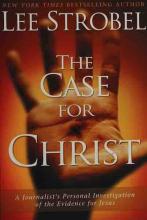
The author of The Case for Christ, an investigative journalist with a legal background, probes with bulldog-like tenacity the evidence for the truth of biblical Christianity. Believers and agnostics alike will learn from this fast-paced book.
Bruck M. METZGER, PROFESSOR OF NEW TESTAMENT, EMERITUS
PRINCETON THEOLOGICAL SEMINARY
Lee Strobel asks the questions a tough-minded skeptic would ask and provides convincing answers to all of them. His book is so good I read it out loud to my wife evenings after dinner. Every inquirer should have this book.
PHILLIP E. JOHNSON, BEST-SELLING AUTHOR AND LAW PROFESSOR, UNIVERSITY OF CALIFORNIA AT BERKELEY
An utterly fascinating treatment of the subject. It is truly a unique book which I wholeheartedly recommend.
Ravi ZACHARIAS
Nobody knows how to sift truth from fiction like an experienced inves- tigative reporter, or to argue a case like someone trained at Yale Law School. Lee Strobel brings both qualifications to this remarkable book.
In addition to his own tremendous testimony as atheist-turned-Chris- tian, the author marshals the irrefutable depositions of recognized
“expert witnesses” to build his ironclad case for Jesus Christ. I agree that The Case for Christ sets a new standard among existing contem- porary apologetics.
D. James KENNEDY, PH.D., SENIOR MINISTER, CORAL RIDGE PRESBYTERIAN CHURCH
¥
[ have never met anyone who has worked harder to provide seekers and believers alike with the rational underpinnings of the Christian faith. This book will become a classic.
Bit. HYBELS, SENIOR PASTOR,
Wittow CREEK ComMMUNITY CHURCH
I was thrilled to be a part of The Case for Christ. It is one of the most readable books in Christian evidences on the market, and I believe that it will have a wide impact. Anyone who is interested in the his- torical basis for Christianity should read this book.
J. P. MorELAND, PROFESSOR OF PHILOSOPHY,
TALBOT SCHOOL OF THEOLOGY, BIOLA UNIVERSITY,
LaMiraAbDA, CALIFORNIA
Educated in law and journalism, Lee Strobel interviewed thirteen lead- ing scholars and authorities, asking the tough questions about Jesus of Nazareth and the biblical record of his life. Lee concludes that it would actually require much more faith for an atheist to maintain athe- ism than it would to trust in Jesus. I believe Lee is right. The Case for Christ presents overwhelming historical evidence that Jesus is who he claimed to be.
Luis PALAU
A convincing case, an exciting read.
PETER KREEFT, PHILOSOPHY PROFESSOR, BOSTON COLLEGE
Lee Strobel’s brilliant investigative, fact-filled journalism adroitly assembles the overwhelming evidence of the claims of Christ. This book is a must for every Christian’s reference and library, and should be shared with others.
Dr. BILL BRIGHT, FOUNDER AND PRESIDENT,
CAMPUS CRUSADE FOR CHRIST INTERNATIONAL
As few people in our generation, Lee Strobel understands the mind- set of modern skeptics. More than an apologetic, this masterful work answers underlying questions of persons examining the claims of
Christ. It is as fascinating as it is convincing.
Dr. Ropert E. COLEMAN, DIRECTOR OF THE SCHOOL OF WORLD MISSION AND EVANGELISM, DIRECTOR, THE BILLY GRAHAM CENTER INSTITUTE OF EVANGELISM
Lee Strobel has written a book that will surely become one of the most read works in popular apologetics. Lee uses his background in law and journalism to narrate his discussion with over a dozen leading evangelical scholars. The former atheist knows how to ask the right questions. The evidence is indeed convincing in The Case fer Christ.
Dr. THOM S. RAINER,
DEAN, THE BILLY GRAHAM SCHOOL OF
MISSIONS, EVANGELISM AND CHURCH GROWTH
THE SOUTHERN BAPTIST THEOLOGICAL SEMINARY,
LOUISVILLE, KENTUCKY
Lee Strobel’s writings are always creative, captivating, and convinc- ing. This time I watched some of his work firsthand as he crafted a book that is persuasive without being manipulative, stimulating with-: out being heavy, and fascinating without being fluffy. I can enthusi- astically encourage you to read this cutting-edge book.
Gary COLLINS, P1t.D, AMERICAN ASSOCIATION OF CHRISTIAN COUNSELORS
NEW YORK TIMES BESTSELLING AUTHOR
LEE STROBEL
THE
CASE
FOR
ZONDERVAN.com/
& ZONDERVAN® WILLOW AUTHORTRACKER esearces follow your favorite authors
Other books by Lee Strobel The Case for a Creator The Case for a Creator audio The Case for a Creator—Student Edition (with Jane Vogel)
The Case for Christ The Case for Christ audio The Case for Christ—Student Edition (with Jane Vogel)
The Case for Easter The Case for Faith The Case for Faith audio The Case for Faith—Student Edition (with Jane Vogel)
The Case for the Real Jesus Experiencing the Passion of Jesus (with Garry Poole)
God’s Outrageous Claims Inside the Mind of Unchurched Harry and Mary Surviving a Spiritual Mismatch in Marriage (with Leslie Strobel)
Surviving a Spiritual Mismatch in Marriage audio What Jesus Would Say
ZONDERVAN
The Case for Christ Copyright © 1998 by Lee Strobel
Requests for information should be addressed to:
Zondervan, Grand Rapids, Michigan 49530
ISBN 978-0-310-60383-2
All Scripture quotations, unless otherwise indicated, are taken from the Holy Bible, New International Version®, NIV®. Copyright © 1973, 1978, 1984, 2011 by Biblica, Inc.™ Used by permission. All rights reserved worldwide.
All rights reserved. No part of this publication may be reproduced, stored in a retrieval system, or transmitted in any form or by any means—electronic, mechani- cal, photocopy, recording, or any other—except for brief quotations in printed reviews, without the prior permission of the publisher.
Interior design: Sherri L. Hoffman
Printed in the United States of America
N12 13:14 15 /OPP/ 83 82 8 80 79 78 77 76 75 74 73 72 71 70 69
Introduction: Reopening the Investigation of a Lifetime 9
PART 1: Examining the Record
1.The Eyewitness Evidence 21
Can the Biographies of Jesus Be Trusted? with Dr. Craig Blomberg
2.Testing the Eyewitness Evidence 47
Do the Biographies of Jesus Stand Up to Scrutiny? with Dr. Craig Blomberg
3.The Documentary Evidence 70
Were Jesus’ Biographies Reliably Preserved for Us? with Dr. Bruce Metzger
4.The Corroborating Evidence 95
Is There Credible Evidence for Jesus outside His Biographies? with Dr. Edwin Yamauchi
5.The Scientific Evidence 122
Does Archaeology Confirm or Contradict Jesus’
Biographies? with Dr. John McRay ve
6.The Rebuttal Evidence 7146
Is the Jesus of History the Same As the Jesus of Faith? with Dr. Gregory Boyd
PART 2: Analyzing Jesus
7.The Identity Evidence 175
Was Jesus Really Convinced That He Was the Son of God? with Dr. Ben Witherington III
8.The Psychological Evidence 192
Was Jesus Crazy When He Claimed to Be the Son of God? with Dr. Gary Collins
9.The Profile Evidence 208
Did Jesus Fulfill the Attributes of God? with Dr. D. A. Carson
10.The Fingerprint Evidence 230
Did Jesus—and Jesus Alone—Match the Identity of the Messiah? with Louis Lapides, M.Div., Th.M.
PART 3: Researching the Resurrection
11.The Medical Evidence 2595
Was Jesus’ Death a Sham and His Resurrection a Hoax? with Dr. Alexander Metherell
12.The Evidence of the Missing Body yah)
Was Jesus’ Body Really Absent from His Tomb? with Dr. William Lane Craig
13.The Evidence of Appearances 303
Was Jesus Seen Alive after His Death on the Cross? with Dr. Gary Habermas
14.The Circumstantial Evidence 329
Are There Any Supporting Facts That Point to the Resur- rection? with Dr. J. P. Moreland
Conclusion: The Verdict of History 349
What Does the Evidence Establish—And What Does It Mean Today?
List of Citations 369
Notes BHT!
Index 387
ACKNOWLEDGMENTS am extremely thankful for the insights and contribu- tions that a variety of people have made to this book.
In particular, ’'m indebted to Bill Hybels, who allowed ‘me to produce a series of presentations on this topic at Willow Creek Community Church; my wife, Leslie, who came up with the idea of translating that concept into a book; and my editor, John Sloan, whose creative input greatly enhanced the project.
Also, I’m grateful to Mark Mittelberg and Garry Poole for their ongoing encouragement and assistance; Chad Meister and Bob and Gretchen Passantino for their research and ideas; Russ Robinson for his legal per- spective; my assistant Jodi Walle for her invaluable help; and my daughter, Alison, and son, Kyle, for their behind- the-scenes contributions.
Finally, I’d like to thank the scholars who allowed me to interview them for this book. Again and again I was impressed not only by their knowledge and wisdom but also by their humble and sincere faith—as well as their desire to help spiritual seekers investigate the outrageous claims of Jesus. ae
INTRODUCTION
Reopening the Investigation of a Lifetime rr the parlance of prosecutors, the attempted murder case against James Dixon was “a dead-bang winner.” Open and shut. Even a cursory examination of the evi- dence was enough to establish that Dixon shot police sergeant Richard Scanlon in the abdomen during a scuf- fle on Chicago’s south side.
Piece by piece, item by item, witness by witness, the evidence tightened a noose around Dixon’s neck. There were fingerprints and a weapon, eyewitnesses and a motive, a wounded cop and a defendant with a history of violence. Now the criminal justice system was poised to trip the trap door that would leave Dixon dangling by the weight of his own guilt.
The facts were simple. Sergeant Scanlon had rushed to West 108th Place after a neighbor called police to report a man with a gun. Scanlon arrived to find Dixon noisily arguing with his girlfriend through the front door of her house. Her father emerged when he saw Scanlon, figuring it was safe to come outside.
Suddenly a fight broke out between Dixon and the father. The sergeant quickly intervened in an attempt to break it up. A shot rang out; Scanlon staggered away, wounded in his midsection. Just then two other squad cars arrived, screeching to a halt, and officers ran over to restrain Dixon.
10 THE CASE FOR CHRIST
A .22-caliber gun belonging to Dixon—covered with his fingerprints and with one bullet having been fired — was found nearby, where he had apparently flung it after the shooting. The father had been unarmed; Scanlon’s revolver remained in his holster. Powder burns on Scan- lon’s skin showed that he had been shot at extremely close range. ¢
Fortunately, his wound wasn’t life-threatening, although it was serious enough to earn him a medal for bravery, proudly pinned on his chest by the police super- intendent himself. As for Dixon, when police ran his rap sheet, they found he had previously been convicted of shooting someone else. Apparently, he had a propensity for violence.
And there I sat almost a year later, taking notes in a nearly deserted Chicago courtroom while Dixon publicly admitted that, yes, he was guilty of shooting the fifteen- year police veteran. On top of all the other evidence, the confession clinched it. Criminal court judge Frank Machala ordered Dixon imprisoned, then rapped his gavel to signal that the case was closed. Justice had been served.
I slipped my notebook into the inside pocket of my sports coat and ambled downstairs toward the press room.
At the most, I figured my editor would give me three para- graphs to tell the story in the next day’s Chicago Tribune.
Certainly, that’s all it deserved. This wasn’t much of a tale.
Or so I thought.
THE WHISPER OF AN INFORMANT
I answered the phone in the pressroom and recognized the voice right away—it was an informant I had culti- vated during the year I had been covering the criminal courts building. I could tell he had something hot for me, Introduction Il because the bigger the tip, the faster and softer he would talk—and he was whispering a mile a minute.
“Lee, do you know that Dixon case?” he asked.
“Yeah, sure,” I replied. “Covered it two days ago.
Pretty routine.”
“Don’t be so sure. The word is that a few weeks before the shooting, Sergeant Scanlon was at a party, showing off his pen gun.”
“His what?”
“A pen gun. It’s a .22-caliber pistol that’s made to look like a fountain pen. They’re illegal for anyone to carry, including cops.”
When I told him I didn’t see the relevance of this, his voice got even more animated. “Here’s the thing: Dixon didn’t shoot Scanlon. Scanlon was wounded when his own pen gun accidentally went off in his shirt pocket. He framed Dixon so he wouldn’t get in trouble for carrying an unau- thorized weapon. Don’t you see? Dixon is innocent!”
“Impossible!” I exclaimed.
“Check out the evidence yourself,” came his reply.
“See where it really points.”
I hung up the phone and dashed up the stairs to the prosecutor's office, pausing briefly to catch my“breath before strolling inside. “You know the Dixon case?” I asked casually, not wanting to tip my hand too early. “If you don’t mind, I’d like to go over the details once more.”
Color drained from his face. “Uh, I can’t talk about it,” he stammered. “No comment.”
It turned out that my informant had already passed along his suspicions to the prosecutor's office. Behind the scenes, a grand jury was being convened to reconsider the evidence. Amazingly, unexpectedly, the once airtight case against James Dixon was being reopened.
12. THE CASE FOR CHRIST
NEW FACTS FOR A NEW THEORY
At the same time, I started my own investigation, study- ing the crime scene, interviewing witnesses, talking with Dixon, and examining the physical evidence. As I thor- oughly checked out the case, the strangest thing hap- pened: all the new facts that I uncovered—and even the old evidence that had once pointed so convincingly toward Dixon’s guilt—snugly fit the pen gun theory.
Witnesses said that before Scanlon arrived on the scene, Dixon had been pounding his gun on the door of his girlfriend’s house. The gun discharged in a downward direction; in the cement of the front porch there was a chip that was consistent with a bullet’s impact. This would account for the bullet that was missing from Dixon’s gun.
Dixon said he didn’t want to be caught with a gun, so he hid it in some grass across the street before police arrived. I found a witness who corroborated that. This explained why the gun had been found some distance from the shooting scene even though nobody had ever seen Dixon throw it.
There were powder burns concentrated inside— but not above—the left pocket of Scanlon’s shirt.
The bullet hole was at the bottom of the pocket.
Conclusion: a weapon had somehow discharged in the pocket’s interior.
Contrary to statements in the police report, the bul- let’s trajectory had been at a downward angle.
Below Scanlon’s shirt pocket was a bloody rip where the bullet had exited after going through | some flesh.
Introduction 13
¢ Dixon’s rap sheet hadn’t told the whole story about him. Although he had spent three years in prison for an earlier shooting, the appellate court had freed him after determining that he had been wrongly convicted. It turns out that police had con- cealed a key defense witness and that a prosecu- tion witness had lied. So much for Dixon’s record of violent tendencies.
AN INNOCENT MAN IS FREED
Finally I put the crucial question to Dixon: “If you were innocent, why in the world did you plead guilty?”
Dixon sighed. “It was a plea bargain,” he said, refer- ring to the practice in which prosecutors recommend a reduced sentence if a defendant pleads guilty and thus saves everybody the time and expense of a trial.
“They said if I pleaded guilty, they would sentence me to one year in prison. I’d already spent 362 days in jail waiting for my trial. All I had to do was admit I did it and I'd go home in a few days. But if I insisted on a trial and the jury found me guilty—well, they'd throw the book at me. They’d give me twenty years for shooting a cop.
It wasn’t worth the gamble. I wanted to go home. ...”
“And so,” I said, “you admitted doing something that you didn’t do.”
Dixon nodded. “That’s right.”
In the end Dixon was exonerated, and he later won a lawsuit against the police department. Scanlon was stripped of his medal, was indicted by a grand jury, pleaded guilty to official misconduct, and was fired from the department.' As for me, my stories were splashed across the front page. Much more important, I had learned some big lessons as a young reporter.
14 THE CASE FOR CHRIST
One of the most obvious lessons was that evidence can be aligned to point.in more than one direction. For exam- ple, there had easily been enough proof to convict Dixon of shooting the sergeant. But the key questions were these: Had the collection of evidence really been thorough?
And which explanation best fit the totality of the facts?
Once the pen gun theory was offered, it became clear that this scenario accounted for the full body of evidence in the most optimal way.
And there was another lesson. One reason the evidence originally looked so convincing to me was because it fit my preconceptions at the time. To me, Dixon was an obvi- ous troublemaker, a failure, the unemployed product of a broken family. The cops were the good guys. Prosecu- tors didn’t make mistakes.
Looking through those lenses, all the original evidence seemed to fall neatly into place. Where there had been inconsistencies or gaps, I naively glossed them over.
When police told me the case was airtight, I took them at their word and didn’t delve much further.
But when I changed those lenses—trading my biases for an attempt at objectivity—I saw the case in a whole new light. Finally I allowed the evidence to lead me to the truth, regardless of whether it fit my original pre- suppositions.
That was more than twenty years ago. My biggest lessons were yet to come.
FROM DIXON TO JESUS
The reason I’ve recounted this unusual case is because in a way my spiritual journey has been a lot like my expe- rience with James Dixon.
Introduction 15
For much of my life I was a skeptic. In fact, I con- sidered myself an atheist. To me, there was far too much evidence that God was merely a product of wishful think- ing, of ancient mythology, of primitive superstition. How could there be a loving God if he consigned people to hell just for not believing in him? How could miracles con- travene the basic laws of nature? Didn’t evolution sat- isfactorily explain how life originated? Doesn’t scientific reasoning dispel belief in the supernatural?
As for Jesus, didn’t you know that he never claimed to be God? He was a revolutionary, a sage, an iconoclas- tic Jew—but God? No, that thought never occurred to him! I could point you to plenty of university professors who said so—and certainly they could be trusted, couldn’t they? Let’s face it: even a cursory examination of the evidence demonstrates convincingly that Jesus had only been a human being just like you and me, although with unusual gifts of kindness and wisdom.
But that’s all I had ever really given the evidence: a cursory look. I had read just enough philosophy and his- tory to find support for my skepticism—a fact here, a sci- entific theory there, a pithy quote, a clever argument.
Sure, I could see some gaps and inconsistencies, but I had a strong motivation to ignore them: a self-serving and immoral lifestyle that I would be compelled to abandon if I were ever to change my views and become a follower of Jesus.
As far as I was concerned, the case was closed. There was enough proof for me to rest easy with the conclu- sion that the divinity of Jesus was nothing more than the fanciful invention of superstitious people.
Or so I thought.
16 THE CASE FOR CHRIST
ANSWERS FOR AN ATHEIST
It wasn’t a phone call from an informant that prompted me to reexamine the case for Christ. It was my wife.
Leslie stunned me in the autumn of 1979 by announcing that she had become a Christian. I rolled my eyes and braced for the worst, feeling like the victim of a bait-and-switch scam. I had married one Leslie—the fun Leslie, the carefree Leslie, the risk-taking Leslie— and now I feared she was going to turn into some sort of sexually repressed prude who would trade our upwardly mobile lifestyle for all-night prayer vigils and volunteer work in grimy soup kitchens.
Instead I was pleasantly surprised—even fasci- nated—by the fundamental changes in her character, her integrity, and her personal confidence. Eventually I wanted to get to the bottom of what was prompting these subtle but significant shifts in my wife’s attitudes, so I launched an all-out investigation into the facts sur- rounding the case for Christianity.
Setting aside my self-interest and prejudices as best I could, I read books, interviewed experts, asked ques- tions, analyzed history, explored archaeology, studied ancient literature, and for the first time in my life picked apart the Bible verse by verse.
I plunged into the case with more vigor than with any story I had ever pursued. I applied the training I had received at Yale Law School as well as my experience as legal affairs editor of the Chicago Tribune. And over time the evidence of the world—of history, of science, of philosophy, of psychology—began to point toward the unthinkable.
It was like the James Dixon case revisited.
Introduction 17
JUDGING FOR YOURSELF
Maybe you too have been basing your spiritual outlook on the evidence you’ve observed around you or gleaned long ago from books, college professors, family members, or friends. But is your conclusion really the best possi- ble explanation for the evidence? If you were to dig deeper—to confront your preconceptions and system- atically seek out proof—what would you find?
That’s what this book is about. In effect, ’m going to retrace and expand upon the spiritual journey I took for nearly two years. I'll take you along as I interview thir- teen leading scholars and authorities who have impec- cable academic credentials.
I have crisscrossed the country—from Minnesota to Georgia, from Virginia to California—to elicit their expert opinions, to challenge them with the objections I had when I was a skeptic, to force them to defend their positions with solid data and cogent arguments, and to test them with the very questions that you might ask if given the opportunity.
In this quest for truth, I’ve used my experience as a legal affairs journalist to look at numerous categories of proof—eyewitness evidence, documentary evidence, corroborating evidence, rebuttal evidence, scientific evi- dence, psychological evidence, circumstantial evidence, and, yes, even fingerprint evidence (that sounds intrigu- ing, doesn’t it?).
These are the same classifications that you’d encounter in a courtroom. And maybe taking a legal per- spective is the best way to envision this process—with you in the role of a juror.
18 THE CASE FOR CHRIST
If you were selected for a jury in a real trial, you would be asked to affirm up front that you haven’t formed any preconceptions about the case. You would be required to vow that you would be open-minded and fair, draw- ing your conclusions based on the weight of the facts and not on your whims or prejudices. You would be urged to thoughtfully consider the credibility of the witnesses, carefully sift the testimony, and rigorously subject the evidence to your common sense and logic. I’m asking you to do the same thing while reading this book.
Ultimately it’s the responsibility of jurors to reach a verdict. That doesn’t mean they have one-hundred-per- cent certainty, because we can’t have absolute proof about anything in life. In a trial, jurors are asked to weigh the evidence and come to the best possible conclusion. In other words, harkening back to the James Dixon case, which scenario fits the facts most snugly?
That’s your task. I hope you take it seriously, because there may be more than just idle curiosity hanging in the balance. If Jesus is to be believed—and I realize that may be a big if for you at this point—then nothing is more important than how you respond to him.
But who was he really? Who did he claim to be? And is there any credible evidence to back up his assertions?
That’s what we'll seek to determine as we board a flight for Denver to conduct our first interview.
PART
Examining the Record
THE EYEWITNESS
EVIDENCE
Can the Biographies of Jesus Be Trusted? si ae I first met shy and soft-spoken Leo Carter, he was a seventeen-year-old veteran of Chicago's grit- tiest neighborhood. His testimony had put three killers in prison. And he was still carrying a .38-caliber slug in his skull—a grisly reminder of a horrific saga that began when he witnessed Elijah Baptist gun down a local grocer.
Leo and a friend, Leslie Scott, were playing basketball when they saw Elijah, then a sixteen-year-old delinquent with thirty arrests ori his rap sheet, slay Sam Blue out- side his grocery store.
Leo had known the grocer since childhood. “When we didn’t have any food, he’d give us some,” Leo explained to me in a quiet voice. “So when I went to the hospital and they said he was dead, I knew I'd have to testify about what I saw.”
Eyewitness testimony is powerful. One of the most dra- matic moments in a trial is when a witness describes in detail the crime that he or she saw and then points con- fidently toward the defendant as being the perpetrator.
Elijah Baptist knew that the only way to avoid prison
21
22 THE CASE FOR CHRIST would be to somehow prevent Leo Carter and Leslie Scott from doing just that.
So Elijah and two of his pals went hunting. Soon they tracked down Leo and Leslie, who were walking down the street with Leo’s brother Henry, and they dragged all three at gunpoint to a darkened loading dock nearby.
“J like you,” Elijah’s cousin said to Leo, “but I’ve got to do this.” With that he pressed a pistol to the bridge of Leo’s nose and yanked the trigger.
The gun roared; the bullet penetrated at a slight angle, blinding Leo in his right eye and embedding in his head.
When he crumbled to the ground, another shot was fired, this bullet lodging two inches from his spine.
As Leo watched from his sprawled position, pretend- ing he was dead, he saw his sobbing brother and friend ruthlessly executed at close range. When Elijah and his gang fled, Leo crawled to safety.
Somehow, against all odds, Leo Carter lived. The bul- let, too precarious to be removed, remained in his skull.
Despite searing headaches that strong medication couldn’t dull, he became the sole eyewitness against Eli- jah Baptist at his trial for killing grocer Sam Blue. The jurors believed Leo, and Elijah was sentenced to eighty years in prison.
Again Leo was the only eyewitness to testify against Elijah and his two companions in the slayings of his brother and his friend. And once more his word was good enough to land the trio in prison for the rest of their lives.
Leo Carter is one of my heroes. He made sure justice was served, even though he paid a monumental price for it. When I think of eyewitness testimony, even to this day—more than twenty years later—his face still appears in my mind.!
=
The Eyewitness Evidence. 23
TESTIMONY FROM DISTANT TIME
Yes, eyewitness testimony can be compelling and con- vincing. When a witness has had ample opportunity to observe a crime, when there’s no bias or ulterior motives, when the witness is truthful and fair, the climactic act of pointing out a defendant in a courtroom can be enough to doom that person to prison or worse.
And eyewitness testimony is just as crucial in inves- tigating historical matters—even the issue of whether Jesus Christ is the unique Son of God.
But what eyewitness accounts do we possess? Do we have the testimony of anyone who personally interacted with Jesus, who listened to his teachings, who saw his miracles, who witnessed his death, and who perhaps even encountered him after his alleged resurrection? Do we have any records from first-century “journalists” who interviewed eyewitnesses, asked tough questions, and faithfully recorded what they scrupulously determined to be true? Equally important, how well would these accounts withstand the scrutiny of skeptics?
I knew that just as Leo Carter's testimony clinched the convictions of three brutal murderers, eyéwitness accounts from the mists of distant time could help resolve the most important spiritual issue of all. To get solid answers, I arranged to interview the nationally renowned scholar who literally wrote the book on the topic: Dr. Craig Blomberg, author of The Historical Reliability of the Gospels.
I knew Blomberg was smart; in fact, even his appear- ance fit the stereotype. Tall (six feet two) and lanky, with short, wavy brown hair unceremoniously combed forward, a fuzzy beard, and thick, rimless glasses, he looked like
24 THE CASE FOR CHRIST the type who would have been valedictorian of his high school (he was), a National Merit Scholar (he was), and a magna cum laude graduate from a prestigious seminary
(he was, from Trinity Evangelical Divinity School).
But I wanted someone who was more than just intelli- gent and educated. I was searching for an expert who wouldn’t gloss over nuances or blithely dismiss challenges to the records of Christianity. I wanted someone with integrity, someone who has grappled with the most potent critiques of the faith and who speaks authoritatively but without the kind of sweeping statements that conceal rather than deal with critical issues.
I was told Blomberg was exactly what I was looking for, and I flew to Denver wondering if he could measure up. Admittedly, I had a few doubts, especially when my research yielded one profoundly disturbing fact that he would probably have preferred had remained hidden:
Blomberg still holds out hope that his beloved childhood heroes, the Chicago Cubs, will win the World Series in his lifetime.
Frankly, that was enough to make me a bit suspicious of his discernment.
THE FIRST INTERVIEW: CRAIG L. BLOMBERG, PH.D.
Craig Blomberg is widely considered to be one of the country’s foremost authorities on the biographies of Jesus, which are called the four gospels. He received his doc- torate in New Testament from Aberdeen University in Scotland, later serving as a senior research fellow at Tyn- dale House at Cambridge University in England, where he was part of an elite group of international scholars that
The Eyewitness Evidence 25 produced a series of acclaimed works on Jesus. For the last dozen years he has been a professor of New Testa- ment at the highly respected Denver Seminary.
Blomberg’s books include Jesus and the Gospels; Inter- preting the Parables; How Wide the Divide?; and commen- taries on the gospel of Matthew and 1 Corinthians. He also helped edit volume six of Gospel Perspectives, which deals at length with the miracles of Jesus, and he coauthored Introduction to Biblical Interpretation. He contributed chap- ters on the historicity of the gospels to the book Reasonable Faith and the award-winning Jesus under Fire. His mem- berships include the Society for the Study of the New Tes- tament, Society of Biblical Literature, and the Institute for Biblical Research.
As I expected, his office had more than its share of scholarly volumes stacked on the shelves (he was even wearing a tie emblazoned with drawings of books).
However, I quickly noted that his office walls were dominated not by dusty tomes from ancient historians but by artwork from his young daughters. Their whimsical and colorful depictions of llamas, houses, and flowers weren’t haphazardly pinned up as a casual afterthought; they had obviously been treated as prizes—painstakingly matted, carefully framed, and personally autographed by Elizabeth and Rachel themselves. Clearly, I thought to myself, this man has a heart as well as a brain.
Blomberg speaks with the precision of a mathemati- cian (yes, he taught mathematics too, earlier in his career), carefully measuring each word out of an appar- ent reluctance to tread even one nuance beyond where the evidence warrants. Exactly what I was looking for.
As he settled into a high-back chair, cup of coffee in hand, I too sipped some coffee to ward off the Colorado chill.
26 THE CASE FOR CHRIST
Since I sensed Blomberg was a get-to-the-point kind of guy, I decided to start my interview by cutting to the core of the issue.
EYEWITNESSES TO HISTORY
“Tell me this,” I said with an edge of challenge in my voice, “is it really possible to be an intelligent, criti- cally thinking person and still believe that the four gospels were written by the people whose names have been attached to them?”
Blomberg set his cup of coffee on the edge of his desk and looked intently at me. “The answer is yes,” he said with conviction.
He sat back and continued. “It’s important to acknowl- edge that strictly speaking, the gospels are anonymous.
But the uniform testimony of the early church was that Matthew, also known as Levi, the tax collector and one of the twelve disciples, was the author of the first gospel in the New Testament; that John Mark, a companion of Peter, was the author of the gospel we call Mark; and that Luke, known as Paul’s ‘beloved physician,’ wrote both the gospel of Luke and the Acts of the Apostles.”
“How uniform was the belief that they were the authors?” I asked.
“There are no known competitors for these three gospels,” he said. “Apparently, it was just not in dispute.”
Even so, I wanted to test the issue further. “Excuse my skepticism,” I said, “but would anyone have had a moti- vation to lie by claiming these people wrote these gospels, when they really didn’t?”
Blomberg shook his head. “Probably not. Remember, — these were unlikely characters,” he said, a grin breaking
The Eyewitness Evidence 27 on his face. “Mark and Luke weren’t even among the twelve disciples. Matthew was, but as a former hated tax collector, he would have been the most infamous char- acter next to Judas Iscariot, who betrayed Jesus!
“Contrast this with what happened when the fanciful apocryphal gospels were written much later. People chose the names of well-known and exemplary figures to be their fictitious authors—Philip, Peter, Mary, James.
Those names carried a lot more weight than the names of Matthew, Mark, and Luke. So to answer your question, there would not have been any reason to attribute author- ship to these three less respected people if it weren't true.”
That sounded logical, but it was obvious that he was conveniently leaving out one of the gospel writers. “What about John?” I asked. “He was extremely prominent; in fact, he wasn’t just one of the twelve disciples but one of Jesus’ inner three, along with James and Peter.”
“Yes, he’s the one exception,” Blomberg conceded with a nod. “And interestingly, John is the only gospel about which there is some question about authorship.”
“What exactly is in dispute?” ,
“The name of the author isn’t in doubt— it’s tértainly John,” Blomberg replied. “The question is whether it was John the apostle or a different John.
“You see, the testimony of a Christian writer named Papias, dated about A.D. 125, refers to John the apostle and John the elder, and it’s not clear from the context whether he’s talking about one person from two per- spectives or two different people. But granted that excep- tion, the rest of the early testimony is unanimous that it was John the apostle—the son of Zebedee—who wrote the gospel.”
28 THE CASE FOR CHRIST
“And,” I said in an effort to pin him down further, “you're convinced that he did?”
“Yes, I believe the substantial majority of the mater- ial goes back to the apostle,” he replied. “However, if you read the gospel closely, you can see some indica- tion that its concluding verses may have been finalized by an editor. Personally, I have no problem believing that somebody closely associated with John may have func- tioned in that role, putting the last verses into shape and potentially creating the stylistic uniformity of the entire document.
“But in any event,” he stressed, “the gospel is obvi- ously based on eyewitness material, as are the other three gospels.”
DELVING INTO SPECIFICS
While I appreciated Blomberg’s comments so far, I wasn’t © ready to move on yet. The issue of who wrote the gospels is tremendously important, and I wanted specific details—names, dates, quotations. I finished off my cof- fee and put the cup on his desk. Pen poised, I prepared to dig deeper.
“Let’s go back to Mark, Matthew, and Luke,” I said.
“What specific evidence do you have that they are the authors of the gospels?”
Blomberg leaned forward. “Again, the oldest and prob- ably most significant testimony comes from Papias, who in about A.D. 125 specifically affirmed that Mark had carefully and accurately recorded Peter’s eyewitness observations. In fact, he said Mark ‘made no mistake’ and did not include ‘any false statement.’ And Papias said Matthew had preserved the teachings of Jesus as well.
The Eyewitness Evidence 29
“Then Irenaeus, writing about A.D. 180, confirmed the traditional authorship. In fact, here—,” he said, reach- ing for a book. He flipped it open and read Irenaeus’ words.
Matthew published his own Gospel among the Hebrews in their own tongue, when Peter and Paul were preaching the Gospel in Rome and founding the church there. After their departure, Mark, the disciple and interpreter of Peter, himself handed down to us in writing the substance of Peter’s preaching. Luke, the follower of Paul, set down in a book the Gospel preached by his teacher. Then John, the disciple of the Lord, who also leaned on his breast, himself produced his Gospel while he was living at Ephesus in Asia.”
I looked up from the notes I was taking. “OK, let me clarify this,” I said. “If we can have confidence that the gospels were written by the disciples Matthew and John, by Mark, the companion of the disciple Peter, and by Luke, the historian, companion of Paul, and sort of a first- century journalist, we can be assured that the events they record are based on either direct or indirect eyéwitness testimony.” .
As I was speaking, Blomberg was mentally sifting my words. When I finished, he nodded.
“Exactly,” he said crisply.
ANCIENT VERSUS MODERN BIOGRAPHIES
There were still some troubling aspects of the gospels that Ineeded to clarify. In particular, I wanted to better under- stand the kind of literary genre they represented.
30 THE CASE FOR CHRIST
“When I go to the bookstore and look in the biogra- phy section, I don’t see the same kind of writing that I see in the gospels,” I said. “When somebody writes a biog- raphy these days, they thoroughly delve into the person's life. But look at Mark—he doesn’t talk about the birth of Jesus or really anything through Jesus’ early adult years.
Instead he focuses on a three-year period and spends half his gospel on the events leading up to and culminating in Jesus’ last week. How do you explain that?”
Blomberg held up a couple of fingers. “There are two reasons,” he replied. “One is literary and the other is the- ological.
“The literary reason is that basically, this is how people wrote biographies in the ancient world. They did not have the sense, as we do today, that it was important to give equal proportion to all periods of an individual’s life or that it was necessary to tell the story in strictly chrono- logical order or even to quote people verbatim, as long as the essence of what they said was preserved. Ancient Greek and Hebrew didn’t even have a symbol for quo- tation marks.
“The only purpose for which they thought history was worth recording was because there were some lessons to be learned from the characters described. Therefore the biographer wanted to dwell at length on those portions of the person’s life that were exemplary, that were illus- trative, that could help other people, that gave meaning to a period of history.”
“And what's the theological reason?” I asked.
“Tt flows out of the point I just made. Christians believe that as wonderful as Jesus’ life and teachings and miracles were, they were meaningless if it were not historically fac- tual that Christ died and was raised from the dead and that
The Eyewitness Evidence 31 this provided atonement, or forgiveness, of the sins of humanity.
“So Mark in particular, as the writer of probably the earliest gospel, devotes roughly half his narrative to the events leading up to and including one week’s period of time and culminating in Christ’s death and resurrection.
“Given the significance of the Crucifixion,” he con- cluded, “this makes perfect sense in ancient literature.”
THE MYSTERY OF Q
In addition to the four gospels, scholars often refer to what they call Q, which stands for the German word Quelle, or
“source.” Because of similarities in language and con- tent, it has traditionally been assumed that Matthew and Luke drew upon Mark’s earlier gospel in writing their own. In addition, scholars have said that Matthew and Luke also incorporated some material from this myste- rious Q, material that is absent from Mark.
“What exactly is Q?” I asked Blomberg.
“Tt’s nothing more than a hypothesis,” he replied, again leaning back comfortably in his chair. “With few excep- tions, it’s just sayings or teachings of Jesus, which once may have formed an independent, separate document.
“You see, it was a common literary genre to collect the sayings of respected teachers, sort of as we compile the top music of a singer and put it into a ‘best of album. Q may have been something like that. At least that’s the theory.”
But if Q existed before Matthew and Luke, it would constitute early material about Jesus. Perhaps, I thought, it can shed some fresh light on what Jesus was really like.
“Tet me ask this,” I said. “If you isolate just the mate- rial from Q, what kind of picture of Jesus do you get?”
32 THE CASE FOR CHRIST
Blomberg stroked his beard and stared at the ceiling for a moment as he pondered the question. “Well, you have to keep in mind that Q was a collection of sayings, and therefore it didn’t have the narrative material that would have given us a more fully orbed picture of Jesus,” he replied, speaking slowly as he chose each word with care.
“Even so, you find Jesus making some very strong claims—for instance, that he was wisdom personified and that he was the one by whom God will judge all humanity, whether they confess him or disavow him. A significant scholarly book has argued recently that if you isolate all the Q sayings, one actually gets the same kind of picture of Jesus—of someone who made audacious claims about himself—as you find in the gospels more generally.”
I wanted to push him further on this point. “Would he be seen as a miracle worker?” I inquired.
“Again,” he replied, “you have to remember that you wouldn’t get many miracle stories per se, because they’re normally found in the narrative, and Q is primarily a list of sayings.”
He stopped to reach over to his desk, pick up a leather- bound Bible, and rustle through its well-worn pages.
“But, for example, Luke 7:18—23 and Matthew 11:2-6 say that John the Baptist sent his messengers to ask Jesus if he really was the Christ, the Messiah they were waiting for. Jesus replied in essence, ‘Tell him to consider my miracles. Tell him what you’ve seen: the blind see, . the deaf hear, the lame walk, the poor have good news preached to them.’
“So even in Q,” he concluded, “there is clearly an awareness of Jesus’ ministry of miracles.”
The Eyewitness Evidence 33
Blomberg’s mention of Matthew brought to mind another question concerning how the gospels were put together. “Why,” I asked, “would Matthew—purported to be an eyewitness to Jesus— incorporate part of a gospel written by Mark, who everybody agrees was not an eye- witness? If Matthew’s gospel was really written by an eye- witness, you would think he would have relied on his own observations.”
Blomberg smiled. “It only makes sense if Mark was indeed basing his account on the recollections of the eye- witness Peter,” he said. “As you’ve said yourself, Peter was among the inner circle of Jesus and was privy to see- ing and hearing things that other disciples didn’t. So it would make sense for Matthew, even though he was an eyewitness, to rely on Peter's version of events as trans- mitted through Mark.”
Yes, I thought to myself, that did make some sense. In fact, an analogy began to form in my mind from my years as a newspaper reporter. I recalled being part of a crowd of journalists that once cornered the famous Chicago political patriarch, the late Mayor Richard J. Daley, to pepper him with questions about a scandal that was brew- ing in the police department. He made some remarks before escaping to his limousine.
Even though I was an eyewitness to what had taken place, I immediately went to a radio reporter who had
~ been closer to Daley, and asked him to play back his tape of what Daley had just said. This way, I could make sure I had his words correctly written down.
That, I mused, was apparently what Matthew did with Mark—although Matthew had his own recollections as a disciple, his quest for accuracy prompted him to rely on
34 THE CASE FOR CHRIST some material that came directly from Peter in Jesus’ inner circle.
THE UNIQUE PERSPECTIVE OF JOHN
Feeling satisfied with Blomberg’s initial answers con- — cerning the first three gospels—called the synoptics, which means “to view at the same time,” because of their similar outline and interrelationship'—next I turned my attention to John’s gospel. Anyone who reads all four gospels will immediately recognize that there are obvi- ous differences between the synoptics and the gospel of John, and I wanted to know whether this means there are irreconcilable contradictions between them.
“Could you clarify the differences between the syn- optic gospels and John’s gospel?” I asked Blomberg.
His eyebrows shot up. “Huge question!” he exclaimed.
“T hope to write a whole book on the topic.”
After I assured him I was only after the essentials of the issue, not an exhaustive discussion, he settled back into his chair.
“Well, it’s true that John is more different than simi- lar to the synoptics,” he began. “Only a handful of the major stories that appear in the other three gospels reap- pear in John, although that changes noticeably when one comes to Jesus’ last week. From that point forward the parallels are much closer.
“There also seems to be a very different linguistic style. In John, Jesus uses different terminology, he speaks in long sermons, and there seems to be a higher Chris- tology—that is, more direct and more blatant claims that Jesus is one with the Father; God himself; the Way, the Truth, and the Life; the Resurrection and the Life.”
The Eyewitness Evidence 35
“What accounts for the differences?” I asked.
“For many years the assumption was that John knew everything Matthew, Mark, and Luke wrote, and he saw no need to repeat it, so he consciously chose to supple- ment them. More recently it has been assumed that John is largely independent of the other three gospels, which could account for not only the different choices of mate- rial but also the different perspectives on Jesus.”
JESUS’ MOST AUDACIOUS CLAIM
“There are some theological distinctives to John,” I observed.
“No question, but do they deserve to be called con- tradictions? I think the answer is no, and here’s why: for almost every major theme or distinctive in John, you can find parallels in Matthew, Mark, and Luke, even if they’re not as plentiful.”
That was a bold assertion. I promptly decided to put it to the test by raising perhaps the most significant issue of all concerning the differences between the synoptics and John’s gospel.
“John makes very explicit claims of Jesus being God, which some attribute to the fact that he wrote later than the others and began embellishing things,” I said. “Can you find this theme of deity in the synoptics?”
“Yes, I can,” he said. “It’s more implicit but you find it there. Think of the story of Jesus walking on the water, found in Matthew 14:22—33 and Mark 6:45—52. Most English translations hide the Greek by quoting Jesus as saying, ‘Fear not, it is I.’ Actually, the Greek literally says, ‘Fear not, I am.’ Those last two words are identical to what Jesus said in John 8:58, when he took upon himself the
36 THE CASE FOR CHRIST divine name ‘I AM,’ which is the way God revealed him- self to Moses in the burning bush in Exodus 3:14. So Jesus is revealing himself as the one who has the same divine power over nature as Yahweh, the God of the Old Testament.”
I nodded. “That’s one example,” I said. “Do you have any others?”
“Yes, I could go on along these lines,” Blomberg said.
“For instance, Jesus’ most common title for himself in the first three gospels is ‘Son of Man,’ and—”
I raised my hand to stop him. “Hold on,” I said. Reach- ing into my briefcase, I pulled out a book and leafed through it until I located the quote I was looking for.
“Karen Armstrong, the former nun who wrote the best- seller A History of God, said it seems that the term ‘Son of Man’ ‘simply stressed the weakness and mortality of the human condition,’ so by using it, Jesus was merely emphasizing that ‘he was a frail human being who would one day suffer and die.” If that’s true,” I said, “that doesn’t sound like much of a claim to deity.”
Blomberg’s expression turned sour. “Look,” he said firmly, “contrary to popular belief, ‘Son of Man’ does not primarily refer to Jesus’ humanity. Instead it’s a direct allusion to Daniel 7:13—14.”
With that he opened the Old Testament and read those words of the prophet Daniel.
In my vision at night I looked, and there before me was one like a son of man, coming with the clouds of heaven. He approached the Ancient of Days and was led into his presence. He was given author- ity, glory and sovereign power; all peoples, nations and men of every language worshiped him. His
The Eyewitness Evidence 37 dominion is an everlasting dominion that will not pass away, and his kingdom is one that will never be destroyed.
Blomberg shut the Bible. “So look at what Jesus is doing by applying the term ‘Son of Man’ to himself,” he continued. “This is someone who approaches God him- self in his heavenly throne room and is given universal authority and dominion. That makes ‘Son of Man’ a title of great exaltation, not of mere humanity.”
Later I came upon a comment by another scholar whom I would soon interview for this book, William Lane Craig, who has made a similar observation.
“Son of Man” is often thought to indicate the humanity of Jesus, just as the reflex expression
“Son of God” indicates his divinity. In fact, just the opposite is true. The Son of Man was a divine fig- ure in the Old Testament book of Daniel who would come at the end of the world to judge mankind and rule forever. Thus, the claim to be the Son of Man would be in effect a claim to divinity.”
Continued Blomberg: “In addition, Jesus claims to for- give sins in the synoptics, and that’s something omy God can do. Jesus accepts prayer and worship. Jesus says, ‘Whoever acknowledges me, I will acknowledge before my Father in heaven.’ Final judgment is based on one’s reaction to—whom? This mere human being? No, that would be a very arrogant claim. Final judgment is based on one’s reaction to Jesus as God.
“As you can see, there’s all sorts of material in the syn- optics about the deity of Christ, that then merely becomes more explicit in John’s gospel.”
38 THE CASE FOR CHRIST
THE GOSPELS’ THEOLOGICAL AGENDA
In authoring the last gospel, John did have the advantage of being able to mull over theological issues for a longer period of time. So I asked Blomberg, “Doesn’t the fact. that John was writing with more of a theological bent mean that his historical material may have been tainted and therefore less reliable?”
“I don’t believe John is more theological,” Blomberg stressed. “He just has a different cluster of theological emphases. Matthew, Mark, and Luke each have very dis- tinctive theological angles that they want to highlight:
Luke, the theologian of the poor and of social concern;
Matthew, the theologian trying to understand the rela- tionship of Christianity and Judaism; Mark, who shows Jesus as the suffering servant. You can make a long list of the distinctive theologies of Matthew, Mark, and Luke.”
I interrupted because I was afraid Blomberg was miss- ing my broader point. “OK, but don’t those theological motivations cast doubt on their ability and willingness to accurately report what happened?” J asked. “Isn’t it likely that their theological agenda would prompt them to color and twist the history they recorded?”
“It certainly means that as with any ideological doc- ument, we have to consider that as a possibility,” he admitted. “There are people with axes to grind who dis- tort history to serve their ideological ends, but unfortu- nately people have concluded that always happens, which is a mistake.
“In the ancient world the idea of writing dispassion- ate, objective history merely to chronicle events, with no ideological purpose, was unheard of. Nobody wrote history if there wasn’t a reason to learn from it.”
The Eyewitness Evidence 39
I smiled. “I suppose you could say that makes every- thing suspect,” I suggested.
“Yes, at one level it does,” he replied. “But if we can reconstruct reasonably accurate history from all kinds of other ancient sources, we ought to be able to do that from the gospels, even though they too are ideological.”
Blomberg thought for a moment, searching his mind for an appropriate analogy to drive home his point. Finally he said, “Here’s a modern parallel, from the experience of the Jewish community, that might clarify what I mean.
“Some people, usually for anti-Semitic purposes, deny or downplay the horrors of the Holocaust. But it has been the Jewish scholars who’ve created museums, written books, preserved artifacts, and documented eyewitness testimony concerning the Holocaust.
“Now, they have a very ideological purpose—namely, to ensure that such an atrocity never occurs again—but they have also been the most faithful and objective in their reporting of historical truth.
“Christianity was likewise based on certain histori- cal claims that God uniquely entered into space and time in the person of Jesus of Nazareth, so the very ideology that Christians were trying to promote required 4s care- ful historical work as possible.”
He let his analogy sink in. Turning to face me more directly, he asked, “Do you see my point?”
I nodded to indicate that I did.
HOT NEWS FROM HISTORY
It’s one thing to say that the gospels are rooted in direct or indirect eyewitness testimony; it’s another to claim that this information was reliably preserved until it was finally
40 THE CASE FOR CHRIST written down years later. This, I knew, was a major point of contention, and I wanted to challenge Blomberg with this issue as forthrightly as I could.
Again I picked up Armstrong's popular book A History of God. “Listen to something else she wrote,” I said.
We know very little about Jesus. The first full- length account of his life was St. Mark’s gospel, which was not written until about the year 70, some forty years after his death. By that time, his- torical facts had been overlaid with mythical ele- ments which expressed the meaning Jesus had acquired for his followers. It is this meaning that St. Mark primarily conveys rather than a reliable straightforward portrayal.’
Tossing the book back into my open briefcase, I turned to Blomberg and continued. “Some scholars say the gospels were written so far after the events that legend developed and distorted what was finally written down, turning Jesus from merely a wise teacher into the mytho- logical Son of God. Is that a reasonable hypothesis, or is there good evidence that the gospels were recorded ear- lier than that, before legend could totally corrupt what was ultimately recorded?”
Blomberg’s eyes narrowed, and his voice took on an adamant tone. “There are two separate issues here, and it’s important to keep them separate,” he said. “I do think there’s good evidence for suggesting early. dates for the writing of the gospels. But even if there wasn’t, Arm- strong’s argument doesn’t work anyway.”
“Why not?” I asked.
“The standard scholarly dating, even in very liberal — circles, is Mark in the 70s, Matthew and Luke in the 80s,
The Eyewitness Evidence 41
John in the 90s. But listen: that’s still within the lifetimes of various eyewitnesses of the life of Jesus, including hos- tile eyewitnesses who would have served as a corrective if false teachings about Jesus were going around.
“Consequently, these late dates for the gospels really aren’t-all that late. In fact, we can make a comparison that’s very instructive.
“The two earliest biographies of Alexander the Great were written by Arrian and Plutarch more than four hun- dred years after Alexander’s death in 323 B.C., yet his- torians consider them to be generally trustworthy. Yes, leg- endary material about Alexander did develop over time, but it was only in the centuries after these two writers.
“In other words, the first five hundred years kept Alexander’s story pretty much intact; legendary mater- ial began to emerge over the next five hundred years.
So whether the gospels were written sixty years or thirty years after the life of Jesus, the amount of time is neg- ligible by comparison. It’s almost a nonissue.”
I could see what Blomberg was saying. At the same time, I had some reservations about it. To me, it seemed intuitively obvious that the shorter the gap between an event and when it was recorded in writing, the les$ likely those writings would fall victim to legend or faulty mem- ories.
“Tet me concede your point for the moment, but let’s get back to the dating of the gospels,” I said. “You indi- cated that you believe they were written sooner than the dates you mentioned.”
“Yes, sooner,” he said. “And we can support that by looking at the book of Acts, which was written by Luke.
Acts ends apparently unfinished—Paul is a central fig- ure of the book, and he’s under house arrest in Rome.
42. THE CASE FOR CHRIST
With that the book abruptly halts. What happens to Paul?
We don’t find out from Acts, probably because the book was written before Paul was put to death.”
Blomberg was getting more wound up as he went.
“That means Acts cannot be dated any later than A.D. 62.
Having established that, we can then move backward from there. Since Acts is the second of a two-part work, we know the first part—the gospel of Luke—must have been written earlier than that. And since Luke incorpo- rates parts of the gospel of Mark, that means Mark is even earlier.
“Tf you allow maybe a year for each of those, you end up with Mark written no later than about A.D. 60, maybe even the late 50s. If Jesus was put to death in A.D. 30 or
33, we’re talking about a maximum gap of thirty years or so.”
He sat back in his chair with an air of triumph. “His- torically speaking, especially compared with Alexander the Great,” he said, “that’s like a news flash!”
Indeed, that was impressive, closing the gap between the events of Jesus’ life and the writing of the gospels to the point where it was negligible by historical stan- dards. However, I still wanted to push the issue. My goal was to turn the clock back as far as I could to get to the very earliest information about Jesus.
GOING BACK TO THE BEGINNING
I stood and strolled over to the bookcase. “Let’s see if we can go back even further,” I said, turning toward Blomberg. “How early can we date the fundamental beliefs in Jesus’ atonement, his resurrection, and his unique association with God?”
The Eyewitness Evidence 43
“It’s important to remember that the books of the New Testament are not in chronological order,” he began. “The gospels were written after almost all the letters of Paul, whose writing ministry probably began in the late 40s.
Most of his major letters appeared during the 50s. To find the earliest information, one goes to Paul’s epistles and then asks, ‘Are there signs that even earlier sources were used in writing them?’”
“And,” I prompted, “what do we find?”
“We find that Paul incorporated some creeds, con- fessions of faith, or hymns from the earliest Christian church. These go way back to the dawning of the church soon after the Resurrection.
“The most famous creeds include Philippians 2:6—11, which talks about Jesus being ‘in very nature God,’ and Colossians 1:15—20, which describes him as being ‘the image of the invisible God,’ who created all things and through whom all things are reconciled with God “by mak- ing peace through his blood, shed on the cross.’
“Those are certainly significant in explaining what the earliest Christians were convinced about Jesus. But per- haps the most important creed in terms of the historical Jesus is 1 Corinthians 15, where Paul uses techniéal lan- guage to indicate he was passing along this oral tradition in relatively fixed form.”
Blomberg located the passage in his Bible and read it to me.
For what I received I passed on to you as of first importance: that Christ died for our sins accord- ing to the Scriptures, that he was buried, that he was raised on the third day according to the Scrip- tures, and that he appeared to Peter, and then to
44. THE CASE FOR CHRIST the Twelve. After that, he appeared to more than five hundred of the brothers at the same time, most of whom are still living, though some have fallen asleep. Then he appeared to James, then to all the apostles. °
“And here’s the point,” Blomberg said. “If the Cru- cifixion was as early as A.D. 30, Paul’s conversion was about 32. Immediately Paul was ushered into Damascus, where he met with a Christian named Ananias and some other disciples. His first meeting with the apostles in Jerusalem would have been about A.D. 35. At some point along there, Paul was given this creed, which had already been formulated and was being used in the early church.
“Now, here you have the key facts about Jesus’ death for our sins, plus a detailed list of those to whom he appeared in resurrected form—all dating back to within two to five years of the events themselves!
“That’s not later mythology from forty or more years down the road, as Armstrong suggested. A good case can be made for saying that Christian belief in the Resur- rection, though not yet written down, can be dated to within two years of that very event.
“This is enormously significant,” he said, his voice ris- ing a bit in emphasis. “Now you’re not comparing thirty to sixty years with the five hundred years that’s generally acceptable for other data—you’re talking about two!”
I couldn’t deny the importance of that evidence. It cer- tainly seemed to take the wind out of the charge that the Resurrection—which is cited by Christians as the crown- ing confirmation of Jesus’ divinity—was merely a mytho- logical concept that developed over long periods of time - as legends corrupted the eyewitness accounts of Christ’s
The Eyewitness Evidence 45 life. For me, this struck especially close to home—as a skeptic, that was one of my biggest objections to Chris- tianity.
I leaned against the bookcase. We had covered a lot of material, and Blomberg’s climactic assertion seemed like a good place to pause.
A SHORT RECESS
It was getting late in the afternoon. We had been talk- ing for quite a while without a break. However, I didn’t want to end our conversation without putting the eye- witness accounts to the same kind of tests to which a lawyer or journalist would subject them. I needed to know: would they stand up under that scrutiny, or would they be exposed as questionable at best or unreliable at worst?
The necessary groundwork having been laid, I invited Blomberg to stand and stretch his legs before we sat back down to resume our discussion.
Deliberations fe Questions for Reflection or Group Study
1. How have your opinions been influenced by some- one’s eyewitness account of an event? What are some factors you routinely use to evaluate whether some- one’s story is honest and accurate? How do you think the gospels would stand up to that kind of scrutiny?
2. Do you believe that the gospels can have a theologi- cal agenda while at the same time being trustworthy in what they report? Why or why not? Do you find
46 THE CASE FOR CHRIST
Blomberg’s Holocaust analogy helpful in thinking through this issue?
3. How and why does Blomberg’s description of the early information about Jesus affect your opinion about the reliability of the gospels?
For Further Evidence More Resources on This Topic
Barnett, Paul. [s the New Testament History? Ann Arbor, Mich.:
Vine, 1986.
. Jesus and the Logic of History. Grand Rapids: Eerd- mans, 1997.
Blomberg, Craig. The Historical Reliability of the Gospels.
Downers Grove, IIl.: InterVarsity Press, 1987.
Bruce, F. F. The New Testament Documents: Are They Reliable?
Grand Rapids: Eerdmans, 1960.
France, R. T. The Evidence for Jesus. Downers Grove, IIl.: Intervarsity Press, 1986.
GES EING-PFHE *
EYEWITNESS EVIDENCE
Do the Biographies of Jesus Stand Up to Scrutiny? ixteen-year-old Michael McCullough’s words were so faint that jurors couldn’t hear them above the soft puff- ing sound of the mechanical respirator that was keep- ing him alive. A lip-reader had to hunch over Michael’s bed, discern what he was saying, and repeat his testimony to the makeshift courtroom.
Paralyzed from the neck down by a bullet that severed his spinal cord, Michael was too frail to be transported to the courthouse for the trial of the two youths accused of attacking him. Instead the judge, jury, defendants, lawyers, reporters, and spectators crowded into Michael’s hospital room, which was declared a temporarybranch of Cook County Circuit Court.
Under questioning by prosecutors, Michael recalled how he left his apartment at a Chicago housing project with two dollars in his pocket. He said he was accosted in a stairway by the two defendants, who intentionally shot him in the face as they tried to steal his money. His story was backed up by two other youths who had watched in horror as the assault took place.
47
48 THE CASE FOR CHRIST
The defendants never denied the shooting; instead they claimed that the gun accidentally discharged while they were waving it around. Defense attorneys knew that the only way they could get their clients off with a reduced sentence was if they could succeed in undermining the testimony that the shooting was a vicious and premedi- tated act of violence.
They did their best to cast doubt on the eyewitness accounts. They questioned the witnesses’ ability to view what happened, but they failed to make any inroads. They tried to exploit inconsistencies in the stories, but the accounts harmonized on the central points. They demanded more corroboration, but clearly no more was needed.
They raised hints about character, but the victim and witnesses were law-abiding youths with no criminal record. They hoped to show a bias against the defendants, but they couldn’t find one. They questioned whether one witness, a nine-year-old boy named Keith, was old enough to understand what it meant to tell the truth under oath, but it was obvious to everyone that he did.
With defense attorneys unable to shake the credibil- ity of the victim and the prosecution witnesses, the two defendants were convicted of attempted murder and sen- tenced to fifty years in the penitentiary. Eighteen days later Michael died.’
Defense attorneys have a challenging job: to raise questions, to generate doubts, to probe the soft and vul- nerable spots of a witness’s story. They do this by sub- jecting the testimony to a variety of tests. The idea is that honest and accurate testimony will withstand scrutiny, while false, exaggerated, or misleading testimony will be exposed.
Testing the Eyewitness Evidence 49
In Michael’s case justice prevailed because the jurors could tell that the witnesses and victim were sincerely and precisely recounting what they had experienced.
Now let’s return to our investigation of the historical evidence concerning Jesus. The time had come to subject Dr. Blomberg’s testimony to tests that would either reveal its weaknesses or underscore its strength. Many of these would be the same tests that had been used by defense attorneys in Michael’s case so many years earlier.
-“There are eight different tests I’d like to ask you about,” I said to Blomberg as we sat down after our fif- teen-minute break.
Blomberg picked up a fresh cup of steaming black cof- fee and leaned back. I wasn’t sure, but it seemed he was looking forward to the challenge.
“Go ahead,” he said.
1. THE INTENTION TEST
This test seeks to determine whether it was the stated or implied intention of the writers to accurately preserve history. “Were these first-century writers even ifiterested in recording what actually happened?” I asked-’
Blomberg nodded. “Yes, they were,” he said. “You can see that at the beginning of the gospel of Luke, which reads very much like prefaces to other generally trusted historical and biographical works of antiquity.”
Picking up his Bible, Blomberg read the opening of Luke’s gospel.
Many have undertaken to draw up an account of the things that have been fulfilled among us, just as they were handed down to us by those who from the first were eyewitnesses and servants of the
50 THE CASE FOR CHRIST word. Therefore, since I myself have carefully investigated everything from the beginning, it seemed good also to me to write an orderly account for you, most excellent Theophilus, so that you may know the certainty of the things you have been taught.”
“As you can see,” Blomberg continued, “Luke is clearly saying he intended to write accurately about the things he investigated and found to be well-supported by witnesses.”
“What about the other gospels?” I asked. “They don’t start with similar declarations; does that mean their writ- ers didn’t have the same intentions?”
“Tt’s true that Mark and Matthew don’t have this kind of explicit statement,” came Blomberg’s reply. “However, they are close to Luke in terms of genre, and it seems rea- sonable that Luke’s historical intent would closely mir- ror theirs.”
“And John?” I asked.
“The only other statement of purpose in the gospels comes in John 20:31: ‘These are written that you may believe that Jesus is the Christ, the Son of God, and that by believing you may have life in his name.’”
“That,” I objected, “sounds more like a theological statement than a historical one.”
“Tl grant you that,” Blomberg replied. “But if you’re going to be convinced enough to believe, the theology has to flow from accurate history. Besides, there’s an impor- tant piece of implicit evidence that can’t be overlooked.
Consider the way the gospels are written—in a sober and responsible fashion, with accurate incidental details, with obvious care and exactitude. You don’t find the outlandish
Testing the Eyewitness Evidence Sl flourishes and blatant mythologizing that you see in a lot of other ancient writings.
“What does all that add up to?” he asked. Then he answered his own question: “It seems quite apparent that the goal of the gospel writers was to attempt to record what had actually occurred.”
Answering Objections
However, is that what really happened? There’s a com- peting and contradictory scenario that has been promoted by some critics.
They have said that early Christians were convinced Jesus was going to be returning during their lifetime to . consummate history, so they didn’t think it was necessary to preserve any historical records about his life or teach- ings. After all, why bother if he’s going to come and end the world at any moment?
“So,” I said, “years later when it became obvious that Jesus wasn’t coming back right away, they found they didn’t have any accurate historical material to draw on in writing the gospels. Nothing had been captured for his- torical purposes. Isn’t that what really happened?”
“There are certainly sects and groups, including reli- gious ones throughout history, for which that argument works, but not with early Christianity,” Blomberg replied.
“Why not?” I challenged him. “What was so differ- ent about Christianity?”
“First, I think the premise is a bit overstated. The truth is that the majority of Jesus’ teachings presuppose a sig- nificant span of time before the end of the world,” he said.
“But second, even if some of Jesus’ followers did think he might come back fairly quickly, remember that Chris- tianity was born out of Judaism.
52 THE CASE FOR CHRIST
“For eight centuries the Jews lived with the tension between the repeated pronouncements of prophets that the Day of the Lord was at hand and the continuing his- tory of Israel. And still the followers of these prophets recorded, valued, and preserved the words of the prophets. Given that Jesus’ followers looked upon him as being even greater than a prophet, it seems very reason- able that they would have done the same thing.”
While that did seem reasonable, some scholars have also raised a second objection that I wanted to pose to Blomberg. “They say that early Christians frequently believed that the physically departed Jesus was speak- ing through them with messages, or ‘prophecies,’ for their church,” I said. “Since these prophecies were consid- ered as authoritative as Jesus’ own words when he was alive on earth, the early Christians didn’t distinguish between these newer sayings and the original words of the historical Jesus. As a result, the gospels blend these two types of material, so we don’t really know what goes back to the historical Jesus and what doesn’t. That’s a troubling charge to a lot of people. How do you respond to that?”
“That argument has less historical support than the previous one,” he said with a smile. “In fact, within the New Testament itself there is evidence that disproves this hypothesis.
“There are occasions when early Christian prophecy is referred to, but it’s always distinguished from what the Lord has said. For example, in 1 Corinthians 7 Paul clearly distinguishes when he has a word from the Lord and when he is quoting the historical Jesus. In the book of Revelation one can clearly distinguish the handful of times in which Jesus directly speaks to this prophet—
Testing the Eyewitness Evidence 53 ‘ traditionally assumed to be John the apostle—and when John is recounting his own inspired visions.
“And in 1 Corinthians 14, when Paul is discussing the criteria for true prophecy, he talks about the responsi- bility of the local church to test the prophets. Drawing on his Jewish background, we know that the criteria for true prophecy would have included whether the prediction comes true and whether these new statements cohere with previously revealed words of the Lord.
“But the strongest argument is what we never find in the gospels. After Jesus’ ascension there were a number of controversies that threatened the early church—should believers be circumcised, how should speaking in tongues be regulated, how to keep Jew and Gentile united, what are the appropriate roles for women in ministry, whether believers could divorce non-Christian spouses.
“These issues could have been conveniently resolved if the early Christians had simply read back into the gospels what Jesus had told them from the world beyond.
But this never happened. The continuance of these con- troversies demonstrates that Christians were interested in distinguishing between what happened during Jesus’ lifetime and what was debated later in the churches.” ee
2. THE ABILITY TEST
Even if the writers intended to reliably record history, were they able to do so? How can we be sure that the material about Jesus’ life and teachings was well pre- served for thirty years before it was finally written down in the gospels?
T asked Blomberg, “Won’t you concede that faulty mem- ories, wishful thinking, and the development of legend
54 THE CASE FOR CHRIST would have irreparably contaminated the Jesus tradition prior to the writing of the gospels?”
He started his answer by establishing the context. “We have to remember that we’re in a foreign land in a distant time and place and in a culture that has not yet invented computers or even the printing press,” he replied.
“Books—or actually, scrolls of papyrus—were relatively rare. Therefore education, learning, worship, teaching in religious communities—all this was done by word of mouth.
“Rabbis became famous for having the entire Old Tes- tament committed to memory. So it would have been well within the capability of Jesus’ disciples to have commit- ted much more to memory than appears in all four gospels put together—and to have passed it along accurately.”
“Wait a second,” I interjected. “Frankly, that kind of memorization seems incredible. How is that possible?”
“Yes, it is difficult for us to imagine today,” he con- ceded, “but this was an oral culture, in which there was great emphasis placed on memorization. And remem- ber that eighty to ninety percent of Jesus’ words were orig- inally in poetic form. This doesn’t mean stuff that rhymes, but it has a meter, balanced lines, parallelism, and so forth—and this would have created a great memory help.
“The other thing that needs to be said is that the def- inition of memorization was more flexible back then. In studies of cultures with oral traditions, there was freedom to vary how much of the story was told on any given occa- sion—what was included, what was left out, what was paraphrased, what was explained, and so forth.
“One study suggested that in the ancient Middle East, anywhere from ten to forty percent of any given retelling | of sacred tradition could vary from one occasion to the we
Testing the Eyewitness Evidence 55 next. However, there were always fixed points that were unalterable, and the community had the right to inter- vene and correct the storyteller if he erred on those impor- tant aspects of the story.
“It’s an interesting” —he paused, searching his mind for the right word—“coincidence that ten to forty percent is pretty consistently the amount of variation among the synoptics on any given passage.”
Blomberg was hinting at something; I wanted him to be more explicit. “Spell it out for me,” I said. “What pre- cisely are you saying?”
“I’m saying that it’s likely that a lot of the similari- ties and differences among the synoptics can be explained by assuming that the disciples and other early Christians had committed to memory a lot of what Jesus said and did, but they felt free to recount this information in var- ious forms, always preserving the significance of Jesus’ original teachings and deeds.”
Still, I had some question about the ability of these early Christians to accurately preserve this oral tradition.
I had too many memories of childhood party games in which words got garbled within a matter of minutes. ere
Playing Telephone
You’ve probably played the game of telephone yourself: one child whispers something into another child’s ear—for instance, “You’re my best friend” —and this gets whispered to others around a big circle until at the end it comes out grossly distorted—perhaps, “You're a brutish fiend.”
“Let’s be candid,” I said to Blomberg. “Isn’t this a good analogy for what probably happened to the oral tradi- tion about Jesus?”
56 THE CASE FOR CHRIST
Blomberg wasn’t buying that explanation. “No, not really,” he said. “Here’s why: When you're carefully memorizing something and taking care not to pass it along until you’re sure you've got it right, you’re doing something very different from playing the game of tele- phone.
“In telephone half the fun is that the person may not have got it right or even heard it right the first time, and they cannot ask the person to repeat it. Then you imme- diately pass it along, also in whispered tones that make it more likely the next person will goof something up even more. So yes, by the time it has circulated through a room of thirty people, the results can be hilarious.”
“Then why,” I asked, “isn’t that a good analogy for passing along ancient oral tradition?”
Blomberg sipped his coffee before answering. “If you really wanted to develop that analogy in light of the checks and balances of the first-century community, you’d have to say that every third person, out loud in a very clear voice, would have to ask the first person, ‘Do I still have it right?’ and change it if he didn’t.
“The community would constantly be monitoring what was said and intervening to make corrections along the way. That would preserve the integrity of the message,” he said. “And the result would be very different from that of a childish game of telephone.”
3. THE CHARACTER TEST
This test looks at whether it was in the character of these writers to be truthful. Was there any evidence of dis- honesty or immorality that might taint their ability or will- ingness to transmit history accurately?
Testing the Eyewitness Evidence 57
Blomberg shook his head. “We simply do not have any reasonable evidence to suggest they were anything but people of great integrity,” he said.
“We see them reporting the words and actions of a man who called them to as exacting a level of integrity as any religion has ever known. They were willing to live out their beliefs even to the point of ten of the eleven remain- ing disciples being put to grisly deaths, which shows great character.
“In terms of honesty, in terms of truthfulness, in terms of virtue and morality; these people had a track record that should be envied.”
4, THE CONSISTENCY TEST
Here’s a test that skeptics often charge the gospels with failing. After all, aren’t they hopelessly contradictory with each other? Aren’t there irreconcilable discrepancies among the various gospel accounts? And if there are, how can anyone trust anything they say?
Blomberg acknowledged that there are numerous points at which the gospels appear to disagree. “These range all the way from very minor variations in wording to the most famous apparent contradictions,” he said.
“My own conviction is, once you allow for the ele- ments I’ve talked about earlier—of paraphrase, of abridg- ment, of explanatory additions, of selection, of omission— the gospels are extremely consistent with each other by ancient standards, which are the only standards by which it’s fair to judge them.”
“Ironically,” I pointed out, “if the gospels had been identical to each other, word for word, this would have raised charges that the authors had conspired among
58. THE CASE FOR CHRIST themselves to coordinate their stories in advance, and that would have cast doubt on them.”
“That’s right,” Blomberg agreed. “If the gospels were too consistent, that in itself would invalidate them as inde- pendent witnesses. People would then say we really only have one testimony that everybody else is just parroting.”
My mind flashed to the words of Simon Greenleaf of Harvard Law School, one of history’s most important legal figures and the author of an influential treatise on evidence.
After studying the consistency among the four gospel writ- ers, he offered this evaluation: “There is enough of a dis- crepancy to show that there could have been no previous concert among them; and at the same time such substan- tial agreement as to show that they all were independent narrators of the same great transaction.”*
From the perspective of a classical historian, Ger- man scholar Hans Stier has concurred that agreement over basic data and divergence of details suggest credi- bility, because fabricated accounts tend to be fully con- sistent and harmonized. “Every historian,” he wrote, “is especially skeptical at that moment when an extraordi- nary happening is only reported in accounts which are completely free of contradictions.”!
While that’s true, I didn’t want to ignore the diffi- culties that are raised by the ostensible discrepancies among the gospels. I decided to probe the issue further by pressing Blomberg on some apparent clear-cut con- tradictions that skeptics frequently seize upon as exam- ples of why the gospels are unreliable.
Coping with Contradictions
I began with a well-known story of a healing. “In Matthew it says a centurion himself came to ask Jesus
Testing the Eyewitness Evidence 59 to heal his servant,” I pointed out. “However, Luke says the centurion sent the elders to do this. Now, that’s an obvious contradiction, isn’t it?”
“No, I don’t think so,” Blomberg replied. “Think about it this way: in our world today, we may hear a news report that says, ‘The president today announced that . .. when in fact the speech was written by a speechwriter and delivered by the press secretary—and with a little luck, the president might have glanced at it somewhere in between. Yet nobody accuses that broadcast of being in error.
“In a similar way, in the ancient world it was per- fectly understood and accepted that actions were often attributed to people when in fact they occurred through their subordinates or emissaries—in this case through the elders of the Jewish people.” .
“So you’re saying that Matthew and Luke can both be right at the same time?”
“That’s exactly what I’m saying,” he replied.
That seemed plausible, so I posed a second example.
“What about Mark and Luke saying that Jesus sent the demons into the swine at Gerasa, while Matthew says it was in Gadara. People look at that and say this is ap,obvi- ous contradiction that cannot be reconciled—it’s two dif- ferent places. Case closed.”
“Well, don’t shut the case yet,” Blomberg chuck- led. “Here’s one possible solution: one was a town; the other was a province.”
That seemed a little too glib for me. He appeared to be skimming over the real difficulties that are raised by this issue.
“It gets more complicated than that,” I said. “Gerasa, the town, wasn’t anywhere near the Sea of Galilee, yet
60 THE CASE FOR CHRIST that’s where the demons, after going into the swine, sup- posedly took the herd over the cliff to their deaths.”
“OK, good point,” he said. “But there have been ruins of a town that have been excavated at exactly the right point on the eastern shore of the Sea of Galilee. The English form of the town’s name often gets pronounced
‘Khersa,’ but as a Hebrew word translated or transliter- ated into Greek, it could have come out sounding some- thing very much like ‘Gerasa.’ So it may very well have been in Khersa—whose spelling in Greek was rendered as Gerasa—in the province of Gadara.”
“Well done,” I conceded with a smile. “I'll surren- der on that one. But here’s a problem that’s not so easy: what about the discrepancies between the genealogies of Jesus in Matthew and Luke? Skeptics often point to them as being hopelessly in conflict.”
“This is another case of multiple options,” he said.
“Such as?”
“The two most common have been that Matthew reflects Joseph’s lineage, because most of his opening chapter is told from Joseph’s perspective and Joseph, as the adoptive father, would have been the legal ancestor through whom Jesus’ royal lineage would have been traced. These are themes that are important for Matthew.
“Luke, then, would have traced the genealogy through Mary’s lineage. And since both are from the ancestry of David, once you get that far back the lines converge.
“A second option is that both genealogies reflect Joseph’s lineage in order to create the necessary legali- ties. But one is Joseph’s human lineage—the gospel of Luke—and the other is Joseph’s legal lineage, with the two diverging at the points where somebody in the line
Testing the Eyewitness Evidence 61 did not have a direct offspring. They had to raise up legal heirs through various Old Testament practices.
_ “The problem is made greater because some names are omitted, which was perfectly acceptable by standards of the ancient world. And there are textual variants— names, being translated from one language into another, often took on different spellings and were then easily con- fused for the name of a different individual.”
Blomberg had made his point: there are at least some rational explanations. Even if they might not be airtight, at least they provide a reasonable harmonization of the gospel accounts.
Not wanting our conversation to degenerate into a stump-the-scholar game, I decided to move on. In the meantime Blomberg and I agreed that the best overall approach would be to study each issue individually to see whether there’s a rational way to resolve the apparent con- flict among the gospels. Certainly there’s no shortage of authoritative books that thoroughly examine, sometimes in excruciating detail, how these differences might be reconciled.°
“And,” said Blomberg, “there are occasions when we may need to hold judgment in abeyance and simply say that since we’ve made sense out of the vast majority of the texts and determined them to be trustworthy, we can then give them the benefit of the doubt when we’re not sure on some of the other details.”
5, THE BIAS TEST
This test analyzes whether the gospel writers had any biases that would have colored their work. Did they have any vested interest in skewing the material they were reporting on?
62 THE CASE FOR CHRIST
“We can’t underestimate the fact that these people loved Jesus,” I pointed out. “They were not neutral observers; they were his devoted followers. Wouldn’t that make it likely that they would change things to make him look good?”
“Well, I'll concede this much,” Blomberg replied, “it creates the potential for this to happen. But on the other hand, people can so honor and respect someone that it prompts them to record his life with great integrity. That’s the way they would show their love for him. And I think that’s what happened here.
“Besides, these disciples had nothing to gain except criticism, ostracism, and martyrdom. They certainly had nothing to win financially. If anything, this would have provided pressure to keep quiet, to deny Jesus, to down- play him, even to forget they ever met him—yet because of their integrity, they proclaimed what they saw, even when it meant suffering and death.”
6. THE COVER-UP TEST
When people testify about events they saw, they will often try to protect themselves or others by conveniently for- getting to mention details that are embarrassing or hard to explain, As a result, this raises uncertainty about the veracity of their entire testimony.
So I asked Blomberg, “Did the gospel writers include any material that might be embarrassing, or did they cover it up to make themselves look good? Did they report any- thing that would be uncomfortable or difficult for them to explain?”
“There's actually quite a bit along those lines,” he said.
“There’s a large body of Jesus’ teaching called the hard sayings of Jesus. Some of it is very ethically demand-
Testing the Eyewitness Evidence 63 ing. If I were inventing a religion to suit my fancy, I prob- ably wouldn’t tell myself to be as perfect as my heav- enly Father is perfect, or define adultery to include lust in my heart.”
“But,” I protested, “there are demanding statements in other religions as well.”
“Yes, that’s true, which is why the more persuasive kind of hard sayings are those that could be embarrass- ing for what the church wanted to teach about Jesus.”
That response seemed vague. “Give me some exam- ples,” I said.
Blomberg thought for a moment, then said, “For instance, Mark 6:5 says that Jesus could do few miracles in Nazareth because the people there had little faith, which seems to limit Jesus’ power. Jesus said in Mark
13:32 that he didn’t know the day or the hour of his return, which seems to limit his omniscience.
“Now, ultimately theology hasn’t had a problem with these statements, because Paul himself, in Philippians
2:5—8, talks about God in Christ voluntarily and con- sciously limiting the independent exercise of his divine attributes.
“But if I felt free to play fast and loose with gospel his- tory, it would be much more convenient to just leave out that material altogether, and then I wouldn’t have to go through the hassle of explaining it.
“Jesus’ baptism is another example. You can explain why Jesus, who was without sin, allowed himself to be baptized, but why not make things easier by leaving it out altogether? On the cross Jesus cried out, ‘My God, my God, why hast thou forsaken me?’ It would have been in the self-interest of the writers to omit that because it raises too many questions.”
64 THE CASE FOR CHRIST
“Certainly,” I added, “there’s plenty of embarrassing material about the disciples.”
“Absolutely,” Blomberg said. “Mark’s perspective of Peter is pretty consistently unflattering. And he’s the ring- leader! The disciples repeatedly misunderstand Jesus.
James and John want the places at Jesus’ right and left hand, and he has to teach them hard lessons about ser- vant leadership instead. They look like a bunch of self- serving, self-seeking, dull-witted people a lot of the time.
“Now, we already know that the gospel writers were selective; John’s gospel ends by saying, somewhat hyper- bolically, that the whole world couldn’t contain all the information that could have been written about Jesus. So had they left some of this out, that in and of itself wouldn’t necessarily have been seen as falsifying the story.
“But here’s the point: if they didn’t feel free to leave out stuff when it would have been convenient and help- ful to do so, is it really plausible to believe that they outright added and fabricated material with no historical basis?”
Blomberg let the question hang for a while before con- cluding with confidence, “I’d say not.”
7. THE CORROBORATION TEST
I introduced this next test by asking Blomberg, “When the gospels mention people, places, and events, do they check out to be correct in cases in which they can be independently verified?” Often such corroboration is invaluable in assessing whether a writer has a commit- ment to accuracy.
“Yes, they do, and the longer people explore this, the more the details get confirmed,” Blomberg replied.
“Within the last hundred years archaeology has repeat-
Testing the Eyewitness Evidence 65 edly unearthed discoveries that have confirmed specific references in the gospels, particularly the gospel of John— ironically, the one that’s supposedly so suspect!
“Now, yes, there are still some unresolved issues, and there have been times when archaeology has created new problems, but those are a tiny minority compared with the number of examples of corroboration.
“In addition, we can learn through non-Christian sources a lot of facts about Jesus that corroborate key teachings and events in his life. And when you stop to think that ancient historians for the most part dealt only with political rulers, emperors, kings, military battles, - official religious people, and major philosophical move- ments, it’s remarkable how much we can learn about Jesus and his followers even though they fit none of those categories at the time these historians were writing.”
That was a concise and helpful answer. However, _while I had no reason to doubt Blomberg’s assessment, I decided it would be worthwhile to do some further research along these lines. I picked up my pen and jot- ted a reminder to myself in the margin of my notes: Get expert opinions from archaeologist and historian. ,
8. THE ADVERSE WITNESS TEST
This test asks the question, Were others present who would have contradicted or corrected the gospels if they had been distorted or false? In other words, do we see examples of contemporaries of Jesus complaining that the gospel accounts were just plain wrong?
“Many people had reasons for wanting to discredit this movement and would have done so if they could have simply told history better,” Blomberg said.
66 THE CASE FOR CHRIST
“Yet look at what his opponents did say. In later Jew- ish writings Jesus is called a sorcerer who led Israel astray—which acknowledges that he really did work mar- velous wonders, although the writers dispute the source of his power.
“This would have been a perfect opportunity to say something like, ‘The Christians will tell you he worked miracles, but we’re here to tell you he didn’t.’ Yet that’s the one thing we never see his opponents saying. Instead they implicitly acknowledge that what the gospels wrote—that Jesus performed miracles—is true.”
I asked, “Could this Christian movement have taken root right there in Jerusalem—in the very area where Jesus had done much of his ministry, had been crucified, buried, and resurrected—if people who knew him were aware that the disciples were exaggerating or distorting the things that he did?”
“T don’t believe so,” Blomberg replied. “We have a picture of what was initially a very vulnerable and frag- ile movement that was being subjected to persecution.
If critics could have attacked it on the basis that it was full of falsehoods or distortions, they would have.
“But,” he emphasized in conclusion, “that’s exactly what we don’t see.”
A FAITH BUTTRESSED BY FACTS
I'll admit I was impressed by Blomberg. Informed and articulate, scholarly and convincing, he had constructed a strong case for the reliability of the gospels. His evi- dence for their traditional authorship, his analysis of the extremely early date of fundamental beliefs about Jesus, his well-reasoned defense of the accuracy of the oral tra- dition, his thoughtful examination of apparent discrep-
Testing the Eyewitness Evidence 67 ancies—all of his testimony had established a solid foun- dation for me to build on.
Yet there was still a long way to go in determining whether Jesus is the unique Son of God. In fact, after talk- ing with Blomberg, my next assignment became clear: figure out whether these gospels, shown by Blomberg to be so trustworthy, have been reliably handed down to us over the centuries. How can we be sure that the texts we're reading today bear any resemblance to what was originally written in the first century? What’s more, how do we know that the gospels are telling us the full story about Jesus?
I looked at my watch. If traffic was light, ’'d make my plane back to Chicago. As I gathered my notes and unplugged my recording equipment, I happened to glance once more at the children’s paintings on Blomberg’s wall—and suddenly for a moment I thought of him not as a scholar, not as an author, not as a professor, but as a father who sits on the edge of his daughters’ beds at night and speaks quietly to them about what’s really important in life. .
What does he tell them, I wondered, about the Bible, about God, about this Jesus who makes such outrageous claims about himself?
I couldn’t resist one last line of questions. “What about your own faith?” I asked. “How has all your research affected your beliefs?”
I barely got the words out of my mouth before he replied. “It has strengthened them, no question. I know from my own research that there’s very strong evidence for the trustworthiness of the gospel accounts.”
He was quiet for a moment, then continued. “You know, it’s ironic: The Bible considers it praiseworthy to
68 THE CASE FOR CHRIST have a faith that does not require evidence. Remember ~ how Jesus replied to doubting Thomas: ‘You believe because you see; blessed are those who have not seen and yet believe.’ And I know evidence can never compel or coerce faith. We cannot supplant the role of the Holy Spirit, which is often a concern of Christians when they hear discussions of this kind.
“But I'll tell you this: there are plenty of stories of scholars in the New Testament field who have not been Christians, yet through their study of these very issues have come to faith in Christ. And there have been count- less more scholars, already believers, whose faith has been made stronger, more solid, more grounded, because of the evidence—and that’s the category I fall into.”
As for me, I had originally been in the first cate- gory—no, not a scholar but a skeptic, an iconoclast, a hard-nosed reporter on a quest for the truth about this Jesus who said he was the Way and the Truth and the Life.
I clicked my briefcase closed and stood to thank Blomberg. I would fly back to Chicago satisfied that once again my spiritual quest was off to a good start.
Deliberations Questions for Reflection or Group Study
1. Overall, how have Blomberg’s responses to these eight evidential tests affected your confidence in the reli- ability of the gospels? Why?
2. Which of these eight tests do you consider the most persuasive and why? |
Testing the Eyewitness Evidence 69
3. When people you trust give slightly different details of the same event, do you automatically doubt their credibility, or do you see if there’s a reasonable way to reconcile their accounts? How convincing did you find Blomberg’s analysis of the apparent contradic- tions among the gospels?
For Further Evidence More Resources on This Topic
Archer, Gleason L. The Encyclopedia of Bible Difficulties.
Grand Rapids: Zondervan, 1982.
Blomberg, Craig. “The Historical Reliability of the New Tes- tament.” In Reasonable Faith, by William Lane Craig, 193—
231. Westchester, Ill.: Crossway, 1994.
_ “Where Do We Start Studying Jesus?” In Jesus under Fire, edited by Michael J. Wilkins and J. P. Moreland, 17-50. Grand Rapids: Zondervan, 1995.
Dunn, James. The Living Word. Philadelphia: Fortress, 1988.
Marshall, I. Howard. / Believe in the Historical Jesus. Grand Rapids: Eerdmans, 1977. a wer
THE DOCUMENTARY
EVIDENCE
Were Jesus’ Biographies Reliably Preserved for Us? ee reporter at the Chicago Tribune, I was a “docu- ent rat”’—I spent countless hours rummaging through court files and sniffing for tidbits of news. It was painstaking and time consuming, but the rewards were worth it. I managed to scoop the competition with front-page stories on a regular basis.
For example, I once stumbled upon some top-secret grand jury transcripts that had inadvertently been put in a public file. My subsequent articles exposed massive bid-rigging behind some of Chicago’s biggest public works projects, including the construction of major expressways.
But the most eye-popping cache of documents I ever uncovered came in a landmark case in which Ford Motor Company was charged with reckless homicide for the fiery deaths of three teenagers in a subcompact Pinto. It was the first time a U.S. manufacturer had been criminally charged for allegedly marketing a dangerous product.
When I checked the court file in tiny Winamac, Indi- ana, I found scores of confidential Ford memos revealing that the automaker knew in advance that the Pinto could
70 ee
The Documentary Evidence 71 explode when struck from behind at about twenty miles an hour. The documents indicated that the automaker decided against improving the car's safety to save a few dollars per vehicle and to increase its luggage space.
A Ford lawyer, who happened to be strolling through the courthouse, spotted me making photocopies of the documents. Frantically he rushed into court to get a judi- cial order sealing the file from the public’s view.
But it was too late. My story, headlined “Ford Ignored Pinto Fire Peril, Secret Memos Show,” was bannered in the Tribune and then flashed throughout the country.’
AUTHENTICATING THE DOCUMENTS
Obtaining secret corporate memos is one thing; verifying their authenticity is another. Before a journalist can pub- lish their contents or a prosecutor can admit the docu- ments as evidence in a trial, steps must be taken to make sure they’re genuine.
Concerning the so-called Pinto papers, could the Ford letterheads on which they were written be counterfeits?
Could the signatures be forgeries? How could I know for sure? And since the memos had obviously beerpho- tocopied numerous times, how could I be confident that their contents hadn’t been tampered with? In other words, how could I be certain that each copied document was identical to the original memo, which I didn’t possess?
What's more, how could I be positive that these memos told the whole story? After all, they represented just a small fraction of the internal correspondence at Ford.
What if there were other memos, still hidden from the public’s view, that would shed a whole different light on the matter if they were revealed?
72 THE CASE FOR CHRIST
These are significant questions, and they’re equally relevant in examining the New Testament. When I hold a Bible in my hands, essentially I’m holding copies of ancient historical records. The original manuscripts of the biographies of Jesus—Matthew, Mark, Luke, and John—and all the other books of the Old and New Tes- taments have long ago crumbled into dust. So how can I be sure that these modern-day versions—the end prod- uct of countless copying throughout the ages—bear any resemblance to what the authors originally wrote?
In addition, how can I tell if these four biographies are telling the whole story? What if there were other biogra- phies of Jesus that have been censored because the early church didn’t like the image of Jesus they portrayed? How could I have confidence that church politics haven’t squelched biographies of Jesus that were every bit as accurate as the four that were finally included in the New Testament, and that would shed important new light on the words and deeds of this controversial carpenter from Nazareth?
These two issues—whether Jesus’ biographies were reliably preserved for us and whether equally accurate biographies have been suppressed by the church—mer- ited careful consideration. I knew that there was one scholar universally recognized as a leading authority on these matters. I flew to Newark and drove a rental car to Princeton to visit him on short notice.
THE SECOND INTERVIEW: BRUCE M. METZGER, PH.D.
I found eighty-four-year-old Bruce Metzger on a Satur- day afternoon at his usual hangout, the library at Prince-
The Documentary Evidence 73 ton Theological Seminary, where, he says with a smile, “I like to dust off the books.”
Actually, he has written some of the best of them, espe- cially when the topic is the text of the New Testament. In all, he has authored or edited fifty books, including The New Testament: Its Background, Growth, and Content; The Text of the New Testament; The Canon of the New Testa- ment; Manuscripts of the Greek Bible; Textual Commen- tary on the Greek New Testament; Introduction to the Apoc- rypha; and The Oxford Companion to the Bible. Several have been translated into German, Chinese, Japanese, Korean, Malagasy, and other languages. He also is coed- itor of The New Oxford Annotated Bible with the Apoc- rypha and general editor of more than twenty-five vol- umes in the series New Testament Tools and Studies.
Metzger’s education includes a master’s degree from Princeton Theological Seminary and both a master’s degree and a doctorate from Princeton University. He has been awarded honorary doctorates by five colleges and universities, including St. Andrews University in Scot- land, the University of Munster in Germany, and Potchef- stroom University in South Africa.
In 1969 he served as resident scholar at Tyndale House, Cambridge, England. He was a visiting fellow at Clare Hall, University of Cambridge, in 1974 and at Wolfson College, Oxford, in 1979. He is currently pro- fessor emeritus at Princeton Theological Seminary after a forty-six-year career teaching the New Testament.
Metzger is chairman of the New Revised Standard Ver- sion Bible Committee, a corresponding fellow of the British Academy, and serves on the Kuratorium of the Vetus Latina Institute at the Monastery of Beuron, Ger- many. He is past president of the Society of Biblical
74 THE CASE FOR CHRIST
Literature, the International Society for New Testament Studies, and the North American Patristic Society.
If you scan the footnotes of any authoritative book on the text of the New Testament, the odds are you're going to see Metzger cited time after time. His books are manda- tory reading in universities and seminaries around the world. He is held in the highest regard by scholars from across a wide range of theological beliefs.
In many ways Metzger, born in 1914, is a throwback to an earlier generation. Alighting from a gray Buick he calls “my gas buggy,” he is wearing a dark gray suit and blue paisley tie, which is about as casual as he gets dur- ing his visits to the library, even on a weekend. His white hair is neatly combed; his eyes, bright and alert, are framed by rimless glasses. He walks slower than he used to, but he has no difficulty methodically climbing the stairway to the second floor, where he conducts his research in an obscure and austere office.
And he hasn’t lost his sense of humor. He showed me a tin canister he inherited as chairman of the Revised Standard Version Bible Committee. He opened the lid to reveal the ashes of an RSV Bible that had been torched in a 1952 bonfire during a protest by a fundamentalist preacher.
“It seems he didn’t like it when the committee changed ‘fellows’ of the King James Version to ‘comrades’ in Hebrews 1:9,” Metzger explained with a chuckle. “He accused them of being communists!”
Though Metzger’s speech is hesitant at times and he’s prone to replying in quaint phrases like “Quite so,” he continues to remain on the cutting edge of New Testa- ment scholarship. When I asked for some statistics, he didn’t rely on the numbers in his 1992 book on the New
The Documentary Evidence 75
Testament; he had conducted fresh research to get up-to- date figures. His quick mind has no problem recalling details of people and places, and he’s fully conversant with all the current debates among New Testament experts. In fact, they continue to look to him for insight and wisdom.
His office, about the size of a jail cell, is window- less and painted institutional gray. It has two wooden chairs; he insisted I take the more comfortable one. That was part of his charm. He was thoroughly kind, surpris- ingly modest and self-effacing, with a gentle spirit that made me want to someday grow old with the same mel- low kind of grace.
We got acquainted with each other for a while, and then I turned to the first issue I wanted to address: how can we be sure the biographies of Jesus were handed down to us in a reliable way?
COPIES OF COPIES OF COPIES
“Pl be honest with you,” I said to Metzger. “When I first found out that there are no surviving originals of the New Testament, I was really skeptical. I thought, If all we have are copies of copies of copies, how can I have any con- fidence that the New Testament we have today bears any resemblance whatsoever to what was originally written?
How do you respond to that?”
“This isn’t an issue that’s unique to the Bible; it’s a question we can ask of other documents that have come down to us from antiquity,” he replied. “But what the New Testament has in its favor, especially when compared with other ancient writings, is the unprecedented multiplicity of copies that have survived.”
“Why is that important?” I asked.
76 THE CASE FOR CHRIST
“Well, the more often you have copies that agree with each other, especially if they emerge from different geographical areas, the more you can cross-check them to figure out what the original document was like. The only way they'd agree would be where they went back genealogically in a family tree that represents the descent of the manuscripts.”
“OK,” I said, “I can see that having a lot of copies from various places can help. But what about the age of the documents? Certainly that’s important as well, isn’t it?”
“Quite so,” he replied. “And this is something else that favors the New Testament. We have copies com- mencing within a couple of generations from the writ- ing of the originals, whereas in the case of other ancient texts, maybe five, eight, or ten centuries elapsed between the original and the earliest surviving copy.
“Tn addition to Greek manuscripts, we also have trans- lations of the gospels into other languages at a relatively early time—into Latin, Syriac, and Coptic. And beyond that, we have what may be called secondary translations made a little later, ike Armenian and Gothic. And a lot of others—Georgian, Ethiopic, a great variety.”
“How does that help?”
“Because even if we had no Greek manuscripts today, by piecing together the information from these transla-. tions from a relatively early date, we could actually repro- duce the contents of the New Testament. In addition to that, even if we lost all the Greek manuscripts and the early translations, we could still reproduce the contents of the New Testament from the multiplicity of quotations in commentaries, sermons, letters, and so forth of the early church fathers.”
The Documentary Evidence 77
While that seemed impressive, it was difficult to judge this evidence in isolation. I needed some context to bet- ter appreciate the uniqueness of the New Testament. How, I wondered, did it compare with other well-known works of antiquity?
A MOUNTAIN OF MANUSCRIPTS
“When you talk about a great multiplicity of manu- scripts,” I said, “how does that contrast with other ancient books that are routinely accepted by scholars as being reliable? For instance, tell me about the writing of authors from about the time of Jesus.”
Having anticipated the question, Metzger referred to some handwritten notes he had brought along.
“Consider Tacitus, the Roman historian who wrote his Annals of Imperial Rome in about A.D. 116,” he began.
“His first six books exist today in only one manuscript, and it was copied about A.D. 850. Books eleven through sixteen are in another manuscript dating from the eleventh century. Books seven through ten are lost. So there is a long gap between the time that Tacitus sought his information and wrote it down and the only existing copies. 7
“With regard to the first-century historian Josephus, we have nine Greek manuscripts of his work The Jew- ish War, and these copies were written in the tenth, eleventh, and twelfth centuries. There is a Latin trans- lation from the fourth century and medieval Russian materials from the eleventh or twelfth century.”
Those numbers were surprising. There is but the thinnest thread of manuscripts connecting these ancient works to the modern world. “By comparison,” I asked,
78 THE CASE FOR CHRIST
“how many New Testament Greek manuscripts are in existence today?”
Metzger’s eyes got wide. “More than five thousand have been cataloged,” he said with enthusiasm, his voice going up an octave.
That was a mountain of manuscripts compared to the anthills of Tacitus and Josephus! “Is that unusual in the ancient world? What would the runner-up be?” I asked.
“The quantity of New Testament material is almost embarrassing in comparison with other works of antiq- uity,” he said. “Next to the New Testament, the greatest amount of manuscript testimony is of Homer’s Iliad, which was the bible of the ancient Greeks. There are fewer than 650 Greek manuscripts of it today. Some are quite fragmentary. They come down to us from the sec- ond and third century A.D. and following. When you con- sider that Homer composed his epic about 800 B.c., you can see there’s a very lengthy gap.”
“Very lengthy” was an understatement; it was a thou- sand years! There was in fact no comparison: the man- uscript evidence for the New Testament was over- whelming when juxtaposed against other revered writings of antiquity—works that modern scholars have absolutely no reluctance treating as authentic.
My curiosity about the New Testament manuscripts having been piqued, I asked Metzger to describe some of them for me.
“The earliest are fragments of papyrus, which was a writing material made from the papyrus plant that grew in the marshes of the Nile Delta in Egypt,” he said.
“There are now ninety-nine fragmentary pieces of papyrus _ that contain one or more passages or books of the New Testament.
The Documentary Evidence 79
“The most significant to come to light are the Chester Beatty Biblical Papyri, discovered about 1930. Of these, Beatty Biblical Papyrus number one contains portions of the four gospels and the book of Acts, and it dates from the third century. Papyrus number two contains large por- tions of eight letters of Paul, plus portions of Hebrews, dating to about the year 200. Papyrus number three has a sizable section of the book of Revelation, dating from the third century.
“Another group of important papyrus manuscripts was purchased by a Swiss bibliophile, M. Martin Bodmer. The earliest of these, dating from about 200, contains about two-thirds of the gospel of John. Another papyrus, con- taining portions of the gospels of Luke and John, dates from the third century.”
At this point the gap between the writing of the biogra- phies of Jesus and the earliest manuscripts was extremely small. But what is the oldest manuscript we possess? How close in time, I wondered, can we get to the original writ- ings, which experts call “autographs”?
THE SCRAP THAT CHANGED HISTORY
“Of the entire New Testament,” I said, “what is the ear- liest portion that we possess today?”
Metzger didn’t have to ponder the answer. “That would be a fragment of the gospel of John, containing material from chapter eighteen. It has five verses—three on one side, two on the other—and it measures about two and a half by three and a half inches,” he said.
“How was it discovered?” i
“Tt was purchased in Egypt as early as 1920, but it sat unnoticed for years among similar fragments of papyri.
Then in 1934 C. H. Roberts of Saint John’s College,
80 THE CASE FOR CHRIST
Oxford, was sorting through the papyri at the John Rylands Library in Manchester, England. He immedi- ately recognized this as preserving a portion of John’s - gospel. He was able to date it from the style of the script.”
“And what was his conclusion?” I asked. “How far back does it go?”
“He concluded it originated between A.D. 100 to 150.
Lots of other prominent paleographers, like Sir Frederic Kenyon, Sir Harold Bell, Adolf Deissmann, W. H. P. Hatch, Ulrich Wilcken, and others, have agreed with his assess- ment. Deissmann was convinced that it goes back at least to the reign of Emperor Hadrian, which was A.D. 117-138, or even Emperor Trajan, which was A.D. 98-117.”
That was a stunning discovery. The reason: skeptical German theologians in the last century argued strenu-~ ously that the fourth gospel was not even composed until at least the year 160—too distant from the events of Jesus’ life to be of much historical use. They were ablé to influence generations of scholars, who scoffed at this gospel’s reliability.
“This certainly blows that opinion out of the water,”
I commented.
“Yes, it does,” he said. “Here we have, at a very early date, a fragment of a copy of John all the way over in a community along the Nile River in Egypt, far from Eph- esus in Asia Minor, where the gospel was probably orig- inally composed.”
This finding has literally rewritten popular views of history, pushing the composition of John’s gospel much closer to the days when Jesus walked the earth. I made a mental note to check with an archaeologist about whether any other findings have bolstered the confidence we can have in the fourth gospel.
The Documentary Evidence 81
A WEALTH OF EVIDENCE
While papyrus manuscripts represent the earliest copies of the New Testament, there are also ancient copies writ- ten on parchment, which was made from the skins of cat- tle, sheep, goats, and antelope.
“We have what are called uncial manuscripts, which are written in all-capital Greek letters,” Metzger explained. “Today we have 306 of these, several dating back as early as the third century. The most important are Codex Sinaiticus, which is the only complete New Tes- tament in uncial letters, and Codex Vaticanus, which is not quite complete. Both date to about A.D. 350.
“A new style of writing, more cursive in nature, emerged in roughly A.D. 800. It’s called minuscule, and we have 2,856 of these manuscripts. Then there are also lectionaries, which contain New Testament Scripture in the sequence it was to be read in the early churches at appropriate times during the year. A total of 2,403 of these have been cataloged. That puts the grand total of Greek manuscripts at 5,664.”
In addition to the Greek documents, he said, there are thousands of other ancient New Testament manuscripts in other languages. There are 8,000 to 10,000 Latin Vul- gate manuscripts, plus a total of 8,000 in Ethiopic, Slavic, and Armenian. In all, there are about 24,000 manuscripts in existence.
“What's your opinion, then?” I asked, wanting to con- firm clearly what I thought I was hearing him say. “In terms of the multiplicity of manuscripts and the time gap between the originals and our first copies, how does the New Testament stack up against other well-known works of antiquity?”
82 THE CASE FOR CHRIST
“Extremely well,” he replied. “We can have great con- fidence in the fidelity with which this material has come down to us, especially compared with any other ancient literary work.”
That conclusion is shared by distinguished scholars throughout the world. Said the late F. F. Bruce, eminent professor at the University of Manchester, England, and author of The New Testament Documents: Are They Reli- able?: “There is no body of ancient literature in the world which enjoys such a wealth of good textual attestation as the New Testament.”
Metzger had already mentioned the name of Sir Fred- eric Kenyon, former director of the British Museum and author of The Palaeography of Greek Papyri. Kenyon has said that “in no other case is the interval of time between the composition of the book and the date of the earliest manuscripts so short as in that of the New Testament.”?
His conclusion: “The last foundation for any doubt that the scriptures have come down to us substantially as they were written has now been removed.”'
However, what about discrepancies among the various manuscripts? In the days before lightning-fast photo- copying machines, manuscripts were laboriously hand- copied by scribes, letter by letter, word by word, line by line, in a process that was ripe for errors. Now I wanted to zero in on whether these copying mistakes have ren- dered our modern Bibles hopelessly riddled with inac- curacies.
EXAMINING THE ERRORS
“With the similarities in the way Greek letters are writ- ten and with the primitive conditions under which the
The Documentary Evidence 83 scribes worked, it would seem inevitable that copying errors would creep into the text,” I said.
“Quite so,” Metzger conceded.
“And in fact, aren’t there literally tens of thousands of variations among the ancient manuscripts that we have?”
“Quite so.”
“Doesn’t that therefore mean we can’t trust them?” I asked, sounding more accusatory than inquisitive.
“No sir, it does not,” Metzger replied firmly. “First let me say this: Eyeglasses weren’t invented until 1373 in Venice, and I’m sure that astigmatism existed among the ancient scribes. That was compounded by the fact that it was difficult under any circumstances to read faded manuscripts on which some of the ink had flaked away.
And there were other hazards—inattentiveness on the part of scribes, for example. So yes, although for the most part scribes were scrupulously careful, errors did creep in.
“But,” he was quick to add, “there are factors coun- teracting that. For example, sometimes the scribe’s mem- ory would play tricks on him. Between the time it took for him to look at the text and then to write down the words, the order of words might get shifted. He may write down the right words but in the wrong sequence. This is noth- ing to be alarmed at, because Greek, unlike English, is an inflected language.”
“Meaning ...,” I prompted him.
“Meaning it makes a whale of a difference in Eng- lish if you say, ‘Dog bites man’ or ‘Man bites dog’— sequence matters in English. But in Greek it doesn’t. One word functions as the subject of the sentence regardless of where it stands in the sequence; consequently, the meaning of the sentence isn’t distorted if the words are
84 THE CASE FOR CHRIST out of what we consider to be the right order. So yes, some variations among manuscripts exist, but generally they’re inconsequential variations like that. Differences in spelling would be another example.”
Still, the high number of “variants,” or differences among manuscripts, was troubling. I had seen estimates as high as two hundred thousand of them.’ However, Met- zger downplayed the significance of that figure.
“The number sounds big, but it’s a bit misleading because of the way variants are counted,” he said. He explained that if a single word is misspelled in two thou- sand manuscripts, that’s counted as two thousand variants.
I keyed in on the most important issue. “How many doctrines of the church are in jeopardy because of vari- ants?”
“T don’t know of any doctrine that is in jeopardy,” he responded confidently.
“None?”
“None,” he repeated. “Now, the Jehovah’s Witnesses come to our door and say, ‘Your Bible is wrong in the King James Version of 1 John 5:7—8, where it talks about ‘the Father, the Word, and the Holy Ghost: and these three are one.’ They'll say, ‘That’s not in the earliest manu- scripts.’
“And that’s true enough. I think that these words are found in only about seven or eight copies, all from the fif- teenth or sixteenth century. I acknowledge that is not part of what the author of 1 John was inspired to write.
“But that does not dislodge the firmly witnessed tes- timony of the Bible to the doctrine of the Trinity. At the baptism of Jesus, the Father speaks, his beloved Son is _ baptized, and the Holy Spirit descends on him. At the ending of 2 Corinthians Paul says, ‘May the grace of the
The Documentary Evidence 85
Lord Jesus Christ, and the love of God, and the fellow- ship of the Holy Spirit be with you all.’ There are many places where the Trinity is represented.”
“So the variations, when they occur, tend to be minor rather than substantive?”
“Yes, yes, that’s correct, and scholars work very care- fully to try to resolve them by getting back to the origi- nal meaning. The more significant variations do not over- throw any doctrine of the church. Any good Bible will have notes that will alert the reader to variant readings of any consequence. But again, these are rare.”
So rare that scholars Norman Geisler and William Nix conclude, “The New Testament, then, has not only survived in more manuscripts than any other book from antiquity, but it has survived in a purer form than any other great book—a form that is 99.5 percent pure.”°
However, even if it’s true that the transmission of the
_New Testament through history has been unprecedented in its reliability, how do we know that we have the whole picture?
What about allegations that church councils squelched equally legitimate documents because they didn’t like the picture of Jesus they portrayed? How do we know that the twenty-seven books of the New Testa- ment represent the best and most reliable information?
Why is it that our Bibles contain Matthew, Mark, Luke, and John, but many other ancient gospels—the Gospel of Philip, the Gospel of the Egyptians, the Gospel of Truth, the Gospel of Nativity of Mary—were excluded?
It was time to turn to the question of the “canon,” a term that comes from a Greek word meaning “rule,”
“norm,” or “standard” and that describes the books that have become accepted as official in the church and
86 THE CASE FOR CHRIST included in the New Testament. Metzger is considered a leading authority in that field.
“A HIGH DEGREE OF UNANIMITY”
“How did the early church leaders determine which books would be considered authoritative and which would be discarded?” I asked. “What criteria did they use in determining which documents would be included i in the New Testament?”
“Basically, the early church had three criteria,” he said. “First, the books must have apostolic authority — that is, they must have been written either by apostles themselves, who were eyewitnesses to what they wrote about, or by followers of apostles. So in the case of Mark and Luke, while they weren’t among the twelve disciples, early tradition has it that Mark was a helper of Peter, and Luke was an associate of Paul.
“Second, there was the criterion of conformity to what was called the rule of faith. That is, was the document congruent with the basic Christian tradition that the church recognized as normative? And third, there was the criterion of whether a document had had continu- ous acceptance and usage by the church at large.”
“They merely applied those criteria and let the chips fall where they may?” I asked.
“Well, it wouldn’t be accurate to say that these crite- ria were simply applied in a mechanical fashion,” he replied. “There were certainly different opinions about which criterion should be given the most weight.
“But what’s remarkable is that even though the fringes of the canon remained unsettled for a while, there was — actually a high degree of unanimity concerning the
’
The Documentary Evidence 87 greater part of the New Testament within the first two cen- turies. And this was true among very diverse congrega- tions scattered over a wide area.”
“So,” I said, “the four gospels we have in the New Testament today met those criteria, while others didn’t?”
“Yes,” he said. “It was, if I may put it this way, an example of ‘survival of the fittest.’ In talking about the canon, Arthur Darby Nock used to tell his students at.
Harvard, ‘The most traveled roads in Europe are the best roads; that’s why they’re so heavily traveled.’ That’s a good analogy. British commentator William Barclay said it this way: ‘It is the simple truth to say that the New Testa- ment books became canonical because no one could stop them doing so.’
“We can be confident that no other ancient books can compare with the New Testament in terms of importance for Christian history or doctrine. When one studies the early history of the canon, one walks away convinced that the New Testament contains the best sources for the his- tory of Jesus. Those who discerned the limits of the canon had a clear and balanced perspective of the gospel of Christ. Z
“Just read these other documents for yourself.
They’re written later than the four gospels, in the second, third, fourth, fifth, even sixth century, long after Jesus, and they’re generally quite banal. They carry names— like the Gospel of Peter and the Gospel of Mary—that are unrelated to their real authorship. On the other hand, the four gospels in the New Testament were readily accepted with remarkable unanimity as being authen- tic in the story they told.”
Yet I knew that some liberal scholars, most notably members of the well-publicized Jesus Seminar, believe
88 THE CASE FOR CHRIST the Gospel of Thomas ought to be elevated to equal sta- tus with the four traditional gospels. Did this mysteri- ous gospel fall victim to political wars within the church, eventually being excluded because of its unpopular doc- trines? I decided I’d better probe Metzger on this point.
THE “SECRET WORDS” OF JESUS
“Dr. Metzger, the Gospel of Thomas, which was among the Nag Hammadi documents found in Egypt in 1945, claims it contains ‘the secret words which the living Jesus spoke and Didymus Judas Thomas wrote down.’ Why was it excluded by the church?”
Metzger was thoroughly acquainted with the work.
“The Gospel of Thomas came to light in a fifth-century copy in Coptic, which I’ve translated into English,” he said. “It contains 114 sayings attributed to Jesus but no narrative of what he did, and seems to have been writ- ten in Greek in Syria about A.D. 140. In some cases I think this gospel correctly reports what Jesus said, with slight modifications.”
This was certainly an intriguing statement. “Please elaborate,” I said.
“For instance, in the Gospel of Thomas Jesus says, ‘A city built on a high hill cannot be hidden.’ Here the adjective high is added, but the rest reads like Matthew’s gospel. Or Jesus says, ‘Render to Caesar the things that are Caesar’s, render to God the things that are God’s, ren- der to me the things that are mine.’ In this case the later phrase has been added.
“However, there are some things in Thomas that are totally alien to the canonical gospels. Jesus says, ‘Split wood; I am there. Lift up a stone, and you will find me —
The Documentary Evidence 989 there.’ That’s pantheism, the idea that Jesus is cotermi- nous with the substance of this world. That’s contrary to anything in the canonical gospels.
“The Gospel of Thomas ends with a note saying, “Let Mary go away from us, because women are not worthy of life.’ Jesus is quoted as saying, ‘Lo, I shall lead her in order to make her a male, so that she too may become a living spirit, resembling you males. For every woman who makes herself male will enter into the kingdom of heaven.’”
Metzger’s eyebrows shot up as if he were surprised at what he had just uttered. “Now, this is not the Jesus we know from the four canonical gospels!” he said emphatically.
I asked, “What about the charge that Thomas was purposefully excluded by church councils in some sort of conspiracy to silence it?”
“That’s just not historically accurate,” came Metzger’s response. “What the synods and councils did in the fifth century and following was to ratify what already had been accepted by high and low Christians alike. It is not right to say that the Gospel of Thomas was excluded by some fiat on the part of a council; the right way to put it is, the Gospel of Thomas excluded itself! It did not harmo- nize with other testimony about Jesus that early Chris- tians accepted as trustworthy.”
“So you would disagree with anyone who would try to elevate Thomas to the same status as that of the four gospels?” I asked.
“Yes, I would very much disagree. I think the early church exercised a judicious act in discarding it. To take it up now, it seems to me, would be to accept something that’s less valid than the other gospels,” he replied. “Now,
90 THE CASE FOR CHRIST don’t get me wrong. I think the Gospel of Thomas is an interesting document, but it’s mixed up with pantheistic and antifeminist statements that certainly deserve to be given the left foot of fellowship, if you know what I mean.
“You have to understand that the canon was not the result of a series of contests involving church politics.
The canon is rather the separation that came about because of the intuitive insight of Christian believers.
They could hear the voice of the Good Shepherd in the gospel of John; they could hear it only in a muffled and distorted way in the Gospel of Thomas, mixed in with a lot of other things.
“When the pronouncement was made about the canon, it merely ratified what the general sensitivity of the church had already determined. You see, the canon is a list of authoritative books more than it is an author- itative list of books. These documents didn’t derive their authority from being selected; each one was authoritative before anyone gathered them together. The early church merely listened and sensed that these were authorita- tive accounts.
“For somebody now to say that the canon emerged only after councils and synods made these pronounce- ments would be like saying, ‘Let’s get several academies of musicians to make a pronouncement that the music of Bach and Beethoven is wonderful.’ I would say, ‘Thank you for nothing! We knew that before the pronouncement was made.’ We know it because of sensitivity to what is good music and what is not. The same with the canon.”
Even so, I pointed out that some New Testament books, notably James, Hebrews, and Revelation, were more slowly accepted into the canon than others. “Should we therefore be suspicious of them?” I asked.
The Documentary Evidence 91
“To my mind, that just shows how careful the early church was,” he replied. “They weren’t ‘gung ho,’ sweep- ing in every last document that happened to have any- thing about Jesus in it. This shows deliberation and care- ful analysis.
“Of course, even today parts of the Syrian church refuse to accept the book of Revelation, yet the people belonging to that church are Christian believers. From my point of view, I accept the book of Revelation as a wonderful part of the Scriptures.”
He shook his head. “I think they impoverish them- selves by not accepting it.”
THE “UNRIVALED” NEW TESTAMENT
Metzger had been persuasive. No serious doubts lingered concerning whether the New Testament’s text had been reliably preserved for us through the centuries. One of Metzger’s distinguished predecessors at Princeton The- ological Seminary, Benjamin Warfield, who held four doc- torates and taught systematic theology until his death in 1921, put it this way:
If we compare the present state of the New Testa- ment text with that of any other ancient writing, we must ... declare it to be marvelously correct. Such has been the care with which the New Testament has been copied—a care which has doubtless grown out of true reverence for its holy words. ... The New Testament [is] unrivaled among ancient writings in the purity of its text as actually transmitted and kept in use.®
In terms of which documents were accepted into the New Testament, generally there has never been any serious
92 THE CASE FOR CHRIST dispute about the authoritative nature of twenty of the New Testament’s twenty-seven books—from Matthew through Philemon, plus 1 Peter and 1 John. This of course includes the four gospels that represent Jesus’ biogra- phies.” The remaining seven books, though questioned for a time by some early church leaders, “were finally and fully recognized by the church generally,” according to Geisler and Nix."
As for the “pseudepigraphia,” the proliferation of gospels, epistles, and apocalypses in the first few cen- turies after Jesus—including the Gospels of Nicodemus, Barnabas, Bartholomew, Andrew, the Epistle of Paul to the Laodiceans, the Apocalypse of Stephen, and others— they are “fanciful and heretical ... neither genuine nor valuable as a whole,” and “virtually no orthodox Father, canon or council” considered them to be authoritative or deserving of inclusion in the New Testament.’
In fact, I accepted Metzger’s challenge by reading many of them myself. Compared with the careful, sober, precise, eyewitness quality of Matthew, Mark, Luke, and John, these works truly deserve the description they received from Eusebius, the early church historian: “Totally absurd and impious.” They were too far removed from Jesus’ ministry to contribute anything meaningful to my inves- tigation, having been written as late as the fifth and sixth centuries, and their often mythical qualities disqualify them from being historically credible.
With all that established, the time had arrived for my investigation to advance to its next phase. I was curi- ous: how much evidence is there for this miracle-work- ing first-century carpenter outside the gospels? Do ancient historians confirm or contradict the New Testament’s claims about his life, teachings, and miracles? I knew
The Documentary Evidence 93 this required a trip to Ohio to visit one of the country’s leading scholars in that field.
As we stood, I thanked Dr. Metzger for his time and expertise. He smiled warmly and offered to walk me downstairs. I didn’t want to consume any more of his Sat- urday afternoon, but my curiosity wouldn’t let me leave Princeton without satisfying myself about one remain- ing issue.
“All these decades of scholarship, of study, of writ- ing textbooks, of delving into the minutiae of the New Testament text—what has all this done to your personal faith?” I asked.
“Oh,” he said, sounding happy to discuss the topic, “it has increased the basis of my personal faith to see the firmness with which these materials have come down to us, with a multiplicity of copies, some of which are very, very ancient.”
“So,” I started to say, “scholarship has not diluted your faith—”
He jumped in before I could finish my sentence. “On the contrary,” he stressed, “it has built it. 've asked ques- tions all my life, I’ve dug into the text, I’ve studied this thoroughly, and today I know with confidence that my trust in Jesus has been well placed.”
He paused while his eyes surveyed my face. Then he added, for emphasis, “Very well placed.”
Deliberations Questions for Reflection or Group Study
1. Having read the interview with Dr. Metzger, how would you rate the reliability of the process by which
94 THE CASE FOR CHRIST the New Testament was transmitted to us? What are some reasons you find this process trustworthy or not?
2. Scan a copy of the New Testament and examine some of the notes in the margins that talk about variant readings. What are some examples you find? How does the presence of these notations affect your under- standing of the passages?
3. Do the criteria for determining whether a document should be included in the New Testament seem rea- sonable? Why or why not? Are there other criteria you believe should be added? What disadvantages do modern scholars have in second-guessing the early church’s decisions concerning whether a document should be included in the Bible?
For Further Evidence More Resources on This Topic
Bruce, F. F. The Canon of Scripture. Downers Grove, Ill.: Intervarsity Press, 1988.
Geisler, Norman L., and William E. Nix. A General Introduc- tion to the Bible. 1968; reprint, Chicago: Moody Press, 1980.
Metzger, Bruce M. The Canon of the New Testament. Oxford:
Clarendon Press, 1987.
. The Text of the New Testament. New York: Oxford Univ.
Press, 1992.
Patzia, Arthur G. The Making of the New Testament. Down- ers Grove, Ill.: InterVarsity Press, 1995.
THE CORROBORATING
EVIDENCE
Is There Credible Evidence for Jesus outside His Biographies?
~Yarry Aleman turned and stabbed his finger at me.
“You,” he sputtered, spitting out the word with dis- gust. “Why do you keep writing those things about me?”
Then he spun around and disappeared down a back stair- well to escape the reporters who were pursuing him through the courthouse.
Actually, it was hard to be a crime reporter in Chicago during the 1970s and not write about Harry Aleman. He was, after all, the quintessential crime syndicate hit man.
And Chicagoans, in a perverse way, love to read about the mob.
Prosecutors desperately wanted to put Aleman in prison for one of the cold-blooded executions they sus- pected he had committed on behalf of his syndicate bosses. The problem, of course, was the difficulty of find- ing anyone willing to testify against a mobster of Aleman’s frightening reputation. :
Then came their big break. One of Aleman’s former cronies, Louis Almeida, was arrested on his way to mur- der a labor official in Pennsylvania. Convicted of weapons charges and sentenced to a decade in prison, Almeida
95
96 THE CASE FOR CHRIST agreed to testify against Aleman in the unsolved slaying of a Teamsters Union shop steward in Chicago—if pros- ecutors would agree to show leniency toward Almeida.
This meant Almeida had a motive to cooperate, which would undoubtedly tarnish his credibility to some degree.
Prosecutors realized they would need to bolster his tes- timony to ensure a conviction, so they went searching for someone to corroborate Almeida’s account.
Webster’s dictionary defines corroborate this way: “To make more certain; confirm: He corroborated my account
_ of the accident.”! Corroborative evidence supports other testimony; it affirms or backs up the essential elements of an eyewitness account. It can be a public record, a pho- tograph, or additional testimony from a second or third person. It can verify a person’s entire testimony or just key parts of it.
In effect, corroborative evidence acts like the sup- port wires that keep a tall antenna straight and unwa- vering. The more corroborative evidence, the stronger and more secure the case.
But where would prosecutors find corroboration of Almeida’s story? It came from a surprising source: a quiet, law-abiding citizen named Bobby Lowe told investigators he had been walking his dog when he saw Aleman mur- der the union steward. Despite Aleman’s bone-chilling notoriety, Lowe agreed to back up Almeida’s story by tes- tifying against the mobster.
THE POWER OF CORROBORATION
At Aleman’s trial Lowe and Almeida mesmerized jurors with their stories. Almeida’s account of driving the get- away car dovetailed with Lowe’s straightforward descrip-
The Corroborating Evidence 97 tion of seeing Aleman murder his victim on a public side- walk the evening of September 27, 1972.
Prosecutors thought they had woven an airtight case against the feared hit man, yet throughout the trial they sensed something was amiss. Their skepticism first sur- faced when Aleman decided against having a jury trial, opting instead to have a judge hear his case.
At the end of the trial the prosecutors’ worst suspi- cions were realized: despite compelling testimony by Lowe and Almeida, the judge ended up declaring Ale- man innocent and letting him go free.
What had happened? Remember, this took place in Cook County, Illinois, where corruption so often lurks.
Years later it was revealed that the judge had been slipped ten thousand dollars in return for the acquittal. When an FBI informant disclosed the bribe, the then-retired judge committed suicide—and prosecutors refiled the murder charge against Aleman.
By the time the second trial was held, the law had been changed so that prosecutors could demand that a jury hear the case. That’s what they did—and finally, a full twenty-five years after the murder, Aleman was found guilty and sentenced to one hundred to three htindred years in prison.” ie
In spite of the delays, the Aleman saga shows how significant corroborative evidence can be. And the same is true in dealing with historical issues. We've already heard, through Dr. Craig Blomberg’s testimony, that in the gospels there is excellent eyewitness evidence for the life, teachings, death, and resurrection of Jesus. But is there any other evidence to corroborate that? Are there writings outside the gospels that affirm or support any
- of the essentials about Jesus or early Christianity?
98 THE CASE FOR CHRIST
In other words, is there any additional documenta- tion that can help seal the case for Christ, as Bobby Lowe’s testimony sealed the case against Harry Aleman?
The answer, according to our next witness, is yes—and the amount and quality of that evidence may very well surprise you.
THE THIRD INTERVIEW: EDWIN M. YAMAUCHI, PH.D.
As I entered the imposing brick building that houses the office of Edwin Yamauchi at Miami University in pic- turesque Oxford, Ohio, I walked underneath a stone arch bearing this inscription: “Ye shall know the truth, and the truth will make you free.” As one of the country’s lead- ing experts in ancient history, Yamauchi has been on a quest for historical truth for much of his life.
Born in Hawaii in 1937, the son of immigrants from Okinawa, Yamauchi started from humble beginnings. His father died just before the Japanese attack on Pearl Har- bor, leaving his mother to earn a meager living as a maid for wealthy families. While lacking formal education her- self, she encouraged her son to read and study, giving him beautifully illustrated books that instilled in him a life- long love of learning.
Certainly his academic accomplishments have been impressive. After earning a bachelor’s degree in Hebrew and Hellenistics, Yamauchi received master’s and doc- toral degrees in Mediterranean studies from Brandeis University.
He has been awarded eight fellowships, from the Rut- gers Research Council, National Endowment for the Humanities, the American Philosophical Society, and oth- ers. He has studied twenty-two languages, including Ara-
The Corroborating Evidence 99 bic, Chinese, Egyptian, Russian, Syriac, Ugaritic, and even Comanche.
He has delivered seventy-one papers before learned societies; lectured at more than one hundred seminaries, universities, and colleges, including Yale, Princeton, and Cornell; served as chairman and then president of the Institute for Biblical Research and president of the Con- ference on Faith and History; and published eighty arti- cles in thirty-seven scholarly journals.
In 1968 he participated in the first excavations of the Herodian temple in Jerusalem, revealing evidence of the temple’s destruction in A.D. 70. Archaeology has also been the theme of several of his books, including The Stones and the Scriptures; The Scriptures and Archaeology; and The World of the First Christians.
Though born into a Buddhist background, Yamauchi has been following Jesus ever since 1952, the year I was born. I was especially curious to see whether his long- term commitment to Christ would color his assessment of the historical evidence. In other words, would he scrupu- lously stick to the facts or be tempted to draw conclusions that went beyond where the evidence warranted?’
I found Yamauchi to have a gentle and unasstming demeanor. Although generally soft-spoken, he’s infénsely focused. He provides thorough and detailed answers to questions, often pausing to supplement his verbal response by offering photocopies of scholarly articles
- he has written on the topic. A good scholar knows you can never have too much data.
Inside his book-cluttered office, in the heart of a heav- ily wooded campus ablaze in autumn colors, we sat down to talk about the topic that still brings a glint to his eyes, even after so many years of research and teaching.
100 THE CASE FOR CHRIST
AFFIRMING THE GOSPELS
Because of my interview with Blomberg, I didn’t want to suggest that we needed to go beyond the gospels in order to find reliable evidence concerning Jesus. So | started by asking Yamauchi this question: “As a histo- rian, could you give me your assessment of the histori- cal reliability of the gospels themselves?”
“On the whole, the gospels are excellent sources,” he replied. “As a matter of fact, they’re the most trust- worthy, complete, and reliable sources for Jesus. The inci- dental sources really don’t add much detailed informa- tion; however, they are valuable as corroborative evidence.”
“OK, that’s what I want to discuss—the corrobora- tive evidence,” I said. “Let’s be honest: some people scoff at how much there really is. For example, in 1979 Charles Templeton wrote a novel called Act of God, in which a fic- tional archaeologist made a statement that reflects the beliefs of a lot of people.”
I pulled out the book and read the relevant paragraph.
The [Christian] church bases its claims mostly on the teachings of an obscure young Jew with messianic pretentions who, let’s face it, didn’t make much of an impression in his lifetime. There isn’t a single word about him in secular history.
Not a word. No mention of him by the Romans.
Not so much as a reference by Josephus.’
“Now,” I said a little pointedly, “that doesn’t sound as if there’s much corroboration of the life of Jesus out- side the Bible.”
Yamauchi smiled and shook his head. “Templeton’s archaeologist is simply mistaken,” he replied in a dis-
The Corroborating Evidence 101 missive tone, “because we do have very, very important references to Jesus in Josephus and Tacitus.
“The gospels themselves say that many who heard him—even members of his own family—did not believe in Jesus during his lifetime, yet he made such an impres- sion that today Jesus is remembered everywhere, whereas Herod the Great, Pontius Pilate, and other ancient rulers are not as widely known. So he certainly did make an impression on those who believed in him.”
He paused, then added, “He did not, of course, among those who did not believe in him.”
TESTIMONY BY A TRAITOR
Templeton and Yamauchi had both mentioned Josephus, a first-century historian who’s well known among schol- ars but whose name is unfamiliar to most people today.
“Give me some background about him,” I said, “and tell me how his testimony provides corroboration concerning Jesus.”
“Yes, of course,” Yamauchi answered as he crossed his legs and settled deeper into his chair. “Josephus was a very important Jewish historian of the first century.
He was born in A.D. 37, and he wrote most of his four works toward the end of the first century. apts
“In his autobiography he defended his behavior in the Jewish-Roman War, which took place from A.D. 66 to
74. You see, he had surrendered to the Roman general Vespasian during the siege of Jotapata, even though many of his colleagues committed suicide rather than give up.”
The professor chuckled and said, “Josephus decided it wasn’t God’s will for him to.commit suicide. He then became a defender of the Romans.”
102 THE CASE FOR CHRIST
Josephus sounded like a colorful character; I wanted more details about him so I could better understand his motivations and prejudices. “Paint me a portrait of him,”
I said. 5
“He was a priest, a Pharisee, and he was somewhat egotistical. His most ambitious work was called The Antiquities, which was a history of the Jewish people from Creation until his time. He probably completed it in about A.D. 93.
“As you can imagine from his collaboration with the hated Romans, Josephus was extremely disliked by his fellow Jews. But he became very popular among Chris- tians, because in his writings he refers to James, the brother of Jesus, and to Jesus himself.”
Here was our first example of corroboration for Jesus out- side the gospels. “Tell me about those references,” I said.
Replied Yamauchi, “In The Antiquities he describes how a high priest named Ananias took advantage of the death of the Roman governor Festus—who is also mentioned in the New Testament—in order to have James killed.”
He leaned over to his bookshelf, pulled out a thick vol- ume, and flipped to a page whose location he seemed to know by heart. “Ah, here it is,” he said. ““He convened a meeting of the Sanhedrin and brought before them a man named James, the brother of Jesus, who was called the Christ, and certain others. He accused them of hav- ing transgressed the law and delivered them up to be stoned.”!
“I know of no scholar,” Yamauchi asserted confidently, “who has successfully disputed this passage. L. H. Feld- man noted that if this had been a later Christian addition to the text, it would have likely been more laudatory of James. So here you have a reference to the brother of
The Corroborating Evidence 103
Jesus—who had apparently been converted by the appearance of the risen Christ, if you compare John 7:5 and 1 Corinthians 15:7—and corroboration of the fact that some people considered Jesus to be the Christ, which means ‘the Anointed One’ or ‘Messiah.’”
“THERE LIVED JESUS ...”
I knew that Josephus had written an even lengthier sec- tion about Jesus, which is called the Testimonium Fla- vianum. I knew too that this passage was among the most hotly disputed in ancient literature because on its sur- face it appears to provide sweeping corroboration of Jesus’ life, miracles, death, and resurrection. But is it authen- tic? Or has it been doctored through the years by people favorable to Jesus?
I asked Yamauchi for his opinion, and it was instantly clear I had tapped into an area of high interest for him.
He uncrossed his legs and sat up straight in his chair.
“This is a fascinating passage,” he said with enthusiasm, leaning forward, book in hand. “But yes, it is controver- sial.” With that he read it to me.
About this time there lived Jesus, a wise mary, if indeed one ought to call him a man. For he Was one who wrought surprising feats and was a teacher of such people as accept the truth gladly.
He won over many Jews and many of the Greeks.
He was the Christ. When Pilate, upon hearing him accused by men of the highest standing among us, had condemned him to be crucified, those who had in the first place come to love him did not give up their affection for him. On the third day he appeared to them restored to life, for the prophets
104 THE CASE FOR CHRIST of God had prophesied these and countless other marvelous things about him. And the tribe of Christians, so called after him, has still to this day not disappeared.°
The wealth of corroboration for Jesus was readily evi-- dent. “You agreed this was controversial—what have scholars concluded about this passage?” I asked.
“Scholarship has gone through three trends about it,” he said. “For obvious reasons, the early Christians thought it was a wonderful and thoroughly authentic attes- tation of Jesus and his resurrection. They loved it. Then the entire passage was questioned by at least some schol- ars during the Enlightenment.
“But today there’s a remarkable consensus among both Jewish and Christian scholars that the passage as a whole is authentic, although there may be some interpolations.”
I raised an eyebrow. “Interpolations—would you define what you mean by that?”
“That means early Christian copyists inserted some phrases that a Jewish writer like Josephus would not have written,” Yamauchi said.
He pointed to a sentence in the book. “For instance, the first line says, ‘About this time there lived Jesus, a wise man.’ That phrase is not normally used of Jesus by Christians, so it seems authentic for Josephus. But the next phrase says, ‘if indeed one ought to call him a man.’
This implies Jesus was more than human, which appears to be an interpolation.”
I nodded to let him know I was following him so far.
“It goes on to say, ‘For he was one who wrought sur- prising feats and was a teacher of such people as accept the truth gladly. He won over many Jews and many of the Greeks.’ That seems to be quite in accord with the vocab-
The Corroborating Evidence 105 ulary Josephus uses elsewhere, and it’s generally con- sidered authentic.
“But then there’s this unambiguous statement, ‘He was the Christ.’ That seems to be an interpolation—”
“Because,” I interrupted, “Josephus says in his ref- erence to James that Jesus was ‘called the Christ.’”
“That's right,” said Yamauchi. “It’s unlikely Josephus would have flatly said Jesus was the Messiah here, when elsewhere he merely said he was considered to be the Messiah by his followers.
“The next part of the passage—which talks about Jesus’ trial and crucifixion and the fact that his followers still loved him—is unexceptional and considered gen- uine. Then there’s this phrase: ‘On the third day he appeared to them restored to life.’
“Again, this is a clear declaration of belief in the Res- urrection, and thus it’s unlikely that Josephus wrote it.
So these three elements seem to have been interpolations.”
“What's the bottom line?” I asked.
“That the passage in Josephus probably was onginally written about Jesus, although without those three points I mentioned. But even so, Josephus corroborates impor- tant information about Jesus: that he was the martyred leader of the church in Jerusalem and that he was-a wise teacher who had established a wide and lasting following, despite the fact that he had been crucified under Pilate at the instigation of some of the Jewish leaders.”
THE IMPORTANCE OF JOSEPHUS
While these references did offer some important inde- pendent verification about Jesus, I wondered why a his- torian like Josephus wouldn’t have said more about such an important figure of the first century. I knew that some
106 THE CASE FOR CHRIST skeptics, like Boston University philosopher Michael Martin, have made this same critique.
So I asked for Yamauchi’s reaction to this statement by Martin, who doesn’t believe Jesus ever lived: “If Jesus did exist, one would have expected Josephus . . . to have said more about him. ... It is unexpected that Josephus mentioned him . .. in passing while mentioning other Messianic figures and John the Baptist in greater detail.”°
Yamauchi’s response seemed uncharacteristically strong. “From time to time some people have tried to deny the existence of Jesus, but this is really a lost cause,” he said with a tone of exasperation. “There is over- whelming evidence that Jesus did exist, and these hypo- thetical questions are really very vacuous and fallacious.
“But I’d answer by saying this: Josephus was interested in political matters and the struggle against Rome, so for him John the Baptist was more important because he seemed to pose a greater political threat than did Jesus.”
I jumped in. “Hold on a second. Aren’t there some scholars who have portrayed Jesus as a Zealot or at least sympathetic to the Zealots?” I asked, referring to a first- century revolutionary group that opposed Rome politically.
Yamauchi dismissed the objection with a wave of his hand. “That is a position the gospels themselves do not support,” he replied, “because remember, Jesus didn’t even object to paying taxes to the Romans. Therefore because Jesus and his followers didn’t pose an immedi- ate political threat, it’s certainly understandable that Jose- phus isn’t more interested in this sect—even though in hindsight it turned out to be very important indeed.”
“So in your assessment, how significant are these two references by Josephus?”
The Corroborating Evidence 107
“Highly significant,” Yamauchi replied, “especially since his accounts of the Jewish War have proved to be very accurate; for example, they’ve been corroborated through archaeological excavations at Masada as well as by historians like Tacitus. He’s considered to be a pretty reliable historian, and his mentioning of Jesus is considered extremely important.”
“A MOST MISCHIEVOUS SUPERSTITION”
Yamauchi had just mentioned the most important Roman historian of the first century, and I wanted to discuss what Tacitus had to say about Jesus and Christianity. “Could you spell out what he corroborates?” I asked.
Yamauchi nodded. “Tacitus recorded what is prob- ably the most important reference to Jesus outside the New Testament,” he said. “In A.D. 115 he explicitly states that Nero persecuted the Christians as scapegoats to divert suspicion away from himself for the great fire that had devastated Rome in A.D. 64.”
Yamauchi stood and walked over to a shelf, scanning it for a certain book. “Ah yes, here it is,” he said, with- drawing a thick volume and leafing through it until he found the right passage, which he then read to me.
Nero fastened the guilt and inflicted the most exquisite tortures on a class hated for their abom- inations, called Christians by the populace.
Christus, from whom the name had its origin, suf- fered the extreme penalty during the reign of Tiberius at the hands of one of our procurators, Pontius Pilatus, and a most mischievous super- stitution, thus checked for the moment, again broke out not only in Judaea, the first source of
108 THE CASE FOR CHRIST the evil, but even in Rome.... Accordingly, an arrest was first made of all who pleaded guilty: then, upon their information, an immense mul- titude was convicted, not so much of the crime of firing the city, as of hatred against mankind.’
I was already familiar with that passage, and I was wondering how Yamauchi would respond to an observa- tion by a leading scholar named J. N. D. Anderson. “He speculates that when Tacitus says this ‘mischievous super- stition’ was ‘checked for the moment’ but later ‘again broke out,’ he was unconsciously bearing testimony to the belief of early Christians that Jesus had been crucified but then rose from the grave,” I said. “Do you agree with him?”
Yamauchi thought for a moment. “This has certainly been the interpretation of some scholars,” he replied, seeming to duck my request for his opinion. But then he made a crucial point: “Regardless of whether the pas- sage had this specifically in mind, it does provide us with a very remarkable fact, which is this: crucifixion was the most abhorrent fate that anyone could undergo, and the fact that there was a movement based on a crucified man has to be explained.
“How can you explain the spread of a religion based on the worship of a man who had suffered the most igno- minious death possible? Of course, the Christian answer is that he was resurrected. Others have to come up with some alternative theory if they don’t believe that. But none of the alternative views, to my mind, are very persuasive.”
I asked him to characterize the weight of Tacitus’s writings concerning Jesus.
“This is an important testimony by an unsympathetic witness to the success and spread of Christianity, based on a historical figure—Jesus—who was crucified under
The Corroborating Evidence 109
Pontius Pilate,” he said. “And it’s significant that Tacitus reported that an ‘immense multitude’ held so strongly to their beliefs that they were willing to die rather than recant.”
CHANTING “AS IF TO A GOD”
I knew that another Roman, called Pliny the Younger, had also referred to Christianity in his writings. “He corrob- orated some important matters, too, didn’t he?” I asked.
“That’s right. He was the nephew of Pliny the Elder, the famous encyclopedist who died in the eruption of Vesuvius in A.D. 79. Pliny the Younger became gover- nor of Bithynia in northwestern Turkey. Much of his cor- respondence with his friend, Emperor Trajan, has been preserved to the present time.”
‘Yamauchi pulled out a photocopy of a book page, say- ing, “In book 10 of these letters he specifically refers to the Christians he has arrested.”
I have asked them if they are Christians, and if they admit it, I repeat the question a second and third time, with a warning of the punishment awaiting them. If they persist, I order them tg be led away for execution; for, whatever the nature of their admission, I am convinced that their stubbornness and unshakable obstinacy ought not to go unpunished. ...
They also declared that the sum total of their guilt or error amounted to no more than this: they had met regularly before dawn on a fixed day to chant verses alternately amongst themselves in honor
~ of Christ as if to a god, and also to bind themselves by oath, not for any criminal purpose, but to abstain from theft, robbery, and adultery. ...
110 THE CASE FOR CHRIST
This made me decide it was all the more nec- essary to extract the truth by torture from two slave-women, whom they called deaconesses. I found nothing but a degenerate sort of cult car- ried to extravagant lengths."
“How important is this reference?” I asked.
“Very important. It was probably written about A.D.
111, and it attests to the rapid spread of Christianity, both in the city and in the rural area, among every class of per- sons, slave women as well as Roman citizens, since he also says that he sends Christians who are Roman citi- zens to Rome for trial.
“And it talks about the worship of Jesus as God, that Christians maintained high ethical standards, and that they were not easily swayed from their beliefs.”
THE DAY THE EARTH WENT DARK
To me, one of the most problematic references in the New Testament is where the gospel writers claim that the earth went dark during part of the time that Jesus hung on the cross. Wasn’t this merely a literary device to stress the significance of the Crucifixion, and not a reference to an actual historical occurrence? After all, if darkness had fallen over the earth, wouldn’t there be at least some men- tion of this extraordinary event outside the Bible?
However, Dr. Gary Habermas has written about a his- torian named Thallus who in A.D. 52 wrote a history of the eastern Mediterranean world since the Trojan War.
Although Thallus’s work has been lost, it was quoted by Julius Africanus in about A.D. 221—and it made refer- ence to the darkness that the gospels had written about!”
The Corroborating Evidence II]
“Could this,” I asked, “be independent corrobora- tion of this biblical claim?”
Explained Yamauchi, “In this passage Julius Africanus says, ‘Thallus, in the third book of his histo- ries, explains away the darkness as an eclipse of the sun—unreasonably, as it seems to me.’
“So Thallus apparently was saying yes, there had been darkness at the time of the Crucifixion, and he spec- ulated it had been caused by an eclipse. Africanus then argues that it couldn’t have been an eclipse, given when the Crucifixion occurred.”
Yamauchi reached over to his desk to retrieve a piece of paper. “Let me quote what scholar Paul Maier said about the darkness in a footnote in his 1968 book Pon- tius Pilate,” he said, reading these words:
This phenomenon, evidently, was visible in Rome, Athens, and other Mediterranean cities.
According to Tertullian . .. it was a “cosmic” or “world event.” Phlegon, a Greek author from Caria writing a chronology soon after 137 A.D., reported that in the fourth year of the 202nd Olympiad (i-e., 33 A.D.) there was “the greatest eclipse of the sun” and that “it became night in the sixth hour of the day [i.e., noon] so that stars even appeared in the heavens. There was a great earthquake in Bithynia, and many things were overturned in Nicaea.”"”
Yamauchi concluded, “So there is, as Paul Maier points out, nonbiblical attestation of the darkness that occurred at the time of Jesus’ crucifixion. Apparently, some found the need to try to give it a natural explana- tion by saying it was an eclipse.”
112. THE CASE FOR CHRIST
A PORTRAIT OF PILATE
Yamauchi’s mentioning of Pilate reminded me of how some critics have questioned the accuracy of the gospels because of the way they portray this Roman leader. While the New Testament paints him as being vacillating and willing to yield to the pressures of a Jewish mob by exe- cuting Jesus, other historical accounts picture him as being obstinate and inflexible.
“Doesn’t this represent a contradiction between the Bible and secular historians?” I asked.
“No, it really doesn’t,” said Yamauchi. “Maier’s study of Pilate shows that his protector or patron was Sejanus and that Sejanus fell from power in A.D. 31 because he was plotting against the emperor.”
I was puzzled. “What does that have to do with any- thing?” I asked.
“Well, this loss would have made Pilate’s position very weak in A.D. 33, which is most likely when Jesus was crucified,” the professor responded. “So it would certainly be understandable that Pilate would have been reluctant to offend the Jews at that time and to get into further trou- ble with the emperor. That means the biblical descrip- tion is most likely correct.”"
OTHER JEWISH ACCOUNTS
Having talked primarily about Roman corroboration of Jesus, I wanted to turn a corner at this point and dis- cuss whether any other Jewish accounts besides that of Josephus verify anything about Jesus. I asked Yamauchi about references to Jesus in the Talmud, an important Jewish work finished about A.D. 500 that i ineepane the Mishnah, compiled about A.D. 200.
The Corroborating Evidence 113
“Jews, as a whole, did not go into great detail about heretics,” he replied. “There are a few passages in the Talmud that mention Jesus, calling him a false messiah who practiced magic and who was justly condemned to death. They also repeat the rumor that Jesus was born of a Roman soldier and Mary, suggesting there was some- thing unusual about his birth.”
“So,” I said, “in a negative way these Jewish refer- ences do corroborate some things about Jesus.”
“Yes, that’s right,” he said. “Professor M. Wilcox put
_ it this way in an article that appeared in a scholarly ref- erence work:”
The Jewish traditional literature, although it men- tions Jesus only quite sparingly (and must in any case be used with caution), supports the gospel claim that he was a healer and miracle-worker, even though it ascribes these activities to sorcery.
In addition, it preserves the recollection that he was a teacher, and that he had disciples (five of them), and that at least in the earlier Rabbinic period not all of the sages had finally made up their minds that he was a “heretic” or’a
“deceiver.”” E wer
EVIDENCE APART FROM THE BIBLE
Although we were finding quite a few references to Jesus outside the gospels, I was wondering why there were not even more of them. While I knew that few historical doc- uments from the first century have survived, I asked, “Overall, shouldn’t we have expected to find more about Jesus in ancient writings outside the Bible?”
114 THE CASE FOR CHRIST
“When people begin religious movements, it’s often not until many generations later that people record things about them,” Yamauchi said. “But the fact is that we have better historical documentation for Jesus than for the founder of any other ancient religion.”
That caught me off guard. “Really?” I said. “Can you elaborate on that?”
“For example, although the Gathas of Zoroaster, about 1000 B.c., are believed to be authentic, most of the Zoroastrian scriptures were not put into writing until after the third century A.D. The most popular Parsi biography of Zoroaster was written in A.D. 1278.
“The scriptures of Buddha, who lived in the sixth century B.C., were not put into writing until after the Christian era, and the first biography of Buddha was writ- ten in the first century A.D. Although we have the sayings of Muhammad, who lived from A.D. 570 to 632, in the Koran, his biography was not written until 767—more than a full century after his death.
“So the situation with Jesus is unique—and quite impressive in terms of how much we can learn about him aside from the New Testament.”
I wanted to pick up on that theme and summarize what we had gleaned about Jesus so far from nonbibli- cal sources. “Let’s pretend we didn’t have any of the New Testament or other Christian writings,” I said. “Even with- out them, what would we be able to conclude about Jesus from ancient non-Christian sources, such as Josephus, the Talmud, Tacitus, Pliny the Younger, and others?”
Yamauchi smiled. “We would still have a consider- able amount of important historical evidence; in fact, it would provide a kind of outline for the life of Jesus,” he said.
The Corroborating Evidence 115
Then he went on, raising a finger to emphasize each point. “We would know that first, Jesus was a Jewish teacher; second, many people believed that he performed healings and exorcisms; third, some people believed he was the Messiah; fourth, he was rejected by the Jewish leaders; fifth, he was crucified under Pontius Pilate in the reign of Tiberius; sixth, despite this shameful death, his followers, who believed that he was still alive, spread beyond Palestine so that there were multitudes of them in Rome by A.D. 64; and seventh, all kinds of people from the cities and countryside—men and women, slave and free—worshiped him as God.”
This was indeed an impressive amount of indepen- dent corroboration. And not only can the contours of Jesus’ life be reconstructed apart from the Bible, but there’s even more that can be gleaned about him from material so old that it actually predates the gospels them- selves.
CORROBORATING EARLY DETAILS
The apostle Paul never met Jesus prior to Jesus’ death, but he said he did encounter the resurrected Christ and later consulted with some of the eyewitnesses toamake sure he was preaching the same message they were.
Because he began writing his New Testament letters years before the gospels were written down, they contain extremely early reports concerning Jesus—so early that nobody can make a credible claim that they had been seriously distorted by legendary development.
“T uke Timothy Johnson, the scholar from Emory Uni- versity, contends that Paul’s letters represent ‘valuable external verification’ of the ‘antiquity and ubiquity’ of the
116 THE CASE FOR CHRIST traditions about Jesus,”” I said to Yamauchi. “Do you agree with him?” .
We had been talking for quite a while. Yamauchi stood briefly to stretch his legs before settling back down.
“There’s no question that Paul’s writings are the earli- est in the New Testament,” he said, “and that they do make some very significant references to the life of Jesus.”
“Can you spell them out?” I asked.
“Well, he refers to the fact that Jesus was a descen- dant of David, that he was the Messiah, that he was betrayed, that he was tried, crucified for our sins, and buried, and that he rose again on the third day and was seen by many people—including James, the brother of Jesus who hadn’t believed in him prior to his crucifixion.
“Tt’s also interesting that Paul doesn’t mention some of the things that are highly significant in the gospels— for instance, Jesus’ parables and miracles—but he focuses on Jesus’ atoning death and resurrection. Those, for Paul, were the most important things about Jesus— and indeed they transformed Paul from being a perse- cutor of Christians into becoming history’s foremost Chris- tian missionary, who was willing to go through all sorts of hardships and deprivation because of his faith.
“Paul also corroborates some important aspects of the character of Jesus—his humility, his obedience, his love for sinners, and so forth. He calls Christians to have the mind of Christ in the second chapter of Philippians. This is a famous passage in which Paul is probably quoting from an early Christian hymn about the emptying of Christ, who was equal to God yet took the form of a man, of a slave, and suffered the extreme penalty, the Cruci- fixion. So Paul’s letters are an important witness to the
The Corroborating Evidence 117 deity of Christ—he calls Jesus ‘the Son of God’ and ‘the image of God.’”
I interrupted by saying, “The fact that Paul, who came from a monotheistic Jewish background, worshiped Jesus as God is extremely significant, isn’t it?”
“Yes,” he said, “and it undermines a popular the- ory that the deity of Christ was later imported into Chris- tianity by Gentile beliefs. It’s just not so. Even Paul at this very early date was worshiping Jesus as God.
“J have to say that all this corroboration by Paul is of the utmost importance. And we have other early letters by the eyewitnesses James and Peter, too. James, for instance, has recollections of Jesus’ Sermon on the Mount.”
TRULY RAISED FROM THE DEAD
We also have volumes of writings by the “apostolic fathers,” who were the earliest Christian writers after the New Testament. They authored the Epistle of Clement of Rome, the Epistles of Ignatius, the Epistle of Polycarp, the Epistle of Barnabas, and others. In many places these writings attest to the basic facts about Jesus, particularly his teachings, his crucifixion, his resurrection, and his divine nature.
“Which of these writings do you consider most sig- nificant?” I asked.
Yamauchi pondered the question. While he didn’t name the one he thought was most significant, he did cite the seven letters of Ignatius as being among the most important of the writings of the apostolic fathers. Ignatius, the bishop of Antioch in Syria, was martyred during the reign of Trajan before A.D. 117.
118 THE CASE FOR CHRIST
“What is significant about Ignatius,” said Yamauchi, “is that he emphasized both the deity of Jesus and the humanity of Jesus, as against the docetic heresy, which denied that Jesus was really human. He also stressed the historical underpinnings of Christianity; he wrote in one letter, on his way to being executed, that Jesus was truly persecuted under Pilate, was truly crucified, was truly raised from the dead, and that those who believe in him would be raised, too.”"'!
Put all this together—Josephus, the Roman histo- rians and officials, the Jewish writings, the letters of Paul and the apostolic fathers—and you've got persuasive evi- dence that corroborates all the essentials found in the biographies of Jesus. Even if you were to throw away every last copy of the gospels, you'd still have a picture of Jesus that’s extremely compelling—in fact, it’s a portrait of the unique Son of God.
I stood and thanked Yamauchi for sharing his time and expertise. “I know there’s a lot more we could talk about, since entire books have been written on this topic,”
I said. “But before we end, Id like to ask you one last question. A personal one, if that’s all right.”
The professor rose to his feet. “Yes, that’s fine,” he said.
I glanced around his modest office, which was filled to the brim with books and manuscripts, records and jour- _ nals, computer disks and papers, all products of a life- time of scholarly research into a world of long ago.
“You’ve spent forty years studying ancient history and archaeology,” I said. “What has been the result in your own spiritual life? Have your studies bolstered or weakened your faith in Jesus Christ?”
He looked down at the floor momentarily, then raised his eyes and looked squarely into mine. He said in a firm”
The Corroborating Evidence 119 but sincere voice, “There’s no question—my studies have greatly strengthened and enriched my spiritual life. They have given me a better understanding of the culture and historical context of the events.
“This doesn’t mean that I don’t recognize that there are some issues that still remain; within this lifetime we will not have full knowledge. But these issues don’t even begin to undermine my faith in the essential trustwor- thiness of the gospels and the rest of the New Testament.
“T think the alternative explanations, which try to account for the spread of Christianity through sociolog- ical or psychological reasons, are very weak.” He shook his head. “Very weak.” .
Then he added, “For me, the historical evidence has reinforced my commitment to Jesus Christ as the Son of God who loves us and died for us and was raised from the dead. It’s that simple.”
TRUTH THAT SETS US FREE
As I emerged from Yamauchi’s building into a sea of col- lege students scurrying from place to place in order to make their next class, I reflected on how satisfying my drive to tiny Oxford, Ohio, had been. I came seeking cor- roboration for Jesus, and I walked away with a rich reser- voir of material affirming every major aspect of his life, miracles, deity, and victory over death.
I knew that our brief conversation had only scratched the surface. Under my arm I was carrying The Verdict of History, which I had reread in preparation for my inter- view. In it historian Gary Habermas details a total of thirty-nine ancient sources documenting the life of Jesus, from which he enumerates more than one hundred
120 THE CASE FOR CHRIST reported facts concerning Jesus’ life, teachings, cruci- fixion, and resurrection.”
What’s more, twenty-four of the sources cited by Habermas, including seven secular sources and several of the earliest creeds of the church, specifically concern the divine nature of Jesus. “These creeds reveal that the church did not simply teach Jesus’ deity a generation later, as is so often repeated in contemporary theology, because this doctrine is definitely present in the earli- est church,” Habermas writes. His conclusion: “The best explanation for these creeds is that they properly rep- resent Jesus’ own teachings.”
That is stunning corroboration for the most important assertion by the most influential individual who has ever lived.
I zipped up my coat as I headed for my car. Glanc- ing back one more time, I saw the October sun illumi- nating the stone inscription I had first noticed when I walked onto the campus of this thoroughly secular uni- versity: “Ye shall know the truth, and the truth will make you free.”
Deliberations Questions for Reflection or Group Study
1. Is there an incident in your life in which you doubted someone’s story until he or she offered some corrob- orating evidence? How was that experience similar to learning about the kind of corroborative evidence that Yamauchi presented?
2. What do you consider to be the most persuasive cor-_ roboration that Yamauchi talked about? Why?
The Corroborating Evidence (121
3. Ancient sources say that early Christians clung to their beliefs rather than disavow them in the face of torture. Why do you think they had such strongly held convictions?
For Further Evidence More Resources on This Topic
Bruce, F. F. Jesus and Christian Origins outside the New Tes- tament. Grand Rapids: Eerdmans, 1974.
Habermas, Gary. The Historical Jesus. Joplin, Mo.: College Press, 1996.
McDowell, Josh, and Bill Wilson. He Walked among Us.
Nashville: Nelson, 1994.
THE SCIENTIFIC
EVIDENCE
Does Archaeology Confirm or Contradict Jesus’ Biographies?
There was something surreal about my lunch with Dr.
Jeffrey MacDonald. There he was, casually munch- ing on a tuna fish sandwich and potato chips in a con- ference room of a North Carolina courthouse, making upbeat comments and generally enjoying himself. In a nearby room a dozen jurors were taking a break after hearing gruesome evidence that MacDonald had brutally murdered his wife and two young daughters.
As we were finishing our meal, I couldn’t restrain myself from asking MacDonald the obvious questions.
‘How can you act as if nothing is wrong?” I said, my voice mixed with astonishment and indignation. “Aren’t you the slightest bit concerned that those jurors are going to find you guilty?”
MacDonald casually waved his half-eaten sandwich in the general direction of the jury room. “Them?” he chor- tled. “They'll never convict me!”
Then, apparently realizing how cynical those words sounded, he quickly added, “I’m innocent, you know.”
That was the last time I ever heard him laugh. Within days the former Green Beret and emergency room physi-
122
The Scientific Evidence 123 cian was found guilty of stabbing to death his wife, Colette, and his daughters, Kimberly, age five, and Kris- ten, age two. He was promptly sentenced to life in prison and carted off in handcuffs.
MacDonald, whose story was masterfully recounted by Joe McGinniss in the best-seller and TV movie Fatal Vision, was cocky enough to think that his alibi would help him get away with murder.
He had told investigators that he was asleep on the couch when drug-crazed hippies awakened him in the middle of the night. He said he fought them off, getting stabbed and knocked unconscious in the process. When he awakened, he found his family slaughtered.
Detectives were skeptical from the start. The living room showed few signs of a life-and-death struggle. Mac-
Donald’s wounds were superficial. Though he had poor eyesight, he was somehow able to provide detailed descriptions of his attackers even though he had not been wearing his glasses.
However, skepticism alone doesn’t win convictions; that requires hard evidence. In MacDonald’s case detec- tives relied on scientific proof to untangle his web of lies and convict him of the slayings.
There’s a wide variety of scientific evidence that’s commonly used in trials, ranging from DNA typing to forensic anthropology to toxicology. In MacDonald’s case it was serology (blood evidence) and trace evidence that dispatched him to the penitentiary.
In an extraordinary—and for prosecutors, fortuitous— coincidence, each member of MacDonald’s family had a different blood type. By analyzing where bloodstains were found, investigators were able to reconstruct the sequence
124 THE CASE FOR CHRIST of events that deadly evening—and it directly contradicted MacDonald’s version of what happened.
Scientific study of tiny blue pajama threads, which were found scattered in various locations, also refuted his alibi. And microscopic analysis demonstrated that holes in his pajamas could not have been made, as he claimed, by an ice pick wielded by the home invaders. In short, it was FBI technicians in white lab coats who were really. behind MacDonald’s conviction.'
Scientific evidence can also make important con- tributions to the question of whether the New Testament accounts of Jesus are accurate. While serology and tox- icology aren’t able to shed any light on the issue, another category of scientific proof—the discipline of archae- ology—has great bearing on the reliability of the gospels.
Sometimes called the study of durable rubbish, archaeology involves the uncovering of artifacts, archi- tecture, art, coins, monuments, documents, and other remains of ancient cultures. Experts study these relics to learn what life was like in the days when Jesus walked the dusty roads of ancient Palestine.
Hundreds of archaeological findings from the first century have been unearthed, and I was curious: did they undermine or undergird the eyewitness stories about Jesus? At the same time, my curiosity was tempered by skepticism. I have heard too many Christians make exor- bitant claims that archaeology can prove a lot more than it really can. I wasn’t interested in more of the same.
So I went on a quest for a recognized authority who has personally dug among the ruins of the Middle East, who has an encyclopedic knowledge of ancient findings,
*.
The Scientific Evidence 125 and who possesses enough scientific restraint to acknowl- edge the limits of archaeology while at the same time explaining how it can illuminate life in the first century.
THE FOURTH INTERVIEW: JOHN MCRAY, PH.D.
When scholars and students study archaeology, many turn to John McRay’s thorough and dispassionate 432-page textbook Archaeology and the New Testament. When the Arts and Entertainment Television Network wanted to ensure the accuracy of its Mysteries of the Bible program, they called McRay as well. And when National Geo- graphic needed a scientist who could explain the intri- cacies of the biblical world, again the phone rang in McRay’s office at well-respected Wheaton College in sub- urban Chicago.
Having studied at Hebrew University, the Ecole Biblique et Archéologique Frangaise in Jerusalem, Van- derbilt University Divinity School, and the University of Chicago (where he earned his doctorate in 1967), McRay has been a professor of New Testament and archaeology at Wheaton for more than fifteen years, His articles have appeared in seventeen encyclopedias and dictionaries, his research has been featured in the Bul- letin of the Near East Archaeology Society and other aca- demic journals, and he has presented twenty-nine schol- arly papers at professional societies.
McRay is also a former research associate and trustee of the W. F. Albright Institute of Archaeological Research in Jerusalem; a former trustee of the American Schools of Oriental Research; a current trustee of the Near East
126 THE CASE FOR CHRIST
Archaeological Society; and a member of the editorial boards of Archaeology in the Biblical World and the Bul- letin for Biblical Research, which is published by the Institute for Biblical Research.
As much as McRay enjoys writing and teaching about the ancient world, he relishes opportunities to personally explore archaeological digs. He supervised excavating teams at Caesarea, Sepphoris, and Herodium, all in Israel, over an eight-year period. He has studied Roman archae- ological sites in England and Wales, analyzed digs in Greece, and retraced much of the apostle Paul’s journeys.
At age sixty-six, McRay’s hair is turning silvery and his glasses have become thicker, but he still exudes an air of adventure. Over the desk in his office—and in fact also over his bed at home—is a detailed horizontal photograph of Jerusalem. “I live in the shadow of it,” he remarked, a sense of longing in his voice, as he pointed out spe- cific locations of excavations and significant findings.
His office features the kind of cozy couch you’d find on the front porch of a country home. I settled into it while McRay, casually dressed in an open-necked shirt and a sports jacket that looked comfortably worn, leaned back in his desk chair.
Seeking to test whether he would overstate the influ- ence of archaeology, I decided to open our interview by asking him what it can’t tell us about the reliability of the New Testament. After all, as McRay notes in his textbook, even if archaeology can establish that the cities of Med- ina and Mecca existed in western Arabia during the sixth and seventh centuries, that doesn’t prove that Muham- mad lived there or that the Koran is true.
The Scientific Evidence 127
“Archaeology has made some important contribu- tions,” he began, speaking in a drawl he picked up as a child in southeastern Oklahoma, “but it certainly can’t prove whether the New Testament is the Word of God.
If we dig in Israel and find ancient sites that are con- sistent with where the Bible said we’d find them, that shows that its history and geography are accurate. How- ever, it doesn’t confirm that what Jesus Christ said is right.
Spiritual truths cannot be proved or disproved by archae- ological discoveries.”
As an analogy, he offered the story of Heinrich Schliemann, who searched for Troy in an effort to prove the historical accuracy of Homer’s Iliad. “He did find Troy,” McRay observed with a gentle smile, “but that didn’t prove the liad was true. It was merely accurate in a particular geographical reference.”
Once we had set some boundaries for what archae- ology can’t establish, I was anxious to begin exploring what it can tell us about the New Testament. I decided to launch into this topic by making an observation that grew out of my experience as an investigative journalist with a legal background.
DIGGING FOR THE TRUTH “e
In trying to determine if a witness is being truthful, jour- nalists and lawyers will test all the elements of his or her testimony that can be tested. If this investigation reveals that the person was wrong in those details, this casts con- siderable doubt on the veracity of his or her entire story.
However, if the minutiae check out, this is some indi- cation—not conclusive proof but some evidence—that
128 THE CASE FOR CHRIST maybe the witness is being reliable in his or her over- all account. .
For instance, if a man were telling about a trip he took from St. Louis to Chicago, and he mentioned that he had stopped in Springfield, Illinois, to see the movie Titanic at the Odeon Theater and that he had eaten a large Clark bar he bought at the concession counter, investigators could determine whether such a theater exists in Spring- field as well as if it was showing this particular film and selling this specific brand and size of candy bar at the time he said he was there. If their findings contradict what the person claimed, this seriously tarnishes his trust- worthiness. If the details check out, this doesn’t prove that his entire story is true, but it does enhance his rep- utation for being accurate.
In a sense, this is what archaeology accomplishes. The premise is that if an ancient historian’s incidental details check out to be accurate time after time, this increases our confidence in other material that the historian wrote but that cannot be as readily cross-checked.
So I asked McRay for his professional opinion. “Does archaeology affirm or undermine the New Testament when it checks out the details in those accounts?”
McRay was quick to answer. “Oh, there’s no question that the credibility of the New Testament is enhanced,” he said, “just as the credibility of any ancient document is enhanced when you excavate and find that the author was accurate in talking about a particular place or event.”
As an example, he brought up his own digs in Cae- sarea on the coast of Israel, where he and others exca- vated the harbor of Herod the Great.
“For a long time people questioned the validity of a statement by Josephus, the first-century historian, that this —
The Scientific Evidence 129 harbor was as large as the one at Piraeus, which is a major harbor of Athens. People thought Josephus was wrong, because when you see the stones above the surface of the water in the contemporary harbor, it’s not very big.
“But when we began to do underwater excavation, we found that the harbor extended far out into the water underground, that it had fallen down, and that its total dimensions were indeed comparable to the harbor at Piraeus. So it turns out Josephus was right after all. This was one more bit of evidence that Josephus knew what he was talking about.”
So what about the New Testament writers? Did they really know what they were talking about? I wanted to put that issue to the test in my next line of questioning.
LUKE’S ACCURACY AS A HISTORIAN
The physician and historian Luke authored both the gospel bearing his name and the book of Acts, which together constitute about one-quarter of the entire New Testament. Consequently, a critical issue is whether Luke was a historian who could be trusted to get things right.
“When archaeologists check out the details of what he wrote,” I said, “do they find that he was careful or sloppy?”
“The general consensus of both liberal and conser- vative scholars is that Luke is very accurate as a histo- rian,” McRay replied. “He’s erudite, he’s eloquent, his Greek approaches classical quality, he writes as an edu- cated man, and archaeological discoveries are showing over and over again that Luke is accurate in what he has to say.”
130 THE CASE FOR CHRIST
In fact, he added, there have been several instances, similar to the story about the harbor, in which scholars initially thought Luke was wrong in a particular refer- ence, only to have later discoveries confirm that he was correct in what he wrote.
For instance, in Luke 3:1 he refers to Lysanias being the tetrarch of Abilene in about A.D. 27. For years schol- ars pointed to this as evidence that Luke didn’t know what he was talking about, since everybody knew that Lysa- nias was not a tetrarch but rather the ruler of Chalcis half a century earlier. If Luke can’t get that basic fact right, they suggested, nothing he has written can be trusted.
That’s when archaeology stepped in. “An inscription was later found from the time of Tiberius, from A.D. 14 to 37, which names Lysanias as tetrarch in Abila near Damascus—just as Luke had written,” McRay explained.
“Tt turned out there had been two government officials named Lysanias! Once more Luke was shown to be exactly right.”
Another example is Luke’s reference in Acts 17:6 to “politarchs,” which is translated as “city officials” by the NIV, in the city of Thessalonica. “For a long time people thought Luke was mistaken, because no evidence of the term ‘politarchs’ had been found in any ancient Roman documents,” McRay said.
“However, an inscription on a first-century arch was later found that begins, ‘In the time of the politarchs . ..’
You can go to the British Museum and see it for your- self. And then, lo and behold, archaeologists have found more than thirty-five inscriptions that mention politarchs, several of these in Thessalonica from the same period
The Scientific Evidence 131
Luke was referring to. Once again the critics were wrong and Luke was shown to be right.”
An objection popped into my mind. “Yes, but in his gospel Luke says that Jesus was walking into Jericho when he healed the blind man Bartimaeus, while Mark says he was coming out of Jericho.” Isn’t this a clear-cut contradiction that casts doubt on the reliability of the New Testament?”
McRay wasn’t stung by the directness of my ques- tion. “Not at all,” came his response. “It only appears to be a contradiction because you’re thinking in con- temporary terms, in which cities are built and stay put.
But that wasn’t necessarily the case long ago.
“Jericho was in at least four different locations as much as a quarter of a mile apart in ancient times. The city was destroyed and resettled near another water sup- ply or a new road or nearer a mountain or whatever. The point is, you can be coming out of one site where Jeri- cho existed and be going into another one, like moving from one part of suburban Chicago to another part of sub- urban Chicago.” :
“What you’re saying is that both Luke and, Mark could be right?” I asked.
“That’s correct. Jesus could have been going out of one area of Jericho and into another at the same time.”
Again archaeology had answered another challenge to Luke. And given the large portion of the New Testa- ment written by him, it’s extremely significant that Luke has been established to be a scrupulously accurate his- torian, even in the smallest details. One prominent archaeologist carefully examined Luke’s references to
132 THE CASE FOR CHRIST thirty-two countries, fifty-four cities, and nine islands, finding not a single mistake.’
Here’s the bottom line: “If Luke was so painstakingly accurate in his historical reporting,” said one book on the topic, “on what logical basis may we assume he was cred- ulous or inaccurate in his reporting of matters that were far more important, not only to him but to others as well?”*
Matters, for example, like the resurrection of Jesus, the most influential evidence of his deity, which Luke says was firmly established by “many convincing proofs”
(Acts 1:3).
THE RELIABILITY OF JOHN AND MARK
Archaeology may support the credibility of Luke, but he isn’t the only author of the New Testament. I wondered what scientists would have to say about John, whose gospel was sometimes considered suspect because he talked about locations that couldn’t be verified. Some scholars charged that since he failed to get these basic details straight, John must not have been close to the events of Jesus’ life.
That conclusion, however, has been turned upside down in recent years. “There have been several discov- eries that have shown John to be very accurate,” McRay pointed out. “For example, John 5:1—15 records how Jesus healed an invalid by the Pool of Bethesda. John provides the detail that the pool had five porticoes. For a long time people cited this as an example of John being inaccurate, because no such place had been found.
“But more recently the Pool of Bethesda has been excavated—it lies maybe forty feet below ground—and — sure enough, there were five porticoes, which means
The Scientific Evidence 133 colonnaded porches or walkways, exactly as John had described. And you have other discoveries—the Pool of Siloam from John 9:7, Jacob’s Well from John 4:12, the probable location of the Stone Pavement near the Jaffa Gate where Jesus appeared before Pilate in John 19:13, even Pilate’s own identity—all of which have lent his- torical credibility to John’s gospel.”
“So this challenges the allegation that the gospel of John was written so long after Jesus that it can’t possi- bly be accurate,” I said.
“Most definitely,” he replied.
In fact, McRay reiterated what Dr. Bruce Metzger had told me about archaeologists finding a fragment of a copy of John 18 that leading papyrologists have dated to about A.D. 125. By demonstrating that copies of John existed this early and as far away as Egypt, archaeology has effectively dismantled speculation that John had been composed well into the second century, too long after Jesus’ life to be reliable.
Other scholars have attacked the gospel of Mark, gen- erally considered the first account of Jesus’ life to be writ- ten. Atheist Michael Martin accuses Mark of being igno- rant about Palestinian geography, which he., says demonstrates that he could not have lived in the region at the time of Jesus. Specifically he cites Mark 7:31:
“Then Jesus left the vicinity of Tyre and went through Sidon, down to the Sea of Galilee and into the region of the Decapolis.”
“It has been pointed out,” said Martin, “that given these directions Jesus would have been traveling directly away from the Sea of Galilee.”
When I posed Martin’s critique to McRay, he furrowed his brow and then went into a flurry of activity, pulling a
134 THE CASE FOR CHRIST
Greek version of Mark off his shelf, grabbing reference books, and unfolding large maps of ancient Palestine.
“What these critics seem to be assuming is that Jesus is getting in his car and zipping around on an interstate, but he obviously wasn’t,” he said.
Reading the text in the original language, taking into account the mountainous terrain and probable roads of the region, and considering the loose way “Decapolis” was used to refer to a confederation of ten cities that varied from time to time, McRay traced a logical route on the map that corresponded precisely with Mark’s description.
“When everything is put into the appropriate context,” he concluded, “there’s no problem with Mark’s account.”
Again archaeological insights had helped explain what appeared at first to be a sticking point in the New Tes- tament. I asked McRay a broad question about that: had he ever encountered an archaeological finding that bla- tantly contravened a New Testament reference?
He shook his head. “Archaeology has not produced _ anything that is unequivocally a contradiction to the Bible,” he replied with confidence. “On the contrary, as we've seen, there have been many opinions of skeptical scholars that have become codified into ‘fact’ over the years but that archaeology has shown to be wrong.”
Still, there were some matters I needed to resolve. I pulled out my notes and got ready to challenge McRay with three long-standing riddles that I thought archaeol- ogy might have some trouble explaining.
PUZZLE 1: THE CENSUS
The birth narratives of Jesus claim that Mary and Joseph were required by a census to return to Joseph’s hometown — of Bethlehem. “Let me be blunt: this seems absurd on the
The Scientific Evidence 135 face of it,” I said. “How could the government possibly force all its citizens to return to their birthplace? Is there any archaeological evidence whatsoever that this kind of census ever took place?”
McRay calmly pulled out a copy of his book. “Actu- ally, the discovery of ancient census forms has shed quite a bit of light on this practice,” he said as he leafed through the pages. Finding the reference he was search- ing for, he quoted from an official governmental order dated A.D. 104.
Gaius Vibius Maximus, Prefect of Egypt [says]:
Seeing that the time has come for the house to house census, it is necessary to compel all those who for any cause whatsoever are residing out of their provinces to return to their own homes, that
~ they may both carry out the regular order of the census and may also attend diligently to the cul- tivation of their allotments.°
“As you can see,” he said as he closed the book, “that practice is confirmed by this document, even though this particular manner of counting people might seem odd to you. And another papyrus, this one from A.D. 48, indi- cates that the entire family was involved in the cerfSts.”
This, however, did not entirely dispose of the issue.
Luke said the census that brought Joseph and Mary to Bethlehem was conducted when Quirinius was govern- ing Syria and during the reign of Herod the Great.
“That poses a significant problem,” I pointed out, “because Herod died in 4 B.C., and Quirinius didn’t begin ruling Syria until A.D. 6, conducting the census soon after that. There’s a big gap there; how can you deal with such a major discrepancy in the dates?”
136 THE CASE FOR CHRIST
McRay knew I was raising an issue that archaeolo- gists have wrestled with for years. He responded by say- ing, “An eminent archaeologist named Jerry Vardaman has done a great deal of work in this regard. He has found a coin with the name of Quirinius on it in very small writ- ing, or what we call ‘micrographic’ letters. This places him as proconsul of Syria and Cilicia from 11] B.c. until after the death of Herod.”
I was confused. “What does that mean?” I asked.
“Tt means that there were apparently two Quiriniuses,” he replied. “It’s not uncommon to have lots of people with the same Roman names, so there’s no reason to doubt that there were two people by the name of Quirinius. The cen- sus would have taken place under the reign of the earlier Quirinius. Given the cycle of a census every fourteen years, that would work out quite well.”
This sounded a bit speculative to me, but rather than bog down this conversation, I decided to mentally file this issue away for further analysis later.
When I did some additional research, I found that Sir William Ramsay, the late archaeologist and professor at both Oxford and Cambridge Universities in England, had come up with a similar theory. He concluded from various inscriptions that while there was only one Quirinius, he ruled Syria on two separate occasions, which would cover the time period of the earlier census.‘
Other scholars have pointed out that Luke’s text can be translated, “This census took place before Quirinius was governing Syria,” which would also resolve the problem.®
The matter was not as precisely pinned down as I would like. However, I had to admit that McRay and oth- ers had offered some plausible explanations. I could con- clude with confidence that censuses were held during the
The Scientific Evidence | 137 time frame of Jesus’ birth and that there is evidence people were indeed required to return to their home- towns—which [ still thought was odd!
PUZZLE 2: EXISTENCE OF NAZARETH
Many Christians are unaware that skeptics have been asserting for a long time that Nazareth never existed dur- ing the time when the New Testament says Jesus spent his childhood there.
In an article called “Where Jesus Never Walked,” atheist Frank Zindler noted that Nazareth is not men- tioned in the Old Testament, by the apostle Paul, by the Talmud (although sixty-three other Galilean towns are cited), or by Josephus (who listed forty-five other villages and cities of Galilee, including Japha, which was located just over a mile from present-day Nazareth). No ancient historians or geographers mention Nazareth before the beginning of the fourth century.’ The name first appears in Jewish literature in a poem written about the seventh century A.D.'°
This absence of evidence paints a suspicious picture.
So I put the issue directly to McRay: “Is there any archae- ological confirmation that Nazareth was in existence’dur- ing the first century?”
This issue wasn’t new to McRay. “Dr. James Strange of the University of South Florida is an expert on this area, and he describes Nazareth as being a very small place, about sixty acres, with a maximum population of about four hundred and eighty at the beginning of the first cen- tury,” McRay replied.
However, that was a conclusion; I wanted the evi- dence. “How does he know that?” I asked.
138 THE CASE FOR CHRIST
“Well, Strange notes that when Jerusalem fell in A.D.
70, priests were no longer needed in the temple because it had been destroyed, so they were sent out to various other locations, even up into Galilee. Archaeologists have found a list in Aramaic describing the twenty-four
‘courses,’ or families, of priests who were relocated, and one of them was registered as having been moved to Nazareth. That shows that this tiny village must have been there at the time.” |
In addition, he said there have been archaeological digs that have uncovered first-century tombs in the vicinity of Nazareth, which would establish the village’s limits because by Jewish law burials had to take place outside the town proper. Two tombs contained objects such as pottery lamps, glass vessels, and vases from the first, third, or fourth centuries.
McRay picked up a copy of a book by renowned archaeologist Jack Finegan, published by Princeton Uni- versity Press. He leafed through it, then read Finegan’s analysis: “From the tombs ... it can be concluded that Nazareth was a strongly Jewish settlement in the Roman period.”!!
McRay looked up at me. “There has been discussion about the location of some sites from the first century, — such as exactly where Jesus’ tomb is situated, but among archaeologists there has never really been a big doubt about the location of Nazareth. The burden of proof ought to be on those who dispute its existence.”
That seemed reasonable. Even the usually skepti- cal Ian Wilson, citing pre-Christian remains found in
1955 under the Church of the Annunciation in present- day Nazareth, has managed to concede, “Such findings. suggest that Nazareth may have existed in Jesus’ time,
The Scientific Evidence 139 but there is no doubt that it must have been a very small and insignificant place.””
So insignificant that Nathanael’s musings in John 1:46 now make more sense: “Nazareth!” he said. “Can any- thing good come from there?”
PUZZLE 3: SLAUGHTER AT BETHLEHEM
The gospel of Matthew paints a grisly scene: Herod the Great, the king of Judea, feeling threatened by the birth of a baby who he feared would eventually seize his throne, dispatches his troops to murder all the children under the age of two in Bethlehem. Warned by an angel, however, Joseph escapes to Egypt with Mary and Jesus. Only after Herod dies do they return to settle in Nazareth, the entire episode having fulfilled three ancient prophecies about the Messiah. (See Matt. 2:13—23.)
The problem: there is no independent confirmation that this mass murder ever took place. There’s nothing in the writings of Josephus or other historians. There’s no archaeological support. There are no records or documents.
“Certainly an event of this magnitude would have been noticed by someone other than Matthew,” I insisted.
“With the complete absence of any historical or archae- ological corroboration, isn’t it logical to conclude that this slaughter never occurred?”
“I can see why you'd say that,” McRay replied, “since today an event like that would probably be splashed all over CNN and the rest of the news media.”
L agreed. In fact, in 1997 and 1998 there was a steady stream of news accounts about Muslim extremists repeat- edly staging commando raids and slaying virtually entire villages, including women and children, in Algeria. The entire world was taking notice.
140 THE CASE FOR CHRIST
“But,” added McRay, “you have to put yourself back in the first century and keep a few things in mind. First, Bethlehem was probably no bigger than Nazareth, so how many babies of that age would there be in a village of five hundred or six hundred people? Not thousands, not hun- dreds, although certainly a few.
“Second, Herod the Great was a bloodthirsty king: . he killed members of his own family; he executed lots of people who he thought might challenge him. So the fact that he killed some babies in Bethlehem is not going to captivate the attention of people in the Roman world.
“And third, there was no television, no radio, no newspapers. It would have taken a long time for word of this to get out, especially fro. such a minor village way in the back hills of nowhere, and historians had much bigger stories to write about.”
As a journalist, this was still hard to fathom. “This just wasn’t much of a story?” I asked, a bit incredulous.
“T don’t think it was, at least not in those days,” he said. “A madman killing everybody who seems to be a potential threat to him—that was business as usual for Herod. Later, of course, as Christianity developed, this incident became more important, but I would have been surprised if this had made a big splash back then.”
Maybe so, but this was difficult to imagine for a jour- nalist who was trained to sniff out news in a highly tech- nological age of rapid and worldwide communications. °
At the same time, I had to acknowledge that from what I knew of the bloody landscape of ancient Palestine, McRay’s explanation did seem reasonable.
This left one other area I wanted to inquire about.
‘And to me, it was the most fascinating of all.
The Scientific Evidence 14]
RIDDLE OF THE DEAD SEA SCROLLS
Admittedly, there is an allure to archaeology. Ancient tombs, cryptic inscriptions etched in stone or scratched onto papyrus, bits of broken pottery, worn coins-—they’re tantalizing clues for an inveterate investigator. But few vestiges of the past have generated as much intrigue as the Dead Sea Scrolls, hundreds of manuscripts dating from 250 B.C. to A.D. 68 that were found in caves twenty miles east of Jerusalem in 1947. They apparently had been hidden by a strict sect of Jews called the Essenes before the Romans destroyed their settlement.
Some bizarre claims have been made about the scrolls, including John Marco Allegro’s absurd book in which he theorized that Christianity emerged from a fertility cult in which adherents tripped out on hallucinogenic mush- rooms!'? In a more legitimate but nevertheless much- questioned assertion, papyri expert Jose O’Callaghan said one Dead Sea fragment is part of the earliest manuscript ever found of the gospel of Mark, dating back to a mere seventeen to twenty years after Jesus was crucified. How- ever, many scholars continue to be skeptical of his inter- pretation."' _*
In any event, no inquiry into the archaeology of the first century would be complete without asking about the scrolls. “Do they tell us anything directly about Jesus?”
I asked McRay.
“Well, no, Jesus isn’t specifically mentioned in any of the scrolls,” he replied. “Primarily these documents give us insights into Jewish life and customs.” Then he pulled out some papers and pointed to an article that was published in late 1997. “Although,” he added, “there is a very interesting development involving a manuscript
142 THE CASE FOR CHRIST called 4Q521 that could tell us something about who Jesus was claiming to be.”
That whet my appetite. “Tell me about it,” I said with some urgency in my voice.
McRay unfolded the mystery. The gospel of Matthew describes how John the Baptist, imprisoned and wrestling with lingering doubts about Jesus’ identity, sent his fol- lowers to ask Jesus this monumental question: “Are you the one who was to come, or should we expect someone else?” (Matt. 11:3). He was seeking a straight answer about whether Jesus really was the long-awaited Messiah.
Through the centuries, Christians have wondered about Jesus’ rather enigmatic answer. Instead of directly saying yes or no, Jesus replied, “Go back and report to John what you hear and see: The blind receive sight, the lame walk, those who have leprosy are cured, the deaf hear, the dead are raised, and the good news is preached to the poor” (Matt. 11:4—5).
Jesus’ response was an allusion to Isaiah 35. But for some reason Jesus included the phrase “the dead are raised,” which is conspicuously absent from the Old Testament text.
This is where 4Q521] comes in. This nonbiblical man- uscript from the Dead Sea collection, written in Hebrew, dates back to thirty years before Jesus was born. It con- tains a version of Isaiah 61 that does include this miss- ing phrase, “the dead are raised.”
“{Scroll scholar Craig] Evans has pointed out that this phrase in 4Q521 is unquestionably embedded in a messianic context,” McRay said. “It refers to the won- ders that the Messiah will do when he comes and when | heaven and earth will obey him. So when Jesus gave his response to John, he was not being ambiguous at all. John
The Scientific Evidence 143 would have instantly recognized his words as a distinct claim that Jesus was the Messiah.”
McRay tossed me the article in which Evans was quoted as saying, “4Q521 makes it clear that [Jesus’] appeal to Isaiah 35 is indeed messianic. In essence, Jesus is telling John through his messengers that messianic things are happening. So that answers [John’s] question:
Yes, he is the one who is to come.”
I sat back in my chair. To me, Evans’ discovery was a remarkable confirmation of Jesus’ self-identity. It was staggering to me how modern archaeology could finally unlock the significance of a statement in which Jesus boldly asserted nearly two thousand years ago that he was indeed the anointed one of God.
“A REMARKABLY ACCURATE SOURCE BOOK”
Archaeology’s repeated affirmation of the New Testa- ment’s accuracy provides important corroboration for its reliability. This is in stark contrast with how archaeology has proved to be devastating for Mormonism.
Although Joseph Smith, the founder of the Mormon church, claimed that his Book of Mormon is “the, most correct of any book upon the earth,”"’ archaeology has repeatedly failed to substantiate its claims about events that supposedly occurred long ago in the Americas.
I remember writing to the Smithsonian Institute to inquire about whether there was any evidence supporting the claims of Mormonism, only to be told in unequivocal terms that its archaeologists see “no direct connection between the archaeology of the New World and the sub- ject matter of the book.” ;
As authors John Ankerberg and John Weldon con- cluded in a book on the topic, “In other words, no Book
144 THE CASE FOR CHRIST of Mormon cities have ever been located, no Book of Mor- mon person, place, nation, or name has ever been found, no Book of Mormon artifacts, no Book of Mormon scrip- tures, no Book of Mormon inscriptions . . . nothing which demonstrates the Book of Mormon is anything other than myth or invention has ever been found.”
However, the story is totally different for the New Tes- tament. McRay’s conclusions have been echoed by many other scientists, including prominent Australian archae- ologist Clifford Wilson, who wrote, “Those who know the facts now recognize that the New Testament must be accepted as a remarkably accurate source book.”
With Craig Blomberg having established the essen- tial reliability of the New Testament documents, Bruce Metzger having confirmed their accurate transmittal through history, Edwin Yamauchi having demonstrated extensive corroboration by ancient historians and others, and now John McRay having shown how archaeology underscores their trustworthiness, I had to agree with Wil- son. The case for Christ, while far from complete, was being constructed on solid bedrock.
At the same time, I knew there were some high- profile professors who would dissent from that assess- ment. You’ve seen them quoted in Newsweek and being interviewed on the evening news, talking about their rad- ical reassessment of Jesus. The time had come for me to confront their critiques head-on before I went any fur- ther in my investigation. That meant a trip to Minnesota to interview a feisty, Yale-educated scholar named Dr.
Gregory Boyd.
The Scientific Evidence 145
Deliberations Questions for Reflection or Group Study
. What do you see as some of the shortcomings and ben- efits of using archaeology to corroborate the New Tes- tament?
. If Luke and other New Testament writers are shown to be accurate in reporting incidental details, does this increase your confidence that they would be sim- ilarly careful in recording more important events?
Why or why not?
. Why do you find Dr. McRay’s analysis of the puz- zles concerning the census, the existence of Nazareth, and the slaughter at Bethlehem to be generally plau- sible or implausible?
. After having considered the eyewitness, documentary, corroborating, and scientific evidence in the case for Christ, stop and assess your conclusions so far. On a scale of zero to ten, with zero being “no confidence” in the essential reliability of the gospels and ten being
“full confidence,” where would you rate yourself at this point? What are some reasons you chose that number?
For Further Evidence More Resources on This Topic
Finegan, Jack. The Archaeology of the New Testament. Prince- ton: Princeton Univ. Press, 1992.
McRay, John. Archaeology and the New Testament. Grand
Rapids: Baker, 1991.
Thompson, J. A. The Bible and Archaeology. Grand Rapids: Eerd- mans, 1975.
Yamauchi, Edwin. The Stones and the Scriptures. New York:
J. B. Lippencott, 1972.
THE REBUTTAL
EVIDENCE
Is the Jesus of History the Same As the Jesus of Faith? ik happens all the time on Perry Mason reruns and in paperback novels, but it’s extremely rare in real-life legal dramas. So when an eyewitness in a murder trial refused to point out the defendant as the slayer and instead confessed that he was the killer, the entire court- room was stunned—and I had an amazing story for the Chicago Tribune.
Richard Moss was accused of shooting a nineteen- year-old Chicagoan to death outside a northwest-side tav- ern. Moss’s lifelong friend, Ed Passeri, was called to the witness stand to describe the altercation that led to the slaying.
Passeri painted the scene that occurred outside the Rusty Nail Pub, and then the defense attorney asked him what happened to the victim.
Without blinking, Passeri replied that after the vic- tim stabbed him with a pair of scissors, “I shot him.”
The court transcriber’s jaw dropped open. Prosecu- tors threw up their hands. The judge immediately halted the proceedings to advise Passeri of his constitutional right against self-incrimination. And then the defendant
146
The Rebuttal Evidence 147 got on the stand io say yes, that’s right—it was Passeri who committed the crime.
“What Passeri did [by confessing] was an act of raw courage,” crowed the defense attorney.
But prosecutors were unconvinced. “What courage?” asked one of them. “Passeri knows he’s not running the risk of prosecution, because the only evidence the state has points to Richard Moss!”
Still overwhelmingly persuaded of Moss’s guilt, prosecutors knew they had to present strong testimony to controvert Passeri’s claim. In legal terminology, what they
- needed was “rebuttal evidence,” defined as any proof that’s offered to “explain, counteract, or disprove” a wit: ness’s account.’
The next day, prosecutors questioned three other eyewitnesses who said there was no doubt that it was Mosses who had committed the slaying. Sure enough, based on this and other evidence, the jurors found Moss guilty. Prosecutors did the right thing. When the overpowering strength of the evidence clearly pointed toward the guilt of the defendant, they were wise to be skepti- cal of an essentially unsupported assertion made by some- one with a vested interest in helping his friend. =”
CAN THE JESUS SEMINAR BE REFUTED?
How does this legal concept of rebuttal evidence fit into my investigation of Jesus?
Now that I had heard powerfully convincing and well reasoned evidence from the scholars I questioned for this book, I needed to turn my attention to the decidedly contitrary opinions of a small group of academics who have been the subject of a whirlwind of news coverage.
148 THE CASE FOR CHRIST
I’m sure you’ve seen the articles. In recent years the news media have been saturated with uncritical reports about the Jesus Seminar, a self-selected group that rep-
‘resents a minuscule percentage of New Testament schol- ars but that generates coverage vastly out of proportion to the group’s influence.
The Seminar’s publicity-savvy participants attracted the press by voting with colored beads on whether they thought Jesus said what the gospels quote him as say- ing. A red bead meant Jesus undoubtedly said this or something like it; a pink bead meant he probably said it; a gray bead meant he didn’t say it but the ideas are similar to his own; and a black bead meant he didn’t utter these words at all.
In the end they concluded Jesus did not say 82 per- cent of what the gospels attribute to him. Most of the remaining 18 percent was considered somewhat doubt- ful, with only 2 percent of Jesus’ sayings confidently determined to be authentic.* Craving controversy and lacking the expertise to scrutinize the Seminar’s method- ology, journalists devoted fountains of ink to the story.
Then the Seminar published The Five Gospels, con- taining the four traditional gospels plus the questionable Gospel of Thomas, with Jesus’ words color-coded to match the group’s findings. Flip through it and you find expanses of black type but precious little in red. For example, the only words in the Lord’s Prayer that the Seminar is con- vinced Jesus said are “Our Father.”
But I wanted to go beyond the headlines and to unearth, as commentator Paul Harvey likes to say, “the rest of the story.” I needed to know if there was any cred-— ible rebuttal evidence to refute these troubling and widely publicized opinions. Were the Jesus Seminar’s findings
The Rebuttal Evidence 149 solidly based on unbiased scholarly research, or were they like Passeri’s ill-fated testimony: well meaning but ultimately unsupported?
For answers, I made the six-hour drive to St. Paul, Minnesota, to confer with Dr. Gregory Boyd, the Ivy
-League—educated theology professor whose books and articles have challenged the Jesus Seminar head-on.
| THE FIFTH INTERVIEW: GREGORY A. BOYD, PH.D.
‘Boyd first clashed with the Jesus Seminar in 1996, when
‘he wrote a devastating critique of liberal perspectives of Jesus, called Cynic Sage or Son of God? Recovering the
‘Real Jesus in an Age of Revisionist Replies. The heavily ifootnoted, 416-page tome was honored by readers of
(Christianity Today as one of their favorite books of the yyear. His popular paperback Jesus under Siege continues
|the same themes on a more introductory level.
- Boyd’s other books include the award-winning Let- iters from a Skeptic, in which he and his then-doubting
‘father wrestle through tough issues involving Christian- tity (culminating in his father becoming a committed Christian), and God at War: The Bible and Spiritual Con- ict. In addition, he was a contributing scholar to The Quest Study Bible, which was designed for people who are asking intellectual questions about the Christian faith.
After receiving a bachelor’s degree in philosophy from ithe University of Minnesota, Boyd earned a master of divinity degree (cum laude) from Yale University Divin- ity School and a doctorate (magna cum laude) from rinceton Theological Seminary.
He is not, however, a stereotypical ivory tower intel- ectual. With wavy black hair, a wiry frame, and a wry
150 THE CASE FOR CHRIST smile, Boyd looks like the academic counterpart of come- dian Howie Mandell. And like Mandell, he is pure kinetic energy.
Words gush from him like water from a ruptured pipe.
He spins out sophisticated ideas and theological concepts at a dizzying rate. He fidgets, he gestures, he squirms in his chair. There’s no time to tuck in his shirt all the way, to file the flurry of papers strewn about his office, or to shelve the books that sit in untidy stacks on his floor.
He’s too busy thinking, debating, questioning, wonder- ing, dreaming, contemplating, inventing—and tackling one project after another.
In fact, one career can’t contain him. In addition to his position as professor of theology at Bethel College, he’s also a pastor at Woodland Hills Church, where his passionate preaching has helped attendance grow from forty-two in
1992 to twenty-five hundred today. This real-world envi- ronment helps anchor him in the reality of everyday life. |
For fun, he debates atheists. He grappled with the late Gordon Stein on the topic “Does God Exist?” He and pas- tor-turned-skeptic Dan Barker sparred over “Did Jesus Rise from the Dead?” And in a program sponsored by the Islamic Center of Minnesota, he challenged a Muslim on the issue “Is God a Trinity?” Boyd’s agile mind, quick wit, empathy with people, and deep reservoir of biblical and philosophical knowledge make him a formidable foe.
_ What’s more, he blends popular culture and serious scholarship as well as anyone I know. He knows foot- ball as well as footnotes. He can start a sentence with an offhand observation about a new movie and end it with a stratospheric reference to a profound philosophical conundrum. He’s as comfortable reading Dilbert or watch- ing Seinfeld as he is writing his impressive book Trinity
The Rebuttal Evidence: 15] and Process: A Critical Evaluation and Reconstruction of Hartshorne’s Di-Polar Theism towards a Trinitarian Metaphysics.
His casual and colloquial style (what other biblical scholar gets away with words like “funky” and “wacko”?) quickly made me feel at home as we squeezed into his second-floor office. It was soon clear that Boyd was wound up and ready to go.
WRITINGS FROM THE RADICAL FRINGE
I decided to start from the perspective of the average con- sumer of news. “People pick up a magazine or newspa- per, read the conclusions of the Jesus Seminar, and assume that this represents the mainstream of New Tes- tament scholarship,” I said. “But is that really the case?”
“No,” he said, looking as if he had just bitten into something sour. “No, no, that’s not the case. But you re right—people get that impression.”
He rocked in his chair until he got comfortable enough to tell a story. “When Time came out with its first major article on the Jesus Seminar,” he said, “I happened to be in the process of talking about Christianity with a guy whom I was building a relationship with. He was very skeptical by nature and quite inebriated with New Age ideas.
“We had a mutual friend who was hospitalized, and when I went to visit him, this other guy was already there, reading Time. As I walked into the room, he said to me, ‘Well, Greg, it looks like the scholars disagree with you,’ and he threw the magazine at me!”
Boyd shook his head in both sadness and disbelief.
“You see, that article gave him the reason to stop tak- ing me seriously. Even though he knew I was a scholar, he interpreted this article as saying that the majority of
152. THE CASE FOR CHRIST scholars—at least, those who aren’t wacko fundamen- talists—hold these views.”
I could empathize with Boyd’s story, having heard too many people equate the Jesus Seminar with all scholars.
“Do you think that impression is an accident?” I asked.
“Well, the Jesus Seminar certainly portrays itself that way,” Boyd replied. “In fact, this is one of its most irri- tating facets, not just to evangelicals but to other schol- ars as well.
“If you look at their book The Five Gospels, they give
‘seven pillars of scholarly wisdom,’ as if you must follow their methodology if you’re going to be a true scholar.
But a lot of scholars, from a wide spectrum of backgrounds, would have serious reservations about one or even most of these pillars. And the Jesus Seminar calls its transla- tion of the Bible ‘The Scholars Version’ —well, what does that imply? That other versions aren’t scholarly?”
He paused for a moment, then cut to the core of the issue. “Here’s the truth,” he said. “The Jesus Seminar rep- resents an extremely small number of radical-fringe schol- ars who are on the far, far left wing of New Testament thinking. It does not represent mainstream scholarship.
“And ironically, they have their own brand of funda- mentalism. They say they have the right way of doing things, period.” He smiled. “In the name of diversity,” he added with a chuckle, “they can actually be quite narrow.”
DISCOVERING THE “REAL” JESUS
“At least,” I said, “the participants in the Jesus Semi- nar have been very up-front about their goals, haven’t they?”
“Yes, that’s right. They’re explicit in saying they want to rescue the Bible from fundamentalism and to free Amer-
The Rebuttal Evidence 153 icans from the ‘naive’ belief that the Jesus of the Bible is the ‘real’ Jesus. They say they want a Jesus who’s rel- evant for today. One of them said that the traditional Jesus did not speak to the needs of the ecological crisis, the nuclear crisis, the feminist crisis, so we need a new pic- ture of Jesus. As another one said, we need ‘a new fiction.’
“One of the twists is that they’re going directly to the masses instead of to other scholars. They want to take their findings out of the ivory tower and bring them into the marketplace to influence popular opinion. And what they have in mind is a totally new form of Christianity.”
The idea of a new Jesus, a new faith, a new Chris- tianity, was intriguing. “So tell me about this Jesus that people from the Jesus Seminar have discovered,” I said.
“What's he like?”
“Basically, they’ve discovered what they set out to find.
Some think he was a political revolutionary, some a reli- gious fanatic, some a wonder worker, some a feminist, some an egalitarian, some a subversive—there’s a lot of diversity,” he said.
Then he zeroed in on the key issue. “But there is one picture that they all agree with: Jesus first of all must be a naturalistic Jesus. F
“In other words, whatever else is said about him, Jesus was a man like you or me. Maybe he was an extraordi- nary man, maybe he tapped into our inherent potential as nobody else ever has, but he was not supernatural.
“So they say Jesus and his early followers didn’t see him as God or the Messiah, and they didn’t see his death as having any special significance. His crucifixion was unfortunate and untimely, and stories about his resurrection came later as a way of trying to deal with that sad reality.”
154 THE CASE FOR CHRIST
GIVING EVIDENCE A FAIR HEARING
I stood and strolled over to his bookshelf as I formulated my next question. “OK, but you personally have faith that Jesus was resurrected, and maybe your faith taints your viewpoint too much,” I said. “The Jesus Seminar paints itself as being on an unbiased quest for truth, as com- pared with religiously committed people—people like you—who have a theological agenda.”
Boyd turned in his seat to face me. “Ah, but that’s not what’s really going on,” he insisted. “The participants of the Jesus Seminar are at least as biased as evangeli- cals—and I would say more so. They bring a whole set of assumptions to their scholarship, which of course we all do to some degree.
“Their major assumption—which, incidentally, is not the product of unbiased scholarly research—is that the gospels are not even generally reliable. They conclude this at the outset because the gospels include things that seem historically unlikely, like miracles—walking on water, raising the dead. These things, they say, just don’t happen. That’s naturalism, which says that for every effect in the natural or physical world, there is a natural cause.”
“Yeah, but isn’t that the way people typically live their lives?” I asked. “Are you saying we should be look- ing for supernatural explanations behind everything that takes place?”
“Everyone would agree that you don’t appeal to supernatural causes if you don’t have to,” Boyd said. “But these scholars go beyond that and say you don’t ever have to. They operate under the assumption that everything in history has happened according to their own experiences, and since they’ve never seen the supernatural, they assume miracles have never occurred in history. wa
The Rebuttal Evidence: 155
“Here’s what they do: they rule out the possibility of the supernatural from the beginning, and then they say, ‘Now bring on the evidence about Jesus.’ No wonder they get the results they do!”
I wanted to turn the tables a bit. “All right, then how would you proceed?” I asked. ;
“] would grant that you shouldn’t appeal to the super- natural until you have to. Yes, first look for a natural explanation. I do that in my own life. A tree falls—OK, maybe there were termites. Now, could an angel have pushed it over? Well, I wouldn't go to that conclusion until there was definite evidence for it.
“So I grant that. But what I can’t grant is the tremen- dous presumption that we know enough about the uni- verse to say that God—if there is a God—can never break into our world in a supernatural way. That’s a very presumptuous assumption. That’s not a presumption based on history; now you’re doing metaphysics.
“J think there should be a certain amount of humil- ity in the historical investigation to say, “You know what?
It is just possible that Jesus Christ did rise from the dead.
It’s just possible that his disciples actually saw what the gospels say they saw.’ And if there’s no other,way of accounting adequately for the evidence, let’s investigate that possibility.’ :
“That, I think, is the only way to give the evidence a fair hearing.”
CRITIQUING THE CRITERIA
To come up with their conclusion that Jesus never spoke most of the words in the gospels, members of the Jesus Seminar used their own set of assumptions and criteria.
But are these standards reasonable and appropriate? Or
156 THE CASE FOR CHRIST were they loaded from the outset, like dice that are weighted so they yield the result that was desired all along?
“There are multiple problems with their assumptions and criteria,” Boyd began in analyzing the group’s approach. “For instance, they assume that the later church put these sayings into the mouth of Jesus, unless they have good evidence to think otherwise. That assumption is rooted in their suspicion of the gospels, and that comes from their assumption that the supernatural can’t occur.
“Historians usually operate with the burden of proof on the historian to prove falsity or unreliability, since people are generally not compulsive liars. Without that assumption we’d know very little about ancient history.
“The Jesus Seminar turns this on its head and says you've got to affirmatively prove that a saying came from Jesus. Then they come up with questionable criteria to do that. Now, it’s OK for scholars to use appropriate cri- teria in considering whether Jesus said something. But I’m against the idea that if Jesus doesn’t meet these cri- teria, he must not have said it. That kind of negative con- clusion can be a problem.”
Dealing in this theoretical realm was starting to bring more murkiness than clarity for me. I needed some con- crete examples so I could follow Boyd’s point. “Talk about some of the specific criteria they used,” I said.
“One is called double dissimilarity,” he replied. “This - means they can believe Jesus said something if it doesn’t look like something a rabbi or the later church would say.
Otherwise they assume it got into the gospels from a Jew- ish or Christian source.
“The obvious problem is that Jesus was Jewish and he founded the Christian church, so it shouldn’t be sur- prising if he sounds Jewish and Christian! Yet they’ve
The Rebuttal Evidence: 157 applied this criterion to reach the negative conclusion that Jesus didn’t say a whole lot.
“Then there’s the criterion of ‘multiple attestation,’
. which means we can only be sure Jesus said something if it’s found in more than one source. Now, this can be a helpful test in confirming a saying. However, why argue in the other direction—if it’s only found in one source, it’s not valid? In fact, most of ancient history is based on sin- gle sources. Generally, if a source is considered reliable— and I would argue that there are plenty of reasons to believe that the gospels are reliable—it should be considered cred- ible, even if it can’t be confirmed by other sources.
“Even when Jesus’ sayings are found in two or three gospels, they don’t consider this as passing the ‘multi- ple attestation’ criterion. If a saying is found in Matthew, Mark, and Luke, they consider that only one source, because they assume that Matthew and Luke used Mark in writing their gospels. They’re failing to recognize that an increasing number of scholars are expressing seri- ous reservations about the theory that Matthew and Luke used Mark. With this line of thinking, you can see why it’s extremely difficult to prove multiple attestation.”
Boyd started to go on, but I told him he had already made his point: loaded criteria, like weighted’ dice, inevitably bring the results that were desired from the beginning.
JESUS THE WONDER WORKER
One approach taken by naturalistic scholars has been to look for parallels between Jesus and others from ancient history as a way of demonstrating that his claims and deeds were not completely unique. Their goal is to explain away the view that Jesus was one of a kind.
158 THE CASE FOR CHRIST
“How do you respond to this?” I asked Boyd. “For example, there were ancient rabbis who did exorcisms or prayed for rain and it came, so some scholars have said Jesus was merely another example of a Jewish wonder worker. Do those parallels hold up?”
I was about to see Boyd the debater in action as he responded point by point to a complex issue without the benefit of notes. I was glad I was taping our conversation; my note taking would never have kept up with his rapid- fire delivery.
“Actually, the parallels break down quickly when you look more closely,” he began, picking up speed as he went. “For one thing, the sheer centrality of the super- natural in the life of Jesus has no parallel whatsoever in Jewish history.
“Second, the radical nature of his miracles distin- guishes him. It didn’t just rain when he prayed for it; we’re talking about blindness, deafness, leprosy, and scolio- sis being healed, storms being stopped, bread and fish being multiplied, sons and daughters being raised from the dead. This is beyond any parallels.
“Third, Jesus’ biggest distinctive is how he did mir- acles on his own authority. He is the one who says, ‘If I, by the finger of God, cast out demons, then the king- dom of God is among you’—he’s referring to himself.
He says, ‘I have been anointed to set the captives free.’
He does give God the Father credit for what he does, but you never find him asking God the Father to do it— he does it in the power of God the Father. And for that there is just no parallel.
“This goes right along with the different way Jesus talked about himself—‘all authority has been given to me,’ ‘honor me even as you honor the Father,’ “heaven
The Rebuttal Evidence. 159 and earth shall pass away but my word will not pass away.’
You don’t find rabbis talking like this anywhere.”
Having been on the receiving end of that quick burst of arguments, I said with a chuckle, “So what’s your point?”
Boyd laughed. “Any parallels with wonder-working rabbis,” he said, “are going to be very, very stretched.”
JESUS AND THE AMAZING APOLLONIUS
I wasn’t going to let Boyd’s debating skills intimidate me.
I decided to raise a more difficult issue: the seemingly stronger parallels between Jesus and a historical figure named Apollonius of Tyana.
“You know the evidence as well as I do,” I said to Boyd. “Here’s someone from the first century who was said to have healed people and to have exorcised demons; who may have raised a young girl from the dead; and who appeared to some of his followers after he died. People point to that and say, ‘Aha! If you’re going to admit that the Apollonius story is legendary, why not say the same thing about the Jesus story?’” d
Boyd was nodding to indicate he was tracking with me.
11] admit that initially this sounds impressive,” he said.
“When I first heard about Apollonius as a college stu- dent, I was really taken aback. But if you do the histor- ical work calmly and objectively, you find that the alleged parallels just don’t stand up.”
I needed specifics, not generalities. “Go ahead,” I said.
“Do your best to shoot it down.”
“OK. Well, first, his biographer, Philostratus, was writ- ing a century and a half after Apollonius lived, whereas the gospels were written within a generation of Jesus. The
160 THE CASE FOR CHRIST closer the proximity to the event, the less chance there is for legendary development, for error, or for memories to get confused.
“Another thing is that we have four gospels, corrob- orated with Paul, that can be cross-checked to some degree with nonbiblical authors, like Josephus and oth- ers. With Apollonius we’re dealing with one source. Plus the gospels pass the standard tests used to assess his- torical reliability, but we can’t say that about the stories of Apollonius.
“On top of that, Philostratus was commissioned by an empress to write a biography in order to dedicate a tem- ple to Apollonius. She was a follower of Apollonius, so Philostratus would have had a financial motive to embell- ish the story and give the empress what she wanted. On the other hand, the writers of the gospel had nothing to gain—and much to lose—by writing Jesus’ story, and they didn’t have ulterior motives such as financial gain.
“Also, the way Philostratus writes is very different than the gospels. The gospels have a very confident eyewit- ness perspective, as if they had a camera there. But Philo- stratus includes a lot of tentative statements, like ‘It is reported that ...’ or ‘Some say this young girl had died; others say she was just ill.’ To his credit, he backs off and treats stories like stories.
“And here’s a biggie: Philostratus was writing in the early third century in Cappadocia, where Christianity had already been present for quite a while. So any borrow- ing would have been done by him, not by Christians. You can imagine the followers of Apollonius seeing Chris- tianity as competition and saying, ‘Oh, yeah? Well, Apol- lonius did the same things Jesus did!’ Sort of like, ‘My dad can beat up your dad!’
The Rebuttal Evidence 161
“One final point. I’m willing to admit that Apollonius may have done some amazing things or at least tricked people into thinking he did. But that doesn’t in any way
~ compromise the evidence for Jesus. Even if you grant the evidence for Apollonius, you're still left with having to deal with the evidence for Christ.”
JESUS AND THE “MYSTERY RELIGIONS”
OK, I thought to myself, let’s give this one more try. A lot of college students are taught that many of the themes seen in the life of Jesus are merely echoes of ancient
“mystery religions,” in which there are stories about gods dying and rising, and rituals of baptism and communion.
“What about those parallels?” I asked.
“That was a very popular argument at the beginning of the century, but it generally died off because it was so discredited. For one thing, given the timing involved, if you’re going to argue for borrowing, it should be from the direction of Christianity to the mystery religions, not vice versa. .
“Also, the mystery religions were do-your-own-thing religions that freely borrowed ideas from various places.
However, the Jews carefully guarded their beliefs from outside influences. They saw themselves as a separate people and strongly resisted pagan ideas and rituals.”
To me, the most interesting potential parallels were the mythological tales of gods dying and rising. “Aren’t those stories similar to Christian beliefs?” I asked.
“While it’s true that some mystery religions had sto- ries of gods dying and rising, these stories always revolved around the natural life cycle of death and rebirth,” Boyd said. “Crops die in the fall and come to life in the spring.
162 THE CASE FOR CHRIST
People express the wonder of this ongoing phenomenon through mythological stories about gods dying and rising.
These stories were always cast in a legendary form. They depicted events that happened ‘once upon a time.’
“Contrast that with the depiction of Jesus Christ in the gospels. They talk about someone who actually lived several decades earlier, and they name names—cruci- fied under Pontius Pilate, when Caiaphas was the high priest, and the father of Alexander and Rufus carried his cross, for example. That’s concrete historical stuff. It has nothing in common with stories about what suppos- edly happened ‘once upon a time.”
“And Christianity has nothing to do with life cycles or the harvest. It has to do with a very Jewish belief— which is absent from the mystery religions—about the resurrection of the dead and about life eternal and rec- onciliation with God.
“As for the suggestion that the New Testament doc- trines of baptism or communion come from mystery reli- gions, that’s just nonsense. For one thing, the evidence for these supposed parallels comes after the second cen- tury, so any borrowing would have come from Christian- ity, not the other way around.
“And when you look carefully, the similarities van- ish. For instance, to get to a higher level in the Mithra cult, followers had to stand under a bull while it was slain, so they could be bathed in its blood and guts. Then they’d join the others in eating the bull.
“Now, to suggest that Jews would find anything attractive about this and want to model baptism and com- munion after this barbaric practice is extremely implau- sible, which is why most scholars don’t go for it.”
The Rebuttal Evidence 163
SECRET GOSPELS AND TALKING CROSSES
As disorderly and disorganized as his office was, Boyd’s mind was sharp and systematized. His analysis of these much touted parallels left little room for doubt. So I decided to advance to another area that the media often write about: the “new discoveries” that are often the sub- ject of books by Jesus Seminar participants.
“There has been a lot written in the popular press about the Gospel of Thomas, Secret Mark, the Cross Gospel, and Q,” I said. “Have there really been any new discoveries that change the way we should think about Jesus?”
Boyd sighed in exasperation. “No, there are no new discoveries that tell us anything new about Jesus. The Gospel of Thomas was discovered long ago, but it’s only now being used to create an alternative Jesus. Some the- ories about the Gospel of Thomas may be new, but the gospel itself is not.
“As for Q, it’s not a discovery but a theory that has been around for one and a half centuries, which tries to account for the material that Luke and Matthew have in common. What’s new is the highly questionable way that left-wing scholars are using their presuppositions to slice this hypothetical Q into various layers of legendary,devel- opment to back up their preconceived theories.”
I knew that John Dominic Crossan, perhaps the most influential scholar in the Jesus Seminar, has made some strong claims about a gospel called Secret Mark. In fact, he asserts that Secret Mark may actually be an uncen- sored version of the gospel of Mark, containing confi- dential matters for spiritual insiders.’ Some have used it to claim that Jesus was actually a magician or that a num-
164 THE CASE FOR CHRIST ber of early Christians practiced homosexuality. This con- spiratorial scenario has captured the media's imagination.
“What proof is there for this?” I asked Boyd.
His answer came quickly. “None,” he said.
Though he apparently didn’t see the need to elabo- rate, I asked him to explain what he meant.
“You see, we don’t have Secret Mark,” he said. “What we have is one scholar who found a quote from Clement of Alexandria, from late in the second century, that sup- posedly comes from this gospel. And now, mysteriously, even that is gone, disappeared.
“We don’t have it, we don’t have a quote from it, and even if we did have a quote from it, we don’t have any reason to think that it has given us any valid informa- tion about the historical Jesus or what early Christians thought about him. On top of that, we already know that Clement had a track record of being very gullible in accepting spurious writings.
“So Secret Mark is a nonexistent work cited by a now nonexistent text by a late second-century writer who’s known for being naive about these things. The vast major- ity of scholars don’t give this any credibility. Unfortu- nately, those who do get a lot of press, because the media love the sensational.”
Crossan also gives credence to what he calls the Cross Gospel. “Does that fare any better?” I asked.
“No, most scholars don’t give it credibility, because it includes such outlandishly legendary material. For instance, Jesus comes out of his tomb and he’s huge—he goes up beyond the sky—and the cross comes out of the tomb and actually talks! Obviously, the much more sober gospels are more reliable than anything found in this account. It fits better with later apocryphal writ- wa
The Rebuttal Evidence~ 165 ings. In fact, it’s dependent on biblical material, so it should be dated later.”
Unlike the overwhelming majority of biblical experts, the Jesus Seminar has accorded extremely high status to the Gospel of Thomas, elevating it to a place alongside the four traditional gospels. In chapter 3 Dr. Bruce Metzger strongly criticized that position as being unwarranted.
Lasked Boyd for his opinion. “Why shouldn’t Thomas be given that kind of honor?”
“Everyone concedes that this gospel has been sig- nificantly influenced by Gnosticism, which was a reli- gious movement in the second, third, and fourth centuries that supposedly had secret insights, knowledge, or rev- elations that would allow people to know the key to the universe. Salvation was by what you knew—gnosis is Greek for ‘know,’” he said.
“So most scholars date the Gospel of Thomas to the mid-second century, in which it fits well into the cultural milieu. Let me give you an example: Jesus is quoted as saying, ‘Every woman who will make herself male will enter the kingdom of heaven.’ That contradicts the atti- tude that we know Jesus had toward women, but it fits well with the Gnostic mind-set. ,
“However, the Jesus Seminar has arbitrarily latched onto certain passages of the Gospel of Thomas and has argued that these passages represent an early strand of tradition about Jesus, even earlier than the canonical gospels.
“Because none of these passages include Jesus mak- ing exalted claims for himself or doing supernatural feats, they argue that the earliest view of Jesus was that he was only a great teacher. But the whole line of reasoning is cir- cular. The only reason for thinking these passages in
166 THE CASE FOR CHRIST
Thomas are early in the first place is because they con- tain a view of Jesus that these scholars already believed was the original Jesus. In truth there is no good reason for preferring the second-century Gospel of Thomas over the first-century gospels of the New Testament.”
HISTORY VERSUS FAITH
The Jesus of history and the Jesus of faith: the Jesus Sem- inar believes there’s a big gulf between the two. In its view the historical Jesus was a bright, witty, countercultural man who never claimed to be the Son of God, while the Jesus of faith is a cluster of feel-good ideas that help people live right but are ultimately based on wishful thinking.
“There’s not just a gulf between the Jesus of history and the Jesus of faith,” Boyd said as I brought up this subject. “If you discredit everything that says Jesus is divine and reconciles people with God, there’s an out- right contradiction between the two.
“Generally speaking, they define the Jesus of faith this way: there are religious symbols that are quite meaningful to people—the symbol of Jesus being divine, of the cross, of self-sacrificial love, of the Resurrection. Even though people don’t really believe that those things actually hap- pened, they nevertheless can inspire people to live a good life, to overcome existential angst, to realize new poten- tialities, to resurrect hope in the midst of despair—blah, blah, blah.”
He shrugged his shoulders. “Sorry,” he said, “I’ve heard this stuff so much, it comes out my ears!
“So these liberals say historical research can’t pos- sibly discover the Jesus of faith, because the Jesus of faith is not rooted in history. He’s merely a symbol,” Boyd con- tinued. “But listen: Jesus is not a symbol of anything
The Rebuttal Evidence 167 unless he’s rooted in history. The Nicene Creed doesn’t say, ‘We wish these things were true.’ It says, ‘Jesus Christ was crucified under Pontius Pilate, and the third day he rose again from the dead,’ and it goes on from there.
“The theological truth is based on historical truth.
That’s the way the New Testament talks. Look at the ser- mon of Peter in the second chapter of Acts. He stands up and says, ‘You guys are a witness of these things; they weren’t done in secret. David’s tomb is still with us, but God has raised Jesus from the dead. Therefore we pro- claim him to be the Son of God.’
“Take away miracles and you take away the Resur- rection, and then you’ve got nothing to proclaim. Paul said that if Jesus wasn’t raised from the dead, our faith is futile, it’s useless, it’s empty.”
Boyd stopped for a moment. His voice dropped a notch, from preaching mode to an intense expression of personal conviction.
“I don’t want to base my life on a symbol,” he said res- olutely. “I want reality, and the Christian faith has always been rooted in reality. What’s not rooted in reality is the faith of liberal scholars. They’re the ones who are fol- lowing a pipe dream, but Christianity is not a pipe dream.”
COMBINING HISTORY AND FAITH
We had spent a lot of time talking about the Jesus of the Jesus Seminar—a symbolic Jesus, but one who's impo- tent to offer the world anything except the illusion of hope.
But before we left, I wanted to hear about the Jesus of Gregory Boyd. I needed to know whether the Jesus he researches and writes scholarly books about as a theol- ogy professor is the same Jesus he preaches about in his church on Sunday mornings.
168 THE CASE FOR CHRIST
“Let me get this straight,” I said. “Your Jesus—the Jesus you relate to—is both a Jesus of history and a Jesus of faith.”
Boyd clenched his fist for emphasis, as if I'd just scored a touchdown. “Yes, that’s it exactly, Lee!” he exclaimed. Moving to the very edge of his chair, he spelled out precisely what his scholarship—and his heart—have brought him to believe.
“It’s like this: if you love a person, your love goes beyond the facts of that person, but it’s rooted in the facts about that person. For example, you love your wife because she’s gorgeous, she’s nice, she’s sweet, she’s kind.
All these things are facts about your wife, and therefore you love her.
“But your love goes beyond that. You can know all these things about your wife and not be in love with her and put your trust in her, but you do. So the decision goes beyond the evidence, yet it is there also on the basis of the evidence.
“So it is with falling in love with Jesus. To have a rela- tionship with Jesus Christ goes beyond just knowing the historical facts about him, yet it’s rooted in the histori- cal facts about him. I believe in Jesus on the basis of the historical evidence, but my relationship with Jesus goes way beyond the evidence. I have to put my trust in him and walk with him on a daily basis.”
I interrupted to say, “Yes, but will you acknowledge that Christianity makes some claims about Jesus that are just plain hard to believe?”
“Yes, of course I do,” he replied. “That’s why I’m glad we have such incredibly strong evidence to show us they’re true.
The Rebuttal Evidence 169
“For me,” he added, “it comes down to this: there’s no competition. The evidence for Jesus being who the dis- ciples said he was—for having done the miracles that he did, for rising from the dead, for making the claims that he did—is just light-years beyond my reasons for think- ing that the left-wing scholarship of the Jesus Seminar is correct.
“What do these scholars have? Well, there’s a brief allusion to a lost ‘secret’ gospel in a late-second-cen- tury letter that has unfortunately only been seen by one person and has now itself been lost. There’s a third-cen- tury account of the Crucifixion and Resurrection that stars a talking cross and that less than a handful of scholars think predates the gospels. There’s a second-century Gnostic document, parts of which some scholars now want to date early to back up their own preconceptions. And there is a hypothetical document built on shaky assump- tions that is being sliced thinner and thinner by using cir- cular reasoning.”
Boyd flopped back in his chair. “No, I’m sorry,” he said, shaking his head. “I don’t buy it. It’s far more rea- sonable to put my trust in the gospels—which pass the tests of historical scrutiny with flying colors—than to put my hope in what the Jesus Seminar is saying.”
A CHORUS OF CRITICISM
Back at my motel, I mentally played back my interview with Boyd. I felt the same way he did: If the Jesus of faith is not also the Jesus of history, he’s powerless and he’s meaningless. Unless he’s rooted in reality, unless he established his divinity by rising from the dead, he’s just a feel-good symbol who’s as irrelevant as Santa Claus.
170 THE CASE FOR CHRIST
But there’s good evidence that he’s more than that. I had already heard well-supported eyewitness, docu- mentary, corroborating, and scientific evidence support- ing the New Testament claim that he is God incarnate, and I was getting ready to hit the road again to dig out even more historical material about his character and res- urrection.
Meanwhile Greg Boyd isn’t a lone voice crying out against the Jesus Seminar. He’s part of a growing crescendo of criticism coming not just from prominent conservative evangelicals but also from other well- respected scholars representing a wide variety of theo- logical backgrounds.
An example was as close as my motel’s nightstand, where I reached over to pick up a book called The Real Jesus, which I had recently purchased. Its author is Dr.
Luke Timothy Johnson, the highly regarded professor of New Testament and Christian origins at the Candler School of Theology of Emory University. Johnson is a Roman Catholic who was a Benedictine monk before becoming a biblical scholar and writing a number of influ- ential books.
Johnson systematically skewers the Jesus Seminar, saying it “by no means represents the cream of New Tes- tament scholarship,” it follows a process that is “biased against the authenticity of the gospel traditions,” and its results were “already determined ahead of time.”®
He concludes, “This is not responsible, or even criti- cal, scholarship. It is a self-indulgent charade.”
He goes on to quote other distinguished scholars with similar opinions, including Dr. Howard Clark Kee, who called the Seminar “an academic disgrace,” and Richard Hayes of Duke University, whose review of The Five
The Rebuttal Evidence- 171
Gospels asserted that “the case argued by this book would not stand up in any court.””
I closed the book and turned off the light. Tomorrow I'd resume my hunt for evidence that would stand up.
Deliberations Questions for Reflection or Group Study
1. Have you read news accounts of the Jesus Seminar’s opinions? What was your response to what was reported? Did the articles give you the impression that the Seminar’s findings represent the opinions of the majority of scholars? What dangers do you see in rely- ing on the news media in reporting on issues of this kind?
2. As you conduct your own investigation of Jesus, should you rule out any possibility of the supernat- ural at the outset, or should you allow yourself to con- sider all the evidence of history, even if it points toward the miraculous as having occurred? Why?
3. Boyd said, “I don’t want to base my life on a sym- bol. I want reality. ...”” Why do you agree or disagree?
Is it enough that Jesus is a symbol of hope, or is it important for you to be confident that his life, teach- ings, and resurrection are rooted in history? Why?
For Further Evidence More Resources on This Topic
| Boyd, Gregory A. Cynic Sage or Son of God? Recovering the Real Jesus in an Age of Revisionist Replies. Wheaton, IIl.:
BridgePoint, 1995.
172. THE CASE FOR CHRIST
. Jesus under Siege. Wheaton, Ill.: Victor, 1995.
Johnson, Luke Timothy. The Real Jesus. San Francisco: Harper SanFrancisco, 1996.
Wilkins, Michael J., and J. P. Moreland, eds. Jesus under Fire.
Grand Rapids: Zondervan, 1995.
PART 2
Analyzing Jesus
2 ile ita
“sae i yt ee ee
} BER AAS
. ne hig a phe IDENTIEY EVIDENCE
Was Jesus Really Convinced That He Was the Son of God? ohn Douglas has an uncanny ability to look into the minds of people he has never met.
As the original “psychological profiler” for the Fed- eral Bureau of Investigation, Douglas would gather infor- mation at a crime scene and then use his insights to peer inside the personality of the still-at-large perpetrator.
Case in point: Douglas predicted that the “Trailside Killer,” a serial murderer who stalked wooded areas near San Francisco from 1979 to 1981, would be someone who had a speech impediment as well as tendencies toward animal cruelty, bed-wetting, and arson. Sure enough, the person finally arrested and convicted in the case fit those descriptions perfectly.' i
With a doctorate in psychology, years of experierice as a detective, and a natural talent for understanding human behavior, Douglas has become renowned for his profiling prowess. He has coauthored several best-sellers on the topic, and when Jodie Foster won the Oscar for her per- formance in Silence of the Lambs, she publicly thanked Douglas for being the real-life figure behind her char- acter’s FBI mentor.
How is Douglas able to understand the thinking process of individuals he has never even talked to?
175
176 THE CASE FOR CHRIST
“Behavior reflects personality,” Douglas explained to Biography magazine.”
In other words, Douglas closely examines the evidence left behind at the crime scene and, where possible, inter- views victims to find out exactly what the criminal said and did. From these clues—the left-behind products of the person’s behavior—he deduces the individual’s psy- chological makeup.
Now to Jesus: without dialoguing with him, how can we possibly delve into his mind to determine what his motivations, intentions, and self-understanding were?
How do we know who he thought he was and what he understood his mission to be?
By looking at his behavior, Douglas would say. If we want to figure out whether Jesus thought he was the Mes- siah or Son of God—or merely considered himself to be a rabbi or prophet—we need to look at what he did, what he said, and how he related to others.
The question of what Jesus thought about himself is a critical issue. Some professors maintain that the myth of Jesus’ deity was superimposed on the Jesus tradition by overzealous supporters years after his death. The real Jesus, these professors believe, would roll over in his grave if he knew people were worshiping him. If you strip away the legends and go back to the earliest material about him, they say you'll find he never aspired to be any- thing more than an itinerant teacher and occasional rab- ble-rouser.
But is the evidence of history on their side? To find out, I flew to Lexington, Kentucky, and drove the wind- ing roads past a series of picturesque horse farms to track down the scholar whose acclaimed book The Christol-_ ogy of Jesus confronts this very subject.
The Identity Evidence 177
THE SIXTH INTERVIEW: BEN WITHERINGTON
Ill, PH.D.
There isn’t much to tiny Wilmore, Kentucky, except Asbury Theological Seminary, where I found Ben With- erington’s office on the fourth floor of a colonial-style building off the rustic community’s main drag. With the gracious hospitality of a Southern gentleman, the North Carolina native offered me a comfortable chair and some coffee as we sat down to discuss who Jesus of Nazareth thought he was. .
The topic is familiar territory to Witherington, whose books include Jesus the Sage; The Many Faces of the Christ; The Jesus Quest; Jesus, Paul, and the End of the World; and Women in the Ministry of Jesus and whose arti- cles about Jesus have appeared in specialized dictio- naries and academic journals.
Educated at Gordon-Conwell Theological Seminary
(master of divinity degree, summa cum laude) and the University of Durham in England (doctorate in theology with a concentration in New Testament), Witherington has taught at Asbury, Ashland Theological Seminary, the Divinity School of Duke University, and Gordon-Conwell.
His memberships include the Society for the Studyof the New Testament, the Society of Biblical Literature, and the Institute for Biblical Research.
Speaking distinctly and deliberately, weighing his words with care, Witherington definitely sounded like a scholar, yet his voice betrayed an unmistakable undercurrent of fascination—even awe—for his subject. This attitude emerged even further when he took me on a tour of a high- tech studio where he had been mixing images of Jesus with songs whose lyrics illuminate the compassion, the sacri- fice, the humanity, and the majesty of his life and ministry.
178 THE CASE FOR CHRIST
- For a scholar who writes heavily footnoted, cautiously nuanced, and academically precise prose on the tech- nical issues involving Jesus, this artistic wedding of video and music is a poetic outlet for exploring the side of Jesus that only the creative arts can come close to capturing.
Back in Witherington’s office, I decided to begin exam- ining the issue of Jesus’ self-understanding with a ques- tion that often springs to the minds of readers when they’re exposed to the gospels for the first time.
“The truth is that Jesus was a bit mysterious about his identity, wasn’t he?” I asked as Witherington pulled up a chair across from me. “He tended to shy away from forthrightly proclaiming himself to be the Messiah or Son of God. Was that because he didn’t think of himself in those terms or because he had other reasons?”
“No, it’s not because he didn’t think of himself in those terms,” Witherington said as he settled into his chair and crossed his legs. “If he had simply announced, ‘Hi, folks;
I'm God,’ that would have been heard as ‘I’m Yahweh,’ because the Jews of his day didn’t have any concept of the Trinity. They only knew of God the Father—whoin they called Yahweh—and not God the Son or God the Holy Spirit.
“So if someone were to say he was God, that wouldn’t have made any sense to them and would have been seen as clear-cut blasphemy. And it would have been coun- terproductive to Jesus in his efforts to get people to lis- ten to his message.
“Besides, there were already a host of expectations about what the Messiah would look like, and Jesus didn’t want to be pigeonholed into somebody else’s categories.
Consequently, he was very careful about what he said publicly. In private with his disciples—that was a dif-
The Identity Evidence 179 ferent story, but the gospels primarily tell us about what he did in public.”
EXPLORING THE EARLIEST TRADITIONS
It was a 1977 book by British theologian John Hick and half a dozen like-minded colleagues that prompted a firestorm of controversy by charging that Jesus never thought of himself as God incarnate or the Messiah. These concepts, they wrote, developed later and were written into the gospels so it appeared that Jesus was making these claims about himself.
To explore that allegation, Witherington has gone back to the very earliest traditions about Jesus—the most primitive material, unquestionably safe from legendary development—and discovered persuasive clues con- cerning how Jesus really regarded himself.
I wanted to delve into that research, starting with this question: “What clues can we find about Jesus’ self- understanding from the way he related to others?”
Witherington thought for a moment, then replied, “Look at his relationship with his disciples. Jesus has twelve disciples, yet notice that he’s not one of the Twélve.”
While that may sound like a detail without a differ- ence, Witherington said it’s quite significant.
“Tf the Twelve represent a renewed Israel, where does Jesus fit in?” he asked. “He’s not just part of Israel, not merely part of the redeemed group, he’s forming the group—just as God in the Old Testament formed his people and set up the twelve tribes of Israel. That’s a clue about what Jesus thought of himself.”
Witherington went on to describe a clue that can be
_ found in Jesus’ relationship with John the Baptist. “Jesus
180 THE CASE FOR CHRIST says, ‘Of all people born of woman, John is the greatest man on earth.’ Having said that, he then goes even fur- ther in his ministry than the Baptist did—by doing mir-- acles, for example. What does that say about what he thinks of himself?
“And his relationship with the religious leaders is perhaps the most revealing. Jesus makes the truly radi- cal statement that it’s not what enters a person that defiles him but what comes out of his heart. Frankly, this sets aside huge portions of the Old Testament book of Leviti- cus, with its meticulous rules concerning purity.
“Now, the Pharisees didn’t like this message. They wanted to keep things as they were, but Jesus said, ‘No, God has further plans. He’s doing a new thing.’ We have to ask, What kind of person thinks he has the authority to set aside the divinely inspired Jewish Scriptures and supplant them with his own teaching?
“And what about his relationship—if we can call it that—with the Roman authorities? We have to ask why they crucified him. If he had merely been an innocuous sage telling nice little parables, how did he end up on a cross, especially at a Passover season, when no Jew wants any Jew to be executed? There had to be a rea- son why the sign above his head said, ‘This is the King of the Jews.””
Witherington let that last comment hang in the air, before providing the explanation himself: “Either Jesus had made that verbal claim,” he said, “or someone clearly thought he did.”
BY THE FINGER OF GOD
While Jesus’ relationships provide one window into his self-understanding, Witherington said that Jesus’
The Identity Evidence 181 deeds—especially his miracles—offer additional insights. However, I raised my hand to stop him.
“Certainly you can’t say that Jesus’ miracles estab- lish that he thought he was God,” I said, “since later his own disciples went out and did the same things—and certainly they weren’t making claims of deity.”
“No, it’s not the fact that Jesus did miracles that illu- minates his self-understanding,” replied Witherington.
“What's important is how he interprets his miracles.”
“What do you mean?” [ asked.
“Jesus says, ‘If I, by the finger of God, cast out demons, then you will know that the kingdom of God has come upon you.” He’s not like other miracle workers who do amazing things and then life proceeds as it always has.
No—to Jesus, his miracles are a sign indicating the com- ing of the kingdom of God. They are a foretaste of what the kingdom is going to be like. And that sets Jesus apart.”
Again I interrupted. “Elaborate on that a bit,” I said.
“How does it set him apart?”
“Jesus sees his miracles as bringing about something unprecedented—the coming of God’s dominion,” replied Witherington. “He doesn’t merely see himself as a worker of miracles; he sees himself as the one in whom and through whom the promises of God come to pass. And that’s a not-too-thinly-veiled claim of transcendence.”
I nodded. Now his point made sense to me. With that I turned to the words of Jesus, in search of more clues concerning his self-understanding.
“He was called Rabbouni, or ‘Rabbi,’ by his follow- ers,” I said. “Doesn’t this imply that he merely taught like the other rabbis of his day?”
Witherington grinned. “Actually,” he said, “Jesus taught in a radical new way. He begins his teachings with
182 THE CASE FOR CHRIST the phrase ‘Amen I say to you,’ which is to say, ‘I swear in advance to the truthfulness of what I’m about to say.’
This was absolutely revolutionary.”
“How so?” I asked.
He replied, “In Judaism you needed the testimony of two witnesses, so witness A could witness the truth of wit- ness B and vice versa. But Jesus witnesses to the truth of his own sayings. Instead of basing his teaching on the authority of others, he speaks on his own authority.
“So here is someone who considered himself to have authority above and beyond what the Old Testament prophets had. He believed he possessed not only divine inspiration, as King David did, but also divine author- ity and the power of direct divine utterance.”
In addition to employing the “Amen” phrase in his teaching, Jesus used the term “Abba” when he was relat- ing to God. “What does that tell us about what he thought about himself?” I asked.
‘Abba’ connotes intimacy in a relationship between a child and his father,” Witherington explained. “Inter- estingly, it’s also the term disciples used for a beloved teacher in early Judaism. But Jesus used it of God—and as far as I can tell, he and his followers were the only ones praying to God that way.”
When I asked Witherington to expand on the impor- tance of this, he said, “In the context in which Jesus oper- ated, it was customary for Jews to work around having to say the name of God. His name was the most holy word you could speak, and they even feared mispronouncing it. If they were going to address God, they might say some- thing like, ‘The Holy One, blessed be he,’ but they were not going to use his personal name.”
“And ‘Abba’ is a personal term,” I said.. i]
‘
: i
The Identity Evidence 183
“Very personal,” he replied. “It’s the term of endear- ment in which a child would say to a parent, ‘Father Dear- est, what would you have me do?’”
However, I spotted an apparent inconsistency. “Wait a second,” I interjected. “Praying ‘Abba’ must not imply that Jesus thinks he’s God, because he taught his disci- ples to use the same term in their own prayers, and they’re not God.”
“Actually,” came Witherington’s reply, “the signifi- cance of ‘Abba’ is that Jesus is the initiator of an intimate relationship that was previously unavailable. The ques- tion is, What kind of person can change the terms of relat- ing to God? What kind of person can initiate a new covenental relationship with God?”
His distinction made sense to me. “So how signifi- cant do you consider Jesus’ use of ‘Abba’ to be?” I asked.
“Quite significant,” he answered. “It implies that Jesus had a degree of intimacy with God that is unlike anything in the Judaism of his day. And listen, here’s the kicker: Jesus is saying that only through having a relationship with him does this kind of prayer dan- guage—this kind of ‘Abba’ relationship with God — become possible. That says volumes about how he regarded himself.”
- Witherington started to add another important clue—
Jesus’ repeated reference to himself as the “Son of Man”—but I let him know that a previous expert, Craig Blomberg, had already explained that this was a refer- ence to Daniel 7. This term, Witherington agreed, is extremely important in revealing Jesus’ messianic or tran- scendent self-understanding.
At this point I paused to take stock of what Wither- ington had said. When I put together the clues from Jesus’
184 THE CASE FOR CHRIST relationships, miracles, and words, his perception of his identity came into sharp focus.
There seemed little question, based upon the earli- est evidence, that Jesus considered himself to be more than a doer of great deeds, more than a teacher, more than another prophet in a line of many. There was ample evi- dence to conclude that he thought of himself in unique and supreme terms—but exactly how sweeping was this self-understanding?
JOHN’S PORTRAIT OF JESUS
In its opening scene the gospel of John uses majestic and unambiguous language to boldly assert the deity of Jesus.
In the beginning was the Word, and the Word was with God, and the Word was God. He was with God in the beginning. Through him all things were made; without him nothing was made that has been made. ... The Word became flesh and made his dwelling among us. We have seen his glory, the glory of the One and Only, who came from the Father, full of grace and truth.
John 1:1-3, 14
I remember reading that regal introduction when I went through the gospel of John for the first time. I recall ask- ing myself, I wonder how Jesus would respond if he were to read John’s words about him? Would he recoil and say, “Whoa, John has got me all wrong! He has embellished and mythologized me to the point where I don’t even rec- ognize myself’? Or would he nod approvingly and say, “Yep, I’m all that—and more”?
The Identity Evidence 185
Later I encountered the words of scholar Raymond Brown, who had come to his own conclusion: “I have no difficulty with the thesis that if Jesus ... could have read John he would have found that gospel a suitable expres- sion of his identity.”*
Now here was my chance to hear directly from With- erington, who has spent a lifetime analyzing the schol- arly minutiae concerning Jesus’ self-perception, about whether he agrees with Brown’s assessment.
There was no hesitation and no equivocation. “Yes, I do,” he said. “I don’t have a problem with that. When you re dealing with the gospel of John, you’re dealing with a somewhat interpreted picture of Jesus, but I also believe it’s a logical drawing out of what was implicit in the his- torical Jesus.
“And I’ll add this: even if you eliminate the gospel of John, there’s still no non-messianic Jesus to be con- jured up out of the material in the other three gospels. It’s just not there.”
Immediately I thought of the famous exchange, recorded in Matthew, in which Jesus asked his disci- ples in a private meeting, “Who do you say I am?” Peter replied with clarity, “You are the Christ, the Son of the living God.” Instead of ducking the issue, Jesus affirmed Peter for his observation. “Blessed are you,” he said, “for this was not revealed to you by man, but by my Father in heaven.” (See Matt. 16:15—17.)
Even so, some popular depictions of Jesus, such as in the movie The Last Temptation of Christ, show him as basically uncertain about his identity and mission. He’s saddled with ambiguity and angst.
“Is there any evidence,” I asked Witherington, “that
. Jesus ever had an identity crisis?”
186 THE CASE FOR CHRIST
“Not an identity crisis, although I do believe he had
- points of identity confirmation,” the professor replied.
“At his baptism, at his temptation, at the Transfiguration, in the Garden of Gethsemane—these are crisis moments in which God confirmed to him who he was and what his mission was.
“For instance, I don’t think it’s accidental that his ministry does not begin in earnest until after his baptism, when he hears the voice saying, ‘You are my Son, with whom I am well pleased.’”
“What did he think his mission was?”
“He saw his job as coming to free the people of God, so his mission was directed to Israel.”
“Specifically to Israel,” I stressed.
“Yes, that’s correct,” Witherington said. “There’s very little evidence that he sought out Gentiles during his min- istry—that was a mission for the later church. You see, the promises of the prophets had come to Israel—and to Israel he must go.’
“I AND THE FATHER ARE ONE”
In his book Reasonable Faith William Lane Craig points to a substantial amount of evidence that within twenty years of the Crucifixion there was a full-blown Christol- ogy proclaiming Jesus as God incarnate.
Church historian Jaroslav Pelikan has pointed out that the oldest Christian sermon, the oldest account of a Christian martyr, the oldest pagan report of the church, and the oldest liturgical prayer (1 Cor. 16:22) all refer to Jesus as Lord and God. Pelikan said, “Clearly, it was the message of what the church believed and taught that
‘God’ was an appropriate name for Jesus Christ.”
The Identity Evidence 187
In light of this, I asked Witherington, “Do you see any possible way this could have developed—especially so soon—if Jesus had never made transcendent and mes- sianic claims about himself?”
Witherington was adamant. “Not unless you’re pre- pared to argue that the disciples completely forgot what the historical Jesus was like and that they had nothing to do with the traditions that start showing up twenty years after his death,” he said. “Frankly, as a historian, this would not make any sense at all.”
In dealing with history, he added, all sorts of things are possible, but not all possible things are equally probable.
“Ts it probable,” he asked, “that all this stuff was con- jured up out of thin air within twenty years after Jesus died, when there were still living witnesses to what Jesus the historical figure was really like? I find that just about as unlikely a historical hypothesis as you could possi- bly come up with.
“The real issue is, what happened after the crucifix- ion of Jesus that changed the minds of the disciples, who had denied, disobeyed, and deserted Jesus? Very sim- ply, something happened to them that was similar to what Jesus experienced at his baptism—it was confirmed to them that what they had hoped Jesus was, he was.’
And what exactly was he? As I was wrapping up my time with Witherington, I wanted him to sum it up for me.
Taking all his research into consideration, what was his personal conclusion about who Jesus saw himself to be?
I posed the question, sat back, and let him spell it out— which he did, with eloquence and conviction.
“Jesus thought he was the person appointed by God to bring in the climactic saving act of God in human his- tory. He believed he was the agent of God to carry that
188 THE CASE FOR CHRIST
- out—that he had been authorized by God, empowered by God, he spoke for God, and he was directed by God to do this task. So what Jesus said, God said. What Jesus did was the work of God.
“Under the Jewish concept of agency, ‘a man’s agent is as himself.’ Remember how Jesus sent out his apostles and said, ‘Whatever they do to you, they’ve done to me’?
There was a strong connection between a man and his agent whom he sends on a mission.
“Well, Jesus believed he was on a divine mission, and the mission was to redeem the people of God. The implication is that the people of God were lost and that God had to do something—as he had always done—to intervene and set them back on the right track. But there was a difference this time. This was the last time. This was the last chance.
“Did Jesus believe he was the Son of God, the anointed one of God? The answer is yes. Did he see him- self as the Son of Man? The answer is yes. Did he see himself as the final Messiah? Yes, that’s the way he viewed himself. Did he believe that anybody less than God could save the world? No, I don’t believe he did.
“And here’s where the paradox gets as quizzical as it can possibly get: the way God was going to save the world was by his Son dying. The most human of all human acts—to die.
“Now, God, in his divine nature, doesn’t die. So how was God going to get this done? How was God going to be the Savior of the human race? He had to come as a human being to accomplish that task. And Jesus believed he was the one to do it.
“Jesus said in Mark 10:45, ‘I did not come to be served but to serve and give my life as a ransom in place
The Identity Evidence 189 of the many.’ This is either the highest form of megalo- mania or it’s the example of somebody who really believes, as he said, ‘I and the Father are one.’ In other words, ‘I have the authority to speak for the Father; I have the power to act for the Father; if you reject me, you’ve rejected the Father.’
“Even if you eliminated the fourth gospel and just read the synoptics, this would still be the conclusion you would come to. And it is the conclusion that Jesus would have led us to if we had a Bible study and asked him this question.
“We have to ask, Why is there no other first-cen- tury Jew who has millions of followers today? Why isn’t there a John the Baptist movement? Why, of all first-cen- tury figures, including the Roman emperors, is Jesus still worshiped today, while the others have crumbled into the dust of history?
“It’s because this Jesus—the historical Jesus—is also the living Lord. That’s why. It’s because he’s still around, while the others are long gone.”
IN THE VERY PLACE OF GOD ad
Like Witherington, many other scholars have painstak- — ingly picked apart the earliest evidence for Jesus and reached the same conclusions.
Wrote Craig, “Here is a man who thought of himself as the Son of God in a unique sense, who claimed to act and speak with divine authority, who held himself to be a worker of miracles, and who believed that people’s eternal des- tiny hinged on whether or not they believed in him.”
Then he added a remark that’s especially startling:
“The clues sufficient for a high Christological self- understanding of Jesus are present even in the attenuated
1909 THE CASE FOR CHRIST twenty percent of Jesus’ sayings recognized by the mem- bers of the Jesus Seminar as authentic.”°
The evidence for concluding that Jesus intended to stand in the very place of God is “absolutely convincing,” concurred theologian Royce Gordon Gruenler.'
So extraordinary is Jesus’ assertion, said Craig, that inevitably the issue of his sanity has to come up. He notes that after James Dunn completed his own epic study of this issue, Dunn was compelled to comment, “One last question cannot be ignored: Was Jesus mad?”*
At the airport in Lexington, waiting for my flight back to Chicago, I dropped coins into a pay phone and called for an appointment to interview one of the country’s lead- ing experts on psychology.
It was time to find out.
Deliberations Questions for Reflection or Group Study
1. What, do you think, are some reasons why Jesus was evasive in disclosing who he was to the public? Can you imagine some ways in which an early proclama- tion of his deity could have harmed his mission?
2. What are some of the difficulties we face in deter- mining what historical figures thought about them- selves? What clues would you find most helpful in trying to determine this? Why did the clues offered by Witherington convince or fail to persuade you that Jesus thought he was God and the Messiah?
3. Jesus taught his disciples to use the term “Abba,” » or “Dearest Father,” in addressing God. What does
The Identity Evidence 19] this tell you about Jesus’ relationship with the Father?
Is that kind of relationship attractive to you? Why or why not?
For Further Evidence More Resources on This Topic
Craig, William Lane. “The Self-Understanding of Jesus.” In Reasonable Faith, by William Lane Craig, 233-54. Westch- ester, IIl.: Crossway, 1994.
Marshall, I. Howard. The Origins of New Testament Christol- ogy. Downers Grove, IIl.: InterVarsity Press, 1976.
Moule, C. F. D. The Origins of Christology. Cambridge: Cam- bridge Univ. Press, 1977.
Witherington, Ben, III. The Christology of Jesus. Minneapo- lis: Fortress, 1990.
THE PSYCHOLOGICAL
EVIDENCE
Was Jesus Crazy When He Claimed to Be the Son of God?
When a psychologist or psychiatrist testifies, he shall wear a cone-shaped hat that is not less than two feet tall. The surface of the hat shall be imprinted with stars and lightning bolts. Addi- tionally, he shall be required to don a white beard that is not less than eighteen inches in length and shall punctuate crucial elements of his testimony by stabbing the air with a wand. Whenever a psy- chologist or psychiatrist provides testimony, the bailiff shall contemporaneously dim the courtroom lights and administer two strikes to a Chinese gong.
By suggesting this amendment to the state statutes in 1997, New Mexico state senator Duncan Scott left no doubt about his attitude toward experts who testify that defendants are insane and therefore not legally respon- sible for their crimes. Apparently, Scott’s cynicism was shared by a majority of his colleagues—they voted to approve his tongue-in-cheek proposal! The joke got as far as the House of Representatives, which eventually blocked it from becoming law.
192
The Psychological Evidence 193
Admittedly, there’s an undercurrent of skepticism in courthouses over psychiatrists and psychologists who tes- tify concerning the mental state of defendants, their abil- ity to cooperate with their attorney in preparing their defense, and whether they were legally insane at the time they committed their crime. Even so, most lawyers rec- ognize that mental health professionals offer important insights for the criminal justice system.
I recall a case in which a mild-mannered housewife stood accused of murdering her husband. At first glance she appeared no different from anybody’s mother—well dressed, pleasant, kindly, looking as if she had just emerged from baking a fresh batch of chocolate chip cook- ies for the neighborhood children. I scoffed when a psy- chologist testified she was mentally unable to stand trial.
Then her lawyer put her on the witness stand. Initially her testimony was clear, rational, and lucid. However, slowly it became more and more bizarre as she described, calmly and with great seriousness, how she had been assaulted by a succession of famous individuals, includ- ing Dwight Eisenhower and the ghost of Napoleon. By the time she finished, nobody in the courtroom doubted that she was totally out of touch with reality. The judge com- mitted her to a mental institution until she was well enough to face the charges against her.
Looks can be deceiving. It’s the psychologist’s job to peer beneath the defendant’s veneer and draw conclu- sions concerning his or her mental condition. It’s an inex- act science, which means mistakes and even abuses can occur, but overall psychological testimony provides important safeguards for defendants.
How does all this relate to Jesus? In the preceding chap- ter Dr. Ben Witherington III offered convincing evidence
194 THE CASE FOR CHRIST that even the earliest material about Jesus showed he was claiming to be God incarnate. That naturally raises the issue of whether Jesus was crazy when he made those assertions.
In search of an expert’s assessment of Jesus’ mental state, I drove to a suburban Chicago office building to elicit testimony from one of the country’s leading author- ities on psychological issues.
THE SEVENTH INTERVIEW: GARY R. COLLINS, PH.D.
With a master’s degree in psychology from the University of Toronto and a doctorate in clinical psychology from Purdue University, Collins has been studying, teaching, and writing about human behavior for thirty-five years.
He was a professor of psychology at Trinity Evangelical Divinity School for two decades, most of that time as chairman of its psychology division.
A live wire with boundless energy and enthusiasm, Collins is a prolific author. He has written nearly 150 arti- cles for journals and other periodicals and currently is editor of Christian Counseling Today and contributing editor of the Journal of Psychology and Theology.
He also has produced an astounding forty-five books on psychology-related topics, including The Magnificent Mind; Family Shock; Can You Trust Psychology?; and the classic textbook Christian Counseling: A Comprehensive Guide. In addition, he was general editor of the thirty-vol- ume Resources for Christian Counseling, a series of books for mental health professionals.
I found Collins in his bright and airy office at the American Association of Christian Counselors, a fifteen-
The Psychological Evidence 195 thousand-member society of which he is the president.
With salt-and-pepper hair and silver-rimmed glasses, he was looking dapper in a maroon turtleneck sweater, her- ringbone sports jacket, and gray slacks (but sorry, no pointy hat or flowing white beard).
I started our interview by gesturing out the window, where snow was gently falling on evergreen trees. “A few miles in that direction is a state mental institution,” | said. “If we were to go over there, I’m sure we'd find some people who claim that they’re God. We’d say they were insane. Jesus said he was God—was he crazy, too?”
“If you want the short answer,” Collins said with a chuckle, “it’s no.”
But, I insisted, this is a legitimate topic that’s worthy of further analysis. Experts say that people suffering from delusional psychosis may appear rational much of the time yet can have grandiose beliefs that they are superla- tive individuals. Some can even attract followers who believe they’re geniuses. Maybe that’s what happened with Jesus, I suggested.
“Well, it’s true that people with psychological diffi- culties will often claim to be somebody they’re not,”
Collins replied as he clasped his hands behind his head.
“They'll sometimes claim to be Jesus himself or the pres- ident of the United States or someone else famous— like Lee Strobel,” he quipped.
“However,” he continued, “psychologists don’t just look at what a person says. They'll go much deeper than that. They’ll look at a person’s emotions, because dis- turbed individuals frequently show inappropriate depres- sion, or they might be vehemently angry, or perhaps they’re plagued with anxiety. But look at Jesus: he never demonstrated inappropriate emotions. For instance, he
196 THE CASE FOR CHRIST cried at the death of his friend Lazarus—that’s natural for an emotionally healthy individual.”
“He certainly got angry at times,” I asserted.
“Yes, he did, but it was a healthy kind of anger at people taking advantage of the downtrodden by lining their pockets at the temple. He wasn’t just irrationally ticked off because someone was annoying him; this was a righteous reaction against injustice and the blatant mis- treatment of people.
“Other deluded people will have misperceptions,” he added. “They think people are watching them or are trying to get them when they’re not. They’re out of con- tact with reality. They misperceive the actions of other people and accuse them of doing things they have no intention of ever doing. Again, we don’t see this in Jesus.
He was obviously in contact with reality. He wasn’t para- noid, although he rightfully understood that there were some very real dangers around him.
“Or people with psychological difficulties may have thinking disorders—they can’t carry on a logical con- versation, they'll jump to faulty conclusions, they’re irra- tional. We don’t see this in Jesus. He spoke clearly, pow- erfully, and eloquently. He was brilliant and had absolutely amazing insights into human nature.
“Another sign of mental disturbances is unsuitable behavior, such as dressing oddly or being unable to relate socially to others. Jesus’ behavior was quite in line with what would be expected, and he had deep and abiding relationships with a wide variety of people from different walks of life.”
He paused, although I sensed he wasn’t finished yet.
I prompted him to continue by asking, “What else do you observe about him?” .
The Psychological Evidence 197
Collins gazed out the window at the beautiful and peaceful snow-blanketed landscape. When he resumed, it was as if he were reminiscing about an old friend.
“He was loving but didn’t let his compassion immo- bilize him; he didn’t have a bloated ego, even though he was often surrounded by adoring crowds; he main- tained balance despite an often demanding lifestyle; he always knew what he was doing and where he was going; he cared deeply about people, including women and chil- dren, who weren’t seen as being important back then; he was able to accept people while not merely winking at their sin; he responded to individuals based on where they were at and what they uniquely needed.”
“So, Doctor—your diagnosis?” I asked.
“All in all, I just don’t see signs that Jesus was suf- fering from any known mental illness,” he concluded, adding with a smile, “He was much healthier than any- one else I know— including me!”
“RAVING MAD”
Granted, as we look back through history, we don’t see obvious signs of delusion in Jesus. But what about people who were directly interacting with him? What did-they see from their much closer vantage point? ee
“Some people who were on the scene in the first cen- tury would vehemently disagree with you,” I pointed out to Collins. “They did conclude that Jesus was crazy. John
10:20 tells us that many Jews thought he was ‘demon- possessed and raving mad.’ Those are strong words!”
“Yes, but that’s hardly a diagnosis by a trained men- tal health professional,” Collins countered. “Look at what prompted those words—Jesus’ moving and profound teaching about being the Good Shepherd. They were
198 THE CASE FOR CHRIST reacting because his assertions about himself were so far beyond their understanding of the norm, not because Jesus was truly mentally unbalanced.
“And notice that their comments were immediately challenged by others, who said in verse 21, “These are not the sayings of a man possessed by a demon. Can a demon open the eyes of the blind?’”
“Why is that significant?” I asked.
“Because Jesus wasn’t just making outrageous claims about himself. He was backing them up with miracu- lous acts of compassion, like healing the blind.
“You see, if I claimed to be the president of the United States, that would be crazy. You’d look at me and see none of the trappings of the office of president. I wouldn’t look like the president. People wouldn’t accept my authority as president. No Secret Service agents would be guard- ing me. But if the real president claimed to be president, that wouldn’t be crazy, because he is president and there would be plenty of confirming evidence of that.
“In an analogous way, Jesus didn’t just claim to be God—he backed it up with amazing feats of healing, with astounding demonstrations of power over nature, with transcendent and unprecedented teaching, with divine insights into people, and ultimately with his own resur- rection from the dead, which absolutely nobody else has | been able to duplicate. So when Jesus claimed to be God, it wasn’t crazy. It was the truth.”
However, Collins’ appeal to Jesus’ miracles opened the door to other objections. “Some people have tried to shoot down these miracles that supposedly help authenticate Jesus’ claim to being the Son of God,” I said, pulling out a book from my briefcase. I read him the words of skeptic Charles Templeton.
The Psychological Evidence 199
Many illnesses, then as now, were psychoso- matic, and could be “cured” when the sufferer’s perception changed. Just as today a placebo pre- scribed by a physician in whom the patient has faith can effect an apparent cure, so, in an early time, faith in the healer could banish adverse symptoms. With each success the healer’s rep- utation would grow and his powers would, as a consequence, become more efficacious.’
“Does this,” I demanded, “explain away the miracles that supposedly back up Jesus’ claim to being the Son of God?”
Collins’ reaction surprised me. “I wouldn’t have a whole lot of disagreement with what Templeton wrote,”
Collins replied.
“You wouldn’t?”
“Not really. Might Jesus have sometimes healed by suggestion? I have no problem with that. Sometimes people can have a psychologically induced illness, and if they get a new purpose for living, a new direction, they don’t need the illness anymore.
“The placebo effect? If you think you're going to get better, you often do get better. That’s a well-established medical fact. And when people came to Jesus,.they believed he could heal them, so he did. But the fact remains: regardless of how he did it, Jesus did heal them.
“Of course,” he quickly added, “that doesn’t explain all of Jesus’ healings. Often a psychosomatic healing takes time; Jesus’ healings were spontaneous. Many times people who are healed psychologically have their symp- toms return a few days later, but we don’t see any evi- dence of this. And Jesus healed conditions like lifelong
200 THE CASE FOR CHRIST blindness and leprosy, for which a psychosomatic expla- nation isn’t very likely.
“On top of that, he brought peuple back from the dead—and death is not a psychologically induced state!
Plus you have all of his nature miracles—the calming of the sea, turning water into wine. They ie naturalis- tic answers.’
Well ... maybe. However, Collins’ mention of the mir-— acle of turning water into wine brought up another pos- sible explanation of Jesus’ amazing feats.
JESUS THE HYPNOTIST
Have you ever seen a stage hypnotist give water to some- _ one they’ve put in a trance and then suggest to them that they were drinking wine? They smack their lips, they get giddy, they start feeling intoxicated, just as if they were swigging a cheap Bordeaux.
British author Ian Wilson has raised the question of whether this is how Jesus convinced the wedding guests at Cana that he had transformed jugs of water into the finest fermented libation..
In fact, Wilson discusses the possibility that Jesus may have been a master hypnotist, which could explain the sup-. posedly supernatural aspects of his life. For instance, hyp- — nosis could account for his exorcisms; his transfiguration, during which three of his followers saw his face glow and his garments shine as white as light; and even his healings.
As evidence, Wilson cites the modern example of a six- teen-year-old boy whose serious skin disorder was inex- plicably healed through hypnotic suggestion.
Perhaps Lazarus wasn’t really brought back from the dead. Couldn’t he have been in a deathlike trance that had been induced by hypnosis? As for the Resurrection,
The Psychological Evidence 201
Jesus “could have effectively conditioned [the disciples] to hallucinate his appearances in response to certain pre- arranged cues (the breaking of bread?) for a predeter- mined period after his death,” Wilson speculated.’
This would even explain the enigmatic reference in the gospels to Jesus’ inability to perform many miracles in his hometown of Nazareth. Said Wilson,
Jesus failed precisely where as a hypnotist we would most expect him to fail, among those who knew him best, those who had seen him grow up as an ordinary child. Largely responsible for any hypnotist’s success rate are the awe and mys- tery with which he surrounds himself, and these essential factors would have been entirely lack- ing in Jesus’ home town.*
“You have to admit,” I said to Collins, “that this is a rather interesting way of trying to explain away Jesus’ miracles.”
There was a look of incredulity on his face. “This guy thas a whole lot more faith in hypnosis than I do!” he exclaimed. “While it’s a clever argument, it just doesn’t stand up to analysis. It’s full of holes.”
One by one, Collins began to enumerate them. “inet, there’s the problem of a whole bunch of people being hyp- notized. Not everybody is equally susceptible.
“Stage hypnotists will talk in a certain soothing tone of voice to the audience and watch for people who seem to be responding, and then they'll pick these people as cheir volunteers, because they’re readily susceptible to
-aypnosis. In a big group many people are resistant. When Jesus multiplied the bread and fish, there were five thou- sand witnesses. How could he have hypnotized them all?
202 THE CASE FOR CHRIST
“Second, hypnosis doesn’t generally work on people who are skeptics and doubters. So how did Jesus hyp- notize his brother James, who doubted him but later saw the resurrected Christ? How did he hypnotize Saul of Tar- sus, the opponent of Christianity who never even met Jesus until he saw him after his resurrection? How did he hypnotize Thomas, who was so skeptical he wouldn’t believe in the Resurrection until he put his fingers in the nail holes in Jesus’ hands?
“Third, concerning the Resurrection, hypnosis wouldn’t explain the empty tomb.”
I jumped in. “I suppose someone could claim that the disciples had been hypnotized to imagine the tomb was empty,” I offered.
“Even if that were possible,” Collins replied, “Jesus _ certainly couldn’t have hypnotized the Pharisees and Roman authorities, and they would have gladly produced his body if it had remained in the tomb. The fact that they didn’t tells us the tomb was really empty.
“Fourth, look at the miracle of turning water into wine. Jesus never addressed the wedding guests. He didn’t even suggest to the servants that the water had been turned into wine—he merely told them to take some water to the master of the banquet. He’s the one who tasted it and said it was wine, with no prior prompting.
“Fifth, the skin healing that Wilson talks about wasn’t spontaneous, was it?”
Actually, I said, the British Medical Journal says it took five days after the hypnosis for the reptilian skin, called ichthyosis, to fall off the teenager’s left arm, and several more days for the skin to appear normal. The hyp- notic success rate for dealing with other parts of his body over a period of several weeks was 50 to 95 percent.> —
The Psychological Evidence 203
“Compare that,” Collins said, “with Jesus healing ten lepers in Luke 17. They were instantaneously healed — and 100 percent. That's not explainable merely by hyp- nosis. And neither is his healing of a man with a shriv- eled hand in Mark 3. Even if people were in a trance and merely thought his hand had been healed, eventually they would have found out the truth. Hypnosis doesn’t last a real long time.
“And finally, the gospels record all sorts of details about what Jesus said and did, but never once do they portray him as saying or doing anything that would sug- gest he was hypnotizing people. I could go on and on.”
I laughed. “I told you it was an interesting expla- nation; I didn’t say it was convincing!” I said. “Yet books are being written to advance these kinds of ideas.”
“Tt’s just amazing to me,” Collins replied, “how people will grasp at anything to try to disprove Jesus’ mir- acles.”
JESUS THE EXORCIST
Before we finished our interview, I wanted to tap into Collins’ psychological expertise in one more area that
_ skeptics find troubling. —
“Jesus was an exorcist,” I observed. “He taliced to demons and cast them out of the people they supposedly possessed. But is it really rational to believe that evil spirits are responsible for some illnesses and bizarre behavior?”
Collins wasn’t disturbed by the question. “From my theological beliefs, I accept that demons exist,” he replied. “We live in a society in which many people believe in angels. They know there are spiritual forces out there, and it’s not too hard to conclude that some
204 THE CASE FOR CHRIST might be malevolent. Where you see God working, some- times those forces are more active, and that’s what was probably going on in the time of Jesus.”
I noticed Collins had referred to his theological beliefs and not his clinical experience. “Have you, as a psychol- ogist, ever seen clear evidence of the demonic?” I asked.
“I haven’t personally, but then I haven’t spent my whole career in clinical settings,” he said. “My friends in clinical work have said that sometimes they have seen this, and these are not people who are inclined to see a demon behind every problem. They tend to be skepti- cal. The psychiatrist M. Scott Peck wrote a bit about this kind of thing in his book People of the Lie.”°
I pointed out that Ian Wilson, in suggesting that Jesus may have used hypnosis to cure people who only believed they were possessed, said dismissively that no “realis- tic individual” would explain a state of possession “as the work of real demons.”
“To some degree, you find what you set out to find,”
Collins said in response. “People who deny the existence of the supernatural will find some way, no matter how far-fetched, to explain a situation apart from the demonic.
They'll keep giving medication, keep drugging the per- son, but he or she doesn’t get better. There are cases that — don’t respond to normal medical or psychiatric treatment.”
“Could Jesus’ exorcisms really have been psychoso- matic healings?” I asked.
“Yes, in some cases, but again you have to look at the whole context. What about the man who was pos- sessed and Jesus sent the demons into the pigs and the pigs ran off the cliff? What’s going on if that was a psy- chosomatic situation? I think Jesus really did drive out demons, and I think some people do that today.
»
The Psychological Evidence 205
“At the same time, we shouldn’t be too quick to jump to a demonic conclusion when faced with a recalcitrant problem. As C. S. Lewis put it, there are two equal and opposite errors we can fall into concerning demons: ‘One is to disbelieve in their existence. The other is to believe, and to feel an excessive and unhealthy interest in them.
They themselves are equally pleased with both errors.’”*
“You know, Gary, that idea might fly with the Ameri- can Association of Christian Counselors, but would sec- ular psychologists consider it rational to believe in the demonic?” I asked.
I thought Collins might take offense at the question, which came out sounding more condescending than I had intended, but he didn’t.
“Tt’s interesting how things are changing,” he mused.
“Our society today is caught up in ‘spirituality.’ That’s a term that can mean almost anything, but it does rec- ognize the supernatural. It’s very interesting what psy- chologists are believing in these days. Some are into East- ern mystical stuff; some talk about the power of shamans to influence people’s lives.
“Whereas twenty-five years ago the suggestion of demonic activity would have been immediately | dis- missed, many psychologists are beginning to recognize that maybe there are more things in heaven and earth than our philosophies can account for.”
“PREPOSTEROUS IMAGINATION!”
Collins and I had drifted a bit from the original point of our interview. As I thought about our talk while I was dri- ving home, I returned to the central issue that had brought
, me to him: Jesus claimed to be God. Nobody is suggesting he was intentionally deceptive. And now Collins has
206 THE CASE FOR CHRIST concluded, based on thirty-five years of psychological experience, that he was not mentally impaired.
However, that left me with a new question: Did Jesus fulfill the attributes of God? After all, it’s one thing to claim divinity; it’s quite another to embody the charac- teristics that make God, God.
At a stoplight, I pulled a notebook out of my brief- case and scrawled a note to myself: Track down D. A. Car- son. I knew that I’d want to talk to one of the country’s leading theologians about this next matter.
In the meantime my talk with Gary Collins prompted me to spend time that night carefully rereading the dis- courses of Jesus. I could detect no sign of dementia, delu- sions, or paranoia. On the contrary, | was moved once more by his profound wisdom, his uncanny insights, his poetic eloquence, and his deep compassion. Historian
Philip Schaff said it better than I can.
Is such an intellect—clear as the sky, bracing as the mountain air, sharp and penetrating as a sword, thoroughly healthy and vigorous, always ready and always self-possessed—liable to a rad- ical and most serious delusion concerning his own character and mission? Preposterous imagination!°
Deliberations Questions for Reflection or Group Study
1. What are some of the differences between a patient in a mental hospital claiming to be God and Jesus making the same assertion about himself?
2. Read Jesus’ teaching called the Beatitudes in Matthew 5:1—12. What observations can you make
The Psychological Evidence 207 about his intellect, eloquence, compassion, insight into human nature, ability to teach profound truths, and overall psychological health?
3. Having read Collins’ response to the theory that hyp- nosis can account for Jesus’ miracles, do you believe this is a viable hypothesis? Why or why not?
For Further Evidence More Resources on This Topic
Collins, Gary R. Can You Trust Psychology? Downers Grove, Ill.: InterVarsity Press, 1988.
. Christian Counseling: A Comprehensive Guide. Waco, Tex.: Word, 1988.
. The Soul Search. Nashville: Nelson, 1998.
Lewis, C. S. The Screwtape Letters. London: Collins-Fontana, 1942.
THE PROFILE EVIDENCE
Did Jesus Fulfill the Attributes of God? hortly after eight student nurses were murdered in a
Chicago apartment, the trembling lone survivor hud- dled with a police sketch artist and described in detail the killer she had seen from her secret vantage point beneath a bed.
Quickly the drawing was flashed around the city— to police officers, to hospitals, to transit stations, to the airport. Soon an emergency room physician called detec- tives to say he was treating a man who looked suspiciously like the flinty-eyed fugitive depicted in the sketch.
That’s how police arrested a drifter named Richard Speck, who was promptly convicted of the heinous slay- ings and ended up dying in prison thirty years later.'
Ever since Scotland Yard first turned a witness’s recol-_ lections into a sketch of a murder suspect in 1889, foren- sic artists have played an important role in law enforcement.
Today more than three hundred sketch artists work with U.S. police agencies, and an increasing number of departments are relying on a computerized system called EFIT (Elec- tronic Facial Identification Technique).
This recently developed technology was successfully used to solve a 1997 kidnapping that occurred at a shop- ping mall just a few miles from my suburban Chicago —
208
The Profile Evidence 209 home. The victim provided details about the kidnap- per’s appearance to a technician, who used a computer to create an electronic likeness of the offender by choos- ing from different styles of noses, mouths, hairlines, and so forth.
Just moments after the drawing was faxed to police agencies throughout the area, an investigator in another suburb recognized the picture as a dead-ringer for a crim- inal he had encountered earlier. Fortunately, this led to a quick arrest of the kidnapping suspect.’
Oddly enough, the concept of an artist’s drawing can provide a rough analogy that can help us in our quest for the truth about Jesus. Here’s how: The Old Testament pro- vides numerous details about God that sketch out in great
_ specificity what he’s like. For instance, God is described as omnipresent, or existing everywhere in the universe; as omniscient, or knowing everything that can be known throughout eternity; as omnipotent, or all-powerful; as eternal, or being both beyond time and the source of all time; and as immutable, or unchanging in his attributes. He’s loving, he’s holy, he’s righteous, he’s wise, he’s just.
Now, Jesus claims to be God. But does he fulfill these characteristics of deity? In other words, if we examine Jesus carefully, does his likeness closely match the sketch of God that we find elsewhere in the Bible? If it doesn’t, we can conclude that his claim to being God is false.
This is an extremely complex and mind-stretching i issue. For example, when Jesus was delivering the Sermon on the Mount on a hillside outside Capernaum, he wasn’t simultaneously standing on Main Street of Jericho, so in what sense could he be called omnipresent? How can he be called omniscient if he readily admits in Mark
13:32 that he doesn’t know everything about the future?
210 THE CASE FOR CHRIST
If he’s eternal, why does Colossians 1:15 call him “the firstborn over all creation”?
On the surface these issues seem to suggest that Jesus doesn’t resemble the sketch of God. Nevertheless, I’ve learned over the years that initial impressions can be deceiving. That’s why I was glad I would be able to dis- cuss these issues with Dr. D. A. Carson, the theologian who has emerged in recent years as one of the most dis- tinguished thinkers in Christianity.
THE EIGHTH INTERVIEW: DONALD A. CARSON, PH.D.
D. A. Carson, a research professor of New Testament at Trinity Evangelical Divinity School, has written or edited more than forty books, including The Sermon on the Mount; Exegetical Fallacies; The Gospel According to John; and his award-winning The Gagging of God.
He can read a dozen languages (his mastery of French stems from a childhood spent in Quebec) and is a mem- ber of the Tyndale Fellowship for Biblical Research, the Society for Biblical Literature, and the Institute for Bib- lical Research. His areas of expertise include the his- torical Jesus, postmodernism, Greek grammar, and the theology of the apostles Paul and John.
After initially studying chemistry (receiving a bache- lor of science degree from McGill University), Carson went on to receive a master of divinity degree before going to England, where he earned a doctorate in New Testament at prestigious Cambridge University. He taught at three other colleges and seminaries before joining Trinity in 1978.
I had never met Carson before I drove onto Trinity’s Deerfield, Illinois, campus for our interview. Frankly, I was expecting a starched academic. But while I found
The Profile Evidence 21]
Carson to be every bit the scholar I had anticipated, I was taken aback by his warm, sincere, and pastoral tone as he responded to what turned out to be, in some cases, rather caustic questions.
Our conversation was held in an otherwise deserted faculty lounge over Christmas break. Carson was wear- ing a white windbreaker over a button-down shirt, blue jeans, and Adidas. After some preliminary banter about our mutual appreciation of England (Carson has lived there off and on through the years, and his wife, Joy, is British), I pulled out my notebook, started my recorder, and posed a background question to help determine whether Jesus has “the right stuff’ to be God.
LIVING AND FORGIVING LIKE GOD
My initial question centered on why Carson thinks Jesus is God in the first place. “What did he say or do,” I asked, “that convinces you that he is divine?” I wasn’t sure how he would respond, although I anticipated he would focus on Jesus’ supernatural feats. I was. wrong.
“One could point to such things as his miracles,” Car- son said as he leaned back in the comfortably upholstered chair, “but other people have done miracles, so while this may be indicative, it’s not decisive. Of course, the Resurrection was the ultimate vindication of his identity. But of the many things he did, one of the most striking to me is his forgiving of sin.
“Really?” I said, shifting in my chair, which was per- pendicular to his, in order to face him more directly. “How
$0?”
“The point is, if you do something against me, I have ithe right to forgive you. However, if you do something
. against me and somebody else comes along and says, ‘I
212 THE CASE FOR CHRIST forgive you,’ what kind of cheek is that? The only per- son who can say that sort of thing meaningfully is God himself, because sin, even if it is against other people, is first and foremost a defiance of God and his laws.
“When David sinned by committing adultery and arranging the death of the woman’s husband, he ultimately says to God in Psalm 51, ‘Against you only have I sinned and done this evil in your sight.’ He recognized that although he had wronged people, in the end he had sinned against the God who made him in his image, and God needed to forgive him.
“So along comes Jesus and says to sinners, ‘I forgive you.’ The Jews immediately recognize the blasphemy of this. They react by saying, ‘Who can forgive sins but God alone?’ To my mind, that is one of the most striking things Jesus did.”
“Not only did Jesus forgive sin,” I observed, “but he asserted that he himself was without sin. And certainly sinlessness is an attribute of deity.”
“Yes,” he replied. “Historically in the West, people considered most holy have also been the most conscious of their own failures and sins. They are people who are aware of their shortcomings and lusts and resentments, and they’re fighting them honestly by the grace of God.
In fact, they’re fighting them so well that others take notice and say, “There is a holy man or woman.’
“But along comes Jesus, who can say with a straight face, ‘Which of you can convict me of sin?’ If I said that, my wife and children and all who know me would be glad to stand up and testify, whereas no one could with respect to Christ.”
Although moral perfection and the forgiveness of sin are undoubtedly characteristics of deity, there are sev
The Profile Evidence 213 eral additional attributes that Jesus must fulfill if he is to match the sketch of God. It was time to progress to those.
After having started by lobbing softballs at Carson, I got ready to throw some curves.
MYSTERY OF THE INCARNATION
Using some notes I had brought along, I hit Carson in rapid-fire succession with some of the biggest obstacles to Jesus’ claim of deity.
“Dr. Carson, how in the world could Jesus be omnipresent if he couldn’t be in two places at once?” I asked. “How could he be omniscient when he says, ‘Not even the Son of Man knows the hour of his return’? How could he be omnipotent when the gospels plainly tell us that he was unable to do many miracles in his home- town?”
Pointing my pen at him for emphasis, I concluded by saying, “Let’s admit it: the Bible itself seems to argue against Jesus being God.”
While Carson didn’t flinch, he did concede that these questions have no simple answers. After all, they strike at the very heart of the Incarnation—God becoming man, spirit taking on flesh, the infinite becoming finite, the eter- nal becoming time-bound. It’s a doctrine that has kept the- ologians busy for centuries. And that’s where Carson chose to start his answer: by going back to the way scholars have
‘tried to respond to these matters through the years.
“Historically, there have been two or three
‘approaches to this,” he began, sounding a bit as if he were
‘beginning a classroom lecture.
“For example, at the end of the last century, the great theologian Benjamin Warfield worked through the gospels iand ascribed various bits either to Christ’s humanity or
214. THE CASE FOR CHRIST to his deity. When Jesus does something that’s a reflec- tion of him being God, that’s ascribed to Christ’s deity.
When there’s something reflecting his limitations or finiteness or his humanness—for example, his tears; does God cry?— that’s ascribed to his humanity.”
That explanation was fraught with problems, it seemed to me. “If you do that, wouldn’t you end up with a schizophrenic Jesus?” I asked.
“It’s easy to slip into that unwittingly,” he replied.
“All the confessional statements have insisted that both Jesus’ humanity and his deity remained distinct, yet they combined in one person. So you want to avoid a solu- tion in which there are essentially two minds—sort of a Jesus human mind and a Christ heavenly mind. How- ever, this is one kind of solution, and there may be some- thing to it.
“The other kind of solution is some form of kenosis, which means ‘emptying.’ This spins out of Philippians 2, where Paul tells us that Jesus, ‘being in the form of God, did not think equality with God was something to be exploited’— that’s the way it should be translated—‘but emptied himself.’ He became a nobody.”
That seemed a little ambiguous to me. “Can you be more explicit?” I asked. “What exactly did he empty himself of?”
Apparently, I had put my finger on the issue. “Ah, that’s the question,” Carson replied with a nod. “Through the centuries, people have given various answers to that.
For instance, did he empty himself of his deity? Well, then he would no longer be God.
“Did he empty himself of the attributes of his deity?
I have a problem with that too, because it’s difficult to separate attributes from reality. If you have an animal that looks like a horse, smells like a horse, walks like a horse,
The Profile Evidence 215 and has all the attributes of a horse, you've got a horse.
So I don’t know what it means for God to empty himself of his attributes and still be God. .
“Some have said, ‘He didn’t empty himself of his attributes, but he emptied himself of the use of his attrib- utes’—a self-limiting type of thing. That’s getting closer, although there are times when that was not what he was doing—he was forgiving sins the way only God can, which is an attribute of deity.
“Others go further by saying, ‘He emptied himself of the independent use of his attributes.’ That is, he func- tioned like God when his heavenly Father gave him explicit sanction to do so. Now, that’s much closer. The difficulty is that there is a sense in which the eternal Son has always acted in line with his Father’s commandments.
You don’t want to lose that, even in eternity past. But it’s getting closer.”
I sensed we were somewhere in the vicinity of the bull’s-eye, but I wasn’t sure we were going to get much closer. That seemed to be Carson’s sentiment, too.
“Strictly speaking,” he said, “Philippians 2 does not tell us precisely what the eternal Son emptied himself of.
He emptied himself; he became a nobody. Some kind of emptying is at issue, but let’s be frank—you're talking about the Incarnation, one of the central mysteries of the Christian faith.
“You're dealing with formless, bodiless, omniscient, omnipresent, omnipotent Spirit and finite, touchable, physical, time-bound creatures. For one to become the other inevitably binds you up in mysteries.
“So part of Christian theology has been concerned not with ‘explaining it all away’ but with trying to take the biblical evidence and, retaining all of it fairly, find ways
216 THE CASE FOR CHRIST of synthesis that are rationally coherent, even if they’re not exhaustively explanatory.”
That was a sophisticated way of saying that theolo- gians can come up with explanations that seem to make sense, even though they might not be able to explain every nuance about the Incarnation. In a way, that seemed log- ical. If the Incarnation is true, it’s not surprising that finite minds couldn’t totally comprehend it.
It seemed to me that some sort of voluntary “emp- tying” of Jesus’ independent use of his attributes was rea- sonable in explaining why he generally didn’t exhibit the
“omnis” —omniscience, omnipotence, and omnipres- ence—in his earthly existence, even though the New Tes- tament clearly states that all these qualities are ultimately true of him.
That, however, was only part of the problem. I flipped to the next page of my notes and began another line of questioning about some specific biblical passages that seemed to directly contradict Jesus’ claim to being God.
CREATOR OR CREATED?
Part of the sketch that Jesus must match is that God is an uncreated being who has existed from eternity past. Isa- iah 57:15 describes God as “he who lives forever.” But, I said to Carson, there are some verses that seem to strongly suggest that Jesus was a created being.
“For instance,” I said, “John 3:16 calls Jesus the
‘begotten’ Son of God, and Colossians 1:15 says he was the ‘firstborn over all creation.’ Don’t they clearly imply that Jesus was created, as opposed to being the Creator?”
One of Carson’s areas of expertise is Greek grammar, which he called upon in responding to both of those verses.
The Profile Evidence 217
“Let’s take John 3:16,” he said. “It’s the King James Version that translates the Greek with the words ‘his only begotten Son.’ Those who consider this the correct ren- dering usually bind that up with the Incarnation itself— that is, his begetting in the Virgin Mary. But in fact, that’s not what the word in Greek means.
“Tt really means ‘unique one.’ The way it was usually used in the first century is ‘unique and beloved.’ So John
3:16 is simply saying that Jesus is the unique and beloved Son—or as the New International Version translates it, ‘the one and only Son’—rather than saying that he’s onto- logically begotten in time.”
“That only explains that one passage,” I pointed out.
“OK, let’s look at the Colossians verse, which uses the term ‘firstborn.’ The vast majority of commentators, whether conservative or liberal, recognize that in the Old Testament the firstborn, because of the laws of succes- sion, normally received the lion’s share of the estate, or the firstborn would become king in the case of a royal family. The firstborn therefore was the one ultimately with all the rights of the father.
“By the second century before Christ, there are places where the word no longer has any notion of actual’beget- ting or of being born first but carries the idea6f the authority that comes with the position of being the right- fui heir. That’s the way it applies to Jesus, as virtually all scholars admit. In light of that, the very expression
‘firstborn’ is slightly misleading.”
“What would be a better translation?” I asked.
“T think ‘supreme heir’ would be more appropriate,” he responded.
While that would explain the Colossians passage, Car- son went even further, with one last point.
218 THE CASE FOR CHRIST
“If you’re going to quote Colossians 1:15, you have to keep it in context by going on to Colossians 2:9, where the very same author stresses, ‘For in Christ all the full- ness of the Deity lives in bodily form.’ The author wouldn’t contradict himself. So the term ‘firstborn’ can- not exclude Jesus’ eternality, since that is part of what it means to possess the fullness of the divine.”
For me, that nailed the issue. But there were other troubling passages as well. For example, in Mark 10
_someone addresses Jesus as “good teacher,” promoting him to reply, “Why do you call me good? No one is good—except God alone.”
“Wasn’t he denying his divinity by saying this?” I asked.
“No, I think he was trying to get the fellow to stop and think about what he was saying,” Carson explained.
“The parallel passage in Matthew is a little more expan- sive anid does not find Jesus downplaying his deity at all.
“T think all he’s saying is, ‘Wait a minute; why are you calling me good? Is this just a polite thing, like you say, “Good day”? What do you mean by good? You call me good master—is this because you’re trying to honey up to me?’
“In a fundamental sense there’s only one who is good, and that’s God. But Jesus is not implicitly saying, ‘So don’t call me that.’ He’s saying, ‘Do you really understand what you’re saying when you say that? Are you really ascrib- ing to me what should only be ascribed to God?’
“That could be teased out to mean, ‘I really am what you say; you speak better than you know’ or ‘Don’t you dare call me that; next time call me “sinner Jesus” like everybody else does.’ In terms of all that Jesus says and does elsewhere, which way does it make sense to take it?”
The Profile Evidence 219
With so many verses that call Jesus “sinless,” “holy,”
“righteous,” “innocent,” “undefiled,” and “separate from sinners,” the answer was pretty obvious.
WAS JESUS A LESSER GOD?
If Jesus was God, what kind of God was he? Was he equal to the Father, or some sort of junior God, possessing the attributes of deity and yet somehow failing to match the total sketch that the Old Testament provides of the divine?
That question comes out of another passage that I pointed out to Carson. “Jesus said in John 14:28, ‘The Father is greater than I.’ Some people look at this and conclude that Jesus must have been a lesser God. Are they right?” I asked.
Carson sighed. “My father was a preacher,” he replied, “and a dictum in our home when I was growing up was, ‘A text without a context becomes a pretext for a proof- text.’ It’s very important to see this passage in its context.
“The disciples are moaning because Jesus has said he’s going away. Jesus says, ‘If you loved me, you'd be glad for my sake when I say I’m going away, because the Father is greater than I.’ That is to say, Jesus is return- ing to the glory that is properly his, so if they really know who he is and really love him properly, they'll be glad that he’s going back to the realm where he really is greater. Jesus says in John 17:5, ‘Glorify me with the glory that I had with the Father before the world began’—that is, ‘the Father is greater than I.’
“When you use a category like ‘greater,’ it doesn’t have to mean ontologically greater. If I say, for example, that the president of the United States is greater than I, ’'m not saying he’s an ontologically superior being. He’s
220 THE CASE FOR CHRIST greater in military capability, political prowess, and pub- lic acclaim, but he’s not more of a man than I am. He’s a human being and I’m a human being.
“So when Jesus says, ‘The Father is greater than I,’ one must look at the context and ask if Jesus is saying, ‘The Father is greater than I because he’s God and 'm not.’ Frankly, that would be a pretty ridiculous thing to - say. Suppose I got up on some podium to preach and said, ‘I solemnly declare to you that God is greater than I am.’
That would be a rather useless observation.
“The comparison is only meaningful if they’re already on the same plane and there’s some delimitation going on. Jesus is in the limitations of the Incarnation—he’s going to the cross; he’s going to die—but he’s about to return to the Father and to the glory he had with the Father before the world began.
“He’s saying, “You guys are moaning for my sake; you ought to be glad because I’m going home.’ It’s in that sense that ‘the Father is greater than I.’”
“So,” I said, “this isn’t an implicit denial of his deity.”
“No,” he concluded, “it’s really not. The context makes that clear.”
While I was ready to accept the fact that Jesus was not a lesser God, I had a different and more sensitive issue to raise: how could Jesus be a compassionate God yet endorse the idea of eternal suffering for those who reject him?
THE DISQUIETING QUESTION OF HELL
The Bible says that the Father is loving. The New Tes- tament affirms the same about Jesus. But can they really | be loving while at the same time sending people to hell?
The Profile Evidence 221
After all, Jesus teaches more about hell than anyone in the entire Bible. Doesn’t that contradict his supposed gen- tle and compassionate character?
In posing this question to Carson, I quoted the hard- edged words of agnostic Charles Templeton: “How could a loving Heavenly Father create an endless hell and, over the centuries, consign millions of people to it because they do not or cannot or will not accept certain religious beliefs?””*
That question, though tweaked for maximum impact, didn’t raise Carson’s ire. He began with a clarification.
“First of all,” he said, “I’m not sure that God simply casts people into hell because they don’t accept certain beliefs.”
He thought for a moment, then backed up to take a run at a more thorough answer by discussing a subject that many modern people consider a quaint anachronism: sin.
“Picture God in the beginning of creation with a man and woman made in his image,” Carson said. “They wake up in the morning and think about God. They love him truly. They delight to do what he wants; it’s their whole pleasure. They’re rightly related to him and they’re rightly related to each other. e
“Then, with the entrance of sin and rebellion into the world, these image bearers begin to think that they are at the center of the universe. Not literally, but that’s the way they think. And that’s the way we think. All the things we call ‘social pathologies’— war, rape, bitterness, nurtured envies, secret jealousies, pride, inferiority complexes— are bound up in the first instance with the fact that we’re not rightly related with God. The consequence is that people get hurt.
“From God’s perspective, that is shockingly disgust- ing. So what should God do about it? If he says, ‘Well, I
222 THE CASE FOR CHRIST don’t give a rip,’ he’s saying that evil doesn’t matter to him. It’s a bit like saying, “Oh yeah, the Holocaust—I don’t care.” Wouldn’t we be shocked if we thought God didn’t have moral judgments on such matters?
“But in principle, if he’s the sort of God who has moral judgments on those matters, he’s got to have moral judg- ments on this huge matter of all these divine image bear- ers shaking their puny fists at his face and singing with Frank Sinatra, ‘I did it my way.’ That’s the real nature of sin.
“Having said that, hell is not a place where people are consigned because they were pretty good blokes but just didn’t believe the right stuff. They’re consigned there, first and foremost, because they defy their Maker and want to be at the center of the universe. Hell is not filled with people who have already repented, only God isn’t gentle enough or good enough to let them out. It’s filled with people who, for all eternity, still want to be at the center of the universe and who persist in their God-defying rebellion.
“What is God to do? If he says it doesn’t matter to him, God is no longer a God to be admired. He’s either amoral or positively creepy. For him to act in any other way in the face of such blatant defiance would be to reduce God himself.”
I interjected, “Yes, but what seems to bother people the most is the idea that God will torment people for eter- nity. That seems vicious, doesn’t it?”
Replied Carson, “In the first place, the Bible says that there are different degrees of punishment, so I’m not sure that it’s the same level of intensity for all people.
“In the second place, if God took his hands off this fallen world so that there were no restraint on human wickedness, we would make hell. Thus if you allow a whole lot of sinners to live somewhere in a confined place
The Profile Evidence 223 where they’re not doing damage to anyone but themselves, what do you get but hell? There’s a sense in which they're doing it to themselves, and it’s what they want because they still don’t repent.”
I thought Carson was finished with his answer, because he hesitated for a moment. However, he had one more crucial point. “One of the things that the Bible does insist is that in the end not only will justice be done, but jus- tice will be seen to be done, so that every mouth will be stopped.”
I grabbed ahold of that last statement. “In other words,” I said, “at the time of judgment there is nobody in the world who will walk away from that experience say- ing that they have been treated unfairly by God. Every- one will recognize the fundamental justice in the way God judges them and the world.”
“That’s right,” Carson said firmly. “Justice is not always done in this world; we see that every day. But on the Last Day it will be done for all to see. And no one will be able to complain by saying, ‘This isn’t fair.”
JESUS AND SLAVERY
There was one other issue I wanted to raise with Car- son. I glanced at my watch. “Do you have a few more min- utes?” I asked. When he indicated he did, I began to address one more controversial topic.
To be God, Jesus must be ethically perfect. But some critics of Christianity have charged that he fell short because, they say, he tacitly approved of the morally abhorrent practice of slavery. As Morton Smith wrote,
There were innumerable slaves of the emperor and of the Roman state; the Jerusalem Temple owned
224 THE CASE FOR CHRIST slaves; the High Priest owned slaves (one of them lost an ear in Jesus’ arrest); all of the rich and almost all of the middle class owned slaves. So far as we are told, Jesus never attacked this prac- tice... . There seem to have been slave revolts in Palestine and Jordan in Jesus’ youth; a mira- cle-working leader of such a revolt would have attracted a large following. If Jesus had denounced slavery or promised liberation, we should almost certainly have heard of his doing it. We hear noth- ing, so the most likely supposition is that he said nothing.’
How can Jesus’ failure to push for the abolition of slav- ery be squared with God’s love for all people? “Why didn’t Jesus stand up and shout, ‘Slavery is wrong’?” I asked. “Was he morally deficient for not working to dis- mantle an institution that demeaned people who were made in the image of God?”
Carson straightened up in his chair. “I really think that people who raise that objection are missing the point,” he said. “If you’ll permit me, I’ll set the stage by talk- ing about slavery, ancient and modern, because in our culture the issue is understandably charged with over- tones that it didn’t have in the ancient world.”
I gestured for him to continue. “Please go ahead,” I said.
OVERTHROWING OPPRESSION
“In his book Race and Culture,> African-American scholar Thomas Sowell points out that every major world culture until the modern period, without exception, has _ had slavery,” Carson explained. “While it could be tied
The Profile Evidence 225 to military conquests, usually slavery served an economic function. They didn’t have bankruptcy laws, so if you got yourself into terrible hock, you sold yourself and/or your family into slavery. As it was discharging a debt, slav- ery was also providing work. It wasn’t necessarily all bad; at least it was an option for survival.
“Please understand me: I’m not trying to romanticize slavery in any way. However, in Roman times there were menial laborers who were slaves, and there were also oth- ers who were the equivalent of distinguished Ph.D.’s, who were teaching families. And there was no association of a particular race with slavery. :
“In American slavery, though, all blacks and only blacks were slaves. That was one of the peculiar hor- rors of it, and it generated an unfair sense of black infe- riority that many of us continue to fight to this day. |
“Now let’s look at the Bible. In Jewish society, under the Law everyone was to be freed every Jubilee. In other words, there was a slavery liberation every seventh year.
Whether or not things actually worked out that way, this was nevertheless what God said, and this was the frame- work in which Jesus was brought up. Ae
“But you have to keep your eye on Jesus’ mission.
Essentially, he did not come to overturn the Roman eco- nomic system, which included slavery. He came to free men and women from their sins. And here’s my point: what his message does is transform people so they begin to love God with all their heart, soul, mind, and strength and to love their neighbor as themselves. Naturally, that has an impact on the idea of slavery.
“Look at what the apostle Paul says in his letter to Philemon concerning a runaway slave named Onesimus.
Paul doesn’t say to overthrow slavery, because all that
226 THE CASE FOR CHRIST would do would be to get him executed. Instead he tells Philemon he’d better treat Onesimus as a brother in Christ, just as he would treat Paul himself. And then, to make matters perfectly clear, Paul emphasizes, ‘Remember, you owe your whole life to me because of the gospel.’
“The overthrowing of slavery, then, is through the transformation of men and women by the gospel rather than through merely changing an economic system. We’ve all seen what can happen when you merely overthrow an economic system and impose a new order. The whole communist dream was to have a ‘revolutionary man’ fol- lowed by the ‘new man.’ Trouble is, they never found the ‘new man.’ They got rid of the oppressors of the peas- ants, but that didn’t mean the peasants were suddenly free—they were just under a new regime of darkness.
In the final analysis, if you want lasting change, you’ve got to transform the hearts of human beings. And that was Jesus’ mission.
“It’s also worth asking the question that Sowell poses: how did slavery stop? He points out that the driving impe- tus for the abolition of slavery was the evangelical awak- ening in England. Christians rammed abolition through Parliament in the beginning of the nineteenth century and then eventually used British gunboats to stop the slave trade across the Atlantic.
“While there were about eleven million Africans who were shipped to America—and many didn’t make it— there were about thirteen million Africans shipped to become slaves in the Arab world. Again it was the British, prompted by people whose hearts had been changed by
Christ, who sent their gunboats to the Persian Gulf to oppose this.”
The Profile Evidence 227
Carson’s response made sense not only historically but also in my own experience. For example, years ago I knew a businessman who was a rabid racist with a superior and condescending attitude toward anyone of another color. He hardly made any effort to conceal his contempt for African-Americans, letting his bigoted bile frequently spill out in crude jokes and caustic remarks. No amount of arguments could dissuade him from his disgusting opinions.
Then he became a follower of Jesus. As I watched in amazement, his attitudes, his perspective, and his val- ues changed over time as his heart was renewed by God.
He came to realize that he could no longer harbor ill-will toward any person, since the Bible teaches that all people are made in the image of God. Today I can honestly say that he’s genuinely caring and accepting toward others, including those who are different from him.
Legislation didn’t change him. Reasoning didn’t change him. Emotional appeals didn’t change him. He'll tell you that God changed him from the inside out—deci- sively, completely, permanently. That's one of many exam- ples I’ve seen of the power of the gospel that Carson was talking about—the power to transform vengeful haters into humanitarians, hardhearted hoarders into softhearted givers, power-mongers into selfless servants, and people who exploit others—through slavery or some other form of oppression—into people who embrace all.
This squares with what the apostle Paul said in Gala- tians 3:28: “There is neither Jew nor Greek, slave nor free, male nor female, for you are all one in Christ Jesus.”
MATCHING THE SKETCH OF GOD
Carson and I talked, sometimes in animated tones, for two hours, filling more tapes than would fit in this chapter. I
228 THE CASE FOR CHRIST found his answers to be well reasoned and theologically sound. In the end, however, how the Incarnation works— how Spirit takes on flesh—remained a mind-boggling concept.
Even so, according to the Bible, the fact that it did occur is not in any doubt. Every attribute of God, says the New Testament, is found in Jesus Christ: e Omniscience? In John 16:30 the apostle John affirms of Jesus, “Now we can see that you know all things.” e Omnipresence? Jesus said in Matthew 28:20, “Surely I am with you always, to the very end of the age” and in Matthew 18:20, “Where two or three come together in my name, there am I with them.”
¢ Omnipotence? “All authority in heaven and on earth has been given to me,” Jesus said in Matthew 28:18. e Eternality? John 1:1 declares of Jesus, “In the beginning was the Word, and the Word was with God, and the Word was God.”
¢ Immutability? Hebrews 13:8 says, “Jesus Christ is the same yesterday and today and forever.”
Also, the Old Testament paints a portrait of God by using such titles and descriptions as Alpha and Omega, Lord, Savior, King, Judge, Light, Rock, Redeemer, Shep- herd, Creator, giver of life, forgiver of sin, and speaker with divine authority. It’s fascinating to note that in the New Testament each and every one is applied to Jesus.°
Jesus said it all in John 14:7: “If you really knew me, you would know my Father as well.” Loose translation:
“When you look at the sketch of God from the Old Tes- _ tament, you will see a likeness of me.’ a
The Profile Evidence 229
Deliberations Questions for Reflection or Group Study
1. Read Philippians 2:5—8, which talks about Jesus emptying himself and being born into humble cir- cumstances, with the cross as his destination. What are some possible motivations for Jesus to do this?
Then read verses 9-11. What happens as a result of Jesus’ mission? What could prompt everyone to some- day conclude that Jesus is Lord?
2. Has the idea of hell been an impediment in your spir- itual journey? How do you respond to Carson’s expla- nation of this issue?
3. Carson addressed some verses that on the surface seemed to suggest that Jesus was a created being or a lesser God. Did you find his reasoning persuasive?
Why or why not? What did his analysis of these issues teach you in terms of the need for appropriate back- ground information in interpreting Scripture?
For Further Evidence "5H.
More Resources on This Topic
Harris, Murray J. Jesus As God. Grand Rapids: Baker, 1993.
Martin, W. J. The Deity of Christ. Chicago: Moody Press, 1964.
McDowell, Josh, and Bart Larson. Jesus: A Biblical Defense
__ of His Deity. San Bernardino, Calif.: Here’s Life, 1983.
Stott, John. Basic Christianity. Grand Rapids: Eerdmans, 1986.
Zodhiates, Spiros. Was Christ God? Grand Rapids: Eerdmans, 1966.
THE FINGERPRINT
EVIDENCE
Did Jesus—and Jesus Alone—
Match the Identity of the Messiah? t was an uneventful Saturday at the Hiller home in
Chicago. Clarence Hiller spent the afternoon paint- ing the trim on the outside of his two-story house on West
104th Street. By early evening he and his family had retired to bed. However, what happened next would change criminal law in America forever.
The Hillers woke in the early morning hours of Sep- tember 19, 1910, and became suspicious that a gaslight near their daughter’s bedroom had gone out. Clarence went to investigate. His wife heard a quick succession of sounds: a scuffle, two men tumbling down the stairs, two gunshots, and the slamming of the front door. She emerged to find Clarence dead at the foot of the stairs.
Police arrested Thomas Jennings, a convicted burglar, less than a mile away. There was blood on his clothes and his left arm had been injured—both, he said, from falling on a streetcar. In his pocket they found the same kind of gun that had been used to shoot Clarence Hiller, but they couldn’t determine if it was the murder weapon.
Knowing they needed more to convict Jennings, detec- tives scoured the inside of Hiller’s home in a search for
230
The Fingerprint Evidence 231 additional clues. One fact soon became obvious: the killer had entered through a rear kitchen window. Detectives went outside—and there, next to that window, forever imprinted in the white paint that the murder victim him- self had so carefully applied to a railing only hours before his death, they found four clear fingerprints from some- one’s left hand.
Fingerprint evidence was a new concept at the time, having been recently introduced at an international police exhibition in St. Louis. So far, fingerprints had never been used to convict anyone of murder in the United States.
Despite strong objections by defense attorneys that such evidence was unscientific and inadmissible, four officers testified that the fingerprints in the paint per- fectly matched those of Thomas Jennings—and him alone. The jury found Jennings guilty, the Illinois Supreme Court upheld his conviction in a historic ruling, and he was later hanged.’
The premise behind fingerprint evidence is simple: each individual has unique ridges on his or her fingers.
When a print found on an object matches the pattern of ridges on a person’s finger, investigators can conclude with scientific certainty that this specific individual has touched that object. ; nie
In many criminal cases, fingerprint identification is the pivotal evidence. I remember covering a trial in which a single thumbprint found on the cellophane wrapper of a cigarette package was the determining factor in con- victing a twenty-year-old burglar of murdering a college coed. That’s how conclusive fingerprint evidence can be.
OK, but what has this got to do with Jesus Christ?
_ Simply this: There is another kind of evidence that’s analogous to fingerprints and establishes to an astounding
232 THE CASE FOR CHRIST degree of certainty that Jesus is indeed the Messiah of Israel and the world.
In the Jewish Scriptures, which Christians call the Old Testament, there are several dozen major prophecies about the coming of the Messiah, who would be sent by God to redeem his people. In effect, these predictions formed a figurative fingerprint that only the Anointed One would be able to match. This way, the Israelites could rule out any impostors and validate the credentials of the authentic Messiah.
The Greek word for “Messiah” is Christ. But was Jesus really the Christ? Did he miraculously fulfill these predictions that were written hundreds of years before he was born? And how do we know he was the only indi- vidual throughout history who fit the prophetic fingerprint?
There are plenty of scholars with long strings of ini- tials after their names whom I could have asked about this topic. However, I wanted to interview someone for whom this was more than just an abstract academic exer- cise, and that took me to a very unlikely setting in south- ern California.
_THE NINTH INTERVIEW: LOUIS S. LAPIDES, M.DIV., TH.M.
Usually a church would be a natural location in which to question someone about a biblical issue. But there was something different about sitting down with Pastor Louis Lapides in the sanctuary of his congregation on the morn- ing after Sunday worship services. This setting of pews and stained glass was not where you would expect to find _ a nice Jewish boy from Newark, New Jersey.
The Fingerprint Evidence 233
Yet that’s Lapides’ background. For someone with his heritage, the question of whether Jesus is the long-antic- ipated Messiah goes beyond theory. It’s intensely per- sonal, and I had sought out Lapides so I could hear the story of his own investigation of this critical issue.
Lapides earned a bachelor’s degree in theology from Dallas Baptist University as well as a master of divinity and a master of theology degree in Old Testament and Semitics from Talbot Theological Seminary. He served for a decade with Chosen People Ministries, talking about Jesus to Jewish college students. He has taught in the Bible department of Biola University and worked for seven years as an instructor for Walk Through the Bible seminars. He is also the former president of a national network of fifteen messianic congregations.
Slender and bespectacled, Lapides is soft-spoken but has a quick smile and ready laugh. He was upbeat and polite as he ushered me to a chair near the front of Beth Ariel Fellowship in Sherman Oaks, California. | didn’t want to begin by debating biblical nuances; instead I started by inviting Lapides to tell me the story of his spir- itual journey.
He folded his hands in his lap, looked at the dark wood walls for a moment as he decided where to’Start, and then began unfolding an extraordinary tale that took us from Newark to Greenwich Village to Vietnam to Los Angeles, from skepticism to faith, from Judaism to Chris- tianity, from Jesus as irrelevant to Jesus as Messiah.
“As you know, I came from a Jewish family,” he began. “I attended a conservative Jewish synagogue for seven years in preparation for bar mitzvah. Although we considered those studies to be very important, our fam- ily’s faith didn’t affect our everyday life very much. We
234. THE CASE FOR CHRIST didn’t stop work on the Sabbath; we didn’t have a kosher home.”
He smiled. “However, on the High Holy Days we attended the stricter Orthodox synagogue, because some- how my dad felt that’s where you went if you really wanted to get serious with God!”
When I interjected to ask what his parents had taught him about the Messiah, Lapides’ answer was crisp. “It never came up,” he said matter-of-factly.
I was incredulous. In fact, I thought I had misun- derstood him. “You're saying it wasn’t even discussed?”
I asked.
“Never,” he reiterated. “I don’t even remember it being an issue in Hebrew school.”
This was amazing to me. “How about Jesus?” I asked.
“Was he ever talked about? Was his name used?”
“Only derogatorily!” Lapides quipped. “Basically, he was never discussed. My impressions of Jesus came from seeing Catholic churches: there was the cross, the crown of thorns, the pierced side, the blood coming from his head. It didn’t make any sense to me. Why would you worship a man on a cross with nails in his hands and his feet? I never once thought Jesus had any connection to the Jewish people. I just thought he was a god of the Gentiles.”
I suspected that Lapides’ attitudes toward Christians had gone beyond mere confusion over their beliefs. “Did you believe Christians were at the root of anti-Semitism?” .
I asked.
“Gentiles were looked upon as synonymous with Christians, and we were taught to be cautious because there could be anti-Semitism among the Gentiles,” he said, sounding a bit diplomatic.
The Fingerprint Evidence 235
I pursued the issue further. “Would you say you developed some negative attitudes toward Christians?”
This time he didn’t mince words. “Yes, actually I did,” he said. “In fact, later when the New Testament was first presented to me, I sincerely thought it was going to basically be a handbook on anti-Semitism: how to hate Jews, how to kill Jews, how to massacre them. I thought the American Nazi Party would have been very comfort- able using it as a guidebook.”
I shook my head, saddened at the thought of how
- many other Jewish children have grown up thinking of Christians as their enemies.
A SPIRITUAL QUEST BEGINS
Lapides said several incidents dimmed his allegiance to Judaism as he was growing up. Curious about the details, I asked him to elaborate, and he immediately turned to what was clearly the most heartrending episode of his life.
“My parents got divorced when I was seventeen,” he said—and surprisingly, even after all these years I could still detect hurt in his voice. “That really put a stake in any religious heart I may have had. I wondered, Where does God come in? Why didn’t they go to a rabbi for coun- seling? What good is religion if it can’t help people in a practical way? It sure couldn’t keep my parents together.
When they split up, part of me split as well.
“On top of that, in Judaism I didn’t feel as if I had a per-
- sonal relationship with God. I had a lot of beautiful cere- monies and traditions, but he was the distant and detached God of Mount Sinai who said, “Here are the rules—you live by them, you'll be OK; I'll see you later.’ And there
236 THE CASE FOR CHRIST
I was, an adolescent with raging hormones, wondering, Does God relate to my struggles? Does he care about me as an individual? Well, not in any way I could see.”
The divorce prompted an era of rebellion. Consumed with music and influenced by the writings of Jack Ker- ouac and Timothy Leary, he spent too much time in Green- wich Village coffeehouses to go to college—making him vulnerable to the draft. By 1967 he found himself on the other side of the world in a cargo boat whose volatile freight—ammunition, bombs, rockets, and other high explosives—made it a tempting target for the Vietcong.
“T remember being told at our orientation in Vietnam, ‘Twenty percent of you will probably get killed, and the other eighty percent will probably get a venereal dis- ease or become alcoholics or get hooked on drugs.’ I thought, I don’t even have a one percent chance of com- ing out normal!
“Tt was a very dark period. I witnessed suffering. I saw body bags; I saw the devastation from war. And I encoun- tered anti-Semitism among some of the Gls. A few of them from the South even burned a cross one night. I probably wanted to distance myself from my Jewish identity— maybe that’s why I began delving into Eastern religions.”
Lapides read books on Eastern philosophies and vis- ited Buddhist temples while in Japan. “I was extremely bothered by the evil I had seen, and I was trying to fig- ure out how faith can deal with it,” he told me. “I used to say, ‘If there’s a God, I don’t care if I find him on Mount Sinai or Mount Fuji. Pll take him either way.’”
He survived Vietnam, returning home with a new- found taste for marijuana and plans to become a Buddhist priest. He tried to live an ascetic lifestyle of self-denial in an effort to work off the bad karma for the misdeeds
The Fingerprint Evidence 237 of his past, but soon he realized he’d never be able to make up for all his wrongs.
Lapides was quiet for a moment. “I got depressed,” he said. “I remember getting on the subway and think- ing, Maybe jumping onto the tracks is the answer. I could free myself from this body and just merge with God. I was very confused. To make matters worse, I started experi- menting with LSD.”
Looking for a new start, he decided to move to Cali- fornia, where his spiritual quest continued. “I went to Bud- dhist meetings, but that was empty,” he said. “Chinese Buddhism was atheistic, Japanese Buddhism worshiped statues of Buddha, Zen Buddhism was too elusive. I went to Scientology meetings, but they were too manipulative and controlling. Hinduism believed in all these crazy orgies that the gods would have and in gods who were blue ele- phants. None of it made sense; none of it was satisfying.”
He even accompanied friends to meetings that had Satanic undercurrents. “I would watch and think, Some- thing is going on here, but it’s not good,” he said. “In the midst of my drug-crazed world, I told my friends I believed there’s a power of evil that’s beyond me, that can work in me, that exists as an entity. I had seen enough evil in my life to believe that.” 38
He looked at me with an ironic smile. “I guess I accepted Satan’s existence,” he said, “before I accepted
God’s.”
“I CAN’T BELIEVE IN JESUS”
It was 1969. Lapides’ curiosity prompted him to visit Sun- set Strip to gawk at an evangelist who had chained him- self to an eight-foot cross to protest the way local tavern owners had managed to get him evicted from his storefront
238 . THE CASE FOR CHRIST ministry. There on the sidewalk Lapides encountered some Christians who engaged him in an impromptu spiritual debate.
A bit cocky, he started throwing Eastern philosophy at them. “There is no God out there,” he said, gestur- ing toward the heavens. “We're God. I'm God. You’re God.
You just have to realize it.”
“Well, if you’re God, why don’t you create a rock?” one person replied. “Just make ee appear. That’s what God does.”
In his drug-addled mind apided imagined he was holding a rock. “Yeah, well, here’s a rock,” he said, extending his empty hand.
_ The Christian scoffed. “That's the difference between you and the true God,” he said. “When God creates some- thing, everyone can see it. It’s objective, not subjective.”
That registered with Lapides. After thinking about it for a while, he said to himself, If I find God, he’s got to be objective. I’m through with this Eastern philosophy that says it’s all in my mind and that I can create my own reality. God has to be an objective reality if he’s going to have any meaning beyond my own imagination.
When one of the Christians brought up the name of Jesus, Lapides tried to fend him off with his stock answer.
“Tm Jewish,” he said. “I can’t believe in Jesus.”
A pastor spoke up. “Do you know of the prophecies about the Messiah?” he asked.
Lapides was taken off guard. “Prophecies?” he said.
“Pve never heard of them.” .
The minister startled Lapides by referring to some of the Old Testament predictions. Wait a minute! Lapides thought. Those are my Jewish Scriptures he’s quoting! —
How could Jesus be in there?
The Fingerprint Evidence 239
When the pastor offered him a Bible, Lapides was skeptical. “Is the New Testament in there?” he asked.
The pastor nodded. “OK, I'll read the Old Testament, but I’m not going to open up the other one,” Lapides told him.
He was taken aback by the minister’s response.
“Fine,” said the pastor. “Just read the Old Testament and ask the God of Abraham, Isaac, and Jacob—the God of Israel—to show you if Jesus is the Messiah. Because he is your Messiah. He came to the Jewish people ini- tially, and then he was also the Savior of the world.”
To Lapides, this was new information. Intriguing information. Astonishing information. So he went back to his apartment, opened the Old Testament to its first book, Genesis, and went hunting for Jesus among words that had been written hundreds of years before the carpen- ter of Nazareth had ever been born.
“PIERCED FOR OUR TRANSGRESSIONS”
“Pretty soon,” Lapides told me, “I was reading the Old Testament every day and seeing one prophecy after another. For instance, Deuteronomy talked about a prophet greater than Moses: who will come and whom we should listen to. I thought, Who can be greateg,than Moses? It sounded like the Messiah—someone as great and as respected as Moses but a greater teacher and a greater authority. I grabbed ahold of that and went search- ing for him.”
As Lapides progressed through the Scriptures, he was stopped cold by Isaiah 53. With clarity and specificity, in a haunting prediction wrapped in exquisite poetry, here was the picture of a Messiah who would suffer and die for the sins of Israel and the world—all written more than seven hundred years before Jesus walked the earth.
240 THE CASE FOR CHRIST
He was despised and rejected by men, a man of sorrows, and familiar with suffering.
Like one from whom men hide their faces he was despised, and we esteemed him not.
Surely he took up our infirmities and carried our sorrows, yet we considered him stricken by God, smitten by him, and afflicted.
But he was pierced for our transgressions, he was crushed for our iniquities; the punishment that brought us peace was upon him, and by his wounds we are healed.
We all, like sheep, have gone astray, each of us has turned to his own way; and the LorD has laid on him the iniquity of us all.
He was oppressed and afflicted, yet he did not open his mouth; he was led like a lamb to the slaughter, and as a sheep before her shearers is silent, so he did not open his mouth.
By oppression and judgment he was taken away.
And who can speak of his descendants?
For he was cut off from the land of the living; for the transgression of my people he was stricken.
He was assigned a grave with the wicked, and with the rich in his death, though he had done no violence, nor was any deceit in his mouth. ...
The Fingerprint Evidence 24]
For he bore the sin of many, and made intercession for the transgressors.
Isaiah 53:3—9, 12
Instantly Lapides recognized the portrait: this was Jesus of Nazareth! Now he was beginning to understand the paintings he had seen in the Catholic churches he had passed as a child: the suffering Jesus, the crucified Jesus, the Jesus who he now realized had been “pierced for our transgressions” as he “bore the sin of many.”
As Jews in the Old Testament sought to atone for their sins through a system of animal sacrifices, here was Jesus, the ultimate sacrificial lamb of God, who paid for sin once and for all. Here was the personification of God’s plan of redemption.
So breathtaking was this discovery that Lapides could only come to one conclusion: it was a fraud! He believed that Christians had rewritten the Old Testament and twisted Isaiah’s words to make it sound as if the prophet had been foreshadowing Jesus.
Lapides set out to expose the deception. “I asked my stepmother to send me a Jewish Bible so I could check it out myself,” he told me. “She did, and guess what? I found that it said the same thing! Now I really had to deal with it.”
THE JEWISHNESS OF JESUS
Over and over Lapides would come upon prophecies in the Old Testament—more than four dozen major predic- tions in all. Isaiah revealed the manner of the Messiah’s birth (of a virgin); Micah pinpointed the place of his birth
(Bethlehem); Genesis and Jeremiah specified his ances-
242 THE CASE FOR CHRIST try (a descendent of Abraham, Isaac, and Jacob, from the tribe of Judah, the house of David); the Psalms fore- told his betrayal, his accusation by false witnesses, his manner of death (pierced in the hands and feet, although crucifixion hadn’t been invented yet), and his resurrec- tion (he would not decay but would ascend on high); and on and on.’ Each one chipped away at Lapides’ skepti- cism until he was finally willing to take a drastic step.
“I decided to open the New Testament and just read the first page,” he said. “With trepidation I slowly turned to Matthew as I looked up to heaven, waiting for the light- ning bolt to strike!”
Matthew’s initial words leaped off the page: “A record of the genealogy of Jesus Christ the son of David, the son of Abraham ...”
Lapides’ eyes widened as he recalled the moment he first read that sentence. “I thought, Wow! Son of Abra- ham, son of David—it was all fitting together! I went to the birth narratives and thought, Look at this! Matthew is quoting from Isaiah 7:14: ‘The virgin will be with child and will give birth to a son.’ And then I saw him quot- ing from the prophet Jeremiah. I sat there thinking, You know, this is about Jewish people. Where do the Gentiles | come in? What’s going on here?
“I couldn’t put it down. I read through the rest of the gospels, and I realized this wasn’t a handbook for the American Nazi Party; it was an interaction between Jesus and the Jewish community. I got to the book of Acts and—this was incredible! —they were trying to figure out how the Jews could bring the story of Jesus to the Gen- tiles. Talk about role reversal!” a
So convincing were the fulfilled prophecies that Lapi- des started telling people that he thought Jesus was the
The Fingerprint Evidence 243
‘Messiah. At the time, this was merely an intellectual pos- sibility to him, yet its implications were deeply troubling.
“] realized that if I were to accept Jesus into my life, there would have to be some significant changes in the way I was living,” he explained. “I’d have to deal with the drugs, the sex, and so forth. I didn’t understand that God would help me make those changes; I thought I had to clean up my life on my own.”
EPIPHANY IN THE DESERT
Lapides and some friends headed into the Mojave Desert for a getaway. Spiritually he was feeling conflicted. He had been unsettled by nightmares of being torn apart by dogs pulling at him from opposite directions. Sitting among the desert scrub, he recalled the words someone had spoken to him on Sunset Strip: “You're either on God’s side or on Satan’s side.”
He believed in the embodiment of-evil—and that’s not whose side he wanted to be on. So Lapides prayed, “God, I've got to come to the end of this struggle. I have to know beyond a shadow of a doubt that Jesus is the Messiah. I need to know that you, as the God of Israel, want mie to believe this.” me
As he related the story to me, Lapides hesitated, unsure how to put into words what happened next. A few moments passed. Then he told me, “The best I can put together out of that experience is that God objectively spoke to my heart. He convinced me, experientially, that he exists. And at that point, out in the desert, in my heart I said, ‘God, I accept Jesus into my life. I don’t under- stand what I’m supposed to do with him, but I want him.
I've pretty much made a mess of my life; I need you to
_ change me.”
244 THE CASE FOR CHRIST
And God began to do that in a process that contin- ues to this day. “My friends knew my life had changed, and they couldn’t understand it,” he said. “They’d say, “Some- thing happened to you in the desert. You don’t want to do drugs anymore. There’s something different about you.’
“I would say, ‘Well, I can’t explain what happened.
All I know is that there’s someone in my life, and it’s someone who’s holy, who’s righteous, who’s a source of positive thoughts about life—and I just feel whole.’”
That last word, it seemed, said everything. “Whole,” he emphasized to me, “in a way I had never felt before.”
Despite the positive changes, he was concerned about breaking the news to his parents. When he finally did, reaction was mixed. “At first they were joyful because they could tell I was no longer dependent on drugs and I sounded much better emotionally,” he recalled. “But that began to unravel when they understood the source of all the changes. They winced, as if to say, ‘Why does it have to be Jesus? Why can’t it be something else?’ They didn’t know what to do with it.”
With a trace of sadness in his voice, he added, “I’m still not sure they really do.”
Through a remarkable string of circumstances, Lapi- des’ prayer for a wife was answered when he met Debo- rah, who was also Jewish and a follower of Jesus. She took him to her church—the same one, it turned out, that was pastored by the minister who many months earlier on Sun- set Strip had challenged Lapides to read the Old Testament.
Lapides laughed. “I'll tell you what—his jaw dropped open when he saw me walk into the church!”
That congregation was filled with ex-bikers, ex-hip- pies, and ex-addicts from the Strip, along with a spat- tering of transplanted Southerners. For a young Jewish
The Fingerprint Evidence 245 man from Newark who was relationally gun-shy with people who were different from him, because of the antisemitism he feared he would encounter, it was healing to learn to call such a diverse crowd “brothers and sisters.”
Lapides married Deborah a year after they met. Since then she has given birth to two sons. And together they’ve given birth to Beth Ariel Fellowship, a home for Jews and Gentiles who also are finding wholeness in Christ.
RESPONDING TO OBJECTIONS
Lapides finished his story and relaxed in his chair. I let the moment linger. The sanctuary was peaceful; the stained glass was glowing red and yellow and blue from the California sun. I sat musing over the power of one per- son’s story of a faith found. I marveled at this saga of war and drugs, of Greenwich Village and Sunset Strip and a barren desert, none of which I ever would have asso- ciated with the pleasant, well-adjusted minister sitting in front of me.
But I didn’t want to ignore the obvious questions that his story raised. With Lapides’ permission I started by asking the one that was foremost on my mind: “If the prophecies were so obvious to you and pointed so unques- tionably toward Jesus, why don’t more Jews accept him as their Messiah?”
It was a question Lapides has asked himself a lot dur- ing the three decades since he was challenged by a Chris- tian to investigate the Jewish Scriptures. “In my case, I took the time to read them,” he replied. “Oddly enough, even though the Jewish people are known for having high intellects, in this area there’s a lot of ignorance.
“Plus you have countermissionary organizations that hold seminars in synagogues to try to disprove the messianic
246 THE CASE FOR CHRIST prophecies. Jewish people hear them and use them as an excuse for not exploring the prophecies personally. They'll say, ‘The rabbi told me there’s nothing to this.’
“T’ll ask them, ‘Do you think the rabbi just brought up an objection that Christianity has never heard before?
I mean, scholars have been working on this for hundreds of years! There’s great literature out there and powerful Christian answers to those challenges.’ If they’re inter- ested, I help them go further.”
I wondered about the ostracism a Jewish person faces if he or she becomes a Christian. “That’s definitely a fac- tor,” he said. “Some people won’t let the messianic prophe- cies grab them, because they’re afraid of the repercus- sions—potential rejection by their family and the Jewish community. That’s not easy to face. Believe me, I know.”
Even so, some of the challenges to the prophecies sound pretty convincing when a person first hears them.
So one by one I posed the most common objections to Lapides to see how he would respond.
1. The Coincidence Argument
First, I asked Lapides whether it’s possible that Jesus merely fulfilled the prophecies by accident. Maybe he’s just one of many throughout history who have coinci- dentally fit the prophetic fingerprint.
“Not a chance,” came his response. “The odds are so astronomical that they rule that out. Someone did the math and figured out that the probability of just eight prophe- cies being fulfilled is one chance in one hundred mil-_ lion billion. That number is millions of times greater than the total number of people who’ve ever walked the planet!
“He calculated that if you took this number of sil- — ver dollars, they would cover the state of Texas to a depth | yi i- isd
~~)
The Fingerprint Evidence 247 of two feet. If you marked one silver dollar among them and then had a blindfolded person wander the whole state and bend down to pick up one coin, what would be the odds he’d choose the one that had been marked?”
With that he answered his own question: “The same odds that anybody in history could have fulfilled just eight of the prophecies.”
I had studied this same statistical analysis by math- ematician Peter W. Stoner when I was investigating the messianic prophecies for myself. Stoner also computed that the probability of fulfilling forty-eight prophecies was one chance in a trillion, trillion, trillion, trillion, tril- lion, trillion, trillion, trillion, trillion, trillion, trillion, tril- lion, trillion!!
Our minds can’t comprehend a number that big. This is a staggering statistic that’s equal to the number of minuscule atoms in a trillion, trillion, trillion, trillion, bil- lion universes the size of our universe!
“The odds alone say it would be impossible for any- one to fulfill the Old Testament prophecies,” Lapides con- cluded. “Yet Jesus—and only Jesus throughout all of his- tory—managed to do it.”
The words of the apostle Peter popped into my head:
“But the things which God announced beforehand by the mouth of all the prophets, that His Christ should suffer, He has thus fulfilled” (Acts 3:18 Nass).
2. The Altered Gospel Argument
I painted another scenario for Lapides, asking, “Isn’t it possible that the gospel writers fabricated details to make it appear that Jesus fulfilled the prophecies?
“For example,” I said, “the prophecies say the Mes- siah’s bones would remain unbroken, so maybe John
248 THE CASE FOR CHRIST invented the story about the Romans breaking the legs of the two thieves being crucified with Jesus, and not break- ing his legs. And the prophecies talk about betrayal for thirty pieces of silver, so maybe Matthew played fast and loose with the facts and said, yeah, Judas sold out Jesus for that same amount.”
But that objection didn’t fly any further than the pre- vious one. “In God’s wisdom, he created checks and bal- ances both inside and outside the Christian community,”
Lapides explained. “When the gospels were being cir- culated, there were people living who had been around when all these things happened. Someone would have said to Matthew, ‘You know it didn’t happen that way.
We’re trying to communicate a life of righteousness and truth, so don’t taint it with a lie.’”
Besides, he added, why would Matthew have fabri- cated fulfilled prophecies and then willingly allowed him- self to be put to death for following someone who he secretly knew was really not the Messiah? That wouldn’t make any sense.
What’s more, the Jewish community would have jumped on any opportunity to discredit the gospels by pointing out falsehoods. “They would have said, ‘I was there, and Jesus’ bones were broken by the Romans dur- ing the Crucifixion,’” Lapides said. “But even though the Jewish Talmud refers to Jesus in derogatory ways, it never once makes the claim that the fulfillment of prophecies _ was falsified. Not one time.”
3. The Intentional Fulfillment Argument
Some skeptics have asserted that Jesus merely maneu- vered his life in a way to fulfill the prophecies. “Couldn’t - he have read in Zechariah that the Messiah would ride
The Fingerprint Evidence 249 a donkey into Jerusalem, and then arrange to do exactly that?” I asked.
Lapides made a small concession. “For a few of the prophecies, yes, that’s certainly conceivable,” he said.
“But there are many others for which this just wouldn’t have been possible.
“For instance, how would he control the fact that the Sanhedrin offered Judas thirty pieces of silver to betray him? How could he arrange for his ancestry, or the place of his birth, or his method of execution, or that soldiers gambled for his clothing, or that his legs remained unbro- ken on the cross? How would he arrange to perform mir- acles in front of skeptics? How would he arrange for his resurrection? And how would he arrange to be born when he was?”
That last comment piqued my curiosity. “What do you mean by when he was born?” I asked.
“When you interpret Daniel 9:24—26, it foretells that the Messiah would appear a certain length of time after King Artaxerxes I issued a-decree for the Jewish people to go from Persia to rebuild the walls in Jerusalem,” Lapi- des replied. ?
He leaned forward to deliver the clincher: “That puts the anticipated appearance of the Messiah at the exact moment in history when Jesus showed up,” he said. “Cer- tainly that’s nothing he could have prearranged.”
4, The Context Argument
One other objection needed to be addressed: were the passages that Christians identify as messianic prophe- cies really intended to point to the coming of the Anointed One, or do Christians rip them out of context and mis- interpret them?
250 THE CASE.FOR CHRIST
Lapides sighed. “You know, I go through the books that people write to try to tear down what we believe. That's not fun to do, but I spend the time to look at each objec- tion individually and then to research the context and the wording in the original language,” he said. “And every single time, the prophecies have stood up and shown themselves to be true.
“So here’s my challenge to skeptics: don’t accept my word for it, but don’t accept your rabbi’s either. Spend the time to research it yourself. Today nobody can say, ‘There’s no information.’ There are plenty of books out there to help you.
“And one more thing: sincerely ask God to show you whether or not Jesus is the Messiah. That’s what I did— and without any coaching it became clear to me who fit the fingerprint of the Messiah.”
“EVERYTHING MUST BE FULFILLED ...”
I appreciated the way Lapides had responded to the objections, but ultimately it was the story of his spiri- tual journey that kept replaying in my mind as I flew back to Chicago late that night. I reflected on how many times I had encountered similar stories, especially among suc- cessful and thoughtful Jewish people who had specifi- cally set out to refute Jesus’ messianic claims.
I thought about Stan Telchin, the East Coast busi- nessman who had embarked on a quest to expose the
“cult” of Christianity after his daughter went away to col- lege and received Y’shua (Jesus) as her Messiah. He was astonished to find that his investigation led him—and his wife and second daughter—to the same Messiah. He later became a Christian minister, and his book that
The Fingerprint Evidence 25] recounts his story, Betrayed!, has been translated into more than twenty languages.°
There was Jack Sternberg, a prominent cancer physi- cian in Little Rock, Arkansas, who was so alarmed at what he found in the Old Testament that he challenged three rabbis to disprove that Jesus was the Messiah. They couldn’t, and he too has claimed to have found wholeness in Christ.’
And there was Peter Greenspan, an obstetrician-gyne- cologist who practices in the Kansas City area and is a clinical assistant professor at the University of Missouri—
Kansas City School of Medicine. Like Lapides, he had been challenged to look for Jesus in Judaism. What he found troubled him, so he went to the Torah and Tal- mud, seeking to discredit Jesus’ messianic credentials.
Instead he concluded that Jesus did miraculously ful- fill the prophecies.
For him, the more he read books by those trying to undermine the evidence for Jesus as the Messiah, the more he saw the flaws in their arguments. Ironically, con- cluded Greenspan, “I think I actually came to faith in Yshua by reading what detractors wrote.”
He found, as have Lapides and others, that ‘Ieaus’ words in the gospel of Luke have proved true: “Every- thing must be fulfilled that is written about me in the Law of Moses, the Prophets and the Psalms” (Luke 24:44).
It was fulfilled, and only in Jesus—the sole individual in history who has matched the prophetic fingerprint of God’s anointed one.
252. THE CASE FOR CHRIST
Deliberations Questions for Reflection or Group Study
1. Even if you’re not Jewish, is there an aspect of Lapi- des’ spiritual journey that is similar to your own? Were there any lessons you learned from Lapides about how
_ you should proceed?
2. Lapides considered his Jewish heritage and unbib- lical lifestyle impediments to becoming a follower of Jesus. Is there anything in your life that would make it difficult to become a Christian? Do you see any costs that you might incur if you became a Christian?
How might they compare with the benefits?
3. Lapides thought Christians were anti-Semitic. In a recent word-association exercise at an East Coast uni- versity, the word most often associated with Christian was intolerant. Do you have negative perceptions of Christians? What do they stem from? How might this influence your receptivity to the evidence about Jesus?
For Further Evidence More Resources on This Topic
Fruchtenbaum, Arnold. Jesus Was a Jew. Tustin, Calif.: Ariel Ministries, 1981.
Frydland, Rachmiel. What the Rabbis Know about the Messiah.
Cincinnati: Messianic, 1993.
Kaiser, Walter C., Jr. The Messiah in the Old Testament. Grand Rapids: Zondervan, 1995.
Rosen, Moishe. Y’shua, the Jewish Way to Say Jesus. Chicago:
Moody Press, 1982.
Rosen, Ruth, ed. Jewish Doctors Meet the Great Physician. San Francisco: Purple Pomegranate, 1997.
Telchin, Stan. Betrayed! Grand Rapids: Chosen, 1982.
PART 3
Researching the Resurrection
THE MEDICAL EVIDENCE
Was Jesus’ Death a Sham and His Resurrection a Hoax?
I paused to read the plaque hanging in the waiting room of a doctor's office: “Let conversation cease. Let laugh- ter flee. This is the place where death delights to help the living.”
Obviously, this was no ordinary physician. I was pay- ing another visit to Dr. Robert J. Stein, one of the world’s foremost forensic pathologists, a flamboyant, husky- voiced medical detective who used to regale me with sto- ries about the unexpected clues he had uncovered while examining corpses. For him, dead men did tell tales—in fact, tales that would often bring justice to the living.
During his lengthy tenure as medical examiner of Cook County, Illinois, Stein performed more than twenty thousand autopsies, each time meticulously searching for insights into the circumstances surrounding the victim’s death. Repeatedly his sharp eye for detail, his encyclo- pedic knowledge of the human anatomy, and his uncanny investigative intuition helped this medical sleuth recon- struct the victim’s violent demise.
Sometimes innocent people were vindicated as a result of his findings. But more often Stein’s work was the final nail in a defendant’s coffin. Such was the case with
255)
256 THE CASE FOR CHRIST
John Wayne Gacy, who faced the executioner after Stein helped convict him of thirty-three grisly murders.
That’s how crucial medical evidence can be. It can determine whether a child died of abuse or an acciden- tal fall. It can establish whether a person succumbed to natural causes or was murdered by someone who spiked the person’s coffee with arsenic. It can uphold or dis- mantle a defendant’s alibi by pinpointing the victim’s time of death, using an ingenious procedure that measures the amount of potassium in the eyes of the deceased.
And yes, even in the case of someone brutally exe- cuted on a Roman cross two millennia ago, medical evi- dence can still make a crucial contribution: it can destroy one of the most persistent arguments used by those who claim that the resurrection of Jesus—the supreme vin- dication of his claim to deity—was nothing more than an elaborate hoax.
RESURRECTION OR RESUSCITATION?
The idea that Jesus never really died on the cross can be found in the Koran,' which was written in the seventh cen- tury— in fact, Ahmadiya Muslims contend that Jesus actu- ally fled to India. To this day there’s a shrine that sup- posedly marks his real burial place in Srinagar, Kashmir.’
As the nineteenth century dawned, Karl Bahrdt, Karl Venturini, and others tried to explain away the Resur- rection by suggesting that Jesus only fainted from exhaus- tion on the cross, or he had been given a drug that made him appear to die, and that he had later been revived by the cool, damp air of the tomb.’
Conspiracy theorists bolstered this hypothesis by pointing out that Jesus had been given some liquid on
*.
The Medical Evidence 257 a sponge while on the cross (Mark 15:36) and that Pilate seemed surprised at how quickly Jesus had succumbed
(Mark 15:44). Consequently, they said, Jesus’ reappear- ance wasn’t a miraculous resurrection but merely a for- tuitous resuscitation, and his tomb was empty because he continued to live.
While reputable scholars have repudiated this so- called swoon theory, it keeps recurring in popular liter- ature. In 1929 D. H. Lawrence wove this theme into a short story in which he suggested that Jesus had fled to Egypt, where he fell in love with the priestess Isis.’
In 1965 Hugh Schonfield’s best-seller The Passover Plot alleged that it was only the unanticipated stabbing of Jesus by the Roman soldier that foiled his complicated scheme to escape the cross alive, even though Schonfield conceded, “We are nowhere claiming ... that [the book] represents what actually happened.”°
The swoon hypothesis popped up again in Donovan Joyce’s 1972 book The Jesus Scroll, which “contains an even more incredible string of improbabilities than Schonfield’s,” according to Resurrection expert Gary Habermas.’ In 1982 Holy Blood, Holy Grail added the twist that Pontius Pilate had been bribed to allow Jesus to be taken down from the cross before he was dead. Even so, the authors confessed, “We could not—and still can- not—prove the accuracy of our conclusion.”
As recently as 1992 a little-known academic from Aus- tralia, Barbara Thiering, caused a stir by reviving the swoon theory in her book Jesus and the Riddle of the Dead Sea Scrolls, which was introduced with much fanfare by a well-respected U.S. publisher and then derisively dis- missed by Emory University scholar Luke Timothy John- son as being “the purest poppycock, the product of fevered imagination rather than careful analysis.”
258 THE CASE FOR CHRIST
Like an urban myth, the swoon theory continues to flourish. I hear it all the time in discussing the Resur- rection with spiritual seekers. But what does the evidence really establish? What actually happened at the Cruci- fixion? What was Jesus’ cause of death? Is there any pos- sible way he could have survived this ordeal? Those are the kinds of questions that I hoped medical evidence could help resolve.
So I flew to southern California and knocked on the door of a prominent physician who has extensively stud- ied the historical, archaeological, and medical data con- cerning the death of Jesus of Nazareth—although it seems that, due to the mysteriously missing body, no autopsy has ever been performed.
THE TENTH INTERVIEW: ALEXANDER
METHERELL, M.D., PH.D.
The plush setting was starkly incongruous with the sub- ject we were discussing. There we were, sitting in the liv- ing room of Metherell’s comfortable California home on a balmy spring evening, warm ocean breezes whisper- ing through the windows, while we were talking about a topic of unimaginable brutality: a beating so barbarous that it shocks the conscience, and a form of capital pun- ishment so depraved that it stands as wretched testimony to man’s inhumanity to man.
I had sought out Metherell because I heard he pos- - sessed the medical and scientific credentials to explain the Crucifixion. But I also had another motivation: I had been told he could discuss the topic dispassionately as well as accurately. That was important to me, because I _ wanted the facts to speak for themselves, without the —
The Medical Evidence 259 hyperbole or charged language that might otherwise manipulate emotions.
As you would expect from someone with a medical degree (University of Miami in Florida) and a doctorate in engineering (University of Bristol in England), Metherell speaks with scientific precision. He is board certified in diagnosis by the American Board of Radi- ology and has been a consultant to the National Heart, Lung, and Blood Institute of the National Institutes of Health of Bethesda, Maryland.
A former research scientist who has taught at the Uni- versity of California, Metherell is editor of five scien- tific books and has written for publications ranging from Aerospace Medicine to Scientific American. His ingenious analysis of muscular contraction has been published in The Physiologist and Biophysics Journal. He even looks the role of a distinguished medical authority: he’s an imposing figure with silver hair and a courteous yet for- mal demeanor.
Pll be honest: at times I wondered what was going on inside Metherell. With scientific reserve, speaking slowly and methodically, he gave no hint of any inner turmoil as he calmly described the chilling details of Jesus’ demise.
Whatever was going on underneath, whatever distress it caused him as a Christian to talk about the cruel fate that befell Jesus, he was able to mask with a profession- alism born out of decades of laboratory research.
He just gave me the facts—and after all, that was what I had traveled halfway across the country to get.
THE TORTURE BEFORE THE CROSS
Initially I wanted to elicit from Metherell a basic descrip- tion of the events leading up to Jesus’ death. So after a
260 THE CASE FOR CHRIST time of social chat, I put down my iced tea and shifted in my chair to face him squarely. “Could you paint a pic- ture of what happened to Jesus?” I asked.
He cleared his throat. “It began after the Last Supper,” he said. “Jesus went with his disciples to the Mount of Olives—specifically, to the Garden of Gethsemane. And there, if you remember, he prayed all night. Now, dur- ing that process he was anticipating the coming events of the next day. Since he knew the amount of suffering he was going to have to endure, he was quite naturally expe- riencing a great deal of psychological stress.”
I raised my hand to stop him. “Whoa—here’s where skeptics have a field day,” I told him. “The gospels tell us he began to sweat blood at this point. Now, c’mon, isn’t that just a product of some overactive imaginations? Doesn’t that call into question the accuracy of the gospel writers?”
Unfazed, Metherell shook his head. “Not at all,” he replied. “This is a known medical condition called hematidrosis. It’s not very common, but it is associated with a high degree of psychological stress.
“What happens is that severe anxiety causes the release of chemicals that break down the capillaries in the sweat glands. As a result, there’s a small amount of bleeding into these glands, and the sweat comes out tinged with blood. We’re not talking about a lot of blood; it’s just a very, very small amount.”
Though a bit chastened, I pressed on. “Did this have any other effect on the body?”
“What this did was set up the skin to be extremely fragile so that when Jesus was flogged by the Roman sol- dier the next day, his skin would be very, very sensitive.”
Well, I thought, here we go. I braced myself for the grim images I knew were about to flood my mind. I had
The Medical Evidence 26] seen plenty of dead bodies as a journalist—casualties of car accidents, fires, and crime syndicate retribution — but there was something especially unnerving in hearing about someone being intentionally brutalized by execu- tioners determined to extract maximum suffering.
“Tell me,” I said, “what was the flogging like?”
Metherell’s eyes never left me. “Roman floggings were known to be terribly brutal. They usually consisted of thirty-nine lashes but frequently were a lot more than that, depending on the mood of the soldier applying the blows.
“The soldier would use a whip of braided leather thongs with metal balls woven into them. When the whip would strike the flesh, these balls would cause deep bruises or contusions, which would break open with fur- ther blows. And the whip had pieces of sharp bone as well, which would cut the flesh severely.
“The back would be so shredded that part of the spine was sometimes exposed by the deep, deep cuts. The whipping would have gone all the way from the shoulders down to the back, the buttocks, and the back of the legs.
It was just terrible.”
Metherell paused. “Go on,” I said.
“One physician who has studied Roman beatings said, ‘As the flogging continued, the lacerations would téar into the underlying skeletal muscles and produce quivering rib- bons of bleeding flesh.’ A third-century historian by the name of Eusebius described a flogging by saying, ‘The suf- ferer’s veins were laid bare, and the very muscles, sinews, and bowels of the victim were open to exposure.’
“We know that many people would die from this kind of beating even before they could be crucified. At the least, the victim would experience tremendous pain and go into hypovolemic shock.”
262 THE CASE FOR CHRIST
Metherell had thrown in a medical term I didn’t know.
“What does hypovolemic shock mean?” I asked.
“Hypo means ‘low,’ vol refers to volume, and emic means ‘blood,’ so hypovolemic shock means the person is suffering the effects of losing a large amount of blood,” the doctor explained. “This does four things. First, the heart races to try to pump blood that isn’t there; second, the blood pressure drops, causing fainting or collapse; third, the kid- neys stop producing urine to maintain what volume is left; and fourth, the person becomes very thirsty as the body craves fluids to replace the lost blood volume.”
“Do you see evidence of this in the gospel accounts?”
“Yes, most definitely,” he replied. “Jesus was in hypovolemic shock as he staggered up the road to the exe- cution site at Calvary, carrying the horizontal beam of the cross. Finally Jesus collapsed, and the Roman soldier ordered Simon to carry the cross for him. Later we read that Jesus said, ‘I thirst,’ at which point a sip of vinegar was offered to him.
“Because of the terrible effects of this beating, there’s no question that Jesus was already in serious to critical condition even before the nails were driven through his hands and feet.”
THE AGONY OF THE CROSS
As distasteful as the description of the flogging was, I knew that even more repugnant testimony was yet to come. That’s because historians are unanimous that Jesus survived the beating that day and went on to the cross— which is where the real issue lies.
These days when condemned criminals are strapped down and injected with poisons, or secured to a wooden chair and subjected to a surge of electricity, the circum- as
The Medical Evidence 263 stances are highly controlled. Death comes quickly and predictably. Medical examiners carefully certify the vic- tim’s passing. From close proximity witnesses scrutinize everything from beginning to end.
But how certain was death by this crude, slow, and rather inexact form of execution called crucifixion? In fact, most people aren’t sure how the cross kills its vic- tims. And without a trained medical examiner to officially attest that Jesus had died, might he have escaped the experience brutalized and bleeding but nevertheless alive?
I began to unpack these issues. “What happened when he arrived at the site of the Crucifixion?” I asked.
“He would have been laid down, and his hands would have been nailed in the outstretched position to the hor- izontal beam. This crossbar was called the patibulum, and at this stage it was separate from the vertical beam, which was permanently set in the ground.”
I was having difficulty visualizing this; I needed more details. “Nailed with what?” I asked. “Nailed where?”
“The Romans used spikes that were five to seven inches long and tapered to a sharp point. They were dri- ven through the wrists,” Metherell said, pointing about an inch or so below his left palm. oe
“Hold it,” I interrupted. “T thought the nails pierced his palms. That’s what all the paintings show. In fact, it’s become a standard symbol representing the Crucifixion.”
“Through the wrists,” Metherell repeated. “This was a solid position that would lock the hand; if the nails had been driven through the palms, his weight would have caused the skin to tear and he would have fallen off the cross. So the nails went through the wrists, although this was considered part of the hand in the language of the day.
264 THE CASE FOR CHRIST
“And it’s important to understand that the nail would go through the place where the median nerve runs. This is the largest nerve going out to the hand, and it would be crushed by the nail that was being pounded in.”
Since I have only a rudimentary knowledge of the human anatomy, I wasn’t sure what this meant. “What sort of pain would that have produced?” I asked.
“Let me put it this way,” he replied. “Do you know the kind of pain you feel when you bang your elbow and hit your funny bone? That’s actually another nerve, called the ulna nerve. It’s extremely painful when you acci- dentally hit it.
“Well, picture taking a pair of pliers and squeezing and crushing that nerve,” he said, emphasizing the word squeezing as he twisted an imaginary pair of pliers. “That effect would be similar to what Jesus experienced.”
I winced at the image and squirmed in my chair.
“The pain was absolutely unbearable,” he continued.
“In fact, it was literally beyond words to describe; they had to invent a new word: excruciating. Literally, excru- ciating means ‘out of the cross.’ Think of that: they needed to create a new word, because there was noth- ing in the language that could describe the intense anguish caused during the crucifixion.
“At this point Jesus was hoisted as the crossbar was attached to the vertical stake, and then nails were driven through Jesus’ feet. Again, the nerves in his feet would have been crushed, and there would have been a simi- lar type of pain.”
Crushed and severed nerves were certainly bad enough, but I needed to know about the effect that hang- ing from the cross would have had on Jesus. “What stresses would this have put on his body?”
The Medical Evidence 265
Metherell answered, “First of all, his arms would have immediately been stretched, probably about six inches in length, and both shoulders would have become dis- located—you can determine this with simple mathe- matical equations.
“This fulfilled the Old Testament prophecy in Psalm
22, which foretold the Crucifixion hundreds of years before it took place and says, ‘My bones are out of joint.”
THE CAUSE OF DEATH
Metherell had made his point—graphically—about the pain endured as the crucifixion process began. But I needed to get to what finally claims the life of a cruci- fixion victim, because that’s the pivotal issue in deter- mining whether death can be faked or eluded. So I put the cause-of-death question directly to Metherell.
“Once a person is hanging in the vertical position,” he replied, “crucifixion is essentially an agonizingly slow death by asphyxiation.
“The reason is that the stresses on the muscles and diaphragm put the chest into the inhaled position; basi- cally, in order to exhale, the individual must push up on his feet so the tension on the muscles would be eased for a moment. In doing so, the nail would tear through the foot, eventually locking up against the tarsal bones.
“After managing to exhale, the person would then be able to relax down and take another breath in. Again he’d have to push himself up to exhale, scraping his blood- ied back against the coarse wood of the cross. This would go on and on until complete exhaustion would take over, and the person wouldn’t be able to push up and breathe anymore.
266 THE CASE FOR CHRIST
“As the person slows down his breathing, he goes into what is called respiratory acidosis—the carbon dioxide in the blood is dissolved as carbonic acid, causing the acidity of the blood to increase. This eventually leads to an irregular heartbeat. In fact, with his heart beating erratically, Jesus would have known that he was at the moment of death, which is when he was able to say, ‘Lord, into your hands I commit my spirit.’ And then he died of cardiac arrest.”
It was the clearest explanation I had ever heard of death by crucifixion—but Metherell wasn’t done.
“Even before he died—and this is important, too— the hypovolemic shock would have caused a sustained rapid heart rate that would have contributed to heart fail- ure, resulting in the collection of fluid in the membrane around the heart, called a pericardial effusion, as well as around the lungs, which is called a pleural effusion.”
“Why is that significant?”
“Because of what happened when the Roman soldier came around and, being fairly certain that Jesus was dead, confirmed it by thrusting a spear into his right side.
It was probably his right side; that’s not certain, but from the description it was probably the right side, between the ribs.
“The spear apparently went through the right lung and into the heart, so when the spear was pulled out, some fluid—the pericardial effusion and the pleural effusion— came out. This would have the appearance of a clear fluid, like water, followed by a large volume of blood, as the eyewitness John described in his gospel.”
John probably had no idea why he saw both blood and a clear fluid come out—certainly that’s not what an untrained person like him would have anticipated. Yet
»
The Medical Evidence 267
John’s description is consistent with what modern med- icine would expect to have happened. At first this would seem to give credibility to John being an eyewitness; how- ever, there seemed to be one big flaw in all this.
I pulled out my Bible and flipped to John 19:34. “Wait a minute, Doc,” I protested. “When you carefully read what John said, he saw ‘blood and water’ come out; he intentionally put the words in that order. But according to you, the clear fluid would have come out first. So there’s a significant discrepancy here.”
Metherell smiled slightly. “I’m not a Greek scholar,” he replied, “but according to people who are, the order of words in ancient Greek was determined not neces- sarily by sequence but by prominence. This means that since there was a lot more blood than water, it would have made sense for John to mention the blood first.”
I conceded the point but made a mental note to confirm it myself later. “At this juncture,” I said, “what would Jesus condition have been?”
Metherell’s gaze locked with mine. He replied with authority, “There was absolutely no doubt that Jesus was
| dead.” om }--—r9
ON
—
—" a
. ANSWERING THE SKEPTICS wre
Dr. Metherell’s assertion seemed well supported by the evidence. But there were still some details I wanted to address—as well as at least one soft spot in his account that could very well undermine the credibility of the bib- lical account.
“The gospels say the soldiers broke the legs of the two criminals being crucified with Jesus,” I said. “Why would they have done that?”
268 THE CASE FOR CHRIST
“If they wanted to speed up death—and with the Sabbath and Passover coming, the Jewish leaders cer- tainly wanted to get this over before sundown—the Romans would use the steel shaft of a short Roman spear to shatter the victim’s lower leg bones. This would pre- vent him from pushing up with his legs so he could breathe, and death by asphyxiation would result in a mat- ter of minutes.
“Of course, we’re told in the New Testament that Jesus’ legs were not broken, because the soldiers had already determined that he was dead, and they just used the spear to confirm it. This fulfilled another Old Tes- tament prophecy about the Messiah, which is that his bones would remain unbroken.”
Again I jumped in. “Some people have tried to cast doubt on the gospel accounts by attacking the Crucifix- ion story,” I said. “For instance, an article in the Harvard Theological Review concluded many years ago that there was ‘astonishing little evidence that the feet of a cruci- fied person were ever pierced by nails.’ Instead, the arti- cle said, the victim’s hands and feet were tied to the cross by ropes.” Won’t you concede that this raises credibility problems with the New Testament account?”
Dr. Metherell moved forward until he was sitting on the edge of his chair. “No,” he said, “because archae- ology has now established that the use of nails was his- torical—although I'll certainly concede that ropes were indeed sometimes used.”
“What’s the evidence?”
“In 1968 archaeologists in Jerusalem found the remains of about three dozen Jews who had died during the uprising against Rome around A.D. 70. One victim, whose name was apparently Yohanan, had been cruci-
The Medical Evidence 269 fied. And sure enough, they found a seven-inch nail still driven into his feet, with small pieces of olive wood from the cross still attached. This was excellent archaeologi- cal confirmation of a key detail in the gospel’s descrip- tion of the Crucifixien.”
Touché, I thought. “But one other point of dispute concerns the expertise of the Romans to determine whether Jesus was dead,” I pointed out. “These people were very primitive in terms of their understanding of
» medicine and anatomy and so forth—how do we know they weren’t just mistaken when they declared that Jesus was no longer living?”
“Tl grant you that these soldiers didn’t go to med- ical school. But remember that they were experts in
| killing people—that was their job, and they did it very v well. They knew without a doubt when a person was dead, : and really it’s not so terribly difficult to figure out.
“Besides, if a prisoner somehow escaped, the responaible soldiers would be put to death themselves, so they had a huge incentive to make absolutely sure that each s and every victim was dead when he was removed from t the cross.” i
~~ AZ
—_ =
Lolli
] THE FINAL ARGUMENT Whi
! Appealing to history and medicine, to archaeology and
» even Roman military rules, Metherell had closed every loophole: Jesus could not have come down from the cross alive. But still, I pushed him further. “Is there any possible way—any possible way—that Jesus could have survived this?”
Metherell shook his head and pointed his finger at me for emphasis. “Absolutely not,” he said. “Remem-
270 THE CASE FOR CHRIST ber that he was already in hypovolemic shock from the massive blood loss even before the crucifixion started.
He couldn’t possibly have faked his death, because you can’t fake the inability to breathe for long. Besides, the spear thrust into his heart would have settled the issue once and for all. And the Romans weren’t about to risk their own death by allowing him to walk away alive.”
“So,” I said, “when someone suggests to you that Jesus merely swooned on the cross .. .”
“T tell them it’s impossible. It’s a fanciful theory with- out any possible basis in fact.”
Yet I wasn’t quite ready to let go of the issue. At the risk of frustrating the doctor, I said, “Let’s speculate that the impossible happened and that Jesus somehow man- aged to survive the crucifixion. Let’s say he was able to’ escape from his linen wrappings, roll the huge rock away from the mouth of his tomb, and get past the Roman sol- diers who were standing guard. Medically speaking, what condition would he have been in after he tracked down his disciples?”
Metherell was reluctant to play that game. “Again,” he stressed, becoming a bit more animated, “there’s just no way he could have survived the cross.
“But if he had, how could he walk around after nails had been driven through his feet? How could he have appeared on the road to Emmaus just a short time later, strolling for long distances? How could he have used his arms after they were stretched and pulled from their joints? Remember, he also had massive wounds on his back and a spear wound to his chest.”
Then he paused. Something clicked in his mind, and now he was ready to make a closing point that would drive a final stake image the heart of the swoon theory once
The Medical Evidence 27] i and for all. It was an argument that nobody has been able i to refute ever since it was first advanced by German the ologian David Strauss in 1835.
“Listen,” Metherell said, “a person in that kind of pathetic condition would never have inspired his disci ples to go out and proclaim that he’s the Lord of life who had triumphed over the grave.
“Do you see what I’m saying? After suffering that hor 1 rible abuse, with all the catastrophic blood loss and trauma, he would have looked so pitiful that the disciples would never have hailed him as a victorious conqueror c of death; they would have felt sorry for him and tried to murse him back to health.
“So it’s preposterous to think that if he had appeared
‘to them in that awful state, his followers would have been prompted to start a worldwide movement based on the hope that someday they too would have a resurrection body like his. There’s just no way.”
——)
} A QUESTION FOR THE HEART
( Convincingly, masterfully, Metherell had established his case beyond a reasonable doubt. He had done it by focus-
1ing exclusively on the “how” question: How was Jesus
» executed in a way that absolutely ensured his death? But
_as we ended, I sensed that something was missing. I had
étapped into his knowledge, but I hadn’t touched his heart.
) So as we stood to shake hands, I felt compelled to ask the y “why” question that begged to be posed.
“Alex, before I go, let me ask your opinion about some- r uation, just something from your heart.”
I felt him let down his guard a bit. “Yes,” he said, “I'll
99 thing—not your medical opinion, not your scientific eval-
;
| try.
272 THE CASE FOR CHRIST
“Jesus intentionally walked into the arms of his
_betrayer, he didn’t resist arrest, he didn’t defend him- self at his trial—it was clear that he was willingly sub- jecting himself to what you’ve described as a humiliating and agonizing form of torture. And I'd like to know why.
What could possibly have motivated a person to agree to endure this sort of punishment?”
Alexander Metherell—the man this time, not the doc- tor—searched for the right words.
“Frankly, I don’t think a typical person could have done it,” he finally replied. “But Jesus knew what was coming, and he was willing to go through it, because this was the only way he could redeem us—by serving as our substitute and paying the death penalty that we deserve because of our rebellion against God. That was his whole mission in coming to earth.”
Having said that, I could still sense that Metherell’s relentlessly rational and logical and organized mind was continuing to crunch down my question to its most basic, nonreducible answer.
“So when you ask what motivated him,” he concluded, “well ... I suppose the answer can be summed up in one word—and that would be love.”
Driving away that night, it was this answer that played over and over in my mind.
All in all, my trip to California had been thoroughly helpful. Metherell had persuasively established that Jesus — could not have survived the ordeal of the cross, a form of cruelty so vile that the Romans exempted their own citizens from it, except for cases of high treason.
Metherell’s conclusions were consistent with the find- ings of other physicians who have carefully studied the _ issue. Among them is Dr. William D. Edwards, whose
The Medical Evidence 273
1986 article in the Journal of the American Medical Asso- ciation concluded, “Clearly, the weight of the historical and medical evidence indicates that Jesus was dead before the wound to his side was inflicted. ... Accord- ingly, interpretations based on the assumption that Jesus did not die on the cross appear to be at odds with mod- ern medical knowledge.”
Those who seek to explain away the resurrection of Jesus by claiming that he somehow escaped the clutches of death at Galgotha need to offer a more plausible the- ory that fits the facts.
And then they too must end up pondering the haunt- ing question that all of us need to consider: What could possibly have motivated Jesus to willingly allow him-
_ self to be degraded and brutalized the way that he did?
Deliberations Questions for Reflection or Group Study
_ 1. After considering Metherell’s account, do you see any validity to the swoon theory? Why or why not? _
‘2. For two millennia the cross has been a symbol, for Christians. Now that you’ve read Metherell’s testi- mony, how might your own view of that symbol be dif- ferent in the future?
: 3. Would you be willing to suffer for the sake of another person? For whom and why? What would it take to motivate you to endure torture in the place of some- one else?
14. How would you react to the soldiers if they were abus- ing, humiliating, and torturing you, as they did Jesus?
274 THE CASE FOR CHRIST
What could possibly account for Jesus’ reaction, which was to utter in the midst of his agony, “Father, forgive them”?
For Further Evidence More Resources on This Topic
Edwards, William D., et al. “On the Physical Death of Jesus Christ.” Journal of the American Medical Association
(March 21, 1986), 1455-63.
Foreman, Dale. Crucify Him. Grand Rapids: Zondervan, 1990.
Hengel, M. Crucifixion in the Ancient World. Philadelphia:
Fortress, 1977.
McDowell, Josh. The Resurrection Factor. San Bernardino, Calif.: Here’s Life, 1981.
THE EVIDENCE OF
THE MISSING BODY
Was Jesus? Body Really Absent from His Tomb?
‘andy heiress Helen Vorhees Brach flew into the
‘world’s busiest airport on a crisp autumn afternoon, stepped into a crowd, and promptly disappeared with- out a trace. For more than twenty years the mystery of what happened to this red-haired, animal-loving phil- anthropist has baffled police and journalists alike.
While investigators are convinced she was murdered, they haven’t been able to determine the specific cir- cumstances, largely because they’ve never found her body. Police have floated some speculation, leaked tan-
| talizing possibilities to the press, and even got a judge to declare that a con man was responsible for her dis- i appearance. But absent a corpse, her murder officially
— & aS eS eee remains unsolved. Nobody has ever been charged with her slaying.
The Brach case is one of those frustrating enigmas that keep me awake from time to time as I mentally sift through the sparse evidence and try to piece together what happened. Ultimately it’s an unsatisfying exercise; I want to know what happened, and there just aren’t enough facts to chase away the conjecture.
275
276 THE CASE FOR CHRIST
Occasionally bodies turn up missing in pulp fiction and real life, but rarely do you encounter an empty tomb.
Unlike the case of Helen Brach, the issue with Jesus isn’t that he was nowhere to be seen. It’s that he was seen, alive; he was seen, dead; and he was seen, alive once more. If we believe the gospel accounts, this isn’t a mat- ter of a missing body. No, it’s a matter of Jesus still being alive, even to this day, even after publicly succumbing to the horrors of crucifixion so graphically depicted in the preceding chapter.
The empty tomb, as an enduring symbol of the Res- urrection, is the ultimate representation of Jesus’ claim to being God. The apostle Paul said in 1 Corinthians
15:17 that the Resurrection is the very linchpin of the Christian faith: “If Christ has not been raised, your faith is futile; you are still in your sins.”
Theologian Gerald O’Collins put it this way: “In a pro- found sense, Christianity without the resurrection is not simply Christianity without its final chapter. It is not Christianity at all.”'
The Resurrection is the supreme vindication of Jesus’ divine identity and his inspired teaching. It’s the proof of his triumph over sin and death. It’s the foreshadowing of the resurrection of his followers. It’s the basis of Chris- tian hope. It’s the miracle of all miracles.
[f it’s true. Skeptics claim that what happened to Jesus’ body is still a mystery akin to Helen Brach’s disappear- ance—there’s not enough evidence, they say, to reach a firm conclusion.
But others assert that the case is effectively closed, because there is conclusive proof that the tomb was vacant on that first Easter Morning. And if you want someone to ° compellingly present that case, your best bet is to visit with —
»
The Evidence of the Missing Body 277
William Lane Craig, widely considered to be among the world’s foremost experts on the Resurrection.
THE ELEVENTH INTERVIEW: WILLIAM LANE
CRAIG, PH.D., D.TH.
I had an unusual perspective the first time I saw Bill Craig in action: I was seated behind him as he defended Christianity before a crowd of nearly eight thousand people, with countless others listening on more than one hundred radio stations across the country.
As moderator of a debate between Craig and an athe- ist selected by the national spokesman for American Atheists, Inc., I marveled as Craig politely but powerfully built the case for Christianity while simultaneously dis- mantling the arguments for atheism. From where I was sitting, I could watch the faces of people as they discov- ered—many for the first time—that Christianity can stand up to rational analysis and rugged scrutiny.
In the end it was no contest. Among those who had entered the auditorium that evening as avowed atheists, agnostics, or skeptics, an overwhelming 82 percent walked out concluding that the case for Christianity had been the most compelling. Forty-seven people entered as notibe- lievers and exited as Christians—Craig’s arguments for the faith were that persuasive, especially compared with the paucity of evidence for atheism. Incidentally, nobody became an atheist.’
So when I flew down to Atlanta to interview him for this book, I was anxious to see how he’d respond to the challenges concerning the empty tomb of Jesus.
He hadn’t changed since I had seen him a few years earlier. With his close-cropped black beard, angular
278 THE CASE FOR CHRIST features, and riveting gaze, Craig still looks the role of a serious scholar. He speaks in cogent sentences, never losing his train of thought, always working through an answer methodically, point by point, fact by fact.
Yet he isn’t a dry theologian. Craig has a refreshing enthusiasm for his work. His pale blue eyes dance as he weaves elaborate propositions and theories; he punc- tuates his sentences with hand gestures that beckon for understanding and agreement; his voice modulates from near giddiness over some arcane theological point that he finds fascinating to hushed sincerity as he ponders why some scholars resist the evidence that he finds so compelling.
In short, his mind is fully engaged, but so is his heart.
When he talks about skeptics he has debated, it isn’t with a smug or adversarial tone. He goes out of his way to men- tion their endearing qualities when he can—this one was a wonderful speaker, that one was charming over dinner.
In the subtleties of our conversation, I sensed that he isn’t out to pummel opponents with his arguments; he’s sincerely seeking to win over people who he believes mat- ter to God. He seems genuinely perplexed why some people cannot, or will not, recognize the reality of the empty tomb. .
DEFENDING THE EMPTY TOMB
Wearing blue jeans, white socks, and a dark-blue sweater with red turtleneck collar, Craig lounged on a floral couch in his living room. On the wall behind him was a large framed scene of Munich.
It was there, fresh with a master of arts degree from Trinity Evangelical Divinity School and a doctorate in
The Evidence of the Missing Body 279 philosophy from the University of Birmingham, England, that Craig studied the Resurrection for the first time, while earning another doctorate, this one in theology from the University of Munich. Later he taught at Trinity Evan- gelical Divinity School and then served as a visiting scholar at the Higher Institute of Philosophy at the Uni- versity of Louvain near Brussels.
His books include Reasonable Faith; No Easy Answers;
Knowing the Truth about the Resurrection; The Only Wise God; The Existence of God and the Beginning of the Uni- verse; and (with Quentin Smith) Theism, Atheism, and Big Bang Cosmology, published by Oxford University Press.
He also contributed to The Intellectuals Speak Out about God; Jesus under Fire; In Defense of Miracles; and Does God Exist? In addition, his scholarly articles have appeared in such journals as New Testament Studies;
Journal for the Study of the New Testament; Gospel Per- spectives; Journal of the American Scientific Affiliation; and Philosophy. He is a member of nine professional soci- eties, including the American Academy of Religion and the American Philosophical Association. .
While he is internationally known for his writings about the intersection of science, philosophy, and,the- ology, he needed no prompting to discuss the subject that
: still makes his heart beat fast: the resurrection of Jesus.
—— a | ew
WAS JESUS REALLY BURIED IN THE TOMB?
Before looking at whether the tomb of Jesus was empty, I needed to establish whether his body had been there in the first place. History tells us that as a rule, crucified
- criminals were left on the cross to be devoured by birds
_ or were thrown into a common grave. This has prompted
280 THE CASE FOR CHRIST
John Dominic Crossan of the Jesus Seminar to conclude that Jesus’ body probably was dug up and consumed by wild dogs.
“Based on these customary practices,” I said to Craig, “wouldn’t you admit that this is most likely what hap- pened?”
“If all you looked at was customary practice, yes, I'd agree,” came his reply. “But that would ignore the spe- cific evidence in this case.”
“OK, then let’s look at the specific evidence,” I said.
With that I pointed out an immediate problem: the gospels say Jesus’ corpse was turned over to Joseph of Arimathea, a member of the very council—the Sanhedrin—that voted to condemn Jesus. “That’s rather implausible, isn’t it?” I demanded in a tone that sounded more pointed than I had intended.
Craig shifted on the couch as if he were getting ready to pounce on my question. “No, not when you look at all the evidence for the burial,” he said. “So let me go through it. For one thing, the burial is mentioned by the apostle Paul in 1 Corinthians 15:3-7, where he passes on a very early creed of the church.”
I acknowledged this with a nod, since Dr. Craig Blomberg had already described this creed in some detail during our earlier interview. Craig agreed with Blomberg that the creed undoubtedly goes back to within a few years of Jesus’ crucifixion, having been given to Paul, after his conversion, in Damascus or in his subsequent visit to Jerusalem when he met with the apostles James and Peter.
Since Craig was going to be referring to the creed, I opened the Bible in my lap and quickly reviewed the pas- sage: “For what I received I passed on to you as of first
».
The Evidence of the Missing Body 281 importance: that Christ died for our sins according to the Scriptures, that he was buried, that he was raised on the third day according to the Scriptures . ..” The creed then goes on to list several appearances of the resurrected Jesus.
“This creed is incredibly early and therefore trust- worthy material,” Craig said. “Essentially, it’s a four-line formula. The first line refers to the Crucifixion, the sec- ond to the burial, the third to the Resurrection, and the fourth to Jesus’ appearances. As you can see, the sec- ond line affirms that Jesus was buried.”
That was too vague for me. “Wait a minute,” I inter- jected. “He may have been buried, but was it in a tomb?
And was it through Joseph of Arimathea, this mysterious character who comes out of nowhere to claim the body?”
Craig remained patient. “This creed is actually a summary that corresponds line by line with what the gospels teach,” he explained. “When we turn to the gospels, we find multiple, independent attestation of this burial story, and Joseph of Arimathea is specifically named in all four accounts. On top of that, the burial story in Mark is so extremely early that it’s simply not possi- ble for it to have been subject to legendary corruption.”
“How can you tell it’s early?” I asked. S
“Two reasons,” he said. “First, Mark is generally con- sidered to be the earliest gospel. Second, his gospel basi- cally consists of short anecdotes about Jesus, more like pearls on a string than a smooth, continuous narrative.
“But when you get to the last week of Jesus’ life—
| the so-called passion story—then you do have a con-
| tinuous narrative of events in sequence. This passion
: story was apparently taken by Mark from an even ear-
| lier souree—and this source included the story of Jesus
| being buried in the tomb.”
282 THE CASE FOR CHRIST
IS JOSEPH OF ARIMATHEA HISTORICAL?
While those were good arguments, I spotted a problem with Mark’s account of what happened. “Mark says that the entire Sanhedrin voted to condemn Jesus,” I said. “If that’s true, this means Joseph of Arimathea cast his bal- lot to kill Jesus. Isn’t it highly unlikely that he would have then come to give Jesus an honorable burial?”
Apparently, my observation put me in good company.
“Luke may have felt this same discomfort,” Craig said, “which would explain why he added one important detail—Joseph of Arimathea wasn’t present when the official vote was taken. So that would explain things. But the significant point about Joseph of Arimathea is that he would not be the sort of person who would have been invented by Christian legend or Christian authors.”
I needed more than merely a conclusion on that mat- ter; I wanted some solid reasoning. “Why not?” I asked.
“Given the early Christian anger and bitterness toward the Jewish leaders who had instigated the crucifixion of Jesus,” he said, “it’s highly improbable that they would have invented one who did the right thing by giving Jesus an honorable burial—especially while all of Jesus’ dis- ciples deserted him! Besides, they wouldn’t make up a specific member of a specific group, whom people could check out for themselves and ask about this. So Joseph is undoubtedly a historical figure.”
Before I could ask a follow-up question, Craig con- tinued. “Ill add that if this burial by Joseph were a leg- end that developed later, you’d expect to find other com- peting burial traditions about what happened to Jesus’ body. However, you don’t find these at all. :
“As a result, the majority of New Testament scholars today agree that the burial account of Jesus-is funda-
The Evidence of the Missing Body 283 mentally reliable. John A. T. Robinson, the late Cam- bridge University New Testament scholar, said the hon- orable burial of Jesus is one of the earliest and best- attested facts that we have about the historical Jesus.”
Craig’s explanations satisfied me that Jesus’ body was indeed placed in Joseph’s tomb. But the creed left an ambiguity: perhaps, even after the Resurrection, his body remained entombed.
“While the creed says Jesus was crucified, buried, and then resurrected, it doesn’t specifically say the tomb was empty,” I pointed out. “Doesn’t this leave room for the possibility that the Resurrection was only spiritual in nature and that Jesus’ body was still in the tomb?”
“The creed definitely implies the empty tomb,” Craig countered. “You see, the Jews had a physical concept of resurrection. For them, the primary object of the res- urrection was the bones of the deceased—not even the flesh, which was thought to be perishable. After the flesh rotted away, the Jews would gather the bones of their deceased and put them in boxes to be preserved until the resurrection at the end of the world, when God would raise the righteous dead of Israel and they would come together in the final kingdom of God. #
“In light of this, it would have been simply a con- tradiction of terms for an early Jew to say that someone was raised from the dead but his body still was left in the tomb. So when this early Christian creed says Jesus was buried and then raised on the third day, it’s saying implic- itly but quite clearly: an empty tomb was left behind.”
HOW SECURE WAS THE TOMB?
Having heard convincing evidence that Jesus had been in the tomb, it seemed important to know how secure
284. THE CASE FOR CHRIST his grave was from outside influences. The tighter the security, the less likely the body could have been tam-
_ pered with. “How protected was Jesus’ tomb?” I asked.
Craig proceeded to describe how this kind of tomb looked, as best as archaeologists have been able to deter- mine from excavations of first-century sites.
“There was a slanted groove that led down to a low entrance, and a large disk-shaped stone was rolled down this groove and lodged into place across the door,” he said, using his hands to illustrate what he was saying. “A smaller stone was then used to secure the disk. Although it would be easy to roll this big disk down the groove, it would take several men to roll the stone back up in order to reopen the tomb. In that sense it was quite secure.”
However, was Jesus’ tomb also guarded? I knew that some skeptics have attempted to cast doubt on the pop- ular belief that Jesus’ tomb was carefully watched around the clock by highly disciplined Roman soldiers, who faced death themselves if they failed in their duty.
“Are you convinced there were Roman guards?” I asked.
“Only Matthew reports that guards were placed around the tomb,” he replied. “But in any event, I don’t think the guard story is an important facet of the evidence for the Resurrection. For one thing, it’s too disputed by contemporary scholarship. I find it’s prudent to base my arguments on evidence that’s most widely accepted by the majority of scholars, so the guard story is better left aside.”
I was surprised by his approach. “Doesn’t that weaken your case?” I asked. |
Craig shook his head. “Frankly, the guard story may — have been important in the eighteenth century; when crit-
The Evidence of the Missing Body 285 ics were suggesting that the disciples stole Jesus’ body, but nobody espouses that theory ioday,” he responded.
“When you read the New Testament,” he continued, “there’s no doubt that the disciples sincerely believed the truth of the Resurrection, which they proclaimed to their deaths. The idea that the empty tomb is the result of some hoax, conspiracy, or theft is simply dismissed today. So the guard story has become sort of incidental.”
WERE ANY GUARDS PRESENT?
Even so, I was interested in whether there was any evi- dence to back up Matthew’s assertion about the guards.
Although I understood Craig's reasons for setting aside the issue, I pressed ahead by asking whether there was any good evidence that the guard story is historical.
“Yes, there is,” he said. “Think about the claims and counterclaims about the Resurrection that went back and forth between the Jews and Christians in the first century.
“The initial Christian proclamation was, ‘Jesus is risen.’ The Jews responded, “The disciples stole his body.’
To this Christians said, ‘Ah, but the guards at the tomb would have prevented such a theft.’ The Jews responded, ‘Oh, but the guards at the tomb fell asleep.’ To that the Christians replied, ‘No, the Jews bribed the guards to say they fell asleep.’
“Now, if there had not been any guards, the exchange would have gone like this: In response to the claim Jesus is risen, the Jews would say, ‘No, the disciples stole his body.’ Christians would reply, ‘But the guards would have prevented the theft.’ Then the Jewish response would have been, ‘What guards? You’re crazy! There were no . guards!” Yet history tells us that’s not what the Jews said.
286 THE CASE FOR CHRIST
“This suggests the guards really were historical and that the Jews knew it, which is why they had to invent the absurd story about the guards having been asleep while the disciples took the body.”
Again a nagging question prompted me to jump in.
“There seems to be another problem here,” I said, paus- ing as I tried to formulate my objection as succinctly as I could.
“Why would the Jewish authorities have placed guards at the tomb in the first place? If they were antic- ipating a resurrection or the disciples faking one, this would mean they had a better understanding of Jesus’ predictions about his resurrection than the disciples did!
After all, the disciples were surprised by the whole thing.”
“You’ve hit on something there,” Craig conceded.
‘However, maybe they placed the guards there to prevent any sort of tomb robbery or other disturbances from hap- pening during Passover. We don’t know. That’s a good argument; I grant its full force. But I don’t think it’s insu- perable.”
Yes, but it does raise some question concerning the guard story. Plus another objection came to mind.
“Matthew says the Roman guards reported to the Jew- ish authorities,” I said. “But doesn’t that seem unlikely, since they were responsible to Pilate?”
A slight smile came to Craig’s face. “If you look care- fully,” he said, “Matthew doesn’t say the guards are Romans. When the Jews go to Pilate and ask for a guard, Pilate says, ‘You have a guard.’ Now, does he mean, ‘All right, here’s a detachment of Roman soldiers’? Or does he mean, ‘You’ve got your own temple guards; use them’?
_ “Scholars have debated whether or not it was a Jew- ish guard. I was initially inclined, for the reason you men- a2
The Evidence of the Missing Body 287 tioned, to think that the guard was Jewish. I’ve rethought that, however, because the word Matthew uses to refer to the guards is often used with respect to Roman soldiers rather than just temple officers.
“And remember, John tells us it was a Roman cen- turion who led Roman soldiers to arrest Jesus under the direction of Jewish leadership. So there is precedent for Roman guards reporting to Jewish religious leaders. It seems plausible that they could also be involved in the guarding of the tomb.”
Weighing the evidence, I felt persuaded that guards
| had been present, but I decided to drop this line of ques-
| lloning, since Craig doesn’t rely on the guard story any-
' way. Meanwhile I was anxious to confront Craig with what
‘ seems to be the most persuasive argument against the
| idea that Jesus’ tomb was vacant on Easter Morning.
WHAT ABOUT THE CONTRADICTIONS?
' Through ihe years, critics of Christianity have attacked the empty tomb story by pointing out apparent discrep-
: ancies among the gospel accounts. For example, skeptic Charles Templeton said recently, “The four descriptions of events ... differ so markedly at so many points that, 1 with all the good will in the world, they cannot be Tec-
¢ onciled.”*
_ Taken at face value, this objection seems to penetrate
. to the heart of the reliability of the empty tomb narratives.
. Consider this summary by Dr. Michael Martin of Boston University, which I read to Craig that morning:
)
In Matthew, when Mary Magdalene and the other Mary arrived toward dawn at the tomb there is a rock in front of it, there is a violent earthquake,
288 THE CASE FOR CHRIST and an angel descends and rolls back the stone.
In Mark, the women arrive at the tomb at sunrise and the stone had been rolled back. In Luke, when the women arrive at early dawn they find the stone had already been rolled back.
In Matthew, an angel is sitting on the rock out- side the tomb and in Mark a youth is inside the tomb. In Luke, two men are inside.
In Matthew, the women present at the tomb are Mary Magdalene and the other Mary. In Mark, the women present at the tomb are the two Marys and Salome. In Luke, Mary Magdalene, Mary the mother of James, Joanna, and the other women are present at the tomb.
Tn Matthew, the two Marys rush from the tomb in great fear and joy, run to tell the disciples, and meet Jesus on the way. In Mark, they run out of the tomb in fear and say nothing to anyone. In Luke, the women report the story to the disciples who do not believe them and there is no sug- gestion that they meet Jesus.'
“And,” I said to Craig, “Martin points out that John conflicts with much of the other three gospels. He con- cludes, ‘In sum, the accounts of what happened at the tomb are either inconsistent or can only be made con- sistent with the aid of implausible interpretations.’”®
I stopped reading and looked up from my notes. My eyes locking with Craig’s, I asked him point-blank, “In light of all this, how in the world can you possibly con- sider the empty tomb story to be credible?”
Immediately I noticed something about Craig’s: demeanor. In casual conversation or when discussing wa
|
]
}
I
(
€ c
The Evidence of the Missing Body 289 tepid objections to the empty tomb, he’s rather mellow.
But the tougher the question and the more piercing the challenge, the more animated and focused he gets. And at this point his body language told me he couldn’t wait to dive into these seemingly dangerous waters.
Clearing his throat, Craig began. “With all due respect,” he said, “Michael Martin is a philosopher, not a historian, and I don’t think he understands the histo- rian’s craft. For a philosopher, if something is inconsis- tent, the law of contradiction says, ‘This cannot be true, throw it out!’ However, the historian looks at these nar- ratives and says, ‘I see some inconsistencies, but I notice something about them: they’re all in the secondary details.’
“The core of the story is the same: Joseph of Ari- mathea takes the body of Jesus, puts it in a tomb, the tomb is visited by a small group of women followers of Jesus early on the Sunday morning following his crucifixion, and they find that the tomb is empty. They see a vision of angels saying that Jesus is risen.
“The careful historian, unlike the philosopher, doesn’t throw out the baby with the bathwater. He says, ‘This suggests that there is a historical core to this story that is reliable and can be depended upon, however,con- flicting the secondary details might be.’
“So we can have great confidence in the core that’s common to the narratives and that would be agreed upon by the majority of New Testament scholars today, even if there are some differences concerning the names of the women, the exact time of the morning, the number of the angels, and so forth. Those kinds of secondary dis- crepancies wouldn’t bother a historian.”
Even the usually skeptical historian Michael Grant, a fellow of Trinity College, Cambridge, and professor at
290 THE CASE FOR CHRIST
Edinburgh University, concedes in his book Jesus: An Historian’s Review of the Gospels, “True, the discovery of the empty tomb is differently described by the vari- ous gospels, but if we apply the same sort of criteria that we would apply to any other ancient literary sources, then the evidence is firm and plausible enough to necessi- tate the conclusion that the tomb was, indeed, found empty.’””°
CAN DISCREPANCIES BE HARMONIZED?
Sometimes while covering criminal trials, ’'ve seen two witnesses give the exact same testimony, down to the nitty-gritty details, only to find themselves ripped apart by the defense attorney for having colluded before the trial. So I remarked to Craig, “I suppose if all four gospels were identical in all their minutiae, that would have raised the suspicion of plagiarism.”
“Yes, that’s a very good point,” he said. “The dif- ferences between the empty tomb narratives suggest that we have multiple, independent attestation of the empty tomb story. Sometimes people say, ‘Matthew and Luke just plagiarized from Mark,’ but when you look at the nar- ratives closely, you see divergences that suggest that even if Matthew and Luke did know Mark’s account, never- theless they also had separate, independent sources for the empty tomb story.
“So with these multiple and independent accounts, no historian would disregard this evidence just because of secondary discrepancies. Let me give you a secular example.
“We have two narratives of Hannibal crossing the Alps to attack Rome, and they’re incompatible and irrec-
The Evidence of the Missing Body 29] oncilable. Yet no classical historian doubts the fact that Hannibal did mount such a campaign. That’s a nonbib- lical illustration of discrepancies in secondary details failing to undermine the historical core of a historical story.”
I conceded the power of that argument. And as I reflected on Martin’s critique, it seemed to me that some of his alleged contradictions could be rather easily rec- onciled. I mentioned this to Craig by saying, “Aren’t there ways to harmonize some of the differences among these accounts?” -
“Yes, that’s right, there are,” Craig replied. “For example, the time of the visit to the tomb. One writer might describe it as still being dark, the other might be saying it was getting light, but that’s sort of like the opti- mist and the pessimist arguing over whether the glass was half empty or half full. It was around dawn, and they were describing the same thing with different words.
“As for the number and names of the women, none of the gospels pretend to give a complete list. They all include Mary Magdalene and other women, so there was probably a gaggle of these early disciples that included those who were named and probably a couple of others.
I think it would be pedantic to say that’s a contradiction.”
“What about the different accounts of what happened afterward?” I asked. “Mark said the women didn’t tell anybody, and the other gospels say they did.”
' Craig explained, “When you look at Mark’s theology, he loves to emphasize awe and fright and terror and wor- ship in the presence of the divine. So this reaction of the women—of fleeing with fear and trembling, and say- ing nothing to anyone because they were afraid—is all part of Mark’s literary and theological style.
292 THE CASE FOR CHRIST
“It could well be that this was a temporary silence, and then the women went back and told the others what had happened. In fact,” he concluded with a grin, “it had to be a temporary silence; otherwise Mark couldn’t be telling the story about it!” ;
I wanted to ask about one other commonly cited dis- crepancy. “Jesus said in Matthew 12:40, ‘For as Jonah was three days and three nights in the belly of a huge fish, so the Son of Man will be three days and three nights in the heart of the earth.’ However, the gospels report that Jesus was really in the tomb one full day, two full nights, and part of two days. Isn’t this an example of Jesus being wrong in not fulfilling his own prophecy?”
‘Some well-meaning Christians have used this verse to suggest Jesus was crucified on Wednesday rather than on Friday, in order to get the full time in there!” Craig said. “But most scholars recognize that according to early Jewish time-reckoning, any part of a day counted as a full day. Jesus was in the tomb Friday afternoon, all day Sat- urday, and on Sunday morning—under the way the Jews conceptualized time back then, this would have counted as three days.
“Again,” he concluded, “that’s just another example of how many of these discrepancies can be explained or minimized with some background knowledge or by just thinking them through with an open mind.”
CAN THE WITNESSES BE TRUSTED?
The gospels agree that the empty tomb was discovered by women who were friends and followers of Jesus. But that, in Martin’s estimation, makes their testimony sus- pect, since they were “probably not objective observers.”
The Evidence of the Missing Body 293
So I put the question to Craig: “Does the women’s rela- tionship with Jesus call the reliability of their testimony i into question?”
Unwittingly I had played right into Craig’s hand. “Actu- ally, this argument backfires on people who use it,” Craig s said in response. “Certainly these women were friends of
) Jesus. But when you understand the role of women in first- century Jewish society, what's really extraordinary is that
‘ this empty tomb story should feature women as the dis-
¢ coverers of the empty tomb in the first place.
“Women were on a very low rung of the social ladder
| in first-century Palestine. There are old rabbinical say-
) ings that said, ‘Let the words of the Law be burned rather
| than delivered to women’ and ‘Blessed is he whose chil- dren are male, but woe to him whose children are female.’
Women’s testimony was regarded as so worthless that they weren't even allowed to serve as legal witnesses in a Jew- ish court of law.
“In light of this, it’s absolutely remarkable that the
» chief witnesses to the empty tomb are these women who
) were friends of Jesus. Any later legendary account would have certainly portrayed male disciples as discovering the tomb—Peter or John, for example. The fact that vwomen are the first witnesses to the empty tomb is most
) plausibly explained by the reality that—like it or not— lthey were the discoverers of the empty tomb! This shows that the gospel writers faithfully recorded what happened, even if it was embarrassing. This bespeaks the historic-
‘ity of this tradition rather than its legendary status.”
| iWHY DID THE WOMEN VISIT THE TOMB?
‘Craig’s explanation, however, left yet another question lingering: why were the women going to anoint the body
294 THE CASE FOR CHRIST of Jesus if they already knew that his tomb was securely sealed? “Do their actions really make sense?” I asked.
Craig thought for a moment before he answered—this time not in his debater’s voice but in a more tender tone.
“Lee, I strongly feel that scholars who have not known the love and devotion that these women felt for Jesus have no right to pronounce cool judgments upon the feasibil- ity of what they wanted to do.
“For people who are grieving, who have lost some- one they desperately loved and followed, to want to go to the tomb in a forlorn hope of anointing the body—I just don’t think some later critic can treat them like robots and say, ‘They shouldn’t have gone.””
He shrugged his shoulders. “Maybe they thought there would be men around who could move the stone. If there were guards, maybe they thought they would. I don’t know.
“Certainly the notion of visiting a tomb to pour oils over a body is a historical Jewish practice; the only ques- tion is the feasibility of who would move the stone for them. And I don’t think we’re in the right position to pro- nounce judgment on whether or not they should have sim- ply stayed at home.”
WHY DIDN’T CHRISTIANS CITE THE EMPTY
TOMB?
In preparing for my interview with Craig, I had gone to the Internet sites of several atheist organizations to see the kind of arguments they were raising against the Res- urrection. For some reason few atheists deal with this topic. However, one critic raised an objection that I wanted to present to Craig.
The Evidence of the Missing Body 295
Essentially, he said a major argument against the empty tomb is that none of the disciples or later Christian preach- ers bothered to point to it. He wrote, “We would expect the
« early Christian preachers to have said: ‘You don’t believe us? Go look in the tomb yourselves! It’s at the corner of Fifth and Main, third sepulcher on the right.”
| Yet, he said, Peter doesn’t mention the empty tomb in his preaching in Acts 2. Concluded this critic, “If even i the disciples didn’t think the empty tomb tradition was n any good, why should we?”
Craig’s eyes widened as I posed the question. “I just
1 don’t think that’s true,” he replied, a bit of astonishment
1 in his voice, as he picked up his Bible and turned to the second chapter of Acts, which records Peter’s sermon at Pentecost.
“The empty tomb is found in Peter's speech,” Craig
1 insisted. “He proclaims in verse 24 that ‘God raised him
: from the dead, freeing him from the agony of death.’
“Then he quotes from a psalm about how God would
‘not allow his Holy One to undergo decay. This had been written by David, and Peter says, ‘I can tell you confi-
‘ dently that the patriarch David died and was buried, and i his tomb is here to this day.’ But, he says, Christ ‘was-not
| abandoned to the grave, nor did his body see decay. God
: has raised this Jesus to life, and we are all witnesses of n the fact.’”
Craig looked up from the Bible. “This speech contrasts
) David’s tomb, which remained to that day, with the
» prophecy in which David says Christ would be raised
: up—his flesh wouldn’t suffer decay. It’s clearly implicit
: that the tomb was left empty.”
Then he turned to a later chapter in the book of Acts.
“In Acts 13:29-31, Paul says, ‘When they had carried ho
296 THE CASE FOR CHRIST out all that was written about him, they took him down from the tree and laid him in a tomb. But God raised him from the dead, and for many days he was seen by those who had traveled with him from Galilee to Jerusalem.’
Certainly the empty tomb is implicit there.”
He shut his Bible, then added, “I think it’s rather wooden and unreasonable to contend that these early preachers didn’t refer to the empty tomb, just because they didn’t use the two specific words empty tomb. There’s.no question that they knew—and their audiences understood from their preaching—that Jesus’ tomb was vacant.”
WHAT’S THE AFFIRMATIVE EVIDENCE?
I had spent the first part of our interview peppering Craig with objections and arguments challenging the empty tomb. But I suddenly realized that I hadn’t given him the opportunity to spell out his affirmative case. While he had already alluded to several reasons why he believes Jesus’ tomb was unoccupied, | said, “Why don’t you give me your best shot? Convince me with your top four or five reasons that the empty tomb is a historical fact.”
Craig rose to the challenge. One by one he spelled out his arguments concisely and powerfully.
“First,” he said, “the empty tomb is definitely implicit in the early tradition that is passed along by Paul in 1 Co- rinthians 15, which is a very old and reliable source of historical information about Jesus.
“Second, the site of Jesus’ tomb was known to Chris- tian and Jew alike. So if it weren’t empty, it would be impossible for a movement founded on belief in the Res- urrection to have come into existence in the same city. where this man had been publicly executed and buried.
The Evidence of the Missing Body 297
“Third, we can tell from the language, grammar, and style that Mark got his empty tomb story—actually, his whole passion narrative—from an earlier source. In fact, there’s evidence it was written before A.D. 37, which is much too early for legend to have seriously corrupted it.
“A. N. Sherwin-White, the respected Greco-Roman classical historian from Oxford University, said it would have been without precedent anywhere in history for leg- end to have grown up that fast and significantly distorted the gospels.
“Fourth, there’s the simplicity of the empty tomb story in Mark. Fictional apocryphal accounts from the sec- ond century contain all kinds of flowery narratives, in which Jesus comes out of the tomb in glory and power, with everybody seeing him, including the priests, Jewish authorities, and Roman guards. Those are the way leg- ends read, but these don’t come until generations after the events, which is after eyewitnesses have died off.
By contrast, Mark’s account of the story of the empty tomb is stark in its simplicity and unadorned by theological reflection.
“Fifth, the unanimous testimony that the empty‘tomb was discovered by women argues for the authenticity of the story, because this would have been embarrassing for the disciples to admit and most certainly would have been covered up if this were a legend.
“Sixth, the earliest Jewish polemic presupposes the historicity of the empty tomb. In other words, there was nobody who was claiming that the tomb still contained Jesus’ body. The question always was, ‘What happened to the body?’
“The Jews proposed the ridiculous story that the guards had fallen asleep. Obviously, they were grasp-
298 THE CASE FOR CHRIST ing at straws. But the point is this: they started with the assumption that the tomb was vacant! Why? Because they knew it was!”
WHAT ABOUT ALTERNATIVE THEORIES?
I listened intently as Craig articulated each point, and to me the six arguments added up to an impressive case.
However, I still wanted to see if there were any loopholes before concluding it was airtight.
“Kirsopp Lake suggested in 1907 that the women merely went to the wrong tomb,” I said. “He says they got lost and a caretaker at an unoccupied tomb told them, “You're looking for Jesus of Nazareth. He is not here,’ and they ran away, afraid. Isn’t that a plausible explanation?”
Craig sighed. “Lake didn’t generate any following with this,” he said. “The reason is that the site of Jesus’ tomb was known to the Jewish authorities. Even if the women had made this mistake, the authorities would have been only too happy to point out the tomb and correct the dis- ciples’ error when they began to proclaim that Jesus had risen from the dead. I don’t know anybody who holds to Lake’s theory today.”
Frankly, other options didn’t sound very likely, either.
Obviously, the disciples had no motive to steal the body and then die for a lie, and certainly the Jewish authorities wouldn’t have removed the body. I said, “We're left with the theory that the empty tomb was a later legend and that by the time it developed, people were unable to disprove it, because the location of the tomb had been forgotten.”
“That has been the issue ever since 1835, when David Strauss claimed these stories are legendary,” Craig replied. “And that’s why in our conversation today we’ve
The Evidence of the Missing Body 299 focused so much on this legendary hypothesis by show- ing that the empty tomb story goes back to within a few years of the events themselves. This renders the legend theory worthless. Even if there are some legendary ele- ments in the secondary details of the story, the histori- cal core of the story remains securely established.”
Yes, there were answers for these alternative expla- nations. Upon analysis, every theory seemed to crum- ble under the weight of evidence and logic. But the only remaining option was to believe that the crucified Jesus returned to life—a conclusion some people find too extra- ordinary to swallow.
I thought for a moment about how I could phrase this in a question to Craig. Finally I said, “Even though these alternative theories admittedly have holes in them, aren’t they more plausible than the absolutely incredible idea that Jesus was God incarnate who was raised from the dead?”
“This, I think, is the issue,” he said, leaning forward.
“T think people who push these alternative theories would admit, ‘Yes, our theories are implausible, but they’re not as improbable as the idea that this spectacular iniracle occurred.’ However, at this point the matter is no 0 longer a historical issue; instead it’s a philosophical question about whether miracles are possible.”
“And what,” I asked, “would you say to that?”
“I would argue that the hypothesis that God raised Jesus from the dead is not at all improbable. In fact, based on the evidence, it’s the best explanation for what happened.
What is improbable is the hypothesis that Jesus rose nat- urally from the dead. That, I would agree, is outlandish.
Any hypothesis would be more probable than saying the corpse of Jesus spontaneously came back to life.
300 THE CASE FOR CHRIST
“But the hypothesis that God raised Jesus from the dead doesn’t contradict science or any known facts of experience. All it requires is the hypothesis that God exists, and I think there are good independent reasons for believing that he does.”
With that Craig added this clincher: “As long as the existence of God is even possible, it’s possible that he acted in history by raising Jesus from the dead.”
CONCLUSION: THE TOMB WAS VACANT
Craig was convincing: the empty tomb—admittedly, a mir- acle of staggering proportions—did make sense in light of the evidence. And it was only part of the case for the Res- urrection. From Craig’s Atlanta home I was getting ready to go to Virginia to interview a renowned expert on the evi- dence for the appearances of the resurrected Jesus, and
‘ then to California to speak with another scholar about the considerable circumstantial evidence.
As I thanked Craig and his wife, Jan, for their hospi- tality, I reflected to myself that up close, in his blue jeans and white socks, Craig didn’t look like the kind of for- midable adversary who would devastate the best Res- urrection critics in the world. But I had heard the tapes of the debates for myself.
In the face of the facts, they have been impotent to put
Jesus’ body back into the tomb. They flounder, they strug-— gle, they snatch at straws, they contradict themselves, they pursue desperate and extraordinary theories to try to account for the evidence. Yet each time, in the end, the tomb remains vacant.
I was reminded of the assessment by one of the tow- ering legal intellects of all time, the Cambridge-educated
The Evidence of the Missing Body 30]
Sir Norman Anderson, who lectured at Princeton Uni- versity, was offered a professorship for life at Harvard University, and served as dean of the F aculty of Laws at the University of London.
His conclusion, after a lifetime of analyzing this issue from a legal perspective, was summed up in one sentence:
“The empty tomb, then, forms a veritable rock on which all rationalistic theories of the resurrection dash them- selves in vain.” ;
Deliberations Questions for Reflection or Group Study
1. What’s your own conclusion concerning whether Jesus’ tomb was empty on Easter Morning? What evi- dence did you find most convincing in coming to that judgment?
2. As Craig pointed out, everyone in the ancient world admitted the tomb was empty; the issue was how it got that way. Can you think of any logical explanation for the vacant tomb other than the resurrection of Jesus?
If so, how do you imagine someone like Bill Ctaig might respond to your theory? ss
3. Read Mark 15:42—16:8, the earliest account of Jesus’ burial and empty tomb. Do you agree with Craig that it is “stark in its simplicity and unadorned by theo- logical reflection”? Why or why not?
302 THE CASE FOR CHRIST
For Further Evidence
‘More Resources on This Topic
Craig, William Lane. “Did Jesus Rise from the Dead?” In Jesus under Fire, edited by Michael J. Wilkins and J. P. More- land, 147-82. Grand Rapids: Zondervan, 1995.
. “The Empty Tomb of Jesus.” In In Defense of Mira- cles, edited by R. Douglas Geivett and Gary R. Haber- mas, 247-61. Downers Grove, IIl.: InterVarsity Press, 1997.
. Knowing the Truth about the Resurrection. Ann Arbor, Mich.: Servant, 1988.
. Reasonable Faith. Westchester, Ill.: Crossway, 1994.
Craig, William Lane, and Frank Zindler. Atheism vs. Chris- tianity: Where Does the Evidence Point? Grand Rapids:
Zondervan, 1993. Videocassette.
Harris, Murray J. Three Crucial Questions about Jesus. Grand
Rapids: Baker, 1994, a
THE EVIDENCE
OF APPEARANCES
Was Jesus Seen Alive After His Death on the Cross?
E 1963 the body of fourteen-year-old Addie Mae Collins, one of four African-American girls tragically murdered in an infamous church bombing by white racists, was buried in Birmingham, Alabama. For years family members kept returning to the grave to pray and leave flowers. In 1998 they made the decision to disin- ter the deceased for reburial at another cemetery.
When workers were sent to dig up the body, however, they returned with a shocking discovery: The grave was empty.
Understandably, family members were terribly dis- traught. Hampered by poorly kept records, cemetery offi- cials scrambled to figure out what had happened. Several possibilities were raised, the primary one being that her tombstone had been erected in the wrong place.! +”
Yet.in the midst of determining what happened, one explanation was never proposed: Nobody suggested that young Addie Mae had been resurrected to walk the earth again. Why? Because by itself an empty grave does not a resurrection make.
My conversation with Dr. William Lane Craig has already elicited powerful evidence that the tomb of Jesus
303
304. THE CASE FOR CHRIST was empty the Sunday after his crucifixion. While I knew that this was important and necessary evidence for his resurrection, I was also aware that a missing body is not conclusive proof by itself. More facts would be needed to establish that Jesus really did return from the dead.
That’s what prompted my plane trip to Virginia. As my flight gently banked over the wooded hills below, I was doing some last-minute reading of a book by Michael Martin, the Boston University professor who has sought to discredit Christianity. I smiled at his words: “Perhaps the most sophisticated defense of the resurrection to date has been produced by Gary Habermas.”
I glanced at my watch. I would land with just enough time to rent a car, drive to Lynchburg, and make my two o'clock appointment with Habermas himself.
THE TWELETH INTERVIEW: GARY HABERMAS, PH.D, D.D.
Two autographed photos of hockey players, shown in flat- out combat on ice, hang on the walls of Habermas’s aus- tere office. One features the immortal Bobby Hull of the Chicago Blackhawks; the other depicts Dave “The Ham- mer” Schultz, the brawling, tough-as-nails forward for the Philadelphia Flyers.
“Hull is my favorite hockey player,” explains Haber- mas. “Schultz is my favorite fighter.” He grinned, then added, “There’s a difference.”
Habermas—bearded, straight-talking, rough-hewn— is also a fighter, an academic pit bull who looks more like a nightclub bouncer than an ivory tower intellectual.
Armed with razor-sharp arguments and historical evidence to back them up, he’s not afraid to come out swinging.
The Evidence of Appearances 305
Antony Flew, one of the leading philosophical atheists in the world, found that out when he tangled with Haber- mas in a major debate on the topic “Did Jesus Rise from the Dead?” The results were decidedly one-sided. Of the five independent philosophers from various colleges and universities who served as judges of the debate’s content, four concluded that Habermas had won. One called the contest a draw. None cast a ballot for Flew. Commented one judge, “I was surprised (shocked might be a more accurate word) to see how weak Flew’s own approach was. ... 1 was left with this conclusion: Since the case against the resurrection was no stronger than that pre- sented by Antony Flew, I would think it was time I began to take the resurrection seriously.”
One of five other professional debate judges who eval- uated the contestants’ argumentation techniques (again Habermas was the victor) felt compelled to write, “I con- clude that the historical evidence, though flawed, is strong enough to lead reasonable minds to conclude that Christ did indeed rise from the dead. . .. Habermas does end up providing ‘highly probable evidence’ for the historicity of the resurrection ‘with no plausible naturalistic evidence against it.’ Habermas, therefore, in my opinion, wins the debate.”* we
After earning a doctorate from Michigan State Uni- versity, where he wrote his dissertation on the Resurrec- tion, Habermas received a doctor of divinity degree from Emmanuel College in Oxford, England. He has authored seven books dealing with Jesus rising from the dead, including The Resurrection of Jesus: A Rational Inquiry;
The Resurrection of Jesus: An Apologetic; The Historical Jesus; and Did Jesus Rise from the Dead? The Resurrec- tion Debate, which was based on his debate with Flew.
306 THE CASE FOR CHRIST
Among his other books are Dealing with Doubt and (with J. P. Moreland) Beyond Death: Exploring the Evidence for Immortality.
In addition, he coedited In Defense of Miracles and contributed to Jesus under Fire and Living Your Faith:
Closing the Gap between Mind and Heart. His one hun- dred articles have appeared in popular publications
(such as the Saturday Evening Post), scholarly journals
(including Faith and Philosophy and Religious Studies), and reference books (for example, The Baker Dictionary of Theology). He’s also the former president of the Evan- gelical Philosophical Society.
I don’t mean to suggest by my earlier description that Habermas is unnecessarily combative; he’s friendly and self-effacing in casual conversations. I just wouldn’t want to be on the other side of a hockey puck—or an argu- ment—from him. He has an innate radar that helps him zero in on his opponent’s vulnerable points. He also has a tender side, which I would discover—quite unexpect- edly—before our interview was over.
I found Habermas in his no-nonsense office at Lib- erty University, where he is currently distinguished pro- fessor and chairman of the Department of Philosophy and Theology and director of the master’s program in apolo- getics. The room, with its black file cabinets, metal desk with simulated wood top, threadbare carpet, and fold- ing guest chairs, is certainly no showplace. Like its occu- pant, it’s free from pretension.
“DEAD PEOPLE DON’T DO THAT”
Habermas, sitting behind his desk, rolled up the sleeves of his blue button-down shirt as I turned on my tape — recorder and started our interview.
The Evidence of Appearances 307
“Tsn’t it true,” I began with prosecutorial bluntness, “that there are absolutely no eyewitnesses to Jesus’ res- urrection?”
“That's exactly right—there’s no descriptive account of the Resurrection,” Habermas replied in an admission that might surprise people who only have a casual knowl- edge of the subject.
“When I was young, I was reading a book by C. S.
Lewis, who wrote that the New Testament says nothing about the Resurrection. I wrote a real big ‘No!’ in the mar- gin. Then I realized what he was saying: nobody was sit- ting inside the tomb and saw the body start to vibrate, stand up, take the linen wrappings off, fold them, roll back the stone, wow the guards, and leave.”
That, it seemed to me, might pose some problems.
“Doesn't this hurt your efforts to establish that the Res- urrection is a historical event?” I asked.
Habermas pushed back his chair to get more com- fortable. “No, this doesn’t hurt our case one iota, because science is all about causes and effects. We don’t see dinosaurs; we study the fossils. We may not know how a disease originates, but we study its symptoms. Maybe nobody witnesses a crime, but police piece together the evidence after the fact.
“So,” he continued, “here’s how I look at the evidence for the Resurrection: First, did Jesus die on the cross?
And second, did he appear later to people? If you can establish those two things, you’ve made your case, because dead people don’t normally do that.”
Historians agree there’s plenty of evidence that Jesus was crucified, and Dr. Alexander Metherell demonstrated in an earlier chapter that Jesus could not have survived
308 THE CASE FOR CHRIST the rigors of that execution. That leaves the second part — of the issue: did Jesus really appear later?
“What evidence is there that people saw him?” I asked.
“Tl start with evidence that virtually all critical scholars will admit,” he said, opening the Bible in front of him. “Nobody questions that Paul wrote 1 Corinthians, and we have him affirming in two places that he per- sonally encountered the resurrected Christ. He says in
1 Corinthians 9:1, ‘Am I not an apostle? Have I not seen Jesus our Lord?’ And he says in 1 Corinthians 15:8, “Last of all he appeared to me also.’”
I recognized that last quote as being attached to the early church creed that Craig Blomberg and I have already discussed. As William Lane Craig indicated, the first part of the creed (verses 3-4) refers to Jesus’ exe- cution, burial, and resurrection.
The final part of the creed (verses 5—8) deals with his post-Resurrection appearances: “[{Christ] appeared to Peter, and then to the Twelve. After that, he appeared to more than five hundred of the brothers at the same time, most of whom are still living, though some have fallen asleep. Then he appeared to James, then to all the apostles.” In the next verse, Paul adds, “And last of all he appeared to me also, as to one abnormally born.”
On the face of it, this is incredibly influential testi- mony that Jesus did appear alive after his death. Here were names of specific individuals and groups of people who saw him, written at a time when people could still check them out if they wanted confirmation. Since I knew that the creed would be pivotal in establishing the Res- urrection, I decided to subject it to greater scrutiny: Why
The Evidence of Appearances 309 are historians convinced it’s a creed? How trustworthy is it? How far back does it go?
“Do you mind if I cross-examine you on this creed?”
I asked Habermas.
He extended his hand as if to invite the inquiry.
“Please,” he said politely, “go ahead.”
“CONVINCE ME IT’S A CREED”
Initially I wanted to determine why Habermas, Craig, Blomberg, and others are convinced that this passage is a creed of the early church and not just the words of Paul, who wrote the letter to the Corinthian church in which it’s contained. .
My challenge to Habermas was simple and direct:
“Convince me it’s a creed.”
“Well, I can give you several solid reasons. First, Paul introduces it with the words received and delivered [or passed on in the NIV], which are technical rabbinic terms indicating he’s passing along holy tradition.
“Second,” Habermas said, looking down at his hands as he grabbed a finger at a time to emphasize each point he was making, “the text’s parallelism and stylized con- tent indicate it’s a creed. Third, the original text uses Cephas for Peter, which is his Aramaic name. In fact, the Aramaic itself could indicate a very early origin. Fourth, the creed uses several other primitive phrases that Paul would not customarily use, like ‘the Twelve,’ ‘the third day,’ ‘he was raised,’ and others. Fifth, the use of cer- tain words is similar to Aramaic and Mishnaic Hebrew means of narration.”
Having run out of fingers, he looked up at me. “Should I go on?” he asked.
310 THE CASE FOR CHRIST
“OK, OK,” I said. “You're saying that these facts con- vince you, as a conservative evangelical Christian, that this is an early creed.”
Habermas seemed a bit offended by that admittedly barbed remark. “It’s not just conservative Christians who are convinced,” he insisted indignantly. “This is an assessment that’s shared by a wide range of scholars from across a broad theological spectrum. The eminent scholar Joachim Jeremias refers to this creed as ‘the earliest tra- dition of all,’ and Ulrich Wilckens says it ‘indubitably goes back to the oldest phase of all in the history of prim- itive Christianity.”
That raised the question of how primitive the creed is. “How far back can you date it?” I asked.
“We know that Paul wrote 1 Corinthians between A.D.
55 and 57. He indicates in 1 Corinthians 15:1—4 that he has already passed on this creed to the church at Corinth, which would mean it must predate his visit there in A.D. 51. Therefore the creed was being used within twenty years of the Resurrection, which is quite early.
“However, I’d agree with the various scholars who trace it back even further, to within two to eight years of the Resurrection, or from about A.D. 32 to 38, when Paul received it in either Damascus or Jerusalem. So this is incredibly early material—primitive, unadorned tes- timony to the fact that Jesus appeared alive to skeptics like Paul and James, as well as to Peter and the rest of the disciples.”
“But,” I protested, “it’s not really a firsthand account.
Paul is providing the list second- or thirdhand. Doesn’t that diminish its value as evidence?”
Not to Habermas. “Keep in mind that Paul person- ally affirms that Jesus appeared to him as well, so this ey
The Evidence of Appearances 31] provides firsthand testimony. And Paul didn’t just pick up this list from strangers on the street. The leading view is that he got it directly from the eyewitnesses Peter and James themselves, and he took great pains to confirm its accuracy.”
That was a strong claim. “How do you know that?”
I asked.
“TI would concur with the scholars who believe Paul received this material three years after his conversion, when he took a trip to Jerusalem and met with Peter and James. Paul describes that trip in Galatians 1:18-19, where he uses a very interesting Greek word—historeo.”
I wasn’t familiar with the meaning of the word. “Why is that significant?”
“Because this word indicates that he didn’t just casu- ally shoot the breeze when he met with them. It shows this was an investigative inquiry. Paul was playing the role of an examiner, someone who was carefully check- ing this out. So the fact that Paul personally confirmed matters with two eyewitnesses who are specifically men- tioned in the creed—Peter and James—gives this extra weight. One of the very few Jewish New Testament 'schol- ars, Pinchas Lapide, says the evidence in support of the creed is so strong that it ‘may be considered as a state- ment of eyewitnesses.’”
Before I could jump in, Habermas added, “And later, in 1 Corinthians 15:11, Paul emphasizes that the other apostles agreed in preaching the same gospel, this same message about the Resurrection. This means that what the eyewitness Paul is saying is the exact same thing as what the eyewitnesses Peter and James are saying.”
Pll admit it: all this sounded pretty convincing. Still, I had some reservations about the creed, and I didn’t want
312. THE CASE FOR CHRIST
Habermas’s confident assertions to deter me from prob- ing further.
THE MYSTERY OF THE FIVE HUNDRED
The creed in 1 Corinthians 15 is the only place in ancient literature where it is claimed that Jesus appeared to five hundred people at once. The gospels don’t corroborate it.
No secular historian mentions it. And to me, that raises a yellow flag.
“If this really happened, why doesn’t anyone else talk about it?” I asked Habermas. “You’d think the apostles would cite this as evidence wherever they went. As the atheist Michael Martin says, ‘One must conclude that it is extremely unlikely that this incident really occurred’ and that this therefore ‘indirectly casts doubt on Paul as a reliable source.”””
That remark bothered Habermas. “Well, it’s just plain silliness to say this casts doubt on Paul,” he replied, sounding both astonished and annoyed that someone would make that claim.
“T mean, give me a break! First, even though it’s only reported in one source, it just so happens to be the ear- liest and best-authenticated passage of all! That counts for something.
“Second, Paul apparently had some proximity to these people. He says, ‘most of whom are still living, though some have fallen asleep.’ Paul either knew some of these people or was told by someone who knew them that they were still walking around and willing to be interviewed.
“Now, stop and think about it: you would never include this phrase unless you were absolutely confident that these folks would confirm that they really did see Jesus
The Evidence of Appearances 313 alive. I mean, Paul was virtually inviting people to check it out for themselves! He wouldn’t have said this if he didn’t know they’d back him up. :
“Third, when you have only one source, you can ask, ‘Why aren’t there more?’ But you can’t say, ‘This one source is crummy on the grounds that someone else didn’t pick up on it.’ You can’t downgrade this one source that way. So this doesn’t cast any doubt on Paul at all— believe me, Martin would love to be able to do that, but he can’t do it legitimately.
“This is an example of how some critics want it both ways. Generally, they denigrate the gospel Resurrection accounts in favor of Paul, since he is taken to be the chief authority. But on this issue, they’re questioning Paul for the sake of texts that they don’t trust as much in the first place! What does this say about their methodology?”
I was still having trouble envisioning this appearance by Jesus to such a large crowd. “Where would this encounter with five hundred people have taken place?”
I asked.
“Well, the Galilean countryside,” Habermas specu- lated. “If Jesus could feed five thousand, he could preach to five hundred. And Matthew does say Jesus appeared ona hillside; maybe more than just the eleven disciples were there.”
Picturing that scene in my mind, I still couldn’t help but wonder why someone else didn’t report on this event.
“Wouldn’t it be likely that the historian Josephus would have mentioned something of that magnitude?”
“No, I don’t think that’s necessarily true. Josephus was writing sixty years afterward. How long do local stories cir- culate before they start to die out?” Habermas asked. “So either Josephus didn’t know about it, which is possible,
314 THE CASE FOR CHRIST or he chose not to mention it, which would make sense because we know Josephus was not a follower of Jesus. You can’t expect Josephus to start building the case for him.”
When I didn’t respond for a moment, Habermas con- tinued. “Look, I’d love to have five sources for this. I don’t. But I do have one excellent source—a creed that’s so good that German historian Hans von Campenhausen says, ‘This account meets all the demands of historical reliability that could possibly be made of such a text.’
Besides, you don’t need to rely on the reference to the five hundred to make the case for the Resurrection. Usu- ally I don’t even use it.”
Habermas’s answer carried some logic. Still, there was another aspect of the creed that weighed on me: it says Jesus appeared first to Peter, whereas John said he appeared first to Mary Magdalene. In fact, the creed doesn’t mention any women, even though they’re promi- nently featured in the gospel accounts.
“Don’t these contradictions hurt its credibility?” I asked.
“Ah, no,” came the reply. “First of all, look at the creed carefully: it doesn’t say Jesus appeared first to Peter. All it does is put Peter’s name first on the list. And since women were not considered competent as witnesses in first-century Jewish culture, it’s not surprising that they’re not mentioned here. In the first-century scheme of things, their testimony wouldn’t carry any weight. So placing Peter first could indicate logical priority rather than temporal priority.
“Again,” he concluded, “the creed’s credibility remains intact. You’ve raised some questions, but wouldn’t you concede that they don’t undermine the persuasive evi- dence that the creed is early, that it’s free from legendary
”
The Evidence of Appearances 315 contamination, that it’s unambiguous and specific, and that it’s ultimately rooted in eyewitness accounts?”
All in all, I was forced to agree that he was right. The weight of the evidence clearly and convincingly supports the creed as being powerful evidence for Jesus’ post-Res- urrection appearances.
So powerful that William Lane Craig, the Resurrec- tion expert I interviewed in the previous chapter, said that Wolfhart Pannenberg, perhaps the greatest living sys- tematic theologian in the world, “has rocked modern, skeptical German theology by building his entire theol- ogy precisely on the historical evidence for the resurrec- tion of Jesus as supplied in Paul’s list of appearances.”
Having satisfied myself about the essential reliabil- ity of the 1 Corinthians 15 creed, it was time to begin looking at the four gospels, which recount the various appearances by the resurrected Jesus in more detail.
THE TESTIMONY OF THE GOSPELS
I started this line of inquiry by asking Habermas to describe the post-Resurrection appearances in Matthew, Mark, Luke, and John. ¢
“There are several different appearances to alot of different people in the gospels and Acts—some indi- vidually, some in groups, sometimes indoors, sometimes outdoors, to softhearted people like John and skeptical people like Thomas,” he began.
“At times they touched Jesus or ate with him, with the texts teaching that he was physically present. The appearances occurred over several weeks. And there are good reasons to trust these accounts—for example, they’re lacking in many typical mythical tendencies.”
316 THE CASE FOR CHRIST
“Can you enumerate these appearances for me?”
From memory, Habermas described them one at a time. Jesus appeared e to Mary Magdalene, in John 20:10—18; to the other women, in Matthew 28:8-10; to Cleopas and another disciple on the road to
Emmaus, in Luke 24:13—32;
¢ to eleven disciples and others, in Luke 24:33—49;
¢ to ten apostles and others, with Thomas absent, in John 20:19—23;
¢ to Thomas and the other apostles, in John 20:26—
30; to seven apostles, in John 21:1—14; e to the disciples, in Matthew 28:16—20. e And he was with the apostles at the Mount of Olives before his ascension, in Luke 24:50—52 and Acts 1:4—9.
“Tt’s particularly interesting,” Habermas added, “that C. H. Dodd, the Cambridge University scholar, has care- fully analyzed these appearances and concluded that sev- eral of them are based on especially early material, including Jesus’ encounter with the women, in Matthew
28:8—10; his meeting with the eleven apostles, in which he gave them the Great Commission, in Matthew 28:16—
20; and his meeting with the disciples, in John 20:19—
23, in which he showed them his hands and side.”
Again, here was a wealth of sightings of Jesus. This was not merely a fleeting observance of a shadowy figure by one or two people. There were multiple appearances to numerous people, several of the appearances being confirmed in more than one gospel or by the 1 Corin- thians 15 creed.
The Evidence of Appearances 317
“Is there any further corroboration?” I asked.
“Just look at Acts,” replied Habermas, referring to the New Testament book that records the launch of the church. Not only are Jesus’ appearances mentioned reg- ularly, but details are provided, and the theme of the dis- ciples being a witness of these things is found in almost every context.
“The key,” Habermas said, “is that a number of the accounts in Acts 1—5, 10, and 13 also include some creeds that, like the one in 1 Corinthians 15, report some very early data concerning the death and resurrection of Jesus.”
With that Habermas picked up a book and read the conclusion of scholar John Drane.
The earliest evidence we have for the resurrection almost certainly goes back to the time immedi- ately after the resurrection event is alleged to have taken place. This is the evidence contained in the early sermons in the Acts of the Apostles .. . there can be no doubt that in the first few chapters of Acts its author has preserved material from very early sources.’ ie
Indeed, Acts is littered with references to Jesus’ appearances. The apostle Peter was especially adamant about it. He says in Acts 2:32, “God has raised this Jesus to life, and we are all witnesses of the fact.” In Acts 3:15 he repeats, “You killed the author of life, but God raised him from the dead. We are witnesses of this.” He con- firms to Cornelius in Acts 10:41 that he and others “ate and drank with him after he rose from the dead.”
Not to be outdone, Paul said in a speech recorded in Acts 13:31, “For many days he was seen by those who
318 THE CASE FOR CHRIST had traveled with him from Galilee to Jerusalem. They are now his witnesses to our people.”
Asserted Habermas, “The Resurrection was undoubt- edly the central proclamation of the early church from the very beginning. The earliest Christians didn’t just endorse Jesus’ teachings; they were convinced they had seen him alive after his crucifixion. That’s what changed their lives and started the church. Certainly, since this was their centermost conviction, they would have made absolutely sure that it was true.”
All of the gospel and Acts evidence—incident after incident, witness after witness, detail after detail, cor- roboration on top of corroboration—was extremely impressive. Although I tried, I couldn’t think of any more thoroughly attested event in ancient history.
However, there was another question that needed to be raised, this one concerning the gospel that most schol- ars believe was the first account of Jesus to be written.
MARK’S MISSING CONCLUSION
When I first began investigating the Resurrection, I encountered a troubling comment in the margin of my Bible: “The most reliable early manuscripts and other ancient witnesses do not have Mark 16:9—20.” In other words, most scholars believe that the gospel of Mark ends at 16:8, with the women discovering the tomb empty but without Jesus having appeared alive to anyone at all. That seemed perplexing.
“Doesn’t it bother you that the earliest gospel doesn’t even report any post-Resurrection appearances?” I asked Habermas.
On the contrary, he didn’t seemed disturbed at all. “I don’t have a problem with that whatsoever,” he said.
The Evidence of Appearances 319
“Sure, it would be nice if he had included a list of appear- ances, but here are some things for you to think about:
“Even if Mark does end there, which not everyone believes, you still have him reporting that the tomb is empty, and a young man proclaiming, ‘He is risen!’ and telling the women that there will be appearances. So you have, first, a proclamation that the Resurrection has occurred, and second, a prediction that appearances will follow.
“You can close your favorite novel and say, ‘I can’t believe the author's not telling me the next episode,’ but you can’t close the book and say, “The writer doesn’t believe in the next episode.’ Mark definitely does. He obviously believed the Resurrection had taken place. He ends with the women being told that Jesus will appear in Galilee, and then others later confirm that he did.”
According to church tradition, Mark was a companion of the eyewitness Peter. “Isn’t it odd,” I asked, “that Mark wouldn’t mention that Jesus appeared to Peter, if he really had?”
“Mark doesn’t mention any appearances, so it wouldn’t be peculiar that Peter’s isn’t listed,” he said. “However, note that Mark does single out Peter. Mark 16:7 says, “But go, tell his disciples and Peter, “He is going ahead’of you into Galilee. There you will see him, just as he told you.”
“This agrees with 1 Corinthians 15:5, which confirms that Jesus did appear to Peter, and Luke 24:34, another early creed, which says, ‘It is true! The Lord has risen and has appeared to Simon,’ or Peter.
“So what Mark predicts about Peter is reported to have been fulfilled, in two early and very reliable creeds of the church—as well as by Peter himself in Acts.”
320 THE CASE FOR CHRIST
ARE THERE ANY ALTERNATIVES?
Without question, the amount of testimony and corrob- oration of Jesus’ post-Resurrection appearances is stag- gering. To put it into perspective, if you were to call each one of the witnesses to a court of law to be cross-exam- ined for just fifteen minutes each, and you went around the clock without a break, it would take you from break- fast on Monday until dinner on Friday to hear them all.
After listening to 129 straight hours of eyewitness testi- mony, who could possibly walk away unconvinced?
Having been a legal affairs journalist who has covered scores of trials, both criminal and civil, I had to agree with the assessment of Sir Edward Clarke, a British High Court judge who conducted a thorough legal analysis of the first Easter Day: “To me the evidence is conclusive, and over and over again in the High Court I have secured the verdict on evidence not nearly so compelling. As a lawyer I accept the gospel evidence unreservedly as the testimony of truthful men to facts that they were able to substantiate.”*
However, could there be any plausible alternatives that — could explain away these encounters with the risen Jesus?
Could these accounts be legendary in nature? Or might the witnesses have experienced hallucinations? I decided to raise those issues with Habermas to get his response.
Possibility 1: The Appearances Are Legendary
If it’s true that the gospel of Mark originally ended before any appearances were reported, it could be argued that there’s evolutionary development in the gospels:
Mark records no appearances, Matthew has some, Luke has more, and John has the most.
The Evidence of Appearances 32]
“Doesn’t that demonstrate that the appearances are merely legends that grew up over time?” I asked.
“For a lot of reasons, no, it doesn’t,”” Habermas assured me. “First, not everybody believes Mark is the earliest gospel. There are scholars, admittedly in the minority, who believe Matthew was written first.
“Second, even if I accept your thesis as true, it only proves that legends grew up over time—it can’t explain away the original belief that Jesus was risen from the dead. Something happened that prompted the apostles to make the Resurrection the central proclamation of the earliest church. Legend can’t explain those initial eye- witness accounts. In other words, legend can tell you how a story got bigger; it can’t tell you how it originated when the participants are both eyewitnesses and reported the events early.
“Third, you’re forgetting that the 1 Corinthians 15 creed predates any of the gospels, and it makes huge claims about the appearances. In fact, the claim involving the biggest number—that he was seen alive by five hundred people at once—goes back to this earliest source! That creates problems for the legendary-development theory.
The best reasons for rejecting the legend theory come from the early creedal accounts in 1 Corinthians 15 and Acts, both of which predate the gospel material.”
“And fourth, what about the empty tomb? If the Res- urrection were merely a legend, the tomb would be filled.
However, it was empty on Easter Morning. That demands an additional hypothesis.”
Possibility 2: The Appearances Were Hallucinations
Maybe the witnesses were sincere in believing they saw Jesus. Perhaps they accurately recorded what took
322 THE CASE FOR CHRIST place. But could they have been seeing a hallucination that convinced them they were encountering Jesus when they really weren’t?
Habermas smiled at the question. “Do you know Gary Collins?” he asked.
That question took me off guard. Sure, I replied, I know him. “I was in his office just recently to interview him for this same book,” I said.
“Do you believe he’s qualified as a psychologist?”
Habermas asked.
“Yes,” I answered warily, since I could tell he was set- ting me up for something. “A doctorate, a professor for twenty years, the author of dozens of books on psycho- logical issues, president of a national association of psy- chologists—yeah, sure, I’d consider him qualified.”
Habermas handed me a piece of paper. “I asked Gary about the possibility that these were hallucinations, and this is his professional opinion,” he told me. I looked at the document.
Hallucinations are individual occurrences. By their very nature only one person can see a given hallucination at a time. They certainly aren’t something which can be seen by a group of people.
Neither is it possible that one person could some- how induce an hallucination in somebody else.
Since an hallucination exists only in this subjec- tive, personal sense, it is obvious that others can- not witness it.°
“That,” said Habermas, “is a big problem for the hal- lucination theory, since there are repeated accounts of
Jesus appearing to multiple people who reported the same thing.
The Evidence of Appearances 323
“And there are several other arguments why halluci- nations can’t explain away his appearances,” he contin- ued. “The disciples were fearful, doubtful, and in despair after the Crucifixion, whereas people who hallucinate need a fertile mind of expectancy or anticipation. Peter was hardheaded, for goodness’ sake; James was a skep- tic—certainly not good candidates for hallucinations.
“Also, hallucinations are comparably rare. They're usu- ally caused by drugs or bodily deprivation. Chances are, you don’t know anybody who’s ever had a hallucination not caused by one of those two things. Yet we're supposed to believe that over a course of many weeks, people from all sorts of backgrounds, all kinds of temperaments, in various places, all experienced hallucinations? That strains the hypothesis quite a bit, doesn’t it?
“Besides, if we establish the gospel accounts as being reliable, how do you account for the disciples eating with Jesus and touching him? How does he walk along with two of them on the road to Emmaus? And what about the empty tomb? If people only thought they saw Jesus, his body would still be in his grave.”
OK, I thought, if it wasn’t a hallucination, maybe it was something more subtle. ‘
“Could this have been an example of groupthink, in which people talk each other into seeing something that doesn’t exist?” I asked. “As Michael Martin observed, “A person full of religious zeal may see what he or she wants to see, not what is really there.””"”
Habermas laughed. “You know, one of the atheists I debated, Antony Flew, told me he doesn’t like it when other atheists use that last argument, because it cuts both ways. As Flew said, ‘Christians believe because they want to, but atheists don’t believe because they don’t want to!’
324 THE CASE FOR CHRIST
“Actually, there are several reasons why the disci- ples couldn’t have talked each other into this. As the cen- ter of their faith, there was too much at stake; they went to their deaths defending it. Wouldn’t some of them rethink the groupthink at a later date and recant or just quietly fall away? And what about James, who didn’t believe in Jesus, and Paul, who was a persecutor of Chris- tians—how did they get talked into seeing something?
Further, what about the empty tomb?
“And on top of that, this view doesn’t account for the forthright language of sight in the 1 Corinthians 15 creed and other passages. The eyewitnesses were at least con- vinced that they had seen Jesus alive, and groupthink doesn’t explain this aspect very well.”
Habermas paused long enough to pull out a book and cap his argument with a quote from prominent theologian and historian Carl Braaten: “Even the more skeptical his- torians agree that for primitive Christianity ... the resur- rection of Jesus from the dead was a real event in history, the very foundation of faith, and not a mythical idea aris- ing out of the creative imagination of believers.”""
“Sometimes,” concluded Habermas, “people just grasp at straws trying to account for the appearances. But noth- ing fits all the evidence better than the explanation that Jesus was alive.”
“NO RATIONAL DOUBT” —
Jesus was killed on the cross— Alexander Metherell has made that graphically clear. His tomb was empty on Easter Morning— William Lane Craig left no doubt about that. His disciples and others saw him, touched him, and ate with him after the Resurrection—Gary Habermas has built that case with abundant evidence. As prominent we
The Evidence of Appearances 325
British theologian Michael Green said, “The appearances of Jesus are as well authenticated as anything in antiq- uity. ... There can be no rational doubt that they occurred, and that the main reason why Christians became sure of the resurrection in the earliest days was just this. They could say with assurance, ‘We have seen the Lord.’ They knew it was he.”
And all this doesn’t even exhaust the evidence. I had already made plane reservations for a trip to the other side of the country to interview one more expert on the final category of proof that the Resurrection is a real event of history.
Before I left Habermas’s office, however, I had one more question. Frankly, I hesitated to ask it, because it was a bit too predictable and I thought I’d get an answer that was a little too pat.
The question concerned the importance of the Res- urrection. I figured if I asked Habermas about that, he’d give the standard reply about it being at the center of Christian doctrine, the axis around which the Christian faith turned. And I was right—he did give a stock answer like that.
But what surprised me was that this wasn’t all te said.
This nuts-and-bolts scholar, this burly and straight-shoot- ing debater, this combat-ready defender of the faith, allowed me to peer into his soul as he gave an answer that
.grew out of the deepest valley of despair he had ever walked through.
THE RESURRECTION OF DEBBIE
Habermas rubbed his graying beard. The quick-fire cadence and debater’s edge to his voice were gone. No more quoting of scholars, no more citing of Scripture,
326 THE CASE FOR CHRIST no more building a case. I had asked about the impor-
- tance of the Resurrection, and Habermas decided to take a risk by harkening back to 1995, when his wife, Deb- bie, slowly died of stomach cancer. Caught off guard by the tenderness of the moment, all I could do was listen.
“I sat on our porch,” he began, looking off to the side at nothing in particular. He sighed deeply, then went on. “My wife was upstairs dying. Except for a few weeks, she was home through it all. It was an awful time. This was the worst thing that could possibly happen.”
He turned and looked straight at me. “But do you know what was amazing? My students would call me—not just one but several of them—and say, “At a time like this, aren’t you glad about the Resurrection?’ As sober as those circumstances were, I had to smile for two reasons. First, my students were trying to cheer me up with my own teaching. And second, it worked.
“As I would sit there, I'd picture Job, who went through all that terrible stuff and asked questions of God, but then God turned the tables and asked him a few questions.
“I knew if God were to come to me, I’d ask only one question: “Lord, why is Debbie up there in bed?’ And I think God would respond by asking gently, ‘Gary, did I raise my Son from the dead?’
“T’d say, ‘Come on, Lord, I’ve written seven books on that topic! Of course he was raised from the dead. But I want to know about Debbie!’
“I think he’d keep coming back to the same ques- tion—“‘Did I raise my Son from the dead?’ ‘Did I raise my Son from the dead?’—until I got his point: the Resur- rection says that if Jesus was raised two thousand years ago, there’s an answer to Debbie’s death in 1995. And do
The Evidence of Appearances 327 you know what? It worked for me while I was sitting on the porch, and it still works today.
“It was a horribly emotional time for me, but I couldn’t get around the fact that the Resurrection is the answer for her suffering. I still worried; I still wondered what I’d do raising four kids alone. But there wasn’t a time when that truth didn’t comfort me.
“Losing my wife was the most painful experience I’ve ever had to face, but if the Resurrection could get me through that, it can get me through anything. It was good for 30 A.D., it’s good for 1995, it’s good for 1998, and it’s good beyond that.”
Habermas locked eyes with mine. “That’s not some sermon,” he said quietly. “I believe that with all my heart.
If there’s a resurrection, there’s a heaven. If Jesus was raised, Debbie was raised. And I will be someday, too.
“Then I'll see them both.”
Deliberations Questions for Reflection or Group Study
Z
1. Habermas reduced the issue of the Resurrection down to two questions: Did Jesus die? And was he later seen alive? Based on the evidence so far, how would you answer those questions and why?
2. How influential is the 1 Corinthians 15 creed in your assessment of whether Jesus was seen alive? What are your reasons for concluding that it’s significant or insignificant in your investigation?
3. Spend a few minutes to look up some of the gospel appearances cited by Habermas. Do they have the
328 THE CASE FOR CHRIST ring of truth to you? How would you evaluate them as evidence for the Resurrection?
4. Habermas spoke about how the Resurrection had a personal meaning for him. Have you faced a loss in your life? How would belief in the Resurrection affect the way you view it?
For Further Evidence
- More Resources on This Topic
Ankerberg, John, and John Weldon. Ready with an Answer.
Eugene, Ore.: Harvest House, 1997.
Geivett, R. Douglas, and Gary R. Habermas, eds. Jn Defense of Miracles. Downers Grove, Ill.: InterVarsity Press, 1997.
Habermas, Gary, and Antony Flew. Did Jesus Rise from the Dead? The Resurrection Debate. San Francisco: Harper
& Row, 1987.
Habermas, Gary, and J. P. Moreland. Beyond Death: Exploring the Evidence for Immortality. Westchester, Ill.: Crossway, 1998.
Morison, Frank. Who Moved the Stone? Grand Rapids: Zonder- van, 1987.
Proctor, William. The Resurrection Report. Nashville: Broad- man & Holman, 1998.
THE CIRCUMSTANTIAL
EVIDENCE
Are There Any Supporting Facts That Point to the Resurrection?
To witnesses watched Timothy McVeigh load two tons
‘of fertilizer-based explosives into a Ryder rental truck. Nobody saw him drive the vehicle to the front of the federal building in Oklahoma City and detonate the bomb, killing 168 people. No video camera captured an image of him fleeing the scene.
Yet a jury was able to conclude beyond a reasonable doubt that McVeigh was guilty of the worst act of domes- tic terrorism in U.S. history. Why? Because fact by fact, exhibit by exhibit, witness by witness, prosecutors used cir- cumstantial evidence to build an airtight case against him.
While none of the 137 people called to the witness stand had seen McVeigh commit the crime, their testimony did provide indirect evidence of his guilt: a businessman said McVeigh rented a Ryder truck, a friend said MeVeigh talked about bombing the building out of anger against the government, and a scientist said McVeigh’s clothes con- tained a residue of explosives when he was arrested.
Prosecutors buttressed this with more than seven hun- dred exhibits, ranging from motel and taxi receipts to tele- phone records to a truck key to a bill from a Chinese say
330 THE CASE FOR CHRIST restaurant. Over eighteen days they skillfully wove a con- vincing web of evidence from which McVeigh was woe- fully unable to extricate himself.
Eyewitness testimony is called direct evidence because people describe under oath how they personally saw the defendant commit the crime. While this is often compelling, it can sometimes be subject to faded mem- ories, prejudices, and even outright fabrication. In con- trast, circumstantial evidence is made up of indirect facts from which inferences can be rationally drawn." Its cumu- lative effect can be every bit as strong—and in many instances even more potent—than eyewitness accounts.
Ask Timothy McVeigh. He may have thought he com- mitted the perfect crime by avoiding eyewitnesses, but he nevertheless landed on death row due to the circum- stantial facts that pointed toward him as devastatingly as any firsthand witness could have.
Having already considered the persuasive evidence for the empty tomb, and eyewitness accounts of the risen Jesus, now it was time for me to seek out any circum- stantial evidence that might bolster the case for the Res- urrection. I knew that if an event as extraordinary as the resurrection of Jesus had really occurred, history would be littered with indirect evidence backing it up.
That quest took me once more to southern California, this time to the office of a professor who masterfully blends expertise in history, philosophy, and science.
THE THIRTEENTH INTERVIEW: J. P. MORELAND, PH.D.
J. P. Moreland’s dark-gray hair, silvery mustache, and gold-rimmed glasses make him appear a little older than
The Circumstantial Evidence 33] his fifty years. Yet he is brimming with energy. He spoke in animated and enthusiastic tones, frequently leaning forward in his swivel chair to emphasize his points, actu- ally bouncing a bit at times, almost as if he were going to leap out and throttle me with his arguments.
“T love this stuff,” he exclaimed during one brief break—the only time during our conversation when he stated the obvious.
Moreland’s highly organized mind works so system- atically, so logically, that he seems to effortlessly con- struct his case in complete sentences and whole para- graphs, without wasted words or extraneous thoughts, ready for proofreading and printing. When my tape recorder would stop, he would pause, give me time to slip in a new cassette, and then pick up exactly where he had left off, without missing a beat.
While Moreland is a well-known philosopher (with a doctorate from the University of Southern California) and is comfortable navigating the conceptual worlds of Kant and Kierkegaard, he doesn’t dwell exclusively in the abstract. His background in science (he has a chemistry degree from the University of Missouri) and mastery of history (as demonstrated by his excellent book Sealing the Secular City) anchor him in the everyday workt and prevent him from floating into purely ethereal thinking.
Moreland, who also has a master’s degree in theology from Dallas Theological Seminary, currently is a profes- sor at the Talbot School of Theology, where he teaches in the master’s program in philosophy and ethics.
His articles have been published in more than thirty professional journals, such as American Philosophical Quarterly; Metaphilosophy; and Philosophy and Phe- nomeological Research. He has written, coauthored, or
332. THE CASE FOR CHRIST edited a dozen books, including Christianity and the Nature of Science; Does God Exist? (a debate with Kai Nielsen); The Life and Death Debate; The Creation Hypothesis; Beyond Death: Exploring the Evidence for
~ Immortality; Jesus under Fire; and Love Your God with All Your Mind.
Sitting down with Moreland in his small but homey office, I already knew that circumstantial evidence is plural rather than singular. In other words, it’s built brick by brick by brick until there’s a sturdy foundation on which conclusions can be confidently based.
So I began our interview with a point-blank challenge:
“Can you give me five pieces of circumstantial evidence that convince you Jesus rose from the dead?”
Moreland listened intently to my question. “Five exam- ples?” he asked. “Five things that are not in dispute by anybody?”
I nodded. With that Moreland pushed his chair back from his desk and launched into his first piece of evi- dence: the changed lives of the disciples and their will- ingness to die for their conviction that Jesus had risen from the dead.
EXHIBIT 1: THE DISCIPLES DIED FOR THEIR
BELIEFS
“When Jesus was crucified,” Moreland began, “his fol- lowers were discouraged and depressed. They no longer had confidence that Jesus had been sent by God, because they believed anyone crucified was accursed by God.
They also had been taught that God would not let his Mes- siah suffer death. So they dispersed. The Jesus movement was all but stopped in its tracks.
The Circumstantial Evidence 333
“Then, after a short period of time, we see them aban- doning their occupations, regathering, and committing themselves to spreading a very specific message—that Jesus Christ was the Messiah of God who died on a cross, returned to life, and was seen alive by them.
“And they were willing to spend the rest of their lives proclaiming this, without any payoff from a human point of view. It’s not as though there were a mansion await- ing them on the Mediterranean. They faced a life of hard- ship. They often went without food, slept exposed to the elements, were ridiculed, beaten, imprisoned. And finally, most of them were executed in torturous ways.
“For what? For good intentions? No, because they were convinced beyond a shadow of a doubt that they had seen Jesus Christ alive from the dead. What you can’t explain is how this particular group of men came up with this par- ticular belief without having had an experience of the res- urrected Christ. There’s no other adequate explanation.”
| interrupted with a “Yes, but . ..” objection. “Yes,” I agreed, “they were willing to die for their beliefs. But,”
I added, “so have Muslims and Mormons and followers of Jim Jones and David Koresh. This may show that they were fanatical, but let’s face it: it doesn’t prove that what they believed is true.” gh
“Wait a minute—think carefully about the difference,”
Moreland insisted as he swiveled to face me head-on, planting both of his feet firmly on the floor.
“Muslims might be willing to die for their belief that Allah revealed himself to Muhammad, but this revelation was not done in a publicly observable way. So they could be wrong about it. They may sincerely think it’s true, but they can’t know for a fact, because they didn’t wit- ness it themselves.
334. THE CASE FOR CHRIST
“However, the apostles were willing to die for some- thing they had seen with their own eyes and touched with their own hands. They were in a unique position not to just believe Jesus rose from the dead but to know for sure.
And when you’ve got eleven credible people with no ulte- rior motives, with nothing to gain and a lot to lose, who all agree they observed something with their own eyes— now you've got some difficulty explaining that away.”
I smiled because I had been playing devil’s advocate by raising my objection. Actually, I knew he was right. In fact, this critical distinction was pivotal in my own spir- itual journey.
It had been put to me this way: People will die for their religious beliefs if they sincerely believe they're true, but people won’t die for their religious beliefs if they know their beliefs are false.
While most people can only have faith that their beliefs are true, the disciples were in a position to know without a doubt whether or not Jesus had risen from the dead. They claimed that they saw him, talked with him, and ate with him. If they weren’t absolutely certain, they wouldn’t have allowed themselves to be tortured to death for proclaiming that the Resurrection had happened.
“OK, I’m convinced on that one,” I said. “But what else do you have?”
EXHIBIT 2: THE CONVERSION OF SKEPTICS
“Another piece of circumstantial evidence,” Moreland went on, “is that there were hardened skeptics who didn’t believe in Jesus before his crucifixion—and were to some degree dead-set against Christianity—who turned around and adopted the Christian faith after Jesus’ death. There’s
The Circumstantial Evidence 335 no good reason for this apart from them having experi- enced the resurrected Christ.”
“You’re obviously talking about James, the brother of Jesus, and Saul of Tarsus, who became the apostle Paul,” I said. “But do you really have any credible evi- dence that James had been a skeptic of Jesus?”
“Yes, I do,” he said. “The gospels tell us Jesus’ fam- ily, including James, were embarrassed by what he was claiming to be. They didn’t believe in him; they con- fronted him. In ancient Judaism it was highly embar- rassing for a rabbi’s family not to accept him. Therefore the gospel writers would have no motive for fabricating this skepticism if it weren’t true.
“Later the historian Josephus tells us that James, the brother of Jesus, who was the leader of the Jerusalem church, was stoned to death because of his belief in his brother. Why did James’s life change? Paul tells us: the resurrected Jesus appeared to him. There’s no other explanation.”
Indeed, none jumped to mind. “And Saul?” I asked.
“As a Pharisee, he hated anything that disrupted the traditions of the Jewish people. To him, this new coun- termovement called Christianity would have been the height of disloyalty. In fact, he worked out his frustration by executing Christians when he had a chance,” More- land replied.
“Suddenly he doesn’t just ease off Christians but joins their movement! How did this happen? Well, every- one agrees Paul wrote Galatians, and he tells us him- self in that letter what caused him to take a 180-degree turn and become the chief proponent of the Christian faith. By his own pen he says he saw the risen Christ and heard Christ appoint him to be one of his followers.”
336 THE CASE FOR CHRIST
I was waiting for Moreland to make this point, so I could challenge him with an objection by Christianity critic Michael Martin. He said that if you count Paul’s conversion as being evidence for the truth of the Res- urrection, you should count Muhammad’s conversion to Islam as being evidence for the truth that Jesus was not resurrected, since Muslims deny the Resurrection!
“Basically, he says the evidential values of Paul’s conversion and Muhammad’s conversion cancel each other out,” I told Moreland. “Frankly, that seems like a good point. Won’t you admit that he’s right?”
Moreland didn’t bite. “Let’s take a look at Muham- mad’s conversion,” he said with confidence in his voice.
“No one knows anything about it. Muhammad claims he went into a cave and had a religious experience in which Allah revealed the Koran to him. There’s no other eye- witness to verify this: Muhammad offered no publicly miraculous signs to certify anything.
“And someone easily could have had ulterior motives in following Muhammad, because in the early years Islam was spread largely by warfare. Followers of Muhammad gained political influence and power over the villages that were conquered and ‘converted’ to Islam by the sword.
“Contrast that with the claims of the early follow- ers of Jesus, including Paul. They claimed to have seen public events that other people saw as well. These were things that happened outside their minds, not just in their minds.
“Furthermore, when Paul wrote 2 Corinthians— which nobody disputes he did—he reminded the people in Corinth that he performed miracles when he was with them earlier. He’d certainly be foolish to make this state- ment if they knew he hadn’t.”
The Circumstantial Evidence 337
“And your point?” I asked.
“Remember,” he said, “it’s not the simple fact that Paul changed his views. You have to explain how he had this particular change of belief that completely went against his upbringing; how he saw the risen Christ in a public event that was witnessed by others, even though they didn’t understand it; and how he performed mira- cles to back up his claim to being an apostle.”
“All right, all right,” I said. “I see your point. And Pll admit, it’s a good one.” With that I gestured for him to go on to his next piece of evidence.
EXHIBIT 3: CHANGES TO KEY SOCIAL STRUC-
TURES
In order to explain his next category of circumstantial proof, Moreland had to provide some important back- ground information about Jewish culture.
“At the time of Jesus, the Jews had been persecuted for seven hundred years by the Babylonians, Assyrians, Persians, and now by the Greeks and the Romans,” More- land explained. “Many Jews had been scattered and, lived as captives in these other nations.
“However, we still see Jews today, while we dons t see Hittites, Perizzites, Ammonites, Assyrians, Persians, Babylonians, and other people who had been living in that time. Why? Because these people got captured by other nations, intermarried, and lost their national iden- tity.
“Why didn’t that happen to the Jews? Because the things that made the Jews, Jews—the social structures that gave them their national identity—were unbeliev- ably important to them. The Jews would pass these struc-
338 | THE CASE FOR CHRIST tures down to their children, celebrate them in synagogue meetings every Sabbath, and reinforce them with their rituals, because they knew if they didn’t, there soon would be no Jews left. They would be assimilated into the cul- tures that captured them.
“And there’s another reason why these social insti- tutions were so important: they believed these institutions were entrusted to them by God. They believed that to abandon these institutions would be to risk their souls being damned to hell after death.
“Now a rabbi named Jesus appears from a lower-class region. He teaches for three years, gathers a following of lower- and middle-class people, gets in trouble with the authorities, and gets crucified along with thirty thou- sand other Jewish men who are executed during this time period.
“But five weeks after he’s crucified, over ten thousand Jews are following him and claiming that he is the ini- tiator of a new religion. And get this: they’re willing to give up or alter all five of the social institutions that they have been taught since childhood have such importance both sociologically and theologically.”
“So the implication is that something big was going on,” I said.
Moreland exclaimed, “Something very big was going y?? on Revolutionizing Jewish Life
I invited Moreland to go through these five social struc- tures and explain how the followers of Jesus had changed or abandoned them.
“First,” he said, “they had been taught ever since the time of Abraham and Moses that they needed to offer
>
The Circumstantial Evidence 339 an animal sacrifice on a yearly basis to atone for their sins. God would transfer their sins to that animal, and their sins would be forgiven so they could be in right standing with him. But all of a sudden, after the death of this Nazarene carpenter, these Jewish people no longer offer sacrifices. .
“Second, Jews emphasized obeying the laws that God had entrusted to them through Moses. In their view, this is what separated them from pagan nations. Yet within a short time after Jesus’ death, Jews were beginning to say that you don’t become an upstanding member of their community merely by keeping Moses’ laws.
“Third, Jews scrupulously kept the Sabbath by not doing anything except religious devotion every Saturday.
This is how they would earn right standing with God, guarantee the salvation of their family, and be in right standing with the nation. However, after the death of this Nazarene carpenter, this fifteen-hundred-year tradition is abruptly changed. These Christians worship on Sun- day—why? Because that’s when Jesus rose from the dead.
“Fourth, they believed in monotheism—only one God.
While Christians teach a form of monotheism, they, say that the Father, Son, and Holy Spirit are one God. This is radically different from what the Jews believed. They would have considered it the height of heresy to say some- one could be God and man at the same time. Yet Jews begin to worship Jesus as God within the first decade of the Christian religion.
“And fifth, these Christians pictured the Messiah as someone who suffered and died for the sins of the world, whereas Jews had been trained to believe that the Mes- siah was going to be a political leader who would destroy the Roman armies.”
340 THE CASE FOR CHRIST
With that context established, Moreland went in for the rhetorical kill, drilling me with his intense and unwa- vering gaze. “Lee,” he said, “how can you possibly explain why in a short period of time not just one Jew but an entire community of at least ten thousand Jews were willing to give up these five key practices that had served them sociologically and theologically for so many cen- turies? My explanation is simple: they had seen n Jesus risen from the dead.”
While Moreland’s point was extremely impressive, I saw a problem in people understanding it today. I told him that it’s very difficult for twentieth-century Americans to appre- ciate the radical nature of this transformation.
“These days people are fluid in their faith,” I said.
“They bounce back and forth between Christianity and New Age beliefs. They dabble in Buddhism, they mix and match and create their own spirituality. For them, mak- ing the kind of changes you mentioned wouldn’t seem like a big deal.”
Moreland nodded. He had apparently heard this objection before. “I'd ask a person like that, ‘What’s your most cherished belief? That your parents were good people? That murder is immoral? Think about how rad- ical something must be to get you to change or give up that belief you treasure so much. Now we're starting to get close.’
“Keep in mind that this is an entire community of people who are abandoning treasured beliefs that have been passed on for centuries and that they believed were from God himself. They were doing it even though they were jeopardizing their own well-being, and they also believed they were risking the damnation of their souls to hell if they were wrong.
The Circumstantial Evidence 34]
“What’s more, they were not doing this because they had come upon better ideas. They were very content with the old traditions. They gave them up because they had seen miracles that they could not explain and that forced them to see the world another way.”
“We're Western individualists who like technologi- cal and sociological change,” I observed. “Traditions don’t mean as much to us.”
“Pl grant that,” Moreland replied. “But these people did value tradition. They lived in a period in which the older something was, the better. In fact, for them the far- ther back they could trace an idea, the more likely it was to be true. So to come up with new ideas was opposite of the way we are today.
“Believe me,” he concluded, “these changes to the Jewish social structures were not just minor adjustments that were casually made—they were absolutely monu- mental. This was nothing short of a social earthquake!
And earthquakes don’t happen without a cause.”
_ EXHIBIT 4: COMMUNION AND BAPTISM
Moreland pointed to the emergence of the sacraments of Communion and baptism in the early church as more circumstantial evidence that the Resurrection is true. But I had some doubts. ig
“Isn’t it only natural that religions would create their own rituals and practices?” I asked. “All religions have them. So how does that prove anything about the Res- urrection?” ;
“Ah, but let’s consider Communion for a moment,” he replied. “What's odd is that these early followers of Jesus didn’t get together to celebrate his teachings or how
342 THE CASE FOR CHRIST wonderful he was. They came together regularly to have a celebration meal for one reason: to remember that Jesus had been publicly slaughtered in a grotesque and humil- lating way.
“Think about this in modern terms. If a group of people loved John F. Kennedy, they might meet regularly to remember his confrontation with Russia, his promo- tion of civil rights, and his charismatic personality. But they’re not going to celebrate the fact that Lee Harvey Oswald murdered him!
“However, that’s analogous to what these early Chris- tians did. How do you explain that? I explain it this way: they realized that Jesus’ slaying was a necessary step to a much greater victory. His murder wasn’t the last word— the last word was that he had conquered death for all of us by rising from the dead. They celebrated his execu- tion because they were convinced that they had seen him alive from the tomb.”
“What about baptism?” I asked.
“The early church adopted a form of baptism from their Jewish upbringing, called proselyte baptism. When Gentiles wanted to take upon themselves the laws of Moses, the Jews would baptize those Gentiles in the authority of the God of Israel. But in the New Testament, people were baptized in the name of God the Father, God the Son, and God the Holy Spirit—which meant they had — elevated Jesus to the full status of God.
“Not only that, but baptism was a celebration of the death of Jesus, just as Communion was. By going under the water, you’re celebrating his death, and by being — brought out of the water, you’re celebrating the fact that Jesus was raised to newness of life.” |
The Circumstantial Evidence S43
I interrupted by saying, “You're assuming that these sacraments weren’t merely adapted from the so-called mystery religions.”
“And for good reasons,” Moreland replied. “First, there’s no hard evidence that any mystery religion believed in gods dying and rising, until after the New Tes- tament period. So if there was any borrowing, they bor- rowed from Christianity.
“Second, the practice of baptism came from Jewish customs, and the Jews were very much against allowing Gentile or Greek ideas to affect their worship. And third, these two sacraments can be dated back to the very ear- liest Christian community—too early for the influence of any other religions to creep into their understanding of
_ what Jesus’ death meant.”
_ EXHIBIT 5: THE EMERGENCE OF THE CHURCH
. Moreland prefaced this final point by saying, “When a
1 major cultural shift takes place, historians always look
{ for events that can explain it.”
“Yes, that makes sense,” I said.
“OK, then let’s think about the start of the Christ. iian church. There’s no question it began shortly dffer the death of Jesus and spread so rapidly that within a period of maybe twenty years it had even reached Cae- sar’s palace in Rome. Not only that, but this movement
‘triumphed over a number of competing ideologies and eventually overwhelmed the entire Roman empire.
“Now, if you were a Martian looking down on the first pcentury, would you think Christianity or the Roman Empire would survive? You probably wouldn’t put money on a ragtag group of people whose primary message was
344. THE CASE FOR CHRIST that a crucified carpenter from an obscure village had tn- umphed over the grave. Yet it was so successful that today we name our children Peter and Paul and our dogs Cae- sar and Nero!
“T like the way C. F. D. Moule, the Cambridge New Testament scholar, put it: ‘If the coming into existence of the Nazarenes, a phenomenon undeniably attested by the New Testament, rips a great hole in history, a hole the size and shape of Resurrection, what does the secular his- torian propose to stop it up with?’”’
While this wasn’t Moreland’s strongest point, since other religious movements have popped up and spread too, circumstantial evidence doesn’t rely solely on the strength of one fact. Rather it’s the cumulative weight of several facts that together tip the scales toward a con- clusion. And to Moreland, the conclusion is clear.
“Look,” he said, “if someone wants to consider this circumstantial evidence and reach the verdict that Jesus did not rise from the dead—fair enough. But they’ve got to offer an alternative explanation that is plausible for all five of these facts.
“Remember, there’s no doubt these facts are true; what's in question is how to explain them. And I’ve never seen a better explanation than the Resurrection.”
I mentally played back the tape of the circumstan- tial evidence: the willingness of the disciples to die-for what they experienced; the revolutionized lives of skep- tics like James and Saul; the radical changes in social structures cherished by Jews for centuries; the sudden appearance of Communion and baptism; and the amaz- ing emergence and growth of the church.
Given all five uncontested facts, I had to agree with Moreland that the Resurrection, and only the Resurrec-
The Circumstantial Evidence 345 tion, makes sense of them all. No other explanation comes close. And that’s just the indirect evidence. When I added the potent proof for the empty tomb of Jesus, and the con- vincing testimony about his post-Resurrection appear- ances, the case seemed conclusive.
That was also the assessment of Sir Lionel Luckhoo, the brilliant and savvy attorney whose astounding 2.45 con- secutive murder acquittals earned him a place in The Guin- ness Book of World Records as the world’s most successful lawyer.' Knighted twice by Queen Elizabeth, this former justice and diplomat subjected the historical facts stout the Resurrection to his own rigorous analysis for several years before declaring, “I say unequivocally that the evidence for the resurrection of Jesus Christ is so overwhelming that it compels acceptance by proof which leaves absolutely no room for doubt.”
But wait. There is more.
TAKING THE FINAL STEP
Our interview over, Moreland and I were bantering about football as I unplugged my tape recorder and began pack- ing away my notes. Though I was in a bit of a hurry to catch my flight back to Chicago, he said something that prompted me to pause. e.
“There’s one other category of evidence you haven't asked about,” he remarked.
My mind reviewed our interview. “I give up,” I said.
“What is it?”
“Tt’s the ongoing encounter with the resurrected Christ that happens all over the world, in every culture, to people from all kinds of backgrounds and personalities—well educated and not, rich and poor, thinkers and feelers,
346 THE CASE FOR CHRIST men and women,” he said. “They all will testify that more than any single thing in their lives, Jesus Christ has changed them.”
Moreland leaned forward for emphasis. “To me, this provides the final evidence—not the only evidence but the final confirming proof—that the message of Jesus can open the door to a direct encounter with the risen Christ.”
“I assume you’ve had an encounter like that,” I said.
“Tell me about it.”
“In 1968 I was a cynical chemistry major at the Uni- versity of Missouri, when I was confronted with the fact that if I examined the claims of Jesus Christ critically but with an open mind, there was more than enough evidence for me to believe it.
“So I took a step of faith in the same direction the evi- dence was pointing, by receiving Jesus as my forgiver and leader, and I began to relate to him—to the resurrected Christ—in a very real and ongoing way.
“In three decades I’ve had hundreds of specific answers to prayers, I’ve had things happen that simply cannot be explained by natural explanations, and I have experienced a changed life beyond anything I could have imagined.”
But, I protested, people experience life change in other religions whose tenets contradict Christianity. “Isn’t it dangerous to base a decision on subjective experiences?”
I asked.
“Let me make two things clear,” he said. “First, ’'m not saying, ‘Just trust your experience.’ I’m saying, ‘Use your mind calmly and weigh the evidence, and then let experience be a confirming piece of evidence.’ Second, if what this evidence points to is true—that is, if all these lines of evidence really do point to the resurrection of
The Circumstantial Evidence 347
Jesus—the evidence itself begs for an experiential test.”
“Define that,” I said.
“The experiential test is, ‘He’s still alive, and I can find out by relating to him.’ If you were on a jury and heard enough evidence to convince you of someone’s guilt, it wouldn’t make sense to stop short of the final step of convicting him. And for people to accept the evidence for the resurrection of Jesus and not take the final step of testing it experientially would be to miss where the evi- dence is ultimately pointing.”
“So,” I said, “if the evidence points strongly in this direction, it’s only rational and logical to follow it into the experiential realm.”
He nodded in approval. “That’s precisely right,” he said. “It’s the final confirmation of the evidence. In fact, I'll say this: the evidence screams out for the experien- tial test.”
Deliberations Questions for Reflection or Group Study -
1. The disciples were in the unique position of kffow- ing for certain whether Jesus had returned from the dead, and they were willing to die for their conviction that he did. Can you think of anyone in history who has knowingly and willingly died for a lie? What degree of certainty would you need before you would be willing to lay down your life for a belief? How thor- oughly would you investigate a matter if you were going to base your life on it?
2. What are your most cherished beliefs? What would it take for you to abandon or radically rethink those trea-
348 THE CASE FOR CHRIST sured opinions—especially if you truly believed you were risking the damnation of your soul if you were wrong? How does your answer relate to the histori- cal fact that thousands of Jews suddenly abandoned’ five key social and religious structures shortly after the crucifixion of Jesus?
. Other than the resurrection of Jesus, can you think of any explanation that would simultaneously account for all five categories of evidence that J. P. Moreland discussed? How do you think someone like him would respond to your hypothesis?
. Moreland ended his interview by talking about the experiential test. What would have to happen before you would be willing to take that step yourself?
For Further Evidence More Resources on This Topic
Green, Michael. Christ Is Risen: So What? Kent, England: Sov- ereign World, 1995.
McDowell, Josh. The Resurrection Factor, 105-20. San
Bernardino, Calif.: Here’s Life, 1981.
Moreland, J. P. Scaling the Secular City. Grand Rapids: Baker,
1987.
Moule, C. F. D. The Phenomenon of the New Testament. Lon- don: SCM Press, 1967.
CONCLUSION:
THE VERDICT OF
HISTORY
What Does the Evidence Establish—
And What Does It Mean Today? he date was November 8, 1981. It was a Sunday. I locked myself in my home office and spent the after- noon replaying the spiritual journey I had been traveling for twenty-one months.
My investigation into Jesus was similar to what you’ve just read, except that I primarily studied books and other historical research instead of personally interacting with scholars. I had asked questions and analyzed answers with as much of an open mind as I could muster. Now I had reached critical mass. The evidence was clear. The one remaining issue was what I would do with it.
Pulling out a legal pad, I began listing the questions Thad posed as I embarked on my investigation, and-some of the key facts I had uncovered. In a similar way, I could sum up the substance of what we’ve learned in ouf’own examination of the evidence.
° CAN THE BIOGRAPHIES OF JESUS BE TRUSTED?
I once thought the gospels were merely religious propa- ganda, hopelessly tainted by overactive imaginations and evangelistic zeal. However, Craig Blomberg, one of the
349
350 THE CASE FOR CHRIST country’s foremost authorities on the topic, built a convincing case that they reflect eyewitness testimony and bear the unmistakable earmarks of accuracy. So early are these biographies that they cannot be explained away as legendary invention. In fact, the fundamental beliefs in Jesus’ miracles, resurrection, and deity go way back to the very dawning of the Christian movement.
¢ DO THE BIOGRAPHIES OF JESUS STAND UP TO
SCRUTINY?
Blomberg argued persuasively that the gospel writers intended to preserve reliable history, were able to do so, were honest and willing to include difficult-to-explain material, and didn’t allow bias to unduly color their reporting. The harmony among the gospels on essential facts, coupled with divergence on some details, lends his- torical credibility to the accounts. What’s more, the early church couldn’t have taken root and flourished right there in Jerusalem if it had been teaching facts about Jesus that his own contemporaries could have exposed as exagger- ated or false. In short, the gospels were able to pass all eight evidential tests.
¢ WERE JESUS’ BIOGRAPHIES RELIABLY PRE-
SERVED FOR US?
World-class scholar Bruce Metzger said that compared with other ancient documents, there is an unprecedented number of New Testament manuscripts and that they can be dated extremely close to the original writings. The modern New Testament is 99.5 percent free of textual dis- crepancies, with no major Christian doctrines in doubt. —
The criteria used by the early church to determine which
Conclusion:The Verdict of History 351 books should be considered authoritative have ensured that we possess the best records about Jesus. e IS THERE CREDIBLE EVIDENCE FOR JESUS
OUTSIDE HIS BIOGRAPHIES?
“We have better historical documentation for Jesus than for the founder of any other ancient religion,” said Edwin Yamauchi. Sources from outside the Bible corroborate that many people believed Jesus performed healings and was the Messiah, that he was crucified, and that despite this shameful death, his followers, who believed he was still alive, worshiped him as God. One expert documented thirty-nine ancient sources that corroborate more than one hundred facts concerning Jesus’ life, teachings, cru- cifixion, and resurrection. Seven secular sources and sev- eral early creeds concern the deity of Jesus, a doctrine
“definitely present in the earliest church,” according to scholar Gary Habermas.
¢ DOES ARCHAEOLOGY CONFIRM OR CONTRA-
DICT JESUS’ BIOGRAPHIES? *
Archaeologist John McRay said there’s no question that archaeological findings have enhanced the New Testament’s credibility. No discovery has ever disproved a biblical ref- erence. Further, archaeology has established that Luke, who
‘wrote about one-quarter of the New Testament, was an espe-
: cially careful historian. Concluded one expert, “If Luke was
: so painstakingly accurate in his historical reporting [of
| minor details], on what logical basis may we assume he was
‘ eredulous or inaccurate in his reporting of matters that were
| far more important, not only to him but to others as well?”
| Like, for instance, the resurrection of Jesus.
352 THE CASE FOR CHRIST e IS THE JESUS OF HISTORY THE SAME AS THE
JESUS OF FAITH?
Gregory Boyd said the much-publicized Jesus Seminar, which doubts Jesus said most of what’s attributed to him, represents “an extremely small number of radical-fringe scholars who are on the far, far left wing of New Testa- ment thinking.” The Seminar ruled out the possibility of miracles at the outset, it employed questionable cri- teria, and some participants have touted myth-riddled documents of extremely dubious quality. Further, the idea that stories about Jesus emerged from mythology about gods dying and rising fails to withstand scrutiny. Said Boyd, “The evidence for Jesus being who the disciples said he was ... is just light-years beyond my reasons for thinking that the left-wing scholarship of the Jesus Seminar is correct.” In sum, the Jesus of faith is the same as the Jesus of history.
¢ WAS JESUS REALLY CONVINCED THAT HE WAS
THE SON OF GOD?
By going back to the very earliest traditions, which are unquestionably safe from legendary devélopment, Ben Witherington III was able to show that Jesus had a supreme and transcendent self-understanding. Based on the evidence, Witherington said, “Did Jesus believe he was the Son of God, the anointed one of God? The answer is yes. Did he see himself as the Son of Man? The answer is yes. Did he see himself as the final Messiah? Yes, that’s the way he viewed himself. Did he believe that anybody less than God could save the world? No, I don’t believe he did.”
Conclusion:The Verdict of History 353
¢ WAS JESUS CRAZY WHEN HE CLAIMED TO BE
THE SON OF GOD?
Well-known psychologist Gary Collins said Jesus exhib- ited no inappropriate emotions, was in contact with real- ity, was brilliant and had amazing insights into human nature, and enjoyed deep and abiding relationships. “I just don’t see signs that Jesus was suffering from any known mental illness,” he concluded. In addition, Jesus backed up his claim to being God through miraculous feats of healing, astounding demonstrations of power over nature, unrivaled teaching, divine understanding of people, and with his own resurrection, which was the final authentication of his identity.
¢ DID JESUS FULFILL THE ATTRIBUTES OF GOD?
While the Incarnation—God becoming man, the infinite becoming finite—stretches our imagination, prominent theologian D. A. Carson pointed out that there’s lots of evidence that Jesus exhibited the characteristics of deity.
Based on Philippians 2, many theologians believe Jesus voluntarily emptied himself of the independent use of these divine attributes as he pursued his mission of human redemption. Even so, the New Testament specif- ically confirms that Jesus ultimately possessed every qualification of deity, including omniscience, omnipres- ence, omnipotence, eternality, and immutability.
¢ DID JESUS—AND JESUS ALONE—MATCH THE
IDENTITY OF THE MESSIAH?
Hundreds of years before Jesus was born, prophets fore- told the coming of the Messiah, or the Anointed One, who
354 THE CASE FOR CHRIST would redeem God’s people. In effect, dozens of these Old Testament prophecies created a fingerprint that only the true Messiah could fit. This gave Israel a way to rule out impostors and validate the credentials of the authentic Messiah. Against astronomical odds—one chance in a trillion, trillion, trillion, trillion, trillion, trillion, tril- lion, trillion, trillion, trillion, trillion, trillion, trillion—
Jesus, and only Jesus throughout history, matched this prophetic fingerprint. This confirms Jesus’ identity to an incredible degree of certainty. e WAS JESUS’ DEATH A SHAM AND HIS RESUR-
RECTION A HOAX?
By analyzing the medical and historical data, Dr. Alexan- der Metherell concluded Jesus could not have survived the gruesome rigors of crucifixion, much less the gap- ing wound that pierced his lung and heart. The idea that he somehow swooned on the cross and pretended to be dead lacks any evidential basis. Roman executioners were grimly efficient, knowing that they themselves would face death if any of their victims were to come down from the cross alive. Even if Jesus had somehow lived through the torture, his ghastly condition could never have inspired a worldwide movement based on the premise that he had gloriously triumphed over the grave.
¢ WAS JESUS’ BODY REALLY ABSENT FROM HIS
TOMB?
William Lane Craig presented striking evidence that the enduring symbol of Easter—the vacant tomb of Jesus— was a historical reality. The empty grave is reported or
Conclusion:The Verdict of History 355 implied in extremely early sources—Mark’s gospel and the 1 Corinthians 15 creed—which date so close to the event that they could not possibly have been products of legend. The fact that the gospels report that women dis- covered the empty tomb bolsters the story’s authentic- ity. The site of Jesus’ tomb was known to both Christian and Jew alike, so it could have been checked by skep- tics. In fact, nobody, not even the Roman authorities or Jewish leaders, ever claimed that the tomb still contained Jesus’ body. Instead they were forced to invent the absurd story that the disciples, despite having no motive or opportunity, had stolen the body—a theory that not even the most skeptical critic believes today.
¢ WAS JESUS SEEN ALIVE AFTER HIS DEATH ON
THE CROSS?
The evidence for the post-Resurrection appearances of Jesus didn’t develop gradually over the years as mythol- ogy distorted memories of his life. Rather, said Resur- rection expert Gary Habermas, the Resurrection was “the central proclamation of the early church from the very beginning.” The ancient creed from ] Corinthiaris 15 mentions specific individuals who encountered the’fisen Christ, and Paul even challenged first-century doubters to talk with these individuals personally to determine the truth of the matter for themselves. The book of Acts is lit- tered with extremely early affirmations of Jesus’ resur- rection, while the gospels describe numerous encounters in detail. Concluded British theologian Michael Green, “The appearances of Jesus are as well authenticated as anything in antiquity. ... There can be no rational doubt that they occurred.”
356 THE CASE FOR CHRIST e ARE THERE ANY SUPPORTING FACTS THAT
POINT TO THE RESURRECTION?
J. P. Moreland’s circumstantial evidence added final doc- umentation for the Resurrection. First, the disciples were in a unique position to know whether the Resurrection happened, and they went to their deaths proclaiming it was true. Nobody knowingly and willingly dies for a lie.
Second, apart from the Resurrection, there’s no good rea- son why skeptics like Paul and James would have been’ converted and would have died for their faith. Third, within weeks of the Crucifixion, thousands of Jews began abandoning key social practices that had critical socio- logical and religious importance for centuries. They believed they risked damnation if they were wrong. Fourth, the early sacraments of Communion and baptism affirmed Jesus’ resurrection and deity. And fifth, the miraculous emergence of the church in the face of brutal Roman per- secution “rips a great hole in history, a hole the size and shape of Resurrection,” as C. F. D. Moule put it.
FAILING MULLER’S CHALLENGE
Pll admit it: I was ambushed by the amount and quality of the evidence that Jesus is the unique Son of God. As I sat at my desk that Sunday afternoon, I shook my head in amazement. I had seen defendants carted off to the death chamber on much less convincing proof! The cumu- lative facts and data pointed unmistakably toward a con- clusion that I wasn’t entirely comfortable in reaching.
Frankly, I had wanted to believe that the deification of Jesus was the result of legendary development in which well-meaning but misguided people slowly turned a wise sage into the mythological Son of God. That seemed safe
Conclusion:The Verdict of History 357
- and reassuring; after all, a roving apocalyptic preacher from the first century could make no demands on me. But while I went into my investigation thinking that this leg- endary explanation was intuitively obvious, I emerged convinced it was totally without basis.
What clinched it for me was the famous study by A.
N. Sherwin-White, the great classical historian from Oxford University, which William Lane Craig alluded to in our interview. Sherwin-White meticulously exam- ined the rate at which legend accrued in the ancient world. His conclusion: not even two full generations was enough time for legend to develop and to wipe out a solid core of historical truth.’
Now consider the case of Jesus. Historically speaking, the news of his empty tomb, the eyewitness accounts of his post-Resurrection appearances, and the conviction that he was indeed God’s unique Son emerged virtually instantaneously.
The 1 Corinthians 15 creed, affirming Jesus’ death for our sins and listing his post-Resurrection appearances to named eyewitnesses, was already being recited by Chris- tians as soon as twenty-four months after the Crucifixion.
Mark’s account of the empty tomb was drawn from mate- rial that dates back to within a few years of the.event itself.
The gospels, attesting to Jesus’ teachings, miracles, and resurrection, were circulating within the lifetimes of Jesus’ contemporaries, who would have been only too glad to set the record straight if there had been embell- ishment or falsehood. The most primitive Christian hymns affirm Jesus’ divine nature.
Blomberg summed it up this way: “Within the first two years after his death, then, significant numbers of Jesus’
358 THE CASE FOR CHRIST followers seem to have formulated a doctrine of the atone- ment, were convinced that he had been raised from the dead in bodily form, associated Jesus with God, and believed they found support for all these convictions in the Old Testament.”
Concluded William Lane Craig, “The time span nec- essary for significant accrual of legend concerning the events of the gospels would place us in the second cen- tury A.D., just the time in fact when the legendary apoc- ryphal gospels were born. These are the legendary accounts sought by the critics.”*
There was simply nowhere near enough time for mythology to thoroughly corrupt the historical record of Jesus, especially in the midst of eyewitnesses who still had personal knowledge of him. When German theolo- gian Julius Miiller in 1844 challenged anyone to find a single example of legend developing that fast anywhere in history, the response from the scholars of his day— and to the present time—was resounding silence.*
On November 8, 1981, I realized that my biggest objection to Jesus also had been quieted by the evidence of history. I found myself chuckling at how the tables had been turned.
In light of the convincing facts I had learned during my investigation, in the face of this overwhelming avalanche of evidence in the case for Christ, the great irony was this: it would require much more faith for me to maintain my atheism than to trust in Jesus of Nazareth!
IMPLICATIONS OF THE EVIDENCE
Remember the story of James Dixon in the introduction of this book? The evidence pointed powerfully toward his
Conclusion:The Verdict of History 359 guilt for shooting a Chicago police sergeant. He even admitted he did it! .
Yet when a more thorough investigation was con- ducted, suddenly a shift occurred: the scenario that fit the facts most perfectly was that the sergeant had framed Dixon, who was innocent of the shooting. Dixon was set free, and it was the officer who found himself convicted.
As we conclude our investigation in the case for Christ, it’s worth revisiting the two big lessons from that story.
¢ First, Has the Collection of Evidence Really Been Thorough?
Yes, it has been. I selected experts who could state their position and defend it with historical evidence that I could then test through cross-examination. I wasn’t merely inter- ested in their opinions; I wanted facts. I challenged them with the current theories of atheists and liberal professors.
Given their background, credentials, experience, and character, these scholars were more than qualified to pre- sent reliable historical data concerning Jesus.
® Second, Which Explanation Best Fits the Totality of the Evidence?
By November 8, 1981, my legend thesis, to which I had doggedly clung for so many years, had been thor- oughly dismantled. What’s more, my journalistic skep- ticism toward the supernatural had melted in light of the breathtaking historical evidence that the resurrection of Jesus was a real, historical event. In fact, my mind could not conjure up a single explanation that fit the evi- dence of history nearly as well as the conclusion that Jesus was who he claimed to be: the one and only Son of God.
360 THE CASE FOR CHRIST
The atheism I had embraced for so long buckled under the weight of historical truth. It was a stunning and rad- ical outcome, certainly not what I had anticipated when I embarked on this investigative process. But it was, in my opinion, a decision compelled by the facts.
All of which led me to the “So what?” question. If this is true, what difference does it make? There were several obvious implications.
If Jesus is the Son of God, his teachings are more than just good ideas from a wise teacher; they are divine insights on which I can confidently build my life.
If Jesus sets the standard for morality, I can now have an unwavering foundation for my choices and decisions, rather than basing them on the ever- shifting sands of expediency and self-centeredness.
If Jesus did rise from the dead, he’s still alive today and available for me to encounter on a personal basis.
If Jesus conquered death, he can open the door of eternal life for me, too.
If Jesus has divine power, he has the supernatural ability to guide me and help me and transform me as I follow him.
If Jesus personally knows the pain of loss and suf- fering, he can comfort and encourage me in the midst of the turbulence that he himself warned is inevitable in a world corrupted by sin.
If Jesus loves me as he says, he has my best inter- ests at heart. That means I have nothing to lose and everything to gain by committing myself to him and his purposes.
Conclusion:The Verdict of History 36]
¢ If Jesus is who he claims to be (and remember, no leader of any other major religion has even pre- tended to be God), as my Creator he rightfully deserves my allegiance, obedience, and worship.
I remember writing out these implications on my legal pad and then leaning back in my chair. I had reached the culmination of my nearly two-year journey.
It was finally time to deal with the most pressing ques- tion of all: “Now what?”
THE FORMULA OF FAITH
After a personal investigation that spanned more than six hundred days and countless hours, my own verdict in the case for Christ was clear. However, as I sat at my desk, I realized that I needed more than an intellectual deci- sion. I wanted to take the experiential step that J. P. More- land had described in the last interview.
Looking for a way to bring that about, I reached over to a Bible and opened it to John 1:12, a verse I had encountered during my investigation: “Yet to all who received him, to those who believed in his name, he gave the right to become children of God.”
The key verbs in that verse spell out with pleat cal precision what it takes to go beyond mere mental assent to Jesus’ deity and enter into an ongoing relationship with him by becoming adopted into God’s family: believe + receive = become.
1. Believe
As someone educated in journalism and law, I was trained to respond to the facts, wherever they lead. For me, the data demonstrated convincingly that Jesus is the
362 THE CASE FOR CHRIST
Son of God who died as my substitute to pay the penalty I deserved for the wrongdoing I had committed.
And there was plenty of wrongdoing. I'll spare myself the embarrassment of going into details, but the truth is that I had been living a profane, drunken, self-absorbed, and immoral lifestyle. In my career, I had backstabbed- my colleagues to gain a personal advantage and had rou- tinely violated legal and ethical standards in pursuit of stories. In my personal life, I was sacrificing my wife and children on the altar of success. I was a liar, a cheater, and a deceiver.
My heart had shrunk to the point where it was rock hard toward anyone else. My main motivator was personal pleasure—and ironically, the more I hungrily sought after it, the more elusive and self-destructive it became.
When I read in the Bible that these sins separated me from God, who is holy and morally pure, this resonated as being true. Certainly God, whose existence I had denied for years, seemed extremely distant, and it became obvious to me that I needed the cross of Jesus to bridge that gulf. Said the apostle Peter, “For Christ died for sins once for all, the righteous for the unrighteous, to bring you to God” (1 Peter 3:18).
All this I now believed. The evidence of history and of my own experience was too strong to ignore.
2. Receive
Every other faith system I studied during my inves- tigation was based on the “do” plan. In other words, it was necessary for people to do something—for example, use a Tibetan prayer wheel, pay alms, go on pilgrimages, undergo reincarnations, work off karma from past mis- deeds, reform their character—to try to somehow earn
Conclusion:The Verdict of History 363 their way back to God. Despite their best efforts, lots of sincere people just wouldn’t make it.
Christianity is unique. It’s based on the “done” plan—Jesus has done for us on the cross what we can- not do for ourselves: he has paid the death penalty that we deserve for our rebellion and wrongdoing, so we can become reconciled with God.
I didn’t have to struggle and strive to try to do the impossible of making myself worthy. Over and over the Bible says that Jesus offers forgiveness and eternal life as a free gift that cannot be earned (see Rom. 6:23; Eph. 2:8—
9; Titus 3:5). It’s called grace—amazing grace, unmer- ited favor. It’s available to anyone who receives it in a sin- cere prayer of repentance. Even someone like me.
Yes, I had to take a step of faith, as we do in every decision we make in life. But here’s the crucial distinc- tion: I was no longer trying to swim upstream against the strong current of evidence; instead I was choosing to go in the same direction that the torrent of facts was flowing. That was reasonable, that was rational, that was logical. What’s more, in an inner and inexplicable way, it was also what I sensed God’s Spirit was nudging me to do. ae
So on November 8, 1981, I talked with God in a heartfelt and unedited prayer, admitting and turning from my wrongdoing, and receiving the gift of forgiveness and eternal life through Jesus. I told him that with his help I wanted to follow him and his ways from here on out.
There were no lightning bolts, no audible replies, no tingly sensations. I know that some people feel a rush of emotion at such a moment; as for me, however, there
_ was something else that was equally exhilarating: there
' was-the rush of reason.
364 THE CASE FOR CHRIST
3. Become
After taking that step, I knew from John 1:12 that I had crossed the threshold into a new experience. I had become something different: a child of God, forever adopted into his family through the historical, risen Jesus.
Said the apostle Paul, “Therefore, if anyone is in Christ, he is a new creation; the old has gone, the new has come”
(2 Cor. 5:17).
Sure enough, over time as I endeavored to follow Jesus’ teachings and open myself to his transforming power, my priorities, my values, and my character were (and con- tinue to be) gradually changed. Increasingly I want Jesus’ motives and perspective to be my own. To paraphrase Martin Luther King Jr., I may not yet be the man I should be or the man, with Christ’s help, I someday will be—but thank God I’m not the man I used to be!
Maybe that sounds mystical to you; I don’t know. Not so long ago it would have to me. But it’s very real to me now and to those around me. In fact, so radical was the difference in my life that a few months after I became a follower of Jesus, our five-year-old daughter Alison went up to my wife and said, “Mommy, I want God to do for me what he’s done for Daddy.”
Here was a little girl who had only known a father who was profane, angry, verbally harsh, and all too often absent. And even though she had never interviewed a scholar, never analyzed the data, never investigated his- torical evidence, she had seen up close the influence that Jesus can have on one person’s life. In effect, she was say- ing, “If this is what God does to a human being, that’s what I want for me.”
Looking back nearly two decades, I can see with clar- ity that the day I personally made a decision in the case we
Conclusion:The Verdict of History 365 for Christ was nothing less than the pivotal event of my entire life.
REACHING YOUR OWN VERDICT
Now to you. At the outset I encouraged you to approach the evidence in this book as a fair and impartial juror as much as possible, drawing your conclusions based on the weight of the evidence. In the end the verdict is yours and yours alone. Nobody else can cast the ballot for you.
Perhaps after reading expert after expert, listening to argument after argument, seeing the answers to ques- tion after question, and testing the evidence with your logic and common sense, you’ve found, as I have, that the case for Christ is conclusive.
The believe part of John 1:12 is firmly in place; all that’s left is to receive Jesus’ grace, and then you'll become his son or daughter, engaged in a spiritual adven- ture that can flourish for the rest of your life and into eter- nity. For you, the time for the experiential step has arrived, and I can’t encourage you more strongly to take that step with enthusiasm.
On the other hand, maybe questions still linger fo you.
Perhaps I didn’t address the objection that’s uppérmost in your mind. Fair enough. No single book can deal with every nuance. However, I trust that the amount of infor- mation reported in these pages will at least have con- vinced you that it’s reasonable—in fact, imperative— to continue your investigation.
Pinpoint where you think the evidence needs to be bol- stered and then seek out additional answers from well- respected experts. If you believe you’ve come up with a
4
366 THE CASE FOR CHRIST scenario that better accounts for the facts, be willing to subject it to tough-minded scrutiny. Use the suggested resources in this book to delve deeper. Study the Bible yourself (one suggestion: The Journey, a special edition of the Bible that’s designed for people who don’t yet believe it’s the word of God).°
Resolve that you’ll reach a verdict when you’ve gath- ered a sufficient amount of information, knowing that you'll never have full resolution of every single issue. You may even want to whisper a prayer to the God who you're | not sure exists, asking him to guide you to the truth about him. And through it all, you’ll have my sincere encour- agement as you continue in your spiritual quest. ~
At the same time, I do feel a strong obligation to urge you to make this a front-burner issue in your life. Don’t approach it casually or flippantly, because there’s a lot riding on your conclusion. As Michael Murphy aptly put it, “We ourselves—and not merely the truth claims—are at stake in the investigation.”° In other words, if my con- clusion in the case for Christ is correct, your future and eternity hinge on how you respond to Christ. As Jesus declared, “If you do not believe that I am the one I claim to be, you will indeed die in your sins” (John 8:24).
Those are sober words, offered out of authentic and loving concern. I cite them to underline the magnitude of this matter and in the hope that they will spur you to actively and thoroughly examine the case for Christ.
In the end, however, remember that some options just aren’t viable. The accumulated evidence has already closed them off. Observed C. S. Lewis, the brilliant and once skeptical Cambridge University professor who was eventually won over by evidence for Jesus,
Conclusion:The Verdict of History 367
I am trying here to prevent anyone saying the really foolish thing that people often say about Him: “I’m ready to accept Jesus as a great moral teacher, but I don’t accept His claim to be God.”
That is the one thing we must not say. A man who was merely a man and said the sort of things Jesus said would not be a great moral teacher. He would either be a lunatic ... or else he would be the Devil of Hell. You must make your choice. Either this man was, and is, the Son of God: or else a mad- man or something worse. You can shut Him up for a fool, you can spit at Him and kill Him as a demon; or you can fall at His feet and call Him Lord and God. But let us not come with any patronizing nonsense about His being a great human teacher. He has not left that open to us. He did not intend to.’
Archer—Gleason L. Archer, The Encyclopedia of Bible Difficul- ties (Grand Rapids: Zondervan, 1982).
Anderson—J. N. D. Anderson, The Evidence for the Resurrec- tion (Downers Grove, IIl.: InterVarsity Press, 1966).
Ankerberg—John Ankerberg and John Weldon, The Facts on the Mormon Church (Eugene, Ore.: Harvest House, 1991).
Ankerberg—John Ankerberg and John Weldon, Knowing the Truth about the Resurrection (Eugene, Ore.: Harvest House, 1996).
Ankerberg—John Ankerberg and John Weldon, Ready with an Answer (Eugene, Ore.: Harvest House, 1997).
Armstrong—Karen Armstrong, A History of God (New York: Bal- lantine/Epiphany, 1993).
| Baigent—Michael Baigent, Richard Leigh, and Henry Lincoln, Holy Blood, Holy Grail (New York: Delacorte, 1982).
| Barnett—Paul Barnett, [s the New Testament History? (Ann Arbor, Mich.: Vine, 1986).
| Barnett—Paul Barnett, Jesus and the Logic of History (Grand Rapids: Eerdmans, 1997).
| Black—Henry Campbell Black, Black’s Law Dictionary, 5th ed.
(St. Paul, Minn.: West, 1979).
| Blomberg—Craig Blomberg, The Historical Reliability of the Gospels (Downers Grove, Ill.: InterVarsity Press, 1987). .
: Boyd, Gregory A. Cynic Sage or Son of God? Recovering the Real Jesus in an Age of Revisionist Replies. Wheaton, Il.: Bridge-
Point, 1995.
1 Boyd—Gregory A. Boyd, Jesus under Siege (Wheaton, IIl.: Victor, 1995).
3 Boyd—Robert Boyd, Tells, Tombs, and Treasure (Grand Rapids:
Baker, 1969).
} Braaten—Carl Braaten, History and Hermeneutics, vol. 2 of New Directions in Theology Today, ed. William Hordern (Philadel- phia: Westminster Press, 1966). iBritish Medical Journal—“A Case of Congenital Ichthyosiform Erythrodermia of Brocq Treated by Hypnosis,” British Med- ical Journal 2 (1952).
369
370 THE CASE FOR CHRIST
Brown—R. E. Brown, “Did Jesus Know He Was God?” Biblical Theology Bulletin 15 (1985).
Bruce—F. F. Bruce, The New Testament Documents: Are They Reli- able? (Grand Rapids: Eerdmans, 1960).
Bruce—F. F. Bruce, The Books and the Parchments (Old Tap- pan, N.J.: Revell, 1963).
Bruce—F. F. Bruce, Jesus and Christian Origins outside the New Testament (Grand Rapids: Eerdmans, 1974).
Bruce—F. F. Bruce, The Canon of Scripture (Downers Grove, IIlL.:
InterVarsity Press, 1988).
Chicago Tribune—“Bomb Victim’s Body Not in Grave,” Chicago Tribune (January 14, 1998).
Clifford—Ross Clifford, The Case for the Empty Tomb (Claremont, Calif.: Albatross, 1991).
Collins, Gary R. Can You Trust Psychology? Downers Grove, IIL:
InterVarsity Press, 1988.
Collins, Gary R. Christian Counseling: A Comprehensive Guide.
Dallas: Word, 1988.
Collins, Gary R. The Soul Search. Nashville: Nelson, 1998.
Craig— William Lane Craig, Knowing the Truth about the Res- urrection (Ann Arbor, Mich.: Servant, 1988).
Craig— William Lane Craig, Reasonable Faith (Westchester, Ill.
Crossway, 1994).
Craig—William Lane Craig, The Son Rises: Historical Evidence for the Resurrection of Jesus (Chicago: Moody Press, 1981).
Craig, William Lane, and Frank Zindler. Atheism vs. Christian- ity: Where Does the Evidence Point? Grand Rapids: Zonder- van, 1993. Videocassette.
Crossan—John Dominic Crossan, The Historical Jesus (San Fran- cisco: HarperSanFrancisco, 1991).
Donato— Marla Donato, “That Guilty Look,” Chicago Tribune
(April 1, 1994).
Drane—John Drane, Introducing the New Testament (San Fran- cisco: Harper & Row, 1986).
Dunn—James D. G. Dunn, Jesus and the Spirit (London: SCM
Press, 1975).
Dunn—James Dunn, The Living Word (Philadelphia: Fortress, 1988).
Edwards— William D.. Edwards et al., “On the Physical Death of Jesus Christ,” Journal of the American Medical Associa- tion (March 21, 1986), 1455-63. rh ky
List of Citations 371
Evans—Colin Evans, The Casebook of Forensic Detection (New York: John Wiley & Sons, 1996).
Finegan—Jack Finegan, The Archaeology of the New Testament
(Princeton: Princeton Univ. Press, 1992).
Foreman, Dale. Crucify Him. Grand Rapids: Zondervan, 1990,
France—R. T. France, The Evidence for Jesus (Downers Grove, Ill.: InterVarsity Press, 1986).
Fruchtenbaum, Arnold. Jesus Was a Jew. Tustin, Calif.: Ariel Min- istries, 1981.
Frydland, Rachmiel. What the Rabbis Know about the Messiah.
Cincinnati: Messianic, 1993.
Geisler—Norman Geisler and Thomas Howe, When Critics Ask
(Wheaton, IIl.: Victor, 1992).
Geisler—Norman L. Geisler and William E. Nix, A General Intro- duction to the Bible (1968; reprint, Chicago: Moody Press, 1980).
Geivett—R. Douglas Geivett and Gary R. Habermas, eds., Jn Defense of Miracles (Downers Grove, IIl.: InterVarsity Press, 1997).
Grant—Michael Grant, Jesus: An Historian’s Review of the Gospels
(New York: Charles Schribner’s Sons, 1977).
Green—Michael Green, Christ Is Risen: So What? (Kent, Eng- land: Sovereign World, 1995).
Green—Michael Green, The Empty Cross of Jesus (Downers Grove, Ill.: InterVarsity Press, 1984).
Greenleaf—Simon Greenleaf, The Testimony of the Evangelists
(Grand Rapids: Baker, 1984). re Gregory—Leland H. Gregory III, “Top Ten Government Bloop- ers,” George (November 1997).
Gruenler—Royce Gordon Gruenler, New Approaches to Jesus and the Gospels (Grand Rapids: Baker, 1982).
Habermas—Gary Habermas, The Historical Jesus (Joplin, Mo.:
College Press, 1996).
Habermas—Gary Habermas, The Verdict of History (Nashville:
Nelson, 1988).
Habermas—Gary Habermas and Antony Flew, Did Jesus Rise ‘from the Dead? The Resurrection Debate (San Francisco: Harper
& Row, 1987), xiv.
Habermas, Gary, and J. P. Moreland. Beyond Death: Exploring the Evidence for Immortality. Westchester, IIl.: Crossway, 1998.
Habermas—Gary Habermas and J. P. Moreland, Immortality: The Other Side of Death (Nashville: Nelson, 1992).
372 THE CASE FOR CHRIST
Harris, Murray J. Jesus As God. Grand Rapids: Baker, 1993.
Harris, Murray J. Three Crucial Questions about Jesus. Grand Rapids: Baker, 1994.
Hengel, M. Crucifixion-in the Ancient World. Philadelphia:
Fortress, 1977.
Ignatius—Ignatius, Trallians 9.
Irenaeus—Irenaeus, Adversus haereses 3.3.4.
Johnson—Denny Johnson, “Pclice Add Electronic ‘Sketch Artist to Their Bag of Tricks,” Chicago Tribune (June 22, 1997).
Johnson—Luke Timothy Johnson, The Real Jesus (San Francisco:
HarperSanFrancisco, 1996).
Josephus—Josephus, The Antiquities 20.200.
Kaiser, Walter C., Jr. The Messiah in the Old Testament. Grand Rapids: Zondervan, 1995.
Kenyon—Frederic Kenyon, Handbook to the Textual Criticism of the New Testament (New York: Macmillan, 1912).
Kenyon—Frederic Kenyon, The Bible and Archaeology (New York:
Harper, 1940).
Lake—Kirsopp Lake, The Historical Evidence for the Resurrection of Jesus Christ (London: Williams & Norgate, 1907).
Lawrence—D. H. Lawrence, Love among the Haystacks and Other Stories (New York: Penguin, 1960).
Lewis—C. S. Lewis, Mere Christianity (New York: Macmillan-Col- lier, 1960).
Lewis—C. S. Lewis, The Screwtape Letters (London: Collins-
Fontana, 1942).
Maier—Paul L. Maier, Pontius Pilate (Wheaton, Ill.: Tyndale
House, 1968).
Maier—P. Maier, “Sejanus, Pilate, and the Date of the Crucifix- ion,” Church History 37 (1968).
Marshall—lI. Howard Marshall, J Believe in the Historical Jesus
(Grand Rapids: Eerdmans, 1977).
Martin—Michael Martin, The Case against Christianity (Philadel- phia: Temple Univ. Press, 1991).
Martin, W. J. The Deity of Christ. Chicago: Moody Press, 1964.
McDowell—Josh McDowell, Evidence That Demands a Verdict
(1972; reprint, San Bernardino, Calif.: Here’s Life, 1986).
McDowell—Josh McDowell, More Than a Carpenter (Wheaton,
Ill.: Living Books, 1977).
McDowell—Josh McDowell, The Resurrection Factor (San Bernardino, Calif.: Here’s Life, 1981).
List-of Citations ~~ 373
McDowell—Josh McDowell and Bart Larson, Jesus: A Biblical Defense of His Deity (San Bernardino, Calif.: Here’s Life, 1983).
McDowell—Josh McDowell and Bill Wilson, He Walked among Us (Nashville: Nelson, 1994). ,
McFarlan—Donald McFarlan, ed., The Guinness Book of World Records (New York: Bantam, 1991).
McGinniss—Joe McGinniss, Fatal Vision (New York: New Amer- ican Library, 1989).
McRay—John McRay, Archaeology and the New Testament (Grand Rapids: Baker, 1991).
Metzger—Bruce M. Metzger, The Canon of the New Testament
(Oxford: Clarendon Press, 1988).
Metzger—Bruce M. Metzger, The Text of the New Testament
(Oxford: Oxford Univ. Press, 1992).
Miller—Kevin D. Miller, “The War of the Scrolls,” Christianity Today (October 6, 1997).
Montgomery—John Warwick Montgomery, ed., Christianity for the Tough-Minded (Minneapolis: Bethany House, 1973).
Moreland, J. P. Scaling the Secular City. Grand Rapids: Baker, 1987. .
Morison, Frank. Who Moved the Stone? Grand Rapids: Zonder- van, 1987.
Moule—C. F. D. Moule, The Phenomenon of the New Testament
(London: SCM Press, 1967).
Miiller—Julius Miiller, The Theory of Myths, in Its Application to the Gospel History, Examined and Confuted (London: John Chapman, 1844).
Neill—Stephen Neill, The Interpretation of the New Testament
1861-1961 (London: 0.U.P., 1964). enn
O’Collins—Gerald 0’Collins, The Easter Jesus (London: Darton, Longman & Todd, 1973).
Patzia—Arthur G. Patzia, The Making of the New Testament
(Downers Grove, Ill.: InterVarsity Press, 1995).
Peck—M. Scott Peck, People of the Lie (New York: Touchstone, 1997).
Pelikan—Jaroslav Pelikan, The Christian Tradition: A History of the Development of Doctrine, vol. 1, The Emergence of the Catholic Tradition (100-600) (Chicago: Univ. of Chicago Press, 1971).
374. THE CASE FOR CHRIST
Phlegon—Phlegon, Olympiades he Chronika 13, ed. Otto Keller, Rerum Naturalium Scriptores Graeci Minores, | (Leipzig:
Teurber, 1877).
Possley—Maurice Possley, “Mob Hit Man Aleman Gets One Hun- dred to Three Hundred Years,” Chicago Tribune (November
26, 1997). :
Proctor, William. The Resurrection Report. Nashville: Broadman
& Holman, 1998.
Rosen—Marjorie Rosen, “Getting Inside the Mind of a Serial Killer,” Biography (October 1997).
Rosen, Moishe. Y’shua, the Jewish Way to Say Jesus. Chicago:
Moody Press, 1982.
Rosen—Ruth Rosen, ed., Jewish Doctors Meet the Great Physi- cian (San Francisco: Purple Pomegranate, 1997).
Schaff—Philip Schaff, The Person of Christ (New York: American Tract Society, 1918).
Schonfield—Hugh Schonfield, The Passover Plot (New York: Ban- tam, 1965).
Sherwin-White—A. N. Sherwin-White, Roman Society and Roman Law in the New Testament (Oxford: Clarendon Press, 1963).
Smith—Morton Smith, “Biblical Arguments for Slavery,” Free Inquiry (Spring 1987), 30.
Sowell—Thomas Sowell, Race and Culture (New York: Basic, ~
1995).
Stoner—Peter W. Stoner, Science Speaks (Chicago: Moody Press, 1969).
Stott, John. Basic Christianity. Grand Rapids: Eerdmans, 1986.
Strobel—Lee Strobel, “His ‘I Shot Him’ Stuns Courtroom,”
Chicago Tribune (June 20, 1975).
Strobel—Lee Strobel, “Pal’s Confession Fails; Defendant Ruled Guilty,” Chicago Tribune (June 21, 1975).
Strobel—Lee Strobel, “Jury in Makeshift Courtroom Hears Dying Boy Tell of Attack,” Chicago Tribune (February 24, 1976). —
Strobel—Lee Strobel, “*Textbook’ Thumbprint Aids Conviction in Coed’s Killing,” Chicago Tribune (June 29, 1976).
Strobel—Lee Strobel, “Four Years in Jail—and Innocent,”
Chicago Tribune (August 22, 1976).
Strobel—Lee Strobel, “Youth’s Testimony Convicts Killers, but Death Stays Near,” Chicago Tribune (October 25, 1976).
Strobel—Lee Strobel, “Did Justice Close Her Eyes?” Chicago Tri- bune (August 21, 1977).
List of Citations 375
Strobel—Lee Patrick Strobel, Reckless Homicide: Ford’s Pinto Trial (South Bend, Ind.: And Books, 1980).
Strobel—Lee Strobel, God’s Outrageous Claims (Grand Rapids:
Zondervan, 1997).
Telchin—Stan Telchin, Betrayed! (Grand Rapids: Chosen, 1982).
Templeton—Charles Templeton, Act of God (New York: Bantam, 1979).
Templeton—Charles Templeton, Farewell to God (Toronto:
McClelland & Stewart, 1996).
Thompson, J. A. The Bible and Archaeology. Grand Rapids: Eerd- mans, 1975.
Warfield—Benjamin B. Warfield, Introduction to Textual Criti- cism of the New Testament (London: Hodder & Stoughton, 1907).
Webster’s— Webster’s Encyclopedic Unabridged Dictionary of the English Language (New York: Gramercy, 1989).
Wilcox—M. Wilcox, “Jesus in the Light of His Jewish Environ- ment,” Aufstieg und Niedergang der rémischen Welt 2, no.
25.1 (1982).
Wilkins—Michael J. Wilkins and J. P. Moreland, eds., Jesus under Fire (Grand Rapids: Zondervan, 1995).
Wilson—lIan Wilson, Jesus: The Evidence (1984; reprint, San Fran- cisco: HarperSanFrancisco, 1988).
Witheringion—Ben Witherington III, The Christology of Jesus
(Minneapolis: Fortress, 1990).
Yamauchi—Edwin Yamauchi, “Josephus and the Scriptures,”
Fides et Historia 13 (1980).
Yamauchi, Edwin. The Stones and the Scriptures. New York: af B. Lippencott, 1972.
Zindler—Frank Zindler, “Where Jesus Never Walked,” eo:
Atheist (Winter 1996-1997).
Zodhiates, Spiros. Was Christ God? Grand Rapids: Eerdmans, 1966.
Zondervan—The Journey (Grand Rapids: Zondervan, 1996).
‘
.
’ .
“.
7
INTRODUCTION: REOPENING THE INVESTIGA-
TION OF A LIFETIME
1. Lee Strobel, “Four Years in Jail—and Innocent,” Chicago Tribune (August 22, 1976) and “Did Justice Close Her Eyes?”
Chicago Tribune (August 21, 1977).
CHAPTER 1: THE EYEWITNESS EVIDENCE
1. Lee Strobel, “Youth’s Testimony Convicts Killers, but Death Stays Near,” Chicago Tribune (October 25, 1976).
2. Irenaeus, Adversus haereses 3.3.4.
3. Arthur G. Patzia, The Making of the New Testament (Down- ers Grove, Ill.: InterVarsity Press, 1995), 164.
4. Ibid., 49.
5. Karen Armstrong, A History of God (New York: Ballan- tine/Epiphany, 1993), 82.
6. William Lane Craig, The Son Rises: Historical Evidence for the Resurrection of Jesus (Chicago: Moody Press, 1981), 140.
7. Armstrong, A History of God, 79.
8. 1 Corinthians 15:3-—7.
CHAPTER 2: TESTING THE EYEWITNESS EVI-, DENCE
1. Lee Strobel, “Jury in Makeshift Courtroom Hears Dying Boy Tell of Attack,” Chicago Tribune (February 24, 1976).
2. Luke 1:1—-4.
3. Simon Greenleaf, The Testimony of the Evangelists (Grand Rapids: Baker, 1984), vii.
EME
378 THE CASE FOR CHRIST
4. Cited in Craig Blomberg, “Where Do We Start Studying Jesus?” in Michael J. Wilkins and J. P. Moreland, eds., Jesus under Fire (Grand Rapids: Zondervan, 1995), 34.
5. See Gleason L. Archer, The Encyclopedia of Bible Difficul- ties (Grand Rapids: Zondervan, 1982) and Nerman Geisler and Thomas Howe, When Critics Ask (Wheaton, Ill.: Victor, 1992).
CHAPTER 3: THE DOCUMENTARY EVIDENCE
1. See Lee Patrick Strobel, Reckless Homicide: Ford’s Pinto Trial (South Bend, Ind.: And Books, 1980), 75—92 and Lee Stro- bel, God’s Outrageous Claims (Grand Rapids: Zondervan, 1997), 43—58. Ford was ultimately acquitted of criminal charges after the judge withheld key documents from the jury, though the automaker was successfully sued in civil cases. Allegations about the Pinto were first reported in Mother Jones magazine.
2. F. F. Bruce, The Books and the Parchments (Old Tappan, N.J.: Revell, 1963), 178, cited in Josh McDowell, Evidence That Demands a Verdict (1972; reprint, San Bernardino, Calif.: Here’s Life, 1986), 42.
3. Frederic Kenyon, Handbook to the Textual Criticism of the New Testament (New York: Macmillan, 1912), 5, cited in Ross Clif- ford, The Case for the Empty Tomb (Claremont, Calif.: Albatross, 1991), 33.
4, Frederic Kenyon, The Bible and Archaeology (New York:
Harper, 1940), 288.
5. Norman L. Geisler and William E. Nix, A General Intro- duction to the Bible (1968; reprint, Chicago: Moody Press, 1980)
361.
6. Ibid., 367, emphasis added.
7. Patzia, The Making of the New Testament, 158.
8. Benjamin B. Warfield, Introduction to Textual Criticism of the New Testament (London: Hodder & Stoughton, 1907), 12— ik
9. Geisler and Nix, A General Introduction to the Bible, 195.
They note that some include Philemon, 1 Peter, and 1 John among
Notes 379 the disputed books, but “it is probably better to refer to these as omitted rather than disputed books.”
10. Ibid., 207.
_ 11. Ibid., 199. This does not include the Apocrypha, which were accepted by particular churches for a particular period of time and today are considered valuable though not canonical.
Examples: Shepherd of Hermas, Epistle to the Corinthians, Epis- tle of Pseudo-Barnabas, Didache, Apocalypse of Peter, The Acts of Paul and Thecla, and Ancient Homily or the Second Epistle of Clement.
12. Ibid.
CHAPTER 4: THE CORROBORATING EVIDENCE
1. Webster's Encyclopedic Unabridged Dictionary of the Eng- lish Language (New York: Gramercy, 1989), 328.
2. Maurice Possley, “Mob Hit Man Aleman Gets One Hundred io Three Hundred Years,” Chicago Tribune (November 26, 1997).
3. Charles Templeton, Act of God (New York: Bantam, 1979), 152.
4. Josephus, The Antiquities 20.200. See also Edwin Yamauchi, ‘Josephus and the Scriptures,” Fides et Historia 13 (1980), 42—
3.
9. Josephus, The Antiquities 18.63—64.
6. Michael Martin, The Case against Christianity (Philadel- yhia: Temple Univ. Press, 1991), 49.
7. Tacitus, Annals 15.44.
8. Pliny the Younger, Letters 10.96.
9. Gary Habermas, The Historical Jesus (Joplin, Mo.: College ress, 1996), 196-97.
10. Paul L. Maier, Pontius Pilate (Wheaton, Ill.: Tyndale House, 968), 366, citing a fragment from Phlegon, Olympiades he
‘hronika 13, ed. Otto Keller, Rerum Naturalium Scriptores Graeci finores, | (Leipzig: Teurber, 1877), 101. Translation by Maier.
11. See P. Maier, “Sejanus, Pilate, and the Date of the Cruci- xion,” Church History 37 (1968), 1-11. ee
380 THE CASE FOR CHRIST
12. M. Wilcox, “Jesus in the Light of His Jewish Environment,”
Aufstieg und Niedergang der rémischen Welt 2, no. 25.1 (1982), 133.
13. Luke Timothy Johnson, The Real Jesus (San Francisco:
HarperSanFrancisco, 1996), 120.
14. Ignatius, Trallians 9. e
15. See Gary Habermas, The Verdict of History (Nashville: Nel- son, 1988).
16. Ibid, 169.
CHAPTER 5: THE SCIENTIFIC EVIDENCE
1. For the full story, see Joe McGinniss, Fatal Vision (New York:
New American Library, 1989). For a description of the scientific evidence, see Colin Evans, The Casebook of Forensic Detection
(New York: John Wiley & Sons, 1996), 277-80.
2. Luke 18:35, Mark 10:46.
3. Norman Geisler and Thomas Howe, When Critics Ask
(Wheaton, IIl.: Victor, 1992), 385.
4. John Ankerberg and John Weldon, Ready with an Answer
(Eugene, Ore.: Harvest House, 1997), 272.
5. Michael Martin, The Case Against Christianity (Philadel- phia: Temple Univ. Press, 1991), 69, emphasis added. |
6. John McRay, Archaeology and the New Testament (Grand —
Rapids: Baker, 1991), 155, emphasis added.
7. Robert Boyd, Tells, Tombs, and Treasure (Grand Rapids:
Baker, 1969), 175, cited in Habermas, The Historical Jesus, 172.
8. Geisler and Howe, When Critics Ask, 185.
9. Frank Zindler, “Where Jesus Never Walked,” American Atheist (Winter 1996-1997), 34.
10. Ian Wilson, Jesus: The Evidence (1984; reprint, San Fran- cisco: HarperSanFrancisco, 1988), 67. ll. Jack Finegan, The Archaeology of the New Testamell
(Princeton: Princeton Univ. Press, 1992), 46.
12. Wilson, Jesus: The Evidence, 67.
13. Wilkins and Moreland, Jesus under Fire, 209.
14. Tbid., 211.
Notes 381
15. Kevin D. Miller, “The War of the Scrolls,” Christianity Today (October 6, 1997), 44, emphasis added.
16. Joseph Smith, History of the Church, 8 vols. (Salt Lake City:
Deseret, 1978), 4:461, cited in Donald S. Tingle, Mormonism
(Downers Grove, IIl.: InterVarsity Press, 1981), 17.
17. John Ankerberg and John Weldon, The Facts on the Mor- mon Church (Eugene, Ore.: Harvest House, 1991), 30, empha- sis in original.
18. Clifford Wilson, Rocks, Relics and Biblical Reliability
(Grand Rapids: Zondervan; Richardson, Tex.: Probe, 1977), 120, cited in Ankerberg and Weldon, Ready with an Answer, 272.
CHAPTER 6: THE REBUTTAL EVIDENCE
1. Henry Campbell Black, Black’s Law Dictionary, 5th ed. (St.
Paul, Minn.: West, 1979), 1139.
2. Lee Strobel, “His ‘I Shot Him’ Stuns Courtroom,” Chicago Tribune (June 20, 1975) and “Pal’s Confession Fails; Defendant Ruled Guilty,” Chicago Tribune (June 21, 1975).
3. Gregory A. Boyd, Jesus under Siege (Wheaton, IIl.: Victor, 1995), 88.
4. John Dominic Crossan, The Historical Jesus (San Francisco:
_ HarperSanFrancisco, 1991), 329.
5. Johnson, The Real Jesus, 3, 5, 8.
6. Ibid, 26.
7. Ibid.
CHAPTER 7: THE IDENTITY EVIDENCE =
1. Marjorie Rosen, “Getting Inside the Mind of a Serial Killer,”
Biography (October 1997), 62—65.
2. Ibid., 64.
3. R. E. Brown, “Did Jesus Know He Was God?” Biblical The- ology Bulletin 15 (1985), 78, cited in Ben Witherington III, The Christology of Jesus (Minneapolis: Fortress, 1990), 277.
4. Jaroslav Pelikan, The Christian Tradition: A History of the
| Development of Doctrine, vol. 1, The Emergence of the Catholic Tra- dition (100-600) (Chicago: Univ. of Chicago Press, 1971), 173,
382. THE CASE FOR CHRIST cited in William Lane Craig, Reasonable Faith seme T.:
Crossway, 1994), 243.
5. Craig, Reasonable Faith, 252.
6. Ibid., 244.
7. Royce Gordon Gruenler, New Approaches to Jesus and the Gospels (Grand Rapids: Baker, 1982), 74.
8. James D. G. Dunn, Jesus and the Spirit (London: SCM Press, 1975), 60, cited in Craig, Reasonable Faith, 252, emphasis added.
CHAPTER 8: THE PSYCHOLOGICAL EVIDENCE
1. Leland H. Gregory III, “Top Ten Government Bloopers,”
George (November 1997), 78.
2. Charles Templeton, Farewell to God (Toronto: McClelland
& Stewart, 1996), 112.
3. Wilson, Jesus: The Evidence, 141.
4. Ibid., 109, emphasis in original.
5. “A Case of Congenital Ichthyosiform Erythrodermia of Broeq Treated by Hypnosis,” British Medical Journal 2 (1952), 996, cited in Wilson, Jesus: The Evidence, 103.
6. M. Scott Peck, People of the Lie (New York: Touchstone, 1997).
7. Wilson, Jesus: The Evidence, 107.
8. C.S. Lewis, The Screwtape Letters (London: Collins-Fontana, 1942), 9.
9. Philip Schaff, The Person of Christ (New York: American Tract Society, 1918), 97, cited in McDowell, Evidence That Demands a Verdict, 107, emphasis added.
CHAPTER 9: THE PROFILE EVIDENCE
1. Marla Donato, “That Guilty Look,” Chicago Tribune (April
1, 1994),
2. Denny Johnson, “Police Add Electronic ‘Sketch Artist’ to Their Bag of Tricks,” Chicago Tribune (June 22, 1997).
3. Templeton, Farewell to God, 230.
4. Morton Smith, “Biblical Arguments for Slavery,” Free Inquiry
(Spring 1987), 30.
5. Thomas Sowell, Race and Culture (New York: Basic, 1995). -
One Al
Notes 383
6. Josh McDowell and Bart Larson, Jesus: A Biblical Defense of His Deity (San Bernardino, Calif.: Here’s Life, 1983), 62—64.
CHAPTER 10: THE FINGERPRINT EVIDENCE
1. Evans, The Casebook of Forensic Detection, 98-100.
2. Lee Strobel, ““Textbook’ Thumbprint Aids Conviction in Coed’s Killing,” Chicago Tribune (June 29, 1976).
3. For basic details on fulfilled prophecies, see McDowell, Evi- dence That Demands a Verdict, 141—77.
4. Peter W. Stoner, Science Speaks (Chicago: Moody Press, 1969), 109.
5. For a discussion of the Daniel prophecy, see Robert C. New- man, “Fulfilled Prophecy As Miracle,” in R. Douglas Geivett and Gary R. Habermas, eds., In Defense of Miracles (Downers Grove, Iil.: InterVarsity Press, 1997), 214—25.
6. Stan Telchin, Betrayed! (Grand Rapids: Chosen, 1982).
7. Ruth Rosen, ed., Jewish Doctors Meet the Great Physician
(San Francisco: Purple Pomegranate, 1997), 9-23.
8. Ibid., 34—35.
CHAPTER 11: THE MEDICAL EVIDENCE
1. Surah IV: 156-57.
2. Wilson, Jesus: The Evidence, 140.
3. Craig, Reasonable Faith, 234.
4. D. H. Lawrence, Love among the Haystacks and Other Sto- ries (New York: Penguin, 1960), 125.
5. Hugh Schonfield, The Passover Plot (New York: Bantam, 1965), 165.
6. Habermas, The Verdict of History, 56.
7. Michael Baigent, Richard Leigh, and Henry Lincoln, Holy Blood, Holy Grail (New York: Delacorte, 1982), 372.
8. Johnson, The Real Jesus, 30.
9. J. W. Hewitt, “The Use of Nails in the Crucifixion,” Harvard Theological Review 25 (1932), 29-45, cited in Josh McDowell, The Resurrection Factor (San Bernardino, Calif.: Here’s Life, 1981), 45.
384. THE CASE FOR CHRIST
10. William D. Edwards et al., “On the Physical Death of Jesus Christ,” Journal of the American Medical Association (March 21, 1986), 1455-63.
CHAPTER 12: THE EVIDENCE OF THE MISSING
BODY
1. Gerald O’Collins, The Easter Jesus (London: Darton, Long- man & Todd, 1973), 134, cited in Craig, The Son Rises, 136.
2. For a tape of the debate, see William Lane Craig and Frank Zindler, Atheism vs. Christianity: Where Does the Evidence Point?
(Grand Rapids: Zondervan, 1993), videocassette.
3. Templeton, Farewell to God, 120.
4. Martin, The Case against Christianity, 78-79.
5. Ibid., 81.
6. Michael Grant, Jesus: An Historian’s Review of the Gospels
(New York: Charles Schribner’s Sons, 1977), 176.
7. Kirsopp Lake, The Historical Evidence for the Resurrection — of Jesus Christ (London: Williams & Norgate, 1907), 247-79, cited in William Lane Craig, Knowing the Truth about the Resurrec- tion (Ann Arbor, Mich.: Servant, 1988), 35-36.
8. J. N. D. Anderson, The Evidence for the Resurrection (Down- ers Grove, IIl.: InterVarsity Press, 1966), 20.
CHAPTER 13: THE EVIDENCE OF APPEARANCES
1. “Bomb Victim’s Body Not in Grave,” Chicago Tribune (Jan- uary 14, 1998).
2. Martin, The Case against Christianity, 87.
3. Gary Habermas and Antony Flew, Did Jesus Rise from the —
Dead? The Resurrection Debate (San Francisco: Harper & Row, 1987), xiv.
4. Ibid., xv.
5. Martin, The Case against Christianity, 90.
6. Craig, The Son Rises, 125.
7. John Drane, Introducing the New Testament (San Francisco:
Harper & Row, 1986), 99.
Notes 385
8. Michael Green, Christ Is Risen: So What? (Kent, England:
| Sovereign World, 1995), 34.
9. Also cited in Gary Habermas and J. P. Moreland, Immor- tality: The Other Side of Death (Nashville: Nelson, 1992), 60.
10. Martin, The Case against Christianity, 75.
11. Carl Braaten, History and Hermeneutics, vol. 2 of New Direc- tions in Theology Today, ed. William Hordern (Philadelphia: West- minster Press, 1966), 78, cited in Habermas and Flew, Did Jesus
. Rise from the Dead? 24.
; 12. Michael Green, The Empty Cross of Jesus (Downers Grove, | IL: InterVarsity Press, 1984), 97, cited in Ankerberg and Weldon, 1 Knowing the Truth about the Resurrection, 22, emphasis in original.
CHAPTER 14: THE CIRCUMSTANTIAL EVIDENCE
. 1. Black, Black’s Law Dictionary, 221.
2. See Josh McDowell, More Than a Carpenter (Wheaton, Il.:
] Living Books, 1977), 60-71.
3. C. F. D. Moule, The Phenomenon of the New Testament (Lon- don: SCM Press, 1967), 3.
4. Donald McFarlan, ed., The Guinness Book of World Records
( (New York: Bantam, 1991), 547.
5. Clifford, The Case for the Empty Tomb, 112.
( CONCLUSION: THE VERDICT OF HISTORY .
1. A. N. Sherwin-White, Roman Society and Roman Law inthe
| New Testament (Oxford: Clarendon Press, 1963), 188-91.
| 2. Blomberg, “Where Do We Start Studying Jesus?” in Wilkins
4 and Moreland, Jesus under Fire, 43, emphasis added.
3. Craig, The Son Rises, 102, emphasis added.
4. Julius Miiller, The Theory of Myths, in Its Application to
| the Gospel History, Examined and Confuted (London: John Chap- i man, 1844), 26, cited in Craig, The Son Rises, 101.
5. The Journey (Grand Rapids: Zondervan, 1996).
6. Michael Murphy, “The Two-Sided Game of Christian Faith,”
1 in John Warwick Montgomery, ed., Christianity for the Tough-
386 THE CASE FOR CHRIST
Minded (Minneapolis: Bethany House, 1973), 125, cited in Anker- berg and Weldon, Knowing the Truth about the Resurrection, 44. —
7. C. S. Lewis, Mere Rrimeecs (New York: Maced 2 lier, 1960), 55-56 . —_
Bas aren
>
|
. Abolition, in England, 226
. Accuracy, of Bible, 64, 81, 100,
133; compared to other ancient works, 50, 77-86;
Jesus Seminar position on, 147-71; theological influ- ence on, 31, 38, 61, 156, 179, 247-48; time, related to, 53-55, 66, 77-86, 161
/ Act of God, 100 i Acts: author of, 26; time of writing, 40-42
1 Allegro, John Marco, 141
Anderson, J. N. D., on Resur- rection, 108
! Ankerberg, John, on Book of Mormon, 143-44
» Annals of Imperial Rome, time related to, 77
/ Antifeminism. See women
/ Anti-Semitism, 234-35, 236, 245
! Apocrypha, 27, 350
| Apollonius of Tyana, compari- son to Jesus, 159-61
' Apostolic fathers, writings of, 117
4 Appearances, post-Resurrec- tion, of Jesus, 303-28
‘ Archaeology: Bible, confirming the, 64-65, 122-45; Book of Mormon, disputing the, 143; limitations of, 127; Nazareth, on existence of, 137-39
| Archaeology and the New Testa- ment, 125
Armstrong, Karen, A History of God, 36, 40
Asphyxiation, in crucifixion, 265
’ Atheism: case against, 277,
305; Resurrection, and posi- tion on, 294-96, 305
Atonement, 30, 42, 188-89
Attributes, of God: eternal, 209, 218, 228; ethical, 223; for- giveness of sin, 37, 211-13; immutable, 209, 228; in Jesus, 209, 212, 213-16, 218, 219, 228 (see also deity; incarnation); justice of, 222-23; kenosis and, 214-15; omnipotent, 209, 213, 215, 228; omnipresent, 209, 213, 215, 228; omni- scient, 209, 213, 215, 228; sinlessness, 209, 218, 223
Authenticity: of original NT documents, 71-72; of ancient writings, 78 ae Authorship, the gospels’, question of, 26-29
Baptism, source of ritual, 161-
62, 341-43, 343-45
Barclay, William, on NT canon, 87
Barker, Dan, debate with Boyd, 150
Barnabas, Epistle of, 117
Beatty Biblical Papyri, 79
387
388
Bell, Sir Harold, on dating of John, 80
Bethlehem, infanticide in, 139-
40
Betrayed, 251
Biography: of ancient leaders, 41, 114-15; Gospels as, 23.
See also history
Blomberg, Craig: on 1 Cor. 15 creed, 280-81, 308, 309; on reliability of the Gospels, 23-45, 49-69, 97, 100, 144, 349-50
Blood loss, in crucifixion, 262, 266, 270
Body, of Jesus, stolen, 284
Bones, practice of breaking, in crucifixion, 267-68
Boyd, Gregory A.: Cynic Sage or Son of God? 149; on Jesus Seminar, 149-72;
Jesus under Siege, 149
Braaten, Carl, on historicity of Resurrection, 324
Bribing, of guards at tomb, 285, 297
Bruce, F. F., The New Testament Documents: Are They Reli- able?, 82
Buddha, 114
Buddhism, 236-37
Canon, New Testament: accep- tance in, 85-88, 148, 350; exclusion from, 84-86, 87-
91, 91-92
Carson, Donald A., on Jesus as deity, 210-28
Censoring, of New Testament writings, 72, 84-86
Census, at birth of Christ, 134-37
THE CASE FOR CHRIST
Character of Christ, 30, 32, 116, 118, 179, 188-90; humanity of, 36-37, 153, 165, 213-14; Jesus Seminar on, 153, 188-90; as teacher, 104, 166, 181-82, 197-98; relating to God, 181-84, 205
(see also attributes, of God)
Christianity, copied by other movements, 160-62
Christology: in early Church, 186; Jesus’ self-understand- ing, 189-91; in John, 28, 184-86
Clarke, Sir Edward, on evi- dence of Resurrection, 320
Clement of Alexandria, and Secret Mark, 163-65
Clement of Rome, Epistle of, 117 :
Codex Sinaiticus, uncial manu- script, 81
Codex Vaticanus, uncial manu- script, 81
Collapse, of Jesus, 262
Collins, Gary R.: on hallucina- tion, 322; on sanity of Jesus, 194-206
Communion, source of ritual, 161-62, 341-43, 344
Conspiracy, alleged, in Resur- rection, 256-58
Converts, from Judaism, 242, 250-51, 337-41
Craig, William Lane, 37; on evi- dence of Resurrection, 277-
301, 303, 309, 315, 324; Rea- sonable Faith, 186, 189-90
Created being, Jesus as, 216
Creeds: Col. 1:15—20, 43; dat- ing of, 44, 309, 310, 312,
Index
Sti, oels Cor. 15:3-7; 44:
280-81, 282-83, 309-15: empty tomb in, 295, 296; post-Resurrection appear- ances in, 307-9, 311, 316; recorded by Paul, 43-44;
Phil. 2:6—11, 43
Crossan, John Dominic, 163, 280
Cross Gospel, 163, 164
Crucifixion: in ancient history, 103, 107; belief in, funda- mental, 30, 116, 117, 272, 332; Christian attitude toward, 282; darkness docu- mented, 110-11; description of, 258, 262-71; history and, 307; and nails, use of, 263, 264, 267-69; physiological effects of, 264, 270
Culture, Jewish, 337-41, 342, 343-45
Daniel, Book of, NT allusions to, 36, 183, 264
Dating: of ancient writings, 77; of creeds in NT, 310, 311, 321; of NT manuscripts, 40-
42, 76-86
Dead Sea Scrolls, 141-43
Death: of apostles, 62, 248, 285, 333; faced by Chris- tians, 107, 109, 324, 334;
Jesus’ triumph over, 276
Deissmann, Adolf, on dating of John, 80
Deity, of Jesus: belief in, funda- mental, 42, 43-44, 115-18, 120, 184, 218; claims to, 34, 35-37, 142-43, 158, 176-91, 195; denial of, 176, 179, 183, 218, 219; evidence of,
389
132, 158; in Gospel of John, 184-86; Jesus Seminar on, 153, 157, 163, 166-67; lim- itation of, 63, 213-16, 219;
Resurrection and, 198, 211, 256-58, 276, 299. See also attributes, of God
Demons, existence of, 203-5
Didymus Judas Thomas, author of Gospel of Thomas, 88
Divinity, of Jesus. See deity, of Jesus
Docetic heresy, 117
Doctrine, effects of variants on, 84
Dodd, C. H., on post-Resurrec- tion appearances, 315
Double dissimilarity, used by Jesus Seminar, 156-57
Drane, John, on evidence of Resurrection, 317
Dunn, James, on sanity of
Jesus, 190
Early church: controversy in, 53; creeds of, recorded by Paul, 43-44, 310; persecu- tion of, 107-8, 109-10, 324, 334; prophecy in, 51-53; spread of, 103, 107, 109-10, 114, 343
Edwards, William D., ‘on death at Crucifixion, 272-73
Effusion: pericardial, 266;
' pleural, 266
Emmaus, road to, 316, 323
Errors, in manuscripts, 61, 82-
85, 91
Eusebius: on flogging, 261; on pseudepigraphia, 92
390
Evidence: circumstantial, 329-
48; corroborating, 95-121, 315-18; testing of, 128
Exorcisms: hypnosis involved in, 200, 204; by Jesus, 203-5; psychosomatic illness related to, 204.
Eyewitness. See testimony: eye- witness
Feldman, L. H., on validity of ancient texts, 102
Finegan, Jack, on Nazareth, 138
Firstborn, describing Jesus, 216
Five Gospels, The, 148, 152, 170-71
Five hundred, the, Jesus’ post-
Resurrection appearance to, 312-15
Flew, Antony, 323; debate on Resurrection, 305
Flogging, effects of, 260-62
Forgiveness of sins, granted by Jesus, 37, 211-12
Garden of Gethsemane, Jesus’ condition in, 260-61
Geisler, Norman, on validity of NT, 85, 92
Genealogy, of Jesus, 60-61, 242
Gentiles: influence on Chris- tianity, 117, 234; Jewish perception of, 234; mission to, 186, 238, 242
German skeptic theology, 80, 315
Gnosticism, in Gospel of
_ Thomas, 165
Gospels: accuracy of (see accu- racy); authorship of, 26-29; as biography, 24; consis-
THE CASE FOR CHRIST tency of, 54-56, 57-61, 130, 163, 287-92; false, 26, 85, 88-91, 92; Jesus Seminar on, 148, 154; medical evi- dence in, 262; papyrus of, 78-80; parchment of, 81-82; preservation of, 39-42, 72, 75-88; reliability of, 49-50, 61-62, 100, 132-34, 169, 246-48, 293-94; synoptic
(see synoptic gospels); theo- logical emphases of, 38, 61
Grammar, Greek, effect on meaning, 83, 267
Grant, Michael, Jesus: An Histo- rian’s Review of the Gospels, 289-90
Greenleaf, Simon, on consis- tency of gospels, 58
Green, Michael, on post-Resur- rection appearances, 325, 355
Gruenler, Royce Gordon, on deity of Jesus, 190
Guards, at tomb, 283-87, 297
Habermas, Gary: defense of Resurrection, 304-28; on
1 Cor. 15 creed, 307-15; on swoon theory, 257; The! Ver- dict of History, 119-20, 257n
Hallucinations, Resurrection appearances as, 321-24
Hatch, W. H. P., on dating of John, 80
Hayes, Richard, review of The Five Gospels,170-71
Health, emotional, of Jesus, 195-201, 206, 273
Heart, effects on, in crucifixion, 266
Hebrews: acceptance into NT canon, 90; papyrus of, 79 rg ar
Index
Hell, condemnation to, 220-23
Hematidrosis, symptoms of, 260
Herod the Great, record of infanticide, 139-40
Hick, John, on deity of Jesus, 179
Hinduism, 237
History: Christianity in, 97-121; contradictions in, 56-58, 59, 289; Crucifixion in, 103, 107, 110, 111, 307; James, brother of Jesus, in, 102;
Jesus in, 64-65, 97-121, 166-69, 184, 189, 282; oral tradition in, 54-56; Pilate in, ‘112, 133; preservation of, 39-42, 49-51, 71-72, 75-88, 103-5; purpose of, 29-31, 38-39, 51, 106; Resurrec- tion in, 305, 307; theological influence on, 29-31, 38, 61, 153, 156, 293. See also accuracy, of Bible
History of God, A, 36, 40
Holy Blood, Holy Grail, 257
| Homer: /liad, 127; manuscripts of, 78
Humanity, of Jesus, 36-37, 213-14; Jesus Seminar on, 153, 166, 182, 188-90,198
Hypnosis: in exorcisms, 203; in miracles, 200-203; in Res- urrection, 202
Hypovolemic shock, symptoms of, 261-62, 266, 270
_ TAM, expression, 36
Identity, of Christ, 175-91, 276;
Jewish, 238, 241-43
_ Ideology. See theology
_ Ignatius, Epistles of, 117-18
39]
Iliad, 127; manuscripts of, 78
Illness, psychologically- induced. See psychosomatic illness
Inaccuracies, of manuscripts.
See accuracy; variants
Incarnation, 213-19, 222; effect on attributes of deity, 213-
16, 219; prophecy of, 241, 248-49
Infanticide, in Bethlehem, 139-40
Intention, of gospel writers, 49-51
Irenaeus, on authorship of Gospels, 29
Isaiah 53, 240-41
James, acceptance into NT canon, 90
James, brother of Jesus: death of, 102, 335; in history, 102; skepticism of, 116, 202, 323, 324, 335, 344
Jeramias, Joachim, 310
Jesus: An Historian’s Review of the Gospels, 290
Jesus and the Riddle of the. 2
Dead Sea Scrolls, 257
Jesus Scroll, The, 257
Jesus Seminar, 87, 147-72; cri- teria of, 155-57; fundamen- talists, opposition to, 152; and Gospel of Thomas, 152, 148, 163, 164-66; on humanity of Jesus, 153, 166, 182, 188-90; news cov- erage, 148, 150-52; on Res- urrection, 280; supernatural, position on, 153, 154, 156, 157-59
392 THE CASE FOR CHRIST
Jewish War, The, 77
Jewish writings, concerning ~
Jesus, 66, 111-13, 114, 117, 248, 297
John, the apostle, 27-28, 29, 53, 266-67
John, the elder, 27
John, Gospel of: accuracy of, 50, 64-65, 132-34, 266; authorship of, 26-28, 29;
Christology of, 184-86;-dat- ing of, 41, 79-80, 133, 316; perspective of, 34-35, 64
John Mark. See Mark, author of Gospel
Johnson, Luke Timothy, 115-
16, 257; The Real Jesus, 170
Joseph of Arimathea, 280, 281, 282
Josephus, historian, 128-29, 139; The Antiquities, 101-2;
The Jewish War, 77; refer- ence to James, brother of Jesus, 102; reference to Jesus, 101, 103-5, 106, 114, 118, 313; reference to Nazareth, 137; Testimonium Flavianum, 103
Joyce, Donovan: The Jesus Scroll, 257; and swoon theory, 257
Judaism: anticipation of Mes- siah, 234, 339; Jewish con- verts to Christianity, 243, 250-51, 337-41; regarding Jesus, 233, 234; relationship to God in, 183-84; traditions — of, 337-41, 342
Julius Africanus, 111
Justice, of God, 222-23
Kee, Howard Clark, on Jesus Seminar, 170
Kenosis, emptying of divine attributes, 214-15
Kenyon, Sir Frederic, on dating of John, 80; The Palaeogra- phy of Greek Papyri, 82
King of the Jews, Jesus’ claim, 180
Koran, 114, 256, 336
Lake, Kirsopp, on Resurrection, 298
Lapide, Pinchas, on 1 Cor. 15 creed, 311
Last Temptation of Christ, The, 185 ;
Latin. See Vulgate
Lawrence, D. H., swoon theory and, 257
Lectionaries, 81
Levi, the apostle. See Matthew, the apostle
Lewis, C. S., 205, 366-67
Luckhoo, Sir Lionel, 345
Luke, Gospel of: accuracy of, 49-51, 58-61, 129-32; authorship of, 26, 28-29; contrasted with John, 34-35; dating of, 40, 42, 79; Mark as source for, 31, 32, 33, 157; theological emphasis of, 38
Luke, the historian, 26, 28,29, 49-50, 129-32
Lysanias, the tetrarch, dispute of, 130
Magician, Jesus as. See sorcery Maier, Paul, Pontus Pilate, 111
Manifestation of God in Jesus, 34
»
Index
\ Man, relationship to God, 221
\ Manuscripts: of ancient works, 77; Greek, total, 81; New Testament, 78-80; quantity of NT, 77-86; Vulgate, 81
\ Mark, author of the Gospel, 25-
27, 28, 29, 32
\ Mark, Gospel of: accuracy of, 50, 131; authorship of, 25-
27, 28, 29; conclusion miss- ing, 318-19; contrasted with John, 34-35; dating of, 40, 42, 79, 141, 281, 297; earli- est gospel, 320; perspective of, 30, 31, 38, 64, 290; Res- urrection in, 281, 297; as source for Matthew and Luke, 31, 32, 33, 157
\ Martin, Michael, 106, 133, 287-89, 291, 304; on evi- dence of Resurrection, 312, 323, 336
. Martyr. See death
. Mary Magdalene, at Jesus’
_tomb, 287, 291, 314
| Matthew, the apostle, author of the Gospel, 25-27, 28, 29, 32
| Matthew, Gospel of: accuracy of, 50, 58-60; authorship of, 26-27, 28, 29; contrasted with John, 34-35; dating of, 40, 79, 316; Mark as source for, 31, 32, 33, 157; per- spective of, 38, 60
| McRay, John, archeologist 125-
145; Archeology and the New Testament, 125
Messiah, Jesus’ identity as, 176, 178, 179, 186, 187-88, 353-
54. See also deity, of Jesus
393
Metherell, Alexander, on the Crucifixion, 258-74, 307, 324, 354
Metzger, Bruce M., 72-94, 144
Minuscule manuscripts, 81
Miracles: by apostles, 181, 336; deity of Jesus, affirming, 181-82, 197-99, 211, 276; denial of, 154, 157-59, 167, 200-3; hypnosis in, 200-3; as portrayed in Jewish writ- ings, 66, 113, 114, 248; in Q passages, 32
Mishna, references to Jesus in, 2,
Mission: of Christ, 188, 225, 226, 238, 272, 273; to Gen- tiles, 186, 238, 242
Moreland, J. P., on circumstan- tial evidence, 330-48
Mormon, Book of, lack of archeological evidence for, 143
Moule, C. F. D, 344
Mohammed, 114, 336
Muslim: denial of Resurrection, 256, 336; strength of faith, 333 pee
Mystery religions, and Jesus, 161-62
Myth: of deity of Jesus, 176, 186-88; evidence against Christian, 186-88, 282, 293, 296-98; as influence of Bible, 40, 43-45, 50, 159, 161-62, 185, 187; Joseph of Arimathia as, 282; in Res- urrection accounts, 43-44, 116, 153, 314-15, 316, 320-
21, 324
394. THE CASE FOR CHRIST
Nag Hammadi documents, 88
Nails, use in Crucifixion, 263,
264, 267-69
Nature: of Christ (see character, of Christ); of God (see attrib- utes, of God)
Nazareth: existence of, 137-39;
Jesus’ effect in, 201
New Testament Documents: Are They Reliable?, 82
Nicene Creed, 167
Nix, William, on validity of NT, 85, 92
Nock, Arthur Darby, on NT canon, 87
Obedience, of Jesus to God, 215
Objectivity, in ancient vs. mod- - ern history, 38
O’Callaghan, Jose, on dating of Mark, 141
O’Collins, Gerald, on Resurrec- tion and Christianity, 276
Oral tradition: recorded by Paul, 42-45; variability of, 54-56. See also history
Originals, of New Testament manuscripts, 75-77
Paleography, used to date man- uscripts, 80
Pannenberg, Wolfhart, on post-
Resurrection appearances, 315
Pantheism, in Gospel of Thomas, 90
Papias, testimony of Gospels’ authorship, 27, 28
Papyrus, NT manuscripts on, 78-80, 141
Passover Plot, The, 257
Paul, the apostle: conversion of, 334-35, 344; creeds as recorded by, 43-44, 116-17, 280-81, 311-312 (see also creeds); date of writings, 43, 79, 115-16; influence on Luke, 26-27, 28; post-Res- urrection appearance to, 115-16, 308, 310
Peck, M. Scott, on evidence of demons, People of the Lie, 204.
Pelikan, Jaroslav, on deity of Jesus, 186
People of the Lie, 204
Persecution, of early church, 107-8, 109, 324, 334
Peter: as eyewitness for Mark, 28, 33, 319; as witness of Resurrection, 314, 318-19, 320
Pharisees, relationship with Jesus, 180, 202
Philostratus, biographer of Apollonius, 159-61
Phlegon, on darkness at Cruci- fixion, 111
Pilate, in history, 111-12, 133
Pliny the Younger, on deity of Jesus, 109-10, 114
Politarchs, dispute over, 130-31
Political threat, of Jesus, 106, —
225,
Polycarp, Epistle of, 117
Pontius Pilate, 111
Preservation of history, in New
‘Testament, 38-39, 72, 75-79
Prophecies: challenges to ful- fillment of, 245-50; of Cru- cifixion, 239, 262, 266; of
Index
Day of the Lord, 52; in early church, 52; Messianic, 142-
43, 232, 241-42, 249, 355, 356; of Resurrection, 242, 294
Pseudepigraphia, 27, 92
Psychosomatic illness: in exor- cisms, 203; healings of, 200, 202-3
Q, source of synoptic gospels, 31-34, 163; characterization of Christ in, 31, 32; Jesus Seminar and, 163
Quantity, of NT manuscripts, 77-80
Quirinius, dispute over reign of,
135-36
Race and Culture, 224
Ramsay, Sir William, on Quirinius, reign of, 136
Real Jesus, The, 170
Reasonable Faith, 186, 188-89
Respiratory acidosis, in cruci- fixion, 266
Resurrection: belief in, funda- mental, 42, 43-45, 116, 117, 166, 276; of Christians, 271, 276, 325-27; and deity of Jesus, 198, 211, 256-57, 276, 300; disciples as wit- nesses, 271, 315-16, 333-34; evidence of, 283, 300, 303-
4; as foundation of Christian- ity, 296, 311, 317, 322, 323; hypnosis related to, 200-1;
Jewish concept of, 283; Jew- ish denial of, 285, 298; myth, related to, 116, 153,
395
314, 315, 321, 324; nature of, 271, 282-83; Paul, as wit- ness of, 113-16, 308, 310;
Peter, as witness of, 314, 319, 323; prophecy and, 241, 295; as purpose of Gospel, 31, 132, 167, 276, 293-94,
Revelation: acceptance into NT canon, 90; dating of, 79
Roberts, C. H., on dating of John, 79-80
Robinson, John A. T., on burial of Jesus, 282-83
Roman authorities, relationship with Jesus, 180, 202
Ropes, use in crucifixion, 268
Rule of faith, in NT canon, 85-86
Sacrifice, role of, 241, 272, 338-39, 341-42
Sacraments, of communion and baptism, 161-62, 341-43
Sanity, of Christ, 197-200, 206, 273
Saul, of Tarsus, conversion of, 334-35, 344
Schaff, Philip, on sanity of Jesus, 206 lad
Schonfield, Hugh: The Passover Plot, 257; swoon theory and, 257%
Scribes, accuracy of, 81-83
Secret Mark, 163-64
Sherwin-White, A. N., on valid- ity of gospels, 297
Scholars Version, The, of the Bible, 152
Sin: against God, 212-13, 221-
22: forgiveness of, by Jesus,
396 THE CASE FOR CHRIST
37, 212, 213; triumph over, by Jesus, 276
Slavery, Jesus’ position on, 223-
27
Smith, Morton, on ethics of Jesus, 223
Son of God: Jesus’ identity as, 176, 178, 185, 186, 188, 205; as myth, 38; referring to Jesus, 117, 166, 167
Son of Man, referring to Jesus, 36-37, 183, 188
Sorcery, Jesus accused of, 113, 163-64
Sowell, Thomas: Race and Cul- ture, 224; on slavery, 224
Stein, Gordon, atheist debate, 150
Steir, Hans, on consistency of Gospels, 58
Strange, James, on Nazareth, 137
Strauss, David, on Resurrec- tion, 271, 298-99
Stress, of Jesus before Crucifix- ion, 260-61
Supernatural: denial of, 153, 154, 155, 204; modem acceptance of, 205
Suppression, of Christian writ- ings. See censorship
Sweat, of blood, 260
Swoon theory, of Resurrection, 257, 270-71
Synoptic gospels: contrasted with John, 34-35; similari- ties among, 53-55. See also gospels
Tacitus, historian, 107; Annals of Imperial Rome, 77; early church in writings of, 107; references to Jesus in writ- ings of, 101, 107-8, 114
Talmud: Jesus in, 112-13, 248;
Nazareth in, 137
Telchin, Stan, Betrayed, 251
Templeton, Charles, 198-99, 287-88; Act of God, 100
Tertullian, on darkness at Cru- cifixion, 111
Testimony: adverse witness, 65-
66, 100-1, 248; contradic- tions of, 290-91; eyewitness, 21-46, 49, 97, 306-7, 312, 329; intentions of, 49-53, 56, 62-64; records of, 20; of Resurrection, 306-8, 309, 315; of self, by Jesus, 181-
82; testing of, 47-69; of women at tomb, 293, 296, 315-16 =. -
Thallus, on darkness at Cruci- fixion, 110-11
Theology, effect on accuracy of NT, 38, 61, 156-57
Thiering, Barbara, Jesus and the Riddle of the Dead Sea Scrolls, 257
Thomas, Gospel of, 88-90;
Jesus Seminar and, 147-48, 163-65
Time, effect on accuracy: of ancient historical works, 39, 76; of biographies of reli- gious founders, 113-14; of Gospels, 38-39; of letters of Paul, 41-42, 116-17
Tomb: burial of Jesus in, 279-
80; empty, 289-90, 295-96, 298, 319; as evidence of Resurrection, 321; guarding of, 284-85; length of Jesus’
*.
Index burial in, 292; women at, 292-94, 298
Torture, before Crucifixion, 259-62
Transformation: by conviction of the Resurrection, 318; by the gospel, 227, 242, 344-45
Translations, Bible: early NT, 76, 81-82; The Five Gospels, 148, 152, 170-71; Latin, 81;
The Scholars Version, by Jesus Seminar, 152
Trinity, doctrine of the, 84-85, 150; Jewish concept of, 117, 178, 339
Truth, theological vs. historical,
166-168
Uncial manuscripts, 81
Vardaman, Jerry, on Quirinius, reign of, 136
Variants, textual, 61, 84-85, 91
Verdict of History, 119 von Campenhausen, Hans, on post-Resurrection appear- ances, 314
Vulgate, Latin, manuscripts, 81
397
Warfield, Benjamin: on deity of Jesus, 213-14; on validity of NT, 91
Water, from side of Jesus, 266-
67
Weldon, John, on Book of Mor- mon, 143-44
Wilken, Ulrich, on dating of John, 80
Wilson, Clifford, on validity of NT, 144.
Wilson, Ian: on hypnotism and miracles, 200-2; on Nazareth, 138
Witherington, Ben, III, on deity. of Jesus, 178-79, 193-94.
Women: in Gospel of Thomas, 89, 165-66; at Jesus’ tomb, 287-89, 291, 292-94; Jew- ish attitude toward, 287-89, 314
Yamauchi, Edwin M.., on valid- ity of NT, 100-15, 144
Zindler, Frank, on Nazareth, 137 ;
Zoraster, Gathas of, 114 - ~ wee cigar ae hae i
WILLOW CREEK ASSOCIATION his resource is just one of many ministry tools published in partnership with the Willow Creek Association. Founded in 1992, WCA was created to serve churches and church leaders striving to create environments where those still outside the family of God are welcomed—and can more easily consider God’s loving offer of salvation through faith.
These innovative churches and leaders are connected at the deepest level by their all-out dedication to Christ and His Kingdom. Willing to do whatever it required to build churches that help people move along the path toward Christ-centered devotion; they also share a deep desire to encourage all believers at every step of their faith journey, to continue moving toward a fully transformed, Christ-centered life.
Today, more than 10,000 churches from 80 denominations worldwide are formally connected to WCA and each other through WCA
Membership. Many thousands more come to WCA for networking, training,.and resources.
———— "0 0 oo
For more information about the ministry of the Willow Creek Association, visit: willowcreek.com. eta aioe ayes erase Cae
Sw, eee ee et pare gar
: ow? “fi Ry raj fea Ree Wes ESS Be j
»
+, 2
Lee Strobel, who holds a Master of Studies in Law degree from Yale Law School, as well as a journalism degree from the University of Missouri, is the former legal editor of The Chicago Tribune. His awards include Illinois’ highest honors for both investigative reporting and community service jour-
_ nalism from United Press International. His journey from athe- ism to Christianity was documented in his Gold Medallion-win-
_ ning best-seller, The Case for Christ: A Journalist’s Personal Investigation of the Evidence for Jesus.
Currently, Lee is a teaching pastor at Saddleback Valley Community Church in Lake Forest, California, and is a board member of the Willow Creek Association. Previously, Lee was
2 teaching pastor at Willow Creek Community Church in sub- urban Chicago and he has taught First Amendment law at Roo- sevelt University.
His other best-sellers include Inside the Mind of Unchurched Harry and Mary, which also won a Gold Medal- lion, What Jesus Would Say, and God’s Outrageous Claims, all published by Zondervan. His book Reckless Homicide has been used as a supplementary text at several law schools.
Lee and his wife, Leslie, have been married for twenty- eight years and have two adult children: Alison, an elementary education graduate of the University of Illinois, and Kyle, a biblical studies graduate of Judson College. <
The Case for Faith LEE STROBEI
A Journalist Investigates a the Toughest Objections CASE to Christianity ROK
Lee Strobel New York Times Bestselling Author
FAITH
Was God telling the truth when he said, “You will seek me and find me when you seek me with all your heart”?
In his #1 bestseller The Case for Christ, Lee Strobel examined the claims of Christ, reaching the hard-won verdict that Jesus is God's unique son. In The Case for Faith, Strobel turns his skills to the most persistent emotional objections to belief—the eight “heart barriers” to faith. This Gold Medallion-winning book is for those who may be feeling attracted to Jesus but who are faced with difficult questions standing squarely in their path. For Christians, it will deepen their convictions and give them fresh confidence in discussing Christianity with even their most skeptical friends.
“Everyone —seekers, doubters, fervent believers — benefits when Lee Strobel hits the road in search of answers, as he does again in The Case for Faith. In the course of his probing interviews, some of the toughest intellectual obstacles to faith fall away.”
Luis Palau
“Lee Strobel has given believers and skeptics alike a gift in this book.
He does not avoid seeking the most difficult questions imaginable, and — refuses to provide simplistic answers that do more harm than good.”
Jerry Sittser, professor of religion, Whitworth College, and author of A Grace Disguised and The Will of God as a Way of Life
‘Available in stores and online! mi ZONDERVAN’
The Case for Christ —
Student Edition
A Journalist’s Personal Investigation of the Evidence for Jesus
Lee Strobel with Jane Vogel
There's little question that he actually lived.
But miracles? Rising from the dead? Some of the stories you hear about him sound like just that—stories. A reasonable person would never believe them, let alone the claim
. that he’s the only way to God!
But a reasonable person would also make sure that he or she understood the facts before jumping to conclusions. That’s why Lee Strobel—an award-winning legal journalist with a knack for asking tough questions — decided to investigate Jesus for himself. An athe- ist, Strobel felt certain his findings would bring Christianity’s claims about Jesus tumbling down like a house of cards.
He was in for the surprise of his life. Join him as he retraces his journey from skepticism to faith. You'll consult expert testimony as you sift through the truths that history, science, psychiatry, literature, and religion reveal. Like Strobel, you'll be amazed at the evidence
—how much there is, how strong it is, and what it says.
The facts are in. What will your verdict be in The Case for Christ? mee
Available in stores and online! pce
@ ZONDERVAN’® ee] -com
Inside the Mind of Unchurched Harry and Mary
How to Reach Friends and Family who Avoid God and the Church
Who are unchurched Harry and Mary? He or she could be the neighbor who is perfectly happy without God. Or the coworker who scoffs at Christianity. Or the supervisor who uses Jesus’ name only as profanity. Or the family member who can’t understand why religion is so important.
Inside the Mind of Unchurched Harry and Mary isn't a book of the- ory. It’s an action plan to help Christians relate the message of Christ to the people they work around, live with, and call their friends. Using personal experiences, humor, compelling stories, biblical illustrations, and the latest research, Lee Strobel helps Christians understand un- believers and what motivates them.
The book includes:
* 15 key insights into why people steer clear of God and the church
- A look at Christianity and its message through the eyes of a former atheist
+ Practical, inspirational strategies for building relationships with unbelievers
- Firsthand advice on surviving marriage to an unbelieving spouse
Available in stores and online! wa iss ZONDERVAN®
-com
The Case for Faith -
Student Edition
A Journalist Investigates > the Toughest Objections to ton FATT
Christianity
Lee Strobel with Jane Vogel
Lee Strobel knows how important it is to find answers that ring true. With his background as an award-winning legal journalist, asking tough questions has been his business. And while his search for the truth convinced Lee that
‘Jesus is real, it also confronted him with some particularly knotty, gut- level questions about Christianity. Why is there suffering? Doesn't science disprove miracles? What about hell—and the millions who've never heard of Jesus? Is God unjust? They're the kind of conundrums that can—and have—blocked people's faith.
They don’t have to block yours. Join Lee ina fascinating journey of discovery. You'll gain powerful insights that will reshape your under- standing of the Bible. And you'll read true stories of people whose experiences demonstrate that faith in Jesus not only make excellent sense, but a life-changing difference.
Available in stores and online! a ZONDERVAN’
The Unexpected Adventure
Taking Everyday Risks to Talk with People about Jesus
Lee Strobel and Mark Mittelberg
When we seize opportunities to talk with others about Jesus, days that start out dull and tedious can quickly blossom into excit- ing escapades. Written for today’s multigenerational, multicultural world, The Unexpected Adventure helps readers take easy steps into a natural evangelistic lifestyle that will energize their own faith while making an eternal difference in the lives of people they encounter.
Using a devotional-style format, bestselling authors Lee Strobel and Mark Mittelberg tell dramatic and sometimes funny stories from their own lives and then draw out practical applications backed by Scripture. Readers will be inspired with fresh compassion for their spiritually confused friends and equipped with practical strategies for influencing others for Christ. Entire churches will be rejuvenated as congregations discover that evangelism can be the adventure of a lifetime — starting today.
Available in stores and online! ms ZONDERVAN’ ea .com
The Case for the Real Jesus :
‘Giver
A Journalist Investigates ‘CASE
Current Attacks on F FORTHE, the Identity of Christ REAL JESUS
Lee Strobel New York Times Bestselling Author
BEE STROBEL
Has modern scholarship debunked the traditional Christ? Has the
_ church suppressed the truth about Jesus to advance its own agenda?
What if the real Jesus is far different from the atoning Savior wor- shipped through the centuries?
In The Case for the Real Jesus, former award-winning legal editor Lee Strobel explores such hot-button questions as:
+ Did the church suppress ancient non-biblical documents that paint a more accurate picture of Jesus than the four Gospels?
» Did the church distort the truth about Jesus by tampering with early New Testament texts?
+ Do new insights and explanations finally disprove the resurrection?
+ Have fresh arguments disqualified Jesus from being the Messiah?
+ Did Christianity steal its core ideas from earlier mythology? lie
Evaluate the arguments and evidence being advanced by prominent atheists, liberal theo- logians, Muslim scholars, and others. Sift through expert testimony.
Then reach your own verdict in The Case for the Real Jesus.
Available in stores and online! mi ZONDERVAN®
Peis) .com
The Case for a Creator
A Journalist Investigates Scientific Evidence That Points Toward God
Lee Strobel New York Times Bestselling Author
A Journalist Investigates Scientific Evidence That Points Toward God
“My road to atheism was paved by science . . . But, ironically, so was my later journey to God.”— Lee Strobel
During his academic years, Lee Strobel became convinced that God was outmoded, a belief that colored his ensuing career as an award-winning journalist at the Chicago Tribune. Science had made the idea of a Creator irrelevant —or so Strobel thought.
But today science is pointing in a different direction. In recent years, a diverse and impressive body of research has increasingly supported the conclusion that the universe was intelligently de- signed. At the same time, Darwinism has faltered in the face of con- crete facts and hard reason.
Has science discovered God? At the very least, it’s giving faith an immense boost as new findings emerge about the incredible com- plexity of our universe. Join Strobel as he reexamines the theories that once led him away from God. Through his compelling and highly readable account, you'll encounter the mind-stretching discoveries from cosmology, cellular biology, DNA research, astronomy, physics, and human consciousness that present astonishing evidence in The Case for a Creator.
Mass market edition available in packs of six.
Available in stores and online! coy pa ZONDERVAN®
The Case for a Creator -
Student Edition
A Journalist Investigates pie paca Scientific Evidence That Points CREATOR.
Toward God “i
Lee Strobel with Jane Vogel
In The Case for a Creator—Student Edition, bestselling author and former atheist Lee _
Strobel and popular writer Jane Vogel take younger readers on a remarkable investigation into the origin of the universe, interview- ing many of the world’s most renown scientists and following the evidence wherever it leads.
Their findings—presented in the third blockbuster “Case” book student edition—offer the most compelling scientific proof ever for intelligent design. Perfect for youth groups and young people eager to rebut the Darwinian and naturalistic views taught so commonly in schools.
Available in stores and online!
= gm ZONDERVAN’ ma -com
The Case for Christ Study Bible
Investigating the Evidence for Belief
Lee Strobel
STUDY BIBLE
E INVESTIGATING THE EVIDENCE FOR SELIEF
Drawn from Lee’s own experiences, and | LEE STROBEL featuring his journalistic style from his | days as an investigative reporter with the Chicago Tribune, the notes and articles throughout The Case for Christ Study Bible are designed to motivate you to investigate the Bible's claims for yourself.
_ Whether you are a Christian seeking encouragement in your faith and knowledge about who God is or a seeker or skeptic searching for answers, you will benefit from Lee’s own extensive search for the truth.
This study Bible features excellent study notes to help you ex- plore God's word, along with book introductions to give a short overview of each book. :
|
Lee Strobel (www.LeeStrobel.com), with a journalism degree from the |
University of Missouri and a Master of Studies in Law degree from Yale Law School, was the award-winning legal editor of the Chicago Tribune and a spiritual skeptic until 1981. His books include four Gold Medallion winners and the 2005 Christian Book of the Year (coauthored with |
Garry Poole). He and his wife live in Colorado.
Available in stores and online! oI s ZONDERVAN*®
The Ambition
‘A Novel see Strobel, New York Times Bestselling Author
LEE STROBEL nN corrupt judge in a mob murder case. A dis-
: lusioned pastor, hungry for power. A cynical
-eporter, sniffing for a scandal. A gambling eddict whose secret tape threatens the lives ef everyone who hears it.
/ New York Times bestselling author Lee Strobel weaves these edgy sharacters into an intricate thriller set in a gleaming, suburban mega-
Jhurch, a big-city newspaper struggling for survival, and the shadowy rorridors of political intrigue. The unexpected climax is as gripping as he contract killing that punctuates the opening scene.
.
’
Available in stores and online!
@ ZONDERVAN’
Wan often amazed at how & man will get a held of a book avd how God will use the book to get a held of the man.”
BOO by the box
Great Christian titles up to 85% off
SALL J1VH
AQVVELINGE Ang ee eee iy
Now in boxes of 12 for small groups and giveaways or boxes of 48 for your entire congregation or ministry.
800.929.2536 - 407.472.2100 www.maninthemirror.org
Would you like a proven, step-by-step process for discipling every man in your church? Culled from thirty years of research and experience in over 2,500 churches, No Man Left Behind addresses the critical issues of ministry to men.
* Shifting your paradigm from a men’s ministry “program” to discipling all your men
* Determining the unwritten “Man Code” your church conveys to every guy who walks in the door
* Meeting the needs of first-time p Ra A OS, guys and seasoned disciples pliers MOY Die Me Yoe: Oda;
* Planning tools and timelines for building a church-wide strategy to reach men
To order your copy, call us at (800) 929-2536.
Available on Amazon.com and other fine booksellers or at http://bookstore.maninthemirror.org/
3 NOE NOK Also available MAN No Man Left Behind training events! dream big, the : g and risk big. ar are a man who wanls to see a thirty, sixty or even one hundred fold increase in your life then Equipping the Man in the Mirrors for you!
Subscribe today at www.maninthemirror.org Discounted bulk subscriptions and orders available as low as $1 each man in the mirror
:
:
: t Helping every church disciple every man.
|
Leadership Training, Seminars, lay a ~~. ay ae
Christian Books and Bible Studies
Find everything you need to grow and disciple other men at: www. maninthemirror.org
We want to hear from you. Please send your comments about this book to us in care of zreview@zondervan.com.
Thank you. ea] oa ZONDERVAN®
ZONDERVAN.com/
AUTHORTRACKER follow your favorite authors
I A EE ee
A SEASONED JOURNALIST CHASES DOWN
THE BIGGEST STORY IN HISTORY
Is there credible evidence that Jesus of Nazareth really is the Son of God?
Retracing his own spiritual journey from atheism to faith, Lee Strobel, former legal editor of the Chicago Tribune, cross-examines a dozen experts with doctorates from schools like Cambridge, Princeton, and Brandeis who are | recognized authorities in their own fields.
Strobel challenges them with question like How reliable is the New Testament?
Does evidence for Jesus exist outside the Bible? Is there any reason to believe the resurrection was an actual event?
Strobel’s tough, point- -blat e this Gold Medallion—winning book read like a captivating, . But it’s not fiction. It’s a riveting quest for the truth about history’s most compelling figure. -
What will your verdict be in The Case for Christ?
“Lee Strobel probes with bulldog-like tenacity the evidence for the truth of biblical Christianity.”
Bruce M. Metzger, PhD, Professor of New Testament, Emeritus, Princeton enone Seminary pee STROBEL (LeeStrobel. com), with a journalism degre« the University of Missouri and a Master of Studies in
’ ym Yale Law School, was the award-winning legal editor of the Chicago Tribune. He is a New York Times bestselling author of more than twenty nonfiction books A former atheist, he served as a teaching pastor at two o!
America’s largest churches. He and his wife live in Colorado te MRM ZONDERVAN.com
ER
WILLOW gh ee Noa tl aut Willow Creek Rernerces follow: gourgeyentte;cu
: RELIGION / Christian Life / Personal Grow Also available on audio CD
Cover design: Kurt Dietsch / Luciditi USD $5.99
Cover photo: Veer ISBN 978-0-310-60383-2 fs ZONDERVAN’®
-com
NOT FOR RESALE
Transcript:
0:06 - Lee Strobel welcome to the show thanks Sean great to be with you it's I'm honored to have you here oh I'm honored
0:12 - to be here I watch your show and love the way you engage with your guest so I thought hey that sounds like it'd be a
0:18 - fun experience so I'm glad to be here well thank you thank you for saying that so sorry about the weight I get I get
0:24 - nervous for every one of these interviews so half the time when I say I'm down there going through my outline I'm just procras ating but uh but uh no
0:32 - seriously though I've been we've been trying to get a hold of you for over a year now and um we finally got you and
0:40 - so I've just I've been I've been really anticipating this interview and and um
0:45 - and um it's just you've been a major part in my my journey to Faith and um I
0:52 - know you don't know that but uh but as I'm sure you have been for for millions and millions of people and uh so it is
0:58 - it is truly an honor to have you here I appreciate that it's been a great adventure you know if you told me you
1:04 - know years ago that I would end up not only being a Christian but telling other
1:09 - people about Jesus I would have slammed the door in your face I I would not have anticipated this at all so yeah well I
1:17 - can't wait to dive into that but um so we're going to release this episode on Christmas probably it'll be either
1:24 - Christmas Eve or Christmas but um we haven't decided yet but I I I've been
1:29 - been one to do this like I said since last year and so to have it here in time to get it edited for for Christmas is uh
1:37 - I think I think you're just the perfect guest oh thanks and um so I want to dive
1:42 - into your backstory some of the books you've written especially case for Christ and um and I want to you know I'm
1:51 - learning here so I'm I'm I'm a very curious person I I I use my curiosity
1:57 - and all of my interviews and and the thing that I'm most curious
2:03 - about more than any any of the other stuff that I interview is is is Jesus
2:08 - Christ and and the Bible and so if you can help me yeah um I would like to keep
2:17 - the theme we're going to go into some Dark Places I'm sure we're going to go into some rabbit holes but overall I
2:24 - really want to talk about who is Jesus Christ and what does he mean to you yeah
2:29 - and the rest of Christianity yeah awesome and um and U so if you could my favorite subject good good mine too good
2:38 - good so and like I said I'm I'm learning um I'm learning we all are we all are I
2:44 - read the Bible and most of the time I'm just being honest I have no idea what I just read and uh so I I have a bunch of
2:52 - different versions I've been diving into this one called the it's called The Action Bible I I heard of that one it's
2:58 - more like a comic there like little comic book sections but they have little Snippets that break it down yeah for
3:04 - dummies like me I like that and uh it helps it helps but uh I can't wait to
3:10 - get your perspective on some of the stuff sure so but Le I know we did this Prayer and Blessings
3:15 - at breakfast but uh I would love I would be honored and I would love to kick this
3:20 - off with a prayer yeah and uh have you lead it yeah I'd love to let me pray
3:26 - father thank you for Sean thank you for you've given him this curiosity about about faith about issues that really
3:31 - really matter thank you that you've given him a platform where he can take people along with him on that journey
3:37 - and that we can all explore and discover together uh we do pray for your blessing on our conversation that it would be
3:43 - encouraging that it would be Illuminating that uh I know dare I even pray it that it be lifechanging for some
3:51 - people we pray this in Jesus name amen amen I would like to add just a couple
3:56 - things I just you know it's been a It's been a some turbulent times in the world
4:01 - and in the and in our country the United States and and um I just I just want
4:07 - everybody to have a really good Merry Christmas this year and and hope it's filled with family and love and um and
4:14 - Lead just some of the things that we spoke about at breakfast um in your family I just hope you guys find some
4:20 - answers in relief and um amen amen thank you thank you sure so everybody starts
4:28 - with an introduction here so you have
4:33 - uh quite the background so we abbreviated it I hope we got all the important parts here but Lee Strobel you Lee Strobel's Atheism and Path to Christianity
4:40 - are a former atheist investigative journalist and legal editor turned Christian after investigating the
4:47 - evidence for Christianity you are an author of 40 plus books numerous
4:52 - best-selling books on Christ on Christianity including the case for Christ which documents your journey from
4:59 - atheist to Christianity your newest book is God real exploring the ultimate
5:04 - question of life examines the evidence for the existence of God your books have
5:10 - sold over 14 million copies and been translated into multiple languages
5:16 - several of your books including the case for Christ have been made into films and
5:21 - documentaries you are a renowned public speaker and apologist frequently addressing topics related to Faith
5:28 - evidence for God and the resurrection of Jesus you have become a household name in the Christian Community and very
5:35 - influential in helping Skeptics explore Christianity intellectually and spiritually in addition to all this you
5:42 - have been married to your wife for 52 years you're a father of two children and have embraced the role of a
5:49 - grandfather congratulations thank you four grandkids four grandkids yeah
5:54 - that's amazing so couple things here what is is what is
6:00 - the definition of an atheist an atheist says there is no God an agnostic says I
6:08 - don't think there's a god um so that's kind of the dividing line uh a lot of
6:14 - people who call themselves atheists are really agnostic because when you think about it to say there is no God you
6:20 - would have to be God to have that you know that omniscience to know that God
6:26 - does not exist so it's kind of a self-refuting definition but generally people who are atheist say there is no
6:33 - God um agnostics say I just don't know I'm not sure I don't believe it I'm not
6:39 - there um I'm questioning I'm doubting I'm a doubter but you were straight atheist yeah I was yeah so is that that
6:47 - sounds like a lot of work to to to prove that there's nothing yeah it kind of It
6:52 - kind of came in stages you know so the first step was when I was in Middle
6:58 - School and I started asking all those questions that middle schoolers like to ask like well if there's a God how can
7:05 - there be suffering in the world or if there's a God why would he send people to hell and and nobody wanted to talk
7:10 - about it and I thought oh I get it they don't want to talk about this because there are no good answers that was my
7:16 - first step second step in atheism was in high school when I took biology and I was taught that Neo Darwinism explains
7:23 - the origin and diversity of life so God's out of a job you don't need God to be a Creator science explains it away
7:29 - and then third and final step in atheism happened in college when I took a course on the historical Jesus from a skeptic
7:37 - and he taught me you can't trust anything that the Bible tells you about Jesus it's all fairy tale make believe
7:43 - wishful thinking and that kind of was the final nail in the coffin that convinced me that yeah um God doesn't
7:50 - exist I tend to be a skeptical person that's that's who I am my background's in journalism and law so you put those
7:57 - together you know you get kind of a jerk and kind of a kind of a skeptic and and and that's who I was so I just thought
8:04 - the mere concept of an all loving all- knowing all powerful creator of the
8:09 - universe come on it's crazy wasn't even worth my time exploring so is it so is
8:15 - it so it is actually a belief system it is oh definitely definitely I believe there is Faith involved um that you have
8:23 - to have a certain amount of faith not in God but in your own intellect in your own ability to discern and and and
8:31 - figure out that there is no uh God behind all this stuff um so I think
8:37 - there's Faith involved um TR faith means trust you're putting your trust in
8:42 - yourself that I'm smarter than everybody else I know that there is no God and I'm
8:48 - going to live a life consistent with that and that's what I did I lived a life consistent with my atheism
8:54 - interesting so would you would you would you
9:01 - spend time trying to disprove God to colleagues friends family
9:07 - members people that you've run into anybody that brought up the existence of God yeah I would scoff I would mock I
9:14 - would um I didn't spend a lot of time trying to deconstruct their faith but I certainly didn't buy it and would make
9:21 - fun of it and make light of it um because my attitude was okay if there is
9:27 - no God if there is no heaven if there is no hell if there is no judgment if there
9:32 - is no ultimate accountability then the most logical way for me to live my life would be as a
9:38 - hedonist someone who just pursued pleasure and so that's what I did I I I
9:43 - I lived a very immoral drunken profane
9:49 - narcissistic self-absorbed um in some way self-destructive kind of life that was
9:55 - my life what people saw was my success I was the legal editor of the Chicago Tribune I was written books doing
10:01 - television I mean they see the success side they didn't see was me literally
10:06 - drunk in the snow in an alley on Saturday night so they weren't getting the full picture of who I was but for me
10:13 - it's like if there is no judgment accountability this is all you get you
10:19 - might as well just try to keep yourself happy live as a henness try to to bring
10:24 - as much quote unquote happiness into life as you can and I was the friendliest drunk in the bar you know I
10:30 - would be the guy who get plastered by midnight and then I'd get pictures of beer and just go around fill everybody's
10:35 - glasses up and I was a friendliest guy in the bar man yeah I could uh
10:42 - definitely relate to that uh sure we have a lot in common I was also very
10:48 - very similar uh for a long long long time but um but before we get uh to in
10:55 - the weeds with everything uh it is Christmas so yeah got you a gift oh come on no everybody gets a gift Lee
11:03 - everybody gets oh fine should I open it go ahead all
11:10 - right those are vigilance League gummy bears gummy bears made right here in the USA nice thank you what else you got
11:19 - it's just candy oh two of them that's it awesome well thanks I appreciate I got a gift for you thank you you know I have a
11:25 - new book coming out in March of 2025 um it's called seeing the supernatural
11:32 - oh wow one of the things that and and the subtitle is investigating Angels demons mystical dreams near-death
11:39 - encounters and other Mysteries of the Unseen World and so I spent a lot of time on this book and what Publishers do
11:46 - is they produce what's called an advanced reader copy uh that goes out to reviewers and to the media uh the actual
11:52 - book is a jacketed hard cover and everything but but this is the first copy that's copy number one copy number
11:59 - number one I signed it to you to Sean first copy I just thought you might like to have it oh man that is
12:06 - uh thank you you're welcome this is getting framed and put in the studio
12:11 - thank you thank you thank you what um we're going to dive into this more towards the end of the interview a
12:18 - little bit but what I'm just curious you know what there's a lot of talk about spiritual warfare right now yeah and so
12:25 - I'm just I'm always curious you know what kids people into what prompted you to write this book ah it's a great Exploring Angels, Demons, and Spiritual Warfare
12:33 - question um we live in a scientific age we live in a technological age and
12:38 - there's a lot of people who say that science disproves Christianity disproves Faith which I disagree with um and they
12:46 - say there's nothing more to reality than what we can see in touch and I said that's not true there
12:53 - is more to reality than what we can see in touch and I wanted to document it in this book by looking at things like uh
12:59 - Miracles uh God's intervention in his Creation in a way that cannot be explained in any other way other than
13:06 - God is entering into our world and creating a miracle um deathbed Visions
13:12 - people see just before they die often a glimpse of what's to come uh Stephen in
13:18 - the Bible just before he died he saw a glimpse of heaven and this is extremely
13:23 - common so I have a a chapter on that near-death experiences people who who are um Clinic Ally dead and yet have a a
13:31 - an experience that's corroborated in one way or the other um um direct encounters
13:38 - from God how God reaches down and touches lives mystical dreams um I
13:43 - believe and the Bible teaches this that there is a realm beyond what we can currently see and touch and it is every
13:49 - bit as real as the realm that we're in and and experience day by day Spiritual
13:55 - Warfare comes in because part of that other realm is is there is a demonic
14:00 - element uh we have Angels literally hundreds of millions of angels that
14:06 - exist there Spirits um but there's also demons and um uh Satan um whose name had
14:13 - been Lucifer um before he fell as an angel and and is now in Warfare with
14:19 - God's plan um you know he sometimes reaches into our world and there are in
14:26 - my book I document cases of possession demonic possession this is real stuff
14:32 - now demons cannot possess a Christian because we're indwelled by the holy spirit that we can't be indwell the same
14:39 - time by a demonic Spirit but Satan can uh Hector us he can harass us and so
14:47 - spiritual warfare is a way that we protect ourselves through prayer and through vigilance and through uh reading
14:53 - scripture and understanding why we believe what we believe these various things we can do to kind of ward off uh
14:59 - these attacks that we otherwise might experience interesting when you say
15:05 - hundreds of millions of angels yeah where do you come up with that because there's a there's a um passage in
15:11 - scripture where John gets a vision of the post Resurrection Jesus on his
15:17 - throne and he says there are 10,000 time
15:22 - 10,000 angels there well that's 100 million Angels just in that setting
15:30 - around the Throne of Jesus worshiping him so we got a minimum of 100 million angels I believe that's just the tip of
15:36 - an iceberg so do we become Angels when we die no no we we are made in God's
15:42 - image uh we um have capabilities that Angels don't have they have capabilities
15:48 - we don't have but they are a separate creation what kind of capabilities um
15:53 - that they would have both well first of all they're they're they're not embodied so they're spirits so they have the
16:00 - ability to move and transport themselves at great speed um that's why you see
16:06 - many pictures of angels with with wings on them they don't technically have wings generally uh but they're able to
16:12 - move you know a lot faster than we are um because they're Spirits are not encumbered by a human body they don't
16:18 - grow old they don't age um so because there's no physical body to get older
16:23 - and older um have they always been yeah no God at some point creat created them
16:30 - uh this would have probably been before the creation of the world and he created this the these Legions of angels whose
16:36 - purpose is describ the scripture to minister to God's people um and you know
16:44 - there are indications this is a bit of a dispute in the Christian world but um
16:49 - there are indications that we have a guardian angel that is an angel who specifically kind of guards over us and
16:55 - watches over us um that's disputed it's disputed there are people who disagree
17:00 - with that I think there's two passages in Scripture that suggest that it's real um certain denominations uh certainly
17:06 - believe in it the Orthodox Christian Church believes at the time of baptism you are assigned a um Guardian Angel um
17:15 - um others believe that you have one from the time that you're born or the time
17:22 - the time that you become a Christian um Peter there's some indication that Peter had a guardian angel we see that in
17:28 - Scripture um when Jesus was talking about little children he said don't you know don't
17:35 - disregard these little kids because their Angels see the face of God every
17:40 - day well who are their angels that would I think Guardian Angels interesting watching over them so there's some P now
17:47 - there is some scripture U that is outside the the Protestant Bible and in
17:53 - the Catholic Bible that talks more about Guardian Angels so um um Catholic may
17:59 - have a little bit stronger view of this than Protestants would um but I think there's sufficient evidence I talk about
18:05 - this in my new book sufficient evidence that Guardian Angels really do exist what what we're getting way into it
18:12 - already here but uh what what evidence is there that they have Guardian Angels first the um uh Jesus talking about the
18:20 - fact that the children their Angels uh uh see the face of God every
18:25 - day so who is he referring to these little children have Angels
18:31 - um yeah that would be consistent if Guardian Angels actually existed there's another case where Peter escaped from
18:37 - prison and everybody thought he was still locked up and he goes he knocks on a house to see his buddies and um the
18:45 - servant hears his voice and says hey Peter's here they say he can't be here he's in prison uh maybe it's his
18:53 - Angel okay well is that a guardian angel they're talking about um now in Jewish
18:59 - culture in the first century uh they believed in guardian angels and some people will say oh well
19:05 - that's that's not saying according to the Bible they are Guardian Angels that's just a nod to the Jewish culture
19:13 - of the day I'm not so sure I think um um when you look at these couple passages
19:20 - um and also what is the purpose of angels but to minister to God's people
19:26 - um I think it's logical that um guardian angels may exist others disagree so it is a point of contention what's what is
19:32 - the what's the disagreement I believe it I believe it we talked about my yeah my 444 experience I tell everybody this
19:39 - yeah but uh it it um I think the disagreement comes where people think
19:45 - that the scriptural support for it is not strong enough that if indeed we did
19:50 - have guardi it would be more explicit it' be clear in the Bible that we've got guardian angels and there's no one verse
19:56 - that I can point to that clear CLE L and unequivocally says oh yeah everybody has
20:02 - a guardian angel or every follower of God or whoever has a guardian angel um
20:07 - but I think the passages I just mentioned at least two passages are suggestive uh that Peter had his Angel
20:14 - and these children had their angel who are you talking about there if it's theirs that that suggests that there
20:20 - would be an angel who was assigned to them so I I I I lean toward the idea
20:26 - that there is a guardian angel for for folks so would it be safe to say that angels
20:33 - are the arch nemesis the the the equivalent
20:38 - of good to a demon uh in a sense I mean they would certainly be our protectors against
20:44 - demonic influence and demonic uh harassment and so forth um we see instances of them as being um Warriors
20:53 - I'll give you an example Billy Graham tells this story there was a true story of a a a missionary from Scotland who
21:00 - was in a South Pacific island and um the local tribe got very upset that he was
21:07 - there to talk about Jesus and they went to murder him and his family and they
21:12 - came and surrounded his house and so him and his family got in there and they what can we we can pray that's all we
21:18 - can do this crowd this mob is intent on killing us and so they prayed all night
21:25 - God protect us God protect us and the mob by Dawn dissipated and nothing
21:30 - happened well the leader of that mob later became a Christian and that
21:35 - missionary talked to him and said hey by the way what happened that one night
21:40 - when you came to kill us and the mob was formed around our house why didn't you kill us and he said well we we couldn't
21:48 - do it with all those men you had guarden the house he said what are you talking about I didn't have any men guarding the house
21:54 - he said no we saw them there were these men they had swords that were drawn on and they surrounded your house and we
22:01 - figured there's no way we can go in and attack these people in light of these guards around the house well who are
22:08 - they they were angels and God had sent angels to protect them um and there's stories like that I mean in my book I
22:14 - document stories where people have experiences with angels um I was talking
22:20 - to a famous Theologian you know how theologians are they're very kind of buttoned down and and um uh he was
22:26 - talking about growing up in a Pentecost church family Pentecostal church and he said yeah he said one day years and
22:33 - years and years ago this local family from our church was driving in their car
22:38 - and their son was in the back seat he was like 10 years old and we didn't have seat belts back then and he opened the
22:44 - door and he fell out of the car going like 70 M an hour and they thought my gosh our son's been killed and they
22:51 - turned around they came back and there he was standing there perfectly fine and
22:56 - they said whatat happened' and he said you didn't see the man catch
23:02 - me and this Theologian began to weep he be he got tears in his eyes he had to take his handkerchief out and wipe his
23:08 - eyes he said I missed that that that that that being in a church that really
23:14 - took this otherworldly stuff seriously um because I believe it was an angel
23:20 - that uh that saved him can I tell you something I don't generally tell people absolutely there's like a confessional Personal Experiences with Angels
23:26 - but um I was visited by an Angel when I was a child I was a Youngster and I had
23:34 - a dream it's the only dream I remember from my childhood it was more Vivid more
23:40 - real more colorful than any dream I'd ever had and an angel appeared to me and
23:45 - I just knew intuitively he was from Heaven he was and he started telling me
23:51 - about heaven and the beauty and the Wonder and the joy of heaven and I'm
23:57 - kind of nodding along we're in the kitchen of our house and I'm kind of nodding along I said well you know I'm going to go there
24:03 - someday and he looked at me said how do you know so what do you mean how do I know
24:09 - I'm a I'm a good kid I I I obey my parents pretty much I I've been to Sunday school a couple of times I I I I
24:16 - I I try to be nice to people and and he looked at me and he said that doesn't
24:22 - matter and this cold chill went through me it's like how can that not matter all
24:27 - my efforts to be good all my efforts to be obedient that you're telling me they don't matter and he said someday you'll
24:34 - understand and that was the end of the dream 16 years later that prophecy came
24:40 - true when my wife dragged me to a church as an atheist January 20 - 24:47 - 1980 and the pastor got up and he talked about heaven and he talked about heaven
24:53 - is not a place that we earn our way there and try to achieve something somehow be good enough to enter into
24:59 - heaven none of us is good enough to enter into the presence of God in heaven forgiveness and eternal life in heaven
25:05 - is a free gift of God's grace because he loves you You're Made In His Image he
25:10 - wants to spend eternity with you he offers forgiveness and eternal life as a free gift of his grace and my first
25:17 - thought was that's what that angel was talking about 16 years ago when he said
25:22 - someday I'll understand and I got it that day I didn't believe it took a while but that's the first day I got oh
25:30 - I get it now that's what Christianity is about it's not earning your way to heaven it's receiving a free gift of
25:37 - forgiveness and eternal life Wow how old were you when that you know I'd say um
25:42 - maybe 10 11 sometime 10 11 12 somewhere in there um it was funny at my
25:48 - ordination when I was being ordained as a pastor years ago I thought do I even tell this story I'm going think I'm nuts
25:55 - you know and I told it and they all yeah okay I mean that's part for the course we all have stories like that and not
26:02 - exactly but we all have experiences of God and but uh yeah that was uh that was
26:07 - my experience with an angel what what did the angel look like um he it was a
26:12 - it was male and by the way um I did read some scholarly articles U from Jewish
26:18 - writers uh saying that uh angels can be female but in scripture they're all male
26:24 - uh doesn't mean they couldn't manifest themselves because they're Spirits so they can manifest himself as a male I
26:30 - assume as a female but all of them in scripture are male um he he was a he he
26:35 - had a soft glow to him um uh didn't have wings um uh didn't look like a cartoon
26:42 - character but there was a gentle glow to him that just intuitively I I knew oh
26:49 - this is an angel I'm talking to an angel so looked human he looked human exactly
26:55 - and even the Bible talks about the fact that uh sometimes when we provide Hospitality to
27:01 - someone we're really providing Hospitality to an Angel um unbeknownst to us and so angels can manifest
27:09 - themselves as PE for all I know you're an angel I don't know but but they can manifest themselves as
27:17 - humanik well I told you about my experience in Sedona yeah you know with the with the with the with the gate
27:24 - guard yeah I think that's may have been what that was could very well be what do you think could very well be I mean now
27:31 - we also have instances where demons will um you know Bible says Satan can can
27:39 - appear as a um some a counterfeit of light in other
27:44 - words he can he can pass himself off as being from God or whatever so we have to
27:51 - be careful because um that's why we have the Bible I think to kind of be a a plum line to test is this legit or not does
28:00 - demons can they can possess people they can influence people they can harass people they can um um appear in
28:08 - different ways I think we talk about ghosts I think ghosts are demons um
28:13 - because a technical definition of a ghost is someone who dies in their Spirit refuses to enter into the next
28:20 - life well that's not a Biblical description of what can happen so if If ghosts are not biblical in that
28:29 - sense maybe they're demonic and I I believe they are I believe that you know
28:34 - are ghosts real well there are some instances where we see apparitions that I believe are ghostly apparitions that
28:41 - have been quite real um but I believe they're
28:47 - satanic I've had encounters with ghosts actually the guy filming this right now
28:53 - uh who's behind the scenes here had the exact same experience as us uh in the old Civil War cabin and um I've had a
29:00 - couple of experiences we caught it on camera but wow yeah but what are what
29:06 - are some of the capabilities that humans would have that Angels do not well um we have uh
29:14 - physical mobility in the sense of we have we are a body we are a spirit who has a body so God created us it's a
29:21 - dualistic thing we we are um Spirit but we're also physical we also have a
29:27 - physical body that's an advantage in some ways I think um um we're
29:34 - also I I think in the pecking order we're actually above Angels um really in
29:41 - many ways yeah I think U um well actually in the Psalms it says we're
29:46 - created a little bit lower than the Angels um but I think there are ways in which we kind of have capabilities that
29:53 - Angels maybe don't have and I I mean in terms of having a physical body gives us
29:59 - certain advantages that a a spirit that doesn't have a body uh would not have
30:05 - Okay Okay well that was that was a great
30:10 - discussion great little warmup but um well Lee I have a uh I have a a a
30:18 - patreon account that's a subscription account and those are our our top supporters yeah and uh so one of the Patreon Questions and Assurance of Salvation
30:23 - things I do they've been with us since the beginning is I always offer them the opportunity to ask each guest a question
30:28 - oh great and um so we had a ton of questions for you
30:34 - yeah this one is from uh Jared Russo are Christians guaranteed heaven
30:41 - once they confess with their mouth and believe it in their heart as Jesus Paul and many others have said if
30:49 - not what have Christians done that caused God to say I never knew you like
30:54 - it says in the Bible Well a definition of a Christian would be someone who has done exactly what he said in other words
31:01 - someone who confesses that um Jesus is Lord Jesus Is God repents of their sin
31:06 - turns from their sin admits that receives this free gift of forgiveness and eternal life that Jesus purchased
31:13 - for us on the cross when he died as our substitute to pay for all of our sins when that happens when a person the
31:20 - Bible says it's a the verse that brought me to Faith John 1:12 but as many as received him to them he gave the right
31:27 - to become children of God even to those who believe in his name so the formula there is believe plus receive equals
31:36 - become so we believe based on um the data of I believe anyway based on the
31:43 - data of history that Jesus is who he claimed to be he proved it by returning from the dead um so I believe that but I
31:51 - had to take another step I had to receive and receiving is confessing that Jesus is who he claimed to be he is God
31:58 - is Lord um admitting my sin receiving forgiveness from Jesus when I do that I
32:04 - become a Christian um someone who is told Someday by Jesus be gone I never
32:13 - knew you would not have been a Christian because a Christian to be a Christian would need to receive Jesus as their
32:20 - forgiver and leader through a prayer like that um and and once that happens I
32:27 - believe once say always saved once you are um adopted as a Son of God that way
32:32 - then he never disowns his children uh and so you're safely in the kingdom of God and that when you pass from this
32:38 - world you'll ultimately end up in heaven um um so Jesus is not talking about th
32:44 - he's talking about those who are hypocrites who claim to be his followers but who aren't really his followers
32:50 - those are the ones that are in trouble the ones who who profess um um certain
32:56 - things and claim to be holy and claim to be righteous and so and um Jesus says in
33:01 - the end I never knew you um sorry be gone could you could you give me an example of of
33:09 - that is there anybody in in in history that that you think that is I mean who I
33:15 - guess what I'm asking is who claims to be a follower of Jesus but doesn't really follow and or believe and and so
33:28 - this is going to sound bad and I don't know the right way to put it but because I do believe in Jesus and
33:35 - and I do I think about him all the time and I think about you know that old saying
33:42 - what would Jesus do I yeah I think about I I have that in my head all the
33:49 - time now and then when I hear something like that for whatever reason I always have
33:56 - my head is it yeah is that me am I really okay am I do I really believe
34:02 - that do I really believe in Jesus this is what happened to my wife after she came to Faith um she kept wondering am I
34:08 - really okay with God am I really saved am I really going to heaven and so she kept praying repeatedly this prayer God
34:15 - I believe you are who you claim to be I believe you're Lord um um come into my life change my life change my character
34:22 - changed my values um I received this free gift she kept praying these prayers
34:27 - and her who had led her to the Lord came up to her one day and said are you calling God a
34:32 - liar no I'm not calling him a liar well the Bible says but as many as received
34:37 - him to them he gave the right to become children of God even to those who believe in his name if you believe and
34:45 - you've received then you have become a child of God according to scripture and
34:50 - you don't need to worry and you always can go back to that I can go back to November the 8th of 1981 3:00 in the
34:56 - afternoon after a 2-year investigation where I TR try to use my journalism training and legal training to disprove
35:03 - Christianity and I came to conclusion no it's true Jesus not only claimed to be
35:08 - the Son of God he proved it by returning from the dead and the historical documentation is
35:15 - overwhelming and that's when I go back to that moment where I realize I'm in deep weeds because I am a sinner of
35:22 - Sinners I live an immoral narcissistic obscene life and I need God I confess
35:30 - that and I admit that and I turn from that and I want to receive you as my
35:36 - forgiver and as my leader I want to receive your free gift of forgiveness and eternal life sometimes I need to go
35:42 - back to that and say did I do that at 3:00 in the afternoon November the 8th of 1981 yep I did I'm okay um has God
35:51 - changed my life since then absolutely so I have evidence of it if there's no evidence of a life Chang then you really
35:58 - have to ask has God really taken root in my life have I really received him as my
36:05 - forgiver but also my Lord in other words someone who leads my life is he really leading my life so I can look back and
36:11 - say God's changed my character my values my worldview My Philosophy my attitude
36:17 - my parenting my marriage I all these things over time over time God's changed
36:23 - for the good so I have evidence that I can look at and say no I can see God how
36:29 - in your because the Bible says in second Corinthians that when a person receives this free gift of God's forgiveness and
36:35 - Grace they become a new creature the old is gone the new has come it doesn't mean
36:41 - we become perfect we're still struggling in a world of sin to you know to try to follow Jesus as best we can we still
36:48 - make mistakes we still take one step forward and two steps back sometimes that's okay but the general orientation
36:54 - of our life ought to be different it ought to be it ought to be much more pointed toward God as being the leader
37:02 - of my life and so when when you look at that kind of evidence when you look at that moment I can go back to and say yep
37:08 - that's the moment um then it dispels those fears that oh somehow this didn't
37:15 - take or somehow I don't know that I'm okay you know I think that
37:22 - um well I don't think I know cuz I was one of them it
37:28 - how can a I think a lot of people always people that are on the fence people that
37:34 - don't believe I think they m a big question was for me is is how does how
37:41 - does a good person who lives a honest uh life filled with integrity and
37:47 - and and love and you know all the good virtues what if they didn't have the
37:52 - opportunity to yeah to learn about Jesus yeah and God's Reach and Near-Death Experiences
37:58 - and to believe him and and when I interviewed um our mutual friend John Burke yeah um I didn't even ask him that
38:06 - question but it it in interviewing [Music] him I think I learned the answer and it
38:13 - it seems like everybody gets the opportunity um to to believe and he I
38:21 - remember he was talking about hellish ndes yeah hellish near experiences where
38:27 - you actually go to like Howard Storm's case famous case yes yeah
38:33 - and it's it's and so even that guy who didn't believe if this is the correct
38:39 - person who didn't believe any of it he was an atheist Christ showed up in when he was
38:47 - when he was dying and and and he was in hell and he did have the opportunity to
38:53 - to say that I believe yeah here's my hesitation on that um because I know Howard's story and you're
38:59 - right he was an atheist he died physically he was clinically dead and um
39:05 - demons were mauling him he said I was like roadkill and he called out to God save me and this orb of light came and
39:14 - literally saved him it was so profound then he eventually recovered from his um
39:19 - clinical death and he he not only renounced his atheism he became a pastor
39:25 - so he's a pastor today that's how found that was to him but here's the problem
39:30 - he wasn't clinically he wasn't dead like he's never returning he was clinically dead but he was going to come back and
39:36 - so I have a little hesitation in terms of um saying that that's a universal
39:42 - experience okay um here's what I would say based on what I understand best in scripture especially the Old Testament
39:48 - Jeremiah the New Testament Hebrews um first of all none of us lives good
39:55 - lives we're all sinners we've all screwed up we've all made mistakes not just made mistakes we've
40:01 - we've Pro I could say this I think we've all done things we knew they were wrong before we did them and we did them
40:06 - anyway I have you have right we all have we've sinned and so yes we do good
40:13 - things too but that doesn't negate the sin it's like if you rob a bank and then you live a perfect life do you think the
40:20 - government would come up to you and say yeah we're going to forget about that bank robbery we got all this evidence you commit no you're guilty of that bank
40:26 - right you need to pay the penalty for robbing that bank even though you did all these good things it doesn't Wipe
40:31 - Out the bad things that you've done and so um so none of us is good we all none
40:38 - of us deserves to go to heaven we we're all Sinners um that's number one uh
40:45 - number two I would say that um anyone anywhere in any culture at any time who
40:54 - calls out to the one true God and says God help me SA save me like Howard did when he had that near-death experience
41:00 - said God help me I I I can't save myself I need help I need you to come to my
41:06 - rescue I think anybody in any culture who prays a prayer like that to the one true God God will provide a way for them
41:15 - to find Redemption and I'll give you an example I I knew a guy later in his life he grew up in India and in the province
41:22 - in India where he lived uh it was illegal to share the Christian message he was mentored in the Hindu Faith by
41:30 - some gurus he got to be about 17 18 years old and he said wait a
41:36 - minute I look at these Hindu scriptures they all contradict each other I they can't they can't all be true they they
41:43 - contradict say God I'm I'm at a loss I if you're there I want to know you I
41:49 - want to meet you I want to experience you God if you're there show me and in a
41:54 - remarkable set of circumstances God brought a couple couple of missionaries into his life shared the message of
42:00 - Jesus with him he came to Faith In Jesus he later immigrated to the United States and he became a member of the church
42:06 - where I was a pastor at in Chicago wow so there's an example of how God uh
42:11 - intervened in the life of this guy he he probably didn't even know the name of Jesus he just knew I'm a mess I need
42:18 - help I need rescuing and God re God's not playing hide and seek from us he not
42:23 - hiding from us um the other phenomenon that going on that I write about in in Dreams of Jesus in the Middle East
42:29 - my new book is that in the Middle East in many Middle Eastern countries it's illegal to
42:36 - share the Christian message um and so what is God doing he's bringing dreams about Jesus
42:44 - to these people this is a phenomenon that is sweeping the Middle East people are not going to sleep as a
42:51 - Muslim meeting Jesus in the dream becoming Christians that's not how it happens because that could be just a sub
42:57 - experience no there's corroboration to these dreams so I'll give you an example
43:03 - it's a woman named no mother of eight Muslim lives in Cairo she one night she
43:09 - goes she has a Jesus Dream It's the most profound Vivid dream unlike any other
43:14 - she's ever had and Jesus appears to her and she feels the love and the grace and the forgiveness and the kindness of
43:21 - Jesus just radiating from him and she's overwhelmed by she never felt anything like it and the walking along a a lake
43:28 - and and she says Jesus tell me more about you and he says my friend will tell you and she said who's your friend
43:36 - and he gestures to another person she hadn't even noticed because she was so mesmerized by Jesus a guy was walking
43:43 - with them along the Lakeside said my friend will tell you she wakes up from the dream the next day she goes to the
43:50 - crowded Marketplace in Cairo she's walking in this crowded mic she sees the man from her dream she goes up to him
43:57 - you you were in my dream he said whoa whoa he said what what are you talking about you same face same clothes same GL
44:03 - you were the man in my dreams and he said did you have a dream about Jesus she said yes he was a missionary
44:10 - undercover in Cairo he wasn't going to go to the crowded Marketplace on that Friday afternoon because it's chaotic
44:17 - but he felt God had a mission for him and he went that day he met that woman and he took her aside and opened the
44:23 - Bible and shared the message of Jesus to her so that's external confirmation that it's not just
44:29 - something going on in her head but this was a special dream that points to something outside that dream see what I
44:37 - say mean in terms of coroporation that's how these are happening and I'm telling you Sean these are so common in the
44:43 - Middle East today that sometimes you see an ad in the Cairo newspaper and it says
44:50 - call this number and we'll tell you about the man in white that you met in your dream last night are you serious
44:55 - how are you finding this stuff out well Tom Doyle who is an expert on the Middle East and travels all over the Middle
45:01 - East I interviewed him for my new book um coming out um seeing the Supernatural
45:06 - and um he describes this whole he said Lee I could pick up the phone right now
45:11 - and call Saudi Arabia called Jordan and gave you five more stories from just this past week this is happening all
45:18 - over the Middle East well that tells me something about God it tells me something he's seeking us first that
45:25 - he's not playing hideand-seek for from us but that but that he's reaching out to us and it's interesting when people
45:31 - say well what about the guy who lives on an island who never hears the name of Jesus that always comes from someone who
45:37 - has heard the name of Jesus you know and my question to them is have you responded have you respond to what you
45:44 - know about Jesus and received him as your forgiver and your leader um because that's not an issue for you um but it is
45:52 - an issue for some people and I believe that anyone who calls out the one true God saying God help me save me I I I
45:59 - realize I've messed up things I I I want to know you are you there tell me show me I believe God will find a way through
46:07 - a dream through a missionary whatever to make that happen when you
46:12 - say when you say this gentleman took this woman and gave her the message of Jesus in one day yeah
46:20 - what what is the what is that message yeah it's a great question you know the Bible is almost 800,000 words and you The Core Message of Christianity
46:29 - know if you try to read the Bible it can mess your mind up I mean it's it's difficult I mean there's a lot of
46:35 - messages there's a lot of messages in the Bible it's a lot there's a lot there
46:40 - and to really understand it takes a lot of study and so forth but I can summarize the central message
46:48 - that God wants us to know from the Bible in one verse 21 - 46:53 - words and the verse is Romans 6:23 which says simply for the wages of sin
47:00 - is death but the free gift of God is eternal life through Christ Jesus our
47:07 - lord so the wages of sin is death what we've earned what we deserve because we've ignored God we've blasphemed
47:14 - against him we've violated his commands we've turned our back on him the what we
47:19 - the wage what we've earned because of that is death which means Eternal separation from God um we'll pay for our
47:26 - own sins separate from God forever but it says there's a another part to the
47:31 - story the free gift of God is eternal life through Christ Jesus your lord in
47:38 - other words it is you can't earn it because if if you try to earn a gift it's not a gift anymore it's a wage no
47:44 - it's not a wage it's a gift the free gift of God is eternal how do you how do
47:50 - you receive a gift you know this is Christmas you know there's a bunch of gifts probably under Christmas trees all
47:55 - over the world they don't be become yours until you receive them and so when
48:01 - we receive that gift we become a child of God forever um you know there's a lot
48:07 - of different religions in the world they all contradict each other um but Christianity is different from I think
48:13 - there's 4,200 religions in the world something like that yeah I think that's right um every other Faith system I've
48:21 - ever explored and I've looked at thousands every other one is spelled D
48:29 - you got to do something to try to earn your way to God use a Tobit prayer wheel
48:35 - go on a pilgrimage to Mecca give alms to the poor do good deeds what do do do
48:41 - something and maybe someday maybe maybe not but maybe you'll do enough to earn
48:47 - your way to heaven that's how every other religion functions Christianity is
48:52 - not spelled do o it's spelled D o n e it's done Jesus said in the cross it's
48:59 - finished it's done he paid the penalty we deserved for the sins that we've
49:05 - committed in other words we don't have to pay the penalty he paid it on the cross on our behalf and all we have to
49:12 - do and he offers forgiveness as a free gift we just need to receive it in
49:17 - Repentance and faith I'm sorry for how I've lived I don't I don't want to be separated from God I I want to know you
49:23 - personally how do I do that I receive this free gift of your grace that's what
49:28 - Grace is it by definition it is free and um so that's the difference um between
49:35 - every other religion and Christianity because they all contradict each other if you I have a good friend who's a
49:40 - Muslim and he comes over to my house and we barbecue and we're buddies and um uh
49:46 - so I've read the Quran and you know in the Quran in Surah 4 verse 156 it says
49:51 - Jesus didn't die on the cross and therefore he wasn't resurrected um the Quran also says that
49:58 - um um God does not have a son uh the Quran also says that no one can bear the
50:03 - sins of another specifically the Quran says that okay those are three things I
50:09 - need to believe to be a Christian now maybe the Quran is right maybe that's
50:14 - maybe that's correct or maybe Christianity is correct but they can't both be correct they they conflict they
50:22 - can't both be correct and so I look at the evidence that Jesus did die on the
50:28 - cross and that he was resurrected from the dead the historical data that
50:33 - convinced me that he not only claimed to be the Son of God he backed it up by returning from the dead and I look at
50:39 - that and I go because of that I can trust that Jesus is who he claimed to be
50:44 - so I say he his message is the one that I want to respond to his message of
50:52 - Grace and hope and Redemption this gift of God that he wants to give all of us
50:57 - why was why was Jesus sent here I think a couple of reasons the in what let me
51:03 - yeah let's start with this what is Jesus or who is
51:09 - Jesus God has existed from eternity past as the godhead God the Father God the
51:14 - son God the Holy Spirit they have always existed in a perfect love relationship and so um God when he
51:23 - decided to create humankind because they're in this love relationship he wanted us to experience
51:31 - love and so he gave us free will what have we done with the Free Will we've turned our back on God we've denied him
51:38 - we look at the world it's a mess uh we've used our Free Will and given God the middle finger basically um and so
51:46 - God loves us he made us in His image we are made in his which means not physically but um our souls are
51:54 - fashioned in the image of God and he loves us and so he said I'm going to The Purpose of Jesus' Sacrifice
51:59 - send Jesus into the world to be born of a virgin um fully God still and fully
52:09 - man and his ultimate purpose is Easter his ultimate purpose is to die to
52:17 - Die Why to die as our substitute who says I'm going to pay the
52:23 - penalty you deserve because I love you I'll pay the penalty you don't have to
52:28 - if you'll receive this gift of forgiveness as a free gift of Grace I'll give you an example uh there's a story I The Parable of the Judge and His Daughter
52:35 - don't think it's a true story it's more of a parable uh of a judge and he's an honest judge he's a righteous judge and
52:42 - one day a woman is brought in front of him on a charge of shoplifting and it's his own
52:50 - daughter and he says what is the evidence against my daughter and they present the evidence
52:57 - that she's clearly guilty clearly guilty well now what does he do he loves his
53:02 - daughter it's his only daughter he loves his daughter but he's a righteous judge he can't just wink and say ah yeah never
53:09 - mind I forgive you um forget the whole thing he can't do that because if he did
53:15 - that he would not be a righteous judge he would not be an honest judge so what does he do he looks out at his daughter
53:21 - says I find you guilty I'm sorry but you're guilty and I have to say that I
53:27 - have to declare it you are guilty and I sentenced you to jail for 60 days and a
53:34 - fine or a fine of $10,000 well he knows she doesn't have $10,000 she's going to
53:40 - have to be separated from him in jail for 60 days but what else could he do he's an honest judge you know what he
53:46 - does he takes off his robe and he walks down in front of the
53:52 - bench and he opens his checkbook and and he writes out a check for
53:58 - $10,000 and he rips it off and he says I want to give this to you so you can pay
54:04 - the penalty that you deserve but I'm going to pay it for you now she has a choice she could turn it down say no no
54:10 - no I I'd rather go to jail I don't think she' do that I think she'd say thank you Father for loving me so much that you
54:18 - paid the penalty I deserve because I'm guilty and she receives that check and
54:23 - she's set free that is a an ology for what goes on with Jesus why Jesus came
54:30 - into the world to die in our place as our substitute so that our sins could be
54:35 - wiped out because only perfect people can go to heaven and so we have to be forgiven completely forgiven and we have
54:43 - to be clothed in the righteousness of God which also happens when we receive him as our forgiver and leader and and
54:50 - then the doors of Heaven are flung open for us but that was the only way if because God is a right just judge he he
54:58 - is Holy he can't just wink and say yeah yeah yeah forget I know you've I know you've done all these evil things in
55:03 - your life but yeah yeah yeah let's just forget about no they have to be paid for um if I lend you my
55:10 - car and you're gone for a day and you come back it's got a big scratch down
55:15 - it I could say oh I just forgive you but then I got to pay for the scratch I got
55:21 - to pay to have it repaired or if I don't when I sell the car I'm going to take a loss for the amount equivalent to fixing
55:28 - that scratch I'm G to have to pay the penalty in one way or the other I can't just wink and say forget it so God can't
55:34 - just wink and say I'm going to ignore the fact that you're Sinners no no no because that would be a lie and he can't
55:40 - lie so do you see so the purpose of Christmas ultimately is Easter now along the way
55:48 - God showed us how to live life you know I mean I mean um he talked about how we
55:54 - should care for others how we should um prioritize people who are hurting how we should reach out in love to people who
56:01 - are who are uh in need of our love and our and our kindness and so forth he he showed us how to live the perfect life
56:09 - but you know if he only did that none of us would get to heaven he had to Easter
56:15 - had to happen he had to go he had to not only die on that cross but then be resurrected from the dead so that when
56:22 - we die we can be resurrected as well so I I got a a few questions one is I
56:32 - want to Rattle them off just so I remember them one is a difference between father son Holy Spirit yeah
56:37 - another one is it's and and we'll come back to that but you know another one is
56:42 - and I would like to address this right now is it is it who is Jesus or who was
56:48 - Jesus uh who is Jesus he is still alive he is still yeah he is he is still with
56:54 - us so to speak I talked to him this morning we talked to him at at breakfast
57:00 - when we prayed um so he is still who he is uh now he was United with a human
57:06 - form at the time of his Incarnation on um and born on Christmas of a virgin um
57:14 - and when the Holy Spirit overcame Mary um it says uh therefore the child was
57:22 - born holy so that that process of the Holy Spirit um um um leading to the
57:30 - birth of Jesus um made it possible for him to be without sin uh he was made
57:36 - holy somehow we don't understand the entire process the Incarnation is mindboggling it's the Timeless becoming
57:43 - time bound it's the Eternal becoming time bound it's the immaterial becoming material I mean it's beyond our ability
57:49 - to understand but clearly scripture says because of the way the Incarnation took place it means that Jesus was holy Jesus
57:57 - was without sin so if if God is Jesus's father yeah then who is Joseph Joseph
58:05 - would be um um is he the caretaker he would be an Earthly quote unquote father
58:10 - just like if you adopted a son um you're not the biological father but you're the father you're an adopted father yeah be
58:17 - more of that yeah okay and in I have another question I
58:24 - mean I'm learning there are a lot of rules
58:32 - in how do I say this and I don't want to say Christianity I want to
58:41 - say there are rules
58:50 - that the other realm has to abide by it seems like
58:55 - there are rules that that that good and evil need to abide by that
59:03 - that demons demons and angels and God and Jesus and good and
59:10 - evil the the farther I dig into this stuff it seems like there are a lot of a lot of rules that I don't understand
59:16 - well there certainly God restrains evil and if if to some degree if if there are
59:24 - specific why are there rules well I I wouldn't
59:30 - posture it as rules I would posture it more as um um God rules over all it
59:36 - seems like there's some kind of some kind of
59:41 - law okay I see where you're going yeah there there is a moral law like like
59:47 - this morning I told you and I don't know the laws yeah but
59:54 - you know I told you I've interviewed an ex yeah um I've dug into these things a
59:59 - little bit a lot of it I don't understand even this morning I had mentioned right before we had breakfast
1:00:04 - we we're building that new studio I went out there they're pouring the foundation and the Footers and uh me and and um one
1:00:13 - of the guys that has worked here the longest went out and and we we we we
1:00:20 - wrapped Bibles up so that they were protected and then we we we put them in each corner of the foundation that's
1:00:26 - awesome because maybe it's Superstition maybe it's not I think I think it's a great
1:00:32 - gesture just to say we want our foundation to be God yeah I love that
1:00:37 - but but what I'm getting at is you know I I I've heard of priests doing that
1:00:43 - I've heard of I've heard of that it may keep demons out and hey if there's any
1:00:49 - chance of that then I'm going to take advantage of it and I and I do I do I mean it's symbolic and I do think and
1:00:56 - and and I it seems there's some sort of law that all of these I for lack of a better term
1:01:03 - entities need to follow well I mean when you told me about
1:01:08 - bearing those Bibles in the foundation I just thought that's a great symbol of
1:01:15 - the fact that we want our Min our organization as best we can yeah we're
1:01:20 - going to make mistakes we're going to mess things up from time to time but we want ultimately to for God to be honored
1:01:26 - by what we do M um that's one thing I don't know and I would you know we can
1:01:33 - kind get into the realm of superstition at some point and say does that mean that demons cannot somehow penetrate
1:01:39 - that because the found I I I I think that's more of a um Superstition than it
1:01:44 - would be um now it could be that if you are declaring to the world that is our
1:01:51 - hope is our intention is our desire that our organization be honoring to God that's
1:01:59 - going to be a deterrent to demonic activity let me let me bring up another
1:02:05 - example I had mentioned uh my friend Eddie Penney at lunch and I and uh and
1:02:12 - and he was a Christmas episode yeah and I don't even know if we he's been somewhat of a mentor to me not somewhat
1:02:18 - he has been a mentor to me um in in in in my journey to Faith and and I don't
1:02:26 - know if he said this on the show or if this was a phone call I can't remember sometimes I get you know the lines get blurred here but and and he's not the
1:02:33 - only one that I've heard say this but he has he has talked about demons in his house um we spoke
1:02:41 - about exorcisms you know and and and people that are levitating and and
1:02:47 - whatnot and you know Eddie's Eddie I remember him people say in the name of
1:02:52 - Jesus Christ leave my house and they have to leave your house so that would be that would be one of the one of the
1:03:00 - laws that and that goes back to the Bible that goes back to Jesus um um casting out I one of the things that
1:03:07 - Jesus is best known for are not only Miracles but exorcisms uh casting out
1:03:12 - demons I think half of Jesus activity in in the gospel of Mark involves casting
1:03:18 - out demons and so forth so how did he do that he you know it it was it is something that he instructed his
1:03:24 - followers to do to um um Challenge and and and confront
1:03:30 - the demons um in the name of Jesus to depart so that comes from the Bible so I
1:03:37 - mean do I believe that demon possession exists yes and in my book um coming out
1:03:42 - in March I mean I deal I have a whole chapter on that uh yes I believe it can happen I don't believe it happens to
1:03:48 - Christians because we are by definition indwell by the holy spirit so we can't be indwelled by a demon at the same time
1:03:55 - but Satan can Hector us he can harass us and that's why we want to as the Bible talks
1:04:02 - about put on the full armor of God to protect ourselves from that through understanding and reading the scriptures
1:04:08 - through prayer and so forth um so yeah that's a good example of want call it a
1:04:14 - rule but it's a it's a um an action we can take to cast out the Demonic um as
1:04:21 - Jesus did in his ministry so that would be a good example um but I think sometimes um you know it's
1:04:29 - hard to um to draw a line between what can be a
1:04:34 - superstitious belief versus what's a Biblical belief and so I can I can look at that and say is casting out a demon
1:04:41 - in the name of Jesus is that a rule that um God uh approves of yeah because we
1:04:49 - have examples in scripture of Jesus casting out demons and we want to do that in his name um but if you tell me
1:04:56 - that oh if you um U wear a crucifix around your neck that it will ward off
1:05:01 - the Demonic I don't see that in scripture um so I I always go back to
1:05:07 - can I is it in the Bible can I trust it um that gives me a plum line it gives me something that I can I can speculate
1:05:14 - about other stuff you know um but that's just me speculating and what does that
1:05:19 - really matter uh I think the Bible has more weight than that and what what version of the Bible do you read
1:05:26 - I read several I think it's healthy to read several sometimes to get a different little bit translation
1:05:31 - difference I like the NIV um um that's my publisher also publishes that version
1:05:38 - it's a great version the ESV is a good version um the new King James version is a good one the new um um what's it
1:05:47 - called the um uh NLT the New Living Translation that's a really good
1:05:53 - translation so what people have to understand though is there there's a difference between the Bible translation and a
1:06:00 - paraphrase so a translation goes back to the original as best we have them the
1:06:06 - the existing documents uh in the Greek and in the Hebrew um and translates
1:06:13 - those into modern language that we can understand that's a that's a translation
1:06:19 - there are also things like um a thing called the message which is a Bible but
1:06:24 - it's a paraphrase it's a Well educated Christian scholar who kind of puts it in
1:06:31 - vernacular that maybe we can understand better and maybe he takes a little liberty with it and that's okay because
1:06:37 - it's consistent with what the Bible says so there's a difference there and I encourage people to use a
1:06:43 - translation uh um because that is staying true to what was originally
1:06:49 - written as best we can determine it by the way talking about I want to give you a little anecdote
1:06:56 - um because we talked at breakfast about numbers and how numbers can be really interesting sometimes and you know it's very commonly said that the number of
1:07:02 - Satan is 666 friend of mine is named Dr Daniel B
1:07:07 - Wallace he's a professor at Dallas Seminary he's probably the world's leading expert on the manuscripts of the
1:07:14 - New Testament and he his ministry is to travel the world and to go to museums
1:07:20 - and seminaries and places that have ancient manuscripts and to take high quality photographs of them for Scholars
1:07:26 - so we can preserve them forever and I was talking to him once and I said um he said yeah I discovered
1:07:33 - something interesting I said what he said I took the oldest manuscript we've
1:07:39 - got of the Book of Revelation and I examin it under a microscope and the number of Satan is
1:07:46 - not 666 it's 616 H I said really and it always stuck
1:07:54 - in my mind I called them back about a year later I said did I understand you right when you said you examined under a
1:08:00 - microscope and the real number is 616 he said yeah so I mean that's that's why
1:08:05 - it's important that we go back to the sources as best we can um you know the original documents are all lost they're
1:08:12 - all reduced to dust because they were made of Papyrus and and and so forth Scrolls and and um but we have reliable
1:08:20 - documents because handwritten copies were made we have thousands of copies that we can compare and contrast and we
1:08:27 - can come to a conclusion about what the original said and that's the translations we have um so are all the
1:08:34 - different versions different translations or is this different or is is there more than that um different
1:08:40 - versions of what the Bible of the that you see in a store for instance yeah they're all translations but a
1:08:46 - translation committee may choose a certain word um say the Greek says this
1:08:52 - we're going to translate it this way um and another group might get together of
1:08:58 - Scholars and say yeah that's good but we think it's a little sharper a little better to translate it this way okay and
1:09:04 - so they're very careful about that there's a Bible called the ne Bible I think it's the new English translation
1:09:09 - Daniel B Wallace who I mentioned is the editor of that that has thousands literally thousands of footnotes that
1:09:17 - explain why they translate the Greek and the Hebrew in the way they did so it
1:09:22 - says you know we had a choice here we could have used this word in English or we could use this one this is why we chose this one we just want you to know
1:09:30 - you know we could have chosen this other one but these are the reasons why so it's really a handy Bible to have I've got one I refer to it all the
1:09:37 - time I want to go back to my other question too about the father son the Holy Spirit
1:09:45 - yeah what what is what is the difference
1:09:50 - uh there's a relational component to it in other words
1:09:55 - God the father has existed from eternity past God the son has existed from eternity past well that Rel that refers
1:10:02 - to a relational how how they relate to each other God the Holy Spirit has existed from um um eternity past and so
1:10:11 - in a in in some ways they have some different functions in the sense that it was Jesus that came and um Left Behind
1:10:19 - The Perks of Heaven Was Born Among Us on Christmas um live the perfect life went
1:10:25 - to the Cross to pay the penalty for our sin that is a role that he fulfilled as part of the godhead um with the
1:10:33 - permission of and the and the leading of the father and the Holy Spirit so there
1:10:40 - there there's one God but three persons
1:10:45 - and how do I know that because if you read scripture you can see it teaches four
1:10:51 - things the father is God the son is God the holy spirit is God and there is one
1:11:00 - God those four teachings are clear in scripture and so how that plays out is
1:11:06 - kind of a mind Bender but we can know that they are all God they are God there
1:11:11 - is one God and that is God in three persons it's been described to me it's
1:11:17 - like water ice vapor yeah there's a problem with that there's a a heresy
1:11:22 - called modalism modalism says that there's one God but he changes like he's
1:11:28 - the father now but then he changes like water changes to steam when it's heated and now he becomes a son and then he
1:11:34 - changes again because water can become ice um and becomes a holy spirit that's a heresy that's not how it works um um
1:11:43 - um he is there are three distinct persons in the godhead who who are God
1:11:50 - um so it's not like um they change roles or uh go from water to ice to steam a
1:11:57 - lot of people use that illustration and and it's you just have to be careful because um that can lead to a heretical
1:12:04 - belief that God changes from the father to the son to the Holy Spirit depending on the circumstances and that's just not
1:12:10 - what happen so did you say that they each have different purposes or well they can each have different roles what
1:12:15 - what what would those roles be well um the role of the holy spirit for instance in my life is to indwell me to uh live
1:12:23 - in me to guide me to be sort of an internal conscience to help me
1:12:30 - incrementally over time to become more like Jesus to change my values to change
1:12:35 - my character so one of the roles of the holy spirit in our life is to minister to us as we grow in our relationship
1:12:42 - with God that's one of the roles that he performs but there are other roles too like um it was through him through the
1:12:48 - holy spirit that Jesus was conceived in the womb of Mary um so
1:12:55 - and Jesus has the role of um being the savior of the world um but they all have
1:13:03 - that role in the sense the Holy Spirit was involved when you look in Genesis even in in early Hebrew
1:13:10 - writings uh you can see the spirit and and the you can see the different
1:13:15 - elements of God the different I elements of God is the wrong term um you can see the three persons of the Trinity playing
1:13:21 - a role in creation Jesus played a role in creation the father played a role in creation the Holy Spirit played a role
1:13:28 - in creation so they're working together as one godhead to accomplish all the
1:13:34 - creation that we have how did Jesus play a role in creation um there's a there's
1:13:39 - a scripture in the New Testament says nothing that was created was created without Jesus so he he played a role
1:13:46 - from eternity past in the creation of of the world wow yeah pretty wild
1:13:53 - fascinating stuff yeah Lee let's take a uh let's take a quick break and when we come back I want to I want to get into
1:13:59 - what uh sent you on your journey sure to disprove God and what you found okay
1:14:05 - thank you well it's that time of year again
1:14:11 - the holiday season is officially here and we've got an amazing holiday offer from my partners at one of the top rated
1:14:17 - precious metal companies gold Co you can get up to $115,000 in bonus silver possibly more
1:14:25 - more on qualified orders can you believe that $155,000 in bonus silver not bad right
1:14:32 - but here's the thing this is only while supplies last it's first come first serve for qualified customers so don't
1:14:39 - let the clock run out on this one gold Co has placed over 2.5 billion in physical precious metals from
1:14:45 - hardworking Americans like you and me I've already made my purchase so what are you waiting for see if you qualify
1:14:52 - for this amazing holiday offer by going to Shan l likes gold.com that's Shan
1:14:57 - likes gold.com enjoy the holidays with goldco performance may vary consult with
1:15:03 - your tax attorney or financial professional before making an investment decision
1:15:17 - [Music]
1:15:46 - we all know a good night's sleep is essential to our overall health and wellness I mean if you're exhausted from
1:15:52 - lack of sleep you're not good for anybody you can't concentrate you don't have the energy you need to get through
1:15:58 - the day that's where Helix sleep comes in Helix is the award-winning mattress
1:16:03 - brand and it is recommended by many for improving sleep better sleep means an
1:16:09 - overall better quality of life I've had my Helix for years now it's been a GameChanger for me I have less pain I
1:16:16 - feel more rested and I have more energy throughout the day thanks to my Helix mattress Helix really has been amazing
1:16:23 - for me helix has every kind of firmness or height mattress for every kind of sleeping comfort and right now get 20%
1:16:31 - off plus two free pillows for all our mattress orders when you order at helixsleep.com
1:16:37 - SRS that's helixsleep.com SRS for 20% off and two free pillows for
1:16:43 - all mattress orders all right Lee we're back from the
1:16:49 - break sorry about the mini interrogation there but uh I'm just curious uh The Journey to Disprove Christianity
1:16:55 - a lot more questions are going to come up but but I wanted to I want to get
1:17:01 - into a little bit about what what sent you on the journey to
1:17:07 - disprove the Bible yeah or God well I was um legal editor of the Chicago
1:17:13 - Tribune and um got married young and um it was an atheist my wife was an
1:17:19 - agnostic she didn't know what to believe and and um she came up to me one day and
1:17:25 - gave me the worst news any atheist husband could get she said I just I've become a Christian I thought oh great
1:17:32 - you know now she's going to start judging me now she's going to try to get me not to hang out with my friends now
1:17:38 - she's going to make the kids think that there's something wrong with me because I don't believe in God I thought I just
1:17:44 - saw trouble on the horizon and trouble came uh because all
1:17:50 - of a sudden she becomes a devout Christian and I'm an adamant atheist well we're just button heads and we've
1:17:56 - never done that we we met when we were 14 we got married at 19 and 20 um you
1:18:02 - know we're best friends and yet for the first time in our marriage we're at loggerheads you know she she wants to go
1:18:08 - to church well am I going to stay home with the kids while you go to church I got other things to do um she I remember
1:18:15 - when she came to me she said I'd like to give some money to the church I said I got a good idea why don't you take the
1:18:22 - money and flush it down the toilet cuz that'll have the same effect so so that was that was what she
1:18:30 - was up against I mean um and I thought I got to get my marriage back together
1:18:35 - here how do I do that well wait a minute there's an easy way all I have to do is
1:18:41 - disprove Christianity you know I went to Yale law school I understand what evidence is um
1:18:47 - I take me a long weekend maybe a three-day weekend and I'm sure I can poke enough holes in Christianity that
1:18:54 - it would fall part what what brought your wife to Faith um it's interesting
1:18:59 - um the door we moved into a condo uh in suburban Chicago and um the doorbell
1:19:05 - rang and it was a neighbor it was a woman she was a nurse and her name was Linda and she had a a child on her hip
1:19:13 - uh who was was 6 months old well we had a 9-month-old daughter and um so Linda
1:19:20 - introduces herself brought a plate of cookies and said um hey you know let's
1:19:26 - get together sometime so they became best friends well Linda was a Christian a strong Christian and they would have
1:19:33 - long conversations about God and lesie wasn't hostile like I was she she just
1:19:40 - had questions like anybody would and Linda had answers and um she went to
1:19:46 - church with her she checked it out and then she brought me that news that she had become a Christian um and that just
1:19:55 - enraged you oh my gosh I just saw this is this is the last thing I need in my life because I just had this caricature
1:20:02 - of Christians who are going to be judgmental and and uh going to look down their nose at me and and and and and by
1:20:08 - the way I thought I was a man in her life now who's this Jesus character well you weren't wrong yeah I do see a lot of
1:20:15 - those things that you just described still today and I'd love to chat about that later on I know there is a lot of
1:20:20 - that and that's what I was recoiling against and so I thought I could disprove it I I ended up spending a year
1:20:28 - and nine months taking my journalism training my legal training and probing
1:20:34 - the historical data concerning the resurrection of Jesus mainly because even as an atheist I understood
1:20:42 - everything everything everything depends on whether Jesus returned from the dead
1:20:48 - or not because clearly Jesus made Transcendent and Messianic in Divine
1:20:53 - claims about himself he claimed he was the son of God at one point he gets up before a group of
1:20:59 - people and he says I and the father are one and the word in Greek there for one
1:21:05 - is not masculine it's neuter which means Jesus was not saying I and the father are the same person he was saying I and
1:21:12 - the father are the same thing we're one in nature we're one in essence and the
1:21:17 - audience got it they said oh you're a man and you're claiming to be God so they were going to kill him for claiming
1:21:23 - to be God well he claimed to be God but so what I could claim to be God you well maybe not
1:21:31 - you anybody could claim that they're God but if Jesus claimed to be God died and
1:21:37 - then three days later rose from the dead that's pretty good evidence he's telling the truth so even as an atheist
1:21:44 - I recognize this is the ball game and if I could just disprove it I'd be home
1:21:49 - free I could rescue her from this cult and go on with our life as it was where
1:21:54 - where do you start to just prove something it's so funny yes because this is back in you know uh 1980 or so when
1:22:03 - you know you're at the library with microfish and microfilm and you're doing inter Library loans it take four months
1:22:09 - to get an ancient book out of the library you're going to museums to look at manuscripts you know but you know I
1:22:15 - was trained to investigate I was an investigative reporter for the Chicago Tribune I I did major investigations I
1:22:21 - did a lot of the original reporting on the Ford Pinto case which is is before your time but it was a big deal back
1:22:26 - then um and uh so I knew to pick up the phone and say call a scholar and say I'm
1:22:34 - Lee strouble from The Chicago Tribune oh he probably thought I'm working on an article and say hey I got a question for
1:22:39 - you what about this oh okay well great thanks so I just began calling people
1:22:47 - researching history checking stuff out and um nowadays it's a lot easier
1:22:53 - nowadays it's very easy to investigate this stuff um one of the greatest Scholars probably
1:23:00 - the greatest scholar in the resurrection Dr Gary habermass is writing a four or five volume set each each volume is like
1:23:08 - 800 Pages or so um on the resurrection all refuting every counterargument out
1:23:15 - there and presenting the case affirmatively and so forth and so there's plenty of stuff out there now if
1:23:21 - someone wants to check it out I ended up writing a book on it called the case for Christ um when I did the book I you know
1:23:29 - I needed to retrace a lot of these interviews that I did because I wasn't planning to write a book I didn't keep
1:23:35 - notes it was just for me my curiosity like you had a bunch of questions um but
1:23:40 - then when I wrote the book of course I had to do in-depth interviews tape record them make sure they were accurate and so forth um and so that book really
1:23:47 - summarizes the evidence so earlier you had mentioned there was a
1:23:53 - passage I think did you say say John 1:12 yeah uh that that did it for you is
1:23:59 - that really what is what is what is John 1112 yeah John 1112 says it's not enough
1:24:05 - just to believe that Jesus is the son of God the Bible says demons believe that
1:24:11 - Jesus is God and they shudder because they know the implications of it for them um it's not enough just to believe
1:24:19 - it we have to receive receive this free gift of forgiveness and eternal life
1:24:24 - this free gift of God's grace and when we do that John 1:12 says we become a child of God
1:24:30 - forever um well I didn't believe and I didn't re I
1:24:37 - didn't you know I thought it was I thought it was fairy tales I thought it was make believe I thought Christianity was was based on wishful thinking um
1:24:45 - mythology and Legend that's what I thought but as I began to investigate the
1:24:50 - resurrection I was stunned because when I was a little kid I don't know if you this when you were a kid my parents for
1:24:56 - Christmas gave me this punching clown it was it was weighted on the bottom it was
1:25:01 - about 3 feet tall and it was inflated and it was a clown and you would hit it like a punching bag and because it was
1:25:08 - weighted on the bottom it would go down when you would hit it but then it would bounce back up and then you'd hit it again it was a toy that I got when I a
1:25:15 - kid that's how I pictured this I thought I had a knockdown punch I thought I could disapprove Christianity so I'd hit
1:25:22 - it with an objection and it would bounce back there's an answer to that dog gone
1:25:27 - it what about this bang i' hit it again and it would bounce back there's an answer to that so I was stunned because
1:25:35 - I did not expect there to be any historical validity to the fact that Jesus died on the cross and rose from
1:25:41 - the dead but I can summarize it really quickly what I found using four words to
1:25:46 - begin with the letter e that way people can remember because remember it's Christmas the reason Jesus came was
1:25:52 - Easter the resurrection how do we we know it's true four letter four words to begin with the letter e
1:25:58 - execution Jesus was dead after being crucified I thought maybe he survived
1:26:04 - and the cool damp air of the Tomb resuscitated him that's what I thought no we have no record anywhere of anyone
1:26:11 - surviving a full Roman crucifixion anywhere not only do we have multiple
1:26:17 - accounts in the documents of the New Testament that tell us that Jesus was dead after being crucified we've got
1:26:22 - five ancient sources outside the B that talk about him being dead what are those sources oh like um Josephus uh tacitus
1:26:31 - these are early historians marbar serapian Lucian um even the Jewish talid
1:26:36 - admits that Jesus was executed um so Jesus was clearly dead in fact get
1:26:42 - this the Journal of the American Medical Association a secular scientific peer-reviewed medical journal carried an
1:26:50 - investigation into the death of Jesus and this was their conclusion quote clearly the weight of the historical and
1:26:57 - medical evidence indicates that Jesus was dead even before the wound to his side was inflicted so that's that's the
1:27:04 - Journal of the American Medical Association you could go to an atheist New Testament scholar like G ludeman and
1:27:10 - he will tell you the death of Jesus on the cross by crucifixion is historically
1:27:15 - indisputable that's the atheist speaking so the first e is for execution Jesus was dead the second e stands for early
1:27:24 - reports that he rose from the dead in other words reports that didn't come after Decades of legendary development
1:27:31 - but go right back to the Cross itself in other words I used to think as a skeptic okay I got to give you the fact Jesus
1:27:36 - was dead get it but the resurrection is a legend and
1:27:41 - I knew I knew it took time for legend to develop in the ancient world you know the great historian a Sherwin white of
1:27:47 - Oxford said the passage of two generations of time is not even enough for legend to grow up and wipe out a
1:27:54 - solid core of historical truth so I knew it took a few generations for legend to develop well what I learned is that we
1:28:02 - have a report of the resurrection of Jesus including named eyewitnesses and
1:28:07 - groups of eyewitnesses that said he died why for our sins he was buried on the third day he rose from the dead and
1:28:15 - these eyewitnesses groups of eyewitnesses and individuals this report
1:28:20 - has been dated back by Scholars to within month months of his death within
1:28:27 - months yeah wow that is that that's a news you can see this that you could
1:28:32 - it's it's in it's in the Bible 1 Corinthians 15 starting at verse two that is a nugget that talks about the
1:28:39 - resurrection of Jesus who wrote first Corinthians Paul Paul had been someone
1:28:45 - who didn't believe in God he was a Pharisee he didn't believe in Jesus uh he was persecuting Christians he's on
1:28:52 - the road to Damascus boom he has encounter with the Risen Christ he realizes Jesus is is is God and he
1:28:59 - becomes the Apostle Paul 22 years later he writes his letter to the church in
1:29:04 - Corinth that's what we call First Corinthians in the Bible and he includes his report about the resurrection where
1:29:10 - did he get that report well we know that it was 1 to three years after the death
1:29:17 - of Jesus that he had this experience with the Risen Christ and became the Apostle Paul he immediately went to
1:29:24 - Damascus and he met with some Apostles many people believe that's when he was given this report about the resurrection
1:29:31 - some people believe it was a few years later a couple years later he went to Jerusalem and he met for 15 days with
1:29:37 - two eyewitnesses to the resurrection who were mentioned in that report Peter and James and the Greek word that Paul uses
1:29:44 - to describe that meeting is this is an investigative meeting they're checking each other out what did you see what do you know what do you know for sure what
1:29:51 - do you experienc some people believe that that's when he was given this report by two people named in the report
1:29:57 - but either way it means within 1 to 6 years after the death of Jesus this
1:30:02 - Creed this report is already in existence and therefore the beliefs that make up this report go back even earlier
1:30:08 - virtually to the Cross itself so there's no huge time gap between the death of Jesus and the later development of a
1:30:14 - legend that he rose from the dead we got a news flash and probably the greatest historian on the first century uh is Dr
1:30:21 - James DG Dunn of the United Kingdom he analyzed this report which comes in
1:30:28 - the form of a Creed of the earliest church with eyewitnesses to the resurrection he analyzed it historically
1:30:34 - and his here was his conclusion he says um um we can be entirely confident that
1:30:45 - this report was written originally within months of the death of Jesus
1:30:52 - within months that is a news flash from ancient history much too quick to be a
1:30:58 - legend that developed over the generations so we got an execution he's dead we got this early report and we got
1:31:04 - other early reports right there first generation same generation of Jesus in Matthew Mark Luke and then John comes a
1:31:11 - little bit later but also I would say in the first generation so we've got these other reports too but this this one that
1:31:17 - I me the original report too what's that is it the original documentation well he
1:31:23 - he's he's reporting it in his letter to the church in Corinth okay and and that's what we have today as but it is
1:31:29 - the original letter is it the original letter well the original letter has been turned to dust because it was written in
1:31:35 - parchment or or on um Scrolls and and Papyrus and so forth but we have people
1:31:41 - who copied it gotcha and so we've got multiple copies um so we got an
1:31:46 - execution we got the early report third e is empty tomb um and what's interesting about
1:31:53 - that is even the enemies of Jesus admitted the tomb was empty how do we
1:31:58 - know because we know from hisory sources inside and outside the Bible that when
1:32:03 - the disciples began saying oh Jesus had been resurrected what the enemies of Jesus said was oh well um the disciples
1:32:11 - stole his body think about that what that's a cover story they're admitting the tomb
1:32:18 - is empty they're just saying this is how it got empty they stole the body so they're conceding and licitly that the
1:32:24 - tomb is empty it's like if you're a student and a teacher comes up if you're a teacher you mean the government
1:32:30 - lied even in the first century can you I can't believe that but you know if
1:32:37 - you're a teacher and a student comes up to you and says the dog ate my homework he's admitting he doesn't have his homework but he's trying to explain what
1:32:43 - happened to it it's the same thing so even the enemies of Jesus admitted the tomb was empty the disciples didn't have
1:32:50 - the motive the means or the opportunity to steal the body um nobody did um and
1:32:55 - then we look at the fourth e eyewitnesses most of what we accept as
1:33:01 - being true from the ancient world is based on Maybe One Source or two sources
1:33:06 - of information when you get right down to it we know things about famous people through ancient history because maybe
1:33:12 - one source or two sources for the conviction of the disciples that they encountered the
1:33:18 - resurrected Jesus we have no fewer than nine ancient sources inside and outside
1:33:24 - the New Testament confirming and corroborating the conviction of the disciples that they encountered the
1:33:30 - Risen Christ that is an avalanche of historical
1:33:35 - data um so I mean I looked at this kind of stuff for almost two years wow and um
1:33:43 - I mean there's much more depth we could go into but um let's go into it let's go yeah well here here's here's a fact that
1:33:50 - this was the final fact that convinced me it was like I was putting other jigsaw puzzle I didn't know what the
1:33:55 - picture was going to be and I'm I got this final puzzle piece to go in and
1:34:01 - when it went in I stepped back and I saw it was a picture of Jesus what was that
1:34:06 - puzzle piece people would tell me oh the disciples really believe that Jesus
1:34:12 - appeared to them resurrected because they were willing to die for that conviction and I would say that doesn't
1:34:19 - convince me so what in World War II kamakazi Pilots crash their airplanes into boats why
1:34:26 - because they thought if they died that way they go to heaven today why would a terrorist crash into the World Trade
1:34:32 - Center in an airplane and kill himself and a whole bunch of people because he sincerely believed with his whole heart
1:34:38 - if he dies that way he's going to Paradise so don't tell me that the disciples willingness to die means
1:34:46 - anything and then somebody clarified they say wait a minute let's use I'm I'm
1:34:51 - I'm fast forwarding because this is before uh uh September 11th but we use that as an illustration the September 11th
1:34:58 - terrorist attacks it's a huge difference between the terror Attacks of September
1:35:03 - 11th and the disciples being willing to die for their convictions the difference
1:35:09 - is those hijackers who hijacked the plane and crashed him into the World Trade Center did not know for a fact if
1:35:16 - they died that way they go to heaven they believed it with all their heart they were taught it they believed it
1:35:22 - they had faith in it and having faith in it they were willing to die that way that tells me nothing
1:35:29 - about the truth of their convictions now let's think about the
1:35:34 - Disciples of all human beings who've ever lived on the planet they were in a unique
1:35:40 - position they were there they touched the resurrected Jesus they talked with him they ate with him of all people who
1:35:48 - ever lived they knew the truth about whether he had returned from the dead
1:35:53 - and Pro proved he's a Son of God cuz they were there they knew the truth knowing the truth they were willing to
1:36:01 - die for it that's the difference and I went a light bulb went on and said whoa
1:36:07 - I get it that gives me confidence in in in what they were saying because they
1:36:14 - were there they touched them they ate with them they talked to them they knew whether this was a lie somebody said to
1:36:19 - me Lee nobody knowingly and willingly dies for
1:36:24 - what they know is a lie they knew if this is true or was a
1:36:30 - lie they were willing to die for it why because they knew it was true wow that
1:36:37 - was the last puzzle piece it was November the8th of 1981 it was a Sunday afternoon about 3 in the
1:36:44 - afternoon and I thought I believe based on the data of history that Jesus
1:36:49 - claimed to be God and backed it up by returning from the dead but now what do I just go back to life
1:36:56 - do I just because remember the demons believe this too and they shudder um and then my wife Lesley
1:37:04 - pointed out a verse to me John 1:12 but as many as received him to them he gave
1:37:09 - the right to become children of God even to those who believe in his name and I looked at that and I thought okay I get
1:37:15 - the equation believe I do plus receive oh that's what
1:37:21 - I have to do to become a child of of God so I got on my knees and I poured out a
1:37:29 - confession of a lifetime of immorality that would absolutely curl your
1:37:34 - hair and at that moment I received complete total forgiveness through Jesus
1:37:41 - Christ and I became a child of God and I remember I went out and I told
1:37:51 - lesie and she bursts into tears that she threw her arms around my neck and she said I almost gave up in you a thousand
1:37:58 - times she said when I was a new Christian I told some women about you at church I said I don't have any hope for my husband he is the hard-headed
1:38:06 - hard-hearted legal editor of the Chicago Tribune he's never going to bend his knee to
1:38:11 - Jesus and this one elderly woman named Sylvia put her arm around Lesley
1:38:17 - shoulder pulled her to the side and said oh lesie no one is beyond hope
1:38:24 - and she gave her a verse from the Old Testament Ezekiel 36:26 that says moreover I will give you
1:38:30 - a new heart and I will put a new spirit within you I will remove from you Your
1:38:36 - Heart of Stone and give you a heart of Flesh and so what I never knew that
1:38:41 - whole two years that I'm on this investigative Journey what I never knew at the time is my wife every day on her
1:38:47 - niece in private prayed that verse for me and God on November the 8th of
1:38:56 - 1981 when I received his free gift of Grace became a child of
1:39:03 - God that verse became true because he began to change not overnight but over time my
1:39:10 - values my character my morality my attitudes My Philosophy my everything about my
1:39:15 - life am I perfect no Far Cry from it do I still sin yes I
1:39:21 - do but I grieve when I do now and I and I and I pray for God to help
1:39:26 - me next time so I won't sin and so I take a couple steps forward couple steps
1:39:31 - back but I grow a little bit every year in my relationship with God and he
1:39:36 - changes me from the inside that's the work of the holy spirit in the life of a of a Christian um um things that I used
1:39:44 - to do that didn't bother me now would I
1:39:49 - I couldn't you know I mean I when I was an atheist in college I helped set up an abortion for a girl I knew who was
1:39:57 - gotten pregnant her boyfriend walked out in her I said I don't worry about we'll just get rid of the baby I set up that abortion we killed
1:40:05 - that child didn't bother me a bit back then I realized God's forgiven me of
1:40:10 - that and now I know I mean God's changed my values I I if I could go back of
1:40:17 - course I wouldn't do that again so things changed fortunately um the Bible
1:40:23 - say second Corinthians um you know when you come to Faith Like That the old is gone the new is
1:40:30 - come wow sorry to get emotional but you know
1:40:36 - I kind of relive it when I tell it you know I mean I go back to that moment and think gosh I just poured out my heart of
1:40:44 - this gross things that I had done in my life terrible sins and just laying that
1:40:52 - all out to God and saying God I believe based on what I've
1:40:59 - learned that Jesus has paid for all that he paid the penalty I deserve for the sins that I've committed and I want to
1:41:06 - receive that gift right now and um and that that sense of being forgiven of
1:41:14 - having that washed away wiped away was just so liberating just so I felt like I was 10 pounds lighter and um
1:41:23 - you know that's the pivotal moment of my life pivotal moment I think of my eternity so you spent two years
1:41:32 - yeah just to just to disprove this just to try to get your wife to quit
1:41:38 - believing yeah I thought it'd be a lot easier I really did I thought oh my gosh
1:41:43 - you telling me someone roast from the dead yeah yeah yeah give me a break I think I could disapprove that
1:41:48 - overnight gosh it was like hitting that thing and it just bounced back up so going back to kind of the laws that we
1:41:55 - were talking about you know that I guess that I had brought up yeah why did God need to send Jesus here
1:42:03 - to suffer mhm to forgive us for our sins why didn't he just forgive us great
1:42:10 - question if he were just to there's always a payment involved when
1:42:16 - forgiveness happens isn't that part of isn't wouldn't wouldn't you consider that some type of a some type of a law
1:42:22 - that needs to be in a sense yeah in a sense it's kind of a law of of the world and that that um
1:42:29 - when you sin against me and you um you scratch my car or something um I can
1:42:35 - forgive you and just say yeah just walk away but then I got to pay for it I got to pay to have a fix or I'm going to lose money when I trade it in so I'm
1:42:41 - going to end up paying for it some someone has to pay the price um and you
1:42:47 - know for who can pay the price except but if it's God then why does somebody need to pay the price if God can do
1:42:54 - anything yeah then why did somebody have to pay the price because the only way
1:42:59 - the only way that God could forgive all of humankind would be to send the
1:43:06 - perfect person that is Jesus who is fully God and fully man who lived the perfect life who himself was without
1:43:13 - sin to pay for the sins of others so it had to be someone who himself was sinless well who's that well it's only
1:43:20 - God himself and it's who Jesus is fully God God fully man so he lived the sinless life so he he becomes the
1:43:26 - sacrific in fact the whole sacrificial system in the Old Testament um among the
1:43:32 - Jewish people was pointing toward this how on the day of atonement the the the U um high priest would go in um and and
1:43:40 - he would sacrifice an animal symbolic of of that animal's life being taken to pay for the
1:43:47 - sins of the Jewish people you know how did that work it worked because it was foreshadowing
1:43:53 - he was trying to say ultimately the Lamb of God who takes away the sin of the world is going to come he's going to be
1:44:00 - born in Bethlehem on Christmas he's going to live the perfect life and he's going to be the one who's going to be
1:44:05 - sacrificed to pay for the sins of the world um so there's always a payment
1:44:11 - it's kind of one of those realities and um uh Jesus is the only one by virtue of
1:44:16 - his sinless life and his nature being fully God and fully man the only one who could be a sacrifice for all of humanity
1:44:24 - man I it's just it's mindboggling it's not it is
1:44:30 - it's it's I'm still not I I I understand what
1:44:36 - you're saying I don't understand why it had to happen if it was God was it well
1:44:43 - I think was it a message to us was he trying to prove something to us no I
1:44:49 - think it's more that he loves us God is love the Bible says God loves us Beyond a love that we can even
1:44:56 - comprehend and he knows because we have used our free will to turn our back on him to violate us laws we've sinned and
1:45:04 - and because we have sinned we can never enter Heaven so what's God to do you're right
1:45:11 - God well God can't do anything he can do many things he's powerful he's omniscient he's omnipotent he can't do
1:45:18 - everything he can't lie you know he can't you know there's certain things he can't do um but in order for him to
1:45:25 - accomplish the atonement for our sins so that cuz the choice is this Sean you can
1:45:30 - pay for your sin the sins that you've committed you want to pay for those okay you can do
1:45:36 - that the Bible says the wages of sin is death you'll be separated from God forever because you can't come into His
1:45:42 - presence because you're a sinner if you want to do that that's your free will that's your choice uh but God doesn't
1:45:49 - want you to do that he loves you he wants to spend eternity with you in heaven um and so he said how can I how can I
1:45:56 - erase this Sin from Shawn's life Jesus what if Jesus Paid For That
1:46:02 - sin what if he atoned for that what if he was the sacrifice who paid the
1:46:07 - penalty that you deserved for the sins that you've committed said no no no I'm paying for him not as some third party
1:46:14 - but he is the god that we sinned against so he's not some innocent third party no he is the God we sinned against um so he
1:46:23 - is the one who's going to go to the Cross to pay that penalty because God loves you he wants to spend eternity
1:46:29 - with you and by wiping out the sin and clo clothing you in the
1:46:36 - righteousness of God the doors of Heaven are opened up and you can spend eternity with them
1:46:42 - forever um so I don't I don't know what else God could have done um how else could he have
1:46:49 - achieved payment for the sins of the world World apart from forcing all of us
1:46:55 - to pay for our own sins um I don't know how else he could have
1:47:00 - done it I think it was the only only path that makes sense to me um and I think honestly God has left
1:47:12 - um a trail in history for people like you and me and others who are curious
1:47:17 - does this really make sense did Jesus really return from the dead and prove he's God and Christianity is true and
1:47:24 - therefore we can trust what he says and so forth um I think God intentionally
1:47:29 - left evidence that leads us that that can be used to lead us to the conclusion
1:47:36 - that Jesus is who he claimed to be you know when I was in law school one of my heroes was a guy who was the greatest Evidence for the Resurrection
1:47:43 - lawyer in the world he was in the later I think it was he was in the Guinness Book of World Records as the most
1:47:49 - successful defense attorney who ever lived his name was sir lol luu get this
1:47:55 - you'll appreciate this he won 247 murder trials in a row as a defense attorney
1:48:01 - either before the jury or on appeal wow yeah nobody's ever done he's in the Guinness book of War right greatest
1:48:06 - lawyer ever lived he was a skeptic like I was about the resurrection you thought
1:48:12 - didn't Jesus didn't return from the dead and prove he says give give me a break and he'll summon chall him Sir Lionel
1:48:17 - you're the greatest La have you ever taken your Monumental legal skill and applied it to the historical record and
1:48:23 - come to an informed conclusion about whether or not Jesus did return from the dead he said no I haven't but I will so
1:48:30 - he said out he did what I did he spent years investigating the evidence and I'll recite to you one sentence he wrote
1:48:36 - that summarized this conclusion he says I say unequivocally that the evidence for the
1:48:41 - resurrection of Jesus Christ is so overwhelming that it compels acceptance by proof which leaves absolutely no room
1:48:49 - for doubt this is a guy that knows evidence he he he could take what looks
1:48:55 - like an airtight case against his client and find all the flaws he was kned twice by Queen Elizabeth he became a member of
1:49:01 - the Supreme Court of his country and that was his conclusion about the
1:49:06 - evidence um by the way I shared that story in California at a church where I
1:49:11 - just moved back in 2000 and a woman came up to me afterwards and she said I'm your new neighbor you just moved into my
1:49:17 - neighborhood you haven't met everybody yet I lived down the block oh great to meet you she said yeah I'm serino's sister wow his sister wow and I said did
1:49:25 - I tell the story accurately she said absolutely she said in fact let me show you some of his private papers where he
1:49:31 - did his research and so forth and so she was she showed me some of his private uh writings and stuff um he later resigned
1:49:38 - from practice of Law and became an evangelist but um but that just shows you now do most people check it out no
1:49:46 - most people don't you know most people don't take two years of their life like I did um and and really delve into it um
1:49:54 - but that's why I wrote the case for Christ to say you know maybe this is a way so I just interview Scholars and let them present the case um in an
1:50:01 - affirmative way but you know I just encourage anybody who's watching to say you know if you if you question if you
1:50:07 - doubt it do what I did check it out there's plenty of evidence out there um
1:50:13 - do the due diligence and come to an informed conclusion about whether Jesus
1:50:18 - is who he claim to be because if he is then what he says about us how he says
1:50:23 - we should live what he says about heaven what he says about the uh Eternal
1:50:29 - condition of our soul and so forth we can trust it if he is who he claim to be
1:50:34 - when we're talking about Sin yeah and that that that if you if you get to know
1:50:45 - Jesus all sins are forgiven yeah I've also heard I've heard both
1:50:51 - things that that all sins are equal there is not one that's that's
1:51:01 - that's stealing is the same as murder is the same as rape is the same as all
1:51:07 - these things is and then I also I've heard there are cardinal sins and what
1:51:14 - what which is it I I think there are gradations of sin I don't think they're all equal um Jesus said a couple of
1:51:22 - times um for instance that people in villages that he went into and
1:51:29 - demonstrated his divinity through his miracles and still rejected God they will suffer greater punishment than
1:51:36 - others um the Bible also says say that again in other words people who had Advanced knowledge of him through his
1:51:44 - miracles and so forth and yet reject him anyway they will be judged more harshly
1:51:49 - than those who didn't see those Miracles and so forth um the Bible also talks
1:51:55 - about the unforgivable sin the sin that can't be forgiven what is and that's the blaspheming of the holy spirit says that
1:52:02 - will not be forgiven in this life or the life to come what exactly does that mean that's a good question and here's my
1:52:08 - best attempted an answer um the holy spirit is who draws us toward Christ is
1:52:15 - God reaching out to us whispering in our ear God loves you Sean God Made You for
1:52:23 - him to spend eternity with he he he um uh he is the one seeking us before we
1:52:30 - even seek God to blaspheme the holy spirit is to turn our back on that and
1:52:35 - say forget you don't want anything and you live your life saying I don't care about God and you die in a way that
1:52:43 - means you're going to end up paying for your own sin because you didn't accept Jesus payment on your behalf and so I
1:52:49 - believe the blasphemy against the Holy Spirit the unforgivable sin is rejecting The God Who is calling out to you to
1:52:56 - come to him did you not do that when you were an atheist I did it I did it um but the end
1:53:04 - of my life wasn't there yet in other words after that then I accepted okay
1:53:09 - yeah so you can um you know you live a life opposed to God as an atheist or I
1:53:16 - did and um but then that turns when you come to Faith
1:53:25 - you know I kind of want to I don't know how to initiate it but I want to talk a little bit about
1:53:32 - the everybody's just so judgmental yeah these days I know isn't it true
1:53:38 - including myself and I catch myself all the time but you know in and we're both
1:53:46 - somewhat active on social media and um you know it's it's like it doesn't
1:53:51 - matter what I post I you know and and I'm never going to let people's judgment interfere with my
1:53:58 - curiosity but I've had I've had all kinds of people on the show I've had remote viewers I've had I've had John
1:54:05 - Burke I've and no matter who it is yeah you push back you get yeah yeah even
1:54:14 - even even today when I talked about you know putting the Bibles in the
1:54:19 - foundation I got people judging me for that I'm just trying you know what I mean I'm just trying and social media
1:54:24 - it's so public and it's so instant and it's so in your face and it's people that don't know you and don't have the
1:54:31 - courtesy to call you up and say hey why are you doing this oh really oh okay I guess I get it you know I mean they
1:54:37 - judge you based on what they see that may be a slice of what you've done and I know it's hard and there's a lot of
1:54:43 - churches that that have that kind of reputation of being judgmental um do you think that they they realize how many
1:54:50 - people you know I wonder if they because it maybe I'm wrong
1:54:56 - but it seems like we're all here to kind of spread the
1:55:01 - word right and so and to to bring people in and so you know I hear this and I
1:55:09 - read it and it really pisses me off yeah you know and and that it drove me away for a very long time and I I you know I
1:55:18 - I have no proof of this but I would imagine that they they push people away yeah from God from
1:55:28 - Christ if I were a betting man I would bet that they push way more people away
1:55:34 - from coming to than they do bring in I hope that but I fear you may be right I
1:55:41 - mean it's sad um you know the Bible says should we judge yes we are to judge in
1:55:46 - in a but the Bible says with gentleness and respect um we should make judgments
1:55:51 - about things that's okay that's good to do but a Jud that yeah Bible says that
1:55:57 - but but um it's how we judge in other words
1:56:02 - judgmentalism is a hypocritical holier than thou um looking down your nose um
1:56:10 - pushing people away you're not good enough um um excluding people on
1:56:17 - whatever basis that's what chases people away um
1:56:23 - uh you know when when we talk about Jesus it's
1:56:28 - going to be a natural divide they're going to be people who are going to say yep yep got you with you there be people
1:56:33 - I don't want to hear that or I I reject that or is making me mad I I'm not going to shy away from the people that makes
1:56:41 - mad because there are people who need to hear the message who want to hear the message and they going to respond to the message so I get all kinds of hate mail
1:56:47 - I get people fantasizing about murdering me I get I all kinds of stuff like that are you serious oh yeah why would they
1:56:53 - want to do that what did you say I I know I know well look at what happened
1:56:58 - to Jesus they killed himh you know they kill the disciples um so or or the
1:57:04 - apostles and and um um so that comes with the territory in a sense what do
1:57:10 - you think about Humanity as a whole I think we are from the position that you're in you
1:57:17 - see thousands of people yeah Mill
1:57:23 - 14 million copies sold of your books yeah we got a lot of exposure yeah what
1:57:30 - do you think of humanity as a whole I think we are headed on the wrong path
1:57:37 - generally that we are sinners that are manifesting our sins in a variety of
1:57:43 - different ways I think we there's a lot of good people I say good not perfect
1:57:49 - people but people who who want to do what right who are trying to follow the teachings of scripture who want to love
1:57:55 - others who want to um uh encourage others who want to be positive and share this message of Hope and Grace and love
1:58:02 - and Redemption and eternal life um but you know the Bible says we're
1:58:08 - coming to a crisis we're coming to a conclusion at some point history is going to be consummated and Jesus is
1:58:14 - going to come back and when that happens it's going to be too late um for people
1:58:19 - who haven't made that choice yet to receive him is there forgiver and leader so um you know in a sense i' I've read
1:58:26 - the end of the story and the end of the story is history will be consummated Satan will be thrown into the Lake of
1:58:33 - Fire that's metaphorical but um and um um Jesus will come back to judge um and
1:58:40 - and um you know you don't want to be found wanting at that moment you want to be um someone who's safely adopted as a
1:58:49 - son or a daughter of God because he won't disown his own children what does that mean for my one-year-old daughter
1:58:56 - when he comes back yeah that's a great question you know what about children who are too young to really understand
1:59:01 - right and wrong who are too young to their brain has not developed enough to make educated decisions or to learn that
1:59:08 - type of stuff exactly um my conviction on
1:59:14 - this I've written about this um and interviewed Scholars about this that um
1:59:19 - in the case of people below the age of accountability who don't really have that sense of
1:59:24 - right and wrong who are too young um that
1:59:29 - um they will not be held accountable for the things that they've done that may have been shouldn't have done the
1:59:35 - naughty things that they've done as infants and so forth um so in other words I think God
1:59:41 - will um it's sort it's sort of you know there's a there's a term a Latin term in
1:59:46 - local parentis and it means um I act in the place of your
1:59:53 - parents um so um if you're if my parents are out of the country if you're a kid
1:59:59 - and you're injured in an accident and your parents are out of the country the court can say I can act in local
2:00:05 - parentis I can act in your parents' place and make decisions about you I
2:00:10 - kind of picture this as when you're that young Jesus acts in local parentis he
2:00:17 - steps in the place of your parents and in a sense um uh um brings um Redemption
2:00:26 - to Children um you know there's a there's a scripture that says that David who committed sin with be Sheba and so
2:00:33 - forth um says that um um that child
2:00:39 - cannot come to me but I can go to him so in other words that child's going to be in heaven I'm someday I'm going to go to
2:00:45 - heaven I will be with that child someday so yeah I think that before the age of
2:00:50 - accountability children are not responsible they're not committing a sin because that that involves some valtion
2:00:57 - you know some choice and you know kids are
2:01:03 - kids did Jesus judge when he was on Earth definitely but he did it with
2:01:09 - gentleness and respect you know we're told that in 1 Peter 3:15 all Christians you know are to present evidence for the
2:01:17 - faith to defend the faith but do it gently and respectfully well there's nothing wrong with
2:01:23 - judging um as long as it's done respectfully and gently we make judgments all the time now there's a
2:01:29 - famous verse it sayso not judge um but you have to keep reading and when you
2:01:34 - keep reading you understand it says don't judge inappropriately um don't be judgmental
2:01:40 - in a way that is hypocritical and says I'm better than you and and who are you who are you to call a name of Jesus you
2:01:47 - you're no um that's being judgmental
2:01:52 - making we need to make good judgments we need we make judgments about everything every day and that's okay but to be
2:01:59 - judgmental is to be sort of like the Pharisees and this uh in the New
2:02:05 - Testament who were um you know they would make a show of their faith and they would pray on the street corners
2:02:11 - and and Jesus said you know what you're going to pray go to your prayer closet and pray in private don't make a show of
2:02:16 - it the way these Hypocrites do and um that's kind of judg others by I'm better
2:02:23 - than you I'm look at me I'm praying on a street corner boy I must be really loved
2:02:28 - by God MH no that's judgmentalism that's
2:02:33 - hypocrisy you know we we' um you were talking a little bit earlier
2:02:41 - about you can't what did you say something The Role of Good Deeds in Christianity
2:02:47 - about you can't Good Deed your way into heaven right you know and I think about
2:02:55 - that a lot yeah I got a lot of bad things that I did in my life yeah and uh
2:03:01 - probably more bad than good without a doubt yeah and um not probably without a
2:03:10 - doubt and so now I feel like I'm trying to make up for a lot of
2:03:17 - lost time and you know and I talk to a
2:03:22 - guy like you and you and you say you no good deeds aren't going to get you into heaven yeah and then and I've been um I
2:03:31 - had a priest on a couple months ago I told you and and uh I've been meeting with him every once in a while and
2:03:38 - having coffee and kind of picking his brain off camera and um and uh I asked
2:03:46 - him about that and and he didn't necessarily say the opposite and I don't I don't want to put
2:03:53 - words in his mouth but he had kind of eluded to the fact that
2:04:01 - maybe maybe he does pay attention to some of the good that you're injecting
2:04:06 - into the world oh definitely here here's here's how I would Envision it I I'm kind of um I like mathematics
2:04:15 - so here's kind of the equation as I see it and as I believe the Bible presents
2:04:20 - it Jesus Jesus plus nothing equals eternal life plus Good
2:04:27 - Deeds so in other words coming to faith in Christ is a gift we can't earn it we
2:04:33 - don't deserve it we don't Merit it we can only receive it in a prayer of repentance and faith I'm sorry for my
2:04:39 - sins I want to turn from that I want to receive you as my Lord and Savior My forgiver My leader I want to follow you
2:04:45 - all the days of my life thank you for forgiving my sins um Jesus plus nothing
2:04:51 - that we can Merit equals eternal life but then there's the other part of the equation so now you've become a
2:04:59 - Christian now you have eternal life so it's Jesus plus nothing equals eternal life plus Good Deeds The Good Deeds are
2:05:07 - on the other side of the equation they don't earn your way to heaven they come because now you've become a follower of
2:05:13 - Jesus and you do good deeds because the holy spirit is working in you and and and you want to you know like I I did
2:05:19 - this abortion set up this abortion for woman um when I was an atheist um now as
2:05:26 - a Christian I do fundraising for Chris's pregnancy centers that help women who
2:05:31 - have a pregnancy that is unwanted uh to realize that they could keep their child or they can adopt it out and and to help
2:05:37 - them through that crisis so am am I doing good deeds to earn my way to heaven no I'm doing that because God has
2:05:45 - changed my life I'm doing that because God has changed my values you're doing
2:05:50 - good deeds not not in a desperate attempt to claw your way to God I hope I do enough I hope my my balance between
2:05:57 - good and bad is no you're doing good deeds because as when you come to Christ
2:06:03 - as a free gift now your values change and now yes you do do good deeds you do
2:06:10 - uh serve others you do live as hopefully um with a sense of the way Jesus lived
2:06:15 - in in in helping other people who are in need and so forth so yes good deeds have a role in the Christian Life life but
2:06:22 - not a role that contributes in any way to Salvation it comes after salvation
2:06:27 - after we've received Christ as our forgiver and leader then we do good deeds because we're
2:06:33 - changed and and you know I do things today I never would have done when I was an atheist so I didn't give a rip about
2:06:39 - people uh now I do because they're made in the image of God and so I see that now and God's changed my values and so
2:06:45 - now I do hopefully some good things um and does God take cognizance of that
2:06:51 - yeah he does does um most Scholars I interview believe that there will be
2:06:56 - rewards in heaven based on how we've lived our Christian Life In other words
2:07:03 - our journey to Heaven is not based on how good we are it's based on forgiveness this free gift of Grace but
2:07:09 - then how we live our life as Christians how we serve others how we do good stuff for others God will ultimately reward us
2:07:16 - for that uh in heaven how so well that's a good question because let's say we go
2:07:22 - both get to heaven and I'm looking at you and going hey he's getting treated better than me he's getting rewarded
2:07:29 - because sea you know he did a bunch of nice things and I didn't do as many and now I feel bad and here I am in heaven
2:07:35 - and I'm pissed off I mean that could happen here's the way I think it happens
2:07:42 - um let's say that I'm a let's say that you're a connoisseur an expert on
2:07:47 - classical music you studied it you played the violin May um you know all the great
2:07:54 - composers um you love to listen to classical music it feeds your soul I don't I like rock and roll I'm an
2:08:03 - average guy I don't have that sensitivity in heaven where there is
2:08:09 - incredible music I will listen to it as someone without much music taste and go
2:08:16 - wow that is the most beautiful sound I've ever heard
2:08:21 - you will listen to it as a connoisseur of classical music your appreciation of
2:08:26 - it will be deeper cuz you will you will experience it in a deeper way I won't
2:08:31 - know that just being next to you we'll sit next to we'll go isn't this music unbelievable you go yeah it's
2:08:37 - unbelievable but you're experiencing on a deeper level than I am because I don't have what you have I didn't spend my
2:08:44 - life studying classical music you see what I'm saying so that way I'm not jealous of you I'm we're both really
2:08:50 - enjoying this music in heaven but you're experiencing a deeper level I think that's kind of how it's going to work um
2:08:57 - so that I don't get jealous and and and think that I've missed out and part of
2:09:02 - it is when you live a lifestyle of serving others of doing good deeds of Living Like Jesus um uh
2:09:12 - yes I think God will reward you for that but you will resonate so much
2:09:17 - more with this perfect place called Heaven that maybe I will Who is maybe a pretty good guy but you know I didn't
2:09:23 - quite do much with my life as a Christian and but I I made it in because I received Christ and and I did some
2:09:30 - good things but um My Rewards are going to be less so you believe it will be you
2:09:38 - believe the person that injected more good into the world may have a more enjoyable yes Consciousness I think I
2:09:46 - think thought process in heaven than somebody who has not there's Jesus himself said um blessed are those um
2:09:54 - when you are persecuted when people say all kinds of false things about you because of me because great will your
2:10:00 - reward be in heaven so Sean when you step out and you do things pointing
2:10:06 - people toward Jesus Through Your show and um and you're criticized for it and
2:10:12 - people attack you on social media or whatever God is saying blessed are you
2:10:17 - when you honor me despite the the persecution the arrows of hate that you
2:10:24 - get because great will your reward be in heaven that's one example that he gives
2:10:29 - in scripture of how he will reward people who have endured persecution and
2:10:35 - and hatred and and social media attacks in this world because of him great will
2:10:42 - they be rewarded in heaven so I think yes I think there will be rewards in heaven I think it will be um it won't be
2:10:48 - the same exact experience for everybody not every Theologian agrees with that but I I think I think the evidence is
2:10:55 - strong that that's true have you heard any of the other theories yeah I quote
2:11:00 - um I did a book called the case for heaven and in that book I interviewed a scholar um and um I think he made
2:11:07 - reference to another scholar who just just doesn't believe it doesn't believe that anybody's going to be treated any
2:11:14 - differently in heaven that we'll all be treated exactly the same in heaven and and I'm sure we will be all treated
2:11:20 - exactly the same but for some people because of who they are and how they
2:11:25 - live their life it will resonate deeper with them in my view and their
2:11:31 - experience even though others will not sense it their experience will be ever deeper than what other people might have
2:11:39 - I think that's biblical it makes sense yeah it does make sense yeah so so good deeds are a good thing and when they're
2:11:45 - done for the right purpose when they're done try to earn our way to God they're useless but when they're done out of a
2:11:51 - heart of gratitude to God and God I want to serve you I want to honor you God you
2:11:57 - know what I'm going to do I know this sounds crazy I know I'm going to get attacked for this I'm going to bury four Bibles in the cement Foundation that
2:12:04 - we're building just as a way of saying I want to build what I'm doing on
2:12:10 - you I think he'll reward that I think that's the kind of thing he'll say you know what you're going to get attacked for that you're going to get made fun of
2:12:16 - for that blessed are you when you take those in inss for me great will your
2:12:23 - reward be in heaven he sees that stuff he he sees how people live for him and
2:12:28 - and I don't believe it's a it's a wasted effort because it comes out of a sincere heart you're not motivated by anything
2:12:34 - except I believe sincerely I want to do this it's a way to to honor God and um
2:12:41 - and he knows that do those attacks bother you when they happen you know yeah of course they do you know to some
2:12:48 - degree and I always go back to that verse from Jesus saying is your reward in heaven um blessed are you when men
2:12:55 - persecute you and say all kinds of things falsely about you because of me um but it still hurts you know you're on
2:13:01 - social media and 90% of the people I meet on social media are really nice
2:13:06 - folks and then there that 10% that just love to attack and and yeah it it gets
2:13:13 - you down a bit I me just being honest doesn't bother me that much what bothers me is when it's a when it's the
2:13:20 - Christian crowd that bothers that really gets to me yeah yeah I get that it's
2:13:27 - like man I feel like I'm doing something good here what yeah what is your problem right right like Y is what you do all
2:13:35 - day you know run around and harass other Christians for like trying to like what
2:13:43 - and I've had a couple Scholars that have attacked me um that's why I like to interview renowned scholars in my
2:13:50 - research so that I'm going to the best possible sources for things but you'll get other Scholars and no no no he's
2:13:55 - wrong and here's why and I go I always listen to him but then I think n this
2:14:02 - first scholar makes more sense yeah you know I watched I think uh I found uh
2:14:07 - John I got to thank John too for connecting me John Burke yeah um thank you John um you know I that's how I
2:14:16 - found him in that documentary um was the case for heaven yeah and I think it was
2:14:23 - at the beginning of that you guys you you were having a conversation about
2:14:29 - how people are scared of death yeah and they are everybody it seems like a lot
2:14:37 - of people want to leave kind of a
2:14:43 - a legacy or a legacy behind yeah and it's interesting I remember when I watched it I
2:14:49 - was uh um you know I did three and a half years of talk therapy from [Music]
2:14:56 - from combat stress yeah and uh for my time and service and uh at the agency
2:15:01 - and and I remember my my doc was asking me what my biggest
2:15:09 - fear was and my biggest fear wasn't death my biggest fear was that nobody will
2:15:15 - remember me when I die yeah and then you know and then
2:15:22 - probably damn near 10 years later I'm watching this yeah documentary that you produced or and and you're talking about
2:15:30 - it and i' never I've never heard anybody else say that yeah apparently it's more
2:15:36 - common than I thought but I talked this one professor and he said I I I have a large class of students I always asked
2:15:41 - this question how many of you know the first names of your great great
2:15:47 - grandparents he said all the years nobody has known the first name of the great great grandfa said one guy um he
2:15:55 - said we're forgotten we will be forgotten and and some people will try
2:16:00 - to write the Great American novel or they'll try to paint the most beautiful painting of the world or they'll try to
2:16:05 - create a skyscraper so that somehow they'll be remembered but it's a vain attempt we're
2:16:12 - going to be forgotten some people remember a little longer than others but the truth is most people have forgotten
2:16:17 - um pretty quickly and uh but that motivates a lot lot of people in a negative way too sir who's the guy that
2:16:24 - killed John lenon uh Chapman um he told the pero I killed him because I wanted a
2:16:30 - piece of his Fame he wanted to be famous so he killed John John Lennon the beetle
2:16:35 - um people do evil things to be known um to be remembered or they do they try to
2:16:42 - do great things well it's neither of them work I mean it's it's a vain attempt um well I'll be forgotten do you
2:16:49 - think about that often it doesn't bother me as much anymore after I did that movie and wrote that book about heaven it's like you know I
2:16:56 - know where I'm going after I die um and I don't have to worry about that I I came close to death we were talking at
2:17:03 - breakfast in 2011 um and um lingered between life and
2:17:11 - death for several days and um that was that was maybe the most clarifying
2:17:17 - experience of my life because all all of a sudden I'm saying what's what is
2:17:22 - really important what really matters when you're you know I have the doctor
2:17:27 - look at me and say you're one step away from a coma two steps away from dying I I was on the verge of dying and uh my
2:17:34 - wife found me unconscious and um when you're in that
2:17:39 - situation nothing is more important nothing matters more than what happens
2:17:46 - when I close my eyes for the last time in this world that's it it you don't care about
2:17:52 - a legacy you don't care am I going to be remembered or forgotten doesn't matter what matters is what happens when I
2:17:58 - close my eyes for the last time in this world where do I open them next that's
2:18:04 - all that matters what about family yeah well that's why that's why
2:18:13 - um you know we share Jesus with our family with our grandkids with our son and daughter both Christians and I think
2:18:20 - the highest achievement I can attain as a grandfather as a father is to see my
2:18:25 - children come to Faith In Jesus and um my son's a PhD in theology a professor
2:18:32 - at a seminary um written many books about prayer and so forth and my
2:18:37 - daughter is a novelist she writes uh fiction but she always weaves the gospel into the fiction they're both serving
2:18:43 - God and my little grandchildren com into Faith one by one and that becomes the
2:18:49 - most important thing to me you know people say What are you do in the later years of your life you're in your 70s now I want to see my grandkids come to
2:18:56 - Faith I want to see them and they are one by one and um that's that's
2:19:04 - thrilling is family important to to Jesus yes it seems
2:19:11 - like and I can't I don't know if it's all or if it's almost all it seems like
2:19:19 - in these near-death experiences which you have your new book coming out yeah that and I you know I haven't dove into
2:19:26 - yours but talking to John Burke there's always family
2:19:31 - lineage am I correct on that what do you mean by family lineage I mean a lot of people are
2:19:37 - seeing Oh past relatives yes absolutely absolutely in fact um deathbed Visions I Deathbed Visions and Near-Death Experiences
2:19:44 - write about deathbed Vision which are different than near-death experience in near-death experience a person is clinically dead mhm
2:19:51 - um maybe no heartbeat no brain waves and yet they see things and hear things some of them they couldn't see or hear if
2:19:57 - they didn't have an authentic aut body experience but they're going to come back they're they're they're temporarily
2:20:03 - dead so to speak deathbed Visions happen when a person is about to die
2:20:10 - permanently and it's a fascinating I interviewed the world's leading expert on these and tens of thousands of these
2:20:17 - cases have been studied um the this is very common in the Bible Stephen before
2:20:23 - he was stoned to death saw heaven open up and he got a glimpse of what was to come and many people before they die get
2:20:30 - a glimpse of what is to come um um it's
2:20:35 - interesting Jesus told a story uh about Lazarus uh and um the
2:20:44 - beggar um the beggar during his lifetime um
2:20:51 - ignored or was treated poorly by Lazarus Lazarus was rich and he treated the the
2:20:57 - the beggar with disdain and yet here we have Lazarus now uh dead but in in Hades
2:21:04 - in separated from God and the beggar is with god
2:21:10 - um and Jesus said something interesting he said the Angels carried
2:21:17 - Lazarus to God and what's fasc about these these Visions deathbed Visions is how many
2:21:25 - people seeing Angels coming for them um I mean it is it is so common at
2:21:31 - one hospice which was a huge hospice operation in New York state they asked
2:21:38 - people they said tell us if you have a um a vision or a vivid dream before you
2:21:46 - die um that um is astounding to you or gives you a glimpse of what's to come or
2:21:51 - whatever 88% had something like that 88% my great-grandmother had this did she
2:21:57 - really did whated she saw I
2:22:03 - was I wasn't in a place where I took it seriously yeah at the time to be honest
2:22:08 - with you but um I heard my mom talk about it and I remember um I remember
2:22:14 - going through it and seeing her in there and she saw a lot of relatives Y and uh
2:22:20 - and she started calling out people's names yes that nobody knew who the hell that she was talking about yeah and very
2:22:28 - common and here's how we know that they're authentic couple things tell me that these are authentic number one how
2:22:33 - common they are um here we are what were the chances that you've had Direct
2:22:38 - experience with that through a relative I just want to I just sorry I just want to interject
2:22:44 - to I believe my I think my great grandma was aund she was 101 or 102 years old
2:22:50 - wow sharp as attack we're not talking zero dementia wow you got good
2:22:57 - jeans one side of my family but um but but seriously sharp as a tag just like
2:23:05 - me and you sitting here right now today and uh not that I'm sharp as aack but uh
2:23:11 - but but I I I just want to this isn't like some crazy
2:23:17 - old it's a good point this is a good point that was with it all the way until
2:23:22 - the end it is I'm telling you Sean it is so common um um Billy Graham's Pulpit
2:23:29 - partner Charles Templeton who became an atheist and later came back to Faith before he died said to his wife on his
2:23:37 - deathbed meline can you see them can you hear they're here he said what are you talking about the Angels you can't see
2:23:42 - them they're here they're right here in this room they're coming for me they're singing they're so beautiful I'm going to heaven um Billy Graham's maternal
2:23:50 - grandmother same thing um and they often see people but here's what's interesting children who die you would think if this
2:23:58 - is just something in someone's imagination subjective experience a
2:24:03 - child if they saw an angel before they died would think they would have wings because children's stories always have
2:24:10 - wings on the Angels that's not what happens so there's a case I studied of a of a child
2:24:16 - she was dying and she said to her mother mommy can you see them and you see the Angels they've come for me they're so
2:24:22 - beautiful and her mother didn't want to deny anything so she lied and she said
2:24:28 - oh yeah yeah I see them I see them oh the the wings are so big and her daughter said Mommy they don't have
2:24:35 - wings you don't have to lie they don't have wings and then she died and um it's
2:24:41 - just an example of you know seeing something not what she would have
2:24:46 - anticipated but seeing Angels without wings that's very common so these deathbed Visions are powerful I
2:24:55 - think in terms of giving us a glimpse into what to come the other example was
2:25:00 - a woman who was dying after childbirth in England and um um great documentation
2:25:07 - of her case and she she on her deathbed she sees can you see these beautiful
2:25:13 - wonderful beings I see them I see them and she oh here's my father her father's
2:25:19 - name Ed I can't remember his name say Ed he's he's beckoning to me yes I'm going to come Ed I'm going to come oh there's
2:25:27 - VA there why is VA there and then she
2:25:32 - died well VA was her sister she didn't know three weeks
2:25:37 - earlier VA had died they didn't tell her because she was so sick they didn't want to cause her to die from the shock of
2:25:45 - her sister die so they never told her wow and here she is seeing her in the Life to Come
2:25:51 - that's another kind of corroboration that I always look for corroboration how do I know it's not just in your head and
2:25:57 - um so I think that's a good example of corroboration when people see something
2:26:03 - that they could not have anticipated like a relative they didn't know had
2:26:08 - die wow that's pretty profound yeah very very let's move into is God real the Scientific Evidence for God's Existence
2:26:16 - book yeah what is some of the evidence that really stood out to you well talk
2:26:21 - about DNA yeah the universe yeah what is what are some of the things that really
2:26:27 - just stood out to you I think one of the most powerful discoveries of modern ages this only goes back what 50 to 100 years
2:26:35 - um people used to think that the Universe was eternal it always existed
2:26:40 - but now we know from a series of scientific discoveries and philosophical arguments from the last century or so
2:26:45 - that the Universe had a beginning in the past at some point in the past the universe began to exist um in fact the
2:26:53 - great cosmologist Alexander valin him and two other cosmologists um cosmology
2:26:59 - just means a study of the origin of the universe uh came up with a theorem that says that um even if our universe turns
2:27:06 - out to be one small part of a Multiverse the Multiverse itself must have had a
2:27:11 - beginning so what does that mean that the Universe had a beginning well it hearkens back to an argument for the
2:27:17 - existence of God that's been popularized by my friend a philosopher Dr William Lang Craig it goes like this whatever
2:27:24 - begins to exist has a cause we now know that the Universe began to
2:27:30 - exist therefore the universe has a cause behind it what kind of a cause can bring
2:27:36 - a universe into existence well it must be Transcendent which means apart from
2:27:42 - creation it must be immaterial or spirit because it existed before the physical
2:27:48 - world must be timeless or Eternal because it existed before physical time came into being must be powerful given
2:27:55 - the immensity of the creation event must be smart given the incredible Precision of the creation event must be personal
2:28:03 - because they had to make the decision to create must be caring because he so carefully crafted a habitat that we
2:28:09 - could exist in um and the scientific principle of aam's Razer tells us there
2:28:15 - would be just one Creator so that's a description of the god of of the Bible right there
2:28:21 - Transcendent immaterial or Spirit Eternal powerful smart personal caring
2:28:28 - it's a description of the god of the Bible that discovery of the universe having a beginning I think is probably
2:28:35 - the single strongest argument from science that God must exist the second
2:28:41 - area is physics the fine-tuning of the universe the universe is finally tuned
2:28:48 - on a Razor's Edge so that life can exist in other words uh the numbers that
2:28:53 - govern the operation of the universe if you were to change them just slightly life would be impossible so in other
2:29:00 - words if you go out in a summer night and look up at the sky and instead of seeing A Sky Full of Stars you saw 50 to
2:29:07 - 100 giant dials in the sky and each dial could be calibrated to one of trillions
2:29:12 - of possible settings that is a picture of what modern physics tells us our
2:29:17 - universe is like 50 to 100 of these uh dimensions of physics it have to be
2:29:23 - perfectly calibrated so life can I'll give you some examples we all know what gravity is right if I drop my cell phone
2:29:29 - for the millionth time if I drop this cell phone it's going to hit the ground because of gravity
2:29:35 - um but gravity is finely tuned so that life can exist how finely tuned picture
2:29:43 - a ruler across the entire known universe 15 billion light years and is broken
2:29:51 - down in 1in increments that ruler represents the range along which the force of gravity
2:29:57 - could have been calibrated anywhere along that ruler but it happens to be at the exact right place so that life can
2:30:04 - exist what if we changed it let's change the force of gravity 1 in compared to 15 - 2:30:11 - billion Lightyear width of the universe intelligent life is impossible anywhere in the universe just with that single
2:30:18 - change my favorite example is the ratio between the electromagnetic force and
2:30:23 - the gravitational force it has to be finally tuned to one part in 10,000 - 2:30:31 - trillion trillion trillion so how do we visualize that that would be like taking
2:30:36 - a continent the size of North America and piling it with dimes to the
2:30:41 - Moon 238,000 miles of Dimes and then taking a billion
2:30:48 - continents the size of North America and piling them with dimes up to the moon
2:30:55 - and then taking one dime and spray painting it red and then mixing it among all the dimes and the billion continents
2:31:02 - going up 238,000 miles and then I blindfold you and I say you can you can
2:31:08 - dig in among all these billion continents the the the dimes all the way to to the moon but you can only reach in
2:31:15 - one time and pick in pick out one dime what are the the odds you'd get the dime
2:31:22 - spray painted red one chance in 10,000 trillion trillion trillion so that shows
2:31:28 - you how astronomical the odds are against this it cannot happen by chance I interviewed one physicist and I said
2:31:36 - what are the odds these numbers are astronomical what are the odds this could have just happened by chance he
2:31:41 - said oh we physicists have a term for that I said oh what is it said ain't going to
2:31:46 - happen the other area of Science and again this is discoveries just with within the last century for sure maybe
2:31:51 - within the last 50 80 years is DNA your body has what 100 trillion
2:31:58 - cells in it open up any cell and if you were to unravel the double helix of
2:32:04 - DNA from one cell it would be 6 feet tall embedded in that DNA is a
2:32:11 - four-letter chemical alphabet that spells out the precise assembly instructions for every protein out of
2:32:17 - which you're made just like English uses a 26-letter alphabet to spell out
2:32:23 - words DNA uses this four-letter chemical alphabet to spell out how to build you
2:32:30 - how to build the proteins that make you there is there are more words in one
2:32:36 - cell in your body than you would find in 200 years of the Sunday New York
2:32:41 - Times wow where does that come from nature cannot produce information it can
2:32:47 - produce patterns I live in Houston if I go down to G elveston and the beach and
2:32:52 - um the sand is wet from overnight and there's Ripple marks in the sand it
2:32:58 - would be logical for me to say the waves made those Ripple marks in the sand because nature can make patterns but if
2:33:06 - I'm walking down the beach and in the wet sand I see John loves Mary with a heart around it and an arrow through it
2:33:11 - I wouldn't say oh the waves made that why because that's information and without an exception
2:33:19 - whenever see information whether it's a painting on a cave wall whether it's a computer code whether it's a novel
2:33:26 - whenever we see information there is always an intelligence behind it um
2:33:31 - Stephen Meyer with a PhD from Cambridge University on origin of life I interviewed him um for my book is God
2:33:39 - real and he looks at every alternative explanation none of them hold water the
2:33:44 - only explanation is there must be a Creator who in a sense signed every cell
2:33:50 - in our body he left behind instructions written instructions four-letter chemical alphabet on how to build you um
2:33:58 - and I think you take those three areas of science together cosmology physics biochemistry that make a they make a
2:34:05 - really strong case that God is real that mind-blowing it is six feet of
2:34:13 - DNA in one cell in your body and you have what 100 trillion cells or something like that it's just it's just
2:34:19 - my mindboggling and to spell it out with Precision I mean it's just I mean the
2:34:26 - more we study in science when we learn the universe has an origin when we learn about the fine-tuning of the that's only
2:34:32 - in the last 50 years or so we've understood the fine-tuning of the universe and now we're understanding DNA more and more we look at all that we go
2:34:40 - how can anybody today deny that there is a supernatural Creator I don't know
2:34:50 - and then when you pair it with the resurrection of Jesus you go well which God are we talking about now we have
2:34:56 - Jesus demonstrated through his resurrection that he is who he claims claim to be the unique Son of God and
2:35:02 - now we have a really strong case for not just the existence of God but for the
2:35:07 - truth of Christianity that is mind-blowing it's fun stuff isn't it it is I mean one of
2:35:12 - the joys of my life I get to sit down with all these great Scholars and just sit there for hours sometimes days and
2:35:18 - just really them with questions like you do with folks and and and and you know
2:35:24 - it every once in a while it just blow my mind yeah it um wow well Le let's take
2:35:33 - uh let's take a break real quick sure when we come back we'll dig in uh a little bit on your new book
2:35:41 - great when I started podcasting I had no idea how to run an online business or
2:35:46 - where to get started I tried several different companies to get my web store up and running and they were all
2:35:52 - confusing then I found Shopify now my online store runs smoother than ever I
2:35:59 - love how easy Shopify is to set up it's flexible powerful and helps me grow my
2:36:04 - business Shopify is the perfect platform to start small and scale up upgrade your
2:36:11 - business and get the same checkout we use with Shopify sign up for your $1 per
2:36:16 - month trial at shopify.com SRS that's all lowercase go to
2:36:22 - shopify.com SRS to upgrade your selling today
2:36:28 - shopify.com
2:36:33 - SRS join me in my special guest for the next behindth scenes experience
2:36:38 - exclusively available on vigilance Elite patreon the behindthescenes footage is raw and uncut this is as close to the
2:36:47 - set as you can possibly get you can expect anything from off topic conversations Studio tours the final
2:36:53 - moments before the interview starts and everything in between the behind the scenes content is constantly evolving
2:36:59 - and will continue to bring you more as we grow you can gain access for just $15 a month exclusively at vigilance Elite
2:37:11 - patreon if you're like me health and wellness is extremely important to you
2:37:16 - but how do you know who to trust when it comes to the supplement industry we have all these companies they pop up every
2:37:24 - other day they're all selling snake oil how do you know who to trust well here's the most important
2:37:30 - question who wants to take the biggest most massive of your entire life
2:37:40 - bubs is a company I've used and trusted for a long time they make great products
2:37:46 - have rigorous quality standards and they are a longtime supporter of this show
2:37:53 - and they have the recipe for the biggest
2:37:59 - of your entire life I love their collagen peptides this isn't just any
2:38:06 - collagen it is a benchmark of trust and
2:38:11 - performance it's crafted with integrity and backed by NSF for sports
2:38:18 - certification giving you their Assurance of its Purity and potency bubs collagen peptides help
2:38:26 - support your joints help enhance recovery and help Revitalize your hair and skin and yes it will help you stay
2:38:35 - regular bubs was founded in honor of Navy SEAL Glenn bub dhy in every product
2:38:41 - supports veterans with 10% of all profits going to help military men and women transition back into civilian life
2:38:49 - and now for the recipe for the biggest and best of your entire life bubs
2:38:58 - collagen peptides mixed with bubs apple cider vinegar gummies and you have a
2:39:05 - recipe for Success every day Bub's collagen
2:39:11 - peptides Bub's apple cider vinegar gummies ready to upgrade your life visit bubs naturals.com today and use promo
2:39:18 - code Sean for 20% off your order bubs naturals.com
2:39:26 - Shan all right Lee we're back from the break we're getting ready to dive into your new book and uh we're going to talk
2:39:33 - about miracles but we were just having a little side conversation about uh Hugh Hefner well and yeah it came up because
2:39:41 - I saw on your water bottle you gave me it says the Sha Ryan Show which is really cool and I was saying uh I used
2:39:49 - to have National TV show called Faith Under Fire and uh I got an opportunity to interview Hugh Hefner about his faith
2:39:57 - and uh so we go to the Playboy mansion and we're sitting there of course he's in his silk pajamas and you know usual
2:40:04 - outfit and he had the same kind of water bottle except it had the Playboy symbol on it and so I'm drinking from this and
2:40:11 - I said this isn't from the grot is it this water you are definitely not the typical
2:40:18 - guest I would uh say hanging out at the Playboy Mansion how was that experience uh he said you want a tour no no that's
2:40:25 - all right I'm fine I'll just stay here in the living room that's fine what did he say about his faith it was very Discussing Faith with Hugh Hefner
2:40:31 - interesting he had kind of a deistic faith in other words Faith about a vague
2:40:37 - all powerful something kind of a deal but not Jesus and not Christianity said
2:40:43 - it's a little too childlike for me and um a little too childlike yeah yeah
2:40:50 - uh so it's obvious why because he was living a very immoral life and if he
2:40:55 - were to put his trust in Jesus all of a sudden that would be out the window so it's easier to put your trust in a
2:41:01 - deistic general idea of a God who has no demands on you who has no moral Authority in your life but then after
2:41:09 - the cameras turned off um I said I want like to give you a gift and I gave him a copy of my book the Case for Christ and
2:41:15 - he was fascinated he said oh and he opened it up and he said is there ever
2:41:21 - any real evidence for Christianity I said yeah I said have you ever looked in the resurrection he said no I so
2:41:27 - actually there's really good evidence of Resurrection really and he was very interested and and we had a great
2:41:33 - conversation I showed him the evidence I went through it with him and gave it to him and he sent me Christmas cards and I
2:41:39 - tried to follow up with him a few times but I I don't think I had much what what does it Christmas card from Hugh Hefner
2:41:45 - look like I I it was not popup
2:41:50 - so I mean I'm I'm just envisioning a big family photo you know let's put this way
2:41:56 - I think I got the G-rated version I'm sure there were other ones that went out I'm surprised they have one yeah yeah
2:42:02 - well that's true so um anyway they have that was a bizarre experience that's pretty interesting that you went there
2:42:08 - to interview but it shows that so many people don't take the time to really ask the kind of questions you've been asking which is how do you know this stuff what
2:42:15 - evidence is there and you know so many people just kind of go through life and never scratch below the surface to try
2:42:20 - to determine could this be true I think people are scared to ask questions maybe
2:42:25 - that's true yeah you know or or embarrassed but uh and I I think I think
2:42:31 - a lot of people are conditioned to think that questioning can be can be rude and um or or not welcomed
2:42:40 - and yeah I I I mean I just think that you should you should be able to
2:42:46 - question everything I feel like we've been conditioned to I don't know we kind of you know
2:42:53 - we've seen it a lot the past couple years why why are you asking questions true you know and it's like it's just a
2:42:59 - question why are you getting pissed off that I'm asking a question and uh but
2:43:04 - know any interestingly uh John the Baptist when he got thrown in prison started to ask questions about God he he
2:43:13 - he he wanted to know is Jesus really the one we've been waiting for we to wait for some other Messiah and um this was a
2:43:20 - guy that should have known for sure that Jesus was who he claimed to be but he had questions but what did he do he
2:43:26 - investigated he got a couple friends together said go track down Jesus and ask him point blank are you the one
2:43:31 - we've been waiting for we have wait for somebody else so they track down Jesus they ask him here's the deal did Jesus get mad no he didn't say how dare John
2:43:39 - of all people have the tarity to express a hesitation about my identity no he said look go back to John and tell him
2:43:46 - what you have seen and heard the blind receed sight the lame walk those who have leprosy are cured the deaf hear the
2:43:52 - dead are raised and the good news is preached to the poor now words go tell them about the evidence that you've seen
2:43:57 - that convinces you that I am who I claim to be so like you said there's nothing
2:44:02 - wrong with questions Jesus didn't get mad when you ask questions it's not like you surprise God and he says I can't
2:44:08 - believe he asked that question you know God knows yeah and but isn't it true though a lot of people hesitate to
2:44:14 - engage ask questions don't want to look dumb maybe or they don't want to I don't know what it is but they think they're
2:44:20 - going to offend God in some way but Jesus didn't get mad at John it was after this incident that Jesus got up
2:44:26 - and said among those born of women there's no one greater than John John the guy who ask a question you know I
2:44:32 - had I had I wanted to ask you a question but some sometimes I can't figure out
2:44:37 - the right I can't figure out how to articulate it I asked we have um we have
2:44:43 - I don't go to church anymore um actually I did go to I I went to mass after after
2:44:49 - I interviewed uh father reill for the first time in a really long time but
2:44:54 - um decades and um actually not decades but um so in
2:45:02 - this in this Bible study that we had I and I could tell it got people a little
2:45:07 - on edge probably I maybe articulated it wrong but I was talking Why is God Hard to Find?
2:45:12 - about why doesn't God make himself more visible yeah and
2:45:19 - and I'll probably butcher this and I'm sure I'll get i'll get all kinds of
2:45:25 - from from the internet people for asking this but you know I basically what I was
2:45:33 - what I was trying to get at is God can be hard to
2:45:38 - find I don't I I I think that God the hiddenness of God can be hard to find
2:45:43 - he's he I don't know if elusive is the right word but it's not like I can call his name and he shows up and helps me
2:45:50 - immediately yeah and he is the father yeah well I'm a
2:45:57 - father and if my son is calling my name and needs help and he's hurt or he needs
2:46:04 - direction or he needs guidance advice anything comforting protection yeah and
2:46:11 - I don't show up I'm labeled a father yeah right yeah and
2:46:17 - so why is God so hard to find at times but he
2:46:24 - is considered the the the father of All fathers but sometimes
2:46:32 - he's nowhere to be found or at least it appears that he's nowhere to be found it's a great question I have a whole
2:46:38 - chapter of that in my book is God real so I I think the two biggest questions that people ask these days are number
2:46:44 - one why would loving God allow suffering and number two why is God so hidden and
2:46:49 - so I did a whole chapter in that book as God real addressing that question and
2:46:55 - there's several elements to that um I interviewed a guy who had been a um
2:47:01 - aspired to be a baseball player professional baseball player he's a theologian now and he was a catcher and
2:47:07 - he said I picture this question like a picture and a catcher he said Jesus is
2:47:13 - the pitcher or the catcher where does the problem lie in Jesus being quote
2:47:19 - unquote hidden or God being so hidden where's does a problem lie in the pitcher or The
2:47:25 - Catcher And he said theologically based on what the Bible teaches the problem
2:47:31 - lies with the catcher it lies with us it says in Romans 1:20 that based on what
2:47:37 - we see in nature that the existence of God is indisputable um that anyone who honestly
2:47:45 - looks at nature would walk away saying um without
2:47:51 - excuse you know they would have no excuse for saying you know not finding god um so his M first point was the real
2:48:00 - problem lies with us what the Bible says is that we tend to suppress the evidence
2:48:06 - why because we want to be Gods we want to live our own lives we don't want to be told how to live we want to do what we want to do and live like we want to
2:48:12 - live and dog G I like getting drunk and dog garet if God's going to tell me not to do that I'm not so sure I want to
2:48:17 - know much about him um the Greek language um uses the imagery of a petal
2:48:25 - it's like when the evidence of God begins to become apparent to you
2:48:30 - sometimes we push down the pedal we suppress it we suppress the evidence and we turn the other way so part of the
2:48:35 - problem is on us that that we we're not looking for God we don't really want to find God we want to live the way we want
2:48:41 - to live but secondly there have been times in history where God has been
2:48:47 - especially evident for instance The Parting of the Red Sea uh the Mana that comes down from
2:48:55 - heaven that sustain the Israelites in the desert um God God's actions in the
2:49:01 - world were so obvious back then what happened did they become more devout no
2:49:09 - they fell into apostasy again so so when we look apostasy um Rebellion against
2:49:16 - God you know they're worshiping um golden calves and things like that they they turned their back against God even
2:49:22 - though he had made his his existence obvious to anyone I'm parting the Red Sea for goodness sake I'm
2:49:29 - providing Mana from heaven so you can live for goodness sake and yet their response
2:49:34 - is to turn their back and go the other way so there's no guarantee that if God
2:49:41 - were to write in the sky I'm here um that we would respond because based on
2:49:47 - the track record of humans last time he made himself so obvious we walked the other way and if he did do that if he
2:49:54 - did in the sky I'm here I could imagine all the atheist websites talking about yeah it's a natural phenomenon that is
2:50:01 - precipitated by too much um um you know moisture in the atmosphere and it's you
2:50:07 - know I mean they would come up with any explanation other than God is real and
2:50:12 - God is here they have a they have a um an interest in not finding him so you
2:50:18 - and the other thing I would say is you know the Bible says knock and you'll find the Bible says seek and you'll find
2:50:25 - um in in the New Testament Hebrews it says those who sincerely seek God will
2:50:30 - find him in the Old Testament Jeremiah it says that um um those who seek God
2:50:36 - will find him so the fact that someone hasn't found God yet does not mean they
2:50:43 - won't find him in fact the Bible suggests keep knocking keep seeking and
2:50:48 - might be some lessons along the way that God wants to teach you before you come
2:50:54 - to uh to meet him um um lessons about perseverance lessons about whatever um
2:51:01 - that could be a possibility but the fact that someone has not yet found god um
2:51:06 - does not mean they will not find God and as I said before I think anyone anywhere
2:51:12 - in any culture who calls out to the one true God and seeks him God will provide
2:51:17 - a way of making himself known to them and his message known to them I I believe that and I've seen miraculous
2:51:25 - ways in which he's done that um what are some of those ways oh um personally yeah
2:51:31 - I mean I I mentioned one earlier about the guy in um um India who was brought
2:51:37 - up by gurus who's realized that Hinduism had too many contradictions to be true
2:51:42 - and at age 17 he called out said God if you're real I want to know you I I I I I
2:51:47 - I don't understand this is not making sense um I know I've messed up I want to be forgiven I want to you know uh and
2:51:55 - God brings against the laws of the land missionaries to him who shared the gospel with him he became a Christian
2:52:01 - later immigrated to the United States and we became friends um so there's an example or we talked earlier about
2:52:07 - dreams that God would bring to in close countries in the Muslim world uh to people Jesus dreams so there are ways in
2:52:15 - which Jesus I believe makes himself more known at certain certain times um but I
2:52:20 - think for some for most people who say why doesn't God make himself more known
2:52:25 - what else do you want to know you know the you know I've got an 800,000 word book called The Bible that lays out just
2:52:32 - about everything you need to know have you looked at it that kind of thing you know yeah I mean obviously we'd like
2:52:38 - them all to sit here and spend time with wouldn't we we could ask him all these questions and he'd have much better
2:52:44 - answers than I would um and we can do that in heaven but um but he has given
2:52:49 - us enough he's given us enough to act on and U and when we do act on that what's
2:52:55 - interesting when we do take a step of faith in the same direction the evidence is pointing which is logical and
2:53:02 - rational to do if the evidence for the resurrection for the existence of God from cosmology from physics from
2:53:08 - biochemistry all these streams of evidence that are flowing in a direction if we respond to that by taking a step
2:53:15 - of faith in the same direction the evidence is pointing and receive this free gift of forgiveness through Christ
2:53:21 - and become a follower of his he becomes more parent to us because as now as we
2:53:28 - read the Bible as Believers it takes on a whole new dimension um a whole new um um um aspect
2:53:38 - to it that that that brings it home more vividly to us than when we were not a
2:53:43 - Believer so I think the Holy Spirit as he takes resonance in us as followers of Christ
2:53:49 - um you know when I pray to God I sense his presence in my life stronger today
2:53:55 - than I did 20 years ago um doesn't mean I can have lunch with them but it means
2:54:01 - that there are times in my life where he has guided me where he has closed doors
2:54:06 - that thank God I didn't go through but he closed those doors and I didn't know it at the time why but I look back and
2:54:11 - say thank you Lord for not letting me go down that path because that would have been a wrong path and I see his evidence
2:54:18 - in my life of the guidings of the Holy Spirit the leadings that he gives um so
2:54:24 - I mean you know there's a whole chapter in my book for those that are really interested but it it is a legitimate
2:54:31 - question um and a lot of people are asking it these days it's especially among young people which book is that in
2:54:37 - out of the 40 that you it's in is God real is okay I will
2:54:44 - uh definitely check that out thank you yeah that's just you know it's uh I could uh when I first asked the question
2:54:50 - I could see and this is a a group of very trusted open-minded people and uh and uh
2:54:59 - that one I could definitely see sparked a little something it's a
2:55:04 - profound question and uh it was you know it kind of began with you know yeah he
2:55:10 - is he's always and I'm like yeah I get that I totally get that but when I'm
2:55:15 - when I'm 12 years old it's not working like that you know and
2:55:21 - and um and it's just but that makes sense thank you sure
2:55:26 - so we want to get into uh I really want to go into spiritual
2:55:32 - warfare with you but uh but this is this is Christmas so yeah seeing the
2:55:37 - supernatural right and uh there's a section in here that you that you had um talked Exploring Miracles and Divine Intervention
2:55:43 - about miracles yeah and so let's keep it
2:55:48 - Miracles are I mean to me it's one of the most fascinating topics um where God
2:55:54 - will intervene in our world uh in a way that is unmistakably him um a miracle is
2:56:02 - an event brought about by the power of God that is a temporary exception to the
2:56:07 - ordinary course of nature for this purpose of showing that God has acted in history so he's intervening you know a
2:56:15 - lot of people said well Miracles are not possible this is what I used to think when I was an atheist Miracles can't
2:56:20 - happen why because they violate the laws of nature you can't violate the laws of
2:56:26 - nature um David Hume the famous atheist from Scotland that was his argument well
2:56:31 - you're misunderstanding what a miracle is um if I take this cell phone and I drop it the law of gravity says it's
2:56:38 - going to hit the ground but if I drop this cell phone and you reach in and grab it before it hits the ground I'm
2:56:43 - not violating you're not violating the law of gravity you're not overturning earning the law of gravity you're
2:56:50 - intervening and if God did create the universe then of course he can intervene
2:56:56 - at his will in those uh laws that he he himself created it's an intervention
2:57:02 - he's not overturning anything it's just a an intervention so I began to look at
2:57:08 - a couple of questions how common are Miracle claims really so I hired a
2:57:13 - public opinions company to do a scientific poll of American adults
2:57:19 - and I asked the question have you ever had one at least one experience in your life that you can only explain as a
2:57:27 - miracle of God and 38% of American adults said yes no good so four out of
2:57:33 - 10 said yes now let's say hypothetically that 99% of them are wrong they think it
2:57:40 - was a miracle it was just a big coincidence let's wipe out 99% that would still mean a million
2:57:46 - Miracles just in the United States so Miracles I think are more common than we
2:57:52 - think and what's interesting is they cluster they they're not evenly distributed around the planet where the
2:57:59 - gospel is just breaking in places like mosm Beek China Brazil that's where we
2:58:05 - see the miraculous taking place one scholar said to me 90% of the growth of
2:58:10 - the church in China is because someone themselves has had a miracle take place
2:58:16 - a healing or they know someone who it's happened to 90% of that is the church growth in China so God tends to
2:58:24 - intervene in those places where the gospel and often there're societies that don't have Bibles or anything but
2:58:30 - they'll respond to the supernatural that way so how do we know that it's
2:58:35 - real I began looking into this and Sean I found case studies published in
2:58:41 - medical journals um I'll describe one of them for you a woman blind blind for 12 years
2:58:50 - she had juvenile macular degeneration which is an incurable condition she learned she went to a School for the
2:58:56 - Blind she learned how to read Braille she walked with a white cane she married
2:59:01 - a pastor Baptist pastor one night they're getting ready for bed and he comes up to her with tears in
2:59:08 - his eyes and he puts his hand on her shoulder and he begins to pray and he says
2:59:14 - God I know you could heal her I know you could heal her right now God I pray I
2:59:19 - ask for right now tonight you would heal my wife of her blindness and she opened her eyes to
2:59:25 - perfect eyesight saw her husband for the first time she said I was blind and now
2:59:31 - I see it's a miracle she has been now she has had perfect eyesight for 47 - 2:59:37 - years that happened 47 years ago been published in a four researchers
2:59:42 - researched it published it as a case study in a in a um secular um um medical
2:59:49 - journal um wow so you know so so there's a a PhD from Harvard she's a professor
2:59:56 - at Indiana University secular University she's hearing stuff like this she says wait a minute I'm going to test
3:00:04 - it let's go to mosm Beek where there's supposedly an outbreak of Miracles and she brings a team in they
3:00:11 - go into the villages and they say bring us all your deaf and all your blind so
3:00:17 - they bring people are DEA blind or severely handicapped in those areas and they tested them
3:00:23 - scientifically what is your level of vision what is your level of hearing they did testing they determined could
3:00:29 - you see at all or they got it down then they were immediately prayed for in the
3:00:35 - name of Jesus by people who tend to have a track record of God using them in healings and then immediately after that
3:00:42 - they were tested again scientifically has your vision changed has your hearing level changed and guess what they found
3:00:48 - virtually everyone improved to one degree or the other in fact the average Improvement in visual Acuity was
3:00:55 - tenfold one woman named Martin when they first met her could not hear the equivalent of a jackhammer next to her
3:01:02 - after 10 minutes of Prayer in the name of Jesus she could hear normal conversations so they're thinking
3:01:07 - something's going on here so they said let's test it somewhere else so they went to Brazil where the gospel is
3:01:12 - breaking in they did the same test they got the same results this was was a scientific study
3:01:20 - published in a peer-reviewed secular scientific medical journal the southern medical journal highly respected medical
3:01:26 - journal um and I interviewed for my book um seeing the supernatural the woman PhD
3:01:33 - that did this I said what do you make of this and she said well she said this is
3:01:38 - not some televangelist going in and trying to create a atmosphere of emotion
3:01:44 - and tricking people and thinking they're feeling better this isn't um trickery it isn't fraud she said all I can say is
3:01:53 - something's going on and she's right I think it's something miraculous wow um I
3:01:59 - interviewed a woman and I do the interview in the book her name was Barbara Barbara was diagnosed with
3:02:05 - multiple sclerosis as a teenager at the male clinic have all their medical records have multiple witnesses to this
3:02:13 - so she goes to male clinic she's multiple sclerosis she began deteriorating rapidly over 16 years
3:02:20 - worse and worse and worse and worse hospitalized repeatedly with lung collapses and things um finally her
3:02:26 - doctors and her parents got together and said you know what next time she gets pneumonia let's just let her die I mean
3:02:34 - this is ridiculous she's just going to suffer this way the let's just let her die so she's in
3:02:39 - hospice one lung is collapsed one lung is at 50% she's blind all she can see are
3:02:46 - shapes great shapes um she has a tube in her throat so she can breathe it goes to oxygen
3:02:53 - canisters in her garage so she could be kept alive because she couldn't breathe on her own um she um had lost all her
3:03:01 - muscle tone hadn't walked in seven years she lost all her muscle tone her fingers were so curled up that her fingers were
3:03:08 - touching her wrists and her toes were extended like this she couldn't wear
3:03:14 - slippers and her she lost control of her bowel and her urination so she's dying she's in her
3:03:22 - bed at home and somebody called in wmbi which is the Christian radio station in
3:03:28 - Chicago and said hey Barbara's dying this woman could someone pray for her
3:03:35 - just ask your audience pray for her well we documented that 450 people began praying for Barbara because we know
3:03:41 - because they wrote letters to Barbara saying I'm praying for you Pentecost Sunday comes she's got three of her two
3:03:48 - or three of her friends there who are reading these letters of people who are praying for her reading them to Barbara and out of nowhere from the
3:03:55 - corner of the room where there's nobody sitting she hears the voice of God saying get up my child and
3:04:04 - walk so she's stunned these her friends didn't hear she said go get my parents
3:04:09 - and she rips the tube from her throat and she jumps out of bed so when I'm
3:04:17 - interviewing her I said what's the first thing you noticed she said Lee I jumped out of bed the first thing I noticed my
3:04:22 - feet were flat on the ground they they'd been curled they've been extended for for a couple years and and then I looked
3:04:30 - and my hands had opened up and then she said the third thing I noticed I could
3:04:36 - see she said you think that'd be the first thing i' noticed it was actually the third thing I noticed and she her her mother comes
3:04:44 - running in and grabs her calves and said your muscle tone has returned her muscle
3:04:49 - tone returned to her legs her father came in started Waltzing around the room with
3:04:54 - her it was Sunday night Pentecost Sunday and they went to a Wesleyan Church in Wheaten Illinois and they said let's go
3:05:01 - to church and tell people there's a service that night so they came to the service and as they came in the pastor
3:05:07 - was up front and he said does anybody have any announcements Barbara comes walking down the main aisle well nobody had seen
3:05:14 - Barbara walk in seven years they all knew she was on the verge of d and the whole place exploded with people
3:05:20 - singing Amazing Grace I once was blind and now I see she was instantaneously completely
3:05:28 - totally healed of multiple sclerosis in that instant by god wow totally healed
3:05:35 - she had two main doctors one doctor she went to see him that Monday she went to see her doctor and he said later he said
3:05:41 - when I saw her walking down the corridor I thought this must be a ghost she must have died cuz this is impossible this is
3:05:48 - medically impossible two of her doctors wrote books about it because they said this there is no medical explanation for
3:05:54 - this uh I got to know Barbara we have multiple eyewitness uh eyewitnesses we've got the doctors who knew her and
3:06:00 - treated her and wrote books about it we've got records from The Mao Clinic um she ended up marrying a pastor and uh
3:06:08 - had a little church in Fredericksburg Virginia um wow and and so you go what
3:06:14 - do you do with something like that what do you do with the guy who was born with
3:06:19 - a gastroparesis which is a par paralysis of his stomach muscles and as an infant
3:06:25 - he's vomiting he's he's he he can't keep down food and they realize this is an incurable condition we have to insert
3:06:32 - tubes into him so the food can go from his stomach to his intestine and he had
3:06:37 - to live with that for for 16 years until one day his parents brought him to a
3:06:43 - church and the pastor came up and put his hand on his shoulder and prayed for his healing and the guy said later it
3:06:48 - was like an electric shock went from my shoulder to my stomach and he was
3:06:54 - instantaneously healed of an incurable condition the only case of gastroparesis
3:06:59 - that's been recorded as being healed um for researchers investigated that case
3:07:05 - and published it as a case study in a peer-reviewed medical journal something's going on Sean and I
3:07:12 - think what something is is God from time to time chooses to intervene and to show
3:07:17 - his power and to show his love and to show his grace in ways that capture the attention of the
3:07:23 - world wow that's um that awesome that's that's amazing I
3:07:30 - mean I mean Barbara was the sweetest person you know when I interview people because I interview people for books and they Scholars and I'm I'm I'm tapping
3:07:37 - into their expertise and so I always pay them because it's only right for me to compensate him for the time and and and
3:07:44 - so at the end of my interview I went to Virginia to interview Barbara on camera I have her whole interview on camera
3:07:49 - I'll show it to you and um she uh so I I offered her payment for her time and so
3:07:56 - sh I I can't take any I can't take anything for this God did this this is this is a testimony to him and his power
3:08:02 - and his grace I couldn't I couldn't take anything um I that's very sweet you're a
3:08:08 - very sweet woman um so I love stories like that me too I
3:08:14 - really do and I love stories where and this a this a form of Miracle where God
3:08:22 - touches someone directly um um and I have a whole
3:08:27 - chapter of that in my book about people through history and contemporaneously in contemporary world
3:08:32 - who are touched by God in a supernatural way I'll give you a quick story guy
3:08:38 - named Robert Robert lived an immoral life he was a drunk he was a gambler he
3:08:44 - was a womanizer uh he once got in a dispute with a business partner beat him up with a baseball bat got sent to
3:08:51 - prison for it took his limo to prison took a limo home uh had a lot of money
3:08:56 - very wealthy he's standing on the beach in Florida and he said God spoke to me not
3:09:03 - through my ears but I heard it inside me and God said Robert I've saved you more
3:09:09 - times you'll ever know now you need to come to me through my son Jesus and this guy's an atheist I I even
3:09:17 - know who Jesus I thought Jesus was a swear word I don't even know who he is you know so the only Christian he knew was Frank gford remember the sports
3:09:24 - caster Frank gford um and so he called up Frank said Frank you're a Christian I
3:09:29 - just had this experience God talked to me I heard him he said who is Jesus and
3:09:36 - Frank said um get that book the Case for Christ at least Roble world that'll that'll explain everything so Robert
3:09:42 - gets my book he reads anyway Robert has a 180 degree r radical transformation
3:09:49 - 180° he becomes a devout follower of Jesus he when when he is
3:09:55 - baptized he gets baptized at the Crystal Cathedral famous
3:10:01 - church back then in California and um he tells a story about how God
3:10:08 - intervened talked to him and how he came to Faith and they began talking to do you know God have you have you met him
3:10:14 - have you experienced him and the pastor rips up his sermon and said youall have heard the gospel anybody wants to come
3:10:20 - up right now receive Jesus as the forgiver and leader and be baptized on the spot come on up 700 people came up
3:10:28 - in two Services when he was buried he died a few years later when he was buried up in
3:10:34 - Montana where he was from at his request on his Tombstone it just says believe in
3:10:39 - Jesus now PE and thousands of people came to his funeral and you wonder well
3:10:45 - why who was this guy well people didn't know him by Robert that was his given name his he was known by his stage name
3:10:53 - evil can evil so evil can evil the famous motorcycle Daredevil writer who is in
3:11:00 - the Guinness Book of World Records for more broken bones than any human being evil can eval had God speak to him
3:11:07 - transform him we became friends I remember he called me for the first time I answered my phone I said uh hello and
3:11:15 - the voice said uh is this Lee stroble I said yeah he said this is evil and I thought Satan has got my phone number
3:11:21 - can he do that can Satan do this what the heck and he said no no evil can evil oh okay so we became friends and um God
3:11:29 - radically changed that guy's life um and I go that's a miracle that's a miracle
3:11:34 - when God reaches down and just grabs somebody like that like like Saul of Tarsus becomes Paul the
3:11:42 - Apostle man I love hearing stuff like that I do too it's encouraging isn't it
3:11:48 - you know I know you asked earlier you know what what how you view the state of the world and yeah there's a lot of bad stuff going on but golly God's still in
3:11:55 - control he's still alive he's still doing stuff like this and when I hear stories about his how he intervenes and
3:12:02 - uh through dreams through Visions through near-death experiences through deathbed Visions through direct
3:12:08 - experiences all these things um it brings me hope it it I don't base my
3:12:13 - theology on it but it tends to bolster my theology because it's consistent with the teachings of the Bible you know
3:12:21 - we're talking about these Miracles that that that you've interviewed people on and and and
3:12:27 - it sounds like some of it stems from prayer and so what I want to ask you is The Power of Prayer
3:12:33 - how do you how do you pray and who do you pray to do you pray to Jesus do you
3:12:39 - pray to God do you pray to the Holy Spirit do you pray to all three um I I kind of follow what Jesus
3:12:47 - did when he gave the Lord's Prayer as kind of a model and he prayed to the father my Father Who Art in Heaven so I
3:12:53 - I tend to pray to the father I don't think it's wrong to pray to Jesus I don't think it's wrong to pray to the Holy Spirit I think that's you could do
3:13:00 - that um but I pray to the father um and
3:13:06 - um why do you do that I'm just curious if you have if Jesus is the way to the
3:13:11 - father yeah yeah because I've always prayed to the father as well and then I've started kind of switching
3:13:18 - well and that's fine to pray to Jesus is fine to pray to the holy spirit is fine but um because that's how Jesus modeled
3:13:24 - it you know Jesus when he gave us the The Lord's Prayer said um Our Father Who
3:13:30 - Art in Heaven so I thought okay then that's a good thing to model my own prayer after if Jesus is praying to the
3:13:36 - father then I'll pray to the father um but to pray I think to Jesus is fine pray the Holy Spirit is fine
3:13:44 - um what what is a little dangerous is
3:13:49 - um um some people pray to Angels H um
3:13:55 - and you know Paul was it Paul or Peter there's an incident in scripture where one of the Apostles um starts to bow
3:14:03 - down to worship an Angel and the angel said no no no I'm um I'm like you I'm not you know you don't worship me and I
3:14:10 - think there's I think the danger of praying to an angel would be number one he's not God number two there's a
3:14:16 - slippery slope that do we start worshiping angels and no I mean that's that's not appropriate um but I mean my
3:14:26 - my son actually wrote a great book on prayer my son's a theologian um he and John Co who's a well-known Theologian
3:14:33 - wrote a book called when prayer gets real and um it's it's something cool
3:14:38 - about your son writing a book on prayer I mean so proud of him and it's such a profound book um I I'd encourage anyone
3:14:45 - who wants to know how do I pray with authenticity how do I pray with power and and so forth that's a really good
3:14:51 - book um to read um when prayer gets real by do you ask do you ask for things I do
3:14:59 - first first of all I I want to uh spend a time in adoration and worship so I have a worship time in my prayer where I
3:15:05 - worship God for who he is and what he's done in my life and others and so I I spend time worshiping him um I I spend a
3:15:12 - time of confession God I I know I I shouldn't have done I did yesterday I I
3:15:18 - I cut that guy off and and uh he just wanted to talk to me and I was rude and and um I'm sorry I help me to be more
3:15:26 - attuned to other people sometimes that maybe sometimes I'm not and so I confess my sins now they've already been
3:15:32 - forgiven but sometimes when we're when we have a pattern of sin in our life
3:15:37 - even though we're a Christian it kind of creates a bit of static in our line in talking to God you know it's it's a
3:15:44 - little bit of a static um and you want to clear that up so I think it's good to
3:15:49 - confess to spend a time of confession and to say um God I'm sorry for this and
3:15:55 - this that I did yesterday I I I knew before I did it I shouldn't and I did it anyway and I'm just I just want to say
3:16:01 - I'm sorry so I do a time of confession then I do a time of Thanksgiving um thank you God for I I
3:16:09 - prayed this just the other day I said God I've been I've been I'm 70 almost 73 years old I've been driving since I was
3:16:15 - 16 and I've never hurt anybody driving thank you God for protecting me
3:16:22 - from that horrible experience it would be to being a traffic accident to hurt somebody and I've never had that and I
3:16:28 - just want to say thank you for protecting me for all these years not just from being hurt myself but from
3:16:33 - hurting somebody else so I want to thank him for what he's he provides for my family for um um ways that he has um
3:16:41 - guided me or or open my eyes to something I needed to see I just spend a time in Thanksgiving
3:16:47 - and then I spent a time in what called supplication which is asking God God you
3:16:53 - know I I I really I really need your help in this area of course he already
3:16:58 - knows I do he's omnicient but the fact that I come to him with it um and and
3:17:06 - and am vulnerable and honest about the things I need in my life um you know we
3:17:12 - don't have the income to get through next month and I know you're the great provider
3:17:17 - and this happened a lot when I took I left journalism to go into the church world at a 60% pay cut and so we lived
3:17:25 - on nothing for many years and there were many times when we would pray God we
3:17:30 - don't have the mortgage money this month and we need your help and he always came through one way or the other um but but
3:17:38 - just to be vulnerable and honest about the things that we need in our life so that's a simple way to remember it's the
3:17:44 - acrostic axe to adore God spend a Time In Worship to confess our sins to thank
3:17:50 - him and then supplication to ask for those things that we need from him is it
3:17:56 - do you is it ceremonial or or or is it
3:18:02 - just are you just talking yeah I'm just talking so it could be when you're driving it could be
3:18:09 - when you're walking around I have a time of prayer that's it's little more uh like built around that acts structure um
3:18:17 - what's acts the the Adoration confession that kind of thing like I just described
3:18:22 - so I I want to take time out for my day to do that but I'm constantly praying to
3:18:27 - God I mean when I'm driving when I'm you know um God I need your help and
3:18:33 - sometimes we we spiritualize things you know like I was in downtown Houston and I needed to find a parking place and I
3:18:39 - thought God I know this is ridiculous but I got to I got to be in this meeting in 10 minutes and there's no parking
3:18:44 - anywhere would you just oh there's a parking place and you know I mean I'm pra just spiritualizing it but dog on it
3:18:51 - it happened so you know I think there's a ongoing conversation we have with God
3:18:58 - if you when you ask for something or you
3:19:04 - need something do you have you ever prayed as if it's already happened oh in
3:19:11 - anticipation of him already granting it I know that's common in some Churches I
3:19:16 - don't generally do that um I thank him because I know whatever he does for me
3:19:21 - is going to be for my best interest um and so if if I pray for x and he gives
3:19:28 - me y um I think there's going to be a reason for it and so I would rather have
3:19:33 - y in the end than x so um I I know there's some in the Pentecostal realm
3:19:39 - Who Will Pray um as if God has already granted it um I don't think we have the
3:19:46 - power to manifest things that way but um my Approach is just to be like a father
3:19:53 - with his child and I know when you're child you got a little kid when he's older he's going to come to you and say
3:19:59 - Dad can you buy me a Corvette and you're going to say I love you son but there's no way I'm going to
3:20:05 - buy you a Corvette but you need to understand why it's because I love you and sometimes I come to God and I say
3:20:10 - God I really need this and he he says no I mean there's an old saying the biggest
3:20:17 - curse is getting everything you pray for really yeah because if you pray you
3:20:23 - think of the things through your life that you've prayed for and you think thank God he didn't grant that prayer
3:20:29 - because it would have been a disaster you know we pray for all kinds of stuff well thank goodness he knows best that's
3:20:35 - a good point I've heard of and sometimes when we don't get what we want and then we find out five years later oh man I'm
3:20:41 - so much better off now than I would have been if if God so God answers every prayer with either a yes or a no or a
3:20:49 - wait um but sometimes a no is a blessing man you know
3:20:55 - I that's an interesting perspective that I've not thought of because I I started praying yeah as if things have already
3:21:04 - happened yeah and I I um have you ever heard of Greg Braden by chance no listen
3:21:10 - to Greg I I I went on a Greg Braden kick for a while but okay but um and through
3:21:17 - some of my other interviews and and I've talked about man manifestation and and
3:21:23 - things like that and I always get a ton of hate when I when I talk about that but you know but and I gave a specific
3:21:31 - example um by the time this releases it will have been a couple months ago but I
3:21:37 - talked about this time that uh me and my wife got engaged under the northern lights and and I think I I think I
3:21:45 - prayed that into existence because it happened in in Alaska in August which is
3:21:51 - almost impossible but it's actually the interview that's running right now and uh the name of the
3:21:59 - woman that I interviewed is Angela Ford and I talk about this got a ton of hate about it and
3:22:05 - um and um you know sometimes in the morning
3:22:12 - I'll I'll get up and I will just
3:22:17 - flip to any random page in the Bible just to see what's I like to randomize it
3:22:24 - because I feel like I feel like he's going to tell me something rather than if I just read it straight through and
3:22:31 - um open it up yesterday morning Sunday morning and
3:22:37 - um it was a passage I don't have any Scripture
3:22:42 - memorized like I said I'm new at this but um in fact you know what I texted it
3:22:49 - to somebody I'm going to run down and grab my phone I'll be right back cuz I want to read this to you CU I would love
3:22:54 - to hear your perspective yeah that was a great line I was saying I used to be able to run downstairs like that there
3:22:59 - there's a there's a great quote that said um uh how to fall asleep in a chair
3:23:06 - number one be old number two sit in a chair I got in the airplane yesterday I
3:23:12 - was asleep before takeoff and and leie said how do you do that and I said I'm old and I sit in a chair that's all I
3:23:19 - need man I wish I could pull that off oh so here it is yeah here's the
3:23:27 - scripture it's Mark 11:24 therefore I tell you whatever you
3:23:33 - ask in prayer believe that you have received it and it will be yours yeah
3:23:41 - so to me that kind of goes along with what
3:23:47 - I was just saying 444 right now but um but uh Ian how do you how do you take
3:23:53 - that well I have to read it in context with other other verses and other teachings of Jesus about prayer I think
3:24:00 - um to put it into context but there's there's nothing wrong with a a sense of anticipation and saying God you know I I
3:24:08 - need this in my life and I know you love me and I know it's this is um something that you want me to have and so I'm I'm
3:24:15 - GNA I'm gon to receive it as if you've already given it I guess there's nothing wrong with that but it's not the posture
3:24:22 - I generally take okay okay yeah I don't I just love hearing how people do
3:24:29 - it you know it there's a variety and you know it's interesting the word denomination comes from the same root as
3:24:35 - the word denominator and yeah there's hund and some odd denominations in Christianity we all have a common
3:24:41 - denominator and that is the gospel that's the core teachings of Jesus H and and then we agree to disagree on some
3:24:48 - peripheral issues how to how to pray how to how to do this do you tithe do you not and you know what it's okay that um
3:24:56 - we have some differences among us as long as we hold tight to the core so
3:25:04 - denominator common denominator we have a common denominator all these denominations but we have some different practices and we have some different
3:25:10 - emphases and um every church is not the same um but as long as there are Iden
3:25:16 - nomination as long as they agree that Jesus is who he claimed to be the unique Son of God who proved by returning from
3:25:22 - the dead uh and so forth and certain non-negotiables then it's okay that we
3:25:27 - view prayer a little differently from one Church to another that's okay when we get to heaven we can raise our hand
3:25:32 - and say Jesus would you just clarify this once and for all would you just you know lay this out in a way we can
3:25:39 - understand it I'm going to have my hand in the air Jesus how does this Calvinism and
3:25:44 - Armenian thing fit together I'm just curious about that I can't wait to hear what he says me neither me
3:25:52 - neither well we we're wrapping up the interview here I want to um got to I
3:25:58 - want to kind of close it out with um why do they call Jesus the way the truth and
3:26:03 - the light they call him that because that was the way he described himself I
3:26:09 - am he said interestingly he would take the words I am and apply them to himself and you think back in the Old Testament
3:26:15 - when Moses encountered God in the form of a burning
3:26:21 - bush and asked for his name God identified himself as I am and so we
3:26:26 - have Jesus using these I am statements I think seven of them and one of those I
3:26:32 - am statements is I am the way the truth and the life and then the important part
3:26:38 - comes next no one comes to the father except through me so in other words it's
3:26:43 - only through the atoning death of Jesus in the cross is only through his resurrection that anybody anywhere has
3:26:50 - any hope of making it out of this thing and getting to Heaven um that's not to
3:26:56 - say there might be some people in the world who don't hear the name of Jesus but who reach out to the one true God
3:27:01 - and um in some way remarkably saved um that could happen but they're not saved
3:27:07 - apart from Jesus it is because of what he did and you know I know this is Christmas season and so forth and um
3:27:14 - it's just a reminder of God's love for for us that he made us in His image um
3:27:19 - loves us so much that he sent his son into the world to suffer a horrible
3:27:26 - death on the cross I mean I've talked to Medical Doctors about what happens to you during crucifixion it is a horrific
3:27:32 - horrific death so bad that the Romans would not even crucify their own citizens they Exempted them because it
3:27:39 - was too horrific and yet Jesus the Bible says in Philippians in the first Christmas Carol that he
3:27:46 - gave up the perks of heaven and he came into this world and he
3:27:54 - lived a life of a servant even to the point of going to the Cross so he
3:28:00 - willingly gave up the perks of Heaven entered into this world on Christmas and then ultimately on Easter uh he is
3:28:07 - resurrected from the dead after having paid for our sins on the cross um I mean
3:28:13 - that he is the way the truth and the life there is no other path uh we're all
3:28:20 - Sinners the only way we can be forgiven is through receiving the payment he made
3:28:26 - on our behalf when he died as our substitute to pay for the sins that we've committed and we receed that we
3:28:32 - become a child of God forever thank you for sharing that my
3:28:38 - pleasure welle we um we kicked this off with a prayer yeah I think we should end
3:28:44 - it with a prayer that'd be awesome yeah yeah can I start absolutely Lord thanks for this opportunity to talk about you
3:28:51 - to talk about the hope that you provide through your son Jesus Christ the fact
3:28:56 - that there is redemption there is eternal life there are um um there is
3:29:04 - forgiveness and it is only through the provision that he made on the
3:29:09 - cross and when we receive that we become your child forever so we thank you for
3:29:15 - that we thank you for your great love for your provision for us you could have walked the other way you could have you
3:29:21 - could have just snapped your fingers and turn this whole planet into a cinder but
3:29:27 - you love us you want to spend eternity with us and I do pray that those who are watching who don't know you personally
3:29:34 - will make today the day that they say I believe that Jesus
3:29:40 - is the unique Son of God he proved it by returning from the dead I am a sinner I
3:29:46 - fallen short of how God wants me to live I confess that I want to turn from that
3:29:51 - and an attitude of repentance and faith I want to receive this free gift of forgiveness and eternal life that Jesus
3:29:58 - purchased for me on the cross I pray many people will make today the day that
3:30:04 - they take that step and that we can then reconvene someday in heaven uh where we
3:30:11 - won't be constrained by time and we can uh just extol your grace and your love
3:30:18 - and tell story after story about how you have made yourself and your ways known
3:30:25 - in this world in um magnificent and miraculous ways we pray all this in
3:30:31 - Jesus name and I'd just like to add that um you know we are we are seeing this
3:30:39 - massive wave of people coming to you Lord and to Jesus
3:30:44 - and the Holy Spirit and and um we just pray that that continues to
3:30:50 - happen it's it's it is awesome to see that happening and and
3:30:57 - and we just hope that you use this this conversation that I
3:31:04 - just had with Lee to to help be a part of that and to bring more people to you
3:31:10 - and last but not least happy birthday Jesus and Merry Christmas yeah amen amen
3:31:19 - Le thanks Sean really enjoyed it a lot a lot of fun it was an honor I hope to see
3:31:24 - you again I hope so yeah I had a lot of fun and I learned I learned a tremendous amount of
3:31:33 - just everything that you're talking about so thank you thank you so much for being here and Merry Christmas thank you
3:31:39 - you too God bless you my friend
3:31:48 - [Music] no matter where you're watching sha Ryan
3:31:55 - Show from if you get anything out of this please like comment subscribe and
3:32:00 - most importantly share this everywhere you possibly can and if you're feeling
3:32:05 - extra generous please leave us a review on Apple and Spotify podcasts